Tree Tomato Farming in Kenya 2026 – The Complete Guide to Growing Tamarillo for Profit
Tree Tomato Farming in Kenya 2026 – The Complete Guide to Growing Tamarillo for Profit
Tree tomato, also known as tamarillo, is a fruit that looks like a plum and grows on a small tree that is very productive in the highland areas of Kenya. The fruit can be yellow, red, or purple, and the taste is sweet and tangy, making it popular for fresh eating and for making juice. In Nairobi supermarkets, tree tomatoes sell for 100 to 150 shillings per kilogram, and the demand has been growing steadily as more people learn about the fruit’s health benefits.

Tree tomato farming in Kenya has become more profitable since farmers started using grafted seedlings because these trees begin fruiting within 12 months, while non-grafted trees can take 2 to 3 years. A well-managed acre with grafted trees produces 20 to 30 tons of fruit annually, and with 1,200 trees per acre using 2 meter by 2 meter spacing, the revenue can reach 2.4 to 4.5 million shillings per acre. The trees continue producing for 6 to 10 years, making this a good long-term investment.
This guide by Farmers Trend Limited covers what you need to know about growing tree tomatoes for money in Kenya. You will learn which varieties to plant, how to prepare your land, how to space the trees, how to feed them, how to control pests, how to harvest, and how much money you can make from tree tomato farming in Kenya. The information comes from farmers who are already growing tree tomatoes successfully and from agricultural research stations that study high-value fruits.

Why Tree Tomato Farming in Kenya Is Growing Fast
Tree tomato farming in Kenya has expanded rapidly into high-altitude zones between 1,500 and 3,000 meters, including Nyeri, Murang’a, Meru, and the Rift Valley areas around Nakuru and Eldoret. The tree tolerates a wide range of conditions but prefers cool temperatures between 15 and 25 degrees Celsius, and it cannot survive frost or waterlogged soils. Farmers in cooler parts of Taita Taveta have also started planting tree tomatoes in 2026, expanding the production areas.
The market for tree tomatoes has grown because the fruit is used for both fresh consumption and industrial juice processing. The juice has a unique sweet-tart flavor that blends well with other fruits, and several juice companies in Kenya buy tree tomatoes from farmers. Supermarkets like Naivas, Carrefour, and Quickmart stock tree tomatoes throughout the year when they are in season, and they pay premium prices for quality fruit.
The tree has a shallow root system that is sensitive to waterlogging, so well-drained soils with a pH of 5.0 to 8.5 are non-negotiable for successful tree tomato farming in Kenya. Heavy clay soils that hold water cause root rot and kill the trees within a year, while sandy loam soils produce vigorous growth and high yields. Farmers should test their soil before planting and avoid areas where water collects after rain.
| Variety Name | Fruit Color | Maturation Time | Average Yield/Tree | Market Demand |
|---|---|---|---|---|
| Red Tamarillo | Deep red | 12-18 months | 15-25 kg | High (fresh, juice) |
| Yellow Tamarillo | Golden yellow | 12-18 months | 15-25 kg | Medium (fresh, processing) |
| Purple Tamarillo | Dark purple | 12-18 months | 15-25 kg | High (export, fresh) |
| Orange Tamarillo | Orange | 12-18 months | 10-20 kg | Low (niche market) |
Choosing Tree Tomato Seedlings for Farming in Kenya
The seedling you plant determines the type of fruit you will get and how long you will wait for harvest, so this decision is very important for commercial tree tomato farming in Kenya. Certified grafted tree tomato seedlings at Farmers Trend nurseries cost 100 shillings per seedling, and these plants are grown from cuttings taken from good mother trees that produce large, sweet fruits. The seedlings are checked by KEPHIS to make sure they are healthy and true to type, and the grafted varieties provide superior resistance to nematodes and root rot.
Grafted tree tomato seedlings begin fruiting within 12 months, while non-grafted trees grown from seeds can take 2 to 3 years to start producing. The grafted trees are also more resistant to soil-borne diseases, which means they live longer and produce more fruit over their 6 to 10 year lifespan. The extra cost of 100 shillings per seedling is worth it because you get fruit sooner and the trees last longer.
The red tamarillo is the most popular variety for commercial tree tomato farming in Kenya because the fruit has a deep red color that looks attractive on the shelf and a sweet-tart flavor that consumers like. The trees are vigorous and productive, and they have good resistance to common diseases. Red tamarillo fetches the highest prices in supermarkets and is preferred by juice processors.
The yellow tamarillo produces golden yellow fruits that are sweeter than the red variety and have a milder flavor. This variety is popular with consumers who find red tamarillo too tangy, and it also sells well in fresh markets. The trees are slightly less productive than red tamarillo but still produce good yields.
The purple tamarillo is a newer variety that has gained popularity in export markets because the dark purple color is unique and attractive. The fruit has a rich, complex flavor that is appreciated by gourmet buyers. Purple tamarillo is more challenging to grow than red or yellow varieties and requires more precise management.
| Cost Item | Quantity | Unit Price | Total |
|---|---|---|---|
| Grafted tree tomato seedlings (red) | 1,200 | 100 KSh | 120,000 KSh |
| Land preparation | 1 acre | 15,000 KSh | 15,000 KSh |
| Manure (2kg per hole) | 2,400 kg | 3,000 KSh/ton | 7,200 KSh |
| DAP fertilizer | 120 kg | 130 KSh/kg | 15,600 KSh |
| Drip irrigation system | 1 acre | 60,000 KSh | 60,000 KSh |
| Staking materials (wooden stakes) | 1,200 | 50 KSh | 60,000 KSh |
| Mulch materials | 1 acre | 10,000 KSh | 10,000 KSh |
| Labor (planting, staking, mulching) | 30 days | 500 KSh/day | 15,000 KSh |
| Pest control materials | 1 acre | 15,000 KSh | 15,000 KSh |
| Pruning tools | 1 set | 5,000 KSh | 5,000 KSh |
| Total First-Year Investment | 322,800 KSh |
Planting Your Tree Tomato Orchard
Tree tomato trees need to be spaced properly to allow air to move between them and to make harvesting easier. The recommended spacing for commercial tree tomato farming in Kenya is 2 meters by 2 meters, which gives you about 1,200 trees per acre. This spacing allows each tree to get enough sunlight and air, and it also leaves room for workers to walk between the rows during harvest.
Dig holes that are 60 centimeters wide, 60 centimeters deep, and 60 centimeters long, and keep the topsoil separate from the subsoil. Mix the topsoil with 2 kilograms of well-rotted manure and 100 grams of DAP fertilizer per hole. Fill the holes back up with this mixture and let them settle for two weeks before you plant. If you plant immediately after digging, the soil will sink and the tree may end up too deep in the ground.
The best time to plant tree tomatoes is at the start of the long rains in March, because the natural rainfall helps the young trees establish their roots before the dry season comes. If you have drip irrigation, you can plant at any time of year, but you must water the trees regularly during the first year and protect them from dry season heat. Planting in the evening reduces transplant shock because the sun is not as strong.
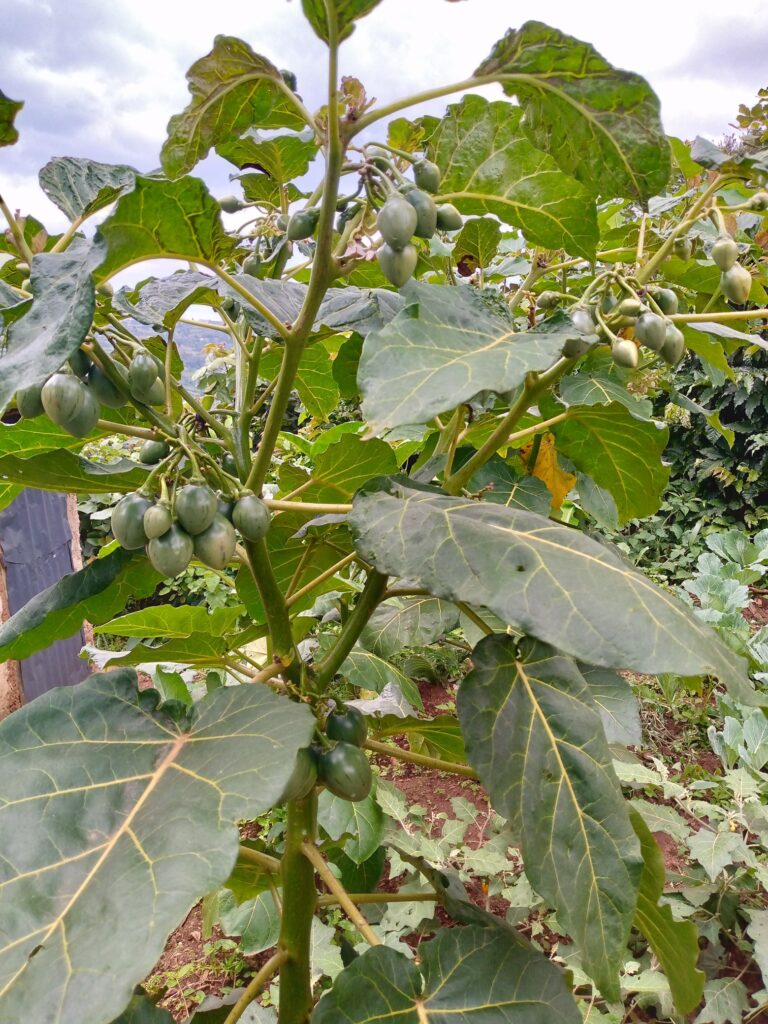
Tree tomato trees need staking to support the heavy fruit loads because the branches can break under the weight of the fruit. Place a wooden stake next to each tree at planting time, and tie the main stem loosely to the stake using soft twine. Do not tie too tightly because the stem needs room to grow.
Feeding Your Tree Tomato Trees
Tree tomato trees need good nutrition to produce high yields of quality fruit, and the fertilizer program is different for the establishment phase and the production phase. Before planting, you should have mixed manure into your soil during land preparation, about 2 kilograms per hole. This manure will feed the trees slowly over the whole season.
About 3 months after transplanting, apply CAN fertilizer at 50 grams per tree. You do this by sprinkling the fertilizer around the base of the tree, being careful not to let it touch the stem. Water the trees after applying fertilizer so that the nutrients go down to the roots.
You should do another application of CAN at 6 months after transplanting, and another one at 9 months after transplanting. For mature trees that are producing fruit, apply CAN at 100 grams per tree every 3 to 4 months during the growing season.
Potassium is very important for fruit quality because it makes the fruit sweeter and improves the color. Apply potassium sulphate at 50 grams per tree when the fruit starts to develop, and repeat every 2 months during the harvest period. Without enough potassium, the fruit will be small and not sweet enough for the market.
Boron and zinc are micronutrients that are essential for flower development and fruit set. Apply a foliar spray containing boron and zinc at 80 percent flowering and again two weeks later. A deficiency of these nutrients causes poor fruit set and misshapen fruits.
Irrigation and Water Management for Tree Tomato Farming
Tree tomatoes need consistent moisture for high yields, but they are very sensitive to waterlogging. The plant requires between 600 and 4,000 millimeters of rainfall annually, but it cannot tolerate stagnant water around the roots. Drip irrigation is the best method for tree tomato farming in Kenya because it delivers water directly to the root zone and keeps the foliage dry, which reduces the incidence of fungal diseases.
During dry periods, apply 20 to 30 liters of water per tree per week, depending on the temperature and the soil type. Sandy soils need more frequent watering than clay soils. The soil should be moist but not waterlogged, and you should check the soil moisture by digging down 10 centimeters near the root zone.
The most critical time for watering is during flowering and fruit development. If the trees experience water stress during this period, the flowers will drop off and the fruit will be small and have poor flavor. Consistent moisture also prevents the fruit from cracking, which makes it unmarketable.
Mulching is essential for tree tomato farming in Kenya because it keeps the soil moist, suppresses weeds, and adds organic matter to the soil. Apply a thick layer of dry grass, straw, or wood chips around the base of each tree, being careful not to cover the stem. The mulch should be 10 to 15 centimeters deep and should extend out to the drip line of the tree.

Pruning Your Tree Tomato Trees
Pruning shapes the tree and directs energy into fruit production. For young trees, the goal is to create a strong framework of branches that will support heavy crops for many years. In the first year, allow the tree to grow to about 1.5 meters tall, then cut off the growing tip to encourage branching. Select 3 to 5 well-spaced branches to be the main structure of the tree.
In the second year and beyond, remove any branches that cross each other or grow inward toward the center of the tree. Remove suckers that grow from the base of the tree and water sprouts that grow straight up from the branches. Keep the center of the tree open so that light can reach all parts of the canopy and air can move freely between the branches.
For mature trees that are producing fruit, the goal of pruning is to maintain the tree at a manageable height and to remove old wood that no longer produces well. Remove about 20 percent of the oldest branches each year, cutting them back to a younger branch. This renewal pruning keeps the tree productive for many years.
Prune during the dry season, which is June to August in Kenya, when the tree has fewer leaves and the sap is not flowing as strongly. Use sharp, clean pruning shears for small branches and a pruning saw for larger branches. Make cuts at 45 degree angles just above a bud that faces outward from the tree. Remove any dead, diseased, or damaged wood as soon as you see it.
Pests and Diseases That Attack Tree Tomatoes
Aphids are the most common pest in tree tomato farming in Kenya, and they cluster on the undersides of young leaves and growing tips, sucking plant sap and causing the leaves to curl and distort. Heavy aphid infestations can reduce yields and also transmit viruses that stunt plant growth. Control aphids with neem oil or insecticidal soap, sprayed on the undersides of the leaves where the aphids hide.
Whiteflies are another pest that attacks tree tomatoes, and they also suck sap and transmit viruses. The adults are small white insects that fly up when the plants are disturbed. Control whiteflies with yellow sticky traps and with neem oil or insecticidal soap.
Powdery mildew is a fungal disease that appears as white powder on the leaves, and it spreads during dry weather with cool nights. Control powdery mildew with sulfur-based fungicides, and improve air circulation by spacing plants properly and pruning to keep the canopy open.
Root rot is caused by waterlogged soil, and it is a serious problem in areas with heavy rainfall or poor drainage. The roots rot, the plants wilt, and they eventually die. Prevention is the best cure, so plant your tree tomatoes in well-drained soil or on raised beds. Do not overwater, and make sure your irrigation system is not putting too much water on the plants.
Blight is another fungal disease that causes dark spots on the leaves and fruit, and it spreads during wet weather. Control blight with copper-based fungicides applied at regular intervals during the rainy season, and prune to improve air circulation.
| Pest/Disease | Damage | Control |
|---|---|---|
| Aphids | Curled leaves, virus transmission | Neem oil, insecticidal soap |
| Whiteflies | Yellowing leaves, virus transmission | Yellow sticky traps, neem oil |
| Powdery mildew | White powder on leaves | Sulfur fungicides |
| Root rot | Wilting, plant death | Good drainage, avoid overwatering |
| Blight | Dark spots on leaves and fruit | Copper fungicides |
| Fruit flies | Larvae inside fruit | Pheromone traps, bait sprays |

Harvesting Your Tree Tomatoes
Tree tomatoes do not all ripen at the same time, so you need to check your trees regularly and pick the fruit as it becomes ready. The fruit is ready to harvest when it has turned from green to red, yellow, or purple, depending on the variety, and when it comes off the tree easily when you twist it gently.
Harvest the fruit by hand, twisting it gently until it comes off the branch. Do not pull hard because this can damage the branch and the fruit. Place the fruit in single layers in shallow crates, and do not stack more than 3 layers deep because the fruit at the bottom will get crushed.
Sort the fruit by size, color, and quality, and remove any fruit that is damaged, diseased, or misshapen. For supermarket sales, pack the fruit in clean cartons with cushioning to prevent bruising during transport. The cartons should be labeled with the variety, weight, and grade.
Store tree tomatoes at 10 to 12 degrees Celsius with high humidity of 85 to 90 percent. Under these conditions, the fruit can be stored for 2 to 3 weeks. The fruit will keep longer if you store it in a cool place away from direct sunlight.
| Year | Yield per Tree (kg) | Total Yield (kg) | Price/kg | Gross Revenue | Net Profit |
|---|---|---|---|---|---|
| 1 | 0 | 0 | 120 | 0 | -322,800 |
| 2 | 5 | 6,000 | 120 | 720,000 | 397,200 |
| 3 | 10 | 12,000 | 130 | 1,560,000 | 1,237,200 |
| 4 | 15 | 18,000 | 140 | 2,520,000 | 2,197,200 |
| 5 | 20 | 24,000 | 150 | 3,600,000 | 3,277,200 |
| 6 | 20 | 24,000 | 150 | 3,600,000 | 3,277,200 |
| 7 | 20 | 24,000 | 150 | 3,600,000 | 3,277,200 |
| 8 | 20 | 24,000 | 150 | 3,600,000 | 3,277,200 |
| 9 | 20 | 24,000 | 150 | 3,600,000 | 3,277,200 |
| 10 | 20 | 24,000 | 150 | 3,600,000 | 3,277,200 |

How Much Money You Can Make from Tree Tomato Farming
The first year of tree tomato farming on one acre costs about 322,800 shillings for seedlings, land preparation, manure, fertilizer, irrigation, staking, and labor. You will not get any fruit in the first year because the trees are still growing, but you will start harvesting in the second year.
- From year 2 onward, the trees start producing. A 2 year old tree gives about 5 kilograms, which is 6,000 kilograms per acre. At 120 shillings per kilogram, you get 720,000 shillings, and your profit is about 397,200 shillings.
- By year 3, each tree gives 10 kilograms, which is 12,000 kilograms per acre. At 130 shillings per kilogram, you get 1,560,000 shillings, and your profit is about 1,237,200 shillings.
- By year 4, each tree gives 15 kilograms, which is 18,000 kilograms per acre. At 140 shillings per kilogram, you get 2,520,000 shillings, and your profit is about 2,197,200 shillings.
- By year 5 and beyond, each tree gives 20 kilograms, which is 24,000 kilograms per acre. At 150 shillings per kilogram, you get 3,600,000 shillings, and your profit is about 3,277,200 shillings per acre every year.

Next Step for Tree Tomato Farming in Kenya
Tree tomato farming in Kenya is a good long-term investment for farmers who have the right land and water. Grafted tree tomato seedlings from Farmers Trend cost 100 shillings each, and a well-managed acre with 1,200 trees yields 20 to 30 tons of fruit per year. The farm gate price ranges from 100 to 150 shillings per kilogram, and by year 5, you can earn over 3.2 million shillings per acre.
The best time to plant is March at the start of the long rains, and you should prepare your land, put in drip irrigation, and stake your trees before you order seedlings. The trees need highland areas like Nyeri, Murang’a, Meru, and the Rift Valley, where the weather is cool and there is no frost.
For certified grafted tree tomato seedlings at 100 shillings, site checks, and the 2026 Tree tomato farming in Kenya PDF guide, contact Farmers Trend Ltd at 0790509684. The farmers who planted tree tomatoes five years ago are now earning millions every season, and their trees will keep producing for another 5 years. The time to start your tree tomato farming in Kenya journey is now.
https://farmerstrend.co.ke/fruits/tree-tomato-farming/tree-tomato-farming-in-kenya-guide/https://farmerstrend.co.ke/wp-content/uploads/2026/04/FrQBOymWIAAMShE.jpghttps://farmerstrend.co.ke/wp-content/uploads/2026/04/FrQBOymWIAAMShE-150x150.jpgTree tomato farming# TrendingBest tree tomato variety in Kenya,Cost of tree tomato farming per acre,Farmers Trend tree tomato seedlings,Grafted tree tomato yield per acre,Grafted vs non-grafted tree tomato,Purple tamarillo variety,Red tamarillo variety,tree tomato farming in kenya pdf,Tree tomato market price per kg Nairobi,Tree tomato seedlings price in Kenya 2026,Tree tomato spacing 2m x 2m,Yellow tamarillo varietyTree Tomato Farming in Kenya 2026 - The Complete Guide to Growing Tamarillo for Profit Tree tomato, also known as tamarillo, is a fruit that looks like a plum and grows on a small tree that is very productive in the highland areas of Kenya. The fruit can be yellow,...FarmersTrendjohn doe[email protected]AdministratorFarmers Trend Ltd.

Leave a Reply