Passion Fruit Farming in Kenya 2026 The Complete Commercial Guide to Earning KSh 2.5 Million Profits Per Acre
Passion Fruit Farming in Kenya: The 2026 Commercial Guide to High-Yield Export Production
Passion fruit farming in Kenya is a good business for farmers who want quick returns. The demand for Kenyan passion fruit is high. European buyers want the purple variety for fresh markets. Juice processors need consistent supply. Local supermarkets stock passion fruit year-round. The market is ready.
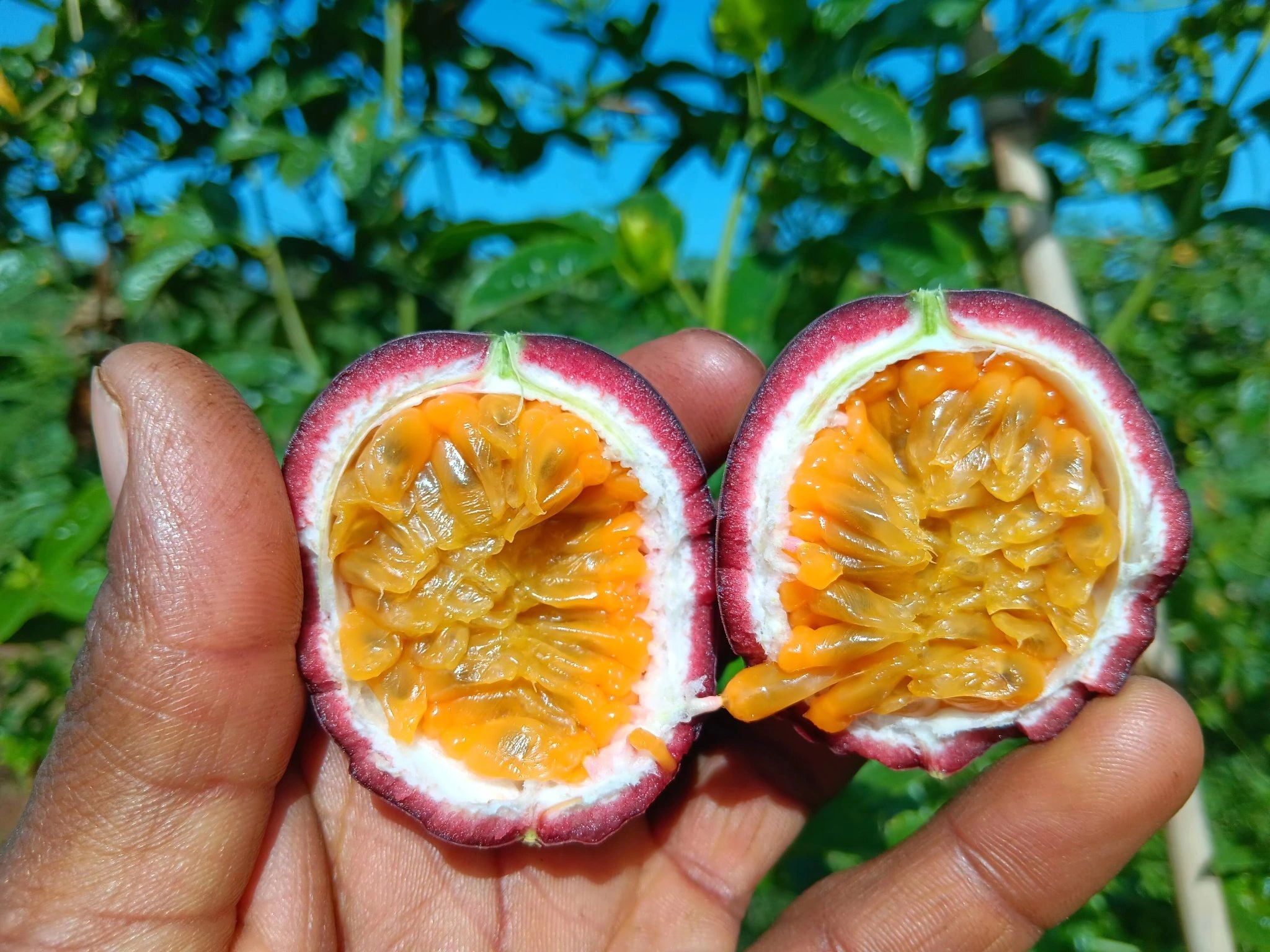
The export market for Kenyan passion fruit has grown steadily over the past five years. European supermarkets stock Kenyan purple passion fruit because of its distinctive tart flavor and high juice content. The fruit arrives by air within 48 hours of harvest. It stays fresh for 3 to 4 weeks under proper cold storage. Buyers in the Netherlands, Germany, and the United Kingdom pay premium prices for quality fruit.
The local processing market is equally strong. Juice manufacturers like Kevian and Del Monte process passion fruit into concentrates and ready-to-drink juices. These companies need consistent supply throughout the year. They pay 80 to 120 shillings per kilogram. They pick up from the farm. They pay within 30 days. This reliable market gives farmers a safety net when export prices drop.
Supermarkets in Nairobi, Mombasa, and Kisumu have also increased their passion fruit orders. Health-conscious consumers buy fresh passion fruit for its high vitamin C content. Hotels use passion fruit in breakfast buffets and cocktail bars. The local market absorbs everything that does not meet export standards. A farmer rarely struggles to sell quality passion fruit.
This guide by Farmers Trend Limited covers everything you need for commercial success in passion fruit farming in Kenya. You will learn about variety selection, trellising, woodiness virus control, nutrition, pruning, harvesting, and export standards.
The 2026 Passion Fruit Market
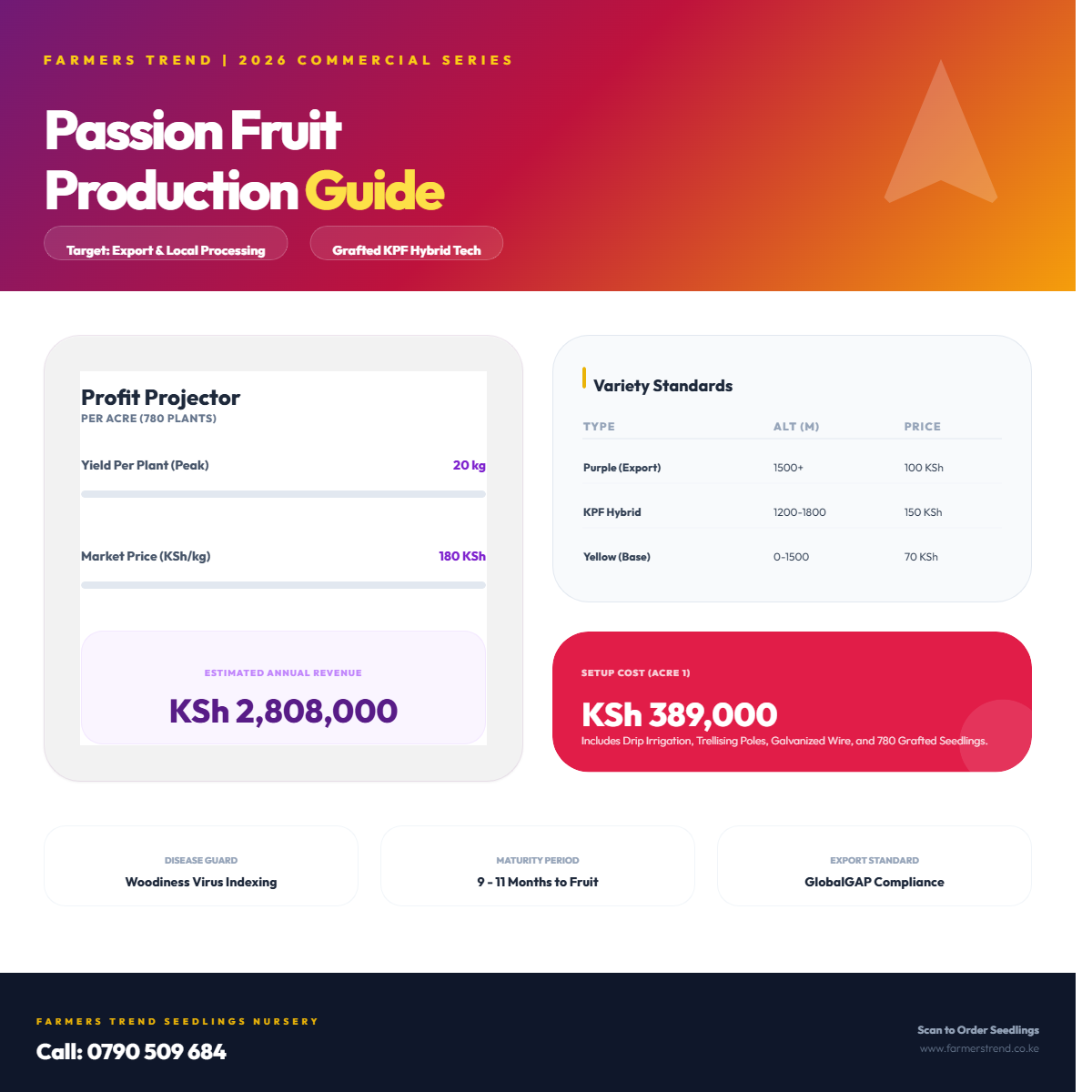
Passion fruit farming in Kenya has two main markets. The local market supplies juice processors like Kevian and Del Monte. Processors pay 80 to 120 shillings per kilogram. They buy in bulk and pay on time. The export market pays 150 to 220 shillings per kilogram for premium purple passion fruit. Exporters need GlobalGAP certification. They need fruit with high sweetness and no pesticide residues.
Is passion fruit farming profitable in Kenya? Yes. A well-managed acre gives 1.5 to 2 million shillings in gross revenue each year. The first year needs investment. From year two, returns are strong.
Varieties and Seedlings
Purple passion fruit grows best in highlands above 1,500 meters. The fruit is smaller and sweeter. Exporters want purple passion fruit for fresh markets.
Yellow passion fruit grows in lowlands and coastal areas. The fruit is larger and more acidic. Juice processors prefer yellow passion fruit. Yellow passion fruit also serves as rootstock for grafted seedlings. Grafting purple passion fruit onto yellow rootstock gives resistance to Fusarium wilt. The plant lives longer and produces more.
KPF4 and KPF11 are hybrid varieties from KALRO. They combine the sweetness of purple with the vigor of yellow. These hybrids yield 15 to 25 kilograms per plant.
| Variety | Altitude | Yield per Plant | Market | Seedling Price |
|---|---|---|---|---|
| Purple | 1,500-2,000m | 15-20 kg | Export | 100 KSh |
| Yellow | 0-1,500m | 20-25 kg | Processing | 70 KSh |
| KPF4 | 1,200-1,800m | 15-25 kg | Dual | 150 KSh |

Grafted passion fruit seedlings price Kenya is 100 shillings at Farmers Trend nurseries. Grafted seedlings on yellow rootstock resist Fusarium wilt. They produce for 4 to 5 years instead of 2 years.
How Many Passion Fruit Plants Per Acre
The standard spacing is 2 meters by 3 meters. This gives 780 plants per acre. This spacing allows each plant enough room. Air circulates well. Disease pressure is lower.
Trellising and Orchard Setup
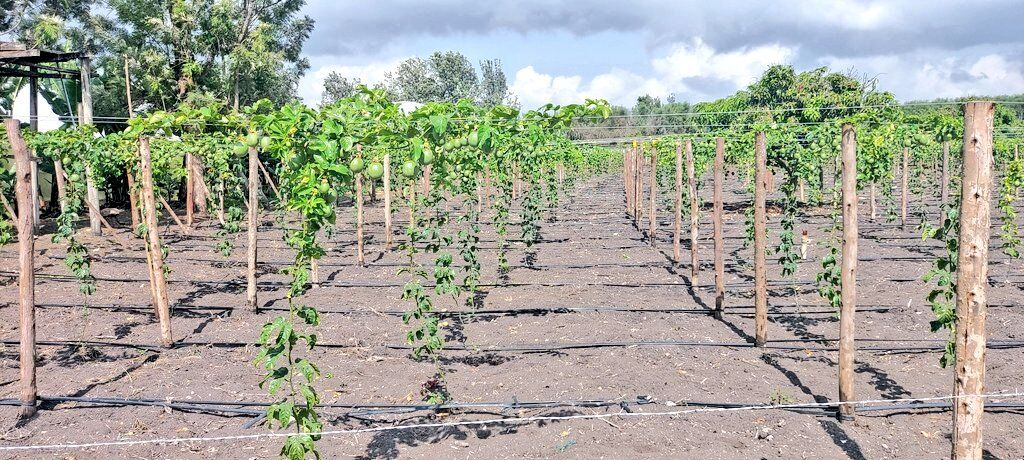
The trellis is the most important structure in passion fruit farming in Kenya. Install it before planting.
- Use treated poles every 4 meters along each row. Poles should be 7 feet long. Bury 1.5 feet deep. Leave 5.5 feet above ground.
- Run 12-gauge galvanized wire along the tops of poles. Tighten the wire firmly. The wire will hold the vines and fruit.
- The A-frame system uses two wires. It costs more but supports heavy yields.

How Long Does Passion Fruit Take to Mature
Grafted seedlings flower 6 to 9 months after planting. First harvest comes 9 to 11 months after planting. Peak production starts in year two. The plant produces for 3 to 4 years.
Year one gives 5 to 10 kilograms per plant. Year two gives 15 to 20 kilograms per plant. Year three gives 10 to 15 kilograms per plant.
How many kg of passion fruit per plant? A healthy plant gives 15 to 25 kilograms each year at peak. With 780 plants per acre, total yield is 11,700 to 19,500 kilograms per acre.
Woodiness Virus and Disease Control
Passion fruit woodiness virus is the biggest problem. The virus makes fruit hard, small, and misshapen. The fruit has no juice. It is worthless.
Aphids spread the virus. These small insects feed on infected plants and carry the virus to healthy plants.
Use only certified, virus-indexed grafted seedlings from Farmers Trend Ltd. Seedlings from unknown sources often carry the virus.
Control aphids with neem oil or recommended insecticides. Apply at first sign of aphids. Remove infected plants immediately. Burn or bury the vines. Do not compost them.
Fusarium wilt causes yellowing and death. Grafted seedlings on yellow passion rootstock resist this disease.
Irrigation and Fertilizer
Drip irrigation is best for passion fruit farming in Kenya. Overhead irrigation wets leaves. Wet leaves get diseases. Drip irrigation puts water at the roots. Leaves stay dry.
Water young plants every 2 to 3 days in dry weather. Mature plants need 15 to 20 liters per week.
Apply CAN at 100 grams per plant during vine growth. Nitrogen makes vines grow. Apply NPK 17:17:17 at 200 grams per plant when flowers appear. Balanced nutrition helps fruit develop.
Potassium makes fruit sweet. Exporters want sweet fruit. Apply potassium nitrate at 150 grams per plant when fruit is growing.
| Growth Stage | Fertilizer | Rate per Plant |
|---|---|---|
| Vine growth | CAN | 100 g |
| Flowering | NPK 17:17:17 | 200 g |
| Fruit growth | Potassium nitrate | 150 g |
Pruning for More Fruit
The single leader system works best. Choose one strong shoot to be the main vine. Tie it to the trellis wire. Remove side shoots until the main vine reaches the wire. Once it reaches the wire, let side branches grow. These side branches will bear fruit.
Remove dead or sick branches. Cut away dense areas so sunlight reaches all parts.
After harvest, cut back the side branches. New growth will give the next crop.
Harvesting for Export
The three-quarter ripe stage is best for export. Purple fruit should be deep purple. The fruit should be firm. Soft fruit bruises during transport. Hard fruit lacks flavor.
Harvest in the morning when it is cool. Use sharp scissors to cut the fruit stem. Do not pull. Pulling damages the vine.
Cool the fruit after harvest. Store at 10°C to 12°C. This keeps fruit fresh for 3 to 4 weeks.
Exporters need GlobalGAP certification. This standard covers food safety and quality. Certification costs 50,000 to 100,000 shillings.
What Is the Price of Passion Fruit per kg in Kenya 2026
Export prices are 150 to 220 shillings per kilogram. Local processors pay 80 to 120 shillings per kilogram. Supermarkets sell at 200 to 300 shillings per kilogram.
Cost of Starting Passion Fruit Farming per Acre
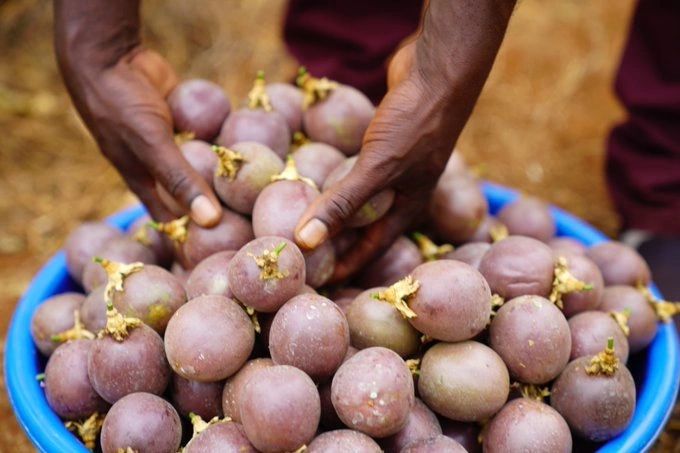
| Cost Item | Amount |
|---|---|
| Grafted seedlings (780 at KSh 100 from Farmers Trend) | 78,000 KSh |
| Trellis poles (156 at KSh 500) | 78,000 KSh |
| Galvanized wire (6 rolls at KSh 8,000) | 48,000 KSh |
| Drip irrigation system | 80,000 KSh |
| Land preparation | 15,000 KSh |
| Manure and fertilizers | 50,000 KSh |
| Labor | 40,000 KSh |
| Total First-Year Investment | 389,000 KSh |
Revenue Projection
| Year | Yield per Plant | Total Yield | Price per kg | Revenue |
|---|---|---|---|---|
| 1 | 5 kg | 3,900 kg | 150 | 585,000 KSh |
| 2 | 18 kg | 14,040 kg | 180 | 2,527,200 KSh |
| 3 | 15 kg | 11,700 kg | 200 | 2,340,000 KSh |
Next Step
Passion fruit farming in Kenya is a profitable venture for farmers who do it right. Grafted seedlings fruit in 9 to 11 months. Yields reach 15 to 25 kilograms per plant. Export prices reach 220 shillings per kilogram. Net profit exceeds 1 million shillings per acre.
The 2026 planting windows are March to May and October to November. Order certified grafted seedlings from Farmers Trend Ltd at 0790509684. Seedlings cost 100 shillings each.
Install the trellis before planting. Use drip irrigation. Apply CAN during vine growth and NPK at flowering. Prune to a single leader. Control aphids to stop woodiness virus. Harvest at three-quarter ripe stage.
The market is waiting. The returns are real. The time to act is now.
https://farmerstrend.co.ke/fruits/passion-fruit-farming/passion-fruit-farming-in-kenya-2026-commercial-guide/https://farmerstrend.co.ke/wp-content/uploads/2026/04/1752296920227-1024x768.jpghttps://farmerstrend.co.ke/wp-content/uploads/2026/04/1752296920227-150x150.jpgPassion fruit farming# TrendingFruitsPassion Fruit Farming in Kenya: The 2026 Commercial Guide to High-Yield Export Production Passion fruit farming in Kenya is a good business for farmers who want quick returns. The demand for Kenyan passion fruit is high. European buyers want the purple variety for fresh markets. Juice processors need consistent supply....FarmersTrendjohn doefarmerstrend@gmail.comAdministratorFarmers Trend Ltd.





Leave a Reply