Zero Grazing House Designs in Kenya: 10-20 Cow Modern Plans with 2026 Costs
The Ultimate Guide to Zero Grazing House Designs in Kenya: 10-20 Cow Modern Plans
Section 1: The Evolution of Zero Grazing House Designs in Kenya

Why Free-Range Grazing is Obsolete in Kiambu, Meru, and Nyandarua
Your grandfather grazed cows on open pasture. You cannot. Land subdivision has destroyed that model.
In Kiambu, the average dairy farm is now half an acre. A single cow needs one acre of pasture to graze without destroying the grass.
You cannot keep ten cows on half an acre using free-range methods. The land turns to mud within one rainy season.
This is why zero grazing house designs in kenya have become the standard in high-potential regions. You confine the cows. You bring the feed to them.
Meru farmers learned this lesson after the 2015 drought. Those with open grazing lost half their herds. Those with zero grazing lost none.
Nyandarua is cold and wet. Open grazing in that mud causes foot rot and pneumonia. A good house prevents both diseases.
Uasin Gishu has the space, but maize farming is more profitable than pasture. Zero grazing allows you to grow maize on ninety percent of your land and keep cows on the remaining ten percent.
The logic is simple. You cannot fight land fragmentation. You can only adapt to it.
Zero grazing allows you to keep more cows on less land. It also allows you to collect manure efficiently. That manure becomes fertilizer for your maize or napier grass.
Shifting from Mud Shelters to High-Yield Biomass Factories
Twenty years ago, a cow shed was a wooden shack with a mud floor. That structure is now obsolete.
Mud floors absorb urine. The urine turns into ammonia gas. That gas burns your cow’s lungs.
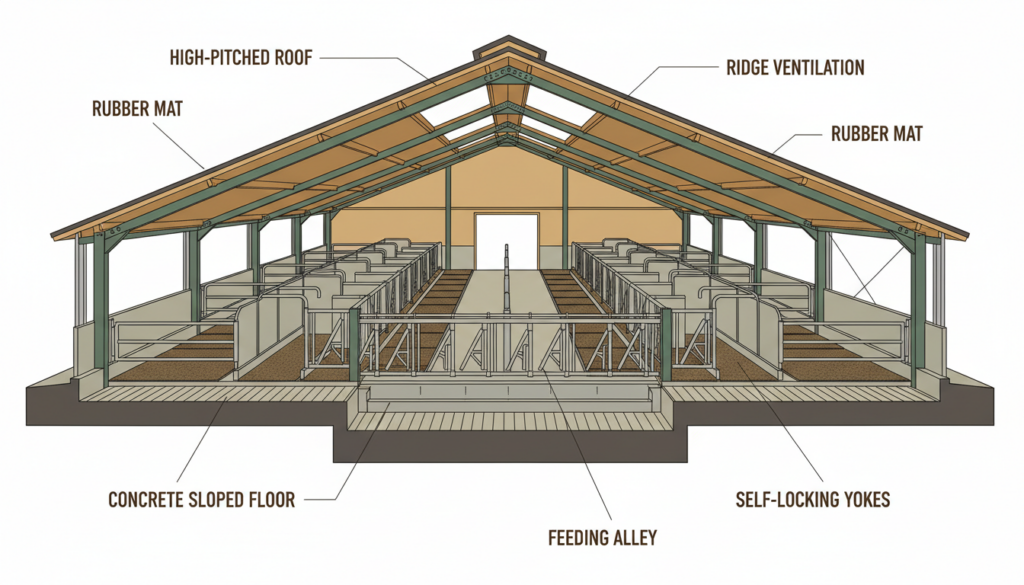
self-locking yokes, sloped concrete floors, and ridge ventilation.
A modern unit treats the cow as a biological machine. You feed it silage, water, and minerals. It outputs milk, manure, and heat.
The best modern zero grazing unit design plans kenya now include sloped concrete floors, rubber mats, and self-locking head yokes. These are not luxuries. They are production tools.
Every square meter of your shed must be designed to move manure away from the cow. Gravity does this work for free.
Every centimeter of roof height must pull hot air up and out. You do not need fans. You need physics.
Every feeding barrier must force the cow’s neck into a natural grazing angle. A bad angle causes drool. Drool loses rumen buffer. Lost buffer kills milk fat.
A modern zero grazing unit has several essential parts. You need cubicles for resting. You need a walking area for movement. You need feed and water troughs. You need a milking place. You need a calf pen. You need a fodder chopping area.
Optional parts include a feed store, a manure storage pit, a roof water catchment system, a water tank, and a holding crush for veterinary work.
Zero grazing requires intensive labor. You cut and carry fodder crops every day. You carry water if you do not have a piped system. You scrape manure twice daily.
Proper planning is required before you start. You must appreciate the high financial and labor demands. If you are not ready for daily work, zero grazing will fail.
Because zero grazing requires significant capital, build in steps. First construct the essential parts. Add the optional parts as money becomes available.
Economic Realities of 10-Cow vs. 20-Cow Operations
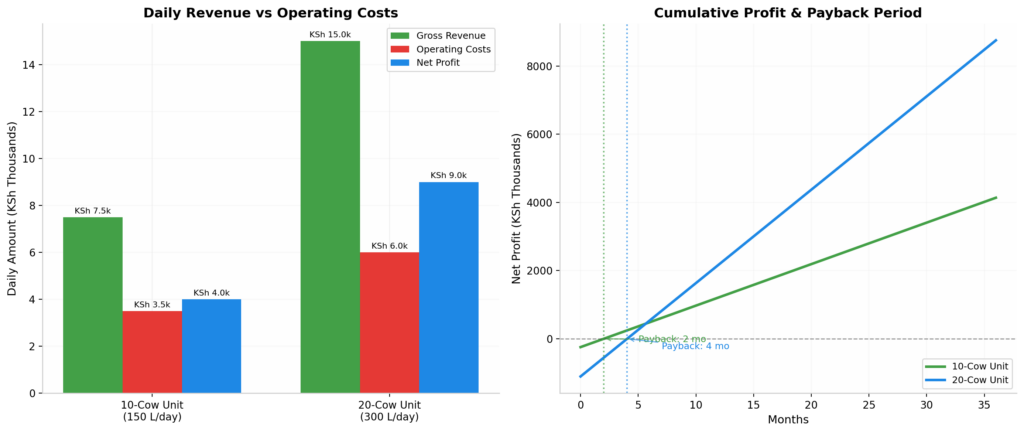
A ten-cow unit produces roughly one hundred and fifty liters per day at fifteen liters per cow. At KSh fifty per liter, that is KSh seven thousand five hundred daily gross revenue.
A twenty-cow unit produces three hundred liters per day. That is KSh fifteen thousand daily gross revenue.
The math seems simple. Double the cows, double the money. But the costs do not double linearly.
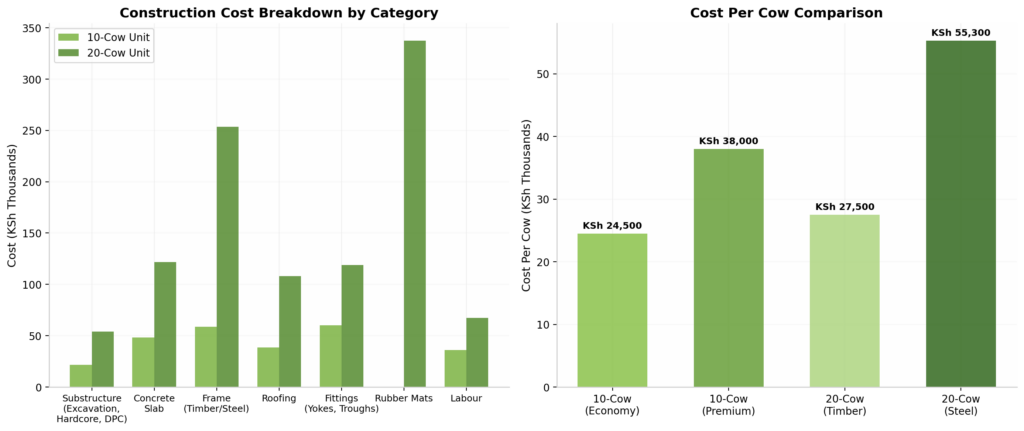
The zero grazing unit construction cost in kenya for ten cows is approximately KSh 245,000 for an economy build. For twenty cows, the cost jumps to KSh 550,000 for timber or KSh 1.1 million for steel.
Why the jump? A twenty-cow unit requires a double-row layout. You need a central feeding alley. You need a wider slab. You need a higher roof for ventilation.
A ten-cow unit can use a single row against a wall. This is simpler and cheaper per cow. The cost per cow for a ten-cow unit is about KSh 24,500. For a twenty-cow steel unit, the cost per cow is about KSh 55,000.
But the revenue per cow is higher in a twenty-cow unit because you can afford better equipment. A small milking machine costs KSh 80,000. For ten cows, that machine sits idle twenty-three hours per day. For twenty cows, you use it twice daily and the cost per liter drops.
Profitable dairy farming in kenya at twenty cows requires you to process your own manure into biogas. A ten-cow unit produces enough gas for cooking. A twenty-cow unit produces enough gas to run a small generator.
This is why serious farmers skip the ten-cow phase and go straight to twenty cows. The upfront pain is higher. The long-term profit is exponentially better.
Low yields in overcrowded structures are most likely because of reduced resting time. Overcrowding decreases the time an animal spends lying down.
When cows do not have enough space, they spend more time standing. Standing increases the risk of hoof problems and lameness.
You must provide adequate resting space for each animal. The health and productivity of your dairy cattle depends on their ability to meet daily behavioral needs.
A good rule for cubicle numbers is simple. For one cow, you need two cubicles. For two cows, three cubicles. For three cows, five cubicles. For four cows, six cubicles. For five cows, seven cubicles. For six cows, nine cubicles.
This extra capacity accounts for heifers and young stock. If you keep young bulls inside the unit, provide separate cubicles for them. When the bull matures, house it away from the main unit.
Section 2: How Dairy Cattle Housing Design and Construction Impacts Cow Comfort and Milk Yield
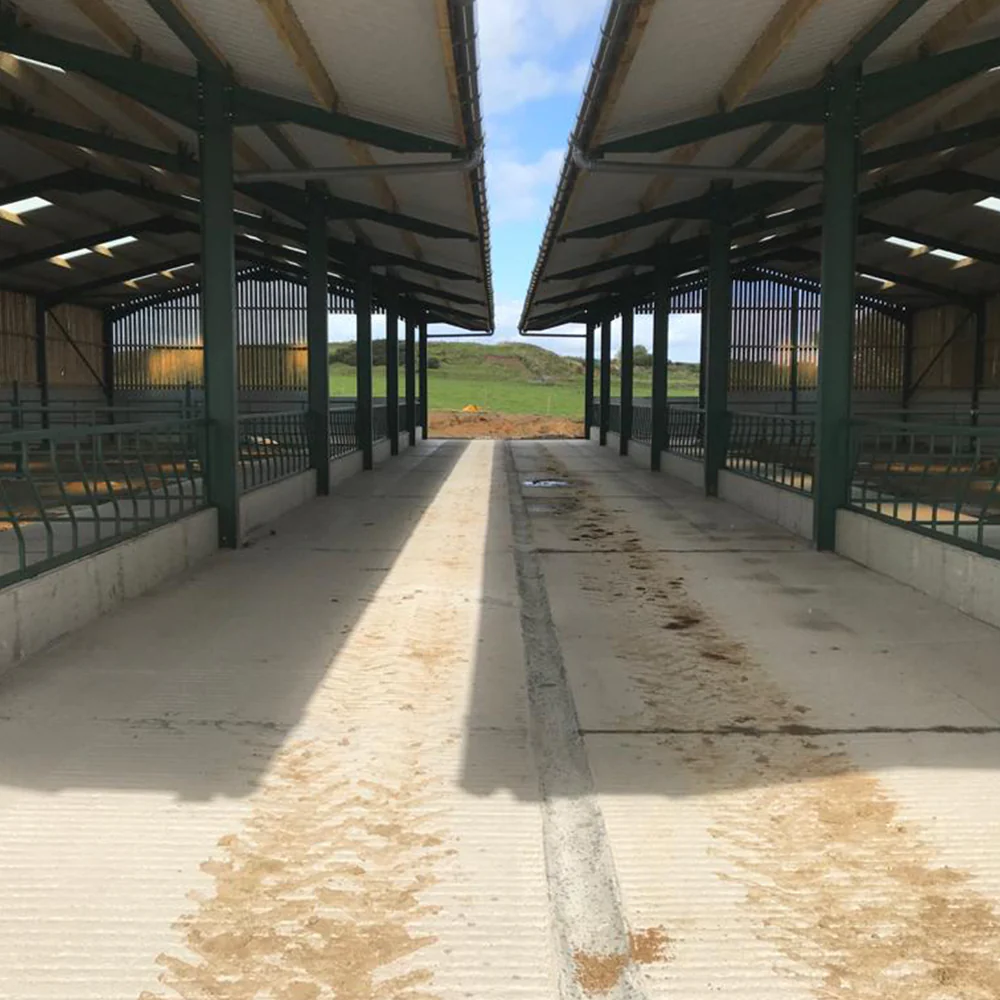
The Biological Link Between Cow Comfort and Milk Yield
A comfortable cow releases oxytocin. Oxytocin is the let-down hormone. It squeezes milk from the alveoli into the teat cistern.
An uncomfortable cow releases cortisol. Cortisol is the stress hormone. It blocks oxytocin completely.
This is not theory. This is veterinary physiology. You cannot milk a stressed cow fully.
When a cow is stressed, her body prioritizes survival over production. Blood flow shifts away from the udder. Milk synthesis slows down.
The effect is immediate and measurable. A cow that is chased, shouted at, or housed poorly will hold back milk.
You can see this at milking time. A comfortable cow stands still. Her udder fills evenly. Milk flows freely.
An uncomfortable cow kicks, steps sideways, or urinates frequently. She is telling you something is wrong.
Dairy cattle housing design and construction directly controls four comfort factors. Floor texture is first. Air temperature is second. Feeding posture is third. Lying space is fourth.
Fix these four things. Your milk yield will rise.
Do not fix them. You will lose money every single day.
The connection between housing and production is so strong that you can predict milk yield by looking at the shed. A dirty, cramped, poorly ventilated shed will never produce high yields.
A clean, spacious, well-designed shed with proper flooring and feeding systems will produce maximum yields.
Floor Trauma: How Bad Surfaces Cause Digital Dermatitis
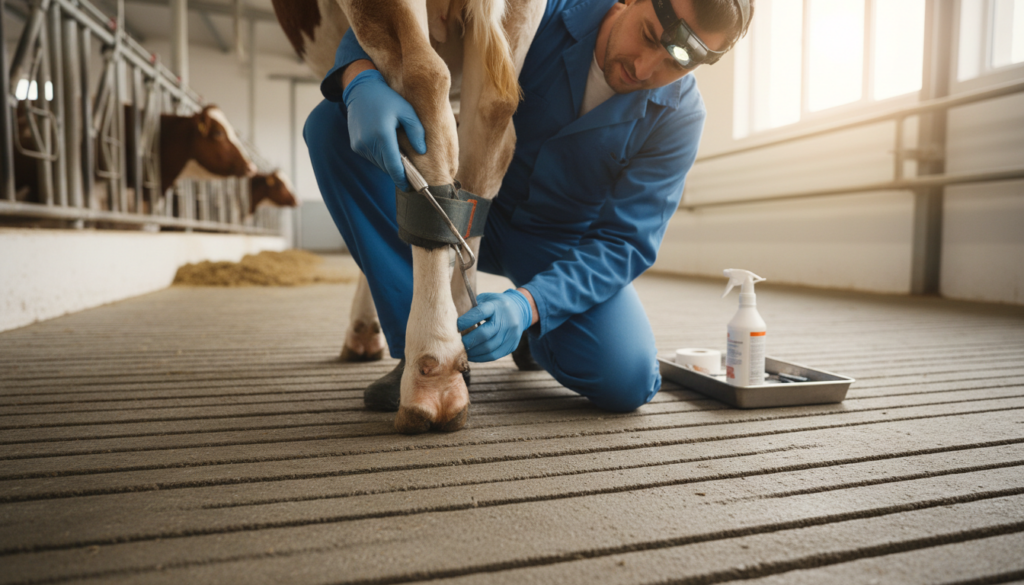
A cow’s hoof is made of keratin. The same material as your fingernail. A fingernail cracks on rough concrete. So does a hoof.
Digital dermatitis is the most common cause of lameness in Kenyan zero grazing units. It starts as a small red lesion between the claws. It spreads to the heel. The cow stops walking.
A lame cow produces five fewer liters per day. She also eats less because walking to the feed trough hurts.
The cause is always the floor. Smooth concrete is too slippery. Rough concrete cuts the hoof. Wet concrete softens the hoof and invites bacteria.
You can identify a floor problem by watching your cows walk. If they step carefully or refuse to turn sharply, the floor is too slippery.
If they limp or stand with a hoof lifted, check for lesions between the claws.
If you see swelling above the hoof, the infection has reached the deeper tissues. Call your vet immediately.
How to build a cow shed in kenya with the correct floor starts with the concrete mix. Use a 1:2:3 cement to sand to ballast ratio.
One bag of cement. Two bags of sharp river sand. Three bags of three-quarter inch ballast.
Do not add extra water to make the concrete easier to work. Extra water weakens the concrete. The surface will dust and erode under hoof traffic.
Add just enough water to make the mix workable. The concrete should hold together when squeezed but not release water when pressed.
Use a concrete vibrator to remove air bubbles. Air bubbles create weak spots. Weak spots crack.
The surface of the walking area must be grooved. You cannot leave it smooth. Smooth concrete becomes slippery when wet.
A cow slipping on wet concrete will spread her legs into a split position. This tears the muscles of the inner thigh. The cow cannot stand properly for two weeks.
You groove the concrete by dragging a comb through the wet surface. The comb is made by welding six-millimeter steel rods onto a long handle. The rods should be spaced fifty millimeters apart.
The grooves should be ten millimeters deep. Drag the comb parallel to the direction the cows walk. This creates channels for water to drain while leaving ridges for hoof grip.
Do not groove perpendicular to the walking direction. Perpendicular grooves trip the cow. A tripping cow falls. A falling cow breaks bones.
After grooving, cure the concrete properly. Cover it with polythene sheet for seven days. Sprinkle water twice daily to keep it moist.
Concrete that dries too fast becomes brittle. Brittle concrete cracks. Cracked concrete traps manure. Trapped manure breeds more bacteria.
Heat Stress: Why Low Roof Design Reduces Dry Matter Intake
A cow produces heat when she digests feed. A lot of heat. A lactating Friesian generates as much heat as a one hundred watt bulb running continuously.
That heat must leave the shed. If it does not, the cow’s body temperature rises. Her respiration rate jumps from thirty breaths per minute to over one hundred.
She stops eating. Dry matter intake drops by fifteen percent. Milk yield follows within forty-eight hours.
The culprit is a low roof. Many zero grazing house designs in kenya use a roof height of two point five meters. This is a greenhouse. Heat rises to two point five meters and stops. There is nowhere else to go.
The solution is a three point five meter eave height for twenty cows. Hot air rises to the roof ridge. The ridge has a continuous opening covered with wire mesh. The hot air exits. Cool air enters from the sides.
No fans. No electricity. Just physics.
You can test your ventilation with a simple match. Light a match at the center of the shed. Watch the smoke. If it rises straight to the ridge and exits, your ventilation works.
If the smoke swirls or hangs at head height, you have a problem. Your cows are breathing that same stale air.
Orientation also matters. The long axis of your shed must run east to west. The roof slope faces north and south. This keeps the sun off the cows’ flanks.
A shed built north to south will cook the cows on the east side in the morning and the west side in the afternoon. Do not make this mistake.
If you live in a very hot area, add shade cloth to the west-facing side. The afternoon sun is the most intense. Block it without blocking the breeze.
If you live in a cold area like Nyandarua, close the south side completely. Use iron sheets or timber planks. Keep the north side open for the gentle sun.
Feeding Barrier Pitfalls: The Danger of Bad Rumen Acidification
A cow’s rumen is a fermentation vat. Bacteria break down fiber into volatile fatty acids. Those fatty acids become milk fat.
The bacteria need a neutral pH of six point two to six point eight to work. If the pH drops below five point five, the bacteria die. This is acute rumen acidosis. It kills cows.
What causes the pH to drop? Too much grain is one cause. But bad feeding posture is another.
When a cow reaches down and forward to eat, saliva drools out of her mouth. Saliva contains bicarbonate. Bicarbonate is the rumen’s buffer. It neutralizes acid.
If the cow drools the bicarbonate onto the floor instead of swallowing it, the rumen becomes acidic.
The signs of rumen acidosis are subtle at first. The cow stops chewing her cud. Her dung becomes loose and foamy. She looks lethargic.
If you see these signs, check your feeding barrier height immediately.
The barrier height must be set so the cow’s neck is at a natural grazing angle. The feed trough must be fifteen centimeters higher than the walking alley. The cow’s head should be level, not stretched down.
Self-locking yokes help. They hold the cow in the correct position while she eats. They also allow you to lock each cow for artificial insemination and veterinary work without chasing her around the shed.
A self-locking yoke costs about KSh 4,500 per position. For twenty cows, that is KSh 90,000. This seems expensive. But it pays for itself in reduced labor costs within six months.
Without yokes, you need two men to restrain a cow for artificial insemination. With yokes, one man does the job in thirty seconds.
Lying Space Optimization: Meeting the Twelve-Hour Daily Resting Requirement
A cow needs twelve hours of lying time per day. This is not a recommendation. This is a biological requirement.
When a cow lies down, blood flow to the udder increases by twenty-five percent. The udder fills with blood. The blood carries nutrients for milk synthesis.
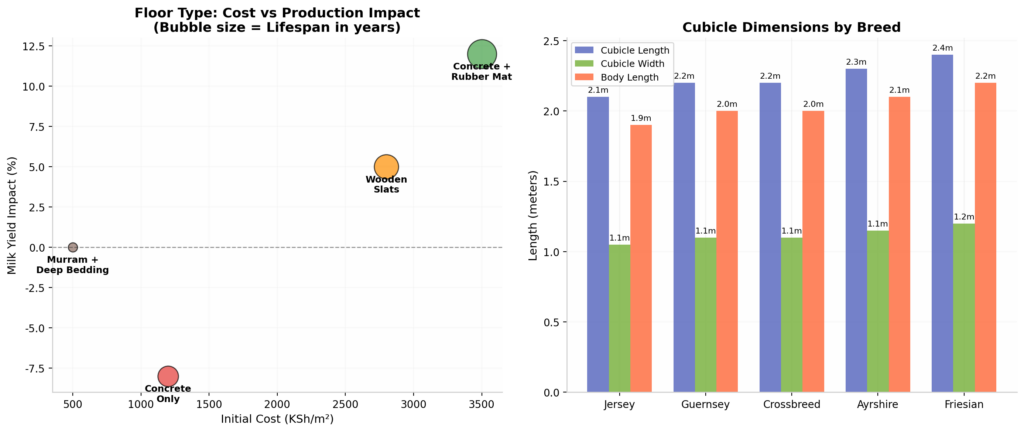
Concrete with rubber mats provides the best return on investment.
A cow that lies less than ten hours per day produces twelve percent less milk. The milk also has lower fat content because blood flow to the udder is restricted.
Why do cows stand instead of lie down? The cubicle is too short. The cubicle is too narrow. The floor is too hard. The neck rail is missing.
Let us fix each of these problems.
The correct cubicle length for a Friesian is two point four meters. This allows the cow to lunge forward when she stands up. A cow lunges forward with her front feet to push her body upright. If the cubicle is shorter than two point four meters, she cannot lunge. She will perch with her front feet in the cubicle and her back feet in the alley.
Perching leads to hoof problems. The back feet stand in wet manure while the front feet rest on dry bedding. The moisture imbalance softens the back hooves. Soft hooves crack.
The correct cubicle width is one point two meters. This prevents the cow from touching her neighbor. Cows are social animals, but they do not like to touch each other when sleeping. If the cubicle is narrow, the cow will stand up to avoid contact. Standing reduces milk yield.
The neck rail is a horizontal bar set one point one meters above the floor. This bar touches the cow’s neck when she stands up. It trains her to step backward before lying down. When she steps back, her dung falls into the walking alley instead of onto the sleeping surface.
This simple piece of steel reduces your bedding costs by fifty percent. Many farmers skip the neck rail to save money. This is false economy. The cost of extra bedding over five years far exceeds the cost of the neck rail.
The brisket board is a low curb at the front of the cubicle. It is fifteen centimeters high. The cow’s brisket hits this board when she tries to lie too far forward. The board stops her with her rear end still over the alley. Again, this keeps dung out of the sleeping area.
The brisket board can be made of concrete or a heavy timber. It must be solid. A flimsy board will break within six months under the weight of a six hundred kilogram Friesian.
Now let us talk about the floor of the cubicle. You have three options.
The first option is compacted murram covered with sawdust or rice husks. This is the traditional method. It is cheap. It is soft. But it requires daily raking and weekly replacement. Bacteria thrive in organic bedding. If you do not replace the bedding frequently, your cows will develop mastitis.
The second option is a concrete slab with a rubber mat on top. This is the modern method. The rubber mat provides cushioning. The concrete below provides drainage. You still need a thin layer of sawdust for absorption, but you use much less than on pure murram.
The third option is a concrete slab with no mat. This is the worst option. Concrete is hard. A cow lying on hard concrete develops swollen hocks and calloused knees. The pain reduces lying time. Reduced lying time reduces milk.
Rubber mats cost about KSh 2,500 per square meter. For a ten-cow unit, the cubicle area is about fifty four square meters. The mats cost KSh 135,000. This seems expensive. But a rubber mat lasts ten years. Over that decade, you save KSh 300,000 in bedding costs and veterinary bills.
The math is clear. Rubber mats pay for themselves in eighteen months.
Do not reduce the cubicle measurements to save space. A cow that does not lie down is a cow that does not produce milk.
Section 3: Site Selection and Layout for a 10-20 Cow Unit
How to Read Your Land Before You Build
Before you pour a single bag of cement, walk around your farm with a critical eye. You are not looking for a beautiful spot. You are looking for a functional spot.
The success of zero grazing house designs in kenya depends more on site selection than on the materials you use. A steel frame on a bad site will fail. A wooden frame on a good site will succeed.
The first question is soil type. Dig a hole half a meter deep where you plan to build. Take a handful of soil from the bottom.
Wet the soil and rub it between your fingers. If the soil forms a long snake that does not break, you have clay soil.
Clay soil is dangerous for any structure. Clay expands when wet and contracts when dry. This movement cracks concrete slabs.
A cracked slab traps manure and urine. The trapped moisture softens the ground underneath. The slab sinks. Then the walls crack. Then the roof leaks.
If the soil feels gritty and falls apart when you squeeze it, you have sandy loam. This is the ideal soil.
Sandy loam drains water quickly. It does not expand or contract with moisture changes. You can pour a thin slab on sandy loam and it will last for twenty years.
If the soil feels sticky but does not form a long snake, you have silt. Silt requires a drainage layer of ballast underneath the slab.
Excavate an extra two hundred millimeters. Fill with compacted three-quarter inch ballast before pouring concrete. This extra step costs money but saves your slab.
Table 1: Soil Type Assessment for Zero Grazing Construction
| Soil Type | Field Test Result | Risk Level | Required Foundation Action |
|---|---|---|---|
| Clay | Forms a long snake that does not break | High | Excavate 300mm, add 200mm hardcore layer |
| Sandy Loam | Gritty, falls apart when squeezed | Low | Standard 150mm sub-base only |
| Silt | Sticky but does not form a snake | Medium | Excavate 200mm extra, add drainage ballast |
| Black Cotton | Shrinks when dry, swells when wet | Very High | Do not build here without deep pile foundation |
The second question is orientation. Many farmers build their shed facing the road because it looks nice. This is a mistake.
The sun does not care about the road. You must orient your building based on the path of the sun.
The long axis of the shed should run from east to west. The roof slope should face north and south. This orientation means the sun hits the roof ridge at midday but does not shine directly into the sides.
The cows stay cool. The floor stays dry. The feed does not heat up.
If you build with the long axis running north to south, the morning sun will blast into the eastern side. The afternoon sun will blast into the western side.
The cows on those sides will suffer heat stress. Their respiration rate will increase. Their feed intake will drop. Their milk yield will follow.
Table 2: Sun Orientation Guide for Different Kenyan Regions
| Region | Climate Type | Recommended Orientation | Special Adjustment |
|---|---|---|---|
| Kiambu | High altitude, intense UV | East-West axis, open side North | Add shade cloth on South side |
| Meru | High altitude, moderate | East-West axis, open side South | Catch morning sun for bedding |
| Nyandarua | Cold, windy | East-West axis, closed West side | Plant windbreak 15m away |
| Uasin Gishu | Moderate, high rainfall | East-West axis, slope facing North | Prioritize drainage to downhill side |
The third question is wind direction. The prevailing wind in most of Kenya comes from the southeast. In the Rift Valley, wind often comes from the northwest.
You must know your local wind pattern. Ask your oldest neighbor. Watch the trees for a full day.
The wind should blow through the shed, not against a solid wall. The open side of your building should face into the prevailing wind.
This creates natural ventilation that removes ammonia gas from the urine and carries away heat from the cows’ bodies. A shed with no natural ventilation becomes a gas chamber.
The ammonia burns the cows’ lungs. They develop chronic cough. Their growth slows. Their milk drops.
If you live in a very windy area like Nyandarua or parts of Laikipia, you need a windbreak. Plant two rows of Grevillea robusta trees fifteen meters away from the shed.
The trees slow the wind without stopping it completely. A complete windbreak creates turbulence. Turbulence lifts the roof. A lifted roof costs money to repair.
Space the trees three meters apart in each row. Stagger the rows so the second row fills the gaps of the first row. By the time the trees are four years old, you will have perfect wind protection.
The fourth question is distance from the farmhouse. You want the unit close enough to the house that you can hear a cow in distress at night.
You also want it far enough that the smell does not ruin your meals. Twenty meters is the ideal distance.
Any closer and the flies will invade your kitchen. Any further and you will waste time walking back and forth.
A farmer who spends forty minutes walking to the cows and back loses forty minutes of productive work. That time could be spent cleaning the milking parlor or chopping silage.
The fifth question is drainage. Water is the enemy of any structure. Water makes the floor slippery. Water softens the hooves. Water turns manure into slurry that flows everywhere.
You must build your shed on the highest point of your land. Rainwater should flow away from the shed, not toward it.
If the only flat spot on your farm is at the bottom of a slope, do not build there. You will spend every rainy season bailing water out of the cow shed.
Instead, build a small mound. Bring in murram and hardcore. Raise the building site by half a meter above the surrounding ground. This extra cost at the beginning saves you years of trouble.
The sixth question is access. A concrete mixer truck needs to reach your site. A lorry delivering feed needs to reach your feed store. A vet with a car needs to park nearby.
If you build your shed behind your house where no vehicle can reach, you will carry every bag of cement on your head. You will carry every bale of hay for fifty meters. Your labor costs will destroy your profit.
Leave a clear path at least three meters wide from the public road to your shed. Compact the path with murram. Maintain it every dry season.
Land Requirements for Ten vs. Twenty Cows
For a ten-cow unit, you need a total land footprint of about one hundred square meters. This includes the shed, the feed store, and the manure pit.
The shed itself measures nine meters long by six meters wide. That is fifty four square meters.
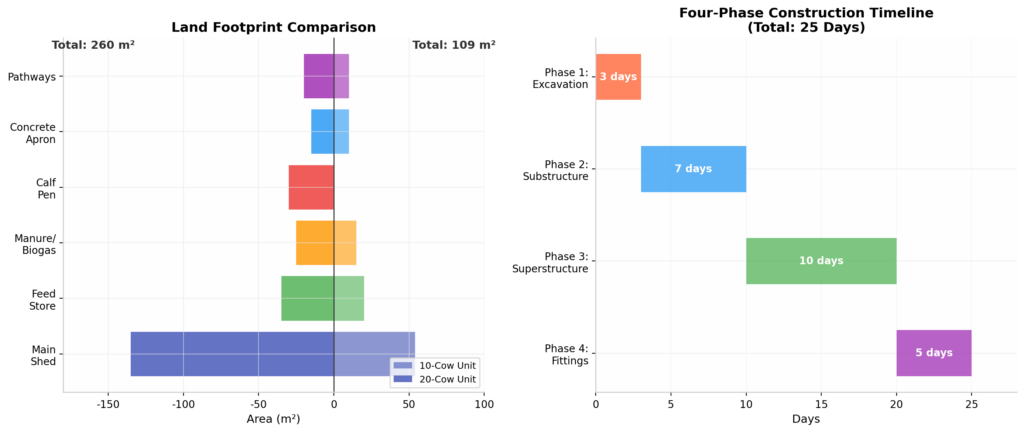
The feed store needs about twenty square meters. You need space to store at least thirty bales of hay and four tons of silage.
The manure pit needs about fifteen square meters. You will empty this pit every three months if you have ten cows.
The concrete apron for loading and hoof trimming needs about ten square meters. This is where you wash cows before milking and trim hooves twice per year.
For a twenty-cow unit, you need about two hundred and twenty square meters. The 20 cow dairy farm layout is not simply twice the length of a ten-cow unit.
The shed itself measures eighteen meters long by seven point five meters wide. That is one hundred and thirty five square meters.
The feed store needs about thirty five square meters. You need space for a small tractor or wheelbarrow to turn around inside.
The manure and biogas area needs about twenty five square meters. Your biogas digester will be at least twelve cubic meters in size.
The calf pen needs about thirty square meters. You must keep calves at least fifteen meters away from the main herd.
The total required land for a twenty-cow unit is about a quarter of an acre. If you have less land than this, reduce your target number of cows.
Table 3: Land Footprint Comparison for 10-Cow vs 20-Cow Units
| Component | 10-Cow Unit Area (m²) | 20-Cow Unit Area (m²) |
|---|---|---|
| Main Shed | 54 | 135 |
| Feed Store | 20 | 35 |
| Manure/Biogas Area | 15 | 25 |
| Calf Pen | Not included | 30 |
| Concrete Apron | 10 | 15 |
| Pathways and Turning | 10 | 20 |
| Total Required Land | 109 m² (0.11 acres) | 260 m² (0.26 acres) |
Biosecurity Zoning for Disease Prevention
Your layout must function like a hospital isolation ward. Disease moves through droplets and through your own boots.
The sick bay and calving pen must be at the extreme downwind end of the shed. If your prevailing wind is from the southeast, put the calving pen at the northwest corner.
Airborne bacteria from a coughing cow must never blow over the main lactating herd. One sick cow can infect twenty cows if the wind is wrong.
The manure storage pit must be at least ten meters away from the feed store. Ammonia from fresh manure contaminates silage. Contaminated silage tastes bad. Cows refuse to eat it.
The calf pen must be at least fifteen meters away from the sick bay. Calves are immunosuppressed. They catch everything.
The wheel bath is a simple concrete trough two meters long and thirty centimeters deep. Place it five meters from the public road entrance.
Fill the wheel bath with hydrated lime solution. Every vehicle that enters your farm must drive through this bath. Vehicles bring foot and mouth disease from the market.
Table 4: Biosecurity Distances for Zero Grazing Units
| Zone | Location | Minimum Distance from Main Shed | Purpose |
|---|---|---|---|
| Sick Bay | Downwind end | Attached but isolated | Prevent airborne infection spread |
| Calf Pen | Upwind | 15 meters | Protect naive immune systems |
| Manure Pit | Downhill, downwind | 10 meters | Prevent ammonia contamination |
| Feed Store | Upwind, uphill | 5 meters | Keep silage clean |
| Wheel Bath | Farm entrance | 20 meters from shed | Stop diseases from public road |
Section 4: Technical Architecture and Blueprint Specifications
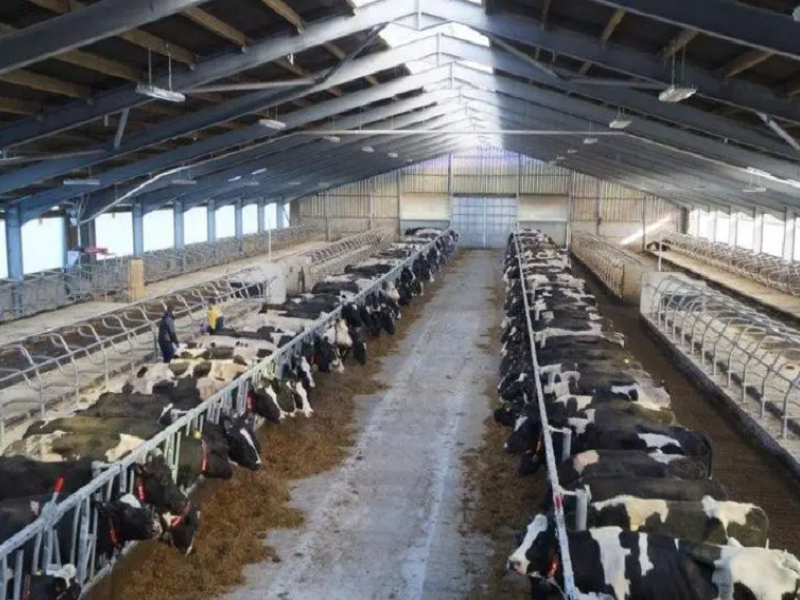
Resting Cubicle Dimensions for Medium to Large Breeds
The resting cubicle is where the cow spends twelve hours per day. You must get these dimensions exactly right.
For a Friesian or Ayrshire cow, each cubicle must be two point four meters long. In feet, that is roughly eight feet.
The cow’s body length is about two point two meters from nose to tail. She needs an extra twenty centimeters to lunge forward when she stands up.
If the cubicle is shorter than two point four meters, she will not lie down properly. She will perch with her front feet in the cubicle and her back feet in the alley.
Perching leads to hoof problems. The back feet stand in wet manure while the front feet rest on dry bedding. The moisture imbalance softens the back hooves.
The width of each cubicle must be one point two meters. In feet, that is four feet.
This width allows the cow to lie flat without touching her neighbor. Cows are social animals, but they do not like to touch each other when sleeping.
If the cubicle is narrow, the cow will stand up to avoid contact. Standing reduces milk yield by up to twelve percent.
Table 5: Cubicle Dimensions by Cow Breed
| Breed | Body Length (m) | Recommended Cubicle Length (m) | Recommended Cubicle Width (m) |
|---|---|---|---|
| Friesian | 2.2 | 2.4 | 1.2 |
| Ayrshire | 2.1 | 2.3 | 1.15 |
| Guernsey | 2.0 | 2.2 | 1.1 |
| Jersey | 1.9 | 2.1 | 1.05 |
| Crossbreed | 2.0 | 2.2 | 1.1 |
The neck rail is a horizontal bar set one point one meters above the floor. This bar touches the cow’s neck when she stands up.
It trains her to step backward before lying down. When she steps back, her dung falls into the walking alley instead of onto the sleeping surface.
This simple piece of steel reduces your bedding costs by fifty percent. Many farmers skip the neck rail to save money. This is false economy.
The brisket board is a low curb at the front of the cubicle. It is fifteen centimeters high.
The cow’s brisket hits this board when she tries to lie too far forward. The board stops her with her rear end still over the alley.
Again, this keeps dung out of the sleeping area. The brisket board can be made of concrete or heavy timber. It must be solid.
Table 6: Cubicle Component Specifications
| Component | Height from Floor (m) | Material | Purpose |
|---|---|---|---|
| Neck Rail | 1.1 | 50mm galvanized pipe | Train cow to step back before lying |
| Brisket Board | 0.15 | Concrete or hardwood | Stop cow from lying too far forward |
| Curb (rear) | 0.10 | Concrete | Contain bedding material |
| Partition | 1.0 | Steel pipe or timber | Separate adjacent cows |
Cubicle Floor Composition and Bedding
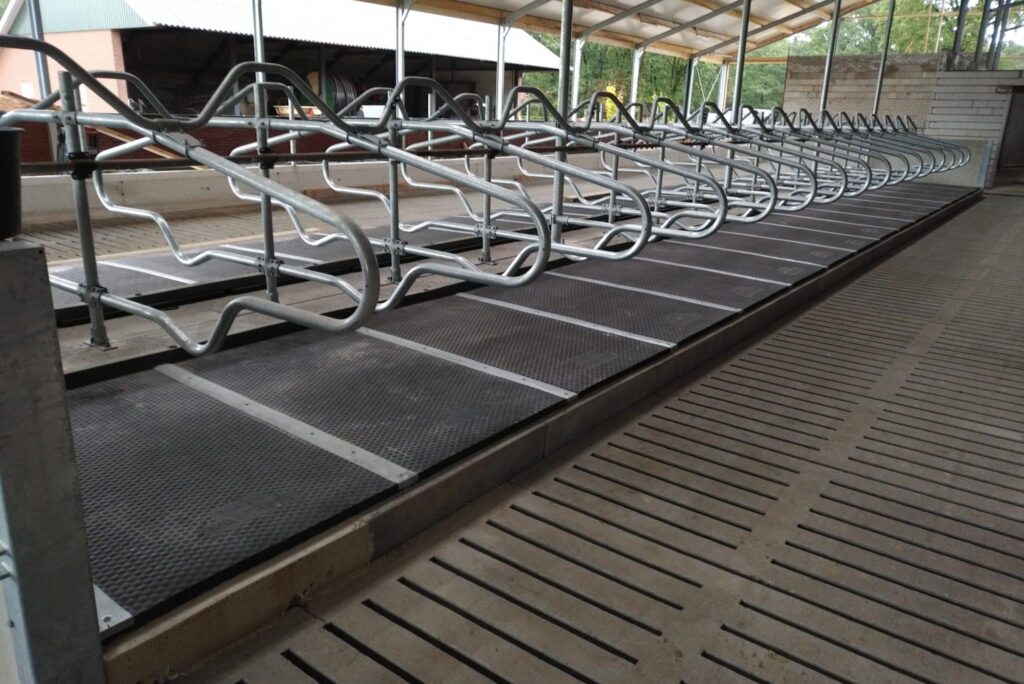
You have three options for the cubicle floor. Each has different costs and benefits.
The first option is compacted murram covered with sawdust or rice husks. This is the traditional method.
It is cheap. It is soft on the cow’s knees and hocks. But it requires daily raking and weekly replacement.
Bacteria thrive in organic bedding. If you do not replace the bedding frequently, your cows will develop mastitis from lying in their own waste.
The second option is a concrete slab with a rubber mat on top. This is the modern method recommended for serious farmers.
The rubber mat provides cushioning. The concrete below provides drainage. You still need a thin layer of sawdust for absorption, but you use much less than on pure murram.
Rubber mats cost about KSh 2,500 per square meter. For a ten-cow unit, the cubicle area is about fifty four square meters. The mats cost KSh 135,000.
This seems expensive. But a rubber mat lasts ten years. Over that decade, you save KSh 300,000 in bedding costs and veterinary bills. The mats pay for themselves in eighteen months.
The third option is a concrete slab with no mat. This is the worst option.
Concrete is hard. A cow lying on hard concrete develops swollen hocks and calloused knees. The pain reduces lying time. Reduced lying time reduces milk.
Never put a cow directly on bare concrete for sleeping. You would not sleep on a concrete floor. Neither should your cow.
Table 7: Cubicle Floor Options Comparison
| Floor Type | Initial Cost (KSh/m²) | Bedding Cost (KSh/cow/year) | Lifespan (years) | Milk Yield Impact |
|---|---|---|---|---|
| Murram + deep bedding | 500 | 3,500 | 1 (bedding changes) | Neutral |
| Concrete + rubber mat | 3,500 | 800 | 10 | +12% due to comfort |
| Concrete only | 1,200 | 2,000 | 5 | -8% due to hock damage |
| Wooden slats | 2,800 | 500 | 7 | +5% (good for calves only) |
Walking Alley Width and Concrete Specifications
The walking alley is the highway system of your unit. Cows must move without hesitation, turning, or slipping.
For a ten-cow unit with a single row of cubicles, the alley must be one point eight meters wide. This allows one cow to pass comfortably.
For a twenty-cow unit with double rows facing each other, the alley must be two point four meters wide. This allows two cows to pass each other.
It also allows you to push a wheelbarrow filled with manure without hitting the cows. A narrow alley will frustrate you every single day.
The alley floor must have a slope of three percent toward the urine collection trench. Three percent means three centimeters of drop for every one meter of length.
This gentle slope makes water and urine flow by gravity. You do not need to push water. You do not need to pump. Gravity does the work for free.
The concrete mix for the alley is critical. Use one part cement, two parts sharp river sand, and three parts three-quarter inch ballast.
This is called a one-two-three mix. Do not add extra water to make the concrete easier to work.
Extra water weakens the concrete. The surface will dust and erode under hoof traffic. You need the concrete to be strong enough to resist constant scratching from steel hoofs.
Add just enough water to make the mix workable. The concrete should hold together when squeezed but not release water when pressed.
Use a concrete vibrator to remove air bubbles. Air bubbles create weak spots. Weak spots crack under the weight of a six hundred kilogram cow.
Table 8: Concrete Mix Specifications for Zero Grazing Floors
| Location | Mix Ratio (C:S:B) | Slump (mm) | Thickness (mm) | PSI Strength Required |
|---|---|---|---|---|
| Walking Alley | 1:2:3 | 50 | 100 | 3,000 |
| Feeding Trough | 1:2:4 | 40 | 75 | 2,500 |
| Cubicle Base | 1:3:5 | 60 | 75 | 2,000 |
| Urine Drain | 1:2:3 | 30 | 100 (walls) | 3,500 |
Grooving the Alley Surface for Slip Resistance
The surface of the alley must be grooved. You cannot leave it smooth.
Smooth concrete becomes slippery when wet. A cow slipping on wet concrete will spread her legs into a split position.
This is called a splay. A splay tears the muscles of the inner thigh. The cow cannot stand properly for two weeks.
She will lie down and refuse to rise. You will need to call a vet to administer anti-inflammatories. The cost of one splay event is roughly KSh 5,000 for the vet, plus KSh 1,000 per day of lost milk.
You groove the concrete by dragging a comb through the wet surface. The comb is made by welding six-millimeter steel rods onto a long handle.
The rods should be spaced fifty millimeters apart. The grooves should be ten millimeters deep.
Drag the comb parallel to the direction the cows walk. This creates channels for water to drain away while leaving ridges for hoof grip.
Do not groove perpendicular to the walking direction. Perpendicular grooves trip the cow. A tripping cow falls. A falling cow breaks bones.
After grooving, cure the concrete properly. Cover it with polythene sheet for seven days.
Sprinkle water twice daily to keep it moist. Concrete that dries too fast becomes brittle. Brittle concrete cracks. Cracked concrete traps manure.
Table 9: Grooving Specifications for Cow Safety
| Parameter | Specification | Reason |
|---|---|---|
| Groove depth | 10mm | Deep enough for drainage, shallow enough to prevent tripping |
| Groove width | 10mm | Allows water to flow freely |
| Spacing between grooves | 50mm center-to-center | Provides adequate grip surface |
| Direction | Parallel to cow movement | Prevents tripping |
| Timing | Applied when concrete is wet but firm | Ensures clean edges without crumbling |
| Tool | Steel comb with 6mm rods | Durable enough for repeated use |
Feeding Trough Dimensions and Design
The feeding trough must be on the opposite side of the alley from the cubicles. Each cow needs sixty to seventy five centimeters of trough space.
For ten cows, you need a six meter long trough. For twenty cows using a double-row layout, you need fifteen meters of trough.
In the double-row layout, you build one central trough that both rows share. The trough is two sided.
The cows on the left eat from the left side of the trough. The cows on the right eat from the right side. This is the most efficient use of space.
The trough must be made of concrete. Wooden troughs rot within three years. Metal troughs rust within five years. Concrete lasts twenty years.
The trough should be fifty centimeters wide at the top and thirty centimeters wide at the bottom. The depth should be thirty centimeters at the front where the cow eats.
The bottom of the trough must slope at five percent toward the cow. As the cow eats from the front, the remaining feed slides down the slope.
She never has to strain to reach the last bits of silage. Feed waste drops from fifteen percent to less than five percent with a properly sloped trough.
The head barrier above the trough is a self-locking yoke. This is a steel pipe frame with a lever that locks each cow in place.
You lift the lever. The cow puts her head through to eat. You lower the lever. She cannot pull her head back until you release the lever.
This allows you to restrain cows for artificial insemination, deworming, vaccination, and hoof trimming without chasing them around the shed.
A self-locking yoke pays for itself in reduced labor costs within six months. Without yokes, you need two men to restrain a cow. With yokes, one man does the job in thirty seconds.
Table 10: Feeding Trough Dimensions by Cow Capacity
| Number of Cows | Linear Trough Length (m) | Trough Configuration | Estimated Concrete Volume (m³) |
|---|---|---|---|
| 10 (single row) | 6.0 | One side only | 0.8 |
| 15 (single row) | 9.0 | One side only | 1.2 |
| 20 (double row) | 15.0 | Two sides (central) | 2.0 |
| 20 (single row) | 12.0 | One side only | 1.6 |
Watering Troughs and Flow Rate Requirements
Water intake drives milk synthesis. A lactating Friesian drinks eighty to one hundred and twenty liters per day.
If water is unavailable for four hours, milk drop persists for forty-eight hours. The cow cannot recover quickly from dehydration.
Your water troughs must be automatic. Manual troughs that you fill with a hose will cost you two hours of labor every day.
Automatic troughs use a float valve that keeps the water at a constant level. The cow pushes a paddle, and fresh water flows.
You need one automatic trough for every ten cows. Place the trough at the exit of the milking parlor.
Cows are thirsty after milking. They will drink heavily. This post-milking drink stimulates the next let-down reflex for the next milking.
The flow rate must be at least fifteen liters per minute. A slow trough will frustrate the cows. The dominant cows will drink first. The subordinate cows will wait.
Use Class 150 PVC pipe of at least one inch in diameter. Bury the pipe half a meter deep to keep the water cool.
Insulate any exposed sections with foam lagging. Sun-heated water reduces intake by thirty percent. A cow will not drink warm water.
Table 11: Water Requirements and Trough Specifications
| Cow Capacity | Daily Water Need (liters) | Number of Auto Troughs | Minimum Flow Rate (L/min) | Pipe Diameter (inches) |
|---|---|---|---|---|
| 10 | 1,000 | 1 | 15 | 1.0 |
| 15 | 1,500 | 2 | 20 | 1.25 |
| 20 | 2,400 | 2 | 25 | 1.5 |
| 20 (high yield) | 3,000 | 3 | 30 | 2.0 |
Milking Parlor Design for Ten to Twenty Cows
For a ten-cow unit, a simple shed with a single milking stall is enough. You milk one cow at a time. The process takes about one hour.
For a twenty-cow unit, you need a swing-over parlor. This is a pit one meter deep and one point two meters wide.
The pit is six meters long. Ten cows stand on the left side of the pit. Ten cows stand on the right side.
The milker stands in the pit at udder height. He attaches the milking machine to the left side cows, then swings the machine over to the right side cows.
He never has to bend over. His back stays straight. His speed increases. Ten cows are milked in thirty minutes instead of one hour.
The floor of the milking pit must be non-slip. Use diamond checker plate aluminum or deep-grooved concrete with ten millimeter grooves at thirty millimeter spacing.
Wet rubber boots slip on smooth concrete. A fallen operator means broken bones and a stopped milking shift.
The milk line should be at zero point eight meters above the pit floor. The vacuum pump needs a capacity of five hundred liters per minute powered by a two horsepower motor.
Table 12: Milking Parlor Specifications by Herd Size
| Herd Size | Parlor Type | Pit Length (m) | Number of Stalls | Milking Time (minutes) |
|---|---|---|---|---|
| 10 | Single stall | Not applicable | 1 | 60 |
| 10 | Swing-over | 3.0 | 5 per side | 30 |
| 20 | Swing-over | 6.0 | 10 per side | 35 |
| 20 | Herringbone | 5.0 | 10 per side | 25 |
Roof Height and Ventilation Requirements
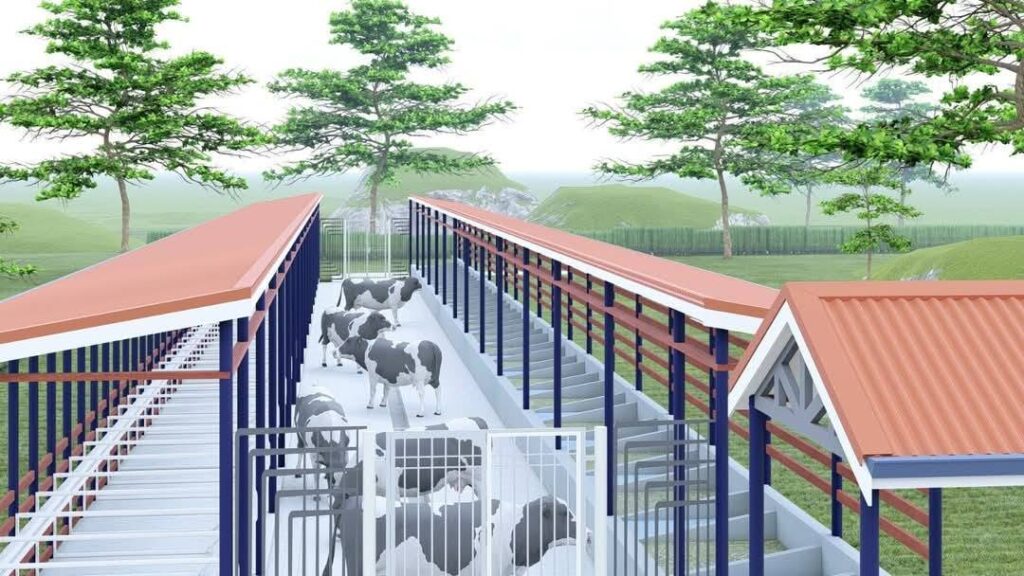
The roof must be high enough to allow heat to rise away from the cows. For a ten-cow unit, the eave height should be three meters.
For a twenty-cow unit, the eave height should be three point five meters. The roof pitch should be twenty five degrees.
This is steep enough to shed rainwater quickly and create a convection current that pulls hot air out through the ridge.
The ridge should have a continuous opening covered with wire mesh. This opening acts as a chimney. Hot air rises and exits through the ridge.
Cool air enters through the open sides. You do not need electric fans. Natural ventilation is free.
Use pre-painted GCI sheets for the roof. The paint reflects sunlight. A reflective roof stays cooler than a bare metal roof.
The temperature difference is as much as ten degrees Celsius. For the ten percent of the roof that sits over the feeding alley, use translucent sheets.
These sheets allow natural light to enter the shed. Cows can see their feed clearly. They eat more. They produce more milk.
Table 13: Roof and Ventilation Specifications
| Cow Capacity | Eave Height (m) | Ridge Height (m) | Roof Pitch (degrees) | Required Ridge Opening (mm) |
|---|---|---|---|---|
| 10 | 3.0 | 4.2 | 25 | 100 |
| 15 | 3.2 | 4.5 | 25 | 120 |
| 20 | 3.5 | 5.0 | 25 | 150 |
| 20 (hot area) | 4.0 | 5.6 | 30 | 200 |
Section 5: Material Procurement and Cost Analysis in KES for 2026
Timber Frame vs. Galvanized Steel Frame
The frame of your unit is the skeleton. It holds the roof and supports the walls. You have two main options.
Treated Eucalyptus or Cypress timber is the traditional choice. It is cheaper upfront.
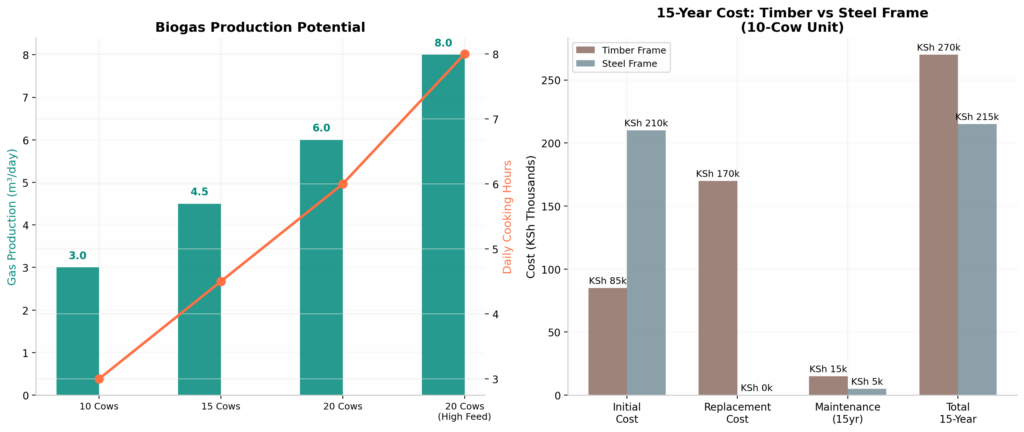
A ten-cow timber frame costs about KSh 85,000. A twenty-cow timber frame costs about KSh 150,000.
But timber has problems. Termites love eucalyptus sap. Even with treatment, termites find a way within eight years.
Timber also rots where it touches the concrete floor. Moisture wicks up from the slab into the wood. The wood softens. The post sinks.
Galvanized steel is the modern choice. It costs more upfront but lasts three times longer.
A ten-cow steel frame costs about KSh 210,000. A twenty-cow steel frame costs about KSh 380,000.
Steel does not rot. Termites cannot eat it. It does not warp in the sun. It does not absorb moisture.
Over fifteen years, steel is cheaper than timber because you replace timber twice in that period.
Table 14: Timber vs. Steel Frame Comparison for Zero Grazing Units
| Parameter | Treated Timber (Cypress) | Galvanized Steel (Box Section) |
|---|---|---|
| Lifespan (years) | 8-10 | 25+ |
| 10-cow frame cost (KES) | 85,000 | 210,000 |
| 20-cow frame cost (KES) | 150,000 | 380,000 |
| Termite risk | High | Zero |
| Maintenance | Re-treat with used oil every 2 years | None |
| Fire risk | Moderate | Low |
| 15-year total cost (KES) | 255,000 (two replacements) | 380,000 (one installation) |
Roofing Material Selection
The roof protects your cows from sun and rain. It also affects the temperature inside the shed.
Pre-painted GCI sheets are the best choice for most farmers. The paint reflects sunlight. A reflective roof stays cooler.
Gauge 30 sheets are thicker than gauge 32. They cost more but last longer and do not dent easily.
Translucent sheets should cover ten percent of your roof. Place them directly over the feeding alley.
The cows can see their feed clearly. Natural light reduces your electricity bill. You do not need lights during the day.
Standard mabati (gauge 32) is cheaper but rusts within five years. Rust drips onto the cows. The brown stains are unsightly and the metal weakens.
Table 15: Roofing Material Costs and Specifications (2026 Prices)
| Material | Gauge | 10-Cow Cost (54m²) | 20-Cow Cost (135m²) | Lifespan (years) | Heat Reflection |
|---|---|---|---|---|---|
| Pre-painted GCI | 30 | 32,400 | 81,000 | 20 | High |
| Pre-painted GCI | 32 | 27,000 | 67,500 | 15 | High |
| Translucent sheets | N/A | 6,500 | 16,250 | 5 | Low |
| Standard mabati | 32 | 24,300 | 60,750 | 5 | Low |
| Aluminum sheet | 28 | 54,000 | 135,000 | 30 | Very High |
Complete Cost Breakdown for 10-Cow Unit
The cost of building a 10 cow zero grazing unit depends on your choice of materials. Economy uses timber and no rubber mats. Premium uses steel and full rubber mats.
For the substructure, you need excavation, hardcore fill, and a damp proof membrane. These costs are the same regardless of frame choice.
- Excavation for a 10-cow unit costs about KSh 2,430. Hardcore fill of five tonnes costs KSh 9,000. The DPC polythene costs KSh 9,720.
- For the concrete slab, you need thirty bags of cement at KSh 750 each. That is KSh 22,500.
- You need four tonnes of river sand at KSh 1,500 per tonne. That is KSh 6,000.
- You need seven tonnes of ballast at KSh 2,200 per tonne. That is KSh 15,400.
- The grooving labour costs KSh 3,500. Curing materials cost KSh 1,000.
- For the superstructure with timber, you need eighteen posts at KSh 850 each. That is KSh 15,300.
- You need thirty wall rails at KSh 550 each. That is KSh 16,500.
- You need six prefabricated roof trusses at KSh 4,500 each. That is KSh 27,000.
- For the roofing, you need thirty GCI sheets at KSh 1,080 each. That is KSh 32,400.
- Nails, ridge cap, and flashings cost KSh 6,000.
- For the fittings, you need ten self-locking yokes at KSh 4,500 each. That is KSh 45,000.
- You need two concrete water troughs at KSh 3,500 each. That is KSh 7,000.
- PVC pipes and fittings cost KSh 8,000.
- If you choose rubber mats for the cubicles, you need 54 square meters at KSh 2,500 per square meter. That is KSh 135,000.
- For labour, a mason for ten days costs KSh 12,000. A carpenter for eight days costs KSh 9,600. Two general labourers for twelve days cost KSh 14,400.
The total for the economy version without rubber mats is KSh 244,750.
The total for the premium version with rubber mats is KSh 379,750.
Table 16: Itemized Cost of Building a 10 Cow Zero Grazing Unit (2026 KES)
| Item | Quantity | Unit Cost | Total (Economy) | Total (Premium) |
|---|---|---|---|---|
| Excavation | 54m² x 0.3m | 150/m³ | 2,430 | 2,430 |
| Hardcore fill | 5 tonnes | 1,800/tonne | 9,000 | 9,000 |
| DPC polythene | 54m² | 180/m² | 9,720 | 9,720 |
| Cement (Bamburi) | 30 bags | 750/bag | 22,500 | 22,500 |
| River sand | 4 tonnes | 1,500/tonne | 6,000 | 6,000 |
| Ballast | 7 tonnes | 2,200/tonne | 15,400 | 15,400 |
| Grooving labour | Lump sum | 3,500 | 3,500 | 3,500 |
| Timber posts | 18 pieces | 850/piece | 15,300 | 15,300 |
| Wall rails | 30 pieces | 550/piece | 16,500 | 16,500 |
| Roof trusses | 6 pieces | 4,500/piece | 27,000 | 27,000 |
| GCI sheets | 30 sheets | 1,080/sheet | 32,400 | 32,400 |
| Nails and ridge | Lump sum | 6,000 | 6,000 | 6,000 |
| Self-locking yokes | 10 units | 4,500/unit | 45,000 | 45,000 |
| Water troughs | 2 units | 3,500/unit | 7,000 | 7,000 |
| PVC pipes | Lump sum | 8,000 | 8,000 | 8,000 |
| Rubber mats | 54m² | 2,500/m² | 0 | 135,000 |
| Mason labour | 10 days | 1,200/day | 12,000 | 12,000 |
| Carpenter labour | 8 days | 1,200/day | 9,600 | 9,600 |
| General labour | 24 man-days | 600/day | 14,400 | 14,400 |
| GRAND TOTAL | 244,750 | 379,750 |
Complete Cost Breakdown for 20-Cow Unit
The zero grazing unit construction cost in kenya for a 20-cow unit is significantly higher per cow. But the efficiency is better.
- For the substructure, excavation costs KSh 8,100. Hardcore fill of twelve tonnes costs KSh 21,600. The DPC costs KSh 24,300.
- For the concrete slab at 120mm thickness, you need eighty bags of cement at KSh 60,000.
- You need ten tonnes of river sand at KSh 15,000. You need eighteen tonnes of ballast at KSh 39,600. Grooving labour costs KSh 7,000.
- For the steel superstructure, you need twenty eight box section posts at KSh 2,200 each. That is KSh 61,600.
- You need 120 meters of steel purlins at KSh 850 per meter. That is KSh 102,000.
- You need twelve steel roof trusses at KSh 7,500 each. That is KSh 90,000.
- For the roofing, you need seventy GCI sheets at KSh 1,180 each. That is KSh 82,600.
- You need eight translucent sheets at KSh 1,950 each. That is KSh 15,600. Galvanized nails and flashings cost KSh 12,000.
- For the fittings, you need twenty self-locking yokes at KSh 90,000. You need four water troughs at KSh 14,000. PVC pipes cost KSh 15,000.
- Rubber mats for the full floor area cost KSh 337,500.
- For the calf pen, raised wooden slats for five pens cost KSh 40,000.
- For labour, a lead mason for fifteen days costs KSh 22,500. A steel fabricator for ten days costs KSh 18,000. Three general labourers for fifteen days cost KSh 27,000.
The total for the steel frame version with rubber mats is KSh 1,105,800.
The economy version with timber and no mats is roughly KSh 550,000.
Table 17: Itemized Cost of Building a 20 Cow Unit (Steel Frame, 2026 KES)
| Item | Quantity | Unit Cost | Total |
|---|---|---|---|
| Excavation | 135m² x 0.4m | 150/m³ | 8,100 |
| Hardcore fill | 12 tonnes | 1,800/tonne | 21,600 |
| DPC polythene | 135m² | 180/m² | 24,300 |
| Cement (Bamburi) | 80 bags | 750/bag | 60,000 |
| River sand | 10 tonnes | 1,500/tonne | 15,000 |
| Ballast | 18 tonnes | 2,200/tonne | 39,600 |
| Grooving labour | Lump sum | 7,000 | 7,000 |
| Steel box posts | 28 pieces | 2,200/piece | 61,600 |
| Steel purlins | 120 meters | 850/meter | 102,000 |
| Steel roof trusses | 12 pieces | 7,500/piece | 90,000 |
| GCI sheets | 70 sheets | 1,180/sheet | 82,600 |
| Translucent sheets | 8 sheets | 1,950/sheet | 15,600 |
| Nails and flashings | Lump sum | 12,000 | 12,000 |
| Self-locking yokes | 20 units | 4,500/unit | 90,000 |
| Water troughs | 4 units | 3,500/unit | 14,000 |
| PVC pipes | Lump sum | 15,000 | 15,000 |
| Rubber mats | 135m² | 2,500/m² | 337,500 |
| Calf pen slats | 5 pens | 8,000/pen | 40,000 |
| Lead mason | 15 days | 1,500/day | 22,500 |
| Steel fabricator | 10 days | 1,800/day | 18,000 |
| General labour | 45 man-days | 600/day | 27,000 |
| GRAND TOTAL | 1,105,800 |
Where to Source Materials for the Lowest Price
Cement is cheapest at the Bamburi depot on Mombasa Road. Buy a full pallet of fifty bags. The price drops to KSh 730 per bag.
Ballast is cheapest from quarries in Ruiru or Kiwanja Ndege in Nakuru. But transport doubles the price beyond fifty kilometers. Source within thirty kilometers of your farm.
Treated timber is best from Timsales on Thika Road or in Nakuru. Cypress four by four posts cost KSh 800 each when bought in bulk.
Steel sections are cheapest from Kinungi Steelworks in Nakuru. Fifty by fifty box section costs KSh 2,100 per piece.
GCI sheets are ten percent cheaper when bought directly from Mabati Rolling Mills factory. Call their sales office and ask for farm pricing.
Rubber mats are cheapest from Kenpoly in Industrial Area, Nairobi. Factory price is KSh 2,400 per square meter.
Self-locking yokes are cheapest when fabricated by a local welder in Nyandarua or Kipipiri. Bring them a drawing. They will charge KSh 3,800 per yoke.
Table 18: Material Sourcing Guide for Best Prices in Kenya
| Material | Best Source | Location | Bulk Discount Available | Contact |
|---|---|---|---|---|
| Cement | Bamburi Depot | Mombasa Road, Nairobi | Yes (pallet of 50 bags) | 0709 111 000 |
| Ballast | Ruiru Quarry | Ruiru, Kiambu | Yes (10 tonnes+) | Local transporter |
| Treated timber | Timsales | Thika Road, Nakuru | Yes (50 pieces+) | 0709 222 000 |
| Steel sections | Kinungi Steelworks | Nakuru Town | Yes (100m+) | 0721 333 444 |
| GCI sheets | Mabati Rolling Mills | Various (factory direct) | Yes (100 sheets+) | 0800 444 555 |
| Rubber mats | Kenpoly | Industrial Area, Nairobi | Yes (50m²+) | 0720 666 777 |
Section 6: Waste Management, Biogas Integration, and Ventilation
Manure and Urine Collection Trenches
A cow produces about twenty five kilograms of manure per day. For twenty cows, that is half a tonne daily.
You cannot let this pile up inside the shed. The ammonia gas will burn your cows’ lungs.
The urine collection trench runs along the back of the cubicles. It is fifteen centimeters wide and ten centimeters deep.
The trench slopes at two percent toward the collection pit. Gravity moves the urine. You do not pump.
The walking alley slopes at three percent toward the same trench. Every time you hose down the alley, the water carries manure into the trench.
The trench must have a removable grating. The grating stops large solids from blocking the pipe. You lift the grating weekly and scrape out the solids.
The solids go to the compost pile. The liquids go to the biogas digester. Separate them. Mixed waste does not digest well.
Table 19: Manure Collection and Trench Specifications
| Parameter | 10-Cow Unit | 20-Cow Unit |
|---|---|---|
| Daily manure production (kg) | 250 | 500 |
| Trench width (cm) | 15 | 20 |
| Trench depth (cm) | 10 | 15 |
| Trench slope | 2% | 2% |
| Collection pit size (m³) | 5 | 10 |
| Emptying frequency (weeks) | 4 | 3 |
Biogas Digester Sizing and Placement
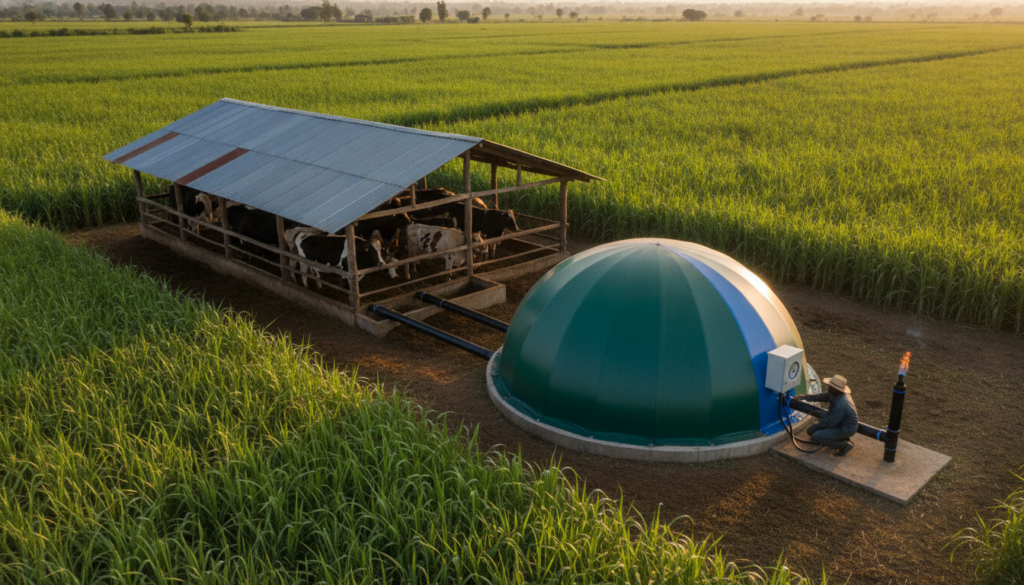
A 20 cow dairy farm layout must include a biogas system. You are wasting money if you do not capture that methane.
A ten-cow unit produces enough gas for cooking two meals daily for a family of six. A twenty-cow unit produces enough gas to run a small generator for four hours.
The digester must be at least twelve cubic meters for ten cows. For twenty cows, you need sixteen cubic meters.
Place the digester at least three meters away from the main shed. Any closer and the digester’s acidic fumes will corrode your roof sheets.
The digester must be downhill from the shed. The manure slurry flows by gravity. You do not want to carry wet manure uphill.
The outlet pipe from the shed to the digester must be at least four inches in diameter. Small pipes block with hair and undigested feed.
The slurry storage pit sits next to the digester. After the digester produces gas, the leftover slurry flows into this pit.
This slurry is excellent fertilizer. It has no smell. It kills weed seeds. Apply it to your napier grass fields.
Table 20: Biogas Digester Sizing for Zero Grazing Units
| Cow Capacity | Digester Size (m³) | Gas Production (m³/day) | Daily Cooking Hours | Generator Running Time (hours) |
|---|---|---|---|---|
| 10 | 12 | 3 | 3 | 1 |
| 15 | 14 | 4.5 | 4.5 | 1.5 |
| 20 | 16 | 6 | 6 | 2 |
| 20 (high feed) | 20 | 8 | 8 | 2.5 |
Ventilation Mechanics for Ammonia Removal
Ammonia is lighter than air. It rises. Your roof design must give it a path to escape.
The open side of your shed should face the prevailing wind. The wind blows through the shed and carries ammonia with it.
The eave height must be at least three meters for ten cows and three point five meters for twenty cows. Low eaves trap ammonia at cow nose level.
The ridge opening must be continuous along the entire roof length. A gap of 150mm is enough. Cover it with wire mesh to keep birds out.
Birds carry Newcastle disease. The mesh should be galvanized. Plastic mesh degrades in UV light within two years.
The walls should not be solid on all sides. The north and south walls should be open. Only the east and west walls need partial closure for sun protection.
If you must close walls due to theft or cold, use shade cloth instead of iron sheets. Shade cloth stops thieves but lets air pass.
Table 21: Ventilation Specifications by Shed Size
| Parameter | 10-Cow Unit | 20-Cow Unit |
|---|---|---|
| Eave height (m) | 3.0 | 3.5 |
| Ridge height (m) | 4.2 | 5.0 |
| Ridge opening (mm) | 100 | 150 |
| Open wall area (%) | 60 | 70 |
| Air changes per hour (minimum) | 8 | 10 |
Section 7: Strategic Action Plan and Frequently Asked Questions
Four-Phase Construction Timeline
Building a zero grazing unit takes planning. Do not rush. Do not pour concrete in the rainy season.
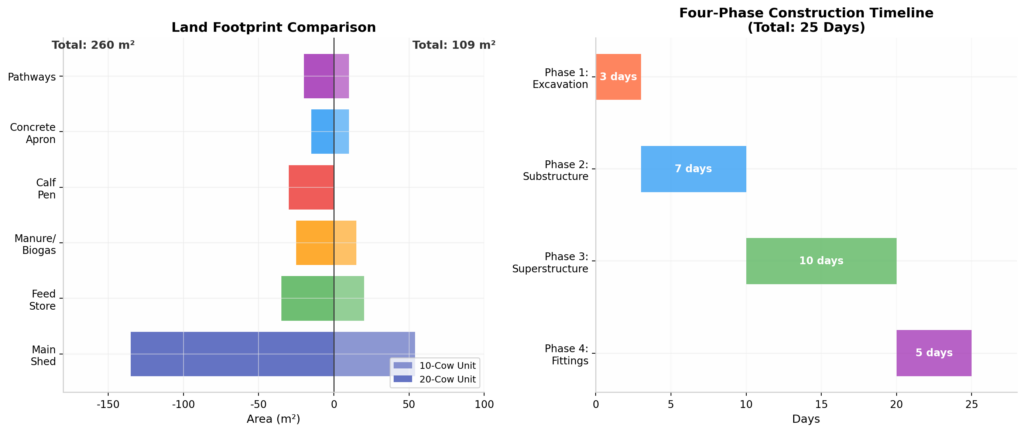
Phase 1: Excavation and Substructure (Week 1)
Clear the site of vegetation. Mark the corners with wooden pegs. Excavate to the required depth. Compact the sub-base with a hand compactor. Lay the DPC polythene. Pour the hardcore layer. Compact again.
Phase 2: Concrete Slab and Drainage (Week 2)
Pour the concrete slab for the walking alley first. Let it cure for three days. Then pour the cubicle bases. Then pour the feeding trough. Do not pour everything at once. The concrete will crack as it shrinks.
Phase 3: Superstructure and Roofing (Week 3 to 4)
Erect the posts. Ensure they are plumb using a spirit level. Fix the wall rails. Install the roof trusses. Screw down the GCI sheets. Do not use nails. Nails lift in the wind. Use self-tapping screws with rubber washers.
Phase 4: Fittings and Finishing (Week 5)
Install the self-locking yokes. Plumb the water troughs. Lay the rubber mats. Install the calf pen slats. Test the drainage with a bucket of water. The water should reach the collection pit within two minutes.
Table 22: Four-Phase Construction Timeline
| Phase | Duration | Key Activities | Materials Required |
|---|---|---|---|
| 1: Excavation | 3 days | Clearing, digging, compacting | Shovels, compactor, pegs |
| 2: Substructure | 7 days | Hardcore, DPC, concrete slab | Ballast, cement, sand, polythene |
| 3: Superstructure | 10 days | Posts, rails, trusses, roofing | Timber/steel, screws, GCI sheets |
| 4: Fittings | 5 days | Yokes, troughs, pipes, mats | Steel, PVC, rubber |
Frequently Asked Questions
1. Where can I download a reliable 10 cow zero grazing unit plan pdf?
KALRO has free PDF plans at their regional offices in Naivasha, Embu, and Kitale. Farmers Trend Limited also “The Ultimate Guide to Zero Grazing House Designs in Kenya .pdf guide” has You can also visit the Ministry of Agriculture website. The search term is “zero grazing unit blueprints.” Do not buy plans from social media sellers. Most are copied from outdated Tanzanian designs that do not fit Friesian cows.
2. How do I stop cows from slipping and injuring joints on wet concrete?
You must groove the concrete. A smooth trowel finish is dangerous. Drag a steel comb through the wet concrete parallel to the walking direction. Grooves should be ten millimeters deep and fifty millimeters apart. If your slab is already poured and smooth, you can cut grooves using an angle grinder with a diamond blade. This takes one full day for a twenty-cow unit.
3. Is wood or concrete better for a resting cubicle floor?
Neither alone is best. Concrete with a rubber mat on top is the gold standard. The concrete provides drainage. The rubber provides cushioning. Wooden slats are good for calves but too slippery for adult cows. Bare concrete causes swollen hocks. Deep bedding of sawdust over murram is acceptable if you change it weekly.
4. What are the legal or county permit requirements for setting up an urban cow shed in Kenya?
You need a construction permit from your county government. In Kiambu, Nairobi, and Uasin Gishu, any structure over fifty square meters requires approval. Your shed must be at least ten meters from any neighbor’s house. The manure pit must be at least thirty meters from any borehole or well. Contact your local agricultural officer. They will inspect your zero grazing house designs in kenya before construction. The permit fee is between KSh 5,000 and KSh 15,000 depending on the county.
5. How often should I replace rubber mats in the cubicles?
Good quality rubber mats last ten years. Inspect them every six months. If you see cracks or soft spots, replace that section. Mats fail faster if cows have sharp hooves. Trim hooves every six months. A sharp hoof cuts rubber like a knife.
6. Can I convert an existing free-range shed into a zero grazing unit?
Yes, but you will spend almost as much as building new. Free-range sheds have the wrong orientation. They have mud floors that need removal. They have low roofs that trap heat. You must pour a new slab, raise the roof, and install cubicles. Sometimes it is cheaper to build fresh on a better site.
7. What is the ideal stocking density for a 20 cow dairy farm layout?
Do not put twenty cows in a shed designed for twenty cows. You need spare capacity for heifers and sick cows. Build for twenty-four cows. This gives you four spare cubicles. One for a growing heifer. One for a sick cow in isolation. One for a cow that is about to calve. One for a cow with a leg injury that needs extra space.
8. How much does a self-locking yoke cost to fabricate locally?
A welder in Kinungi or Nyandarua will charge KSh 3,800 to KSh 4,500 per yoke. Bring a drawing with exact measurements. The steel costs about KSh 2,000 per yoke. The welder’s labour is the rest. Factory-made yokes cost KSh 8,000 each. Local fabrication is cheaper but check the welding quality. Poor welds snap under a struggling cow.
9. What is the payback period for investing in a zero grazing unit?
For a ten-cow unit costing KSh 245,000, the payback period is about eighteen months. Your milk revenue increases by KSh 150 per cow per day compared to poor housing. That is KSh 1,500 daily for ten cows. Over eighteen months, that is KSh 810,000. The unit pays for itself and then generates profit. For a twenty-cow steel unit at KSh 1.1 million, the payback period is about twenty four months.
10. Do I need a separate milking parlour or can I milk in the main shed?
You can milk in the main shed for ten cows. For twenty cows, you need a separate parlour. Milking in the main shed creates wet floors. Wet floors soften hooves. Soft hooves get digital dermatitis. The parlour isolates the wet area to a small zone. The rest of the shed stays dry.
11. What is the best bedding material for zero grazing units in Kenya?
Rice husks are best. They absorb three times their weight in moisture. They do not compact into a hard mat. They are cheap in rice-growing areas like Mwea and Ahero. Sawdust is second best. It absorbs well but compacts after one week. Wheat straw is third. It is comfortable but does not absorb urine. Change rice husks every ten days. Change sawdust every seven days. Change straw every five days.
12. How high should the feed trough be from the floor?
The bottom of the trough should be fifteen centimeters higher than the walking alley. This puts the cow’s neck at a natural grazing angle. If the trough is too low, the cow drools saliva onto the floor. If the trough is too high, the cow cannot reach the last bit of silage. Fifteen centimeters is the exact height measured by animal scientists.
Table 23: Quick Reference for Common Zero Grazing Problems and Solutions
| Problem | Likely Cause | Solution | Estimated Cost (KES) |
|---|---|---|---|
| Cows slipping | Smooth concrete | Groove the surface | 5,000 (labour) |
| Lameness | Standing water | Fix drainage slope | 10,000 (re-screeding) |
| Low milk yield | Heat stress | Raise roof, add ridge vent | 50,000 (modification) |
| Mastitis | Wet bedding | Add rubber mats, change bedding more often | 135,000 (mats) |
| Cow fights at feed trough | Insufficient space | Widen trough or reduce cows per group | 20,000 (extension) |
| Ammonia smell | Poor ventilation | Open north and south walls | 0 (remove sheets) |
| Feed waste | Bad trough slope | Re-cast trough with 5% slope | 15,000 |
| Scours in calves | Cold concrete floor | Add raised wooden slats | 40,000 (5 pens) |


Leave a Reply