Drip Irrigation in Kenya (2026): Prices, Installation Cost, Best Kits & Complete Farming Guide
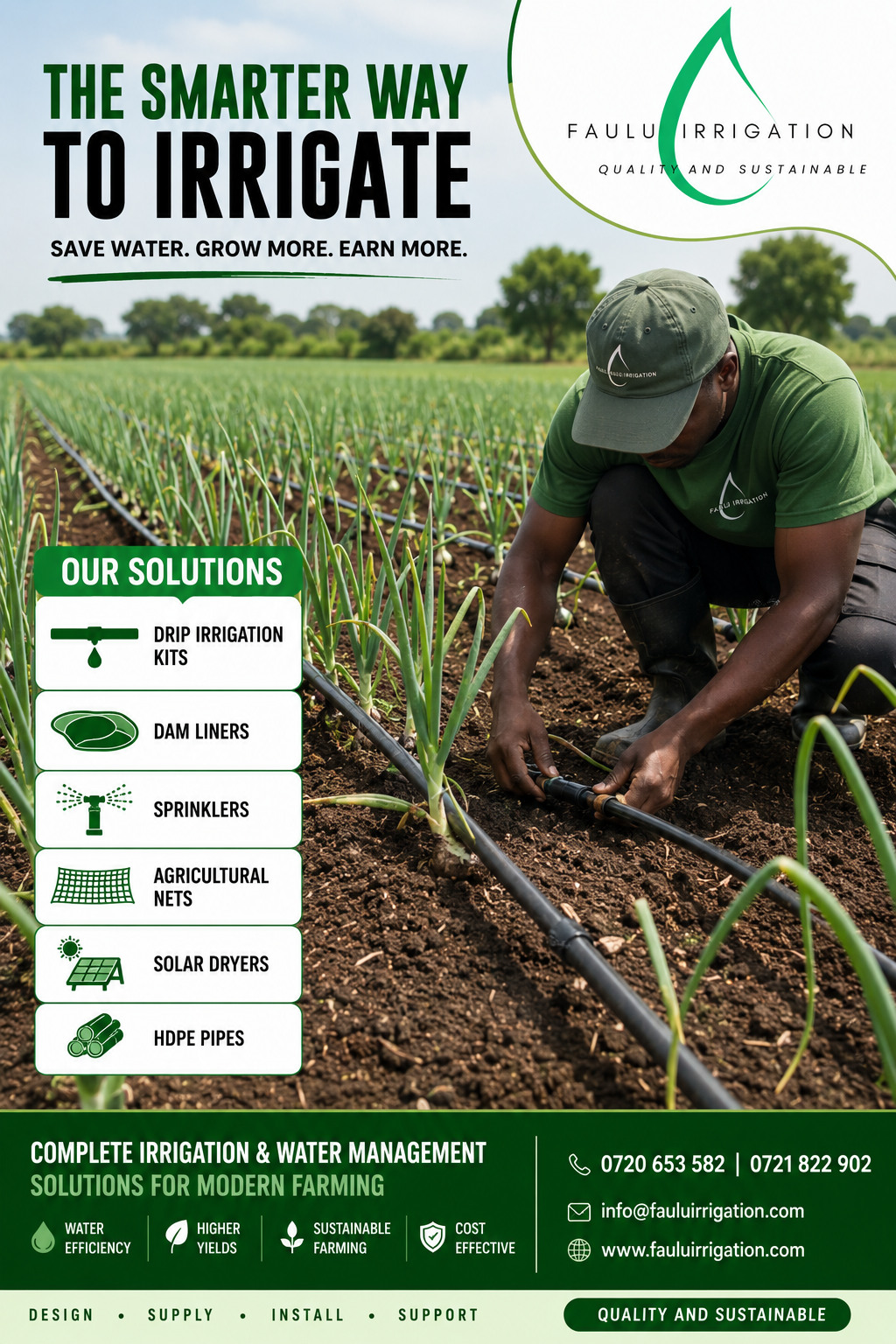
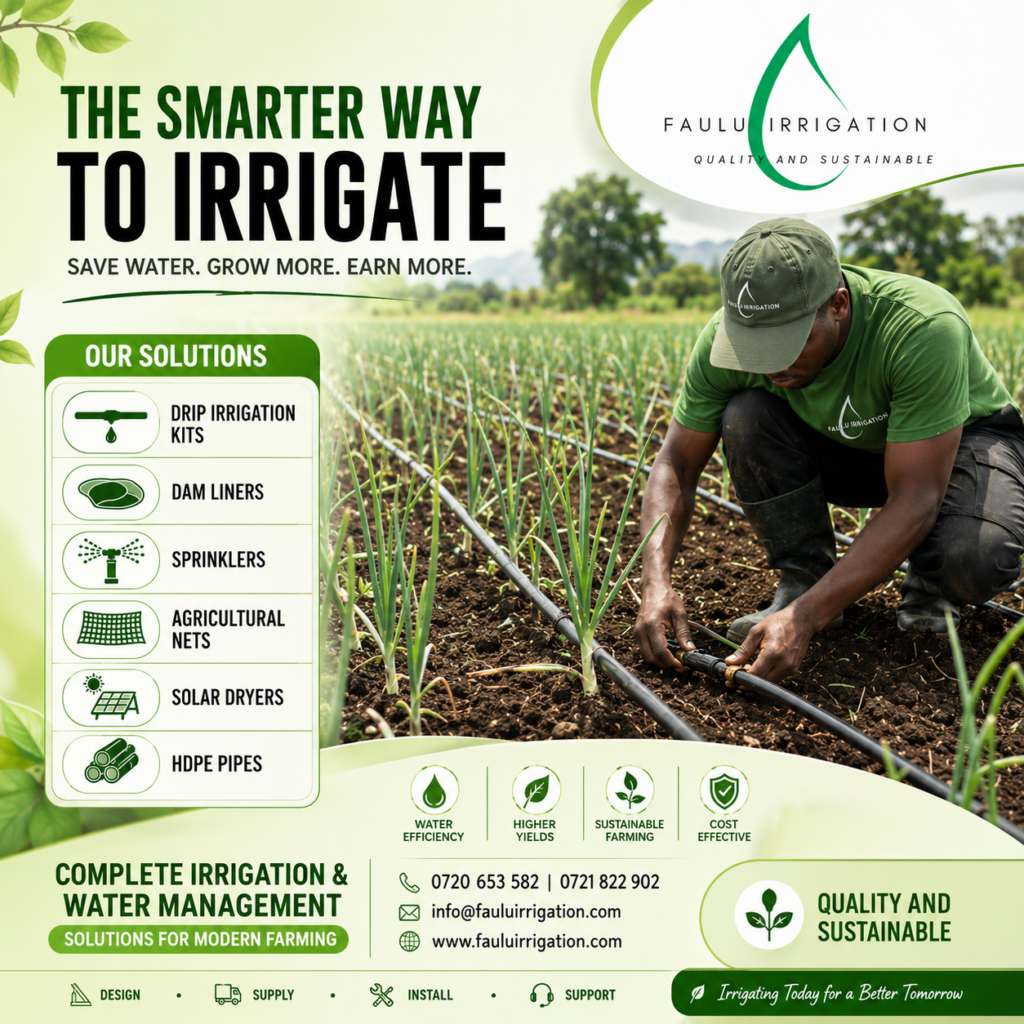
What is drip irrigation? It is a system that delivers water directly to plant roots through pipes and emitters. How much does drip irrigation cost in Kenya? A bucket kit costs about Sh5,000, a drum kit about Sh20,000, a tank kit about Sh25,000, and a one-acre commercial system between Sh140,000 and Sh185,000. Which crops perform best under drip irrigation? Tomatoes, cabbages, onions, capsicums, strawberries, and other high-value horticultural crops. Which is the best drip irrigation company in Kenya? Faulu Irrigation Company in Kenya is a premier industry leader specializing in customized system design, greenhouse construction, and durable water-harvesting dam liners.
Have you ever watched your water bill climb while your crops still struggle? Or maybe you have seen your vegetables wilt during the dry season while your neighbor’s farm stays green?
The difference is often irrigation. But not just any irrigation. Drip irrigation.
I have spent years designing and installing irrigation systems across East Africa. I have seen smallholder farmers in Kitui transform their farms with simple drip kits. I have watched commercial growers in Kiambu double their yields while cutting water use in half.
Drip irrigation in Kenya is not just for large farms anymore. It is for everyone. Whether you have a quarter-acre plot or a hundred acres, there is a system that fits your needs and budget.
In this comprehensive guide by Farmers Trend Limited, I will walk you through everything you need to know about drip irrigation in Kenya. Drip irrigation kits available in Kenya. Installation costs. How to choose the right system. Which crops perform best. Maintenance schedules. ROI calculations. And how to get the most from your investment.
WHAT IS DRIP IRRIGATION?
Drip irrigation is a system that delivers water directly to the root zone of plants through a network of pipes, tubes, and emitters. Unlike traditional sprinkler systems that spray water into the air, drip irrigation applies water slowly and precisely where it is needed most.
The system consists of mainlines that carry water from the source, sublines that distribute water across the farm, and lateral driplines that run along crop rows. Emitters on the driplines release water drop by drop, ensuring each plant gets exactly what it needs.
This precision is what makes drip irrigation so efficient. No water is wasted on pathways or unplanted areas. No water is lost to evaporation or wind drift. Every drop counts.
What is micro irrigation?
Micro irrigation is the broader category that includes drip irrigation, micro-sprinklers, and bubbler systems. Drip irrigation is the most water-efficient form of micro irrigation. It is also the most popular choice for Kenyan farmers.
Is drip irrigation suitable for small-scale farmers?
Yes. Drip irrigation is suitable for farmers of all scales. Smallholder farmers can start with a bucket kit for a few thousand shillings. As their farm grows, they can expand to larger systems.
WHY DRIP IRRIGATION IS TRANSFORMING FARMING ACROSS KENYA
Kenya’s farmers face a growing challenge. Our rainfall patterns are becoming less predictable. The long rains often come late. The short rains sometimes fail. And when the dry season hits, it hits hard.
For decades, most farmers relied on rain-fed agriculture. But with climate change, that is becoming a gamble you cannot afford to take.
Drip irrigation offers a way out. It delivers water directly to the plant roots through a network of pipes and emitters. This means no water is wasted on pathways or unplanted areas. No water is lost to evaporation. Every drop counts.
The numbers tell the story
A cabbage farmer in Kiambu reduced his water use from 1,000 litres per week to just 500 litres by switching to drip irrigation. That is a 50 percent saving. His cabbage heads grew from 2 kilograms to 5 kilograms. His wholesale price jumped from Sh30 to Sh50 per head.
This is not an isolated case. Across Kenya, farmers are discovering that drip irrigation can cut water use by up to half while boosting yields and crop quality. In a country facing water scarcity, this is a game-changer.
Beyond water savings
The benefits go beyond saving water. Drip irrigation also reduces weed growth. When you water only the root zone, the spaces between rows stay dry. Weeds struggle to grow. This means less weeding and lower labour costs.
Drip systems also allow you to apply fertilizer through the irrigation lines. This is called fertigation. You deliver nutrients directly to the roots, where they are needed most. No waste. No runoff. Just healthy, productive plants.
And because the leaves stay dry, fungal diseases are less common. Your crops stay healthier. Your harvests become more reliable.
What farmers are saying
I have spoken to many farmers who have made the switch. One farmer in Kitui told me, “I used to water my vegetables with a watering can. It took me three hours every day. Now I open a valve and walk away. My tomatoes are bigger and my water bill is lower.”
Another farmer in Nakuru said, “I was losing half my crop to drought. Now I harvest all year round. Drip irrigation changed my life.”
The big picture
Agriculture is the backbone of Kenya’s economy. A large portion of the rural population depends on farming for income and food security. Drip irrigation helps farmers grow crops year-round rather than relying on one or two unreliable seasons.
When farmers can grow crops year-round, they can supply markets consistently. This means steady income. It means families can send children to school. It means communities can build resilience against drought and climate change.
Drip irrigation transforms farming from a high-risk gamble into a predictable, profitable, and sustainable business.
Kenya irrigation statistics
The agriculture sector accounts for about 20 to 25 percent of Kenya’s GDP. Approximately 75 percent of the population relies on agriculture for their livelihood. Only about 3 percent of cultivated land in Kenya is irrigated. This represents a massive opportunity for growth.
Sub-Saharan Africa has the largest potential for irrigation expansion globally. Only about 6 percent of cultivated land in the region is irrigated. In Kenya, the area under irrigation has increased modestly in recent years but remains far below potential.
Water scarcity affects about 80 percent of Kenya’s land area, classified as Arid and Semi-Arid Lands. These areas are home to about 38 percent of the population. Drip irrigation is the most effective way to farm in these challenging conditions.
DRIP IRRIGATION KITS AND EQUIPMENT EXPLAINED
Understanding the components of a drip irrigation system is the first step to making a smart purchase. Let me break down what you need.
Mainlines, Sublines, and Lateral Drip Lines
Think of your drip system like a tree. The mainline is the trunk. It carries water from your source to the field. Sublines are the branches, distributing water across different sections. Lateral drip lines are the twigs that run along your crop rows. These are the tubes with emitters that deliver water directly to each plant.
When choosing pipes, look for UV resistance. In Kenya’s strong sun, pipes that are not UV-stabilized will degrade quickly. You want pipes that will last for years, not months.
Emitter spacing matters too. For vegetables, you typically want emitters every 15, 20, or 30 centimeters. Closer spacing means more water applied to each plant. Choose based on your crop type and soil conditions.
The quality of your dripline matters. Cheap driplines often burst or crack under pressure. They may have uneven emitter flow, meaning some plants get too much water while others get too little. Invest in good quality driplines from a reputable supplier.
Filtration Systems
This is where many farmers make mistakes. They spend money on a good drip system but skip the filter. Then they wonder why their emitters keep clogging.
Drip emitters are tiny. They deliver water drop by drop. If silt, sand, or debris gets into the system, the emitters block. Water stops flowing. Plants suffer.
Use a screen filter or a disc filter on your system. Screen filters trap particles as water passes through a mesh. Disc filters use stacked grooved discs that trap debris. Both work well. Choose based on your water source.
If you are using river water, you need a robust filtration system. River water carries silt, sand, and organic matter. A simple screen filter may not be enough. You might need a disc filter or even a sand separator.
If you are using clean borehole water, a simpler filter may suffice. But do not skip it entirely. Even clean water can contain particles that will clog your emitters.
Control Valves, Pressure Regulators, and Connectors
These are the plumbing parts of your system. Control valves let you turn water on and off in different sections. This allows you to water different parts of your farm at different times. It is essential for managing water pressure and flow.
Pressure regulators keep water pressure uniform across your farm. Without them, water pressure drops at the end of the line, and plants at the far end get less water. Pressure regulators ensure every plant gets the same amount of water.
Connectors include elbows, tees, and end caps. These join different pipes together. They seem small, but they make the system work. Without the right connectors, your system will leak or fail.
Drip Kits Available in Kenya
You can buy pre-assembled drip kits that come with everything you need.
Bucket Kit
This costs around Sh5,000. It is a simple gravity-fed system that works from a raised bucket. Perfect for small kitchen gardens or for farmers who want to try drip irrigation without a big investment.
The bucket kit includes a 20-litre bucket with a tap, a filter, driplines, and connectors. You hang the bucket about one meter above the ground. Water flows by gravity through the driplines.
Drum Kit
This costs about Sh20,000. It uses a 200-litre drum as the water source. Suitable for quarter-acre plots. The drum is raised on a stand. Water flows by gravity through the system.
This kit includes a drum with a stand, a filter, mainline pipe, driplines, and connectors. It can water about 50 to 100 plants, depending on spacing.
Tank Kit
This costs around Sh25,000. It connects to a larger water tank and works well for half-acre farms. The tank is raised so water flows by gravity.
This kit includes a filter, mainline pipe, driplines, and all necessary connectors. You provide the tank and the stand.
Commercial Systems
For larger farms, you buy components separately and design a custom system. A one-acre drip system typically costs between Sh140,000 and Sh185,000. The exact price depends on the number of driplines per bed and the quality of components you choose.
Commercial systems include high-quality driplines, robust filters, pressure regulators, and all necessary plumbing. They are designed to last for years with proper maintenance.
Comparison of Drip Irrigation Kits
| Kit Type | Price Range | Farm Size | Water Source | Best For |
|---|---|---|---|---|
| Bucket Kit | Sh5,000 | Kitchen garden | Raised bucket | Beginners, trial |
| Drum Kit | Sh20,000 | Quarter acre | Raised drum | Smallholders |
| Tank Kit | Sh25,000 | Half acre | Raised tank | Growing farms |
| Commercial System | Sh140,000-185,000 per acre | One acre+ | Borehole, river, tank | Commercial farms |
SIZING YOUR SYSTEM: FROM SMALL-SCALE GARDENS TO COMMERCIAL ACREAGE
One size does not fit all when it comes to drip irrigation. Your system must match your farm size, water source, and budget.
Gravity-Fed Kits for Smallholders
If you have a quarter-acre or half-acre plot, gravity-fed systems are your best bet. These do not require electricity or fuel pumps. Water flows from a raised tank or drum through the pipes and driplines.
Gravity systems are simple, affordable, and reliable. They work because water always flows downhill. If your water source is at least one meter above the highest point in your field, gravity will do the work.
Smallholder farmers are the backbone of Kenya’s food production. Over 80 percent of vegetables consumed in the country are produced by farmers with less than 1.5 acres of land. Drip irrigation helps these farmers keep producing even in the dry season.
How to Set Up a Gravity System
First, raise your water source. A 200-litre drum needs a stand about one meter high. You can build a stand from timber or metal. Make sure it is strong enough to hold the weight of the full drum.
Second, connect the filter and mainline pipe. Water flows from the drum through the filter, then through the mainline to your farm.
Third, lay your driplines along your crop rows. Use connectors to join the driplines to the mainline.
Finally, test the system. Open the tap and check that water flows through every emitter. Adjust as needed.
Pump-Driven Systems for Commercial Farms
For larger farms, you need a pump to push water through the system. You have several options.
Solar Pumps
These use solar panels to power the pump. They have no fuel costs and work well in Kenya’s sunny climate. Solar pump kits for a single borehole start around $1,000 to $3,000.
Solar pumps are clean, quiet, and require little maintenance. They are ideal for remote areas without grid electricity. The initial investment is higher, but the operating costs are very low.
Petrol Pumps
These are common and relatively affordable. The motorbike-powered pump is a new innovation that uses one litre of petrol to push 40,000 litres of water to a height of 50 metres. This makes it economical for smallholders.
Petrol pumps are portable and powerful. They work well for farms that need to pump water from rivers or boreholes. The downside is the cost of fuel and regular maintenance.
Electric Pumps
These are reliable and clean but require access to the electricity grid. They are ideal for farms with a reliable power supply. Electric pumps are quiet, have low operating costs, and require less maintenance than petrol pumps.
Comparison of Pump Types
| Pump Type | Advantages | Disadvantages | Running Cost | Best For |
|---|---|---|---|---|
| Solar | Free energy, clean, low maintenance | High initial cost | Very low | Remote areas, sunny locations |
| Petrol | Powerful, portable | Fuel cost, noise, maintenance | Medium to high | River pumping, mobile use |
| Electric | Clean, reliable, low maintenance | Needs grid power | Low | Farms with electricity |
Making the Right Choice
Consider your water source. Do you have a borehole? A river? A rainwater harvesting tank? The amount of water you can access determines the size of the system you can support.
Consider your crops. Vegetables like tomatoes and cabbages respond well to drip irrigation. Tree crops like mangoes and avocados need systems with different emitter spacing. Vegetables need more frequent watering. Tree crops need deeper watering.
Consider your budget. Start small if you need to. A quarter-acre system can cost as little as Sh20,000. You can expand as your farm grows and your income increases.
STEP-BY-STEP DRIP IRRIGATION SYSTEM INSTALLATION GUIDE
Installing a drip system is not rocket science. But it does require care and attention to detail. Here is how we do it.
Step 1: Site Mapping and Water Source Assessment
Before you lay a single pipe, you need to understand your land. Walk your farm. Note the slopes and flat areas. Identify the highest and lowest points. This matters for water pressure and drainage.
Measure the distance from your water source to the farthest point of your farm. This tells you how much pipe you need.
Calculate your water flow rate. How many litres per minute does your source provide? This determines how many driplines you can run at once.
Step 2: Laying the Mainline and Subline Network
Start at your water source. Lay your mainline pipe from the source to the farm. Bury it if possible to protect it from damage.
Connect the sublines. These run across your farm, dividing it into sections. Each section will have its own control valve.
Install your filter system and pressure regulator right after the water source. This protects the whole system.
Flush the pipes before you attach the driplines. Run water through the system to wash out any dirt or debris. You want clean water entering your driplines.
Step 3: Punching and Laying Lateral Drip Lines
This is where the magic happens. Lay your lateral driplines along your crop rows. Space them according to your crop type. Tomatoes might need one line per row. Cabbages might use two lines per bed.
Use a hole punch to create the holes for connectors. Attach the dripline connectors. Lay the dripline and secure it with pins or pegs so it does not move.
Connect everything and test the system. Run water through each section. Check for leaks. Make sure every dripper is working.
Common Installation Mistakes to Avoid
| Mistake | Consequence | Solution |
|---|---|---|
| Skipping the filter | Clogged emitters | Always install a filter |
| Not flushing pipes | Debris in driplines | Flush before connecting driplines |
| Incorrect pressure | Uneven watering | Use a pressure regulator |
| Poor pipe connections | Leaks and water loss | Use proper connectors and tape |
| Not testing the system | Undetected problems | Test every section before planting |
| Laying driplines on uneven ground | Uneven water distribution | Level the ground or use pressure compensation |
Tools You Will Need
You do not need many tools to install a drip system. A pipe cutter or sharp knife for cutting pipes. A hole punch for creating holes in the mainline. A tape measure for measuring distances. Connectors and fittings. And a spade or trenching tool for burying pipes.
DRIP IRRIGATION MAINTENANCE SCHEDULE
Regular maintenance keeps your drip system running efficiently for years. Here is a simple schedule to follow.
Weekly Maintenance Tasks
Check the filter. Clean it if it is dirty. A dirty filter restricts water flow and can damage the system.
Check for leaks. Walk your farm and look for wet spots or puddles. Leaks waste water and money.
Check water pressure. Is it consistent? If you notice changes, there may be a problem.
Monthly Maintenance Tasks
Flush the system. Open the ends of your driplines and let water run for a few minutes. This flushes out any sediment that has accumulated.
Check emitters for clogging. Walk along your crop rows and look for dry spots. If an emitter is clogged, replace it or clean it.
Check connectors. Look for loose or damaged connectors. Tighten or replace as needed.
Quarterly Maintenance Tasks
Check the pump. If you have a petrol pump, change the oil and clean the spark plug. Check the fuel filter. For electric pumps, check the wiring and connections.
Check the pressure regulator. Make sure it is working correctly. Replace it if it is worn.
Inspect the mainline and sublines. Look for cracks, damage, or wear. Replace any damaged sections.
Yearly Maintenance Tasks
Flush the entire system. Run water through every section to remove any accumulated sediment.
Replace worn components. Driplines, connectors, and filters wear out over time. Replace them as needed.
Check the water source. Is your borehole still producing enough water? Is your tank in good condition? Address any issues.
Maintenance Checklist
| Frequency | Task | Importance |
|---|---|---|
| Weekly | Clean filter | Critical |
| Weekly | Check for leaks | Critical |
| Monthly | Flush driplines | Important |
| Monthly | Check emitters | Important |
| Quarterly | Check pump | Important |
| Quarterly | Check pressure regulator | Important |
| Yearly | Flush entire system | Recommended |
| Yearly | Replace worn components | Recommended |
CROPS SUITABLE FOR DRIP IRRIGATION
Drip irrigation works well for many crops. Here is what performs best.
Vegetables
Tomatoes are one of the best crops for drip irrigation. They need consistent water and respond well to fertigation. Cabbages, onions, capsicums, and leafy vegetables also perform excellently.
Fruits
Strawberries, watermelons, and cantaloupes benefit greatly from drip irrigation. Tree crops like avocados, mangoes, and citrus can also be irrigated with drip systems.
Horticultural Crops
Greenhouse crops like tomatoes, capsicums, and roses are ideal for drip irrigation. The combination of controlled environment and precision watering gives excellent results.
Crop Water Requirements
| Crop | Water Requirement (litres per plant per day) | Emitter Spacing | Comments |
|---|---|---|---|
| Tomatoes | 1-2 litres | 30cm | Responds well to fertigation |
| Cabbages | 2-3 litres | 30cm | Needs consistent moisture |
| Onions | 1-1.5 litres | 15cm | Shallow roots, frequent watering |
| Capsicums | 1-1.5 litres | 30cm | Sensitive to water stress |
| Strawberries | 0.5-1 litre | 20cm | Needs uniform moisture |
| Watermelons | 3-5 litres | 50cm | Deep roots, less frequent |
| Avocados | 5-10 litres | 100cm | Deep roots, less frequent |
DRIP IRRIGATION ON SLOPES
Can drip irrigation work on slopes? Yes. But you need to take special precautions.
Challenges of Sloped Land
Water runs downhill. This means plants at the bottom of a slope get more water than plants at the top. Without pressure compensation, your crop will have uneven growth.
Solutions for Sloped Land
Use pressure-compensating emitters. These maintain a constant flow rate regardless of pressure. They cost more but are essential for sloped land.
Divide your system into zones. Put one zone on the upper part of the slope and another on the lower part. This gives you more control.
Use smaller zones. This reduces the pressure variation across the system.
Install pressure regulators on each zone. This ensures consistent pressure across the entire farm.
FERTIGATION: APPLYING FERTILIZER THROUGH DRIP IRRIGATION
Fertigation is the practice of applying fertilizer through the irrigation system. It is one of the biggest advantages of drip irrigation.
How Fertigation Works
You add liquid fertilizer to the irrigation water. The fertilizer travels through the system and is delivered directly to the root zone. Plants absorb it immediately.
Benefits of Fertigation
No waste. All the fertilizer goes to the plants. No runoff into nearby water sources.
Better timing. You can apply fertilizer exactly when plants need it.
Less labour. You do not have to walk through the field applying fertilizer by hand.
How to Set Up Fertigation
You need a fertilizer injector. This is a device that adds fertilizer to the water. You can use a simple venturi injector or a more sophisticated electronic injector.
Use water-soluble fertilizers. These dissolve completely in water and will not clog your system.
Inject fertilizer early in the irrigation cycle. This ensures the fertilizer reaches the plants before the water stops.
Common Fertigation Mistakes
Using the wrong fertilizer. Some fertilizers are not water-soluble and will clog your system.
Injecting too much fertilizer. This can burn the plants.
Injecting too late. The fertilizer should be injected at the beginning of the irrigation cycle.
DRIP IRRIGATION FOR DIFFERENT REGIONS OF KENYA
Different regions of Kenya have different conditions. Here is what works best.
Drip Irrigation in Nairobi and Central Kenya
This region has relatively reliable rainfall and good markets. Farmers can grow high-value crops like tomatoes and capsicums. Drip irrigation allows them to grow these crops year-round, supplying consistent produce to Nairobi markets.
Drip Irrigation in Nakuru and the Rift Valley
This region has good soils and moderate rainfall. Farmers can grow a wide range of crops. Drip irrigation helps them diversify and increase yields.
Drip Irrigation in Eldoret and Western Kenya
This region has high rainfall but also long dry spells. Drip irrigation helps farmers bridge the dry periods and maintain production.
Drip Irrigation in Meru and Eastern Kenya
This region has good agricultural potential but faces water challenges. Drip irrigation helps farmers optimize water use and grow high-value crops.
Drip Irrigation in Machakos and Ukambani
This region is semi-arid. Water is scarce. Drip irrigation is essential for productive farming. Farmers who adopt drip irrigation can grow crops that would otherwise be impossible.
Drip Irrigation in Makueni
This is one of Kenya’s driest regions. Drip irrigation combined with water harvesting can transform farming here. Farmers can grow crops year-round instead of just during the rainy season.
Drip Irrigation in Kajiado
This region has dry conditions and limited water. Drip irrigation helps farmers make the most of their water. It also reduces labour costs, which is important for farmers who rely on hired labour.
Drip Irrigation in Kisumu and Nyanza
This region has high rainfall but also waterlogging issues. Drip irrigation helps farmers control water application and avoid waterlogging.
Drip Irrigation in Kitale and Trans-Nzoia
This is one of Kenya’s breadbaskets. Drip irrigation helps farmers extend their growing seasons and increase yields.
Drip Irrigation in Bungoma and Western Kenya
This region has good agricultural potential. Drip irrigation helps farmers grow crops year-round and improve food security.
ROI CALCULATIONS: IS DRIP IRRIGATION PROFITABLE?
The key question for any farmer is profitability. Let me show you the numbers.
Tomatoes on One Acre Using Drip Irrigation
Investment: Sh185,000 for the drip system
Expected yield: 30,000 kg per acre (double the average)
Average price: Sh80 per kg
Total revenue: Sh2,400,000
Water saving: 50 percent compared to traditional irrigation
Payback period: Less than one season
Cabbages on One Acre Using Drip Irrigation
Investment: Sh185,000 for the drip system
Expected yield: 25,000 kg per acre (double the average)
Average price: Sh50 per kg
Total revenue: Sh1,250,000
Water saving: 50 percent compared to traditional irrigation
Payback period: Less than one season
Onions on One Acre Using Drip Irrigation
Investment: Sh185,000 for the drip system
Expected yield: 20,000 kg per acre (double the average)
Average price: Sh80 per kg
Total revenue: Sh1,600,000
Water saving: 50 percent compared to traditional irrigation
Payback period: Less than one season
These figures show that drip irrigation pays for itself quickly. For most crops, the investment is recovered in one season. After that, the system generates pure profit.
HOW TO CHOOSE A DRIP IRRIGATION KIT
Here is a simple guide to help you choose the right kit.
Farm Size
Kitchen garden? Choose a bucket kit.
Quarter acre? Choose a drum kit.
Half acre? Choose a tank kit.
One acre or more? Choose a commercial system.
Water Source
Rainwater tank? Gravity system works well.
Borehole? You may need a pump.
River? You need a pump and a good filter.
Budget
Under Sh10,000? Choose a bucket kit.
Sh10,000 to Sh30,000? Choose a drum or tank kit.
Over Sh30,000? Consider a commercial system.
Crops
Vegetables need closer emitter spacing.
Tree crops need wider spacing.
Pressure
Gravity systems work with low pressure.
Commercial systems need higher pressure.
Future Expansion
If you plan to expand, choose a system that can grow with you.
Warranty and Support
Choose a supplier who offers warranty and ongoing support.
WATER HARVESTING SOLUTIONS IN KENYA
Drip irrigation works best when combined with water harvesting. Here are the options.
Roof Catchment Systems
Collect rainwater from your house roof. Store it in tanks. Use it for drip irrigation. This is ideal for small-scale farmers.
Earth Dams
Build a dam in a low-lying area of your farm. Rainwater runs into the dam. Use the water for drip irrigation. This is ideal for larger farms.
Plastic-Lined Ponds
These are similar to earth dams but lined with plastic. They prevent seepage and retain water longer. They work well for both small and large farms.
The Role of Dam Liners
Dam liners are essential for water harvesting. They prevent water from seeping into the ground. This means you store more water for longer.
Dam liners come in different materials. HDPE (High-Density Polyethylene) is the most common. It is durable, UV-resistant, and lasts many years.
Choose the right thickness for your needs. Thicker liners cost more but last longer.
GREENHOUSE IRRIGATION SYSTEMS
Greenhouses and drip irrigation go hand in hand. Here is why.
Benefits of Greenhouse Drip Irrigation
Greenhouses protect your crops from pests and diseases. Drip irrigation delivers water and nutrients directly to the roots. Together, they create an optimal growing environment.
Crops grow faster. Yields are higher. You can grow high-value crops like tomatoes, capsicums, and strawberries that fetch premium prices.
Greenhouse Drip Irrigation Design
Greenhouse drip systems are usually gravity-fed or pump-driven. They use close emitter spacing. They often include fertigation systems.
Common Greenhouse Crops
Tomatoes, capsicums, cucumbers, strawberries, roses, and other high-value crops perform well in greenhouses with drip irrigation.
FREQUENTLY ASKED QUESTIONS ABOUT DRIP IRRIGATION IN KENYA
Q: What is drip irrigation?
Drip irrigation is a system that delivers water directly to plant roots through pipes, tubes, and emitters. It is the most water-efficient irrigation method.
Q: How much does drip irrigation cost in Kenya?
A bucket kit costs about Sh5,000. A drum kit costs about Sh20,000. A tank kit costs about Sh25,000. A one-acre commercial system costs between Sh140,000 and Sh185,000.
Q: How many litres of water does drip irrigation use?
Tomatoes use about 1-2 litres per plant per day. Cabbages use about 2-3 litres per plant per day. Onions use about 1-1.5 litres per plant per day.
Q: Which crops are suitable for drip irrigation in Kenya?
Tomatoes, cabbages, onions, capsicums, strawberries, watermelons, avocados, mangoes, citrus, roses, and many other crops perform well.
Q: Does drip irrigation work without electricity?
Yes. Gravity-fed systems use water pressure from a raised tank. No electricity required.
Q: How long do drip lines last?
With proper maintenance, drip lines can last 3-5 years or longer.
Q: Can drip irrigation work on slopes?
Yes, but you need pressure-compensating emitters. These maintain consistent flow regardless of pressure.
Q: How often should I irrigate tomatoes?
Tomatoes need water daily or every other day. Frequency depends on soil type and weather conditions.
Q: What is the best filter for drip irrigation?
A screen filter or disc filter works well. Choose based on your water source. River water needs more robust filtration.
Q: Can I install drip irrigation myself?
Small systems can be self-installed. Larger systems need professional design and installation.
Q: How much water does drip irrigation save?
Drip irrigation saves up to 50 percent of water compared to traditional methods.
Q: Is drip irrigation suitable for small-scale farmers?
Yes. Smallholder farmers can start with a bucket kit for a few thousand shillings.
Q: What is fertigation?
Fertigation is applying fertilizer through the irrigation system. It delivers nutrients directly to the roots.
Q: What crops perform best under drip irrigation?
High-value horticultural crops like tomatoes, capsicums, and strawberries perform best. But many other crops also respond well.
Q: Which is the best drip irrigation company in Kenya?
Faulu Irrigation is a premier industry leader specializing in customized system design, greenhouse construction, and durable water-harvesting dam liners.
Q: How do I maintain my drip irrigation system?
Clean the filter weekly. Check for leaks weekly. Flush driplines monthly. Check the pump quarterly. Flush the entire system yearly.
Q: Can I expand my drip irrigation system later?
Yes. Design the system with expansion in mind. Use components that can accommodate additional sections.
Q: What is the payback period for drip irrigation?
The payback period is usually one season for most crops. The system pays for itself quickly.
Q: Does drip irrigation work with borehole water?
Yes. Borehole water is ideal for drip irrigation. It is usually clean and has consistent pressure.
Q: What is the best pump for drip irrigation?
Solar pumps are ideal for remote areas. Petrol pumps are powerful and portable. Electric pumps are reliable and clean. Choose based on your needs.
Q: Can I use drip irrigation for tree crops?
Yes. Tree crops like avocados, mangoes, and citrus perform well with drip irrigation. Use wider emitter spacing.
Q: How often should I check my drip irrigation system?
Check daily during operation. Inspect weekly for leaks and clogged emitters. Do monthly maintenance.
Q: What is the difference between drip irrigation and sprinkler irrigation?
Drip irrigation applies water directly to the root zone. Sprinkler irrigation sprays water into the air. Drip irrigation is more water-efficient.
Q: Can drip irrigation work with rainwater harvesting?
Yes. Rainwater harvesting and drip irrigation are a powerful combination. Rainwater is free and clean.
Q: What is the lifespan of a drip irrigation system?
With proper maintenance, a drip irrigation system can last 5-10 years or more.
DRIP IRRIGATION INSTALLATION COSTS IN DIFFERENT LOCATIONS
Here are estimated installation costs in different locations.
Drip Irrigation Installation in Nairobi
Professional installation costs Sh15,000 to Sh25,000 for a half-acre system. Costs are higher due to labour rates.
Drip Irrigation Installation in Nakuru
Installation costs Sh15,000 to Sh20,000 for a half-acre system. Labour is more affordable than Nairobi.
Drip Irrigation Installation in Eldoret
Installation costs Sh12,000 to Sh18,000 for a half-acre system. Labour costs are moderate.
Drip Irrigation Installation in Meru
Installation costs Sh12,000 to Sh18,000 for a half-acre system. Many farmers install themselves to save costs.
Drip Irrigation Installation in Machakos
Installation costs Sh12,000 to Sh18,000 for a half-acre system. Labour is affordable.
Drip Irrigation Installation in Kajiado
Installation costs Sh12,000 to Sh18,000 for a half-acre system. Some farmers install themselves.
Drip Irrigation Installation in Makueni
Installation costs Sh10,000 to Sh15,000 for a half-acre system. Labour is relatively affordable.
Drip Irrigation Installation in Kisumu
Installation costs Sh12,000 to Sh18,000 for a half-acre system. Labour costs are moderate.
Drip Irrigation Installation in Kitale
Installation costs Sh12,000 to Sh18,000 for a half-acre system. Labour is affordable.
Drip Irrigation Installation in Bungoma
Installation costs Sh10,000 to Sh15,000 for a half-acre system. Labour is relatively affordable.
DRIP IRRIGATION PRICES IN KENYA BY COMPONENT
Here are typical prices for drip irrigation components.
| Component | Price Range | Notes |
|---|---|---|
| Mainline pipe (100m) | Sh3,000-Sh5,000 | UV-resistant pipe |
| Dripline (100m) | Sh4,000-Sh8,000 | 15cm, 20cm, or 30cm spacing |
| Filter | Sh2,000-Sh5,000 | Screen or disc filter |
| Pressure regulator | Sh1,500-Sh3,000 | Maintains uniform pressure |
| Control valve | Sh500-Sh1,500 | For each zone |
| Connectors | Sh200-Sh500 | Various types |
| Bucket kit | Sh5,000 | Complete kit |
| Drum kit | Sh20,000 | Complete kit |
| Tank kit | Sh25,000 | Complete kit |
| Commercial system (1 acre) | Sh140,000-Sh185,000 | Complete system |
DRIP IRRIGATION WATER REQUIREMENTS
Knowing how much water your crops need is essential.
Calculating Water Requirements
Multiply the number of plants by the water requirement per plant. Add 20 percent for system losses.
Example: 10,000 tomato plants x 1.5 litres per day = 15,000 litres per day. Add 20 percent = 18,000 litres per day.
Water Storage Requirements
For a gravity system, you need enough storage to irrigate for 1-3 days. For a one-acre tomato farm, you need 18,000 litres per day. A 50,000-litre tank would give you about 3 days of irrigation.
DOWNLOADABLE RESOURCES
Here are resources you can use.
Installation Checklist
Site assessment completed
Water source assessed
Pipes measured and cut
Filter installed
Pressure regulator installed
Driplines laid and connected
System tested for leaks
All emitters working
Maintenance Checklist
Filter cleaned (weekly)
Leaks checked (weekly)
Driplines flushed (monthly)
Emitters checked (monthly)
Pump serviced (quarterly)
Pressure regulator checked (quarterly)
Entire system flushed (yearly)
Worn components replaced (yearly)
Water Requirement Calculator
Number of plants x water requirement per plant x 1.2 = daily water requirement.
CONTACT PROFESSIONAL IRRIGATION ENGINEERS
While small systems can be self-installed, larger systems need professional design and installation.
Professional Design Benefits
Correct system sizing
Proper pressure management
Optimal emitter spacing
Quality components
Long-term reliability
Warranty and support
Why Choose Faulu Irrigation
Faulu Irrigation is a premier industry leader specializing in customized irrigation system design, greenhouse construction, and durable water-harvesting dam liners.
Their mission is ensuring sustainable, economical food production and reliable water access for both small-scale and large-scale farmers throughout Kenya and East Africa.
They understand the challenges Kenyan farmers face. They know that each farm is different. That is why they design custom solutions for each customer.
Contact Faulu Irrigation
If you are ready to upgrade your farming operation, reach out to Faulu Irrigation for expert guidance and reliable equipment.
Contact Details:
Email: sales@fauluirrigation.co.ke
Phone: +254 717 120 401
Location: Utawala, Nairobi, Kenya (Along Eastern Bypass Road)
CONCLUSION
Drip irrigation is transforming farming across Kenya. It saves water, increases yields, and allows farmers to grow crops year-round. Whether you are a smallholder with a quarter-acre plot or a commercial farmer with hundreds of acres, there is a drip irrigation system that fits your needs.
The key is to start. Start with a small system if you have to. A bucket kit costs just a few thousand shillings. As you see the results, you can expand.
Remember the benefits. Up to 50 percent water savings. Reduced weed growth. Higher yields. Healthier crops. Steady income throughout the year.
Do not wait for the rains to fail. Take control of your water and your future. Invest in drip irrigation today.
Contact Faulu Irrigation for expert guidance and reliable equipment. Their team of experienced professionals is ready to help you design, install, and maintain a drip irrigation system that will transform your farm.
https://farmerstrend.co.ke/trending/best-drip-irrigation-in-kenya/https://farmerstrend.co.ke/wp-content/uploads/2026/07/faulu-irrigation-in-kenya-1024x1024.pnghttps://farmerstrend.co.ke/wp-content/uploads/2026/07/faulu-irrigation-in-kenya-150x150.png# Trendingaffordable irrigation equipment East Africa,affordable irrigation Kenya,cabbage drip irrigation,climate-smart agriculture Kenya,commercial and small scale irrigation Kenya,drip irrigation equipment Kenya,drip irrigation for commercial farms,drip irrigation for small scale farmers,drip irrigation in Kenya,drip irrigation installation cost Kenya,drip irrigation kit prices,drip irrigation kits prices Kenya,drip irrigation maintenance Kenya,drip irrigation system design,drip irrigation troubleshooting,drought-resistant farming,Faulu Irrigation Kenya,gravity drip irrigation Kenya,greenhouse and dam liners Kenya,greenhouse drip irrigation,horticulture irrigation Kenya,irrigated farming Kenya,irrigation systems installation Nairobi,precision irrigation Kenya,solar drip irrigation Kenya,tomato drip irrigation,vegetable irrigation Kenya,water harvesting dam liners Kenya,water harvesting solutions Kenya,water-efficient farmingWhat is drip irrigation? It is a system that delivers water directly to plant roots through pipes and emitters. How much does drip irrigation cost in Kenya? A bucket kit costs about Sh5,000, a drum kit about Sh20,000, a tank kit about Sh25,000, and a one-acre commercial system between...FarmersTrendjohn doefarmerstrend@gmail.comAdministratorFarmers Trend Ltd.










Leave a Reply