Watermelon Farming in Kenya 2026: From Planting to Harvest Profitable Commercial Guide
Table of Contents
ToggleCommercial Watermelon Farming in Kenya 2026: The Millionaire’s Blueprint for Maximum Tonnage and Sugar Content
Watermelon farming is not a small garden activity. If you try to manage an acre of creeping vines without a strict spray and irrigation schedule, you will end up harvesting a field of bitter, cricket-sized tennis balls instead of premium crimson melons. The crop demands regular monitoring and attention. You must follow specific steps from the day you plant to the day you harvest.
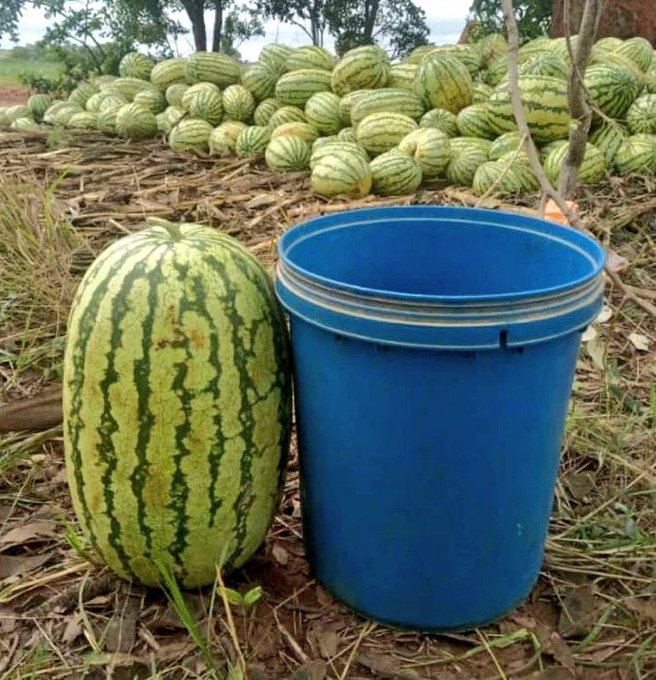
This guide by Farmers Trend Ltd. is for Kenyan farmers who want to make good money from watermelon farming in Kenya. We will show you how to increase sugar content in your fruit. We will teach you how to stop blossom end rot using Calcium.
Many farmers lose money because they guess their way through the season. They plant seeds without testing soil. They water without a schedule. They spray chemicals after the disease has already spread. By then the damage is done. You cannot afford to make these mistakes.
Commercial watermelon farming in Kenya is a short season crop. You plant and harvest within 90 to 100 days. No other crop turns your money into profit this fast. But speed does not mean easy. You must do everything right from the start. One wrong step and you wait another season to try again.
We at Farmers Trend Limited have worked with successful growers in Makueni, Kajiado, and Machakos. We have seen what works and what fails. This guide gives you the working methods. Follow them completely. Do not pick and choose. The farmers who follow all steps make millions. The farmers who skip steps struggle to break even.
The 2026 Watermelon Market in Kenya
Watermelon is one of the most profitable short season cash crops in Kenya right now. The demand comes from Nairobi, Mombasa, Kisumu, and Nakuru. Hotels buy watermelons for breakfast buffets. Juice bars blend fresh juice daily. Schools include watermelon in lunch programs. Open air markets sell sliced melons to passing customers.
The local market demand keeps growing. More Kenyans are eating fresh fruit for health reasons. Watermelon is cheap compared to imported fruits. A family can buy a whole melon for KES 100 to KES 200 and feed four people. This value for money drives constant demand throughout the year.
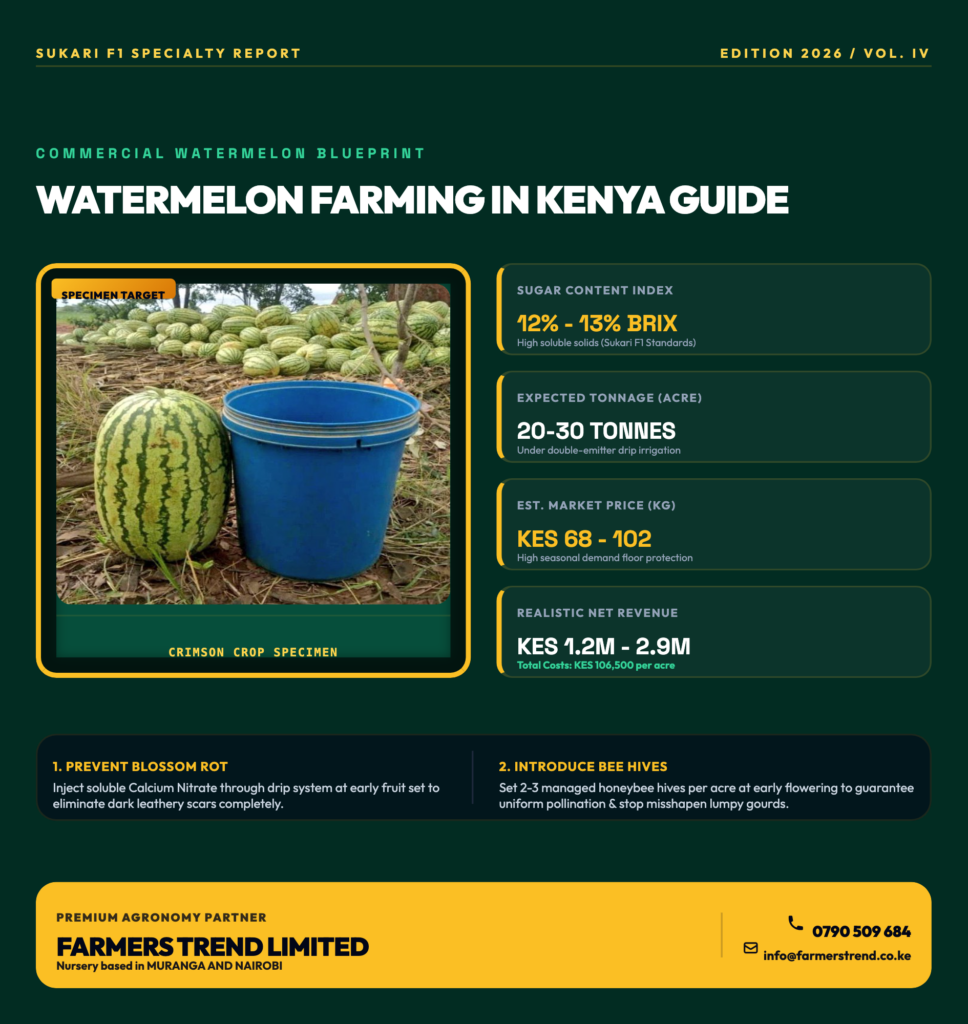
In 2026, wholesale prices range from KES 68 to KES 102 per kilogram. The price depends on the season. When many farmers harvest at the same time, prices drop. When supply is low, prices go up. Smart farmers plan their planting so they harvest when other farmers are not harvesting.
Early season harvesting gives you the best prices. January and February have low supply because the long rains harvest ended months ago. If you plant in October using short rains, you harvest in January or February. You will sell at the highest price of the year.
Late season harvesting in May and June gives lower prices. Many farmers plant with the long rains in March. Everyone harvests together. Buyers have too many choices. They push prices down. You can still make profit, but your margins shrink.
Successful watermelon farming in Kenya treats timing as a profit tool. You do not just grow fruit. You grow fruit when the market needs it most. Plan your planting calendar around market demand, not just when rain falls.
Specifically, you should calculate backwards from your target harvest week. A Sukari F1 variety takes 85 to 90 days from planting to harvest. Add 10 days for land preparation and seed treatment. Consequently, if you want to harvest in early February, you must plant in late October. This timing uses the short rains. It also avoids the main harvest flood from long rains farmers in July.
As a result, early season growers often receive KES 30 to KES 40 more per kilogram than peak season growers. On a 20 tonne harvest, that difference is KES 600,000 to KES 800,000 extra income. The timing decision alone can double your profit. However, early season planting requires irrigation because the short rains may be unreliable. You need a borehole or river water to back up the rainfall.
Where to Grow Watermelon in Kenya
Not every part of Kenya can grow sweet watermelon. The crop needs heat. It needs sun. It cannot survive cold temperatures or heavy clay soils. You must choose your land carefully before you buy a single seed.
The best regions for watermelon farming in Kenya are Makueni, Kajiado, Machakos, Tharaka Nithi, and the Coastal counties. These areas have the right temperatures. Daytime heat stays between 22 and 35 degrees Celsius. Night temperatures do not drop too low. The plant keeps growing without cold stress.
Do not plant watermelon in high altitude areas. Kiambu, Limuru, Nyandarua, and parts of Nakuru are too cold. The fruit will stay small and taste bitter. The plant cannot make sugar when nights are cold. You will work hard for three months and harvest nothing worth selling.
The soil type matters as much as the location. Watermelon needs well drained sandy loam soil. This soil allows water to pass through easily. Roots can breathe. Heavy clay soil holds water like a bucket. The roots sit in wet mud and rot. The plant turns yellow and dies.
Sandy loam soil also warms up faster in the morning. The plant starts photosynthesizing early. This extra sunlight translates directly into more sugar in the fruit. Dark clay soils stay cold longer. Every hour of lost sunlight reduces your final Brix reading.
If your land has heavy soil, you have two choices. You can add large amounts of manure and sand to improve drainage. This costs money and labor. Or you can find different land. For most farmers, finding new land is cheaper than fixing bad soil.
Before you plant, test your soil temperature. Dig a small hole 10 centimeters deep. Insert a soil thermometer. Leave it for five minutes. If the temperature stays below 18 degrees Celsius, delay planting. Cold soil stops seeds from germinating. The seeds rot before they sprout. You waste your money and your time.
Specifically, the ideal soil temperature range for watermelon germination is 22 to 28 degrees Celsius. At 22 degrees, seeds emerge in 7 to 8 days. At 28 degrees, seeds emerge in 4 to 5 days. At 18 degrees, emergence may take 14 days or longer. Consequently, the longer the seed sits in cold wet soil, the higher the chance of fungal infection. Pythium and Rhizoctonia species attack the seed and seedling. You will see damping off where the seedling rots at the soil line and falls over.
As a result, many farmers in cooler zones lose 30 to 50 percent of their seeds to soil rot. They replant multiple times. Each replant delays the harvest window. A delayed harvest misses the early season premium prices. The financial loss compounds with every week of delay.
Choosing the Right Watermelon Variety in Kenya
The variety you choose determines your final yield and sugar content. Hybrid seeds cost more than local varieties. They also produce more fruit with better sweetness. You cannot use saved seed from last season. Hybrid genetics do not breed true. The second generation fruit will be small, misshapen, and low in sugar.
The seed rate for watermelon farming in Kenya is 500 to 600 grams per acre. This gives you about 1,500 to 2,000 seeds. Do not plant more seeds thinking you will get more fruit. Overcrowding reduces yield. Each plant needs space to send out runners. Overcrowded plants compete for light and produce small fruit.
Here is the variety performance matrix comparing the main hybrids available in Kenya.
Table 1: Variety Performance Matrix for Watermelon Farming in Kenya
| Variety | Maturity Days | Brix Percentage | Rind Toughness for Transport | Average Yield (Tonnes/Acre) |
|---|---|---|---|---|
| Sukari F1 | 85-90 | 12-13% | Medium | 25-30 |
| Sugar Baby | 80-85 | 10-11% | Thin (handle carefully) | 15-20 |
| Asali F1 | 88-95 | 11-12% | Medium | 20-25 |
| Zuri F1 | 85-90 | 11-12% | High (very tough) | 22-28 |
- Sukari F1 is the best choice for high sugar content. It reaches 12 to 13 percent Brix, which is very sweet. The rind is medium tough. You can transport it to Nairobi without too many losses. Maturity takes 85 to 90 days.
Specifically, the Brix percentage measures the total soluble solids in the juice. One degree Brix equals one gram of sugar in 100 grams of juice. Consequently, a Sukari F1 fruit at 13 Brix contains 13 percent sugar by weight. The average market watermelon tests at 8 to 10 Brix. As a result, Sukari F1 tastes noticeably sweeter. Buyers will pay a premium for this difference.
- Sugar Baby is an older variety. It matures faster at 80 to 85 days. The sugar content is lower at 10 to 11 percent. The rind is thin. You must handle these melons very carefully during transport. One bump cracks the flesh inside. This variety works for local markets near your farm.
- Asali F1 takes longer to mature at 88 to 95 days. The sugar content is moderate. The yield is also moderate. Some farmers like it because it stores longer after harvest. You can keep it for two weeks without losing quality.
- Zuri F1 has the toughest rind. You can stack these melons on a truck and drive on rough roads. Few will crack. The sugar content is good but not as high as Sukari. This variety is best for farmers who send fruit long distances to Mombasa or across the border.
For most Kenyan farmers, Sukari F1 is the best choice. Buyers want sweet fruit. They will pay more for 13 Brix than for 10 Brix. The medium rind toughness is fine if you pack your fruit carefully.
Preparing Seeds and Spacing Plants Correctly on Watermelon Farming in Kenya
Hybrid seeds need treatment before planting. Fungus in the soil attacks the seed as soon as it goes into the ground. You must protect your investment. Soak seeds in a fungicide solution containing Metalaxyl and Thiram for 30 minutes. Then spread them on a clean sack to dry. Do not let them sit in the sun. Direct heat damages the seed.
After drying, plant immediately. Do not store treated seeds. The fungicide coating breaks down over time. Plant within 24 hours for best results.
Spacing determines how many plants survive and produce fruit. Place each plant 60 to 100 centimeters apart within the row. Space the rows 2.0 to 2.5 meters apart. This gives each plant enough room to send out runners without touching the next plant.
When plants are too close together, the vines tangle. Leaves overlap and block sunlight. Air cannot move through the canopy. Fungal diseases spread quickly. You cannot fix these problems later. You must design your spacing correctly on planting day.
Dig a small hole for each seed. Place the seed 2.5 centimeters deep. Cover with loose soil. Do not pack the soil hard. The seedling needs to push through easily. Water gently so the seed does not wash out of the hole.
After planting, mark your rows clearly. Use wooden stakes at each end. This helps you walk through the field without stepping on the planting stations. When the seeds sprout after 5 to 7 days, you will see the rows clearly.
Specifically, the plant population per acre is calculated as follows. With row spacing of 2.5 meters and within row spacing of 0.8 meters, each plant occupies 2 square meters. One acre is 4,047 square meters. Consequently, you will have approximately 2,023 plants per acre. Each healthy plant can produce 2 to 3 marketable fruit. As a result, your potential fruit count ranges from 4,000 to 6,000 melons per acre.
However, not every plant will reach full production. Some will suffer pest damage. Others will have poor pollination. A realistic target is 1,500 to 2,000 marketable fruit per acre. At an average weight of 5 to 8 kilograms per fruit, this gives you 7.5 to 16 tonnes per acre. With excellent management and the Sukari F1 variety, you can push this to 20 to 30 tonnes.
Drip Irrigation and Water Management
Drip irrigation is not a luxury for watermelon farming in Kenya. It is a requirement. Overhead sprinklers wet the leaves and promote fungal disease. They also waste water through evaporation. Drip lines put water directly at the root zone where the plant needs it.
Use double emitter drip lines. Place one line on each side of the planting row. This gives even moisture coverage across the entire root ball. Single lines leave dry spots. The roots on the dry side stop growing. Your plant becomes lopsided and stressed.
Water amounts change as the plant grows. For the first 30 days, give the plant 15 to 20 liters per day per square meter. This keeps the young vine growing fast. When the plant starts flowering from day 31 to 50, reduce slightly to 12 to 15 liters. A little stress encourages more flowers.
During fruit set from day 51 to 75, water demand peaks. The fruit is swelling every day. Give 20 to 25 liters per day. Any water shortage now makes the fruit stop growing. The skin becomes hard and the flesh stays small. You cannot fix this later.
The most important rule comes ten days before harvest. Cut your watering down by 70 percent. Give just enough water to keep the plant from wilting. This dry period forces the plant to concentrate sugars into the fruit. Your Brix level will increase by 2 to 3 points.
Farmers who ignore this rule harvest water logged fruit. The flesh looks pale and tastes like plain water. Buyers test one melon and walk away. They will not come back. Always finish your season with a dry period.
Specifically, you must calibrate your drip system before planting. Turn on the system and measure how much water comes out of one emitter in one minute. Collect the water in a graduated cylinder. If one emitter releases 2 liters per hour, and you have 2 emitters per plant, each plant receives 4 liters per hour. Consequently, to deliver 20 liters per plant, you must run the system for 5 hours.
As a result, your daily irrigation schedule depends on your emitter flow rate. High flow emitters at 4 liters per hour need less runtime. Low flow emitters at 1 liter per hour need more runtime. You must match your pump size and pipe diameter to your total water requirement. A common mistake is installing a pump that is too small. The pressure drops at the far end of the field. Those plants get less water. Their fruit stays small.
Fertilizers and Stopping Blossom End Rot
Fertilizer costs money. You want every shilling to produce more fruit. The only way to know what your soil needs is a soil test. Send samples to Farmers Trend Virtual Agrovet, Cropnuts or KALRO. The test costs KES 2,000 to KES 5,000. This small expense saves you from wasting KES 20,000 on wrong fertilizers.
The ideal soil pH for watermelon is 6.0 to 6.8. If your pH is below 5.8, add agricultural lime. If your pH is above 7.0, add sulfur. Correcting pH is the first step. Without the right pH, your plants cannot access the nutrients you apply.
At planting time, apply DAP fertilizer. Place 100 kilograms per acre in a band 5 centimeters below and to the side of the seed. DAP contains phosphorus. Phosphorus builds strong roots. Strong roots reach deep water and resist drought. Do not put DAP directly on the seed. It will burn and kill the young root.
Here is the complete input and drip irrigation budget per acre.
Table 2: Input and Drip Irrigation Budget Sheet per Acre for Watermelon Farming in Kenya
| Input Item | Cost per Acre (KES) | Notes |
|---|---|---|
| Certified hybrid seeds (Sukari F1) | 8,000 | 500-600 grams |
| Land preparation (plough and harrow) | 3,500 | Tractor services |
| Double emitter drip line kit | 25,000 | Includes pipes and fittings |
| DAP fertilizer (100 kg) | 6,500 | At planting |
| CAN fertilizer (50 kg) | 3,000 | Top dress at vining |
| Potassium Nitrate (80 kg) | 12,000 | Applied through drip |
| Calcium Nitrate (20 kg) | 4,000 | For blossom end rot prevention |
| Boron and Zinc micronutrients | 2,500 | Foliar spray |
| Fungicides (copper and triazoles) | 8,000 | Preventative and curative |
| Insecticides (systemic and baits) | 6,000 | Includes fruit fly control |
| Pheromone traps (15 pieces) | 3,000 | For melon fruit fly |
| Labor (planting, weeding, spraying) | 15,000 | Seasonal labor |
| Combine harvest and transport | 10,000 | Per acre |
| Total Cost per Acre | 106,500 | Excludes land rent |
Blossom End Rot is a common problem in watermelon farming in Kenya. You will see black, leathery scars on the bottom of the fruit. The rot starts as a small water soaked spot. It grows into a sunken dark lesion. The fruit becomes unmarketable.
The cause is calcium deficiency during early fruit set. Calcium is a strange nutrient. Once a leaf or fruit forms, it cannot move calcium from older tissues to newer ones. You must supply calcium directly when the fruit is setting.
Specifically, calcium moves only in the xylem tissue. The xylem transports water from the roots to the leaves. This movement happens during transpiration. When the plant is transpiring, water moves up. Calcium moves with it. However, at night or under water stress, transpiration slows. Calcium movement stops. Consequently, fruit that grows rapidly during hot days may not receive enough calcium. The tissue at the blossom end breaks down. The rot begins.
Apply soluble Calcium Nitrate through your drip system at fruit set. Use 10 kilograms per acre dissolved in water. Follow this with a foliar spray of Calcium chloride mixed with Boron. The boron helps move calcium into the fruit tissue. Repeat the same application two weeks later.
This simple protocol stops blossom end rot completely. Your fruit will have smooth dark green skin. No black spots. No leathery patches. Premium buyers will choose your fruit over others.
Increasing Sugar Content with Potassium
Sugar content is measured in Brix. One degree Brix means one gram of sugar in 100 grams of juice. Premium watermelons have 12 to 13 Brix. Average market fruit has 8 to 10 Brix. The difference comes from potassium management.
Potassium moves sugar from the leaves into the fruit. The leaves capture sunlight and make carbohydrates. Potassium acts like a pump pushing those carbohydrates into the developing fruit. Without enough potassium, the sugar stays in the leaves. The fruit stays bland.
Stop all nitrogen fertilizers after fruit set. Nitrogen makes leaves grow. Too much nitrogen makes the plant keep growing leaves instead of ripening fruit. Your melons will be green inside and taste like cucumber. Many farmers make this mistake. They keep applying CAN or urea late in the season. They ruin their own harvest.
Start your potassium program when fruit is the size of a golf ball. This is usually day 45 after planting. Apply 20 kilograms of Potassium Nitrate per acre through your drip system. Repeat every 10 days for the next 30 days. Each application pushes more sugar into the fruit.
The total potassium applied should reach 80 to 100 kilograms per acre. This investment costs KES 12,000. The return is a Brix level of 12 to 13 percent. Your fruit will taste noticeably sweeter than your neighbors. You can charge KES 10 to KES 15 more per kilogram.
Test your Brix using a handheld refractometer. This tool costs KES 3,000 to KES 5,000. Cut a small piece of flesh from the center of the fruit. Squeeze a drop of juice onto the lens. Look through the eyepiece. The scale tells you your sugar percentage. Do not guess your quality. Measure it.
Specifically, the biochemical role of potassium is to activate the enzyme invertase. Invertase breaks down sucrose into glucose and fructose. These simple sugars are sweeter than sucrose. Consequently, high potassium levels shift the sugar profile toward sweeter compounds. As a result, the fruit tastes sweeter even at the same total sugar concentration.
Pollination and Bee Hives
Watermelon plants have separate male and female flowers. The male flower produces pollen. The female flower has a small swelling at the base that becomes the fruit. Pollen must move from the male flower to the female flower. Without this transfer, the female flower wilts and falls off.
Poor pollination gives you misshapen fruit. The fruit grows unevenly because only part of the flower received pollen. One side swells while the other side stays flat. The melon looks like a lumpy gourd. Supermarkets reject these fruits. Open air markets buy them at half price.
Natural pollinators like wild bees are often not enough on large farms. You need managed honeybee hives. Place 2 to 3 strong hives per acre at the edge of your field. Position the hives so bees fly across the crop, not along the fence line. Introduce the hives when the first female flowers open. This is usually 35 to 40 days after planting.
Bees give you a second income. A single hive produces 20 to 30 kilograms of honey per season. Honey sells for KES 300 per kilogram. Each hive returns KES 6,000 to KES 9,000. The bees pay for themselves while they pollinate your watermelons.
Protect your bees by spraying chemicals in the late afternoon. Bees are most active in the morning. If you spray then, you kill your pollinators. Wait until 4 PM or later. Choose bee safe products like Bacillus thuringiensis for caterpillar control. Read the label before you buy any insecticide.
Specifically, the female watermelon flower is only receptive for one day. It opens in the morning and closes by midday. If no bee visits during that window, the flower will not set fruit. Consequently, you need active bee foraging during the morning hours. Placing hives too far from the field reduces bee traffic. Keep hives within 100 meters of the crop edge.
Controlling Fruit Flies and Other Pests
The melon fruit fly is the most destructive pest for watermelon farming in Kenya. The female fly stings young fruit and lays eggs inside. The eggs hatch into maggots. The maggots tunnel through the flesh. The fruit rots from the inside. You do not see the damage until harvest. You cut open a melon and find a writhing mess of white larvae.
Once the maggots are inside, no spray can save the fruit. You must prevent the fly from stinging in the first place. Prevention is your only defense.
Install pheromone traps at 10 to 15 traps per acre. Use cuelure traps that attract male flies. Hang the traps at waist height on wooden stakes. Replace the lure every 4 to 6 weeks. Count the trapped flies every week. If you see the numbers rising, you need to spray immediately.
Protein bait sprays work very well against fruit flies. Mix a protein hydrolysate with a fast acting insecticide like malathion or Profenofos. Spray only on the leaves around the field perimeter. Flies are attracted to the protein smell. They feed on the bait and die before they reach the fruit. Apply bait sprays every 7 to 10 days during fruit set.
Red spider mites are another problem. They thrive in hot dry conditions. They suck sap from the underside of leaves. You will see fine stippling on the upper leaf surface. Heavy infestations turn leaves bronze and crispy. Use abamectin to kill mites. Spray the underside of the leaves where the mites hide.
Whiteflies transmit viral diseases. They are small white insects that fly up when you shake the plant. Use imidacloprid as a soil drench early in the season. This systemic product moves through the plant and kills whiteflies when they feed.
Always rotate your chemicals. Never use the same product twice in a row. Pests develop resistance quickly. Alternate between different chemical classes. Keep a spray log. Write down what you used, when, and at what rate. This discipline keeps your chemicals working.
Specifically, nozzle calibration is critical for effective spraying. Use a flat fan nozzle for systemic insecticides. Use a cone nozzle for fungicides that need leaf coverage. The water volume should be 200 to 300 liters per hectare for ground spraying. For airblast sprayers, you can use 100 to 150 liters per hectare. Check your nozzle output by spraying into a graduated cylinder for one minute. Adjust your pressure and travel speed to deliver the correct volume.
Fungal Diseases and Prevention on Watermelon Farming in Kenya
Fungal diseases destroy your leaves. Without healthy leaves, the plant cannot make sugar. The fruit stops growing. You lose your harvest. Prevention is cheaper than cure. Always.
Powdery mildew looks like white powder on older leaves. It starts on the lower leaves and moves up. Downy mildew causes yellow angular spots on the upper leaf surface. Purple mold grows underneath. Anthracnose creates dark sunken lesions on leaves, stems, and fruit.
Weeds and overhead watering make these diseases worse. Weeds trap moisture around the plant base. Overhead sprinklers wet the leaves for hours. The fungus spores germinate in the wet conditions. Keep your field weed free. Use drip irrigation only. These two steps reduce fungal disease by 80 percent.
Copper based fungicides are your first defense. Apply copper hydroxide at 2 kilograms per acre every 14 days. Start when the vines begin running. Copper coats the leaf surface. It kills spores before they germinate. It cannot cure existing infections. You must apply it before the disease arrives.
When you see active disease, switch to systemic triazoles like tebuconazole or difenoconazole. These chemicals move inside the plant tissue. They stop fungal growth from the inside. Apply at the first sign of white powder or yellow spots. Do not wait. A delayed spray costs you tonnes of yield.
In wet weather, you may need to spray every 7 days. The cost of fungicides is small compared to losing your entire crop. Budget for 6 to 8 sprays per season. If the weather is dry, you may use fewer. Always be ready to spray when conditions change.
Specifically, Mancozeb is a broad spectrum protectant fungicide. It works well against anthracnose. Apply Mancozeb at 2 kilograms per hectare mixed with a wetting agent. Metalaxyl is effective against downy mildew. However, Metalaxyl is at risk of resistance. Consequently, always mix Metalaxyl with a protectant like Mancozeb. Never use Metalaxyl alone.
Knowing When to Harvest
Harvesting too early destroys your reputation. The fruit looks ready on the outside. The skin is dark green. But inside the flesh is pale and low in sugar. The buyer cuts one melon at the market. If it is white inside, they will never buy from you again.
Harvesting too late is also bad. Overripe fruit becomes mealy. The flesh loses its crisp texture. It tastes hollow and flat. You must hit the exact maturity window.
Look at the tendril next to the fruit stem. This small curly tendril turns brown and dies when the fruit is ready. A green tendril means wait. A completely dry brown tendril means harvest now.
Check the ground spot. The area where the fruit rests on the soil starts white. As the fruit matures, the ground spot turns cream yellow. A white ground spot means immature. A cream yellow spot means ready.
Thump the fruit with your knuckle. Immature fruit makes a high pitched ringing sound. Mature fruit makes a dull low pitched thud. Practice this skill on known fruits. Cut one open to confirm. After a while you will trust your ear.
Harvest in the cool morning hours. Use a sharp knife to cut the stem 2 centimeters above the fruit. Leave a short stem attached. This prevents rot from entering the fruit. Handle each melon gently. A single drop cracks the flesh inside. That melon will rot during transport.
Specifically, you can also measure the fruit’s soluble solids with a refractometer at harvest. Cut a small wedge from the center of the melon. Squeeze the juice onto the lens. A reading of 12 Brix or higher indicates premium quality. A reading below 10 Brix means the fruit is not ready or the plant lacked potassium. Use this data to improve next season.
The 90 Day Schedule on Watermelon Farming in Kenya
Here is the 90 day crop nutrition, fertigation, and pest schedule.
Table 3: The 90 Day Crop Nutrition, Fertigation, and Pest Schedule for Watermelon Farming in Kenya
| Growth Stage | Days | Fertilizer Application | Pest and Disease Action |
|---|---|---|---|
| Seedling emergence | 1-10 | None | Monitor for cutworms. Apply bait if needed. |
| Vegetative growth (vining) | 11-30 | CAN top dress at day 20 (50 kg/acre) | Apply copper fungicide at day 15. Set up pheromone traps. |
| Flowering | 31-45 | Reduce water to encourage flowers | Introduce bee hives. Spray protein bait for fruit flies. |
| Fruit set | 46-60 | Apply Calcium Nitrate (10 kg/acre) through drip. Apply Boron foliar. Start Potassium Nitrate (20 kg/acre). | Spray systemic triazole fungicide. Monitor for spider mites. |
| Fruit expansion | 61-80 | Apply Potassium Nitrate every 10 days (20 kg/acre each time). Total 80 kg. | Spray copper fungicide. Continue protein bait. |
| Maturation and harvest | 81-90 | Stop all fertilizer. Cut water by 70 percent. | No spraying. Harvest as fruit reaches maturity. |
Your target yield is 20 to 30 tonnes per acre. At KES 68 per kilogram, 20 tonnes gives you KES 1,360,000 in revenue. At KES 102 per kilogram, 30 tonnes gives you KES 3,060,000.
Your total production costs are KES 106,500 per acre. This includes everything from seeds to transport. Your net profit per acre ranges from KES 1,250,000 to KES 2,950,000.
These numbers are real. Farmers following this guide achieve them. The key is following every step. Do not pick the steps you like and skip the ones you do not. The full system works together. Skip one part and the whole harvest suffers.
Your Next Steps
How profitable is watermelon farming in Kenya?
Watermelon farming in Kenya can generate KES 1.25 million to KES 2.95 million net profit per acre. With Sukari F1 variety, you harvest 20 to 30 tonnes per acre. At KES 68 to KES 102 per kilogram, revenue ranges from KES 1.36 million to KES 3.06 million. Production costs including drip irrigation, seeds, fertilizer, and labor total KES 106,500 per acre.
Test your soil before you buy drip pipes or seeds. Know your pH and nutrient levels. Design your fertility plan around your soil test results. Guessing wastes money.
Order certified hybrid seeds from Virtual Agrove, Kenya Seed Company or Amiran. Buy Sukari F1 for high sugar content. Buy Zuri F1 if you transport long distances. Do not buy saved seed from last season.
Install your drip lines before planting. Test the system for leaks. Run water through each line to check pressure. Fix any problems before the seeds go in the ground.
Set up your pheromone traps early. Do not wait until you see fruit flies. By then they have already started stinging your young fruit. Prevention is everything.
Introduce bee hives at flowering. Do not rely on wild insects. They are not enough. Managed hives cost money but they pay for themselves with honey and higher yields.
We at Farmers Trend Limited are here to help you succeed. For certified hybrid seeds, double emitter drip line kits, pheromone traps, refractometers, and the complete 2026 Watermelon Farming in Kenya PDF guide, contact us at 0790509684.
What variety are you planning to plant this season? Are you trying Sukari F1 for high sugar or Zuri F1 for tough transport? Leave your answer in the comments below. Sharing your experience helps other Kenyan farmers learn.
The market is waiting for your sweet fruit. The planting season is coming. Prepare your land now.



Leave a Reply