Certified Grafted Hass Avocado Seedlings at KSh 250: 7 Best Steps to Big Profits
Certified grafted Hass avocado seedlings give your orchard the strongest start for fruit production. At KSh 250 per seedling, Farmers Trend Limited supplies certified grafted Hass avocado trees from nurseries in Murang’a and Nairobi. Every certified grafted Hass avocado seedling carries true Hass wood on a healthy rootstock, so your orchard bears early and bears well. You pay once for each seedling. You live with the result for 25 years or more. Choose well, plant well, and manage your trees from the first week.

This guide walks you through every stage of orchard establishment. You will learn how to pick quality seedlings, space your trees, build soil fertility, manage moisture, prune, and secure pollination. Each section gives you steps, numbers, and examples you apply on your own farm.
Why Certified Grafted Hass Avocado Seedlings Decide Your Orchard Income
A Hass avocado orchard is a long investment. Grafted trees often begin bearing 2 to 3 years after planting and reach full commercial crops by year 5 or 6. Good trees keep producing for decades. Weak trees carry their faults through every season.
Seed-grown avocado trees show wide variation. Fruit differ in size, shape, and taste. Trees take 5 to 8 years to bear, and some never bear well. Grafting solves this problem. Your nursery joins a stem piece of proven Hass wood, called the scion, onto a strong young rootstock. The new tree produces Hass fruit true to type and bears early.
Certification adds a second layer of protection. A certified seedling comes from a registered nursery, which uses approved scion wood and healthy rootstock. Inspectors check the plants for disease and pests. You receive trees you trust, not trees you hope will work.
Compare the two choices you face when you buy planting material.
| Feature | Certified grafted Hass seedling | Uncertified or seed-grown seedling |
|---|---|---|
| Fruit type | True Hass, with dark pebbled skin and rich flesh | Mixed types, with uneven fruit |
| Time to first harvest | 2 to 3 years | 5 to 8 years |
| Tree size | Uniform across your block | Tall and uneven |
| Disease status | Inspected at the nursery | Unknown |
| Market acceptance | Meets buyer and export standards | Often rejected |
| Cost per seedling at Farmers Trend Limited | KSh 250 | Lower price, higher loss |
A saving of KSh 100 per seedling disappears fast. If you plant 100 trees and 20 fail or produce poor fruit, you lose years of work. Quality planting material protects your money.
The Market for Certified Grafted Hass Avocado Fruit in Kenya
Kenya exports avocados to Europe, the Middle East, and Asia. Hass is the main export variety because the thick skin handles transport and the fruit holds a long shelf life. Local buyers, supermarkets, and oil processors also buy Hass. Demand stays steady for fruit with the right size and dry matter.

Export buyers ask for fruit in size classes between about 150 and 300 grams, free of blemishes, and harvested at the right maturity. You meet these standards when you start with the correct variety and manage your orchard well. Tree health, nutrition, and water supply all show up in fruit quality.
Many smallholder farms in Kenya produce low yields because of poor planting material, wide variation in tree age, and weak management. You close this gap when you follow a plan. The seven steps below give you the plan.
Step 1: Choose the Right Site for Hass Avocado Trees
Site choice sets the limits for your orchard. You fix soil with manure and fertilizer. You do not fix altitude or frost. Check the following points before you buy a single seedling.
| Factor | Best range for Hass avocado |
|---|---|
| Altitude | About 1,200 to 2,000 metres above sea level |
| Temperature | Mild, with day averages near 20 to 25 degrees Celsius |
| Annual rainfall | 1,000 to 1,600 mm, well spread, or irrigation to fill gaps |
| Soil depth | At least 1 metre of free-draining soil |
| Soil pH | 5.5 to 6.5 |
| Drainage | No standing water after heavy rain |
| Slope | Gentle slope with good air movement |
Avocado roots need air. Waterlogged soil kills feeder roots and invites root rot, the most serious disease of the crop. Avoid low spots where water collects. If your farm has heavy clay, plant on raised mounds 30 to 40 cm high.
Frost damages flowers and young shoots. Avoid frost pockets in valley bottoms. Strong wind breaks branches and knocks off young fruit. Plant a windbreak of tall trees, such as grevillea or cypress, on the windward side of your block.
Hass avocado grows well in many Kenyan highland counties, including Murang’a, Kiambu, Nyeri, Meru, Nakuru, Kisii, and parts of Taita Taveta. If you farm outside these areas, ask an agronomist to review your site first. Farmers Trend Limited advises you on site suitability when you call.
Test your soil before planting
Take soil samples at 20 cm and 50 cm depth from at least five points in your field. Mix the samples and send them to a laboratory. The report shows pH, phosphorus, potassium, calcium, magnesium, and trace elements. A soil test costs a small fraction of the value of one season of lost fruit. Use the results to plan your planting hole mix and your fertilizer schedule.
Acidic soil below pH 5.5 needs agricultural lime. Alkaline soil above pH 7 restricts iron and zinc uptake, which causes yellow leaves. Correct pH problems in the months before planting.
Step 2: Select Quality Certified Grafted Hass Avocado Seedlings
You judge a seedling on the ground, before you pay. Inspect every tree in your order. Use this checklist.
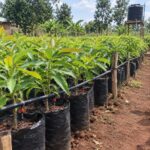
- Check the graft union. The joint sits 15 to 25 cm above the soil in the polybag. The union looks smooth and fully healed, with no gaps or cracks.
- Check the stem. Look for a straight, firm stem about as thick as a pencil at the union or thicker.
- Check the height. Good seedlings stand 50 to 90 cm tall at sale.
- Check the leaves. Leaves show a uniform dark green colour. Reject seedlings with yellow leaves, spots, or curled tips.
- Check for rootstock shoots. Shoots below the graft union come from the rootstock. Remove any you find. Reject seedlings with many of them.
- Check the polybag. The roots grow straight and fill the bag without circling. No roots poke out through the bottom.
- Check for pests. Look under leaves for scale, mites, and thrips damage.
- Ask for the nursery details. A certified nursery tells you the source of scion wood and the rootstock used.
Farmers Trend Limited sells certified grafted Hass avocado seedlings at KSh 250 each from its Murang’a and Nairobi nurseries. You visit, inspect your seedlings, and collect them. You also order for delivery countrywide or for export.
Order the right number of certified grafted Hass avocado seedlings
Order 5 to 10 percent extra seedlings to replace losses in the first season. Plant extras in polybags near your orchard. Move them into gaps after the first rains. This keeps your tree stand uniform in age.
Step 3: Give Your Hass Avocado Trees Enough Spacing
Spacing decides how much light each tree receives, how well air moves through the canopy, and how easily you spray, prune, and harvest. Crowded trees shade each other. Lower branches stop bearing. Disease spreads fast in damp canopies.
Hass trees grow to 8 to 10 metres in height if you leave them alone. Good pruning holds them near 4 to 5 metres. Most Kenyan growers plant at 8 by 8 metres. This spacing gives you room for machines and for a full canopy at year 8 to 10.
| Spacing (metres) | Trees per hectare | Trees per acre | Seedling cost per hectare at KSh 250 |
|---|---|---|---|
| 10 by 10 | 100 | 40 | KSh 25,000 |
| 9 by 9 | 123 | 50 | KSh 30,750 |
| 8 by 8 | 156 | 63 | KSh 39,000 |
| 7 by 7 | 204 | 83 | KSh 51,000 |
Choose 8 by 8 metres if you have average soil and plan to prune each year. Choose 9 by 9 or 10 by 10 metres on deep, fertile soils where trees grow large. Choose 7 by 7 metres only if you commit to strict canopy control from year 4.
Mark your field correctly
- Run a baseline along one edge of your field.
- Measure out from the baseline at right angles.
- Place a peg at each planting point.
- Line up rows with the slope direction on hillsides, or follow the contour to slow runoff.
- Leave a 4 to 5 metre access path every few rows for vehicles and harvest crates.
Step 4: Plant Your Certified Grafted Hass Avocado Seedlings the Right Way
Plant at the start of the rains so your seedlings establish roots before dry weather. If you have irrigation, you plant at any time, but avoid the hottest weeks.
Prepare the planting hole
Dig holes 60 by 60 by 60 cm. In heavy soil, dig 90 cm wide to loosen the sides. Dig holes at least 4 weeks before planting. Place the topsoil on one side and the subsoil on the other.
Mix the topsoil with the following materials for each hole.
- 20 kg of well-decomposed farmyard manure or compost.
- 100 to 200 g of rock phosphate or triple superphosphate.
- Agricultural lime if your soil test shows low pH.
Fill the hole with the mixed topsoil first. Place the subsoil on top. Leave the hole to settle for two weeks.
Plant on the day
- Water your seedlings in the polybags the evening before.
- Dig a small pit in the settled soil, slightly larger than the root ball.
- Cut the polybag along the side and slide the root ball out. Keep the soil around the roots intact.
- Place the seedling upright. Set the graft union at least 10 cm above the soil surface. Never bury the union.
- Firm the soil around the roots with your hands. Leave no air pockets.
- Water with 15 to 20 litres per tree.
- Stake each seedling with a light pole and tie loosely.
- Spread mulch 8 to 10 cm thick in a ring around the tree. Keep the mulch 10 cm away from the stem to prevent collar rot.
- Shade young seedlings with banana leaves or shade net for the first 3 to 4 weeks in hot, dry areas.
Care for new trees in the first three months
Water every 3 to 4 days if rain stops. Check for wilting each morning. Replace dead seedlings within the first month. Remove any shoots below the graft union as soon as you see them. Weed by hand around the stem. Do not hoe close to the trunk, because avocado roots lie near the surface.
Step 5: Maintain Good Soil Fertility in Your Hass Avocado Orchard
Healthy soil feeds your trees every season. Fertile soil supports flowering, fruit set, and fruit size. Poor soil leads to weak shoots, small fruit, and low yield.
Feed your trees by age
Apply manure or compost every year at the start of the rains. Use 20 kg per tree for young trees and 40 kg or more for mature trees. Spread manure under the canopy edge, not against the trunk.
Add inorganic fertilizer in split doses. Use the table as a starting guide for a balanced NPK fertilizer such as 17:17:17 or 20:10:10. Adjust amounts using your soil test and leaf analysis results.
| Tree age | Fertilizer per tree per year | Number of splits |
|---|---|---|
| Year 1 | 100 to 200 g | 3 |
| Year 2 | 250 to 400 g | 3 |
| Year 3 | 500 to 800 g | 3 |
| Year 4 | 1 to 1.5 kg | 3 |
| Year 5 and above | 1.5 to 3 kg, based on yield and tests | 3 to 4 |
Apply the first split at the start of the long rains, the second at mid-season, and the third before flowering or after harvest. Spread fertilizer in a ring under the canopy and water well after application.
Watch for trace element needs
Avocado trees respond strongly to zinc and boron. Zinc shortage causes small, narrow leaves with yellow patches. Boron shortage reduces fruit set and causes misshapen fruit. Spray zinc and boron as foliar feeds before flowering, following the label rates. A leaf analysis once a year tells you exactly what your trees lack.
Protect and build your soil
- Mulch every year with grass, crop residue, or wood chips. Mulch holds moisture, cools the soil, and feeds soil life.
- Keep the ground under the canopy free of tall weeds.
- Avoid deep tillage between rows after the first year. Avocado feeder roots sit in the top 30 cm of soil.
- Plant a cover of low legumes between rows, and cut them back before they climb your trees.
- Test your soil every 2 to 3 years and correct pH.
Intercrop with care in young orchards
You earn income from the space between rows in years 1 to 3. Grow beans, vegetables, or other short crops. Keep a clear ring of 1 metre around each tree. Avoid tall crops such as maize close to young trees, because they shade seedlings and compete for water.
Step 6: Manage Moisture for Healthy Hass Avocado Growth
Avocado trees suffer from both too little water and too much water. Dry spells cause leaf drop and small fruit. Wet soil causes root rot. Your goal is steady, moderate moisture in the root zone.
Irrigate according to tree stage
Drip irrigation suits avocado orchards well. Drip lines place water at the root zone, save water, and keep leaves dry. Micro-sprinklers wet a wider area and help cool the orchard floor. Place emitters a short distance from the trunk, not against the stem.
| Stage | Watering guide |
|---|---|
| Weeks 1 to 12 after planting | 15 to 20 litres per tree every 3 to 4 days in dry weather |
| Months 3 to 12 | 20 to 40 litres per tree once or twice a week in dry weather |
| Years 2 to 3 | 40 to 80 litres per tree each week in dry weather |
| Bearing trees | Increase with canopy size. Water more during flowering and fruit growth |
Treat these amounts as a starting guide. Dig a small hole 20 cm deep near the tree. Squeeze a handful of soil. If the soil falls apart dry, irrigate. If the soil forms a wet ball which drips, wait. Tensiometers and soil moisture probes give you better control as your orchard grows.
Keep your soil moist but never waterlogged
- Irrigate in the early morning to cut evaporation.
- Mulch to hold soil moisture between irrigations.
- Dig drainage channels on flat land.
- Plant on mounds in heavy soil.
- Stop irrigation during prolonged rain.
- Harvest rainwater in tanks or pans for dry months.
Water stress during flowering and early fruit growth causes heavy fruit drop. Water stress during later fruit growth reduces fruit size. Plan your irrigation to cover these two periods first.
Step 7: Prune Your Certified Grafted Hass Avocado Trees Appropriately
Pruning shapes your tree, lets light into the canopy, and keeps your trees at a height you reach. Prune with a clear purpose. Avoid heavy cuts, because avocado trees respond poorly to severe pruning.
Formative pruning in the first three years
- When your seedling reaches 60 to 80 cm, pinch or cut the growing tip to force side branches.
- Choose 3 to 4 strong side branches, spread around the stem, as your main framework.
- Remove weak, crossing, and downward-growing shoots.
- Remove all shoots below the graft union as they appear.
- Top the tree again when new leaders reach 1.5 to 2 metres to keep the shape open.
Maintenance pruning on bearing trees
- Prune soon after harvest, before the new growth flush.
- Remove dead, diseased, and broken wood first.
- Open the centre of the canopy so light and air reach the inner branches.
- Cut back tall branches to hold tree height near 4 to 5 metres.
- Lift low branches to 30 to 50 cm above the ground to improve airflow and cut the splash of soil-borne disease.
- Remove no more than about one quarter of the canopy in a single season.
Prune safely
Use sharp, clean tools. Disinfect blades between trees with a household bleach solution or methylated spirit. Make clean cuts above a node or bud. Seal large cuts with a recommended wound paint. Prune in dry weather so wounds heal fast and fungi find no entry point. Paint exposed trunks and large limbs with white lime wash in sunny areas to prevent sunburn.
Ensure Good Pollination for Your Hass Avocado Orchard
Avocado flowers are small and appear in the thousands on each tree. Only a small share of flowers set fruit. Good pollination raises this share and lifts your yield.
Understand type A and type B flowers
Avocado flowers open twice. Each flower opens first as a female and closes. The flower opens again as a male on the next day. Type A varieties, such as Hass, open female in the morning and male in the afternoon of the following day. Type B varieties, such as Fuerte, Ettinger, Zutano, and Bacon, open female in the afternoon and male in the morning of the following day.
Because of this timing, Hass trees receive pollen from type B trees flowering nearby. Hass sets fruit alone, but yields improve when you plant type B varieties within the orchard.
| Variety | Flower type | Role in your orchard |
|---|---|---|
| Hass | A | Main commercial variety |
| Fuerte | B | Pollen source and local market fruit |
| Ettinger | B | Pollen source |
| Zutano | B | Pollen source |
| Bacon | B | Pollen source |
Plant one type B tree for every 8 to 10 Hass trees. Spread them through your rows so every Hass tree stands near a pollen source. Keep the pollinizer trees pruned and healthy so they flower at the same time as your Hass trees.
Bring in bees
Honey bees do most pollination work in avocado orchards. Place 5 to 10 strong hives per hectare when flowering starts. Position hives in sheltered spots within the orchard, away from strong wind. Provide clean water near the hives. Local beekeepers rent hives at flowering time, and the cost returns through higher fruit set.
Protect your bees with these actions.
- Do not spray insecticides during flowering.
- If you must spray, apply in the late evening after bees return to the hive.
- Keep flowering weeds and wild flowers near the orchard for extra forage.
- Avoid copper and sulphur sprays on open flowers.
Support flowering with good timing
Cold nights and heavy rain during flowering reduce bee activity and pollen movement. You do not control the weather, but you control tree health, water, and nutrition. Strong trees flower well and hold more fruit. Apply boron before flowering. Keep soil moist during bloom. Avoid heavy pruning or high nitrogen rates shortly before flowering, because both push leaf growth instead of flowers.
Orchard Management From Flowering to Fruit Development
Hass fruit take about 8 to 12 months to mature after flowering, depending on altitude and temperature. Your management in this period shapes fruit size, quality, and marketability.
| Stage | What you do |
|---|---|
| Before flowering | Apply boron and zinc foliar feeds. Place beehives. Control weeds. Remove deadwood |
| Flowering | Keep soil moist. Stop insecticide sprays. Watch for fungal flower diseases |
| Fruit set and early growth | Irrigate steadily. Apply the second fertilizer split. Scout for thrips and mites |
| Fruit filling | Maintain regular irrigation. Apply potassium and calcium as your soil test advises. Remove diseased fruit |
| Maturity and harvest | Test dry matter. Harvest by clipping. Handle fruit with care |
| After harvest | Prune. Apply manure. Apply the next fertilizer split |
Harvest at the right maturity
Hass fruit do not ripen on the tree in the same way as many other fruits. Mature fruit stays green or darkens on the tree, then softens after you pick. Export and many local buyers set a minimum dry matter of about 21 percent for Hass fruit. Fruit picked below this level ripen poorly and taste watery.
Take fruit samples to a laboratory or use a drying test as buyers require. Clip the fruit with a short piece of stalk using secateurs. Place fruit in shaded crates. Do not drop fruit. Move fruit to the pack house or buyer the same day.
Protect Your Hass Avocado Trees From Pests and Diseases
Healthy trees resist pests and diseases better. Good drainage, balanced feeding, and clean orchard practice prevent most problems.
Root rot
Root rot, caused by the soil fungus Phytophthora cinnamomi, is the most serious disease of avocado. Infected trees show yellow, wilting leaves, thin canopies, and dieback. Prevent the disease with certified seedlings, well-drained soil, mounds in heavy ground, clean tools, and no overwatering. Contact an agronomist at the first sign of decline. Phosphonate treatments, applied under professional advice, help protect trees.
Fungal diseases of leaves and fruit
Anthracnose and cercospora spot damage leaves and fruit, especially in wet, humid weather. Prune for airflow, remove infected fruit and leaves, and apply registered fungicides at the right time. Follow label rates and pre-harvest intervals.
Insect and mite pests
- Thrips scar the fruit skin and lower market grade. Scout flowers and young fruit each week.
- Mites cause bronzing of leaves. Check the underside of leaves.
- Scale insects feed on stems and leaves. Remove heavily infested twigs.
- Fruit flies and stink bugs damage ripening fruit. Use traps and collect fallen fruit.
Scout your orchard once a week. Record findings. Apply control measures only when pest numbers pass the action level. Use registered products and observe pre-harvest intervals, which protect your market access, especially for export.
Plan the Cost and Return of Your Certified Grafted Hass Avocado Orchard
Orchard establishment needs planning. Seedlings form one part of your cost. You also pay for land preparation, holes, manure, fertilizer, water, labour, and staking.
Consider the seedling cost for one acre at 8 by 8 metre spacing.
| Item | Quantity | Cost |
|---|---|---|
| Certified grafted Hass seedlings at KSh 250 | 63 trees | KSh 15,750 |
| Extra seedlings for gap filling at 10 percent | 6 trees | KSh 1,500 |
| Total seedling cost for one acre | 69 trees | KSh 17,250 |
Now consider a simple income example. Assume your mature Hass tree yields 100 kg of fruit a year. Your acre carries 63 trees. This gives 6,300 kg each year. If you sell at KSh 30 per kg at the farm gate, your yearly income reaches KSh 189,000 from one acre. Prices change by season and market, so replace these figures with your local buyer’s prices. Better management and good varieties push yields higher. Poor management cuts yields in half.
This example shows why seedling cost is small compared with long-term income. Seedlings at KSh 17,250 per acre produce income for decades. Spend your money on quality at planting, because you cannot replace a failed orchard cheaply after three years of work.
Common Mistakes When Starting a Hass Avocado Orchard
| Mistake | Result | Fix |
|---|---|---|
| Buying uncertified seedlings | Disease, mixed fruit, low yield | Buy certified grafted seedlings from a registered nursery |
| Planting too close | Shaded canopy, low yield, disease | Use 8 by 8 metres or wider |
| Burying the graft union | Rootstock shoots, tree death | Keep the union 10 cm above soil |
| Overwatering | Root rot | Drain well and water by soil moisture |
| Skipping soil tests | Wrong fertilizer, wasted money | Test soil before planting |
| Spraying during flowering | Bee loss, poor fruit set | Spray outside bloom or in the evening |
| Heavy pruning | Sunburn, lost crop | Prune lightly each year |
| Picking immature fruit | Poor ripening, rejection | Test dry matter before harvest |
Certified Grafted Hass Avocado Versus Other Avocado Types
Kenyan farmers grow several avocado types. Each type fits a different market. Compare them before you commit your land.
| Feature | Certified grafted Hass avocado | Fuerte | Local seedling avocado |
|---|---|---|---|
| Skin | Thick, pebbled, turns dark when ripe | Thin, smooth, stays green | Varies widely |
| Export suitability | Main export variety | Limited, mostly local and some export | Poor |
| Shelf life | Long, handles transport well | Shorter | Short |
| Fruit uniformity | High | Medium | Low |
| Bearing age when grafted | 2 to 3 years | 2 to 3 years | 5 to 8 years |
| Role in your block | Main crop | Pollen source and local sales | Not advised |
Hass wins on export demand and fruit handling. Fuerte earns a place as a pollinizer. Local seedling trees give you the least control over quality, size, and harvest time. Build your orchard around certified grafted Hass avocado trees and add a small share of Fuerte for pollen.
Your Five Year Calendar for Certified Grafted Hass Avocado Trees
A calendar keeps your work on time. Use this table as a planning tool. Adjust dates to your local rainfall pattern.
| Period | Main tasks for your certified grafted Hass avocado orchard |
|---|---|
| 3 months before planting | Test soil. Correct pH. Clear land. Mark rows. Book your seedlings |
| 1 month before planting | Dig holes. Mix manure and phosphate. Arrange water supply |
| Planting day | Plant at the start of the rains. Water, stake, and mulch |
| Year 1 | Water in dry spells. Remove rootstock shoots. Shape the young tree. Apply three fertilizer splits |
| Year 2 | Continue formative pruning. Install drip lines if not yet in place. Scout for pests |
| Year 3 | Expect first flowers and a light crop. Place beehives at flowering. Spray zinc and boron |
| Year 4 | Harvest your first real crop. Test dry matter. Prune after harvest |
| Year 5 | Raise fertilizer and water with canopy size. Record yield per tree |
Thin early flowers in year one and two
Young trees sometimes flower early. Remove these flowers and any small fruit in the first two years. The tree then sends energy into roots and shoots. Stronger trees carry heavier crops later.
Keep Records of Your Certified Grafted Hass Avocado Orchard
Records show you what works. Without records, you guess. Keep a simple notebook or phone file for each block of your orchard.
- Record the planting date, spacing, and number of seedlings planted.
- Record each fertilizer and manure application, with date, product, and amount.
- Record irrigation volumes and rainfall.
- Record spray dates, products used, and pre-harvest intervals.
- Record flowering dates and beehive placement.
- Record harvest date, kilograms picked, fruit sizes, and the price you receive.
- Record tree deaths and the cause when you find one.
Export buyers ask for spray records and traceability. Good records open market doors and protect your price. After three seasons, your numbers tell you which trees, blocks, and practices earn the most.
Receive and Care for Your Seedlings Before Planting
Your certified grafted Hass avocado seedlings need care between collection and planting. Poor handling in this period damages the roots and the graft.
- Transport seedlings upright. Do not stack polybags or carry seedlings by the stem.
- Cover the load with a shade cloth during long trips to protect leaves from wind and sun.
- Unload seedlings in a shaded spot at your farm.
- Water the polybags daily until you plant.
- Plant within one to two weeks of collection. Longer waits stress the roots.
- Keep seedlings off bare ground so roots do not grow out of the bag.
- Harden seedlings in partial sun for several days before planting.
How to Order Certified Grafted Hass Avocado Seedlings From Farmers Trend Limited
Ordering takes a few minutes. Follow these steps.
- Decide your spacing and count your trees. Use the spacing table in this guide.
- Add 10 percent for gap filling.
- Call or WhatsApp 0724 559 286 or 0790 509684 with your quantity and location.
- Choose pickup at the Murang’a or Nairobi nursery, or request delivery.
- For export orders, share your destination and volume so Farmers Trend Limited plans supply.
- Inspect your seedlings on collection or on arrival, using the checklist in Step 2.
Book early before the rains. Demand for certified grafted Hass avocado seedlings rises at the start of every planting season, and early orders secure your trees on time.
Buy Certified Grafted Hass Avocado Seedlings at Farmers Trend Limited
Farmers Trend Limited sells certified grafted Hass avocado seedlings at KSh 250 per seedling. You collect your seedlings at the Murang’a or Nairobi nursery. Farmers Trend Limited also delivers countrywide and ships for export orders.

Your order gives you the following benefits.
- Certified grafted Hass seedlings with healthy graft unions.
- Pickup at Murang’a and Nairobi nurseries.
- Delivery across Kenya.
- Export orders handled.
- Planting advice on spacing, soil, irrigation, pruning, and pollination.
Call or WhatsApp 0724 559 286 or 0790 509684. Email info@farmerstrend.co.ke. Visit Farmers Trend Limited for more farming guides.
For research based guidance on avocado production in Kenya, read the publications of the Kenya Agricultural and Livestock Research Organization.
Frequently Asked Questions About Certified Grafted Hass Avocado Seedlings
How much do certified grafted Hass avocado seedlings cost?
Farmers Trend Limited sells certified grafted Hass avocado seedlings at KSh 250 per seedling.
How long do grafted Hass avocado trees take to bear fruit?
Grafted Hass trees often bear their first fruit 2 to 3 years after planting. Full commercial yields follow from year 5 or 6 with good management.
How many Hass avocado trees fit on one acre?
At 8 by 8 metre spacing, one acre holds about 63 trees. At 9 by 9 metres, you plant about 50 trees.
Which spacing suits Hass avocado best?
Most farmers choose 8 by 8 metres. Use wider spacing on deep, fertile soil.
Do Hass avocado trees need a pollinator?
Hass sets fruit alone, but yields rise when type B trees such as Fuerte grow nearby and honey bees visit the flowers. Plant one type B tree for every 8 to 10 Hass trees.
When do you prune Hass avocado trees?
Shape young trees at 60 to 80 cm height. Prune bearing trees soon after harvest.
How much water does a young Hass avocado tree need?
Give a newly planted tree 15 to 20 litres every 3 to 4 days in dry weather. Increase the amount as the tree grows, and check soil moisture before you irrigate.
What makes a Hass avocado seedling certified?
A registered nursery produces the seedling from approved scion wood and healthy rootstock. Inspectors check the plants for disease and pests before sale.
Why choose a certified grafted Hass avocado instead of a seed-grown tree?
A certified grafted Hass avocado bears true Hass fruit in 2 to 3 years. A seed-grown tree takes 5 to 8 years and produces mixed fruit.
What is the best time to plant certified grafted Hass avocado seedlings?
Plant at the start of the rains. With irrigation, plant at any time outside the hottest weeks.
Does Farmers Trend Limited deliver avocado seedlings?
Yes. Farmers Trend Limited delivers countrywide and supports export orders. Call or WhatsApp 0724 559 286 or 0790 509684 to place your order.
Plant Your Hass Orchard on Solid Ground
Your Hass avocado orchard rests on seven decisions. You pick a suitable site. You buy certified grafted Hass avocado seedlings. You space trees at 8 by 8 metres or wider. You plant with the graft union above the soil. You feed the soil with manure and balanced fertilizer. You hold moisture steady without waterlogging. You prune lightly and secure pollination with type B trees and bees.
Each decision lifts your yield and your fruit quality. Each mistake costs you seasons. Start with the seedling, because every later step depends on the tree you plant. Farmers Trend Limited offers certified grafted Hass avocado seedlings at KSh 250 each, with pickup in Murang’a and Nairobi, countrywide delivery, and export supply.
Place your order today. Call or WhatsApp 0724 559 286 or 0790 509684, or email info@farmerstrend.co.ke.
https://farmerstrend.co.ke/trending/certified-grafted-hass-avocado/https://farmerstrend.co.ke/wp-content/uploads/2026/10/WhatsApp-Image-2026-10-08-at-13.00.28-1024x409.jpeghttps://farmerstrend.co.ke/wp-content/uploads/2026/10/WhatsApp-Image-2026-10-08-at-13.00.28-150x150.jpeg# TrendingAvocado FarmingFruitsIn Fruitsavocado beehives,avocado dry matter,avocado farming Murang'a,avocado farming Nairobi,avocado farming profits Kenya,avocado nursery Kenya,avocado orchard management,avocado pollinators,avocado root rot,avocado seedlings delivery Kenya,avocado seedlings for export,avocado tree spacing,avocado trees per acre,buy Hass avocado seedlings Kenya,certified avocado seedlings Kenya,Certified Grafted Hass Avocado Seedlings,Farmers Trend Limited,fruit tree seedlings Kenya,Fuerte pollinizer,grafted Hass avocado seedlings KSh 250,Hass avocado export Kenya,Hass avocado export seedlings,hass avocado farming in kenya,Hass avocado fertilizer schedule,Hass avocado harvest,Hass avocado irrigation,Hass avocado orchard,Hass avocado orchard establishment,Hass avocado pests and diseases,Hass avocado planting guide,Hass avocado pollination,Hass avocado pruning,hass avocado seedlings for sale,Hass avocado seedlings Murang'a,Hass avocado seedlings Nairobi,Hass avocado seedlings price in Kenya,Hass avocado soil fertility,hass avocado spacing,Hass avocado trees per acre,how to plant Hass avocado,Kenya horticulture,maximize Hass avocado harvestCertified grafted Hass avocado seedlings give your orchard the strongest start for fruit production. At KSh 250 per seedling, Farmers Trend Limited supplies certified grafted Hass avocado trees from nurseries in Murang'a and Nairobi. Every certified grafted Hass avocado seedling carries true Hass wood on a healthy rootstock, so...FarmersTrendjohn doefarmerstrend@gmail.comAdministratorFarmers Trend Ltd.


Leave a Reply