Why Dairy Farming in Kenya Can Increase Milk Production Through Better Feeding Before Introducing New Dairy Species
- Dairy farming in Kenya could produce more milk through balanced rations, better fodder and improved cow management before farmers invest in new dairy species.
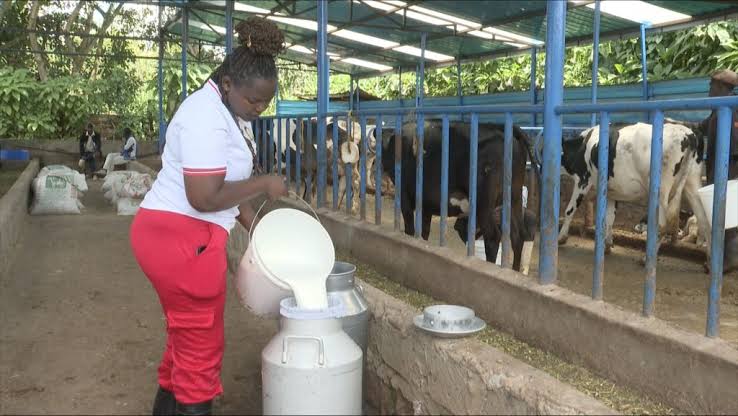
Dairy Farming in Kenya Can Increase Milk Production Through Better Feeding Before Introducing New Dairy Species
Can a dairy cow double its milk production in less than 20 days without changing its breed? Under the right conditions, a substantial increase is possible, particularly when a cow has been underfed or its ration lacks essential nutrients. However, doubling milk yield within that period is not a result every farmer should expect. The outcome depends on how much milk the cow was producing initially, its stage of lactation, the quality of the feed, its health and its genetic potential.
The question has become relevant following renewed discussion about how Kenya can increase milk production. President William Ruto recently proposed exploring improved camel and buffalo breeds as part of efforts to address milk shortages. The proposal has prompted a wider debate about whether Kenya should diversify its dairy sector or first concentrate on getting more from the cattle it already has.
For dairy farmers, the debate touches on a familiar problem. Milk production often falls short of what a cow could achieve because the animal does not receive enough energy, protein, minerals, good-quality roughage and water. Some farmers buy dairy meal without knowing whether the quantity matches the cow’s production. Others depend heavily on mature Napier grass, maize stover or hay that has lost much of its nutritional value.
In such circumstances, the first opportunity may not be buying another animal. It may be improving the feeding programme, identifying the nutritional gaps and ensuring that the cow can convert its feed into milk efficiently.
Kenya needs a practical discussion about milk production that considers both sides of the equation. New dairy species may have a role in suitable production systems, but their potential should be assessed against the cost of feeding, animal health requirements, productivity, market demand and the performance that can be achieved by improving existing dairy herds.
Why Kenyan dairy cows may produce less milk than they should
A cow’s milk yield is determined by several interacting factors. Genetics sets much of the animal’s productive potential, but nutrition, health, stage of lactation, reproduction, housing and management determine how much of that potential is realised.
A well-bred dairy cow cannot sustain high milk production on poor-quality fodder alone. Likewise, giving expensive dairy meal to an animal that lacks adequate roughage, has insufficient water or is suffering from a disease will not necessarily deliver the expected increase.
The International Livestock Research Institute’s dairy cattle feeding manual explains that feeding requirements vary with the animal’s size, production level and stage of life. A ration must supply nutrients for maintenance, milk production, growth and reproduction rather than simply provide enough material to fill the animal’s stomach.
For many Kenyan farms, one of the biggest constraints is the quality and consistency of the basal feed. Napier grass, Rhodes grass hay, natural pasture, maize stover and other crop residues can all contribute to a ration, but their feeding value differs considerably. The age at harvesting, fertiliser application, soil conditions, storage and the presence of mould all influence how much nutrition the animal obtains.
Mature grass may provide fibre but insufficient energy and protein for a cow producing substantial quantities of milk. Poorly conserved hay can lose nutritional value, while drought-damaged fodder may be too limited to maintain production. When the feed supply deteriorates, farmers may notice declining milk yields, loss of body condition, delayed return to heat or difficulty maintaining pregnancy.
A farmer who sees milk production fall should therefore investigate the whole feeding and management system instead of immediately assuming the cow needs a different breed.
Can a cow double its milk yield in less than 20 days?
The answer depends on the starting point.
Consider a cow producing 5 litres of milk a day because it is receiving inadequate feed. If the farmer corrects a major nutritional deficiency, provides enough good-quality roughage and balances the ration, milk production may improve considerably. A cow whose production has been suppressed by poor nutrition has more room for improvement than one already receiving a ration suited to its requirements.
However, increasing production from 5 litres to 10 litres a day is very different from increasing it from 20 litres to 40 litres. The latter requires a substantially greater supply of nutrients and a cow with the capacity to sustain that level of production. It cannot be achieved simply by adding more dairy meal.
A cow’s response also depends on its stage of lactation. Milk production generally rises after calving, reaches a peak and then gradually declines. Feeding improvements made early in lactation may produce a different response from those introduced late in the lactation cycle. A cow with mastitis, lameness, internal parasites or another health problem may fail to respond as expected even when its feed is improved.
Research on dairy production in tropical conditions identifies both genetics and nutrition as important influences on milk yield, while also recognising the physiological limits that affect how nutrients are used by the animal. The FAO’s guidance on milk production and nutritional requirements provides further background on these relationships.
The sensible conclusion is that a major increase in milk yield within 20 days may be possible in an underfed cow, but it should be treated as a result to investigate and measure, not a guaranteed feeding formula.
Farmers should record daily milk production before changing the ration, document the feeding changes and continue recording output afterwards. Comparing the figures over several weeks helps distinguish a genuine response from normal daily fluctuations, changes in milking routines or the natural progression of lactation.
What balanced feeding means for a dairy cow
Balanced feeding means supplying the right combination of nutrients in quantities that match the animal’s needs. It is not simply feeding more grass, buying a more expensive dairy meal or mixing several ingredients together without measuring their nutritional contribution.
A dairy ration must provide energy, protein, fibre, minerals and vitamins. It must also contain enough dry matter for the cow to consume the nutrients it needs without disrupting rumen function.
The rumen is the large fermentation chamber in a cow’s digestive system. Microorganisms living there break down fibrous plant material and help make nutrients available to the animal. These microorganisms need a suitable environment and a consistent supply of feed. Abrupt changes in diet, excessive amounts of rapidly fermentable concentrates or insufficient effective fibre can disrupt digestion and reduce performance.
Kenya’s Ministry of Agriculture training material on ration formulation emphasises that balanced rations should meet the animal’s requirements for maintenance, growth, reproduction and milk production. It also notes that improving the utilisation of the feed already available can help address low productivity. Farmers can consult the Kenya dairy ration formulation training manual for further guidance.
Energy is essential for milk production
Energy supports body maintenance, movement, pregnancy and milk synthesis. Dairy cows obtain energy from carbohydrates, fibre and fats in their diets, but the amount available depends on both feed composition and digestibility.
A cow producing more milk needs more energy. If the ration does not meet this requirement, the animal may draw on its body reserves, lose condition and struggle to maintain production. Some mobilisation of body reserves can occur naturally after calving, but excessive loss of condition can compromise health and reproductive performance.
Energy shortages can arise when cows depend on mature, fibrous fodder with low digestibility or when the amount of concentrate offered is insufficient for the cow’s actual production. The appropriate response is to assess the quality of the basal feed and formulate a ration that meets the deficit, rather than increasing concentrate feeding without considering the rest of the diet.
Protein must match the cow’s needs
Protein supplies nitrogen and amino acids required for body functions and milk production. The rumen microorganisms also need an appropriate supply of nitrogen and energy to function effectively.
A ration that contains inadequate protein can limit production, particularly when the cow depends on low-protein roughage. Protein sources used in dairy rations may include oilseed cakes and other suitable feed ingredients, depending on availability, quality and cost.
However, feeding excessive protein is not automatically beneficial. It may increase production costs without delivering a corresponding improvement in milk yield. The objective is to provide an appropriate balance of protein and energy based on the animal’s requirements and the quality of the feeds available.
Fibre keeps the rumen functioning
Good-quality roughage is a foundation of dairy production. Napier grass, suitable pasture grasses, hay and other forage crops provide fibre that supports rumination and normal rumen function.
The quality of the fibre matters. Young, properly managed fodder may be more digestible than over-mature material, allowing a cow to obtain more nutrients from a given quantity. Yet a cow also needs sufficient physically effective fibre to maintain normal chewing and rumination.
Too little effective fibre, particularly when combined with excessive concentrate feeding, can increase the risk of digestive disorders and reduce milk fat. Too much low-quality, bulky forage can limit feed intake and leave the animal short of the energy and protein required for milk production.
The aim is to offer enough good-quality roughage while balancing the ration with appropriate supplements.
Minerals and vitamins should not be overlooked
Calcium, phosphorus, magnesium, sodium and trace minerals are among the nutrients required for normal metabolism, bone development, reproduction and milk production. Requirements differ with age, physiological status and production level.
Mineral deficiencies or imbalances may contribute to poor performance, reproductive difficulties and health problems. Farmers should use suitable mineral supplements according to the animal’s requirements and the composition of the basal ration. Giving several supplements at once without understanding their contents can be wasteful and may create imbalances.
A livestock nutritionist or veterinary professional can help identify the appropriate supplement where a herd has persistent production or reproductive problems.
How much feed does a dairy cow need?
There is no single feed quantity that is correct for every dairy cow. Requirements depend on body weight, milk production, pregnancy, body condition, feed quality and environmental conditions.
One useful concept is dry matter intake. Dry matter is the portion of feed remaining after water is removed. Two feeds that weigh the same when offered fresh may supply very different quantities of actual nutrients because one may contain much more water than the other.
For example, 20 kilograms of fresh fodder with a dry matter content of 20% provides 4 kilograms of dry matter. If another feed contains 40% dry matter, 20 kilograms of that feed provides 8 kilograms of dry matter. The quantities offered are identical by fresh weight, but the amount of dry feed supplied is twice as high in the second example.
This distinction is important for Kenyan farmers who combine fresh Napier grass, silage, hay and concentrates. Rations based only on buckets, bundles or wheelbarrows can be misleading because the moisture content and density of each feed vary.
The FAO’s small-scale dairy farming guidance explains that dry matter intake is affected by factors such as body weight, milk yield, feed digestibility, roughage quality, climate and water availability. It also emphasises the importance of sufficient fibre and unrestricted access to drinking water.
For this reason, farmers should seek ration advice based on the actual feeds available, the cow’s estimated weight and its recorded milk output. A ration that works for a small indigenous or crossbred cow producing a few litres daily may be inadequate for a large, high-producing Friesian.
Why adding more dairy meal may not solve the problem
Dairy meal is often associated with higher milk production, but its value depends on how it fits into the whole ration.
A cow receiving insufficient roughage may not have the effective fibre required for healthy rumen function. A cow eating poor-quality fodder may have a high total feed intake but still receive inadequate digestible energy. Another cow may receive sufficient energy but lack the protein needed to use it effectively.
Simply increasing dairy meal does not correct every one of these problems. It can raise costs, and excessive or poorly managed concentrate feeding can contribute to rumen acidosis and other digestive problems.
The more productive approach is to assess the ration as a whole. Farmers should consider the quality and quantity of forage, the concentrate’s nutritional composition, the amount actually consumed, the cow’s milk yield and whether the ration is meeting the animal’s maintenance and production requirements.
The Ministry of Agriculture’s ration formulation material includes examples of how the proportions of basal feed and supplements can change as milk production increases. These are useful illustrations of why feeding requirements vary with production, but they should not be treated as a universal formula for every Kenyan farm. Actual rations need to account for the ingredients’ nutrient content and the cow’s individual requirements.
Producing more milk from fodder grown on the farm
One of the most important ways to improve dairy profitability in Kenya is to produce more useful feed per acre and reduce the cost of purchased fodder.
Many farmers face high costs when they depend on bought hay, commercial concentrates and transported forage. Feed shortages can become particularly severe during dry periods, when pasture growth declines and prices rise.
Napier grass remains an important forage on many smallholder farms, but production and quality depend on the variety, soil fertility, moisture and harvesting interval. Over-mature Napier grass can be bulky and fibrous, making it less digestible. Harvesting at an appropriate stage and maintaining the stand can improve its feeding value.
Farmers may also consider suitable forage legumes, such as lucerne or desmodium, where local climate, soil conditions and management allow them to grow successfully. Legumes can contribute protein to the diet, although their actual value depends on their quality and how they are incorporated into the ration.
Maize and other suitable crops can be conserved as silage when harvested at the correct stage and ensiled properly. Silage can help bridge seasonal feed shortages, but poor fermentation, contamination or mould can make it unsuitable for livestock.
Haymaking provides another way to conserve forage for dry periods. Effective drying and storage are important because moisture, rain damage and poor storage conditions can reduce quality or encourage mould growth.
Farmers should plan fodder production around the herd’s expected requirements rather than waiting until feed becomes scarce. Keeping a record of fodder harvested, stored and consumed helps estimate how long reserves will last and whether additional feed needs to be produced or purchased.
Does feed optimisation reduce competition between people and livestock for grain?
The concern about competition for feed ingredients deserves attention, especially where maize and other grains are used both for human food and animal feeding.
However, the issue is more complex than assuming all dairy feed competes directly with human diets. Dairy rations can include grasses, crop residues, silage, hay, suitable agro-industrial by-products and other ingredients that are not necessarily used as direct human food. Some by-products may provide valuable nutrients to livestock when their quality and safety are properly assessed.
The important question is how to formulate a ration that meets the cow’s needs at a cost the farmer can sustain, while making appropriate use of locally available feed resources.
This does not mean every crop residue or industrial by-product is suitable for dairy cattle. Some have low nutritional value, while others may contain contaminants or require careful inclusion limits. Feed ingredients should be assessed for their nutritional composition, safety and suitability before they are used.
Better feed conservation can also reduce waste. Fodder that is harvested too late, spoiled during storage or left to deteriorate represents land, labour and production costs that have already been incurred without generating the expected benefit.
Improving the digestibility of forage, reducing storage losses and balancing rations can help farmers obtain more milk from the resources they already use. Nevertheless, the size of the benefit must be measured on individual farms rather than assumed in advance.
What Kenya’s feed standards mean for dairy farmers
The quality and safety of commercial animal feeds are important to both animal performance and food production. Farmers buying dairy meal, mineral supplements or other manufactured feeds should pay attention to the product label, intended use, composition, batch information and supplier reliability.
The Kenya Bureau of Standards lists standards covering compounded cattle feeds and dairy cattle feed supplements. Farmers and feed manufacturers should check the applicable current standard and relevant regulatory requirements when selecting or producing feeds through the KEBS standards catalogue.
A product that meets the applicable requirements still needs to be used correctly. The quantity required depends on the animal, its milk output and the rest of its diet. Farmers should avoid assuming that all products marketed for high-producing cows are interchangeable or that feeding beyond the recommended amount will automatically increase production.
Feed safety is equally important. Mouldy fodder and contaminated ingredients can affect animal health and may introduce hazards into the food chain. Where there are concerns about feed quality, farmers should seek advice rather than trying to correct the problem by mixing the suspect feed with other ingredients.
Could dairy buffaloes help Kenya increase milk supply?
The proposal to explore dairy buffaloes deserves a fair assessment. Buffaloes are domesticated livestock in several countries and are kept for milk, meat and other purposes. They are not simply wild animals intended for game parks, and established buffalo dairy systems operate in countries including India.
Buffalo milk is often valued for its relatively high fat and total solids content, which can make it useful for products such as yoghurt, butter and certain cheeses. However, buffalo breeds and individual animals vary in milk yield, composition, feeding requirements and adaptation to their production environment.
The commercial question is not whether buffaloes can produce milk. They can. The question is whether introducing and maintaining dairy buffaloes would be an effective, affordable and scalable way to address Kenya’s particular milk supply constraints.
Before such a programme proceeds, policymakers would need to examine the suitability of the proposed breeds for Kenyan conditions, the availability and cost of feed, water and housing, breeding and veterinary services, animal welfare, milk collection arrangements and market demand for buffalo milk.
Importing animals would also require appropriate veterinary risk assessment, quarantine and biosecurity arrangements. These safeguards are important whenever livestock are moved across borders, regardless of species.
Buffaloes should not be dismissed simply because they are different from cattle. Equally, they should not be presented as an automatic solution to a national milk deficit without evidence that the proposed production system would work under Kenyan conditions.
Would buffaloes necessarily produce less milk than dairy cattle?
There is no sound basis for a universal comparison without specifying the breeds, production systems and measures being compared. Some dairy cattle breeds have been selected for high milk volume, while buffaloes may produce milk with a higher concentration of fat and other solids.
Farmers and policymakers need to distinguish between litres produced, total milk solids, feed required per litre, feed required per unit of milk solids, production costs and the price the farmer receives.
A system producing fewer litres might still be commercially viable if the milk attracts a suitable price and the production costs are competitive. Conversely, high-fat milk does not automatically make an enterprise profitable if feed, animal purchase, housing, veterinary care and marketing costs are excessive.
The relevant assessment should compare the complete production system rather than relying on a single characteristic.
Would buffaloes worsen competition for feed?
That outcome cannot be assumed without examining the proposed system. Buffaloes need adequate feed and water, as do dairy cattle, but the feeds they can use and their production performance depend on the breed, management and environment.
The FAO’s guidance on small-scale dairy farming notes that buffaloes can utilise some coarse feeds more effectively than cattle, although this does not eliminate the need to meet their nutritional requirements. The FAO small-scale dairy farming guide provides further background on feeding systems.
Whether a buffalo programme would increase pressure on grain supplies would depend on the ration, herd size, productivity and use of alternative feed resources. A programme that relies heavily on expensive purchased ingredients could face serious cost challenges, but the same principle applies to cattle.
The appropriate policy response is to compare realistic feed budgets and production outcomes before scaling either system. Kenya should not replace an evidence-based evaluation with assumptions that buffaloes will inevitably solve or worsen the feed problem.
Why improving the existing cattle herd deserves attention first
Kenya already has farmers, milk collection systems, veterinary services, artificial insemination providers, feed suppliers and established markets built around dairy cattle. These systems are not perfect, but they offer a foundation for improving production.
Better feeding is one opportunity because it can address a direct constraint on animals already in production. It may also produce benefits beyond the immediate increase in milk yield, including improved body condition and, where the underlying nutritional problem is corrected, better reproductive performance.
Other improvements include early detection of mastitis, appropriate parasite control, consistent milking routines, clean housing, adequate ventilation and selection of animals suited to the farm’s resources. Genetic improvement can also help, but farmers need to match the cow’s productive potential with their ability to supply sufficient feed and care.
A high-producing cow can become expensive to maintain when feed is scarce or costly. A lower-yielding animal that thrives on available resources may be more suitable for some farms, particularly where land, capital and fodder production are limited.
This is why dairy development programmes should not focus only on increasing the number of litres each animal can produce under ideal conditions. They should also assess the cost of producing those litres, the stability of output across seasons, animal health and the farmer’s net return.
The economics of milk production matter more than litres alone
An increase in milk yield is useful only if it improves the farm’s financial position without creating unsustainable costs or harming the cow.
Suppose a farmer improves feeding and obtains additional milk each day. The financial benefit depends on how much extra milk is sold, the price received, any additional feed and labour costs, and whether the increase can be sustained.
Farmers can use a simple calculation to assess the immediate effect:
Additional daily milk revenue = extra litres sold × price received per litre.
To estimate the net daily benefit, subtract the additional daily costs of feed, supplements, labour and any other expenses directly associated with the change.
For example, if a cow produces 3 additional litres daily and the farmer receives KSh50 per litre, the extra gross revenue would be KSh150 a day. If the revised ration costs an additional KSh90 daily, the difference would be KSh60 before other additional expenses. These figures are illustrative, not a prediction of what every farmer will earn.
The calculation becomes more complicated when milk production changes over time, feed prices fluctuate or the cow’s body condition and reproductive performance are affected. Farmers should therefore compare results over a sufficiently long period and include costs that are easy to overlook.
A feeding programme that increases milk yield but consumes all the extra revenue is not necessarily a good investment. The aim is to improve profit per cow and the efficiency with which feed is converted into saleable milk.
What government, researchers and the dairy industry should prioritise
Improving dairy productivity requires action beyond the farm. Government agencies, researchers, extension officers, feed manufacturers, cooperatives and milk processors all have roles in addressing the constraints that limit production.
First, farmers need practical extension support on ration formulation, forage management and feed conservation. Advice should be based on the feeds actually available in each production area and should help farmers make decisions that are financially realistic.
Second, investment in fodder production can help reduce seasonal shortages. Research into suitable forage varieties, better harvesting practices, silage and hay conservation can improve the quantity and quality of feed available throughout the year.
Third, feed quality and safety require attention. Farmers need access to reliable products and clear information about their nutritional composition and intended use. Feed manufacturers should comply with applicable standards, while authorities need effective systems for oversight and enforcement.
Fourth, dairy development programmes should improve access to veterinary care and reliable milk production records. Without accurate records, it is difficult to know whether a new feeding programme, breed or management intervention is delivering the expected benefit.
Finally, proposals to introduce new dairy species should be assessed through transparent feasibility studies and carefully designed trials. These should measure milk volume, milk composition, feed conversion, animal health, reproductive performance, adaptation, production costs and market returns. The results should be compared with realistic improvements that could be achieved using existing dairy cattle.
The objective should be to select investments that deliver the greatest sustainable benefit to farmers, rather than assuming that one intervention will resolve every challenge in the dairy sector.
The bottom line for dairy farmers in Kenya
Kenya’s milk supply challenge cannot be reduced to a single problem or solved through one intervention. Feed costs, poor-quality fodder, nutritional imbalances, animal health, genetics, seasonal shortages and market conditions all influence how much milk farmers produce and how much they earn.
Correcting nutritional deficiencies can produce substantial improvements in some cows, particularly where poor feeding has suppressed production. But doubling milk yield in under 20 days is not a universal outcome, and farmers should be cautious about any feeding claim that promises the same result regardless of breed, health or starting production.
Dairy buffaloes may have a role in suitable production systems, but their introduction should be judged by evidence on adaptation, feed requirements, productivity, animal health, costs and market demand. They should neither be treated as a guaranteed answer to Kenya’s milk shortage nor rejected without a proper assessment.
For many farmers, a sensible starting point is to record milk production, assess the quality of the available fodder, balance the ration, provide adequate water and investigate health problems that may be limiting output. Better feed planning and conservation can also help reduce the cost of keeping productive animals through dry seasons.
The wider policy lesson is that Kenya should measure dairy investments by the additional milk and income they generate relative to their full costs. Improving the performance of the existing cattle herd deserves serious attention alongside any carefully evaluated investment in new dairy species.
What do you think should come first in Kenya’s dairy sector: investment in precision feeding and fodder production, or trials involving dairy buffaloes and other species? And what has made the biggest difference to milk production on your farm?
https://farmerstrend.co.ke/livestock-farming/dairy-farming/dairy-farming-in-kenya-milk-production-feed-optimization/https://farmerstrend.co.ke/wp-content/uploads/2026/10/Dairy-Farming-in-Kenya.jpeghttps://farmerstrend.co.ke/wp-content/uploads/2026/10/Dairy-Farming-in-Kenya-150x150.jpegDairy Farming# TrendingLivestock FarmingDairy farming in Kenya could produce more milk through balanced rations, better fodder and improved cow management before farmers invest in new dairy species.Dairy Farming in Kenya Can Increase Milk Production Through Better Feeding Before Introducing New Dairy Species Can a dairy cow double its milk production in less...FarmersTrendjohn doefarmerstrend@gmail.comAdministratorFarmers Trend Ltd.





Leave a Reply