Passion Fruit Buyers From Uganda: What 5 Trucks a Week in Sirikwa Teach You About Market Power
Passion fruit buyers from Uganda send more than five trucks a week to Sirikwa village. A 2021 Kenya News Agency report quoted a local farmer on the traffic. Buyers who drive to your area want your fruit. Farmers who understand why they come hold a stronger position at the farm gate.
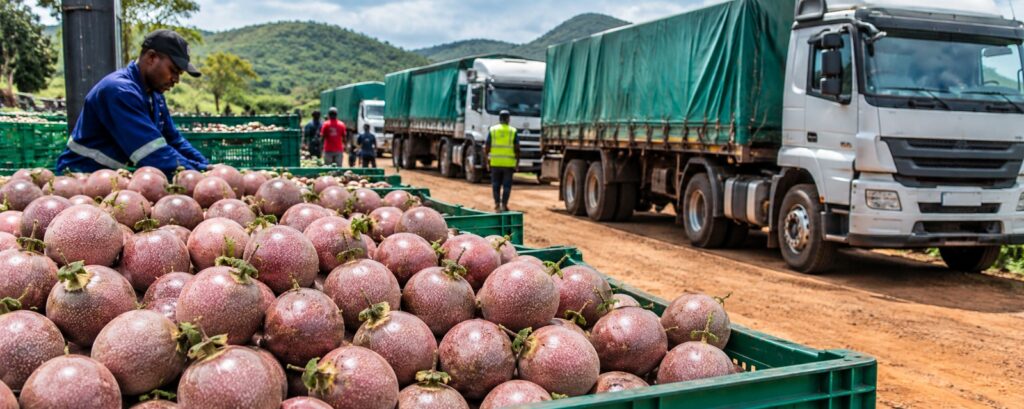
Strong demand does not guarantee a strong price. One Uasin Gishu grower told Business Daily in 2021 prices fell to KSh 20 per kilo around a Uganda election. The buyers who fill trucks in good weeks also set the price in bad weeks. Your market power depends on the choices you make before the first truck arrives.
Farmers Trend Limited wrote this guide to turn those lessons into action. You will learn who the Ugandan buyers are, what they want, how to protect your price, which seedlings to plant, how to grow fruit to buyer standard and what one acre earns at different prices. You also get a clear plan for your first 90 days.
What 5 Trucks a Week in Sirikwa Tell You About Passion Fruit Buyers From Uganda
The Kenya News Agency report, republished by People Daily on 12 July 2021, profiles Edwin Kipkoech Rono, then 33. Rono left maize farming in 2018. Maize prices fell 40 percent while his production costs rose. He planted passion fruit on three acres and later expanded to 14 acres.
Rono named Ugandan processors as the biggest market for farmers in Sirikwa. He reported more than five trucks from Uganda collecting fruit from farmers in the area every week. Those trucks come to the farm. You skip the cost of hauling fruit to a distant market, and you skip the wait for a broker to find a buyer.
Treat this report as a 2021 snapshot. Truck numbers change with season, price and border conditions. Call buyers in your own area before you plan your acreage. Ugandan demand has reached Kenyan farms for years, and the table below shows the numbers from several sources.
| Source | Reported fact | Note |
|---|---|---|
| Kenya News Agency and People Daily | More than 5 trucks a week from Uganda collect fruit in Sirikwa | Report from 2021 |
| Kenya Yearbook sector report | Uganda takes 50 percent of Kenya’s passion fruit production | Based on a 2015 value chain study |
| Exporter quoted by Kenya News Agency | The Kampala market needs up to 50 tons a week | Exporter statement, not a market audit |
| Business Daily | Price fell to KSh 20 per kilo around a Uganda election | Farmer account from 2021 |
Why Passion Fruit Buyers From Uganda Look to Kenya
Kenya Supplies Fruit All Year
A Kenya Yearbook sector report states Kenya guarantees a year-round supply of tropical fruit. Passion fruit grows in warm lowlands with yellow varieties and in cool highlands with purple varieties. Buyers who run juice plants need fruit every week, not in one short season. Farmers in many counties fill this need.
Supply Falls Short of Demand
Kenya imported about 1,250 metric tonnes of passion fruit a year between 2011 and 2015 to cover local deficits, according to the same Kenya Yearbook report. A 2010 paper from Kenya’s agricultural research community reported a 50 percent drop in fruit production over four years. The authors blamed diseases, pests and climate change. A market with short supply gives growers of clean fruit room to negotiate.
Juice Demand Pulls Fruit Across the Border
An exporter told the Kenya News Agency his firm sells fruit to Kampala traders who make fresh juice for street vendors. He also named supermarkets, hotels, city markets and export buyers in the Middle East and Europe. Juice processors need volume and steady supply. Sirikwa shows what happens when farmers in one area deliver both.
European shipments stopped after Kenyan fruit exceeded pesticide residue limits. Regional buyers in Uganda and South Sudan kept buying. This history matters to you. Buyers across the region now watch how you spray, and clean fruit opens more doors than dirty fruit at any price.
What Passion Fruit Buyers From Uganda Want From Your Farm
Yellow Passion Fruit for Processing
Rono told the Kenya News Agency industrial processors now favour yellow passion fruit over purple. He said yellow fruit is sweeter, less acidic and bigger, so each fruit carries more juice. He reported a juice yield of 35 percent for yellow fruit against 20 to 25 percent for purple. He also reported six spray rounds a season for purple against three for yellow.
Purple fruit keeps a strong place in Kenya’s fresh market. The Kenya Yearbook report notes local buyers still prefer the purple fruit and remain unsure about yellow. Choose your variety by buyer, not by habit. Ask the buyer which fruit the buyer collects before you order seedlings.
| Factor | Yellow passion fruit | Purple passion fruit |
|---|---|---|
| Juice yield, as reported | 35 percent | 20 to 25 percent |
| Spray rounds per season, as reported | 3 | 6 |
| Taste profile | Sweeter, less acidic, bigger fruit | Preferred by many Kenyan fresh market buyers |
| Typical buyer | Processors and juice makers | Local fresh market and specialty buyers |
| Growing zone | Lower, warmer areas | Higher, cooler areas |
Clean, Uniform Fruit
A buyer who loads a truck wants fruit of one size and one ripeness. Pick fruit when the skin changes colour. Sort out cracked, shrivelled and diseased fruit at the farm. Pack in clean crates. A farmer who delivers uniform fruit every week earns repeat visits from the same trucks.
Niche Buyers Pay for Consistent Quality
Cyrus Kiprotich of Kaptagat supplies black wonder purple passion fruit to Kenyan Originals, a Kenyan brewer. Capital FM reported he delivers mostly daily in season and sells at KSh 130 per kilo. He chose black wonder because the variety performs in his highland area. Niche buyers want one reliable supplier who delivers the same quality every day. Approach hotels, juice bars, bakeries and food makers in your town with samples and a delivery schedule.
Steady Weekly Volume
Processors plan production weeks ahead. A buyer prefers ten farmers who deliver every week to one farmer who delivers a large load once. John Magaju, a passion fruit farmer in Meru featured by Nation Africa, picks fruit every three days and sells the fruit at KSh 120 per kilo. Frequent picking gives you frequent sales and fresher fruit.
Spray Records and Safe Residues
Write down every spray. Record the product, the dose, the date and the harvest interval. Buyers who sell to export markets trace fruit back to farms. Records protect your access to those buyers. Follow the label and respect the waiting period before harvest.
| Record column | What you write |
|---|---|
| Date | The day you spray, feed or harvest |
| Block | The part of the farm and the age of the vines |
| Product and dose | Name, active ingredient and amount per litre |
| Waiting period | The days you leave before the next harvest |
| Kilos and price | Kilos sold, the buyer and the price per kilo |
A farmer who shows this record to a buyer proves control over quality. Buyers trust records more than promises.
5 Market Power Lessons From the Sirikwa Trucks
Lesson 1: Buyers Who Come to You Cut Your Costs
Collection at the farm gate removes transport costs and spoilage on the road. You keep more of every kilo you sell. Build a clean, shaded collection point on your farm with crates, a weighing scale and a record book. A tidy loading area shows buyers you run a serious operation.
Lesson 2: One Buyer Country Is One Risk
The Business Daily story shows the danger. A farmer who sold mostly to Uganda saw prices fall to KSh 20 per kilo around an election in Uganda. He reported heavy losses. Sirikwa farmers face the same exposure when five trucks all come from one country.
Keep two or three buyers. Sell part of your harvest to a Ugandan processor, part to a Kenyan exporter and part to the local fresh market. Spread your sales so one border closure or one political event does not empty your account.
A simple split works. Contract half your harvest at a fixed price. Sell 30 percent through your group to the best bidder. Keep 20 percent for local fresh market sales. Adjust the shares each season after you review your records.
Lesson 3: Sell With a Group
TechnoServe reports farmer business groups sell fruit collectively and improve their bargaining power. The same page notes most passion fruit in Kenya and Uganda goes to local markets, while processors and export buyers offer growth. A group of 20 farmers offers a buyer a full truck. One farmer offers a few crates.
Form a group in your village. Agree on variety, quality rules and a collection day. Pick one member to keep records. Negotiate price as a group and share transport and sorting costs. Buyers prefer one phone call and one contract to twenty small deals.
Lesson 4: Stagger Your Planting
Rono told Business Daily he harvests a block of passion fruit for about two years before he replants. Plan your farm in blocks. Plant a new block every six to twelve months. Old blocks keep supplying while young blocks come into bearing. Buyers keep returning to farms with steady supply.
Lesson 5: Know Your Break-Even Price Before You Negotiate
Write down your cost per kilo before a buyer names a price. Include seedlings, manure, fertiliser, spray, labour, trellis posts, wire and transport. A farmer who knows the break-even price turns down offers below cost. A farmer who guesses accepts losses. The next section shows the numbers.
What Price Does to Your Income Per Acre
Farmers Trend Limited estimates the first-year cost of one acre of passion fruit at KSh 300,000 to KSh 400,000. This covers seedlings, manure, fertiliser, pesticides, labour and trellising. Farmers Trend Limited expects a first-year yield of about 15,000 kilos per acre with good management. The table also shows a cautious case of 5,000 kilos per acre.
| Price per kilo | Income at 15,000 kg | Income at 5,000 kg | Source of the price |
|---|---|---|---|
| KSh 20 | KSh 300,000 | KSh 100,000 | Business Daily, price around a Uganda election |
| KSh 70 | KSh 1,050,000 | KSh 350,000 | Farmers Trend Limited estimate |
| KSh 80 | KSh 1,200,000 | KSh 400,000 | Average buying price reported by Nation Africa |
| KSh 120 | KSh 1,800,000 | KSh 600,000 | Magaju farm sales reported by Nation Africa |
Read the table in two steps. First, look at the 15,000 kilo column. Even at KSh 20 per kilo, income reaches the low end of your cost. Second, look at the 5,000 kilo column. At this yield your break-even price rises to between KSh 60 and KSh 80 per kilo. A low price combined with a low yield wipes out your margin.
Yield claims vary widely. A Kaptagat farmer who supplies a Kenyan brewer told Capital FM one tree gives about one kilo per season. Farmers Trend Limited expects a much higher figure for well-managed vines. Count kilos per vine on your own farm for the first season. Use your own numbers when you negotiate.
The price columns also show your market power in plain figures. The gap between KSh 20 and KSh 120 per kilo on 5,000 kilos equals KSh 500,000. A seller with clean fruit, a group and two or three buyers sits near the top of this range. A lone seller with no records sits near the bottom.
How to Calculate Your Break-Even Price Per Kilo
Divide your total cost by the kilos you harvest. Use a cost of KSh 350,000, the middle of the range Farmers Trend Limited estimates. The table shows how yield changes the lowest price you accept.
| Yield per acre | Break-even price per kilo |
|---|---|
| 3,000 kg | KSh 117 |
| 5,000 kg | KSh 70 |
| 8,000 kg | KSh 44 |
| 15,000 kg | KSh 23 |
A farmer who harvests 3,000 kilos needs KSh 117 per kilo to cover costs. A farmer who harvests 8,000 kilos needs KSh 44. Yield decides how much room you have to negotiate. Better seedlings, steady feeding and hand pollination lift yield and lower your break-even price. Write your own figure on the first page of your notebook.
How to Approach Passion Fruit Buyers From Uganda
Start with a phone call, not a delivery. Ask each buyer six questions. Which variety do you collect? How many kilos do you need each week? How do you set the price? When do you pay? Who sorts and weighs the fruit? What happens to rejected fruit?
Ask for the answers in writing, even on a single page. Include the collection day, the weighing method and the payment date. Agree the quality rules before the first load. Weigh your fruit on your own scale and keep a copy of every weight slip.
Visit the buyer’s collection point or a farm the buyer already buys from. Talk to two or three farmers. Ask whether the buyer pays on time and whether prices drop during the season. Farmers in Sirikwa and Moiben shared their experience with reporters. Ask your neighbours too.
Plant for Your Buyers With Grafted Passion Fruit Seedlings
Farmers Trend Limited sells grafted passion fruit seedlings at KSh 100 per seedling. Farmers Trend Limited offers grafted purple passion and non-grafted yellow passion options. Ask the team which option fits your altitude and your buyer before you order.
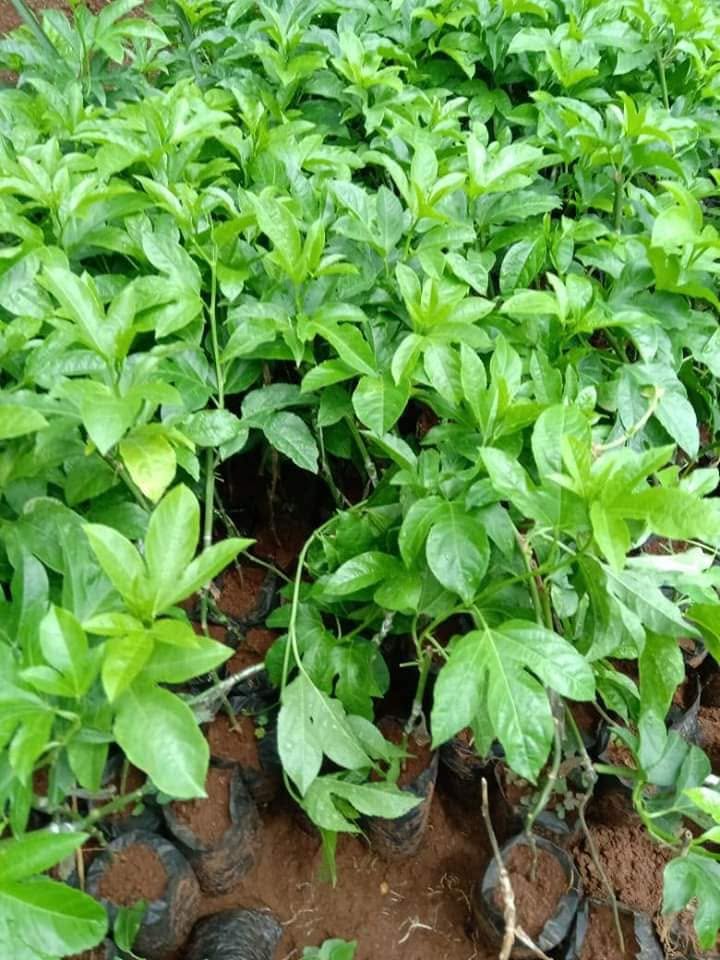
Grafting joins a rootstock to a fruiting top. The rootstock supplies disease resistance. The top supplies fruit quality. Magaju in Meru grafts a giant yellow rootstock with purple fruit. He told Nation Africa the yellow root resists disease better and the purple top produces better fruit.
Farmers Trend Limited recommends a spacing of 2.5 metres within rows and 3 metres between rows. This gives about 550 seedlings per acre. At KSh 100 each, seedlings for one acre cost KSh 55,000. This equals 13.8 to 18.3 percent of the first-year cost range of KSh 300,000 to KSh 400,000. Healthy planting material protects the other 82 to 86 percent of your spending.
Clean planting material also answers a buyer concern. The EU-funded Market Access Upgrade Programme, known as MARKUP, promotes disease-free, high-yielding planting material to raise quality and safety standards for export. Rono said smallholders reach exporters only if they have clean, quality planting material.
Order from Farmers Trend Limited on Call or WhatsApp 0724 559 286 or 0790 509 684. Email info@farmerstrend.co.ke. Share your county, altitude, acreage and buyer. The team advises on the number of seedlings and the delivery plan.
Grow Fruit to Buyer Standard
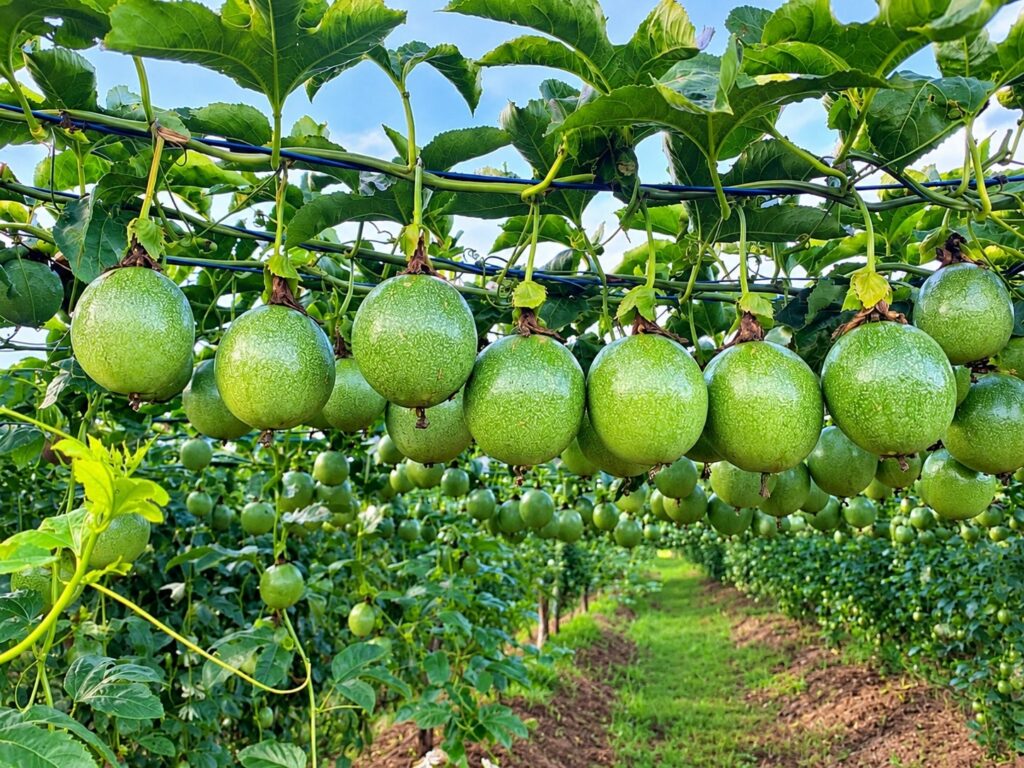
Choose the Right Site and Soil
Farmers Trend Limited gives these ranges. Temperature runs from 18 to 30 degrees Celsius. Altitude runs from 1,200 to 2,000 metres above sea level. Annual rainfall runs from 900 to 2,000 millimetres, with irrigation to fill gaps. Choose well-drained sandy loam rich in organic matter, with a pH between 5.5 and 7.0. Test your soil and add lime if the soil is too acidic.
Plant With Care
Dig holes 60 centimetres in each direction. Mix the topsoil with 10 to 20 kilos of well-decomposed manure and 200 grams of DAP. Place the seedling so the graft union sits above the soil. Buried graft unions invite infection. Firm the soil and water straight away. Plant at the start of the rains or when you have irrigation.
Build a Strong Trellis
Place posts 3 metres apart along the rows. Run wires 1.5 to 2 metres above the ground. Train vines along the wire so fruit spreads evenly. A weak trellis collapses under a heavy crop and costs you a full season of income. Spend on posts and wire at the start.
Feed and Prune on Schedule
Farmers Trend Limited recommends 200 grams of calcium ammonium nitrate per plant every three months. Magaju stresses compost, mulch and regular watering, and he monitors potassium and calcium. Agronomist Patrick Kiunga of Mikinduri Hope in Meru advises enough calcium, zinc and boron to reduce deficiencies. Prune dead and diseased branches so air moves through the vines.
Hand Pollinate for Higher Yield
Passion fruit flowers are self-sterile and need cross-pollination, usually by bees. A Feed the Future report describes a pilot with 3,100 Kenyan smallholders. Farmers reported hand pollination raised production by up to 20 percent. The work takes one person a full day per acre. Brazilian farmers use the same practice and report gains of 20 to 30 percent. Ask your buyer or extension officer for a training session.
Harvest at the Right Time
Fruit is ready 8 to 12 months after planting, according to Farmers Trend Limited. Pick when the skin turns purple on purple varieties or yellow on yellow varieties. Pick often. Overripe fruit drops and bruises. Magaju harvests every three days and reports more than 90 kilos in a week from his orchard.
Protect Your Buyers With Disease Control
Disease cuts your volume and your price. Rono said yellow passion fruit resists Fusarium wilt and tolerates root rot, nematodes, brown spot and woodiness virus. These are his field claims, so confirm resistance with your seedling supplier. Grafted seedlings put a resistant rootstock under your fruit.
Watch your vines every week. Look for yellow leaves, wilting, hard thick fruit and twisted growth. Remove sick vines early. Keep tools clean. Farmers Trend Limited publishes guides in its passion fruit farming section, including success stories and a call to revive Kenya’s passion fruit industry. The 2021 reports above and the Kenya Yearbook agree on one point: pest and disease control decides who keeps export and processor buyers.
4 Mistakes Which Weaken Your Position at the Farm Gate
First, farmers plant before they confirm a buyer. Acres of fruit with no buyer force you to accept the first offer. Confirm at least one buyer before you order seedlings.
Second, farmers sell through one broker. A single broker controls your information and your price. Compare offers from two or three buyers every month.
Third, farmers deliver mixed fruit. Unsorted loads earn the price of the worst fruit. Sort and grade before every sale.
Fourth, farmers keep no records. Without kilos, prices and costs, you cannot show a buyer your supply or defend your price. Keep a notebook from day one.
Your 90 Day Plan to Reach Passion Fruit Buyers From Uganda
| Period | Action |
|---|---|
| Days 1 to 14 | Call three buyers or aggregators. Ask which variety they collect, the volume per week, the price basis, the payment terms and the quality rules |
| Days 15 to 30 | Test your soil. Mark rows at 2.5 by 3 metres. Order posts, wire and seedlings. Form or join a farmer group |
| Days 31 to 45 | Dig holes, mix manure and DAP, and set up the trellis |
| Days 46 to 60 | Plant grafted seedlings with the union above the soil. Water and mulch |
| Days 61 to 90 | Scout weekly, record every input, train vines along the wire and agree a delivery schedule with your group |
Keep one notebook for the whole farm. Write costs, sprays, kilos and prices. After three months you hold the data you need to negotiate with any buyer.
Frequently Asked Questions About Passion Fruit Buyers From Uganda
How do you find passion fruit buyers from Uganda in your county?
Ask your county agriculture office, farmer groups and exporters already working nearby. Visit collection centres on collection days. Ask farmers who sell to Ugandan trucks for an introduction. Call at least three buyers and compare their answers before you commit.
Who are the passion fruit buyers from Uganda?
They include processors, traders and exporters who collect fruit from Kenyan farms. Rono named Ugandan processors as the biggest market in Sirikwa. An exporter also named Kampala traders who supply street juice vendors.
Which variety do Ugandan processors prefer?
Rono reported processors prefer yellow passion fruit for its sweetness, lower acidity, size and higher juice share. Confirm the choice with your own buyer before you plant.
How many passion fruit seedlings does one acre need?
Farmers Trend Limited gives about 550 seedlings per acre at 2.5 by 3 metres. At KSh 100 per grafted seedling from Farmers Trend Limited, the seedlings cost KSh 55,000.
When does passion fruit start to bear?
Farmers Trend Limited states harvest starts 8 to 12 months after planting. Variety, altitude and care change the exact timing.
What price should you expect per kilo?
Reports in this guide range from KSh 20 around a Uganda election to KSh 120 for a Meru farmer selling directly. Farmers Trend Limited uses KSh 70 as an example. Negotiate from your own break-even price.
Do you need a contract to sell to exporters?
Some exporters offer contracts. An exporter executive told the Kenya News Agency his firm works with a market systems project to link smallholders to contract supply. Read every term on price, payment date, quality rules and rejection before you sign.
Where do you buy grafted passion fruit seedlings in Kenya?
Farmers Trend Limited sells grafted passion fruit seedlings at KSh 100 each from its nurseries in Murang’a and Nairobi. Call or WhatsApp 0724 559 286 or 0790 509 684, or email info@farmerstrend.co.ke.
Your Next Step for Better Prices From Buyers
Five trucks a week in Sirikwa show you where passion fruit demand sits. Passion fruit buyers from Uganda want fruit, and they reward the farmers who deliver clean, steady supply. Your power to earn a good price depends on four decisions. You choose a variety your buyer wants. You plant clean grafted seedlings. You grow uniform, residue-safe fruit. You sell with a group to more than one buyer.
Start with the phone. Call three buyers this week and test how each one treats farmers. Write down what each one wants and pays. Then order your seedlings from Farmers Trend Limited on 0724 559 286 or 0790 509 684, and plant for a market you have already confirmed.
https://farmerstrend.co.ke/trending/passion-fruit-buyers-from-uganda/https://farmerstrend.co.ke/wp-content/uploads/2026/10/WhatsApp-Image-2026-10-27-at-13.08.44-1024x409.jpeghttps://farmerstrend.co.ke/wp-content/uploads/2026/10/WhatsApp-Image-2026-10-27-at-13.08.44-150x150.jpeg# TrendingFruitsIn FruitsPassion fruit farmingagribusiness in KEnya,East Africa fruit trade,Farmers Trend agrovet,Farmers Trend Limited,fruit farming in kenya,grafted passion fruit seedlings,grafted passion fruit seedlings in Kenya,grafted passion fruit seedlings price,horticulture in kenya,how to sell passion fruit,Kenya fruit exports,Kenya to Uganda passion fruit trade,maize to passion fruit,passion fruit break-even price,passion fruit buyers from Uganda,passion fruit buyers in Kenya,passion fruit contract farming,passion fruit cooperatives,passion fruit disease control,passion fruit export from Kenya,passion fruit exporters,passion fruit farm gate price,passion fruit farmer groups,passion fruit farmers Kenya,passion fruit farming in kenya,passion fruit farming in Nakuru,passion fruit farming in Uasin Gishu,passion fruit farming profit,passion fruit Fusarium wilt,passion fruit hand pollination,passion fruit harvesting,passion fruit income per acre,passion fruit juice processing,passion fruit market in Kenya,passion fruit market in Uganda,passion fruit market power,passion fruit planting,passion fruit price per kilo,passion fruit prices in Kenya,passion fruit processors,passion fruit profit per acre,passion fruit records,passion fruit seedlings KSh 100,passion fruit spacing,passion fruit trellis,purple passion fruit,selling passion fruit in bulk,Sirikwa passion fruit,yellow passion fruit,yellow passion fruit for juice,yellow vs purple passion fruitPassion fruit buyers from Uganda send more than five trucks a week to Sirikwa village. A 2021 Kenya News Agency report quoted a local farmer on the traffic. Buyers who drive to your area want your fruit. Farmers who understand why they come hold a stronger position at the...FarmersTrendjohn doefarmerstrend@gmail.comAdministratorFarmers Trend Ltd.






Leave a Reply