Male and Female Date Palms: 7 Clear Differences Every Farmer Must Know and How Many Males Do You Need Per 100 Females
Male and female date palms are two separate trees, and only one of them bears dates. The female palm grows the fruit. The male palm grows the pollen. Without pollen from a male, your female palms give you few dates or none. This single fact decides how many palms you plant, which seedlings you buy and when your first income arrives.
This guide gives you 7 clear differences between male and female date palms. Then the guide answers the question every date farmer asks: how many males do you need per 100 females? The answer from FAO figures is 2 males, and Farmers Trend Limited advises you to plant 1 spare. The sections below show the math, the sources and the pollination steps.
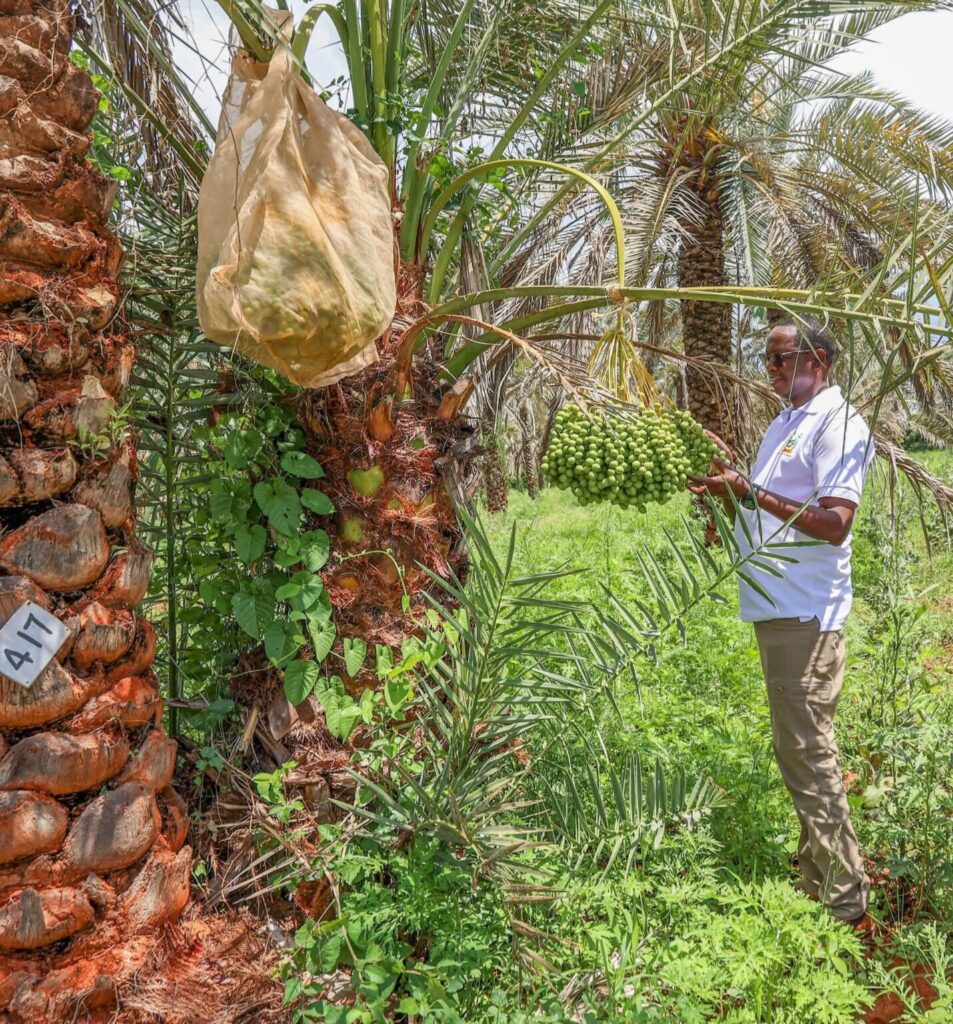
Kenya is moving fast on dates. National and county officials have named Wajir, Mandera, Marsabit, Turkana, Garissa, Kitui, Tana River and Makueni as target counties for commercial date farming. You need to understand male and female date palms before you invest in a single seedling.
Farmers Trend Limited prepared this pillar guide for Kenyan farmers. The facts come from FAO, the World Agroforestry Centre, university trials, Kenyan government statements and Kenyan news reports. The guide also shows the price and planting plan for Medjool date palm offshoots at KSh 1,500 each.
What Dioecious Means for Male and Female Date Palms
The date palm, Phoenix dactylifera, is a dioecious plant. This word means each tree carries either male flowers or female flowers, never both. A male palm stays male for life. A female palm stays female for life.
Scientists have found three genes present in all male date palms and absent in all female date palms. Sex follows an XY system, similar to the system in people. Feeding, pruning or watering never changes the sex of a palm.
Many fruit trees, such as mango, guava and tree tomato, carry both sexes on one tree. A date palm does not. You must plan the sex mix of your orchard before you plant. A mistake here costs you years.
7 Clear Differences Between Male and Female Date Palms
1. Only female date palms bear fruit
Female palms grow dates. Male palms never do. A male palm produces pollen and nothing else of commercial value. When you count palms for income, you count only females.
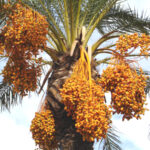
A Danish science museum botanical garden reports yields of up to 200 kg per palm per year under good conditions, with some palms reaching 700 kg. These numbers apply to female palms only. A bunch carries more than 1,000 fruits. Your income comes from the female palms you keep healthy and well pollinated.
2. Male and female flowers have different parts
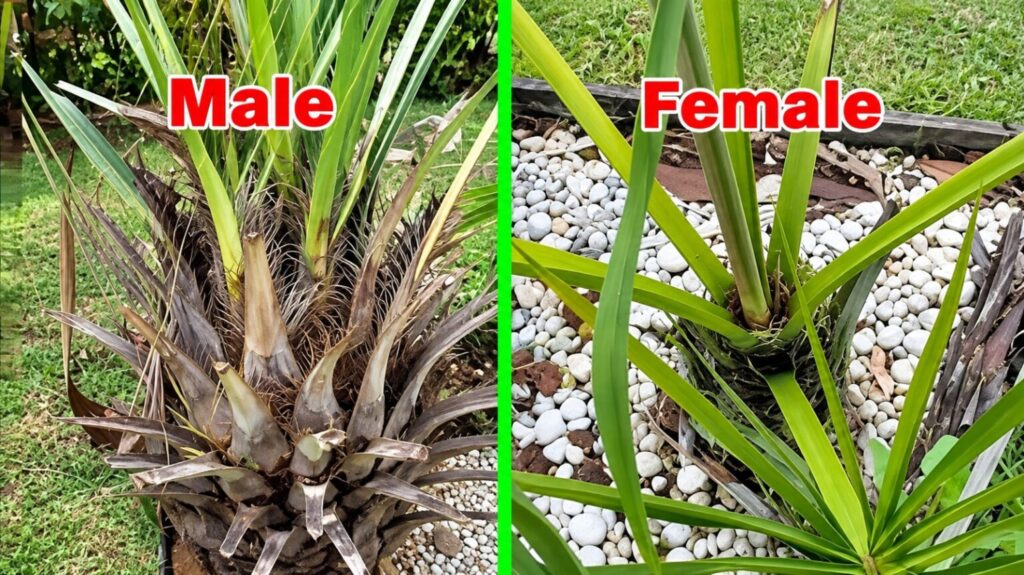
The male flower has stamens, which make pollen. The male flower has small stigmas or none at all. The female flower has stigmas and ovaries, which receive pollen and grow into dates. The female flower has no stamens.
Both sexes carry flowers inside a protective sheath called a spathe. The spathe opens and shows the flower strands. The male spathe releases pollen. The female spathe waits for pollen to arrive.
3. Male date palms flower earlier than females
Male palms open their spathes before females in many varieties. Research from Pakistan notes males shed pollen right after the spathe opens. A study of the Khadrawy, Saidy and Shamran cultivars found the gap between male and female opening forces growers to store pollen for later use.
In India, male spathes open from December to March. In Eritrea, flowering occurs from January to March. Your Kenyan site decides your own dates. Record the date each palm flowers for three seasons and you will know your calendar.
4. Males and females do different jobs on your farm
Female palms earn money. Male palms support the females. One male palm supplies pollen to many females in a commercial orchard. A male palm takes up land and water but sells nothing.
Some growers abroad buy male flowers from local markets at pollination time. This lets them skip male palms. Kenya’s date industry is new, so you should grow your own males in the first years.
5. Males and females appear in different numbers
Wild stands have about equal numbers of males and females. A commercial orchard does not. FAO reports a male to female ratio of 1 to 50, or 2 percent, in a modern plantation. The World Agroforestry Centre reports 1 male to 40 or 50 females. Some oasis farms in Oman go up to 1 male for 100 females, with hand pollination.
The next section explains how to choose your ratio.
6. A young date palm shows no sign of sex
Neither a seed nor a young plant shows sex. The palm shows sex at first flowering, around 4 to 5 years old. A farmer who plants 1,000 seeds gets about 500 males and 500 females. Seed grown palms also vary in fruit quality.
This problem is why commercial growers use offshoots or tissue culture plants. These plants are copies of a known mother palm. The planter then knows the sex and the variety before planting. The World Agroforestry Centre notes suckers are preferable because you choose male or female plants.
7. The male you choose changes your fruit
Pollen from different males changes fruit set, bunch weight and fruit quality. A study on the Barhee variety in Bikaner, India, tested different male sources and found the pollen source plays a key role in yield and quality. A Pakistani trial on the Dhakki variety found significant differences in fruit set and bunch yield between 15 male palms.
Farmers call this effect pollen influence on the fruit. A poor male gives poor fruit set. A good male gives heavy bunches. Select your males with the same care as your females.
The 7 differences in one table
| Feature | Female date palm | Male date palm |
|---|---|---|
| Bears dates | Yes | No |
| Flower parts | Stigmas and ovaries, no stamens | Stamens with pollen, small or no stigmas |
| Flowering time | Later in most varieties | Earlier in most varieties |
| Job on the farm | Earns income | Supplies pollen |
| Share of the orchard | About 98 percent | About 2 percent |
| Sex known | At first flowering, or from the mother palm if you plant offshoots | At first flowering, or from the mother palm if you plant offshoots |
| Effect on fruit | Sets the variety and the fruit type | Changes fruit set, bunch weight and quality |
How Many Male Date Palms Do You Need Per 100 Females?
You need 2 male date palms for every 100 females in a mature commercial orchard with hand pollination. This number comes from the FAO ratio of 1 male to 50 females. Farmers Trend Limited advises you to plant 3 males per 100 females in a new orchard. The third male covers a male which flowers late, sheds weak pollen or dies.
Sources give different ratios. The table below shows each figure and what each ratio gives you for 100 females.
| Ratio | Males per 100 females | Source and setting |
|---|---|---|
| 1 male to 1 female | 100 | Natural stands with wind pollination |
| 1 male to 40 to 50 females | 2 to 2.5 | World Agroforestry Centre profile |
| 1 male to 50 females (2 percent) | 2 | FAO, modern plantation with artificial pollination |
| 1 male to 100 females | 1 | Oman farms with hand pollination by skilled climbers |
The ratio rises as pollination quality falls. Wind and insects give weak pollination in an orchard. Hand pollination or machine pollination gives strong results with fewer males. An orchard with few trained workers needs more males, not fewer.
Why Farmers Trend Limited advises 3 males per 100 females at the start
Your first years carry risk. A male palm might flower after the females open. A male might produce little pollen. A male might die from pests or poor care. One spare male costs you 1 percent of your land. A missed pollination costs you a full season of fruit.
After three seasons, you know which males flower on time and which give the best fruit set. Keep the best males. Remove the weak males and replace them with female palms.
What the ratio looks like on a hectare
The table below applies the 2 percent ratio to common spacings. A hectare holds 10,000 square metres. Divide by the area per palm and you get palms per hectare.
| Spacing | Palms per hectare | Males at 2 percent | Females |
|---|---|---|---|
| 10 by 10 metres | 100 | 2 | 98 |
| 9 by 9 metres | 123 | 2 | 121 |
| 8 by 8 metres | 156 | 3 | 153 |
| 7 by 7 metres | 204 | 4 | 200 |
Males use about 2 percent of your land. Every other palm earns fruit. This is why the ratio protects the whole orchard at low cost.
How much pollen 100 females need
FAO states one adult female palm produces 15 to 25 spathes on average. FAO also states 1 gram of pollen pollinates ten female spathes. For 100 females, you pollinate 1,500 to 2,500 spathes. This needs 150 to 250 grams of pollen per season.
Use this figure to plan your male count and your pollen storage. A strong male gives enough pollen for many females when you collect and store the pollen with care.
Where to place your male palms
Spread your males through the orchard. Do not plant all of them in one corner. Farmers Trend Limited advises one male in each block of 50 females. You then collect pollen close to the females and carry the pollen fast to the spathes.
How to Identify Male and Female Date Palms
You have three ways to know the sex of a palm. Choose the method which suits your budget and your timeline.
Wait for the first flowers
A palm shows sex when the first spathe opens at around 4 to 5 years. A male spathe gives off yellow pollen. A female spathe holds strands with small flowers which carry ovaries and no pollen. This method costs nothing. This method also costs you 4 to 5 years of orchard space with a risk of planting too many males.
Buy offshoots from a mother palm of known sex
An offshoot grows at the base of the mother palm. The offshoot carries the same sex and variety as the mother. When the mother is female and bears good fruit, the offshoot is female and bears the same fruit. Ask Farmers Trend Limited to name the mother palm and describe her fruit.
Buy tissue culture plantlets from a named source
Tissue culture produces many plants from small tissue samples in a laboratory. Plants from the same culture show consistent size, colour and sweetness. A good laboratory records the sex and variety of each batch. Ask for the written record before you pay.
Seed, Offshoot or Tissue Culture: Which Keeps Your Sex Ratio Right
Your planting material decides how many males you get. The table compares the three options.
| Planting material | Sex known before planting | Fruit quality | Result for your ratio |
|---|---|---|---|
| Seed | No, shows at flowering | Varies from tree to tree | About half the palms turn out male |
| Offshoot | Yes, same as the mother | Same as the mother | You set the ratio yourself |
| Tissue culture | Yes, if the laboratory records the sex | Uniform within a batch | You set the ratio yourself |
Seed grown palms look cheap. They cost you more in the end. If half your palms are male, you lose half your fruiting land. If your females vary in quality, you have no uniform product to sell.
Kutch Farm in Kibwezi, Makueni County, grows Indian and Israeli date varieties, and the farm shows yields of up to 200 kg per tree. Government officials visiting the farm reviewed the full cycle, from selection of male and female palms to controlled pollination, irrigation and harvest. This tells you where Kenya expects the industry to go.
Medjool Date Palm Offshoots at KSh 1,500 From Farmers Trend Limited
Farmers Trend Limited sells Medjool date palm offshoots at KSh 1,500 each. The offshoots are healthy and well established. They suit commercial farmers and small scale farmers.
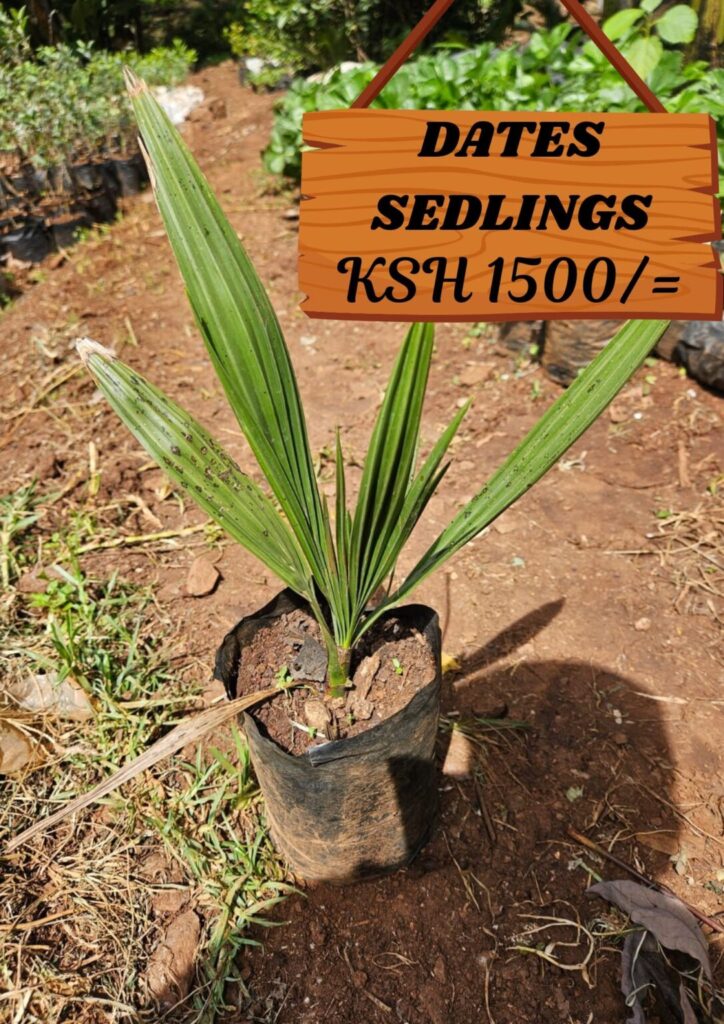
An offshoot copies the mother palm, so you know the variety and the sex. Ask Farmers Trend Limited to confirm the sex of every offshoot you order. This step protects your male to female ratio.
Why Medjool suits your orchard
Medjool is one of the most preferred commercial date varieties. The fruit is large, soft and sweet. Demand is high in Kenya and abroad. Kenyan officials report Medjool fetches up to KSh 1,200 per kilo on export markets. The variety performs well in hot, dry regions and gives good returns under proper management.
Why offshoots give you true-to-type palms
Farmers Trend Limited propagates date palms from offshoots. You get true-to-type plants with known fruit quality. Offshoot grown palms establish faster and keep the traits of the mother plant. A seed grown palm gives you neither a known sex nor a known fruit.
What your offshoots cost
| Number of offshoots | Cost at KSh 1,500 each |
|---|---|
| 10 | KSh 15,000 |
| 50 | KSh 75,000 |
| 100 | KSh 150,000 |
| 200 | KSh 300,000 |
One hectare at 7 by 7 metres holds about 200 female palms. The female offshoots cost KSh 300,000. Farmers Trend Limited also gives farming guidance and arranges delivery.
Where Medjool offshoots fit best
Medjool offshoots suit commercial date farms, agroforestry projects, irrigated dryland farming and export oriented fruit production.
Where Male and Female Date Palms Grow Best in Kenya
Dates perform best in warm, dry and semi-arid regions with plenty of sunlight. Farmers Trend Limited recommends Makueni, Kitui, Machakos, Kajiado, Taita Taveta, Tharaka Nithi, Baringo, Isiolo, Samburu, Turkana, Garissa, Wajir and Mandera. Farmers Trend Limited also recommends the lower zones of Meru and Embu and the hot areas of Laikipia. With irrigation, commercial date farming works in many other regions.
| Requirement | Target for your orchard |
|---|---|
| Temperature | 25 to 40 degrees Celsius |
| Sunshine | Long sunny seasons |
| Humidity | Low during fruit ripening |
| Rainfall | Low during flowering and harvest |
| Soil type | Deep, well drained sandy loam, or sandy soil with good drainage |
| Soil fertility | Enough organic matter |
| Soil pH | 6.5 to 8.0 |
| Drainage | No waterlogging |
Hot and dry climates give better fruit quality. Avoid waterlogged areas because poor drainage harms root health. Test your soil and your irrigation water before you plant.
How to Pollinate Male and Female Date Palms Step by Step
Commercial date farms use hand pollination. FAO describes the old method of placing a whole male spathe in the crown of a female palm and leaving the rest to the wind. Modern farms use artificial pollination because this gives good fruit set and reduces the number of males you need.
Step 1: Collect male spathes at the right time
Cut the male spathe right before the flowers open. A trial in Australia collected male inflorescences once they emerged from the spathe and before anthesis. The workers hung the strands over clean sheets of paper to catch the pollen.
Step 2: Dry, sieve and store the pollen
Sieve the pollen through a fine mesh to remove plant parts. The Australian trial used a 100 micron sieve. Store the pollen in an airtight container. The trial stored all pollen sources at 4 degrees Celsius over silica gel for extended periods. A household fridge gives this temperature. Label every container with the name of the male palm and the date.
Stored pollen protects you from the flowering gap. Males flower early in many varieties. Fresh pollen is not ready at the time the females open. Stored pollen is.
Step 3: Watch for female spathe opening
Check your female palms every day from the expected flowering period. The spathe splits open and shows the flower strands. Mark each palm with the date of opening.
Step 4: Pollinate on the second to fourth day
An Indian trial on Barhee pollinated between the second and fourth days after spathe opening to match receptivity. Receptivity varies by variety. A study on Deglet Nour reports a receptive period of about 7 days. Ask your seedling supplier for the receptive period of your variety.
Place a few male strands inside the female spathe. Tie the spathe closed with soft string. Some farmers cover the bunch with a paper bag for protection. Pollinate each new spathe as the spathe opens.
Step 5: Repeat the pollination
One palm opens several spathes over weeks. FAO notes pollinating each freshly opened spathe gives more reliable results than pollinating the whole palm once. Repeat until you pollinate every spathe you plan to keep.
Step 6: Check the fruit set
The Indian trial confirmed fruit set 10 to 14 days after pollination. Look for small green fruitlets on the strands. A bunch with many empty spots needs a second look at your pollen quality and your timing.
Large orchards: machine pollination
FAO describes mechanical pollination with a duster driven along the date rows. A pollen to filler ratio of 1 to 4 and three passes gave high yields in older US trials. Machines suit orchards where labour is costly. FAO also notes a worker climbs each palm 8 to 10 times from pollination to harvest, which shows how heavy the work is.
Matching Your Male Date Palms to Your Female Varieties
A male is not a universal pollinator. Different males give different results on the same female. The Northern Territory Government of Australia ran trials to find the best male pollinator for each female variety. The work found some males produced almost twice the pollen weight of others.
Follow four rules when you choose males.
| Rule | What you do |
|---|---|
| Match the male to the female | Ask the supplier which male gives the best fruit set on your female variety |
| Test before you scale | Pollinate a few females with each male and compare fruit set and bunch weight |
| Check flowering time | Pick males which flower within a few weeks of your females, or store pollen |
| Keep records | Note each male by number with the date, pollen volume and results |
After two seasons your records show which males earn their place. Keep them. Replace the rest.
Spacing and Planting for Male and Female Date Palms
Date palms need space. A mature palm reaches 20 to 30 metres in height in the best conditions and spreads long leaves. Sources give a range of spacings. A Taiwan government report notes commercial plantations at 10 by 10 metres, with 9 by 9 metres also in use. An international saline agriculture trial used 8 by 8 metres. A University of Khartoum irrigation study used 8 by 10 metres.
Farmers Trend Limited recommends 7 by 7 metres for Medjool offshoots. Each palm gets 49 square metres. This spacing gives room for root development, sunlight, farm operations and efficient irrigation. Keep the same spacing for males and females.
| Area | Palms at 7 by 7 metres | Males at 2 percent | Females |
|---|---|---|---|
| One acre (4,047 square metres) | About 83 | 2 | 81 |
| One hectare (10,000 square metres) | About 204 | 4 | 200 |
How to plant Medjool date offshoots
Select a sunny, well drained site. Dig planting holes 60 cm wide, 60 cm long and 60 cm deep. Mix the topsoil with well decomposed manure and refill the hole.
Plant the offshoot at the same depth as in the nursery bag. Never bury the growing point at the centre of the crown. The Taiwan report warns the growing point rots when water covers the crown.
Firm the soil around the offshoot. Water at once after planting. Mulch around the base and leave space around the stem. Build a basin around the trunk so the water stays in the root zone.
Water and soil
Date palms tolerate drought, but commercial production needs regular watering. Use drip irrigation for the best results. Water deeply to encourage strong roots. Give more water during flowering and fruit development. Water need depends on climate, soil and palm age.
Date palms tolerate salty soil and water better than many fruit crops. The ICBA trial in the Arabian Peninsula found low to moderate salinity does not harm fruit quality, and high salinity harms some varieties. A salt test of your water before you plant protects your investment.
The guideline from the International Center for Biosaline Agriculture shows daily water use changes with spacing, tree age and the ripening stage. Ask an agronomist to design your drip system.
What Male and Female Date Palms Earn in Kenya
Kenya imports most of the dates Kenyans eat. Kenyan government officials say Medjool fetches up to KSh 1,200 per kilogram on export markets. They estimate a mature, well managed hectare earns KSh 3.4 million to KSh 4.4 million per year. Eastleigh Voice reports Nairobi City Market prices from KSh 300 to over KSh 1,200 per kilo, depending on quality and origin.
Treat these numbers as planning ranges. Your income depends on the variety, the price you get and the yield per palm. The table below uses 200 female palms on one hectare at 7 by 7 metres, with 4 males. All figures are gross sales in KSh, before costs.
| Yield per female palm | Kilos per hectare | At KSh 300 per kilo | At KSh 500 per kilo | At KSh 800 per kilo |
|---|---|---|---|---|
| 30 kg | 6,000 | 1,800,000 | 3,000,000 | 4,800,000 |
| 50 kg | 10,000 | 3,000,000 | 5,000,000 | 8,000,000 |
| 100 kg | 20,000 | 6,000,000 | 10,000,000 | 16,000,000 |
The government range of KSh 3.4 million to KSh 4.4 million sits near 30 kg per palm at KSh 600 to KSh 700 per kilo. Eastleigh Voice reports yields of 50 to 100 kg per palm per season, depending on variety and climate. Plan with the lower figures.
Test your cost against your income. The 200 female offshoots cost KSh 300,000 at KSh 1,500 each. At 30 kg per palm and KSh 500 per kilo, one season of fruit from 200 palms sells for KSh 3,000,000. This is 10 times the offshoot cost.
Date palms do not pay in year one. Farmers Trend Limited expects early fruiting at 4 to 6 years under good management. Full commercial production improves as palms mature. A World Agroforestry Centre profile reports about 45 kg per tree after 6 to 7 years in Eritrea. Budget for water, labour and pollination for several seasons before your first sale. The 4 male palms on your hectare use 2 percent of the land. They protect the other 200 palms.
Pests, Fruit Care and Bunch Management
The red palm beetle is a major pest of palms. Inspect the crown and the trunk every month. Report heavy damage to your county agriculture office. Remove and bury damaged offshoots and plants.
Thin your fruit early. The University of Nevada guide advises thinning from the time the fruit is pea sized. A mature healthy palm carries 10 to 12 fruit stalks without overload. A palm which carries too many bunches falls into alternate bearing, with little or no fruit every second year.
Tie the bunches so the fruit clusters hang freely. Support the stalk so the weight does not break the stalk. Protect ripening fruit from rain and birds. Date palms need low humidity during ripening.
Common Mistakes With Male and Female Date Palms
| Mistake | Result | Fix |
|---|---|---|
| Planting seed grown palms | About half turn out male and fruit quality varies | Plant offshoots or tissue culture plants of known sex |
| Planting too few males | Poor fruit set and empty bunches | Plant 2 males per 100 females, plus 1 spare |
| Planting too many males | Wasted land and lower income | Hold males near 2 to 3 percent |
| Ignoring the flowering gap | No pollen when females open | Collect and store pollen at 4 degrees Celsius |
| Pollinating on the wrong day | Weak fruit set | Pollinate on days 2 to 4 after spathe opening and repeat |
| Using one random male | Low yield and uneven fruit | Match the male to the female and keep records |
| Burying the growing point | Dead plant | Keep the crown clear of soil and water |
| Leaving too many bunches | Alternate bearing | Thin early and keep 10 to 12 stalks on a mature palm |
| Skipping a water salt test | Poor growth and fruit quality | Test water before you plant |
Frequently Asked Questions About Male and Female Date Palms
What are the main differences between male and female date palms?
Female palms bear dates and have flowers with ovaries. Male palms produce pollen and bear no fruit. Males flower earlier in many varieties. You plant far fewer males than females. You know the sex only at flowering unless you plant offshoots or tissue culture plants of known sex.
How many males do you need per 100 females?
You need 2 males per 100 females in a mature orchard with hand pollination, based on the FAO ratio of 1 to 50. Farmers Trend Limited advises 3 males per 100 females in a new orchard to cover late flowering or weak pollen.
Does a male date palm ever bear dates?
No. A male date palm produces pollen and never bears fruit. A male stays male for life.
Do I need a male palm if I plant only one female?
You need pollen from a male. A single female without pollen gives few dates or none. Plan to obtain pollen from a source of known quality, or plant at least one male near your females.
When do date palms show their sex?
Date palms show their sex at first flowering, around 4 to 5 years of age. A seed or a young plant shows no sign of sex.
Is wind enough to pollinate date palms?
Wind pollinates date palms in wild stands, which have about equal numbers of males and females. Commercial orchards use hand or machine pollination to get good fruit set with only 2 percent males.
When do I pollinate the female palm?
Pollinate on the second to fourth day after the female spathe opens, and repeat as new spathes open. Fruit set shows 10 to 14 days later.
Which Kenyan counties suit date palms?
Officials name Wajir, Mandera, Marsabit, Turkana, Garissa, Kitui, Tana River and Makueni. Farmers Trend Limited lists more counties in the section above. Hot, dry areas with sandy, well drained soils and low humidity during ripening suit the crop.
How much do Medjool date palm offshoots cost?
Farmers Trend Limited sells Medjool date palm offshoots at KSh 1,500 each. One hundred offshoots cost KSh 150,000.
How many date palms fit in one acre?
At 7 by 7 metres, one acre holds about 83 palms. Plant 81 females and 2 males, and add 1 spare male in a new orchard. One hectare holds about 204 palms.
How long before my date palms earn money?
Farmers Trend Limited expects early fruiting at 4 to 6 years under good management. Meaningful harvests build over the following years. A World Agroforestry Centre profile reports about 45 kg per tree after 6 to 7 years in Eritrea. Plan your cash flow for several years without date income.
Plant the Right Mix of Male and Female Date Palms From Day One
Male and female date palms decide your harvest. The female bears the dates. The male supplies the pollen. You plant about 98 females for every 2 males, and you add 1 spare male in a new orchard. For 100 females, you need 2 males, or 3 with the spare. The pollen from your males must reach your females on the second to fourth day after the spathe opens.
Your steps are clear. Choose a dry site with well drained soil and a water supply you have tested for salt. Buy offshoots or tissue culture plants of known sex from a named source. Plant at 7 by 7 metres, with the offshoot at bag depth and the growing point clear of soil. Spread your males through the orchard. Collect pollen before the flowers open and store the pollen at 4 degrees Celsius. Pollinate your females by hand, record every result and keep the best males. Thin the fruit early.
Kenya expects the date industry to grow in the arid counties. The farmers who learn the male and female system first gain the most. Farmers Trend Limited sells Medjool date palm offshoots at KSh 1,500 each, with farming guidance and delivery arrangements. Call 0790 509 684 or write to info@farmerstrend.co.ke to order and plan your orchard.
https://farmerstrend.co.ke/trending/male-and-female-date-palms/https://farmerstrend.co.ke/wp-content/uploads/2026/10/images-2026-10-22T133125.561.jpghttps://farmerstrend.co.ke/wp-content/uploads/2026/10/images-2026-10-22T133125.561-150x150.jpg# TrendingDates FarmingFruitsIn Fruits500,date farming counties in Kenya,date farming in Kenya,date palm climate requirements,date palm farming for beginners,date palm irrigation,date palm offshoots for sale,date palm planting guide,date palm pollen,date palm pollination,date palm profit per hectare,date palm seedlings,date palm seedlings KSh 1,date palm seedlings price in Kenya,date palm soil requirements,date palm spacing 7 by 7 metres,date palms per acre,dates in Garissa,dates in Kajiado,dates in Kitui,dates in Makueni,dates in Turkana,dates in Wajir,drip irrigation date palms,dryland farming Kenya,Farmers Trend Limited,fruit farming in kenya,hand pollination of date palms,how many male date palms per 100 females,identify male and female date palms,male and female date palms,male date palm ratio,Medjool date palm offshoots,Medjool date palm seedlings,Medjool dates Kenya,Medjool dates price per kiloMale and female date palms are two separate trees, and only one of them bears dates. The female palm grows the fruit. The male palm grows the pollen. Without pollen from a male, your female palms give you few dates or none. This single fact decides how many palms...FarmersTrendjohn doefarmerstrend@gmail.comAdministratorFarmers Trend Ltd.






Leave a Reply