FRUIT FARMING FOR SALARIED WORKERS: 5 PROVEN WAYS TO RUN AN ORCHARD FROM TOWN
Fruit farming for salaried workers works when you run your orchard like a second job with a clear system. You hold a job in town. Your trees stand in a village or a nearby county. You are not at the farm every day, so your plan must work while you are away.
The opportunity is real. FAS Nairobi projects Kenya’s avocado production to rise 4.8 percent in 2026 to 727,000 tonnes. Kenya is Africa’s top avocado exporter by volume. Demand for fruit grows and trees keep producing for decades. The Agricultural Finance Corporation lends at a fixed 10 percent interest rate. SACCOs reach rural borrowers.
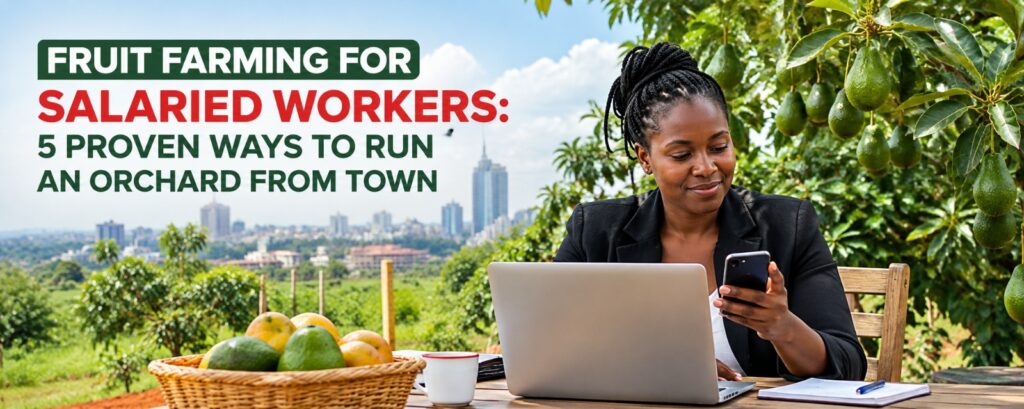
This guide to fruit farming for salaried workers gives you five proven ways to run an orchard from town. You will see how to hire and control a caretaker. You will learn which trees need the least labour. You will see how to automate water. You will learn how to manage the farm by phone. You will learn how to sell and finance without quitting your job. You also get a weekly time plan, a budget example with real arithmetic and a list of mistakes to avoid.
What Is Fruit Farming for Salaried Workers?
Fruit farming for salaried workers means you keep your job and build an orchard as a second income. You own or lease the land. A caretaker does the daily work. You make decisions, pay bills, check reports and visit on a schedule. Your salary pays for the first years while the trees grow.
Your role is manager, not labourer. A manager sets goals, tracks money and checks results. Weeding, watering, spraying and picking belong to your caretaker and casual workers. When you treat the orchard as a business with a manager and a worker, you protect both your job and your trees.
Land is the first requirement in fruit farming for salaried workers. Many salaried Kenyans hold family land in a rural county. Others lease land near town. Both routes work. You need a title deed or a written lease. You need a water source. You need a road your lorry or pickup reaches.
Why Fruit Farming for Salaried Workers Makes Sense in Kenya
Trees give you income for decades. A grafted Hass avocado tree gives the first fruit in two to three years. At maximum production, a single mature tree gives 70 to 100 kg of fruit a year, according to a Kenyans.co.ke profit guide. A Nation report from Murang’a in January 2026 says a healthy avocado tree gives 350 to 500 fruits per season. Over 80 percent of farmers in one area grow Hass.
Fruit farming for salaried workers also spreads your risk. Your salary stays steady while trees grow. Your orchard income does not depend on your employer. After you retire, the same trees keep paying.
Support exists. The Agricultural Finance Corporation reports the client base grew from roughly 119,000 to 213,000 borrowers. The corporation offers asset financing and structured value chain financing. Nurseries, county extension officers and farmer groups also supply seedlings and advice.
Choose the Right Location for Fruit Farming for Salaried Workers
Location decides your costs, your visits and your buyers. Match the tree to the zone first.
- Hass avocado grows well in highland counties such as Murang’a, Nyeri and Kiambu.
- Grafted mango suits warm lowland counties.
- Macadamia suits the lower tea and coffee zones.
Then match the farm to your calendar. Count the hours from your home to the farm on a normal Friday evening. A farm you reach in a few hours allows weekend visits without leave days. A farm you reach in a full day costs you more in transport and time. Visits drop.
Check the road and the water. A tarmac or murram road which stays open in the rains lets buyers collect fruit. A reliable water source keeps young trees alive. Ask neighbours about dry-season water before you sign a lease or buy land.
Five Checks Before You Start Fruit Farming for Salaried Workers
Run these checks before you start fruit farming for salaried workers and before you buy a single seedling. Each check protects your money.
✔ Check 1, land: Confirm you hold a title deed or a signed lease. A lease must state the years, the rent and who owns the trees at the end.
✔ Check 2, water: Confirm a reliable source such as a borehole, a river with a permit, a pan or roof water in a tank. Trees die in the first dry spell without water.
✔ Check 3, distance: Choose a farm you reach in a few hours. A shorter trip means more visits and tighter control.
✔ Check 4, caretaker: Confirm a reliable person lives on or near the land. Housing on the farm helps you keep a good caretaker.
✔ Check 5, buyer: Talk to an exporter, an aggregator or a farmer group before you plant. Learn the grades and the price they pay.
Way 1: Hire a Caretaker for Your Orchard and Sign a Written Contract
A caretaker is the most important decision in fruit farming for salaried workers. A good caretaker protects your trees every day. A poor one wastes your money and hides problems.
Know What a Caretaker Costs
Kenyan job listings show the going rates. A farm hand job in Kirinyaga lists a salary of Sh12,000 a month. A farm worker job in Kajiado lists Sh15,000 a month. At these rates, one full-time worker costs Sh144,000 to Sh180,000 a year. Your orchard income must cover this cost.
Write a Contract With Clear Terms
Huduma Global advises absentee owners to use a management contract with five parts: responsibilities, compensation, reporting requirements, termination conditions and a way to settle disputes. Put the same five parts in your caretaker agreement. Sign the agreement with a witness. Keep a copy at home and give a copy to your caretaker.
State the duties in plain words. List weeding, watering, mulching, spraying, pruning help, harvesting and reporting. State the working days and the leave days. State the pay date. State what happens when trees die from neglect.
Pay a Wage Plus a Result Bonus
Pay a fixed monthly wage on a fixed date. Add a small bonus tied to the kilos you sell. A bonus aligns the caretaker with your goal. Pay by M-Pesa so you hold a record of every payment.
Control Money With a Farm Account
Open a separate M-Pesa or bank account for the farm. Huduma Global advises a dedicated account and receipts for every expense. Set a spending limit. For example, allow your caretaker to spend up to Sh2,000 without asking you. Require a receipt or a photo for every purchase.
Match Labour Cost to Orchard Size
A full-time caretaker only pays when your orchard is large enough. The table shows an example. The example assumes a Hass orchard at 8 m by 8 m spacing, a mature yield of 70 kg per tree, a farm gate price of Sh30 per kilo and a caretaker at Sh15,000 a month, or Sh180,000 a year. These figures are planning examples. Replace them with your own.
| Orchard size | Trees | Yearly income at maturity | Caretaker share of income |
|---|---|---|---|
| 1 acre | 63 | Sh132,300 | 136 percent |
| 2 acres | 126 | Sh264,600 | 68 percent |
| 5 acres | 316 | Sh663,600 | 27 percent |
| 10 acres | 632 | Sh1,327,200 | 14 percent |
The table shows a clear rule. Orchards below about two acres do not support a full-time caretaker. On a small orchard, share one caretaker with a neighbour and split the wage. Two farmers who split Sh12,000 pay Sh6,000 each. You also hire casual workers for weeding and harvest and pay only for days worked.
Remember the delay. Trees take years to reach full yield. Your salary covers caretaker costs in years one to three. Plan your cash flow before you plant.
Way 2: Choose Low-Labour Fruit Trees for Fruit Farming for Salaried Workers
Tree choice decides how many hours your orchard demands in fruit farming for salaried workers. Long-lived tree crops need less daily work than short-cycle crops. Choose trees which tolerate your caretaker’s occasional mistakes and need few interventions.
| Tree | Time to first fruit | Zone | Labour needs |
|---|---|---|---|
| Hass avocado | 2 to 3 years (grafted) | 1,500 to 2,100 m | Low. Peaks at planting, pruning and harvest |
| Grafted mango | 3 to 4 years | Warm lowlands | Low. Peaks at harvest |
| Macadamia | 4 to 6 years | 1,000 to 1,700 m | Low. Weekly nut collection in season |
| Purple passion fruit | 6 to 9 months | 1,200 to 2,000 m | High. Weekly scouting, disease control and replanting |
Hass Avocado for Fruit Farming for Salaried Workers
Hass avocado is the strongest choice for most salaried farmers in the highlands. The tree lives for decades. Buyers exist in local and export markets. Murang’a, Nyeri, Kiambu and Uasin Gishu all grow Hass.
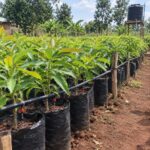
Plant Hass on well-drained ground. Waterlogging causes root rot, a risk the Nation report also stresses. Plant on mounds in wet soil. At 8 m by 8 m spacing, one acre holds about 63 trees. Mulch each tree to cut weeding work. Buy certified grafted seedlings from a registered nursery.
Grafted Mango and Macadamia
Grafted mango suits warm lowlands. Trees fruit about three to four years after planting and need little care between harvests. Macadamia suits lower tea and coffee zones and needs weekly nut collection in season. Both trees suit a caretaker who visits the orchard daily and has few tasks between harvests.
Passion Fruit Needs More Control
Passion fruit gives income in 6 to 9 months but needs close attention. Vines live a few years, and woodiness and wilt diseases need weekly scouting. Add passion fruit only after your caretaker proves reliable with tree crops. Clean seedlings and a weekly check protect the investment.
Way 3: Automate Water With Drip Irrigation and Storage Tanks
Water is the biggest labour saver in fruit farming for salaried workers. A caretaker who carries water by hand cannot keep a large orchard alive. Drip irrigation delivers water at the root and needs little labour once installed.
Install three parts.
- Storage: A tank or pan stores water.
- Movement: A pump or gravity line moves the water.
- Delivery: Drip lines with emitters deliver the water to each tree.
Add a timer which opens the valve at a set hour. Early morning watering cuts evaporation loss.
Ask at least three suppliers for written quotes per acre. Compare the cost of tubing, emitters, filters, tank and installation. Ask each supplier about solar pumping. Solar systems remove fuel costs and theft risk of fuel. Ask for a warranty and training for your caretaker.
Train your caretaker to check the system. Look for blocked emitters, leaks and tank level on every watering day. Send a photo of the tank gauge to you each week. Fix leaks early. A leak wastes water and starves trees at the end of the line.
Mulch every tree. Straw or dry grass around the base holds moisture and cuts weeding. Together, drip lines and mulch reduce your caretaker’s work and your water bill.
Way 4: Run Your Orchard by Phone With a Simple Reporting System
You manage fruit farming for salaried workers from town. Your tools are a phone, a messaging group and a record sheet. Build a routine and follow the routine every week.
Use a Daily Photo and a Weekly Call
Ask your caretaker to send one dated photo each working day. The photo shows the task done, such as weeding or watering. Huduma Global advises regular photographic and video updates from the farm manager. Hold a 15-minute call on a fixed day each week. Review the photos, the plan for next week and the money spent.
Keep a Simple Record Sheet
Use a notebook or a spreadsheet. Record each week’s tasks, costs, tree problems and sales. A clear record shows you which trees perform and where money leaks. Banks, SACCOs and exporters ask for records.
| Record | What you write | Who writes |
|---|---|---|
| Daily photo | Date, task done, tree block | Caretaker |
| Expense log | Item, amount, receipt photo | Caretaker |
| Tree health note | Yellow leaves, pests, dead trees | Caretaker |
| Sales sheet | Kilos, buyer, price, payment date | You and caretaker |
| Monthly summary | Total cost, total sales, balance | You |
Use Technology Which Fits Your Budget
You need no costly software. A phone camera, a messaging group and a shared spreadsheet cover most needs. Create one messaging group with you and your caretaker. Post the daily photo and the weekly plan in the group. Keep the group free of other chatter. Some owners install solar-powered cameras at the farm gate and the store. Add cameras only after your basic routine works.
Visit on a Schedule
Visit your orchard at least once a month, and every week at harvest. Arrive without warning on some visits. Walk every row. Count trees, check mulch and drip lines, and look at leaves for pests and disease. Compare what you see with the photos you received. Pay wages at the farm on visit days so you meet your caretaker in person.
Set Clear Rules for Problems
Agree in advance on what the caretaker does when problems appear. For pests or sick trees, the caretaker sends a photo to you and to your agrovet on the same day. For a broken pump, the caretaker calls you at once. For theft or damage, the caretaker reports to the village elder and to you. Clear rules prevent delays.
Way 5: Use Groups, Buyers and Finance for Fruit Farming for Salaried Workers
◆ Join a Farmer Group
In fruit farming for salaried workers, a farmer group sells larger volumes and negotiates better prices. A group also shares transport and training. If you live in town, a group in the farm’s county gives your caretaker support and gives you a local contact. Choose a group with a written constitution and a bank account.
◆ Secure a Buyer Before Harvest
Fruit farming for salaried workers pays only when you have a buyer. Agree on a buyer, a grade and a price range before your trees fruit. Exporters and aggregators want traceable, clean fruit and good records. Keep your record sheet current. Ask your county agriculture office which buyers operate in your area.
◆ Borrow Within Your Means
The Agricultural Finance Corporation lends at a fixed 10 percent interest rate. The corporation runs a wholesale model, so ask AFC which SACCO or partner serves your county. At 10 percent, a loan of Sh100,000 costs Sh10,000 in interest for one year. Borrow only for assets with a clear return, such as drip irrigation or seedlings. Do not borrow to pay your caretaker while your trees are young. Trees take years to repay.
◆ Consider a Farm Management Service
Some companies manage orchards for absentee owners for a fee. Check each company’s references. Ask to visit orchards they manage. Read the contract with a lawyer. A management service costs more than a caretaker but adds supervision, agronomy advice and sales.
Your Weekly Time Plan for Fruit Farming for Salaried Workers
This plan for fruit farming for salaried workers fits a full-time job. The plan asks for about two hours a week plus one monthly visit.
| Day | Task | Time |
|---|---|---|
| Monday | Review weekend photos and the caretaker’s plan for the week | 15 minutes |
| Wednesday | Check expenses and M-Pesa statement. Pay bills | 20 minutes |
| Friday | Weekly call. Review photos, tree health and next week’s plan | 15 minutes |
| Sunday | Update your record sheet and monthly summary | 30 minutes |
| Monthly | Visit the orchard. Walk every row and inspect the irrigation | One day |
Seasonal Calendar for Fruit Farming for Salaried Workers
Time your work to the rains. The short rains start in October in most farming regions. The long rains start in March. Match your tasks to each season.
- Before the short rains: Dig and fill planting holes. Install drip lines. Order seedlings. Plant into steady rain in October or November. Mulch each tree and stake young trees against wind.
- During the dry months, January to February: Water on schedule. Mulch. Weed. Check for pests. Replace seedlings which failed. Visit the farm to inspect the irrigation system.
- Before the long rains: Apply manure and fertiliser. Prune. Repair fences.
- During the long rains: Watch for waterlogging, disease and weeds. Plan harvest and transport for fruiting trees at least a month ahead.
Budget and Income Example for Fruit Farming for Salaried Workers
Use real numbers before you commit to fruit farming for salaried workers. This example covers two acres of Hass avocado with 126 trees. The figures are planning examples. Replace them with your own prices.
| Item | Calculation | Cost |
|---|---|---|
| Seedlings | 126 trees at Sh250 | Sh31,500 |
| Manure, fertiliser, digging and planting | 126 trees at Sh250 | Sh31,500 |
| Establishment total | Sh63,000 | |
| Shared caretaker, 3 years | Sh6,000 a month for 36 months | Sh216,000 |
| Inputs for 3 years | Sh20,000 a year for 3 years | Sh60,000 |
| Total cash needed in years 1 to 3 | Sh339,000 |
This orchard needs about Sh339,000 over three years with a shared caretaker. A full-time caretaker at Sh12,000 a month would add another Sh216,000 over the same period. Your salary covers these costs while trees grow.
Now the return. At maturity, 126 trees at 70 kg each give 8,820 kg. At Sh30 per kilo, income is Sh264,600 a year. At Sh20, income is Sh176,400. At Sh40, income is Sh352,800. Intercrops such as beans between young trees give early income in years one and two.
This example shows the truth about fruit farming for salaried workers. The orchard pays slowly and then pays for decades. A larger orchard gives a better return per caretaker shilling. Plan your size to match your cash and your time.
A Three-Year Plan for Fruit Farming for Salaried Workers
A plan keeps your spending and your time under control. This plan suits a two-acre Hass orchard in the highlands.
Year one: Secure water. Dig holes. Plant 126 certified grafted seedlings. Hire or share a caretaker on a written contract. Plant beans or vegetables between the rows for early income. Keep every receipt and photo. Visit monthly.
Year two: Replace dead trees. Prune for shape. Apply manure and fertiliser. Review your records with your caretaker. Talk to buyers and join a farmer group. Expect your first flowers late in the year.
Year three: Expect the first small harvest from grafted trees. Sort and grade the fruit. Sell through your buyer or group. Compare your costs with your sales. Decide whether to expand, keep the size or add a second tree crop. Use real records, not memory, to decide.
Mistakes to Avoid in Fruit Farming for Salaried Workers
| Mistake | Result | Fix |
|---|---|---|
| Hiring a caretaker without a written contract | Disputes and theft with no recourse | Sign a contract with duties, pay and reporting rules |
| Paying wages months in advance | Your caretaker loses motivation | Pay monthly on a fixed date |
| Buying land far from your home | Visits drop and control fades | Choose a farm you reach in a few hours |
| Planting before you secure water | Trees die in the first dry spell | Install water first and plant into steady rain |
| Planting high-labour crops first | Caretaker overload and crop failure | Start with tree crops and add short-cycle crops later |
| Mixing farm and personal money | No clear profit figure | Use a separate farm account |
| Skipping a buyer search | Fruit rots or sells at a low price | Agree on a buyer before harvest |
| Putting all savings in year one | Cash runs out before fruit | Budget for three years of costs |
Legal and Safety Basics for Fruit Farming for Salaried Workers
Protect your land and your people in fruit farming for salaried workers. Keep your title deed or lease in a safe place and carry a copy to the farm. Use a lawyer to draft a lease or a caretaker agreement. Follow the Employment Act and register your employee for statutory deductions where the law requires. Confirm current requirements with your county labour office.
Protect your trees from theft and livestock. Fence the orchard or plant a live fence. Keep records of every sale. Insure valuable equipment where cover exists. Keep a first aid kit and a protective kit for spraying.
Buy Certified Seedlings for Fruit Farming for Salaried Workers From Farmers Trend Limited
Good seedlings reduce your labour. Healthy grafted trees fruit earlier and need fewer replacements. Farmers Trend Limited supports fruit farming for salaried workers with fruit tree seedlings from nurseries in Murang’a and Nairobi. The company delivers countrywide.
Order certified grafted Hass avocado seedlings here:
Grafted Hass Avocado Seedlings
Tell the team your county, altitude and acreage. The team recommends trees for your farm and plans delivery to your caretaker.
Call or WhatsApp: 0724 559 286 or 0790 509 684
Email: info@farmerstrend.co.ke
Website: farmers trend
FAQ on Fruit Farming for Salaried Workers
What is fruit farming for salaried workers?
Fruit farming for salaried workers means you keep your job and run an orchard as a second income. A caretaker does the daily work. You manage by phone and monthly visits.
How much land do you need?
For fruit farming for salaried workers, start with one to two acres. One acre holds about 63 Hass trees at 8 m by 8 m spacing. A larger orchard spreads the cost of a caretaker over more trees.
Which fruit suits a salaried farmer?
Tree crops suit fruit farming for salaried workers best. Hass avocado suits highland farms. Grafted mango suits warm lowlands. These trees need little daily work.
How much does a caretaker cost?
Kenyan job listings show Sh12,000 to Sh15,000 a month for farm workers. Share a caretaker with a neighbour to halve this cost on small orchards.
How often should you visit?
For fruit farming for salaried workers, visit once a month and every week at harvest. Hold a weekly call and review a daily photo from your caretaker.
How long before you earn?
Grafted Hass gives the first fruit in two to three years. Grafted mango takes about three to four years. Passion fruit fruits in 6 to 9 months but needs more labour. Plan your cash for three years.
Are you able to borrow for an orchard?
Yes. The Agricultural Finance Corporation lends at a fixed 10 percent interest rate through a wholesale model. SACCOs lend to members. Borrow only for assets with a clear return.
Does this work with a nine to five job?
Yes. The weekly plan takes about two hours plus one visit a month. Your caretaker handles daily work.
Start Your Orchard This Short Rains Season Without Quitting Your Job
Fruit farming for salaried workers rests on five proven ways. Hire a caretaker on a written contract. Choose low-labour trees such as Hass avocado and grafted mango. Automate water with drip irrigation and a tank. Run the farm by phone with photos, calls and records. Use groups, buyers and fair finance.
Start small with fruit farming for salaried workers. Choose one to two acres you reach easily. Confirm your water, your caretaker and your buyer. Order certified seedlings and dig your holes before the short rains settle. Plant into steady rain and protect each tree from waterlogging.
Record your costs and your hours from the first week. Review your numbers every month. Add trees as your orchard pays. Contact Farmers Trend Limited on 0724 559 286 or 0790 509 684 to order your seedlings.
https://farmerstrend.co.ke/trending/fruit-farming-for-salaried-workers/https://farmerstrend.co.ke/wp-content/uploads/2026/10/WhatsApp-Image-2026-10-16-at-15.06.26-1024x409.jpeghttps://farmerstrend.co.ke/wp-content/uploads/2026/10/WhatsApp-Image-2026-10-16-at-15.06.26-150x150.jpeg# TrendingAvocado FarmingCropsFruitsIn cropsIn FruitsMacadamia FarmingMango FarmingPassion fruit farmingabsentee farming Kenya,Agricultural Finance Corporation loan,avocado farming Kenya,drip irrigation orchard,farm budget Kenya,farm management service,farm manager absentee owner,farm record keeping,farmer group Kenya,fruit buyer Kenya,fruit farming for salaried workers,fruit farming Kenya,fruit seedlings Kenya,grafted hass avocado seedlings,grafted mango farming,hass avocado farming,Kiambu avocado,long rains planting,low labour fruit trees,M-Pesa farm account,Macadamia Farming,Murang'a avocado,Nyeri avocado,orchard caretaker,part time farming Kenya,run an orchard from town,SACCO farm loan,salaried farmer Kenya,short rains planting,small orchard profitFruit farming for salaried workers works when you run your orchard like a second job with a clear system. You hold a job in town. Your trees stand in a village or a nearby county. You are not at the farm every day, so your plan must work while...FarmersTrendjohn doefarmerstrend@gmail.comAdministratorFarmers Trend Ltd.





Leave a Reply