AI in Agriculture in Kenya Raises Questions About Who Benefits as Technology Reaches Smallholder Farmers
- AI in agriculture in Kenya could improve weather forecasts, pest management and market access, but farmers need affordable tools, reliable advice and control over their farm data.
AI in Agriculture in Kenya Raises Questions About Who Benefits as Technology Reaches Smallholder Farmers
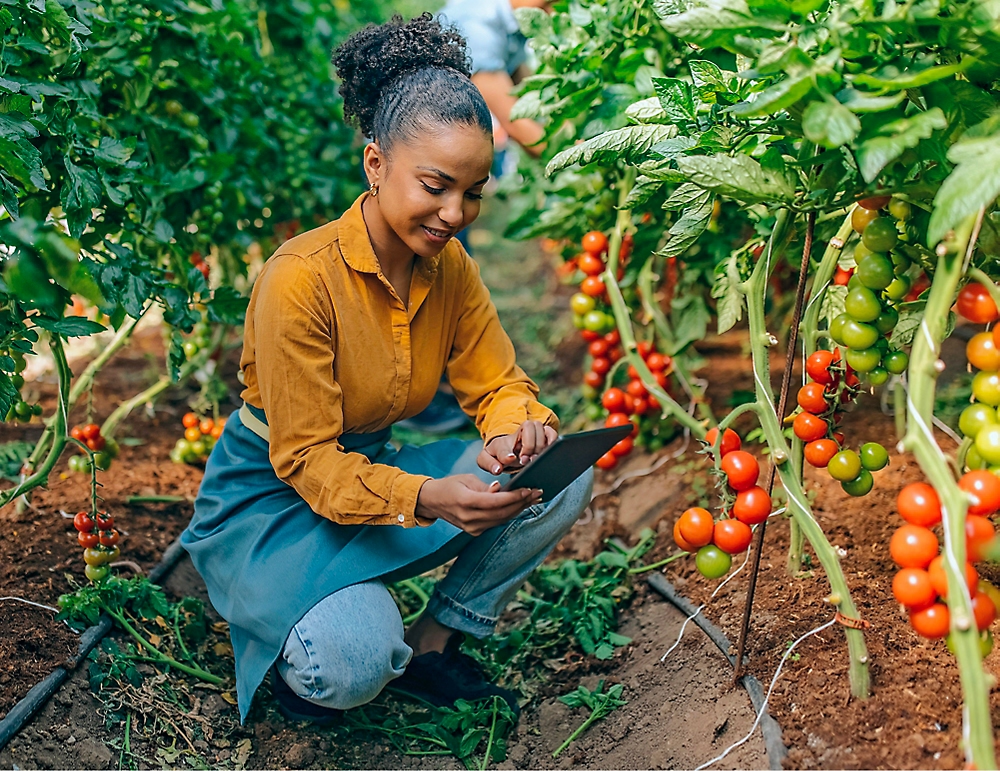
A farmer in Makueni wants to know whether the coming weeks will bring enough rain to plant maize. A tomato grower in Kirinyaga needs to identify a disease spreading through the greenhouse before it destroys the crop. An avocado farmer in Murang’a wants to know whether the fruit will meet an exporter’s quality requirements, while a dairy farmer in Nyandarua needs to decide whether the cost of additional feed makes economic sense.
These farmers have different problems, but they share one need. They must make decisions that affect their income using information that is often incomplete, expensive or difficult to access at the right time.
Artificial intelligence, satellite imagery and digital agricultural services could help address some of these challenges. A farmer might receive a localised weather forecast, submit a photograph of a diseased leaf for assessment, access farming advice in Kiswahili or another familiar language, or use digital information to decide when to plant and how to manage a crop.
However, the availability of technology does not automatically translate into better farming outcomes. A forecast is only useful if the farmer receives it in time and understands what it means for the next farm operation. A disease diagnosis is only valuable if it is sufficiently accurate to guide the right response. Market information matters when farmers can use it to negotiate better prices or identify buyers.
This distinction is becoming increasingly important as international organisations and technology companies invest in AI tools for agriculture.
On 18 September 2026, the Gates Foundation and Google announced an expanded initiative intended to bring artificial intelligence resources to 200 million smallholder farmers across Sub-Saharan Africa and South Asia. The programme includes climate forecasting, satellite-based field mapping and agricultural information in African languages. The announcement described more than $100 million in combined funding and technical support for the initiative. Kenya is among the countries where deployments of the field-mapping technology are under way. The announcement by the Gates Foundation and Google sets out the scale of the ambition.
On 5 October, the Food and Agriculture Organization of the United Nations and the Holy See’s mission in Geneva brought together stakeholders to discuss how AI can be applied to agrifood systems while protecting human dignity, inclusion and accountability. Later in October, a workshop organised through the Africa Network of Agricultural Policy Research Institutes and its partners is scheduled to examine the political economy of AI in African agrifood systems, including who controls data and who benefits from the technology. The FAO discussion on human-centred AI and the ANAPRI workshop on AI in African agrifood systems point to a question that deserves attention in Kenya.
Who will benefit when AI reaches the farm, and what will those benefits look like in the daily lives of farmers?
For Kenya, this is not simply a technology question. It is about agricultural productivity, the cost of production, access to markets, the quality of extension services and the ability of farmers to make informed decisions without becoming dependent on systems they do not control.
Why AI in agriculture matters to Kenyan farmers
Agriculture in Kenya involves millions of people operating under different conditions. Some grow maize and beans for household consumption and local markets. Others produce tea, coffee, potatoes, vegetables, flowers, avocados, macadamia and other crops for domestic or export markets. Livestock farmers depend on rainfall, pasture, feed, animal health services and access to milk or meat buyers.
The information required by each group is different.
A maize farmer in a semi-arid area may need to know whether the expected rainfall is sufficient to support planting. A farmer growing potatoes in a cooler highland area may need timely advice on disease prevention. A mango grower may need information about flowering, fruit development, pest pressure and the availability of buyers. A dairy farmer may want to compare the cost of different feed ingredients against expected milk production.
Traditional agricultural extension remains important, but reaching every farmer consistently is difficult. Extension officers may cover large geographical areas, while farmers often need assistance at short notice. Agricultural research findings may take time to reach the people who need them, and commercial advice can sometimes be tied to the sale of particular inputs.
Digital services could help bridge some of these gaps by making agricultural information available more quickly and at a lower cost per farmer.
AI systems can analyse large amounts of information, recognise patterns and generate recommendations or predictions. When connected to reliable weather data, satellite imagery, crop information and local agricultural knowledge, they can help turn complex information into advice that farmers can use.
The important qualification is that AI does not create reliable knowledge out of nothing. Its performance depends on the quality of its data, the design of the system, the conditions in which it is used and the accuracy of the information available for a particular location and crop.
A tool developed using information from a different climate, farming system or crop variety may not perform equally well on a Kenyan farm. It needs local testing, expert oversight and continued improvement.
The opportunity is substantial, but the technology must be adapted to the actual problems Kenyan farmers face.
Can AI help farmers decide when to plant?
Rainfall uncertainty is one of the most important challenges facing farmers who depend on seasonal rains.
A farmer may prepare land after the first showers, only for the rains to stop before the crop establishes itself. Planting too early can expose seed to inadequate moisture, while planting too late may leave the crop vulnerable to a dry spell at a sensitive growth stage.
The consequences can include poor germination, uneven crop establishment, reduced yields and wasted expenditure on seed, labour and fertiliser.
AI-assisted weather forecasting could help farmers make better-informed decisions by combining weather observations, historical records, satellite information and atmospheric models to estimate conditions at a particular location.
A useful service would go beyond telling a farmer that rain is expected. It would explain the likely timing and reliability of rainfall and help the farmer understand the implications for a specific crop.
For example, a farmer in Makueni considering maize planting needs information relevant to local soil moisture, the expected duration of the rainy period and the maturity period of the variety being considered. A forecast that is too general may not be enough to support that decision.
Farmers growing horticultural crops may need different information. A tomato farmer could use forecasts to plan irrigation, drainage, field operations and disease monitoring. An avocado grower may need to understand whether expected weather conditions could affect flowering, fruit development or water requirements.
The Gates Foundation and Google’s initiative includes work intended to make climate information more relevant at farm level through the TomorrowNow climate platform and other technology partnerships. The wider challenge is translating forecasting capabilities into practical services that farmers can access and trust.
For the farmer, the value should be measured by whether the information improves decisions. Does it help reduce unnecessary irrigation? Does it prevent planting immediately before a damaging dry spell? Does it help a farmer prepare for heavy rainfall? Does it reduce losses enough to justify any subscription or service charge?
These are more useful measures of success than the number of forecasts generated.
AI forecasts will also have limitations. Weather remains uncertain, particularly at very local scales, and a forecast cannot guarantee rainfall on an individual farm. Farmers should receive clear explanations of uncertainty rather than advice presented as a certainty.
The best system would combine weather information with local observations and agricultural expertise, allowing farmers to make informed decisions rather than follow a digital prediction blindly.
Satellite imagery could change how small farms are understood
Satellite imagery has applications beyond weather forecasting. It can help identify agricultural land, estimate crop cover, monitor vegetation and detect changes in fields over time.
However, smallholder farms can be difficult to map accurately. Many plots are small, irregularly shaped or separated by hedges, trees, paths and other features. Several crops may grow close together, while some farms contain mixed cropping systems that are difficult to classify from overhead images.
Artificial intelligence can help analyse satellite images and identify field boundaries or patterns associated with different crops. This may improve the information available to governments, agricultural researchers, insurers and other institutions.
The Gates Foundation and Google have described work on an Agricultural Understanding Platform intended to help map smallholder fields and monitor crop development. The associated land-use data initiatives have deployments under way in Kenya and several other countries.
For Kenya, better agricultural mapping could support several practical applications.
Government agencies could improve their understanding of where particular crops are grown and how production patterns change. Researchers could identify areas affected by drought or other environmental stresses. Agricultural programmes could potentially use more accurate information to plan support, while insurers and financial service providers could investigate ways of assessing agricultural risks.
Yet it is important to distinguish between mapping a farm and providing a direct benefit to the farmer.
A satellite image may help an institution understand where maize is grown, but that does not automatically provide the farmer with affordable fertiliser, reliable rainfall information or a buyer for the harvest.
The benefit depends on how the information is used and whether farmers can access the services built around it.
If mapping helps a farmer qualify for a legitimate insurance product, receive a relevant advisory service or access a well-designed support programme, it may have practical value. If the data is collected mainly to improve the planning of outside organisations without delivering a meaningful benefit to farmers, the value to the farmer may be limited.
Kenya needs to assess agricultural mapping not only by its technical accuracy but also by the services and opportunities it creates for the people whose farms are being mapped.
Can an AI assistant become a virtual agricultural extension officer?
One of the most promising applications of AI is the ability to answer questions in ordinary language.
A farmer could ask why maize leaves are turning yellow, how to prepare land for potatoes, when to prune an avocado tree or how to manage a particular pest. Instead of searching through lengthy technical documents, the farmer could receive an explanation in a familiar language.
Such tools may be especially useful when a farmer cannot reach an agricultural officer immediately or needs clarification after receiving advice during a field visit.
An AI assistant could also help farmers understand fertiliser labels, compare cultivation methods, calculate planting populations, prepare production budgets and keep records of farm operations.
For example, a farmer planning an avocado orchard could ask about spacing, land preparation, irrigation, pollination requirements and the time needed before the trees begin producing commercially. A maize farmer could ask for help calculating seed requirements for a given acreage. A dairy farmer could request an explanation of how changes in feed affect the cost of milk production.
However, there is a significant difference between answering a general farming question and making a diagnosis that determines whether a farmer spends money on treatment.
If a farmer uploads a photograph of a diseased tomato plant, an AI tool may suggest possible causes. But a photograph alone may not reveal the full problem. Several diseases and nutrient deficiencies can produce similar symptoms, and the correct diagnosis may require information about the field, weather, recent spraying, crop stage and the pattern of spread.
An incorrect answer could lead the farmer to buy an unnecessary pesticide, delay a necessary intervention or apply a product that is inappropriate for the crop.
The same danger applies to livestock health. A digital assistant can help explain symptoms and suggest when professional attention is needed, but it should not replace a qualified veterinary professional when an animal may have a serious condition.
For AI to support agricultural extension responsibly, it should be designed to recognise uncertainty, ask relevant follow-up questions and direct farmers to qualified human assistance when necessary.
Its recommendations should also be based on credible, locally relevant agricultural knowledge. A system that confidently gives incorrect advice in fluent Kiswahili is not necessarily more useful than one that admits it does not have enough information.
The goal should be to strengthen agricultural extension, not create the impression that a digital assistant can replace every agronomist, livestock officer or experienced farmer.
Why African languages matter
Language can determine whether a farmer benefits from technology at all.
Agricultural information is often presented in technical English, while many farmers are more comfortable discussing farm problems in Kiswahili or their local languages. Even when farmers can read English, technical terminology may make complex recommendations difficult to understand.
A farmer who misunderstands pesticide instructions, fertiliser recommendations or disease-management advice may make an expensive mistake.
AI tools that support speech and text in African languages could help make agricultural knowledge more accessible. The Gates Foundation and Google initiative includes support for open-source speech and text datasets across more than 40 African languages, intended to improve access to agricultural information.
In Kenya, the practical applications could include Kiswahili-based agricultural assistants and services adapted to languages used by farmers in different regions. A farmer could ask a question by voice rather than typing a long message, which may be useful for people who are less comfortable with written digital communication.
But language support requires more than translating English sentences word for word.
Agricultural terms can vary by region, and farmers may use local names for crops, pests, diseases and production practices. A name that refers to one pest in a particular area may mean something different elsewhere. Some local expressions may not have direct equivalents in technical agricultural language.
Developers need to work with farmers, agricultural researchers, extension officers and language specialists to build systems that understand these differences.
The tools must also be tested in real farming situations. It is not enough for a system to produce fluent responses if the advice is inaccurate or confusing.
A useful agricultural assistant should understand the question, provide relevant information, explain uncertainty and help the farmer identify the next practical step.
It should also be accessible to farmers who cannot afford expensive smartphones or large amounts of mobile data. Voice services, lightweight applications, SMS and carefully designed offline features may all have a role, depending on the service and the infrastructure available.
The test is not whether AI can speak a language. It is whether farmers can use that language to make better decisions.
Can AI help farmers reduce input costs?
Input costs are a major concern for farmers because fertiliser, seed, pesticides, irrigation, labour and transport can consume a large share of the money earned from a harvest.
AI could help farmers improve the way they use these resources by combining farm records, soil information, weather forecasts, crop observations and agronomic recommendations.
For example, a system might help a farmer plan irrigation according to crop requirements and expected rainfall. Another could support fertiliser planning using soil-test results and the nutrient needs of the crop. Image analysis could help identify areas where a crop appears stressed, prompting a field inspection before the problem becomes widespread.
In principle, these applications could reduce waste and improve the timing of farm operations.
However, AI should not be treated as a substitute for soil testing, proper diagnosis or qualified agronomic advice. Recommendations need to account for local conditions, crop requirements and the reliability of the underlying data.
A farmer may receive a recommendation to apply fertiliser, but if the underlying problem is poor drainage or root damage, the additional expenditure may not solve it.
Likewise, an automated pest diagnosis should not trigger a chemical application without considering the actual pest, its severity, the crop’s growth stage and the likely benefit of treatment.
The most useful systems would help farmers distinguish between problems that require immediate intervention and those that can be managed through monitoring, prevention or changes in farm practices.
This is particularly important for smallholders who cannot afford repeated purchases of products that fail to solve the problem.
AI should help farmers spend more intelligently, not simply create another channel through which products are promoted.
Will AI help farmers earn better prices?
Agricultural technology discussions often focus on increasing production. But farmers can produce a good harvest and still make little money if they cannot sell it at a reasonable price.
This is common in markets where many farmers harvest similar crops at the same time, transport is expensive or access to buyers is limited. Perishable produce presents an additional challenge because farmers may have only a short period in which to sell before quality deteriorates.
AI could help improve market decisions by analysing price trends, demand patterns, transport costs, weather conditions and production information. Digital services could help farmers compare potential markets, estimate the cost of delivery and understand which quality requirements apply to particular buyers.
A farmer growing tomatoes might use market information to compare prices across nearby markets before paying for transport. An avocado grower could use digital records to coordinate harvesting with a buyer or packhouse, provided the service is connected to reliable demand information.
Farmers’ groups could potentially use aggregated production data to estimate how much produce will be available and negotiate sales more effectively.
But market intelligence has limits. A system that reports a high price in Nairobi does not automatically tell a farmer in a remote area how much will remain after transport, packaging, market fees, handling and losses.
Nor does information guarantee that a buyer will purchase the crop at the advertised price.
Farmers need reliable and timely information that reflects the conditions under which they actually trade. Where possible, digital platforms should make the difference between farm-gate prices, wholesale prices and retail prices clear.
They should also help farmers understand quality requirements and payment terms rather than focusing only on the highest quoted price.
AI may improve a farmer’s ability to negotiate, but lasting gains also depend on competition among buyers, reliable transport, appropriate storage, transparent contracts and stronger farmer organisations.
Who owns the data collected from Kenyan farms?
This is one of the most important questions in the discussion about AI in agriculture.
A digital agricultural service may collect a considerable amount of information. Depending on the system, this could include farm boundaries, crop types, planting dates, harvest estimates, soil information, weather observations, photographs, input use and production records.
Some data may be supplied directly by farmers. Other information may be generated through satellite imagery, connected equipment or government and research databases.
Individually, these details may seem ordinary. Combined, they can reveal a great deal about a farmer’s land, production plans, financial circumstances and business performance.
Farm data can help farmers receive better services, but it can also be commercially valuable to other organisations.
An input supplier may be interested in understanding where a particular crop is grown. A financial institution may want to assess production risk. A buyer may seek information about expected harvest volumes. An insurer may use field data to assess eligibility for coverage.
These uses are not necessarily harmful. They may support useful services and better decisions. The issue is whether farmers understand what information is being collected, how it will be used, who can access it and whether they have a meaningful choice.
A farmer should not have to surrender unrestricted control over sensitive information simply to receive basic agricultural advice.
Questions about data governance are central to the wider African debate on AI. The upcoming ANAPRI workshop in Addis Ababa is examining who controls the data and infrastructure used by AI systems, who shapes the resulting decisions and how the benefits and risks are distributed.
For Kenya, these questions should be part of agricultural technology programmes from the beginning rather than addressed after a service has become widely used.
Farmers need clear explanations of data collection and use. Organisations deploying digital tools should disclose their arrangements for sharing information, protecting it and retaining it. Farmers should also understand whether they can access, correct or request the deletion of information where applicable.
Where farm data is used to train AI models or develop commercial services, the arrangements should be transparent. The rights and interests of farmers should not disappear simply because the information has been converted into a digital format.
Kenya’s data protection framework provides a starting point for these discussions, but practical safeguards also depend on how individual services are designed and operated.
The principle is straightforward. Agricultural data should help improve farming outcomes without exposing farmers to avoidable risks or making them powerless over information about their own businesses.
Could AI widen the gap between smallholders and large farms?
Technology does not benefit every farmer equally.
A large commercial farm may have reliable internet, smartphones, farm-management software, irrigation systems, soil-testing services and staff who can interpret technical information. It may also have the capital to invest in precision agriculture equipment and act quickly on digital recommendations.
A smallholder farmer may share a basic phone with family members, depend on intermittent mobile connectivity and lack the money to purchase additional inputs even after receiving good advice.
Both farmers may receive the same weather alert, but their ability to respond could be very different.
The commercial farmer may have irrigation equipment ready to use. The smallholder may depend on rainfall. One farmer may be able to buy disease-control products immediately, while another must wait until money becomes available.
This means that information alone cannot eliminate inequality.
If AI services are designed primarily for farmers who can afford smartphones, subscriptions, data bundles and additional equipment, they may reinforce existing differences in agricultural productivity.
To reach smallholders, services must be designed around their actual circumstances. This may include low-data applications, voice-based services, shared access through farmer groups, extension officers who can help interpret recommendations and affordable ways to receive timely information.
There also needs to be a realistic understanding of what farmers can do with the advice.
A recommendation to install irrigation is of limited value to someone who cannot afford the equipment or lacks a dependable water source. Advice to sell through a formal market may be impractical if the farmer cannot meet the buyer’s minimum volume or transport requirements.
Good digital agricultural services should identify feasible options for different farmers rather than assume that everyone has the same resources.
The measure of inclusion is not the number of people who receive a message. It is whether the service helps people with different levels of income, connectivity and farming capacity make decisions they can realistically implement.
What happens when an AI recommendation is wrong?
AI systems can produce inaccurate or misleading answers. In agriculture, the consequences may be financial, environmental or related to human and animal health.
An incorrect pest diagnosis could lead to unnecessary pesticide use. A misleading weather prediction could influence planting decisions. A fertiliser recommendation that ignores soil conditions could increase expenditure without improving crop performance.
The farmer may bear the cost of these errors even if the technology was developed and promoted by a well-funded organisation.
This raises questions about responsibility.
Who should respond when a farmer follows an AI recommendation and suffers a loss? Was the system intended only to provide general information, or did it present its output as a specific recommendation? Was the information tested under local conditions? Did the service explain its limitations? Was a qualified person available to review high-risk advice?
These questions matter because farmers may reasonably assume that a service supported by a major technology company, development organisation or government programme has been thoroughly tested.
The name of a reputable organisation does not make every automated recommendation correct.
Agricultural AI should be tested using local crops, climates, languages and farming practices. It should be evaluated by people with relevant technical expertise, and it should be updated when errors or changing conditions are identified.
Systems should also distinguish between low-risk questions and decisions that require professional assessment. Explaining how to calculate a planting population is different from diagnosing a potentially destructive disease or recommending treatment for a serious livestock condition.
When confidence is low, the service should say so and direct the farmer to an appropriate source of help.
Trust will depend less on how confidently an AI assistant speaks and more on whether its advice is accurate, useful and accountable.
Kenya needs local agricultural knowledge inside AI systems
One risk in agricultural technology is assuming that a solution developed elsewhere can be transferred to Kenya without substantial adaptation.
Kenya’s farming systems vary widely. Conditions in the highlands differ from those in the coastal region, while arid and semi-arid counties face challenges that may be very different from those in areas with more reliable rainfall.
Crop varieties, planting calendars, pest pressure, soil conditions, farming practices and market arrangements also vary.
An AI assistant trained on general agricultural information may provide a technically plausible answer that does not suit a particular Kenyan location.
For example, advice about planting dates must account for local rainfall patterns and the crop’s growth cycle. Fertiliser recommendations need to reflect soil conditions and the crop’s nutrient requirements. Pest management advice must consider which pests are present and which control methods are registered and appropriate for the crop.
This is why Kenyan agricultural researchers, universities, extension officers, farmer organisations and experienced producers should be involved in the development and evaluation of agricultural AI services.
Local expertise can help identify errors, improve language support and ensure that recommendations reflect farming conditions on the ground.
Farmers themselves should also be involved. They understand the practical constraints that may not appear in technical datasets, including the timing of labour availability, access to inputs, transport difficulties, local market practices and the trade-offs involved in household spending.
Their experience should inform how tools are designed, tested and improved.
AI can process information at a scale that would be difficult for an individual adviser, but it still needs reliable local knowledge to produce recommendations that make sense.
Will technology companies and development organisations remain involved?
Another important issue is what happens after the initial funding period ends.
An agricultural technology programme may begin with substantial investment, technical support and partnerships with research organisations. It may reach many farmers during its pilot or expansion phase.
But farmers need services that remain available when funding priorities change.
Weather information must continue to be updated. Agricultural knowledge must reflect emerging pests, new varieties and changing production conditions. Software requires maintenance, data protection and technical support. Farmers may need assistance when a service stops working or gives an unexpected result.
If a programme depends entirely on temporary funding, its long-term future may be uncertain.
There is also the question of who pays for the service once the initial support is exhausted. Some tools may be offered free to farmers, while others may depend on subscriptions, commercial partnerships or government funding.
A free service can be valuable, but farmers should understand the conditions attached to its use. They should know whether it is expected to remain free, whether certain features may later become paid services and whether their data may be used to support a commercial model.
The organisations involved should explain how services will be maintained, how local institutions will participate and what will happen if the original programme ends.
Building local technical capacity is particularly important. Kenyan institutions should be able to evaluate the tools, adapt them to local conditions and contribute to their future development rather than remain dependent on external organisations for every major change.
The long-term objective should be a reliable agricultural information system that continues to serve farmers beyond the life of a particular announcement or funding commitment.
How should Kenya measure whether agricultural AI is working?
Technology programmes often report how many farmers have registered, downloaded an application, received a message or been reached through a partner organisation.
These figures help describe the scale of an initiative, but they do not establish whether farmers have benefited.
A farmer may receive a weather alert and ignore it because the message is unclear. Another may use an AI assistant but receive advice that does not match local conditions. A third may obtain useful information but lack the money to act on it.
Counting all three as successful outcomes would conceal important differences.
Kenya needs evaluations that examine what happens after farmers receive information.
For weather services, researchers could assess whether farmers make better planting decisions, reduce avoidable crop losses or improve the use of irrigation. For crop diagnosis tools, evaluation could examine the accuracy of recommendations, whether unnecessary treatments decline and whether farmers seek professional help when appropriate.
Market services should be assessed by whether they help farmers reach buyers, reduce transaction costs, improve bargaining power or increase the net income retained after transport and other expenses.
Language services should be tested for comprehension and accuracy, not merely their ability to produce fluent responses.
Evaluations should also compare outcomes across different groups, including women farmers, young people, farmers in remote areas and households with limited access to digital devices.
The costs of using the technology must be included. If a service improves yield but requires expensive equipment, subscriptions or inputs, the overall economic benefit may be smaller than the headline result suggests.
Independent evaluation is valuable because the organisations developing and funding a technology may have an interest in demonstrating success. Transparent results help farmers, policymakers and investors understand what works, what does not and what needs to change.
Ultimately, the central question is whether farmers are better off because the technology was introduced.
What Kenyan farmers should look for before trusting an AI farming tool
Farmers do not need to wait for every policy question to be settled before using useful digital services. However, they should assess whether a tool is suitable for their needs before relying on it for expensive or high-risk decisions.
First, the farmer should establish whether the service understands the crop, location and problem involved. General agricultural information may be sufficient for a simple calculation, but a pest diagnosis or fertiliser recommendation may require more specific information.
Second, the farmer should check the source of the advice. A tool that draws on credible agricultural research and locally relevant technical knowledge is more useful than one that generates answers without explaining their basis.
Third, recommendations should be compared with field observations and, where necessary, advice from qualified agricultural professionals. An AI response should not override clear evidence that the crop is experiencing a different problem.
Fourth, farmers should examine the cost of the service and any additional expenditure it recommends. A tool is not necessarily valuable because it is free to download. It must provide benefits that justify the time, data and money required to use it.
Finally, farmers should understand what happens to their information. Before submitting farm maps, photographs, financial records or other sensitive information, they should review the service’s privacy and data-use arrangements.
These precautions do not mean rejecting agricultural technology. They help farmers use it as a tool for making better decisions rather than treating it as an authority that cannot be questioned.
What Kenya’s agricultural sector should do next
The expansion of AI in agriculture presents an opportunity for Kenya, but the country needs to approach it with clear priorities.
Agricultural technology should begin with problems farmers have identified, not with a product looking for a market. Farmers should help determine which services deserve investment, how recommendations are delivered and what outcomes count as success.
Government agencies, research institutions, universities, farmer organisations, technology companies and development partners need to work together on local testing, language support, data governance and the integration of digital services with existing extension systems.
Agricultural officers should have opportunities to use appropriate tools to support fieldwork, while retaining the ability to question automated recommendations and provide context that a digital system may miss.
Public institutions should also consider how useful agricultural data can be made available for research and public benefit while protecting personal and commercially sensitive information.
Where private companies provide digital services, there should be clear expectations about accuracy, transparency, data protection and accountability. Farmers should not have to accept unclear terms simply because a service is presented as a solution to a pressing agricultural problem.
Connectivity and affordability require attention as well. Rural farmers need practical ways to access information without being excluded by the cost of devices, data bundles or subscriptions.
Most importantly, digital agricultural programmes should be judged alongside the wider conditions that determine farm performance. Better information cannot compensate entirely for the absence of water, affordable inputs, reliable roads, storage, credit or buyers.
AI should complement these foundations, not be used as a substitute for them.
The real test is whether farmers gain more control over their decisions
The expansion of AI in agriculture has the potential to change how farmers access knowledge, manage production risks and connect with markets. The ability to analyse weather information, interpret images and provide agricultural guidance in familiar languages could make useful expertise available to more people.
For Kenya, the opportunity is particularly relevant where farmers face unpredictable rainfall, limited extension support, costly crop losses and difficulty accessing timely market information.
But the benefits will not come from technology alone.
Farmers need information they can trust, delivered in a form they can use, at a cost they can afford. They need the freedom to question recommendations, access to human expertise when decisions are complicated and safeguards that protect their farm data. They also need the resources to act on the information they receive.
The international commitments announced in September and the discussions held in October show that AI in agriculture is attracting significant attention and investment. The next challenge is to demonstrate what these investments deliver on actual farms.
For a smallholder farmer in Kenya, success should not be measured by how advanced an AI model is, how many languages it can generate or how many farms appear on a satellite map.
Success is a farmer who receives a useful warning before a damaging weather event, identifies a crop problem correctly, avoids an unnecessary expense, finds a reliable buyer or makes a better decision about the next season.
It is also a farmer who understands how their data is being used and retains a meaningful say in decisions that affect their livelihood.
Artificial intelligence should make farmers better informed and more capable of managing their businesses. It should not turn them into passive recipients of advice produced by systems they cannot understand or influence.
Kenya has an opportunity to help shape this future by ensuring that farmers, researchers and local agricultural institutions have a genuine role in designing and governing the tools they will use.
The question is no longer whether AI can be applied to agriculture. It is whether the technology can deliver measurable benefits to the people who grow the country’s food, while protecting their interests and strengthening their ability to make their own decisions.
That is the standard against which agricultural AI should be judged.
Frequently Asked Questions About AI in Agriculture in Kenya
What is AI in agriculture?
AI in agriculture refers to the use of artificial intelligence to analyse information and support farming decisions. Applications include weather forecasting, crop monitoring, pest and disease identification, farm mapping, irrigation planning, market analysis and digital agricultural advice.
How can AI help smallholder farmers in Kenya?
AI could help smallholder farmers access more localised weather information, identify possible crop problems, understand agricultural recommendations and compare market options. Its usefulness depends on the accuracy of the information, affordability, access to technology and the farmer’s ability to act on the advice.
What is the Gates Foundation and Google AI initiative for farmers?
On 18 September 2026, the Gates Foundation and Google announced an expanded initiative intended to bring AI resources to 200 million smallholder farmers across Sub-Saharan Africa and South Asia. The programme includes climate forecasting, satellite-based field mapping and support for agricultural information in African languages.
Can AI identify crop diseases accurately?
AI tools can help identify possible crop diseases from images and other information, but accuracy varies by crop, disease, image quality and local conditions. Farmers should not rely on an automated diagnosis alone when an incorrect decision could cause substantial losses. Expert assessment may be necessary.
Can farmers use AI without a smartphone?
Potentially, yes. Depending on how a service is designed, farmers may access some information through voice services, SMS, agricultural extension officers or farmer groups. However, not every AI service supports these channels, and access depends on connectivity, language support and the cost of using the service.
Who owns agricultural data collected from farmers?
Ownership and access depend on the type of data, the service’s terms and the applicable legal framework. Farmers should understand what information is collected, how it is used, who can access it and what rights they have. Data governance should be transparent and protect farmers from inappropriate use of their information.
Will AI replace agricultural extension officers in Kenya?
AI may help extension officers reach more farmers and provide information more quickly, but it cannot replace all field assessments, practical demonstrations or professional judgement. A strong system combines digital tools with local expertise and human support.
What are the main risks of using AI in farming?
Risks include inaccurate recommendations, poor performance in local conditions, limited access for farmers without reliable connectivity, privacy concerns, dependence on external service providers and the cost of acting on advice. Local testing, transparent data policies and professional oversight can help manage these risks.
How can Kenya ensure that smallholder farmers benefit from agricultural AI?
Kenya can prioritise farmer-led design, local research, affordable access, African-language support, reliable agricultural data, strong privacy safeguards and independent evaluation. Programmes should measure improvements in farm decisions, production costs, crop losses and farmer incomes rather than relying only on the number of people reached.
https://farmerstrend.co.ke/trending/ai-in-agriculture-in-kenya-smallholder-farmers/https://farmerstrend.co.ke/wp-content/uploads/2026/10/AI-in-Agriculture-in-Kenya-Raises-Questions-About-Who-Benefits-as-Technology-Reaches-Smallholder-Farmers.avifhttps://farmerstrend.co.ke/wp-content/uploads/2026/10/AI-in-Agriculture-in-Kenya-Raises-Questions-About-Who-Benefits-as-Technology-Reaches-Smallholder-Farmers-150x150.jpg# TrendingAI in agriculture in Kenya could improve weather forecasts, pest management and market access, but farmers need affordable tools, reliable advice and control over their farm data.AI in Agriculture in Kenya Raises Questions About Who Benefits as Technology Reaches Smallholder Farmers A farmer in Makueni wants to know whether...FarmersTrendjohn doefarmerstrend@gmail.comAdministratorFarmers Trend Ltd.


Leave a Reply