Papaya Farming in Kenya: 6 Best Varieties Which Fruit in 9 Months
Papaya farming in Kenya gives you fruit within 9 months of planting. Few orchard crops pay this fast. Dwarf varieties grow 2 to 3 metres tall, so you harvest from the ground without a ladder. A starter orchard of 100 trees needs only 400 square metres of land.
Farmers practise papaya farming in Kenya in warm counties such as Kirinyaga, Murang’a, Makueni, Machakos and Kilifi. The Kenya News Agency reports Solo Sunrise gaining popularity in Kirinyaga and Murang’a. One demonstration farm ran out of seedlings.
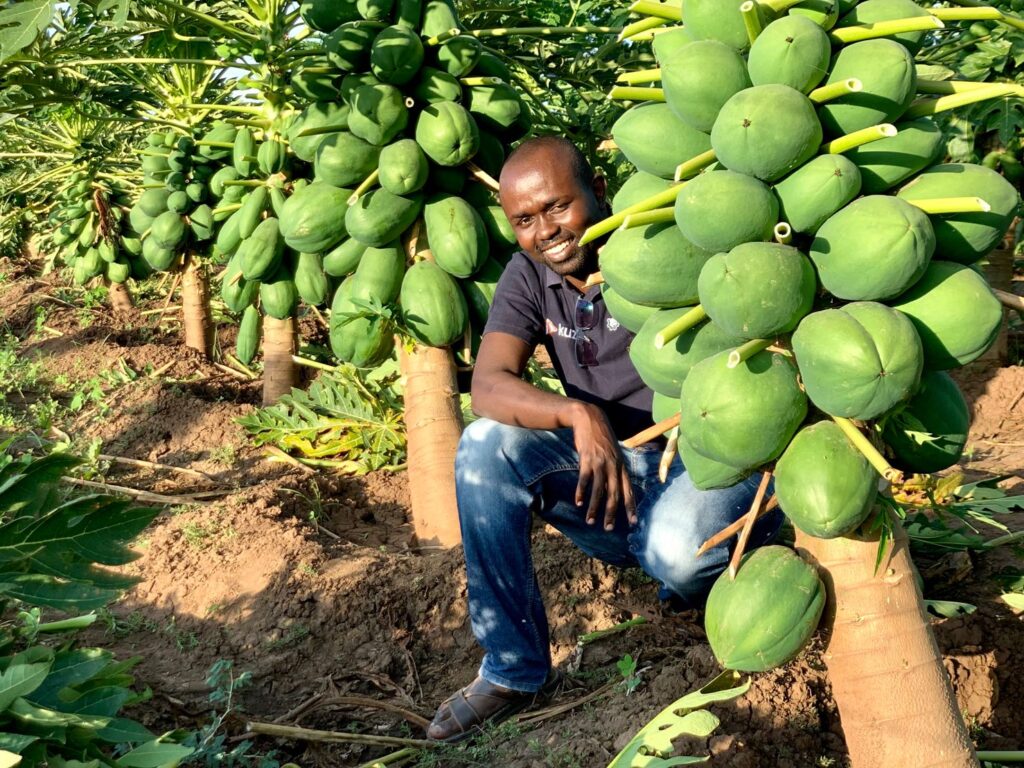
This guide to papaya farming in Kenya covers six papaya varieties, the climate and soil papaya needs, spacing, fertiliser, watering, pests, harvest and returns. You will also see a three-year income plan for 100 trees and a planting plan for the coming short rains.
Why Papaya Farming in Kenya Pays Fast
Papaya farming in Kenya pays steadily because the tree flowers and fruits continuously once the tree starts bearing. You harvest every week or two for years, not once a season. This steady supply gives you regular cash.
The numbers support the crop. The Kenya News Agency quotes experts who say Solo Sunrise matures in 6 to 8 months and gives 200 to 300 fruits per tree each year. Farmers Trend Limited lists a yield of 25 to 50 kg per dwarf tree each year for a well-managed orchard. At 2 m by 2 m spacing, one acre holds about 1,000 trees.
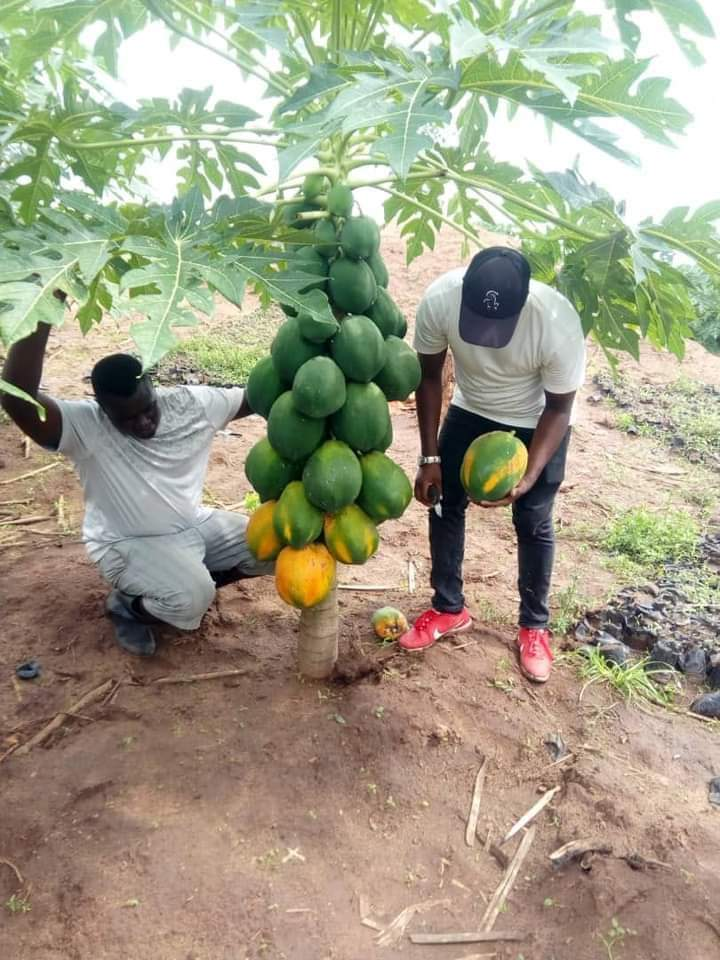
Demand stays strong because most Kenyan papaya sells in local markets. Fruit sells in open-air markets, supermarkets, hotels and juice bars. Solo Sunrise fruit keeps for up to 14 days after harvest, which gives you time to reach distant buyers and export agents.
Papaya farming in Kenya also suits small farms. A quarter acre holds 250 trees. You need no tall support structure and no heavy machinery. You plant, feed, water and pick.
Six Papaya Varieties Which Fruit in 9 Months
Variety choice decides your fruit size, taste, tree height and income in papaya farming in Kenya. Farmers Trend Limited lists five dwarf varieties on the dwarf pawpaw (papaya) seedlings page: Red Royal F1, Malkia F1, Solo Sunrise, Calina IPB9 and Red Lady Dwarf. Sinta F1 is a sixth variety grown in Kenya. The table compares the six.
| Variety | Time to first fruit | Type | Fruit |
|---|---|---|---|
| Solo Sunrise | 6 to 8 months | Dwarf, hybrid | Small, pear-shaped, deep red flesh, sweet |
| Calina IPB9 | 8 to 9 months | Dwarf | Red interior, sweet |
| Red Lady Dwarf | About 9 months | Dwarf | Oval, sweet, slightly smaller than Calina |
| Malkia F1 | 8 to 9 months | Semi-dwarf hybrid | Sweet red flesh, high yield potential |
| Red Royal F1 | 8 to 9 months | Dwarf hybrid | Vigorous plants with strong stems |
| Sinta F1 | 8 to 9 months | Hybrid | Confirm size and flesh colour with your nursery |
Maturity depends on altitude, temperature and care. The figures above come from Kenyan and East African farm reports and seed listings. Expect fruit toward the later end of each range in cooler areas.
Solo Sunrise Papaya
Solo Sunrise is the fastest variety on this list. The tree begins to bear fruit about six months after planting, when the tree stands near one metre tall, according to a Daily Monitor farming guide. New flowers keep forming at the crown, so fruit production keeps rising.
The fruits are small and pear-shaped with deep red flesh and a sweet taste. The size suits supermarkets, hotels and home buyers who want a single-serve fruit. The Kenya News Agency reports a productive life of up to 4 years and a shelf life of up to 14 days. Water the trees steadily in dry spells.
Calina Papaya (IPB9)
Calina, also sold as IPB9, produces red-fleshed fruits with a sweet taste. Farmers rate Calina among the best varieties for Kenya. The trees stay dwarf, so you harvest with ease and wind damages them less.
Choose Calina when you want larger fruit than Solo Sunrise. Farmers Trend Limited lists Calina Papaya IPB9 among the dwarf seedling varieties on the Farmers Trend Limited page.
Red Lady Dwarf Papaya
Red Lady comes from the Philippines. The tree takes about nine months to mature, which is slightly longer than Solo Sunrise. The tree then bears for more than five years, according to the Daily Monitor guide. The fruits are oval and sweet, and slightly smaller than Calina fruits.
Choose Red Lady when you want a longer-lived orchard. A longer life means fewer replanting rounds and a lower cost per year.
Malkia F1 Papaya
Malkia F1 is a semi-dwarf hybrid with sweet red flesh. Seed sellers in Kenya describe Malkia as a high-yield variety. Hybrid seedlings give uniform trees, so your fruit ripens at similar times and sizes. Uniform fruit simplifies grading and selling.
Red Royal F1 Papaya
Red Royal F1 is a dwarf hybrid. Seed sellers describe vigorous plants with strong stems. Strong stems carry heavy fruit loads and resist wind. Plant Red Royal in places where wind is common and stake the young trees.
Sinta F1 Papaya
Sinta F1 is a hybrid papaya listed by Kenyan seed sellers and farm guides. Ask your nursery for the fruit size, flesh colour and time to first fruit of the seedlings you buy. Ask the Farmers Trend Limited team about current Sinta F1 stock.
Choose a Variety for Papaya Farming in Kenya
Choose by market and by risk. For fastest cash and small fruit, choose Solo Sunrise. For larger red-fleshed fruit, choose Calina or Malkia F1. For a longer orchard life, choose Red Lady. Many farmers plant two varieties. Two varieties spread your risk and give you fruit of different sizes for different buyers.
Papaya Farming in Kenya: Climate and Soil Needs
Papaya farming in Kenya works best with warmth, steady moisture and loose, well-drained soil. Match your farm to these needs before you buy seedlings.
Altitude and Temperature
Dwarf papaya performs best from sea level to 1,800 metres above sea level. Higher altitudes slow growth because the air is cooler. The best temperature range runs from 25 to 30 degrees Celsius. Cold nights and frost damage the trees. Avoid frost pockets and cold valley floors.
Rainfall and Water
Papaya needs 1,000 to 1,500 mm of rain each year, spread evenly. Gaps of several weeks without rain leave the trees stressed and the fruits small. Plan drip irrigation if your area has a long dry season. Papaya also fears waterlogging. Roots rot within days in standing water.
Soil Type and pH
Choose well-drained sandy loam soil rich in organic matter. The best soil pH ranges from 6.0 to 6.8. Test your soil before you plant. Add agricultural lime if your soil is more acid than this range. Avoid heavy clay and hollows where water collects.
Choose Healthy Seedlings for Papaya Farming in Kenya
Healthy seedlings decide your first-year income in papaya farming in Kenya. A weak seedling grows slowly and fruits late. Farmers Trend Limited prices dwarf papaya seedlings from KSh 100 to KSh 150 each, depending on the variety.
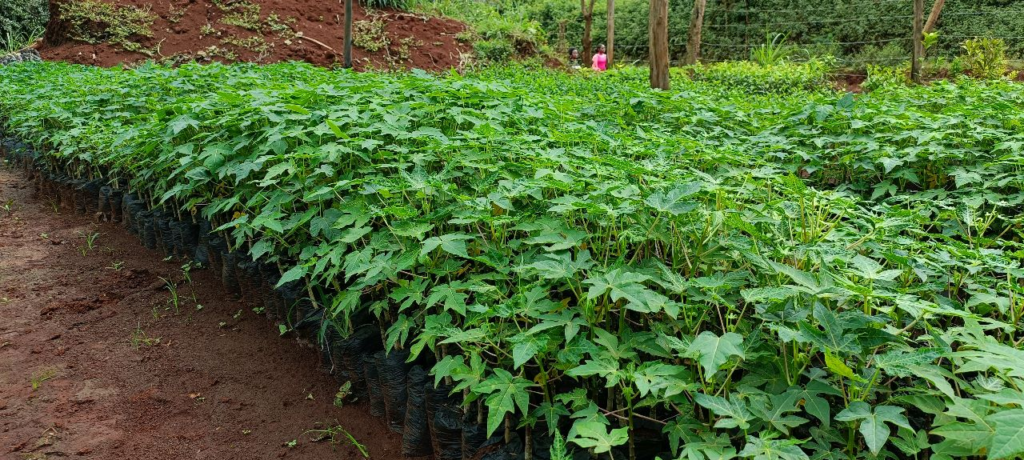
Check each seedling before you pay. Look for a straight stem, dark green leaves and firm, white roots. Reject seedlings with yellow leaves, spots, wilting or roots circling the bag. Buy from a registered nursery which raises seedlings in clean media off the ground.
Papaya plants are female, male or hermaphrodite. Female and hermaphrodite plants bear fruit. Male plants bear no fruit but pollinate female plants. Ask your nursery which type your seedlings are. Plant two seedlings in each hole if your nursery advises this. Keep the stronger fruit-bearing plant after the first flowers open and remove the other.
How to Start Papaya Farming in Kenya Step by Step
Prepare Your Land
Clear weeds, bushes and debris. Plough and harrow the soil to a fine, loose texture so roots grow deep. Mark your rows with strings and pegs. Choose a site with good drainage and shelter from strong wind.
Choose Your Spacing
Spacing sets your tree count and your yield per acre in papaya farming in Kenya. Close spacing gives more trees but needs more water and feed. Wider spacing suits taller varieties.
| Spacing | Trees per acre | Best for |
|---|---|---|
| 2 m by 2 m | About 1,000 | Dwarf varieties with drip irrigation |
| 2.5 m by 2.5 m | About 650 | Dwarf and semi-dwarf varieties on rainfed land |
| 3 m by 3 m | About 450 | Taller varieties and poorer soils |
Dig and Fill the Holes
Dig holes 60 cm wide, 60 cm long and 60 cm deep. Keep the topsoil in one pile and the subsoil in another. Mix the topsoil with 20 kg of well-decomposed manure and 250 g of DAP fertiliser per hole. Return the mix to the hole two weeks before planting. For 1,000 trees, you need about 20 tonnes of manure and 250 kg of DAP.
Plant the Seedling
Remove the seedling gently from the bag without breaking the root ball. Set the seedling upright in the hole at the same depth as in the bag. Fill with the enriched soil. Firm the soil around the base and water well.
Plant on Mounds During El Niño Rains
Forecasters have flagged strong short rains this season. Papaya farming in Kenya fails in waterlogged soil because papaya roots die within days. Protect your orchard. Build mounds about 30 cm high and plant on top of the mounds. Dig a drainage trench on the uphill side of each row. Check the holes after each heavy storm.
Mulch Your Seedlings
Spread straw or dry grass around each seedling. Keep the mulch 10 cm from the stem. Mulch keeps the soil moist, suppresses weeds and cools the roots.
Stake Young Trees
Tie each seedling to a stake. Wind and heavy rain topple young papaya trees. Remove the stakes when the stem thickens and the tree stands upright without support.
Grow Short Crops Between Young Trees
Papaya trees leave open ground in the first six months. Grow beans, kale or onions between the rows. Keep these crops at least 50 cm from each stem. You earn from the crops while the papaya grows. Do not plant maize or other tall crops between papaya trees, because tall crops shade the seedlings.
Water Your Papaya Trees
Papaya farming in Kenya needs regular water through the year. Dry spells cause flower drop, small fruits and poor taste. Waterlogging causes root rot. You manage both with drip irrigation and good drainage.
Water each seedling immediately after planting. In dry weather, give each tree about 10 to 20 litres per week and raise the amount as the tree grows. Adjust for your soil and weather. Sandy soils need water more often than loam soils.
Drip irrigation delivers water at the root and saves labour. Install one dripper per tree or a drip line along each row. Harvest roof water during the rains and store the water in tanks for the dry months. Mulch around each tree to cut water loss.
Feed Your Papaya Trees
Papaya is a heavy feeder, so papaya farming in Kenya needs a feeding plan. Weak feeding gives small, bland fruit and short-lived trees. Feed in stages.
At planting, supply 20 kg of manure and 250 g of DAP per hole. During the vegetative stage, apply a balanced fertiliser such as NPK 17:17:17 each month. Start with about 50 g per tree and raise the amount as the tree grows. When fruiting starts, switch to a potassium-rich fertiliser such as NPK 12:12:24. Potassium improves fruit size, sweetness and shelf life.
Spread fertiliser in a ring about 30 cm from the stem and cover the fertiliser lightly with soil. Keep fertiliser off the stem and leaves. Add manure once or twice a year. Papaya also needs boron. Poor boron supply causes lumpy, deformed fruit. Ask your agrovet about a foliar feed with boron.
Follow your soil test results. Adjust amounts for your soil, your variety and the rainfall.
Prune and Care for Trees in Papaya Farming in Kenya
Remove old, diseased and damaged leaves each month. Open canopies improve airflow and reduce disease. Cut excess side shoots so the tree puts energy into fruit.
Weed the circle around each tree by hand. Avoid deep hoeing, because papaya roots grow near the surface. Remove male plants after flowering unless your nursery advises keeping a few for pollination. Thin crowded fruits on a branch so the remaining fruits grow larger.
Papaya Pests and Diseases
Pest control in papaya farming in Kenya starts with a weekly walk through your orchard. Early detection keeps your costs low. Take samples to your agrovet or county agriculture office when you see an unfamiliar problem.
| Problem | Signs | Control |
|---|---|---|
| Aphids | Curled leaves, sticky residue, virus spread | Remove infested leaves and use a registered insecticide |
| Spider mites | Yellow speckles, fine webbing under leaves | Spray a registered miticide and keep trees watered |
| Mealybugs | White cotton-like clusters on stems and fruits | Remove infested parts and use a registered insecticide |
| Fruit flies | Soft spots and maggots inside fruit | Use traps, pick ripe fruit on time and bury fallen fruit |
| Powdery mildew | White powder on leaves | Prune for airflow and spray a registered fungicide |
| Papaya mosaic virus | Mottled, twisted leaves and stunted growth | Uproot and burn infected trees, control aphids and buy clean seedlings |
| Root rot | Wilting, yellow leaves and soft stem base | Improve drainage, plant on mounds and avoid overwatering |
Read the label on every chemical. Wear protective gear. Observe the waiting period before harvest. Rotate products to avoid resistance.
Harvest and Handle Your Papaya
Pick fruit when the bottom end shows a tinge of yellow. This sign shows the fruit has reached maturity. For distant markets, pick at this early colour stage. For local markets and nearby buyers, let more of the skin turn yellow.
Harvest by hand or with a clean knife. Hold the fruit and twist or cut the stalk. Papaya bruises easily, so place each fruit gently in a padded crate. Do not drop fruit or stack crates too high.
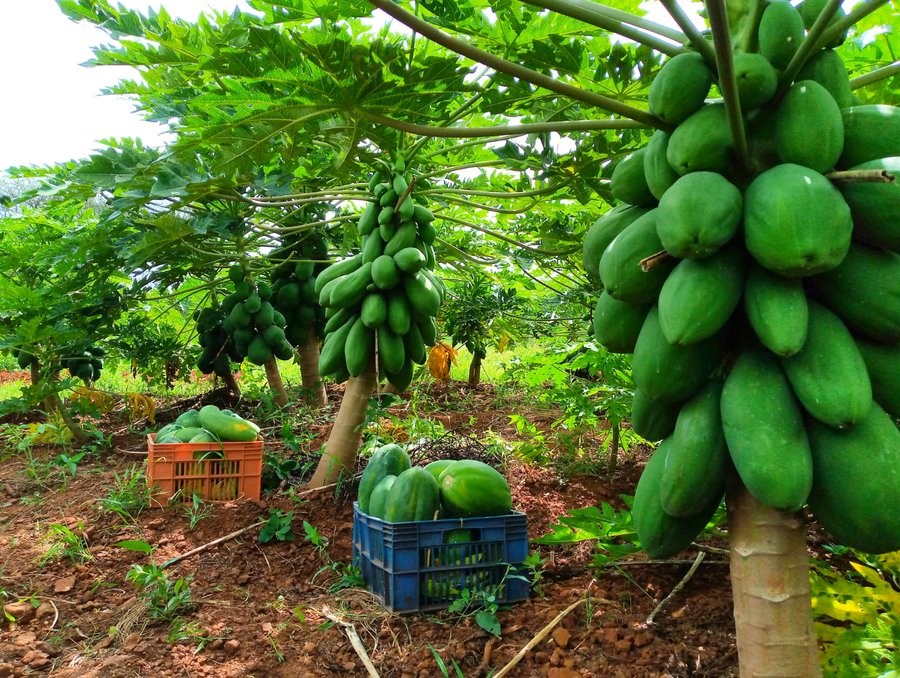
Harvest in the morning when the fruit is cool. Keep harvested fruit in the shade. Sort fruit by size and remove damaged pieces before you take the fruit to market. Clean, graded fruit sells for a higher price. Fruit of the Solo Sunrise variety keeps for up to 14 days, so you have time to find the best buyer.
Papaya Farming in Kenya: Yield Per Acre and Returns
In papaya farming in Kenya, a well-managed dwarf tree gives 25 to 50 kg of fruit per year. At 2 m by 2 m spacing, one acre holds about 1,000 trees. This gives a yield of 25,000 to 50,000 kg per acre in a mature year. Your yield depends on water, feeding, pest control and variety.
The example below shows papaya farming in Kenya on a starter orchard of 100 trees on 400 square metres. The example assumes a farm gate price of Sh50 per kilo. Yields rise from 15 kg per tree in year one to 50 kg in year three. Establishment costs are Sh35,000 for 100 trees, which covers seedlings at Sh150, manure and fertiliser at Sh150 and digging and planting at Sh50 per tree. Running costs for fertiliser, water, spraying and labour are Sh15,000 per year. These figures are planning examples. Replace them with your own prices.
| Year | Yield per tree | Total fruit | Income at Sh50 per kilo | Costs | Net income |
|---|---|---|---|---|---|
| Year 1 | 15 kg | 1,500 kg | Sh75,000 | Sh50,000 | Sh25,000 |
| Year 2 | 35 kg | 3,500 kg | Sh175,000 | Sh15,000 | Sh160,000 |
| Year 3 | 50 kg | 5,000 kg | Sh250,000 | Sh15,000 | Sh235,000 |
| Three-year total | 10,000 kg | Sh500,000 | Sh80,000 | Sh420,000 |
Price drives your income from papaya farming in Kenya. At Sh80 per kilo, each income figure rises by 60 percent. At Sh30 per kilo, each income figure falls by 40 percent. Prices drop when many farmers harvest at once. Stagger your planting by a few months so your harvest does not match your neighbours’ harvest.
Most orchards in papaya farming in Kenya remain productive for 3 to 5 years, depending on variety and care. Plan to replant a portion of your orchard each year. This keeps income steady and avoids a gap when old trees decline.
Your First 12 Months of Papaya Farming in Kenya
A calendar keeps your work in order. Use this plan and adjust the dates to your rainfall.
Before planting, test your soil, dig and fill the holes, install your drip lines and order your seedlings. Do this work two to four weeks ahead of planting so the manure settles and the nursery has your variety ready.
In months 1 to 3, plant on mounds into steady rain. Stake each seedling, mulch and water. Weed the circle by hand. Apply NPK 17:17:17 every month. Plant beans or kale between the rows for early income.
In months 4 to 6, prune old leaves and scout your trees every week. Remove weak plants so each hole keeps one strong tree. Solo Sunrise trees start to flower and fruit in this period. Check for aphids, because aphids spread virus.
In months 7 to 9, switch to a potassium-rich fertiliser as the trees start to fruit. Find your buyers and agree on prices. Prepare padded crates, a shaded sorting area and transport. Begin harvest when the first fruits show a yellow tinge at the base.
In months 10 to 12, harvest every week. Record your kilos, prices and costs. Plan your second batch of seedlings so your orchard keeps producing when the first trees age.
Papaya Farming in Kenya: Costs for One Acre
Budget before you start papaya farming in Kenya. One acre at 2 m by 2 m spacing needs about 1,000 seedlings. At KSh 100 to KSh 150 per seedling from Farmers Trend Limited, seedlings cost KSh 100,000 to KSh 150,000. Add 20 tonnes of manure and 250 kg of DAP for the planting holes. Add drip irrigation, stakes, mulch, labour and pest control.
Start with 100 or 250 trees if this budget is too large. A small orchard teaches you the crop at low risk. You then expand with your own earnings. Spread your seedling purchase across two or three batches to ease cash flow and to stagger your harvest.
Where to Sell the Fruit From Papaya Farming in Kenya
Local Markets and Traders
Most fruit from papaya farming in Kenya sells locally. Visit markets in your county and in the nearest large town. Ask traders what size and ripeness they want. Agree on a price before you harvest a large lot.
Supermarkets, Hotels and Juice Bars
These buyers want uniform, clean fruit delivered on schedule. Solo Sunrise and other small, sweet varieties suit them. Take samples and a written price offer. Keep delivery promises, because reliable supply wins repeat orders.
Farmer Groups and Export Agents
A group sells larger volumes and negotiates better prices. A group also shares transport costs. Export buyers require traceable fruit and good record keeping. Keep records of every spray and fertiliser application. Ask your county agriculture office which agents buy papaya in your area.
Value Addition
Value addition raises returns from papaya farming in Kenya. Surplus and slightly damaged fruit still earns money. Process fruit into juice, jam or dried papaya. Dried papaya keeps for months and sells at a higher price per kilo. Check hygiene and licensing rules with your county health office before you sell processed products.
Common Mistakes in Papaya Farming in Kenya
| Mistake | Result | Fix |
|---|---|---|
| Planting in waterlogged soil | Root rot kills the trees | Choose well-drained land and plant on mounds |
| Buying uncertified seedlings | Weak trees, mixed fruit and low yield | Buy from a registered nursery with a clear variety label |
| Skipping water in dry spells | Flower drop and small fruit | Install drip irrigation and mulch |
| Underfeeding the trees | Bland fruit and short tree life | Feed monthly and switch to potassium at fruiting |
| Ignoring virus symptoms | Disease spreads through the orchard | Uproot and burn sick trees and control aphids |
| Planting everything at once | Price crash at harvest and a gap later | Plant in batches every few months |
| Poor handling at harvest | Bruised fruit sells for less | Use padded crates and harvest in the morning |
Buy Dwarf Papaya Seedlings From Farmers Trend Limited
Farmers Trend Limited supports papaya farming in Kenya with dwarf pawpaw (papaya) seedlings from the Virtual Agrovet shop. Prices run from KSh 100 to KSh 150 per seedling, depending on the variety. Choose from Red Royal F1, Malkia F1, Solo Sunrise, Calina Papaya IPB9 and Red Lady Dwarf.
Farmers Trend Limited also publishes a full pawpaw farming guide with more planting detail. The Farmers Trend Limited team recommends varieties for your county, altitude and market. Order early so your seedlings arrive before the rains settle.
Call or WhatsApp 0724 559 286 or 0790 509 684. Email info@farmerstrend.co.ke. Visit www.farmerstrend.co.ke.
Frequently Asked Questions on Papaya Farming in Kenya
How long does papaya farming in Kenya take to give fruit?
Most varieties fruit 8 to 9 months after transplanting. Solo Sunrise fruits in 6 to 8 months. Cooler areas add weeks to these figures.
How many papaya trees fit in one acre?
One acre holds about 1,000 trees at 2 m by 2 m spacing, about 650 trees at 2.5 m by 2.5 m and about 450 trees at 3 m by 3 m.
How much does a dwarf papaya seedling cost?
Farmers Trend Limited prices dwarf papaya seedlings from KSh 100 to KSh 150 each. The price depends on the variety.
Which papaya variety is best for beginners?
Solo Sunrise suits beginners. The variety fruits early, and the small fruit sells easily. Calina is a strong second choice for larger red-fleshed fruit.
What altitude suits papaya?
Dwarf papaya performs best from sea level to 1,800 metres. Avoid cold, frosty areas.
How much water does papaya need?
Papaya needs 1,000 to 1,500 mm of rain per year. In dry weather, give each tree about 10 to 20 litres per week and adjust for your soil.
How long does a papaya orchard last?
Most orchards stay productive for 3 to 5 years. Solo Sunrise lasts up to 4 years, and Red Lady bears for more than five years with good care.
Is papaya farming in Kenya profitable?
Papaya farming in Kenya pays when you manage water, feeding and pests and sell at a fair price. The example above shows a net income of Sh420,000 over three years from 100 trees at Sh50 per kilo. Your result depends on your costs and your market.
Start Papaya Farming in Kenya This Season
Papaya farming in Kenya rewards you quickly. You plant, and within 9 months you pick fruit. Choose a variety which suits your market. Solo Sunrise pays early, Calina and Malkia give larger fruit and Red Lady lasts longest.
Match your farm to the crop. Choose warm land below 1,800 metres, with well-drained soil and a reliable water source. Dig 60 cm holes, mix in 20 kg of manure and 250 g of DAP and plant on mounds if the rains are heavy. Feed monthly, mulch, scout for pests every week and harvest at the first yellow tinge.
Start with 100 trees. Record your costs, yields and prices. Add more trees as your income grows, and plant in batches so your harvest stays steady. Contact Farmers Trend Limited on 0724 559 286 or 0790 509 684 to order your papaya seedlings.
https://farmerstrend.co.ke/trending/papaya-farming-in-kenya/https://farmerstrend.co.ke/wp-content/uploads/2026/10/pawpaw-farming-in-kenya-2023-1024x768.jpghttps://farmerstrend.co.ke/wp-content/uploads/2026/10/pawpaw-farming-in-kenya-2023-150x150.jpg# TrendingFruitsIn FruitsPawpaw farmingCalina IPB9,dwarf pawpaw seedlings,Malkia F1,papaya farming in Kenya,papaya market price Kenya,papaya pests and diseases,papaya spacing,papaya varieties in Kenya,papaya yield per acre,pawpaw farming kenya,Red Lady papaya,Red Royal F1,Sinta F1,Solo Sunrise papayaPapaya farming in Kenya gives you fruit within 9 months of planting. Few orchard crops pay this fast. Dwarf varieties grow 2 to 3 metres tall, so you harvest from the ground without a ladder. A starter orchard of 100 trees needs only 400 square metres of land.Farmers practise...FarmersTrendjohn doefarmerstrend@gmail.comAdministratorFarmers Trend Ltd.


Leave a Reply