Grafted Red Oratia Tree Tomato Seedlings at KSh 100: Fruit in 8 Months, Harvest Weekly for 6 Profitable Years
Grafted Red Oratia tree tomato seedlings cost KSh 100 each. Each seedling starts to fruit 8 months after planting. You then harvest every week for about 6 years. One acre holds 1,200 plants on a 6 by 6 feet spacing. The crop has no fixed season, so your trees carry flowers, green fruit and ripe fruit together.
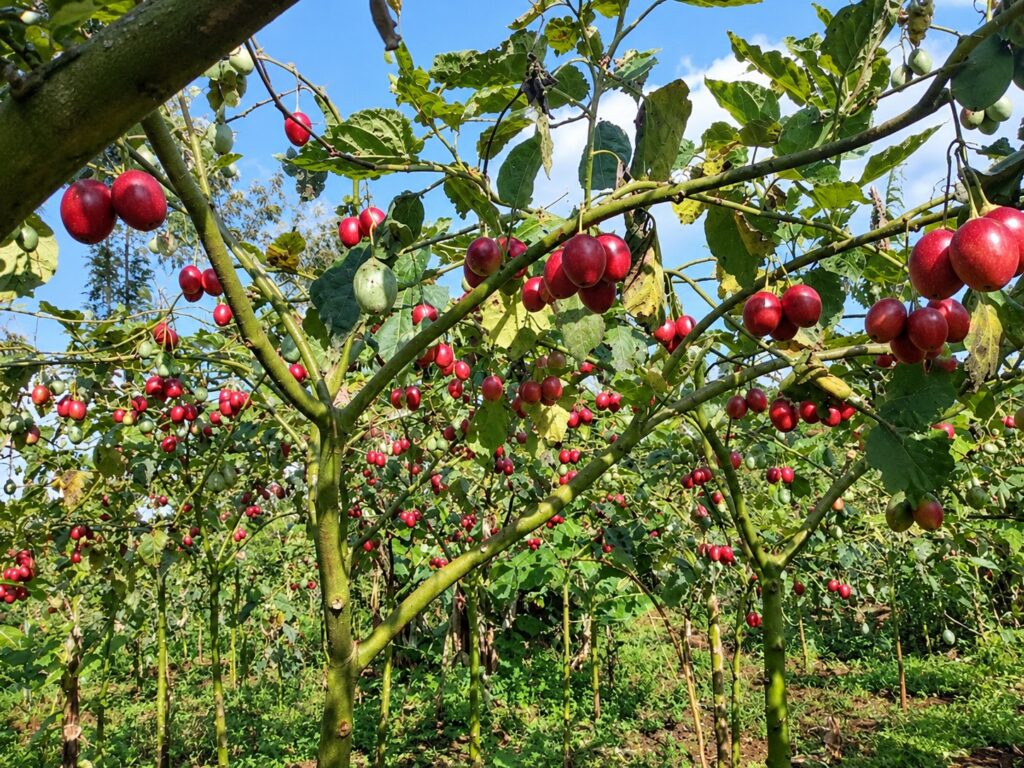
A tree tomato grown from seed needs 18 to 24 months before the first fruit. A grafted Red Oratia seedling needs 8 months. This gap decides when your first income arrives and how fast you recover your costs.
This pillar guide covers every step. You will learn how the crop works, what one acre costs, what one acre earns, and how to plant, feed, prune, protect and sell. Farmers Trend Limited prepared the guide for Kenyan farmers who want a steady weekly income from a small piece of land.
The facts come from Kenyan growers, Kenyan newspapers and the field work of Farmers Trend Limited. John Kiruthi, the founder of Farmers Trend, has propagated more than 40,000 grafted tree tomato seedlings in Nyeri and Limuru. He keeps one acre of tree tomatoes in each town. The demand is real and the method is proven.
What Grafted Red Oratia Tree Tomato Seedlings Are
Tree tomato, also called tamarillo, belongs to the Solanaceae family. The tree grows up to about 5 metres tall. Kenyan farmers grow the crop in Migori, Kisii, Kakamega, Meru, Murang’a, Embu, Nyeri, Nyandarua and Kericho. Red Oratia is the red fruited variety many Kenyan growers rate as the best for the country. The fruit turns red when ripe.
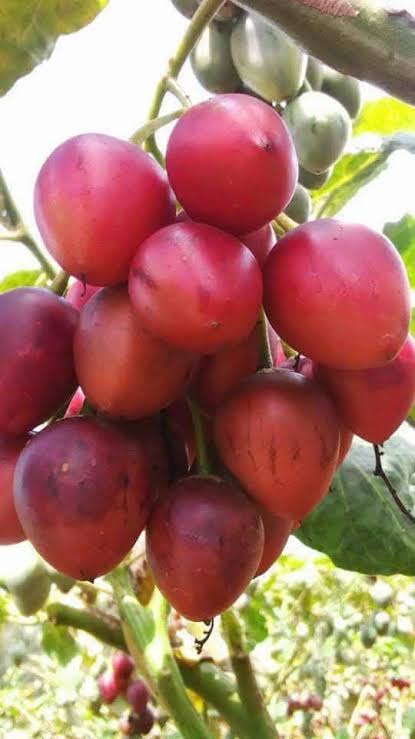
A grafted seedling joins two plants. The top part, called the scion, comes from a Red Oratia tree. The bottom part, called the rootstock, comes from bugweed, known in Kenya as Muthakwa. The grafter joins the two parts and ties the joint until they grow together as one plant.
Bugweed has a taproot, which goes deep and reaches water in the lower soil. A tree tomato grown from seed has shallow roots. Shallow roots dry out fast and give weak support in strong wind. The bugweed rootstock gives the tree a stronger anchor and better access to water.
The rootstock also helps against nematodes. These are tiny worms in the soil which attack roots. A study of six tree tomato types, published through IntechOpen, tested their response to root knot nematodes. The researchers rated Red Oratia as moderately resistant in two tests. The grafted type was moderately resistant in the greenhouse and tolerant in the field.
John Kiruthi of Farmers Trend makes the same point. He says trees grafted on Muthakwa live longer, resist nematodes and bear bigger and tastier fruit.
Product facts at a glance
| Item | Detail |
|---|---|
| Variety | Red Oratia tree tomato |
| Seedling type | Grafted on bugweed (Muthakwa) rootstock |
| Price | KSh 100 per seedling |
| Time to first fruit | 8 months after transplanting |
| Productive life | 6 years |
| Harvest | Weekly, with no fixed season |
| Plants per acre | 1,200 on a 6 by 6 feet spacing |
Why Grafted Red Oratia Tree Tomato Seedlings Beat Seed Grown Trees
You have two choices. You plant a non grafted seedling or a grafted one. A non grafted seedling costs about KSh 50. Farmers Trend Limited sells grafted Red Oratia seedlings on Muthakwa rootstock at KSh 100 each.
The extra KSh 50 buys speed. Non grafted tree tomatoes fruit after 1.5 to 2 years. Grafted tree tomatoes fruit after 8 months. You start selling 10 to 16 months earlier.
Do the math on one tree. Take a yield of 10 kg per year and a price of KSh 80 per kilo. One tree earns KSh 800 per year, or about KSh 15 per week. The extra KSh 50 returns in about 4 weeks of harvest. Across 1,200 plants, you pay KSh 60,000 more and you start earning 10 to 16 months sooner.
| Factor | Non grafted seedling | Grafted Red Oratia seedling |
|---|---|---|
| Time to first fruit | 18 to 24 months | 8 months |
| Seedling price | About KSh 50 | KSh 100 |
| Root system | Shallow | Deep taproot from bugweed |
| Nematode risk | Higher | Lower |
| Fruit size and taste | Smaller | Bigger and tastier, per Farmers Trend |
| Productive life | Shorter | Longer, planned at 6 years |
Some farmers report productive lives of up to 10 years on grafted trees. Farmers Trend Limited plans an orchard for 6 years. This plan protects your budget. Any extra years add profit.
Eight Months to First Fruit and Six Years of Weekly Harvests
Grafted trees fruit about 8 months after transplanting. Nation Africa reports the same figure for grafted tree tomato. Farmers Trend Limited sees the same timing on managed farms. Poor feeding, dry spells and weak seedlings push the date back.
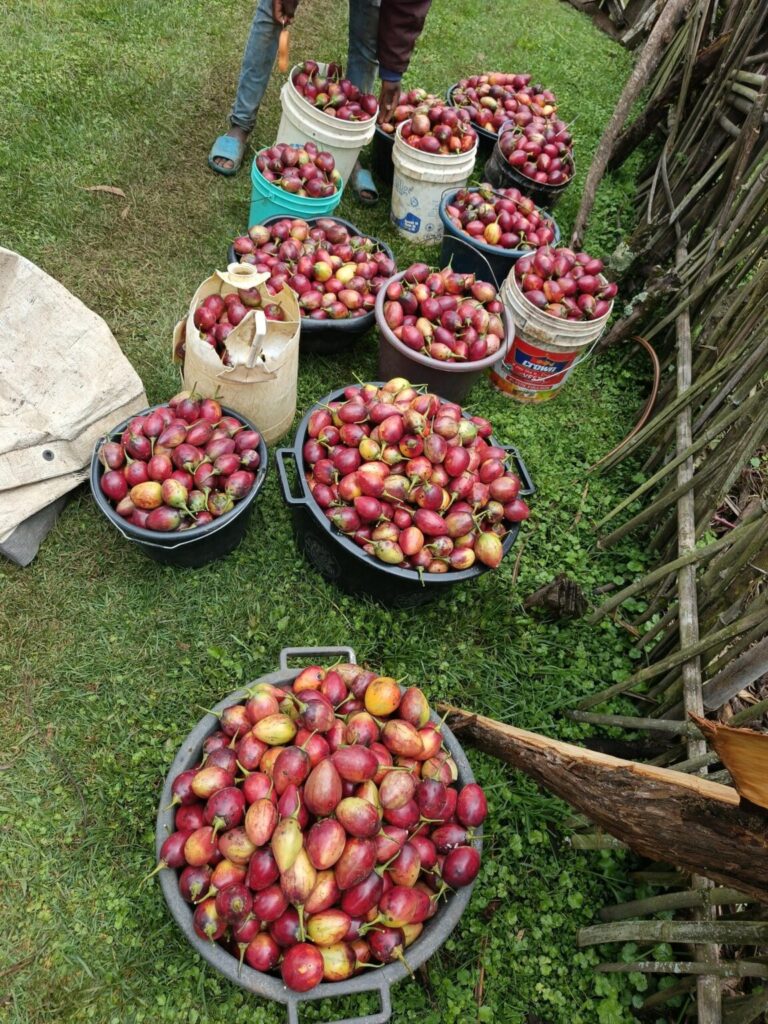
Plant in November 2026 and you pick your first fruit in July 2027. Plant in March and you pick in November. Each month of delay costs you one month of income.
After the first fruit, the tree flowers and fruits in overlapping waves. You find flowers, small green fruit and ripe fruit on the same tree. This is why you harvest every week. You never wait for a season to open.
| Period | What happens on your farm |
|---|---|
| Month 0 | You transplant seedlings into prepared holes |
| Months 1 to 7 | You water, mulch, feed, stake and prune young trees |
| Month 8 | The first fruit turns red and you start picking |
| Months 9 to 12 | Harvests rise as trees add fruiting branches |
| Years 2 to 5 | You harvest weekly at full production |
| Year 6 | You plan replacement seedlings for the oldest trees |
Replacement planning starts in year 5. Order new seedlings early. Plant them between old rows or in a fresh block. You then keep your weekly income unbroken while the old block retires.
1,200 Plants Per Acre: Spacing and Layout
An acre measures 43,560 square feet. A 6 by 6 feet spacing gives each plant 36 square feet. Divide 43,560 by 36 and you get 1,210 plants. Farmers Trend Limited rounds this to 1,200 plants. The difference leaves room for paths.
Six feet equals about 1.8 metres. Each tree gets a square of 1.8 by 1.8 metres. This spacing gives light and air to every tree. Crowded trees hold moisture on the leaves and invite disease.
Other sources quote different spacing. Nation Africa gives 2 metres between rows and 1 metre between plants. Seed grown trees at 3 by 3 metres suit large farms with machines. Choose one spacing and hold the same distance across the whole block.
| Spacing | Area per plant | Plants per acre |
|---|---|---|
| 3 by 3 metres | 9 square metres | About 450 |
| 2 by 1 metres | 2 square metres | About 2,020 |
| 6 by 6 feet | About 3.4 square metres | About 1,200 |
Mark your rows with a rope and pegs. Run rows across the slope on hilly land. This slows runoff and saves topsoil. Leave a path of 1 metre every 10 rows so you move crates without damaging branches.
Income From One Acre of Grafted Red Oratia Tree Tomato Seedlings
Your income depends on two numbers. These are the yield per tree and the price per kilo. Both vary by farm, by market and by month.
What a tree yields
Graduate Farmer reports 10 to 20 kg of fruit per tree per year. Some growers quote figures near 30 kg per tree on well managed farms. Farmers Trend Limited advises you to plan with 10 to 20 kg. A budget built on the low figure leaves you safe.
What a kilo sells for
The Standard reports prices of KSh 80 to KSh 150 per kilo. Nation Africa reports KSh 80 to KSh 140. Prices move with supply, grade and the market you serve. Use KSh 80 for a cautious plan and KSh 100 for a normal plan.
Gross sales per acre per year
The table below multiplies yield per tree by 1,200 trees and by the price. All figures are gross sales in KSh before labour, manure, fertiliser, sprays, packaging and transport.
| Yield per tree per year | Kilos per acre | At KSh 80 per kilo | At KSh 100 per kilo | At KSh 120 per kilo |
|---|---|---|---|---|
| 10 kg | 12,000 | 960,000 | 1,200,000 | 1,440,000 |
| 15 kg | 18,000 | 1,440,000 | 1,800,000 | 2,160,000 |
| 20 kg | 24,000 | 1,920,000 | 2,400,000 | 2,880,000 |
What this means each week
A weekly harvest turns the annual figure into a steady flow. Divide the yearly kilos by 52 and you get your weekly volume.
| Yield per tree per year | Kilos per week | Gross sales per week at KSh 100 |
|---|---|---|
| 10 kg | About 230 | About KSh 23,000 |
| 15 kg | About 346 | About KSh 35,000 |
| 20 kg | About 462 | About KSh 46,000 |
Your seedling cost against your income
One acre needs 1,200 seedlings. At KSh 100 each, the seedlings cost KSh 120,000. A tree repays the cost of the seedling with one kilogram of fruit sold at KSh 100. Your whole seedling bill returns after you sell 1,200 kg, or about 5 weeks of picking at the low yield.
Test the six year view. Take the cautious case of 10 kg per tree and KSh 80 per kilo. This gives KSh 960,000 per year in gross sales. Five full years of harvest add up to KSh 4,800,000. The first year adds a partial harvest on top, because picking starts at month 8.
Subtract your real costs before you call this profit. Keep a simple record of every shilling. Farmers Trend Limited advises you to track manure, fertiliser, labour, water, sprays, crates and transport per month. Your records show which cost lines to cut.
Where Grafted Red Oratia Tree Tomato Seedlings Grow Best
Tree tomato likes a subtropical climate with cool nights. Sources agree on the broad needs. Check your site against the table before you order seedlings.
| Requirement | Range |
|---|---|
| Altitude | 1,500 to 3,000 metres above sea level |
| Temperature | 15 to 25 degrees Celsius |
| Rainfall | 600 to 4,000 mm per year, or irrigation in drier areas |
| Soil pH | 5 to 8.5 |
| Soil structure | Deep, well drained and loose |
| Frost | Not tolerated |
Tree tomato roots do not tolerate standing water. Water in the root zone kills a tree in a matter of days. Pick a site with good drainage. Avoid hollows where water collects after heavy rain.
Compacted soil restricts roots. If your soil is heavy, loosen the soil deeply before you dig holes. Add well decomposed manure to improve structure. A soil test tells you your pH and nutrient levels. Take the test before you plant, not after trees show problems.
Dry areas below 300 mm of annual rainfall stress the crop. If you farm in a drier zone, install drip irrigation first. A tree tomato gets stressed quickly without water, and stress cuts fruit set.
Wind is the second site factor. The tree is shallow rooted and carries heavy fruit. Plant a windbreak of trees on the windward side. Grafted trees on bugweed rootstock hold better than seed grown trees, but a windbreak still reduces damage.
How to Plant Grafted Red Oratia Tree Tomato Seedlings
Plant at the start of the rains. In most of the country the long rains start in March and the short rains start in October. With irrigation, you plant in any month. Plant on a cool, cloudy day or in the late afternoon.
Prepare the land
Clear weeds and old crop residue. Plough or hoe the soil until the soil is loose. Take your soil sample and send the sample to a laboratory. Peg your 6 by 6 feet grid. You need 1,200 pegs for one acre.
Dig and fill the holes
Dig each hole about 60 cm wide and 60 cm deep. Place the topsoil on one side and the subsoil on the other. Mix two spadefuls of topsoil with well decomposed manure. Organic farming guides advise one bucket of fully decomposed manure per hole as a base.
Nation Africa also advises 200 g of DAP fertiliser per plant at planting. For 1,200 plants, this equals 240 kg, or about 5 bags of 50 kg. Let your soil test decide the final rate. Mix the fertiliser well with the soil. Fertiliser touching the roots burns them.
Refill the hole with the mix and leave the hole for two weeks before you plant. This gives the manure time to settle and the soil time to stabilise.
Plant the seedling
Water the seedling in the bag before you move the seedling. Remove the bag carefully. Keep the root ball whole. Place the seedling in the hole and cover only the root ball with soil. Bury only enough to cover the root hairs. Keep the graft joint well above the soil line. Soil on the joint invites rot and sends roots from the scion, which cancels the benefit of the rootstock.
Firm the soil around the seedling with your hands. Water well. Add a stake and tie the stem loosely with soft string.
Mulch and water
Spread dry grass or crop residue around each plant. Keep the mulch a few centimetres away from the stem. Mulch holds moisture, controls weeds and keeps soil cool. Water the trees twice a week during dry spells for the first three months. Keep the soil moist but never waterlogged.
Crop Care for Weekly Harvests
A tree tomato fruits and grows at the same time. This is why you must care for the trees every week. Missed feeding or missed water shows up in the next harvest.
Feeding
Tree tomatoes need continuous feeding. Apply well decomposed manure around each tree twice a year. Spread the manure under the canopy and work the manure lightly into the soil. Top dress with calcium ammonium nitrate in split doses, as Greenlife Crop Protection advises. Split doses reduce losses and feed the tree steadily.
Follow your soil test results. A test shows which nutrients your soil lacks. Fruiting trees draw heavily on soil nutrients. Ask an agronomist to set rates for your farm. Do not copy a neighbour who farms on different soil.
Watering
A tree tomato stresses quickly without water. Dry spells cause flower drop and small fruit. Drip irrigation suits the crop. Drip lines deliver water to the root zone and keeps leaves dry. Dry leaves lower disease pressure.
Use your finger to test soil moisture. Push your finger 5 cm into the soil beside the tree. Dry soil needs water. Wet soil needs none. Never let water stand around the trunk.
Pruning
Pruning controls plant size, fruit size and harvest timing. Start when the seedling reaches knee height. Keep one strong main stem. Cut the top at about 1 metre to force side branches. Select 3 to 4 strong branches to form the frame.
Each year, remove dead, crossing and weak branches. Keep the tree at a height where you reach the top fruit from the ground. Remove any shoots which grow from the rootstock below the graft joint. These shoots come from bugweed and take food from your fruiting tree.
Use clean, sharp secateurs. Dip the blades in a disinfectant between trees. This stops disease spreading from one tree to the next.
Weeding and staking
Keep a weed free circle around each tree. Weeds compete for water and shelter pests. Use mulch and hand weeding. Avoid deep hoeing near the trunk, because tree tomato roots sit close to the surface.
Stake young trees for the first year. Heavy fruit loads bend branches. Support laden branches with soft ties. Replace broken stakes at once.
Pests and Diseases in Grafted Red Oratia Tree Tomato
Tree tomatoes are fairly resistant to most diseases and pests. Weekly harvesting still gives you a chance to scout every tree. Walk your rows each week with a notebook. Record the problem, the block and the date.
Four pests appear most often in Kenyan farms. These are aphids, thrips, whiteflies and nematodes. Use the table to identify each one and act early.
| Pest | What you see | What you do |
|---|---|---|
| Aphids | Curled young leaves and sticky leaf surfaces | Remove heavily hit shoots and spray a product registered for the crop |
| Thrips | Silvery scars on leaves and rough patches on fruit | Keep weeds down and spray according to the product label |
| Whiteflies | Tiny white insects under leaves, yellowing leaves | Use yellow sticky traps and spray a registered product |
| Nematodes | Stunted trees and swollen knots on roots | Plant grafted seedlings on bugweed rootstock and add manure |
Read every spray label. Follow the dose, the water volume and the waiting period before harvest. Wear protective gear. Never spray on the day you harvest. Buyers expect clean fruit, and your market depends on clean fruit.
Prevention works better than spraying. Space trees properly. Prune for airflow. Mulch the soil so water does not splash soil onto leaves. Remove fallen fruit and leaves. Plant only well grafted seedlings.
A weak tree attracts pests faster than a strong one. Good feeding and steady watering are your first line of defence.
Harvesting and Selling Your Tree Tomatoes
When and how to pick
Pick the fruit when the skin turns red. Red Oratia gives red fruit when ripe. Walk through the rows every week and pick only ripe fruit. Use clean hands or clippers. Cut the stalk with the fruit. Do not pull the fruit off the branch.
Place fruit gently in plastic crates lined with soft material. Keep the crates in shade. Move them to the market or the store on the same day. Fruit left in the sun loses firmness and fetches a lower price.
Grading your fruit
Sort fruit by size and colour. Sell the large, clean fruit to supermarkets and groceries. Sell medium fruit to open markets. Sell small and marked fruit to juice vendors. Grading raises your average price per kilo.
Where you sell
Nation Africa reports demand for tree tomato above supply. Buyers include supermarkets, groceries and fresh produce markets. Growers sell in Nairobi at Marikiti and Githurai, and in Mombasa, Kisumu and Eldoret. The fruit also goes to export buyers. Fresh tree tomato is blended with sugar and water to make juice, which gives you a second market through juice sellers.
| Market | Buyer type | What they want |
|---|---|---|
| Supermarkets | Retail chains | Graded, clean fruit in crates or packs |
| Groceries | Neighbourhood shops | Regular weekly supply |
| Open markets | Traders at Marikiti and Githurai | Volume at fair price |
| Juice vendors | Small processors | Ripe fruit with small blemishes |
| Export buyers | Exporters | Uniform, high quality fruit |
Build relationships with three or four steady buyers. A weekly harvest suits a weekly order. Agree on the day, the volume and the price. Steady buyers protect you from market gluts.
How to Buy Genuine Grafted Red Oratia Tree Tomato Seedlings
The seedling decides your first 8 months. A weak graft costs you the whole crop. One Nyeri farmer, Dennis Kanyugo, lost KSh 75,000 when he bought poorly grafted seedlings. He says proper grafting happens when the seedling reaches about 4 inches. Some seedlings he bought stood at 2 inches, which hurt their survival.
Check six things before you plant.
| Check | What a good seedling shows |
|---|---|
| Graft joint | A clean, healed union with no gaps or cracks |
| Rootstock | Bugweed (Muthakwa) |
| Height | A sturdy seedling past 4 inches at grafting, with a straight stem |
| Leaves | Green, firm and free from spots, holes and insects |
| Roots | Full root ball in the bag with white, healthy roots |
| Shoots below the joint | None, or cut cleanly |
Ask for the grafting date and the source of the scion. Ask how long the seedlings hardened before delivery. Farmers Trend Limited answers these questions when you call 0790 509 684. Inspect every seedling on delivery and reject any seedling with a weak joint.
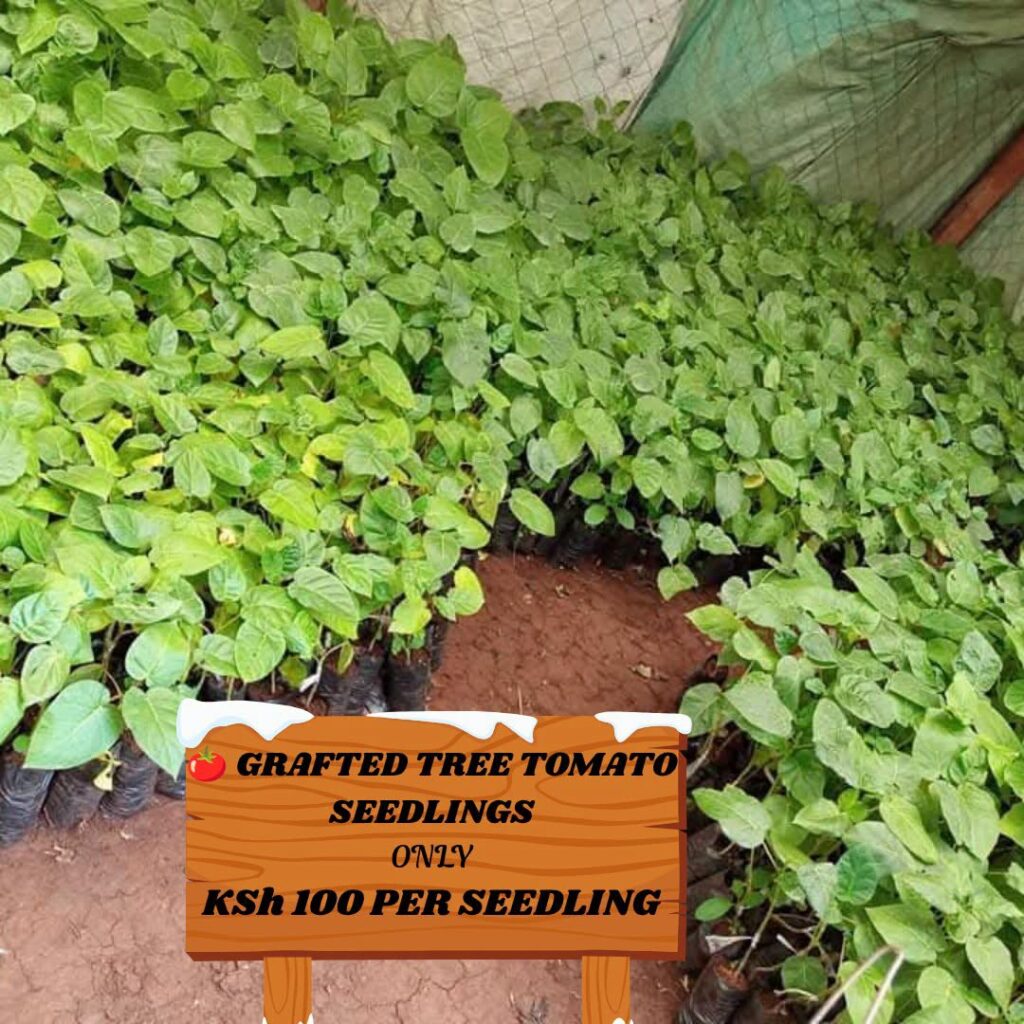
Farmers Trend Limited sells grafted Red Oratia tree tomato seedlings on bugweed rootstock at KSh 100 each. Poorly grafted seedlings cost more in lost trees than you save on the price.
Order about 1,300 seedlings per acre. This covers 1,200 holes and about 100 spare plants for gap filling. The cost of 1,300 seedlings is KSh 130,000. Plant the spares in a small nursery bed and use them to replace any tree which fails in the first two months.
Common Mistakes With Grafted Red Oratia Tree Tomato Seedlings
Most failures come from a short list of errors. Avoid these and you protect your income.
| Mistake | Result | Fix |
|---|---|---|
| Buying poorly grafted seedlings | Dead trees and lost months | Inspect every joint before you plant |
| Planting in waterlogged soil | Root death within days | Choose a well drained site and dig drainage channels |
| Burying the graft joint | Rot and wasted rootstock | Keep the joint above the soil line |
| Skipping the soil test | Wrong fertiliser and low yield | Test soil before planting |
| Letting rootstock shoots grow | Weak fruiting tree | Cut shoots below the joint each week |
| Crowding trees | More disease and smaller fruit | Hold the 6 by 6 feet spacing |
| No water in dry spells | Flower drop and small fruit | Install drip irrigation |
| Selling ungraded fruit | Low average price | Grade by size and colour |
Frequently Asked Questions About Grafted Red Oratia Tree Tomato Seedlings
How long do grafted Red Oratia tree tomato seedlings take to fruit?
Grafted Red Oratia tree tomato seedlings start to fruit about 8 months after transplanting. Non grafted trees take 1.5 to 2 years.
How much do grafted Red Oratia tree tomato seedlings cost?
Farmers Trend Limited sells grafted Red Oratia tree tomato seedlings at KSh 100 each. One acre of 1,200 plants costs KSh 120,000 in seedlings.
How many tree tomato plants fit in one acre?
One acre holds about 1,200 plants on a 6 by 6 feet spacing. The exact math gives 1,210. Rounding down leaves room for paths.
How long does a grafted tree tomato live?
Plan for 6 years of weekly harvests. Some growers report up to 10 years of production on grafted trees. Good feeding, pruning and pest control extend the life of the tree.
Does tree tomato have a season?
Tree tomato has no fixed season. Trees flower and fruit in overlapping waves, so you harvest weekly across the year. Dry spells and cold snaps reduce output for a few weeks, so keep your water supply steady.
How much will one acre earn?
At 10 to 20 kg per tree and KSh 80 to KSh 120 per kilo, one acre of 1,200 trees earns KSh 960,000 to KSh 2,880,000 in gross sales per year. Subtract your costs to find your profit.
Which areas suit tree tomato?
Tree tomato grows well between 1,500 and 3,000 metres above sea level, with temperatures of 15 to 25 degrees Celsius. Growers farm the crop in Nyeri, Nyandarua, Murang’a, Meru, Embu, Kericho, Kisii, Kakamega and Migori. Lower, drier areas need irrigation.
When do I plant for the best start?
Plant at the start of the rains. In Kenya, the long rains start in March and the short rains start in October. A November planting gives you first fruit in July.
Do I need a soil test?
Yes. A soil test shows your pH and nutrient levels. The result tells you how much manure and fertiliser to apply. The test costs little against a bill of KSh 120,000 for seedlings.
Plant Grafted Red Oratia Tree Tomato Seedlings and Start Your Weekly Harvest
Grafted Red Oratia tree tomato seedlings give you an early return on a small acreage. The seedling costs KSh 100. The first fruit arrives in 8 months. The harvest runs weekly for about 6 years. One acre holds 1,200 trees, and each tree repays the cost of the seedling with one kilogram of fruit.
Your steps are clear. Test your soil and pick a well drained site. Peg a 6 by 6 feet grid. Dig and fill the holes two weeks ahead. Buy grafted seedlings with a healed joint on bugweed rootstock. Plant with the joint above the soil. Mulch, water, feed and prune every week. Scout for pests. Grade your fruit and sell to steady buyers.
Farmers Trend Limited supplies grafted Red Oratia tree tomato seedlings at KSh 100 each. Call 0790 509 684 or write to info@farmerstrend.co.ke to place your order and plan your planting date. Order now and your first harvest starts in 8 months.
https://farmerstrend.co.ke/trending/grafted-red-oratia-tree-tomato/https://farmerstrend.co.ke/wp-content/uploads/2026/10/WhatsApp-Image-2026-10-21-at-12.56.52-1024x768.jpeghttps://farmerstrend.co.ke/wp-content/uploads/2026/10/WhatsApp-Image-2026-10-21-at-12.56.52-150x150.jpeg# TrendingFruitsIn FruitsTree tomato farming1,200 plants per acre,best fruit trees for small land,bugweed rootstock,Farmers Trend Limited,fruit farming in kenya,grafted Red Oratia tree tomato seedlings,grafted tree tomato seedlings,Muthakwa rootstock,Red Oratia tree tomato,Tamarillo farming in kenya,tree tomato farming in kenya,tree tomato fertiliser,tree tomato fruiting in 8 months,tree tomato harvest weekly,tree tomato irrigation,tree tomato juice,tree tomato lifespan,tree tomato markets in Kenya,tree tomato nematodes,tree tomato per acre,tree tomato pests and diseases,tree tomato planting guide,tree tomato price per kilo,tree tomato profit per acre,tree tomato pruning,tree tomato seedlings in Kenya,tree tomato seedlings KSh 100,tree tomato seedlings price in Kenya,tree tomato spacing,tree tomato yield per treeGrafted Red Oratia tree tomato seedlings cost KSh 100 each. Each seedling starts to fruit 8 months after planting. You then harvest every week for about 6 years. One acre holds 1,200 plants on a 6 by 6 feet spacing. The crop has no fixed season, so your trees...FarmersTrendjohn doefarmerstrend@gmail.comAdministratorFarmers Trend Ltd.






Leave a Reply