Makueni Custard Apple Farmer Gets 3 to 4 Sacks a Harvest From 15 African Pride Trees: What the Numbers Mean for Your Orchard
Custard apple farming in Makueni gives farmer Martin Kisenga three to four sacks of fruit at each harvest from about 15 African Pride trees. Each sack weighs 90 kilograms. He sells a sack for KSh 3,000. The numbers are modest, and the numbers are real.
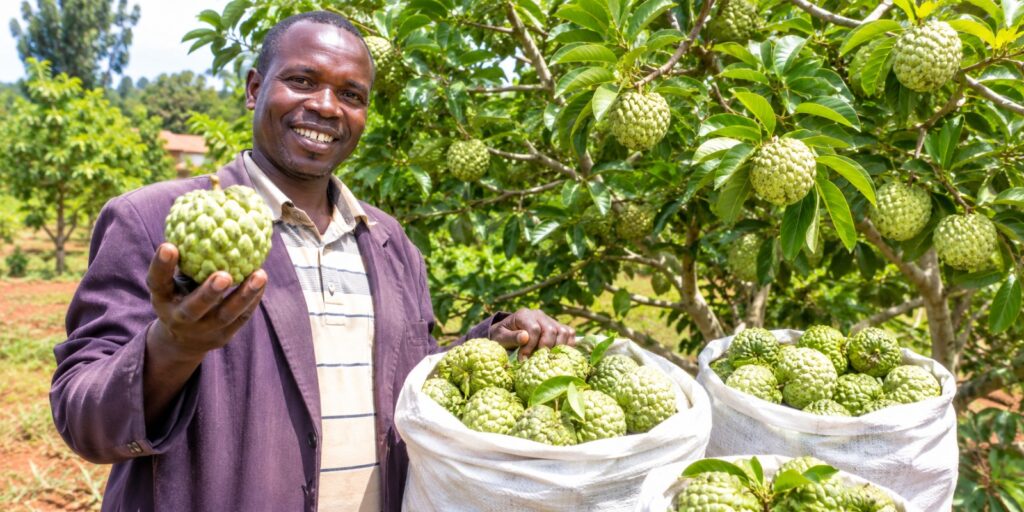
This article uses the numbers to show what custard apple farming earns on a small orchard. You see the income per tree and per acre, the cost of seedlings, the care the trees need and the market choices which change your price. You also see why a yield estimate and a field result differ, so you plan with figures you trust.
The Nation published the profile of Kisenga in the Seeds of Gold series. The prices and the age of the farmer come from the report at the time. Check today’s market prices before you plan. The Nation article is at The Nation report on the Makueni farmer.
The Makueni Farmer Behind This Custard Apple Farming Story
Kisenga lives in Kithumba village, uphill from Nunguni in Makueni County. He started farming in 1994 after he quit the taxi business. He was 74 years old when the Nation told his story. He grows custard apples on part of his one acre.
The orchard has about 15 trees of the African Pride variety. He also keeps 35 grafted avocado trees of the Fuerte, Hass, Zutano, Bacon and Reed varieties. He grafts seedlings for sale as well. At the time of the report, a grafted seedling sold for KSh 10.
Kisenga said he makes about KSh 50,000 after a good harvest from the sale of his fruits. Seedling sales add more. Prof Mathews Dida, a plant breeder at Maseno University, told the Nation grafting assures good quality fruit and Makueni suits avocados, custard apples and mangoes.
The Custard Apple Farming Numbers at a Glance
| Item | Figure |
|---|---|
| Custard apple trees on the farm | About 15 African Pride trees |
| Fruits per tree | 50 to 70 on average, depending on conditions such as birds |
| Time to harvest | Three to four months |
| Sacks per harvest | Three to four |
| Weight of a sack | 90 kg |
| Price per sack to traders at Salama centre | KSh 3,000 |
| Price per fruit when sold singly | KSh 5 to KSh 20 |
| Income after a good harvest from fruit sales | About KSh 50,000 |
| Avocado price per sack | KSh 3,000 |
| Grafted seedling price at the time of the report | KSh 10 |
Kisenga plants trees at different times, a sound habit for custard apple farming. He gets a near-constant supply of fruit from the staggered blocks. His method is simple, and the method shows you a sound habit for your own custard apple orchard.
What 3 to 4 Sacks a Harvest Means for Each Tree
The report gives the sacks for the whole group of trees. The report does not give a figure per tree. You find the figure with simple arithmetic.
Three to four sacks of 90 kilograms equal 270 to 360 kilograms of fruit. Divide the weight by 15 trees. Each tree gives about 18 to 24 kilograms in a harvest. At KSh 3,000 per sack, three to four sacks bring KSh 9,000 to KSh 12,000. Each tree earns about KSh 600 to KSh 800 in a harvest.
The price per kilogram is KSh 33, or KSh 3,000 divided by 90. Now check the fruit count. Fifteen trees with 50 to 70 fruits each give 750 to 1,050 fruits. A weight of 270 to 360 kilograms spread across those fruits gives an average of about 260 to 480 grams per fruit. These are my calculations from the report. They show the figures agree with each other.
What the Same Trees Earn Per Fruit
Kisenga also sells fruits one by one at KSh 5 to KSh 20 each. Take 750 to 1,050 fruits. At KSh 5, the harvest brings KSh 3,750 to KSh 5,250. At KSh 20, the harvest brings KSh 15,000 to KSh 21,000. Selling by the fruit pays less than the sack at the low end and more at the high end.
Take a fruit of 300 grams sold for KSh 20. A kilogram of such fruit sells for about KSh 67. The sack price works out at KSh 33 per kilogram. Selling larger fruit one by one earns twice the sack price per kilogram. Your sorting and your buyer decide your price.
What an Acre of Custard Apple Farming Earns
A small orchard shows the pattern. Scale the numbers to an acre to plan your own land. Farmers Trend Limited recommends a spacing of 4 metres by 4 metres. At this spacing, an acre holds about 250 trees.
Kisenga’s 15 trees would fill about 240 square metres at this spacing, or about 0.06 of an acre. Multiply his per-tree income of KSh 600 to KSh 800 per harvest by 250 trees. An acre of trees at his level brings KSh 150,000 to KSh 200,000 per harvest. These are planning figures. Mature trees, good care and a good market change the result.
Reality Check: Field Results Against Yield Estimates
Farmers Trend Limited estimates a mature custard apple tree produces 50 to 100 kilograms of fruit a year. Kisenga’s trees gave about 18 to 24 kilograms in a harvest. The estimate is two to five times higher.
Several things explain the gap. Tree age matters, because young trees bear less. Management matters, because feed, pruning and water raise yield. Birds take fruit, as Kisenga noted. Variety and site matter as well. Your own result sits somewhere in this range, and you learn where only after the first seasons.
Plan with the low figure. Build your cash flow on 20 kilograms per tree. Treat higher yields as extra income when you reach them. The table below shows income per acre at 250 trees for three yields and three prices.
| Yield per Tree | Fruit per Acre | At KSh 33 per kg | At KSh 60 per kg | At KSh 150 per kg |
|---|---|---|---|---|
| 20 kg | 5,000 kg | KSh 165,000 | KSh 300,000 | KSh 750,000 |
| 50 kg | 12,500 kg | KSh 412,500 | KSh 750,000 | KSh 1,875,000 |
| 100 kg | 25,000 kg | KSh 825,000 | KSh 1,500,000 | KSh 3,750,000 |
The prices come from three sources. KSh 33 per kilogram is Kisenga’s sack price. KSh 60 per kilogram is the price a Murang’a farmer told The Standard he gets for custard apples. KSh 150 per kilogram is the price in the Farmers Trend Limited yield estimate. Your result depends on where you sell. A sack sold to a market trader earns less per kilogram than graded fruit sold to a supermarket or a direct buyer.
Read the table across and down. Price moves your income as much as yield. A farmer at 50 kilograms per tree earns KSh 412,500 at KSh 33 and KSh 1,875,000 at KSh 150. Your market plan matters as much as your trees.
Why Custard Apple Farming Suits Makueni and Similar Areas
Custard apples grow well in relatively dry settings with moderate humidity. The Nation report gives a temperature range of 25 to 30 degrees Celsius. The trees also perform well on hill slopes with moderate, shallow soils, because the roots are shallow and do not penetrate deep.
Farmers Trend Limited recommends temperatures of 15 to 30 degrees Celsius, annual rainfall of 700 to 1,200 millimetres and well drained sandy loam soil with a pH of 6.0 to 7.5. Farmers Trend Limited gives an altitude range of 0 to 1,800 metres above sea level. Once established, the trees tolerate dry spells, but they need irrigation in prolonged drought.
Sources differ on altitude. An agronomist quoted by the Nation says sweetsop, or Annona squamosa, grows from 0 to 1,100 metres. Confirm the right altitude for your site with your extension officer and your nursery before you plant. Your altitude, your rainfall and your soil decide the success of custard apple farming on your land.
Which Custard Apple Do You Grow?
Kenyan farmers use the Kiswahili name matomoko for the fruit. Farmers Trend Limited lists custard apple as Annona squamosa. A Murang’a farmer told the Nation his fruit is Annona reticulata. The two species look alike and both go by the same local name.
Ask your nursery for the species and the variety name when you buy. Write the name on your records. The variety decides your altitude range, your fruiting time and your market. Kisenga’s African Pride is one variety, and Farmers Trend Limited advises you on the varieties which suit your area.
Grafting Gives You Quality and Uniform Fruit
Prof Dida said grafting assures good quality fruit. Fredrick Kinyanjui, a Murang’a farmer, grafts improved varieties onto indigenous rootstock. He told the Nation the seeds of local custard apples germinate at about 99 percent, while hybrid seeds germinate below 10 percent. Grafting solves the problem. You get the traits of the improved variety on a strong, local root.
Kisenga said he usually plants seedlings. Seeds also grow, but the trees do not mature faster. Buy grafted seedlings from a nursery you trust, so every tree in your custard apple orchard carries the variety you chose.
Stagger Your Planting for a Steady Supply
Kisenga plants at varied times and enjoys a near-constant supply. A staggered orchard spreads your harvest and your income. You also avoid the rush when all the fruit ripens in a week, and fruit is perishable. Plant one block now, another block in the next rains and a third block a year later.
How to Plant Your Custard Apple Orchard in the Rains
The rains are here, and the soil holds moisture. Planting now gives your trees a good start. Prepare your site and your holes in this order.
Choose Your Site and Prepare the Land
Choose well drained land for custard apple farming. Clear weeds and debris. Test your soil for pH and nutrients, and amend the soil if the results call for changes. Avoid waterlogged ground, because wet soil invites fungal disease and root rot.
Dig Holes and Set Your Spacing
Dig holes 60 centimetres wide, long and deep. Space the holes 4 metres by 4 metres. Mix the topsoil with 20 kilograms of well decomposed manure and 200 grams of DAP fertiliser. Fill the hole with the mix and let the soil settle.
Plant, Water and Mulch
Remove each seedling from the nursery bag without disturbing the root ball. Place the seedling in the centre of the hole and fill with the enriched soil. Firm the soil around the base and water thoroughly. Apply a thick layer of organic mulch around the base to retain moisture and suppress weeds.
Water young trees steadily in the first year so the roots establish. Check the soil weekly in dry spells. Keep the mulch a hand’s width from the stem.
Care for Your Custard Apple Trees From Year One
Good care raises the yield you reach in custard apple farming. Follow a simple routine.
Feed on a Schedule
Apply a balanced fertiliser such as NPK 10:10:10 twice a year. Switch to a potassium-rich fertiliser during fruiting to improve fruit quality. Add manure to replace the nutrients the tree uses. Spread feed under the canopy, not against the trunk.
Prune and Weed
Prune regularly to keep a manageable size and to remove dead or diseased branches. A tree of manageable height is easier to harvest and spray. Weed around the base to cut competition for water and nutrients.
Water Carefully at Flowering
Kinyanjui said his trees shed leaves in September and flower in October. He said trees need good watering at this stage to curb flower abortion, which affects fruit formation. Once the trees get irrigation or good rains, flowering and fruit formation begin. Watch your own trees and plan water for the flowering period in your area.
Pests and Diseases in Custard Apple Farming
Custard apple is hardy, but pests and disease still cost you fruit. Learn the main threats.
Fruit flies and the false codling moth are the biggest pests in custard apple farming, according to Kinyanjui. He uses pheromone traps to control them. Farmers Trend Limited also lists fruit borers, aphids and mealybugs. Powdery mildew and anthracnose are the main diseases he names, and fungal infection and root rot affect trees in poorly drained soil.
Scout your orchard every month. Look at leaves, flowers and fruit. Set traps before the fruit forms. Collect and bury fallen fruit. Use registered products and follow the label, and ask your extension officer for advice before you spray.
Harvest, Handle and Sell Your Custard Apple Crop
Custard apple fruit is perishable. The Standard describes custard apples as highly perishable with a short post-harvest window, so you need to move fruit to buyers fast. A ripe custard apple turns pale green. Harvest when the fruit shows the colour and the texture your buyer wants.
Kinyanjui reports peak harvest between April and August, with some fruit in October. Kisenga sells to traders at Salama centre and by the fruit. Kinyanjui sells to buyers in Nairobi, including a supermarket. The Standard’s business column reported Europe as the largest market for Kenyan custard apples and said demand was yet to be met, though the column is several years old.
Sort, Pack and Choose Your Buyer
Sort fruit by size and condition. Pack in padded crates or sacks lined with clean material. Handle each fruit gently, because the skin bruises. Keep the crates in shade. Deliver within hours.
Compare buyers for your custard apple crop. A market trader pays by the sack. A supermarket or a retail buyer pays for graded fruit. Larger, even fruit earns more per kilogram when you sell by the piece. Agree the price before you harvest.
Add Value From Soft and Surplus Fruit
Ripe custard apple makes juice, jam and desserts. The pulp suits ice cream. Farmers Trend Limited points to desserts and beverages as value addition options. Fruit which ripens too fast to sell fresh earns money as pulp or juice.
How Reliable Are the Numbers? Check These Before You Invest in Custard Apple Farming
Treat every figure in this article as a starting point. The report covers one farmer with 15 trees. The farmer gave the figures himself, and the Nation published them several seasons ago. Prices, yields and costs change.
Check the numbers in four ways. Visit a custard apple farm near you and ask to see the trees. Ask the farmer for the number of fruits and the price per sack in the last season. Ask two buyers what they pay today. Record your own harvests for two seasons before you plant more trees.
Your own records matter most. Write the date of each harvest, the number of sacks or fruits, the price and the buyer. After two seasons, you know your real yield and your real price. You then plan the next block of custard apple farming with facts from your own farm.
A Three-Season Cash Flow Plan for Custard Apple Farming
Trees take years to bear, so your cash flow needs a plan. Take a staggered plan with three blocks of 100 trees each. At KSh 350 per seedling, each block costs KSh 35,000 in seedlings. Plant block one this season, block two in a year and block three in two years.
Take Kisenga’s per-tree figure of KSh 600 to KSh 800 per harvest. A mature block of 100 trees brings KSh 60,000 to KSh 80,000 per harvest. Three mature blocks bring KSh 180,000 to KSh 240,000 per harvest. The staggered plan also spreads the first fruit across three years instead of one.
Fund the early years from other income. Intercrop beans or vegetables between young trees, and keep a clear strip around each tree. Sell seedlings or grafting work later, as Kisenga does. Custard apple farming rewards patient planning.
Birds, Fruit Drop and Other Field Losses in Custard Apple Farming
Kisenga said his average of 50 to 70 fruits per tree depends on conditions such as birds feeding on the fruit. Birds lower your count. Plan for losses when you estimate your yield, and protect the fruit where birds are heavy.
Cover fruit with paper or net bags where birds cause damage. Pick ripe fruit on time. Collect fallen fruit each day and bury the fruit, because rotting fruit draws fruit flies. Water your trees well at flowering, because flower abortion cuts your fruit count before the fruit forms.
Each of these steps raises the number of sound fruits you take to market. A 10 percent gain on 1,000 fruits is 100 more fruits. At KSh 10 per fruit, the gain is KSh 1,000 on one small orchard in one harvest. The gain grows with the size of your custard apple farming.
How to Sell Custard Apples Beyond the Market Trader
A sack sold to a trader earns KSh 33 per kilogram in the Makueni report. Other buyers pay more for graded fruit. Hotels, supermarkets, juice makers and fruit shops want even, clean fruit. Visit them and ask what they need.
Group with other farmers. Pool graded fruit and deliver on a fixed day. A group offers a buyer volume and a steady schedule, which earns a better price than one farmer with one sack. Agree the price and the grade in writing before you deliver.
Compare the price per kilogram from each route. Weigh a sample of your fruit and count the pieces. Then compare the sack price with the price per fruit. Choose the route which pays more for your fruit and your distance to the buyer.
Mix Your Custard Apple Farming With Other Fruit Trees
Kisenga does not rely on custard apples alone. His 35 grafted avocado trees sell at KSh 3,000 a sack too, the same as custard apples. Kinyanjui grows avocados, mangoes and plantain bananas around his custard apples. Mixed orchards spread your risk. A poor price in one fruit does not sink the whole farm.
Plan your mix for custard apple farming. Choose fruits which suit your altitude and rainfall. Choose fruits which ripen in different months, so you earn across the year. Keep a block of food crops as well.
Plan Your Own 15-Tree Starter Orchard
A 15-tree orchard matches Kisenga’s. The orchard needs about 240 square metres at 4 metres by 4 metres. Farmers Trend Limited sells custard apple seedlings at KSh 350 each. Fifteen seedlings cost KSh 5,250. Add five spares for KSh 1,750.
At Kisenga’s figures of KSh 9,000 to KSh 12,000 per harvest, one harvest from mature trees covers the cost of the seedlings. Trees need time to mature. Sources give different ages for first fruit. A Standard column says trees start bearing three to four years after planting. Kinyanjui says trees start fruiting after six years under good practices. Farmers Trend Limited projects fruit from year three. Plan your cash for the longer period.
Treat a 15-tree orchard as a test of your site, your care and your market. The trees teach you your real yield before you commit more land and money. If the test goes well, add blocks each season.
To scale your custard apple farming, multiply. Fifty trees cost KSh 17,500. One hundred trees cost KSh 35,000. An acre of 250 trees costs KSh 87,500 in seedlings. Start your custard apple farming with a block you manage well, then expand as you learn your yield and your market.
Custard Apple Seedlings From Farmers Trend Limited
Farmers Trend Limited sells custard apple seedlings at KSh 350 each. Take advantage of the ongoing rains to establish your trees while soil moisture is favourable and give the trees a good start. Order your seedlings from the Murang’a and Nairobi nurseries. Farmers Trend Limited offers countrywide delivery and free agronomy support on purchase. Order at Custard Apple Seedlings.
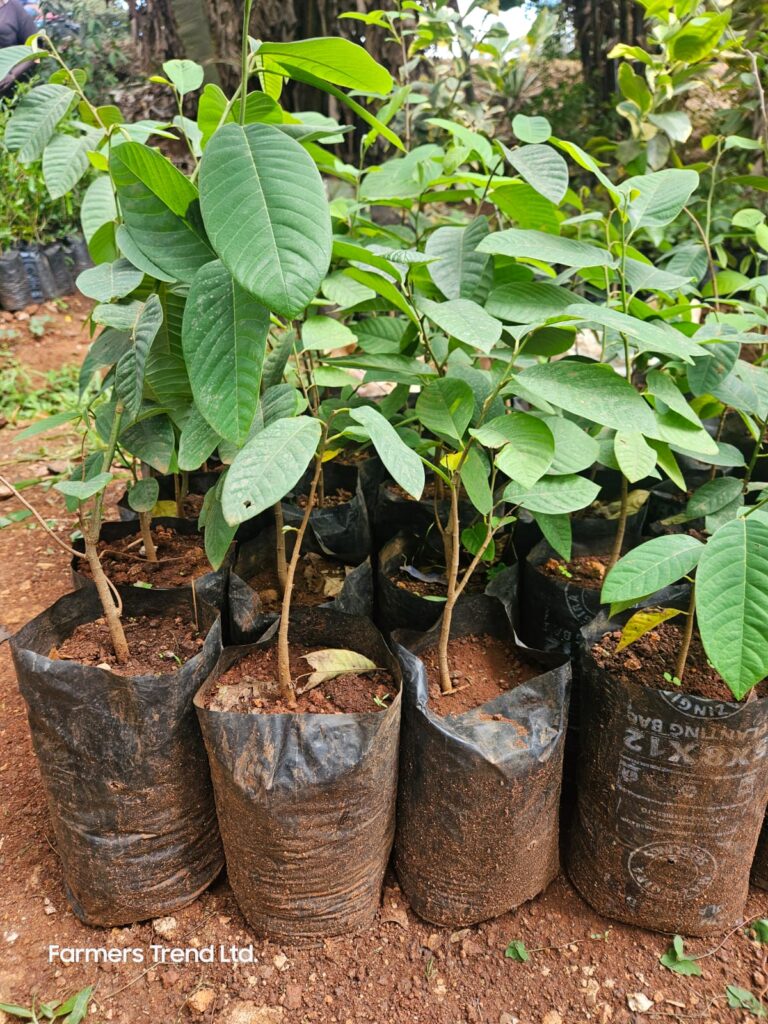
Read more on custard apple farming in Kenya in 2026 at Custard Apple Farming in Kenya in 2026. Ask Farmers Trend Limited for the variety and species which suit your altitude.
What to Check Before You Pay for Seedlings
Look at the roots, the stem and the leaves of every custard apple seedling. Choose seedlings with healthy, green leaves and a straight, firm stem. Check the graft union is healed. Ask for the species and the variety name. Buy from a nursery which gives agronomy advice after the sale.
Custard Apple Farming Mistakes to Avoid
Avoid planting on waterlogged ground. Avoid skipping the manure and fertiliser in the planting hole. Avoid planting without a buyer, because fruit spoils fast. Avoid selling every fruit by the sack when graded fruit sells for more per kilogram.
Avoid starting custard apple farming without records. Write down every harvest, every price and every cost from the first season, so you know your real return.
Avoid planning on the highest yield. Use the low figure for your cash flow. Avoid ignoring pests until fruit shows damage. Avoid planting one block and waiting, because a staggered orchard gives you steady income.
Frequently Asked Questions About Custard Apple Farming in Kenya
How many sacks does a Makueni custard apple farmer get from 15 trees?
Martin Kisenga gets three to four sacks of fruit at each harvest from about 15 African Pride trees. A sack weighs 90 kilograms and sells for KSh 3,000.
How many fruits does a custard apple tree give?
Kisenga reports an average of 50 to 70 fruits per tree, depending on conditions such as birds feeding on the fruit.
How much does a custard apple tree earn?
From the sack figures, each tree gives about 18 to 24 kilograms in a harvest and earns about KSh 600 to KSh 800. Farmers Trend Limited estimates a mature tree gives 50 to 100 kilograms a year.
Is custard apple farming profitable in Kenya?
Custard apple farming pays when you match your yield, your price and your costs. Kisenga earns about KSh 50,000 after a good harvest from his fruit sales, and larger orchards earn more. Plan with the low yield figure, sell graded fruit and keep records so you know your own return.
When do custard apple trees start to bear?
Sources differ. A Standard column says three to four years after planting. A Murang’a farmer says six years under good practices. Farmers Trend Limited projects fruit from year three. Plan for the longer period.
What spacing do custard apple trees need?
Farmers Trend Limited recommends 4 metres by 4 metres, which gives about 250 trees per acre.
Which months do custard apple trees flower and fruit?
A Murang’a farmer reports flowering in October after leaf shedding in September, with peak harvest between April and August. Timing varies by area and variety.
Is matomoko the same as custard apple?
Yes. Matomoko is the Kiswahili name used in Kenya for custard apple. Different sources name the species as Annona squamosa or Annona reticulata, so ask your nursery which species and variety you buy.
How much do custard apple seedlings cost?
Farmers Trend Limited sells custard apple seedlings at KSh 350 each from the Murang’a and Nairobi nurseries, with countrywide delivery and free agronomy support on purchase.
Start Your Custard Apple Farming This Rainy Season
Custard apple farming rewards the farmer who reads the numbers. Kisenga gets three to four sacks of 90 kilograms from 15 African Pride trees at each harvest. Each tree gives about 18 to 24 kilograms and about KSh 600 to KSh 800. An acre of 250 trees at his level brings KSh 150,000 to KSh 200,000 per harvest.
Higher yields exist in custard apple farming, and Farmers Trend Limited estimates 50 to 100 kilograms per mature tree. Plan with the low figure, sort and sell your fruit well, scout for pests and stagger your planting. Mix custard apples with avocados or other fruit to spread your risk.
The rains are here. Establish your trees while soil moisture is favourable. Farmers Trend Limited sells custard apple seedlings at KSh 350 each from the Murang’a and Nairobi nurseries, with countrywide delivery and free agronomy support on purchase. Order at Custard Apple Seedlings.
Call or WhatsApp 0790509684 or 0724559286 to place your order.
https://farmerstrend.co.ke/trending/custard-apple-farming/https://farmerstrend.co.ke/wp-content/uploads/2026/11/WhatsApp-Image-2026-11-10-at-13.25.42-1024x512.jpeghttps://farmerstrend.co.ke/wp-content/uploads/2026/11/WhatsApp-Image-2026-11-10-at-13.25.42-150x150.jpeg# TrendingFruitsIn FruitsMatomoko (Custard apple) farmingAfrican Pride custard apple,Annona reticulata,Annona squamosa,custard apple anthracnose,custard apple farming,custard apple farming in kenya,custard apple harvest,custard apple market Kenya,custard apple pests,custard apple price per sack,custard apple profit Kenya,custard apple seedlings kenya,custard apple seedlings price Kenya,custard apple spacing,custard apple value addition,Custard apple yield per acre,custard apple yield per tree,Farmers Trend Limited,fruit fly custard apple,fruit tree farming Kenya,grafted custard apple,Makueni custard apple farmer,Makueni fruit farming,matomoko farming,matomoko seedlings,short rains plantingCustard apple farming in Makueni gives farmer Martin Kisenga three to four sacks of fruit at each harvest from about 15 African Pride trees. Each sack weighs 90 kilograms. He sells a sack for KSh 3,000. The numbers are modest, and the numbers are real.This article uses the numbers...FarmersTrendjohn doefarmerstrend@gmail.comAdministratorFarmers Trend Ltd.


Leave a Reply