The Foreign Pest Onslaught in Kenya: If Scientists Are Helpless, What Chance Do Farmers Have?
Kenyan farmers are used to challenges. From unreliable rains to the rising cost of fertilizer and seeds, they have always worked under pressure. Yet in the past decade, a new wave of threats has emerged that few were prepared for: a relentless onslaught of foreign invasive pests and diseases. These new enemies have crossed oceans and borders, infiltrating fields, and spreading with alarming speed. Their arrival has left behind ruined harvests, higher costs, and countless sleepless nights for the men and women who grow the country’s food.
This invasion has not been theoretical. For the avocado farmer in Nakuru, the rice grower in Mwea, or the tomato producer in Kirinyaga, it has been really painful. Each season now carries a new level of uncertainty. Will the crops survive the next pest outbreak? Will the inputs sprayed on the farm actually work? Will the market accept the produce in the face of growing concerns over pesticide residues? These questions weigh heavily on farmers’ minds, and the answers are becoming less clear.
The Persea Mite Threat to Avocado

The Persea mite was detected in Kenya in 2023, first reported in avocado orchards in Nakuru. Though almost invisible to the naked eye, this pest has quickly drawn the attention of farmers, exporters, and agricultural scientists. Native to Central and South America, it has long troubled avocado growers in countries like Mexico and Chile. Its arrival in Kenya has raised fears that one of the country’s most lucrative export crops could be under serious threat.
The mite attacks avocado leaves by piercing the tissues on the underside and sucking out plant nutrients. The feeding activity leaves behind characteristic dark necrotic spots that spread across the surface of the leaves. As damage builds, the leaves lose their ability to photosynthesise effectively. Eventually, the leaves dry up and fall prematurely, leaving trees weak and exposed. Defoliated trees struggle to flower and bear fruit. Yield losses follow, and in severe infestations, entire orchards risk collapse.
For avocado farmers in Kenya, the timing of this pest invasion could not be worse. Over the last decade, avocado production has expanded rapidly, with thousands of smallholder farmers joining the sector. Exports to Europe, the Middle East, and most recently China, have transformed avocados into a multi-billion-shilling industry. In 2022, the crop earned the country over Sh15 billion, positioning it as one of Kenya’s top agricultural exports. For rural families in Nakuru, Murang’a, Kisii, and other producing counties, avocados have become more than a crop—they are a pathway to income, school fees, and financial stability. The entry of the Persea mite now threatens this progress.
What makes the pest even more concerning is the experience of countries that have dealt with it for decades. In California, Mexico, and Chile, the Persea mite is a persistent and costly enemy. It reproduces rapidly, completing several generations within a single season, which allows populations to explode in a short time. Farmers in those regions have relied heavily on miticides, but resistance has developed in many areas, making chemical control increasingly unreliable. Researchers have experimented with biological control methods, such as predatory mites, but these approaches require strong extension systems and investment to succeed. Kenya, with its limited pest management infrastructure, will find the challenge steep.
The broader impact extends far beyond the orchard. The avocado industry supports thousands of jobs along the value chain. Harvesters, packhouse workers, transporters, and exporters all depend on consistent supply. International buyers demand high-quality fruit that meets strict standards. If orchards weaken and yields decline, Kenya risks not only reduced earnings but also loss of trust in competitive export markets. For a crop that has been branded as one of the country’s flagship exports, such a scenario could erode years of market-building efforts.
Golden Apple Snail in Rice Fields

The Golden Apple Snail was first reported in Mwea around 2020, and in just a few seasons it has grown into one of the most feared threats to rice farming in Kenya. Originally from South America and parts of Asia, the pest has spread aggressively in tropical environments where rice paddies offer perfect breeding grounds. Its arrival in Mwea, Kenya’s main rice-producing zone, marked the beginning of a new crisis for farmers who were already struggling with rising costs, water shortages, and fluctuating grain prices.
The snail targets the most vulnerable stage of rice development. It feeds voraciously on young seedlings shortly after transplanting, slicing through tender shoots with its strong mouthparts. Within days, entire plots can be stripped bare. Farmers describe the scenes with dread: flooded paddies filled with snails moving in waves, devouring everything in their path. One Mwea farmer likened it to “planting food for the snails instead of planting food for my family.” The pest multiplies quickly, laying hundreds of eggs in bright pink clusters along irrigation canals and paddy edges. Each clutch hatches into dozens of young snails that mature within weeks, swelling the population to unmanageable levels.
What makes the Golden Apple Snail so difficult to control is the lack of an effective, affordable, and environmentally safe solution. Manual collection of snails is labour-intensive and often impractical for larger farms. Chemical molluscicides exist but are expensive and pose risks to water quality and aquatic biodiversity. Some farmers have resorted to draining paddies temporarily to expose and kill snails, but this disrupts rice growth and reduces yields. As a result, rice production in Mwea has become not only riskier but also more expensive, with added labour and input costs eating into already slim profit margins.
The broader implications extend beyond the farmers of Mwea. Rice is a staple food for millions of households in Kenya, and the Mwea Irrigation Scheme contributes a significant portion of the national supply. Reduced productivity in this region means higher reliance on imports to meet demand, putting pressure on national food security and foreign exchange. At the household level, reduced harvests translate into lower incomes for farmers and higher prices for consumers.
The Golden Apple Snail’s spread also raises questions about biosecurity and pest surveillance in Kenya. Its arrival signals another case of an invasive species slipping through unnoticed until it is firmly established. Once these pests find a suitable environment, eradication becomes nearly impossible. Instead, farmers and authorities are forced into perpetual management mode, spending more each season without ever fully eliminating the problem.
For now, scientists and agricultural officers are exploring options. Some studies suggest that introducing natural predators, such as ducks, could help control snail populations in an eco-friendly way. Others are experimenting with cultural practices like planting older seedlings that are less vulnerable to snail attacks. Yet these solutions require careful testing and farmer training before they can be adopted at scale.
The Golden Apple Snail has transformed rice farming in Mwea into a gamble. Each planting season, farmers weigh the risk of losing their investment to an enemy they cannot fully control. For a crop that is central to both household diets and national food supply, the stakes are high. The battle against this invasive pest will demand innovation, stronger extension support, and a national commitment to safeguarding local food production systems.
Papaya Mealybug Damage

Papaya farmers in Kenya have been battling the papaya mealybug since it was first detected in 2016. Native to the tropical regions of the Americas, this insect has spread rapidly across Asia and Africa, leaving destruction in its wake. In Kenya, the pest has become a nightmare for smallholder orchard owners who depend on papaya as both a household food source and an income-generating fruit crop.
The papaya mealybug is easy to spot but difficult to control. The insect congregates in large numbers on tender plant tissues, coating stems, leaves, and fruits in a cotton-like mass that hides the colonies beneath. Beneath this white covering, the mealybugs feed by sucking sap from the plant. Their feeding weakens papaya trees within weeks, causing leaves to yellow, curl, and eventually drop. Fruits become stunted, deformed, or fail to mature. In severe infestations, entire orchards can collapse, with plants dying prematurely before producing marketable yields.
For small-scale papaya growers, the impact has been devastating. Many farmers entered papaya farming encouraged by its high local demand and quick returns compared to traditional crops. A healthy papaya tree can produce fruit within 8 to 10 months of planting and continue yielding for years. The arrival of the mealybug turned this promise into a gamble. Farmers now face higher costs as they attempt frequent spraying, often with little success. In many cases, chemical pesticides only suppress the pest temporarily, and overuse has triggered environmental and health concerns.
Beyond direct feeding damage, the papaya mealybug creates secondary problems. As it feeds, it excretes a sugary substance called honeydew that coats leaves and fruits. This sticky layer attracts sooty mold, a black fungus that further reduces photosynthesis and makes fruits unattractive to buyers. For farmers who rely on papaya sales in local markets, mold-covered fruit is nearly impossible to sell, wiping out household income.
Scientists in Asia and parts of Africa have shown that biological control can be an effective solution. In India, for instance, the introduction of natural enemies such as the parasitoid wasp Acerophagus papayae drastically reduced mealybug populations. Similar initiatives have been discussed in East Africa, but large-scale coordinated programs are still limited. Without such interventions, farmers are left to struggle on their own, relying on costly inputs that eat into profits.
The broader implications are troubling. Papaya is a widely consumed fruit in Kenya, valued for its nutritional benefits, including high vitamin A and C content. It also serves as a key cash crop for rural households, particularly women and youth. As the papaya mealybug spreads, production has become riskier and less attractive, discouraging new farmers from investing in orchards. This reduces both local supply and farmer incomes, undermining the potential of papaya as a tool for rural economic empowerment.
Potato Cyst Nematode Crisis

Potato farmers in Kenya, especially in Nyandarua County, have been grappling with one of the most destructive pests ever detected in the country: the potato cyst nematode. First identified between 2015 and 2016, this pest has changed the face of potato farming, threatening both household incomes and Kenya’s position as a leading potato producer in East Africa.
The potato cyst nematode is a microscopic roundworm that lives in the soil and targets the roots of potato plants. While invisible to the naked eye, its impact is dramatic. The nematode penetrates potato roots, causing swelling, reduced root function, and stunted plant growth. Infected plants often appear weak, yellow, and uneven in the field. Yields drop sharply, with some farmers reporting losses of up to 80 percent.
One of the greatest challenges with this pest is its resilience. The cysts it produces in the soil can survive for decades without a host crop. This means that once a field is infested, even long crop rotations cannot eliminate the nematode. Farmers who once depended on potato as their main cash crop have found themselves with land that is practically unusable for potato production, leading to painful decisions to abandon the crop altogether.
Nyandarua, often referred to as Kenya’s potato basket, has been hardest hit. Thousands of households in the region rely on potato sales for school fees, medical bills, and daily living expenses. The arrival of the nematode turned this lifeline into a source of despair. Farmers who had invested in certified seed, fertilizers, and irrigation watched helplessly as their crops withered and yields collapsed. Some resorted to planting potatoes in small unaffected plots, while others shifted to alternative crops such as maize, beans, or cabbages, though with much lower returns.
Control of the potato cyst nematode remains one of the most difficult tasks in plant health. Conventional methods like crop rotation or chemical fumigation offer limited relief. Many nematicides are expensive, environmentally hazardous, or unavailable to smallholders. Researchers have suggested resistant potato varieties as a potential solution, but progress in breeding and distribution has been slow. Quarantine measures have also been introduced to prevent the spread of contaminated soil and seed, but enforcement is inconsistent.
The economic cost of this pest goes beyond the farm gate. Potato is Kenya’s second most important food crop after maize, feeding millions of people daily through chips, crisps, and traditional meals. Reduced production not only raises prices for consumers but also affects traders, processors, and transporters linked to the potato value chain. In Nyandarua alone, the nematode has disrupted entire communities that once thrived on potato farming.
For many farmers, the psychological toll has been as severe as the financial one. The knowledge that a pest too small to see can destroy decades of work and render land useless has left many hopeless. Without a coordinated national response, the potato cyst nematode will continue to spread silently, threatening more counties and undermining Kenya’s food security.
Tomato Leaf Miner (Tuta Absoluta) Invasion

Tomato farming in Kenya took a dramatic turn in 2014 with the arrival of Tuta absoluta, a pest that growers now describe as one of the most destructive forces ever to hit the crop. Known as the tomato leaf miner, this small moth has redefined how tomatoes are grown, marketed, and consumed in the country.
The adult moth itself is unremarkable, but its larvae are devastating. They burrow into tomato leaves, stems, and fruits, creating winding tunnels that quickly make the crop unmarketable. Once inside, the larvae are shielded from most chemical sprays, making them difficult to reach with pesticides. Farmers often walk into their fields and find plants riddled with holes, fruits scarred beyond repair, and entire harvests reduced to waste.
Before Tuta absoluta appeared, tomato farming was relatively manageable. Farmers typically relied on two or three pesticide sprays in an entire season to keep pests under control. That system collapsed almost overnight. Today, tomato farmers report spraying weekly, and in some desperate cases, multiple times within the same week. This explosion in pesticide use has pushed production costs through the roof, eroding profits even in seasons of high market prices.
The economic burden on smallholder farmers has been immense. Tomatoes are a high-value crop, grown across Kenya from Kirinyaga and Meru to Nakuru and Kajiado. Families depend on them for school fees, medical expenses, and daily survival. With Tuta absoluta in the fields, farmers are forced to spend far more on chemicals while often harvesting far less. The cycle has left many questioning whether tomato farming is still worth the effort.
Yet the problem is not only economic. The surge in pesticide use has created food safety concerns across the country. Chemical residues have increasingly been detected in tomatoes sold in both local markets and supermarkets. For consumers, this raises questions about the safety of a staple that is used daily in homes, hotels, and restaurants. For exporters, the pest threatens Kenya’s ability to compete in international markets, where tolerance for chemical residues is far stricter.
Attempts to control Tuta absoluta have been ongoing, but with limited success. Farmers often mix multiple pesticides, hoping to find a formula that works. Some turn to biological control methods, such as pheromone traps and natural predators, though these remain expensive and unfamiliar to many. Researchers are also working on integrated pest management strategies, but adoption is slow, especially among smallholders who lack access to technical advice.
The persistence of Tuta absoluta has highlighted a broader vulnerability in Kenya’s farming systems. The country’s borders remain porous, and with limited surveillance capacity, invasive pests like this moth can spread undetected until they are firmly established. Once in place, eradication is impossible, leaving farmers to adapt through trial, error, and ever-rising costs.
Ten years since its arrival, Tuta absoluta has become a permanent fixture in Kenyan tomato farming. It has reshaped production practices, driven pesticide use to unprecedented levels, and raised alarms over food safety. For farmers, the pest is no longer an unfamiliar enemy but a daily battle.
Fall Armyworm Devastation
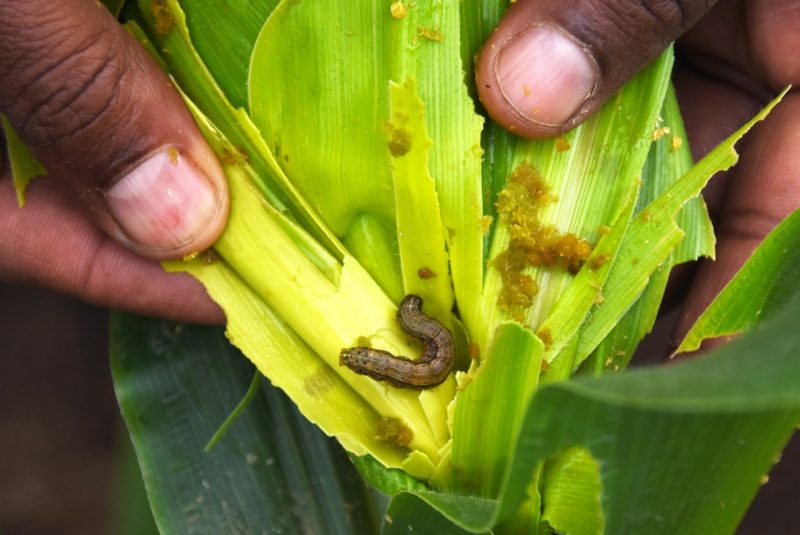
The arrival of the fall armyworm in 2017 was a turning point for maize farming in Kenya. Within weeks of its detection, the pest had spread across counties at a pace that shocked both scientists and farmers. Entire fields were stripped of their green leaves, leaving behind bare stems and devastated harvests. For a country where maize is not just a staple food but also a cultural anchor, the invasion of this pest was nothing short of a national crisis.
The fall armyworm, native to the Americas, is a voracious feeder. Its caterpillars target the tender whorls of maize plants, boring into leaves and feeding continuously, sometimes even tunneling into the cobs. The damage reduces the plant’s ability to photosynthesize, stunts growth, and drastically lowers yields. In severe infestations, the pest leaves nothing but ragged plants incapable of producing grain.
For smallholder farmers, who make up the majority of maize growers in Kenya, the invasion was devastating. Many had no knowledge of the pest, let alone how to control it. Extension services were quickly overwhelmed, and farmers turned to agro-vet shops in a desperate search for answers. Within months, pesticides became the most common response, with farmers spending thousands of shillings per acre in repeated attempts to save their crops.
Yet the results have been frustrating. Fall armyworm has shown a remarkable ability to withstand chemical sprays. Farmers often report that even after several applications, the caterpillars continue to thrive. In many cases, this has led to overuse and misuse of pesticides, raising production costs while still failing to prevent significant losses. Stories of farmers losing half or even entire harvests have become common across maize-growing regions.
The broader impact has been severe. Maize is Kenya’s primary staple, consumed in nearly every household in the form of ugali, githeri, and porridge. When fall armyworm struck, food prices surged, affecting millions of families who depend on maize flour for daily meals. Traders, millers, and transporters linked to the maize value chain also felt the ripple effects of reduced harvests.
Years later, despite extensive research, a lasting solution remains elusive. Scientists have tested biological control agents such as parasitic wasps, fungal pathogens, and even pheromone traps. Governments and NGOs have run awareness campaigns urging integrated pest management. Yet the pest remains entrenched, adapting to every control method thrown its way.
The fall armyworm has also exposed gaps in Kenya’s agricultural systems. The speed of its spread highlighted weaknesses in surveillance and response. Border checks were not strong enough to prevent its entry, and coordination among counties lagged in the crucial early months. Farmers were left to bear the brunt of the invasion, often with conflicting advice and limited resources.
For now, the fall armyworm is a permanent part of Kenyan agriculture. Farmers continue to struggle with its control, often planting with uncertainty about how much they will harvest.
Maize Lethal Necrosis Disease

Perhaps the most devastating of all the recent agricultural threats has been maize lethal necrosis disease, which was first reported in Kenya in 2011, in Bomet and Naivasha. Unlike many pests and diseases that leave farmers with at least a partial harvest, MLND is ruthless. It wipes out entire fields, leaving nothing behind but dry, shriveled stalks. For a crop that forms the backbone of Kenya’s food security, the arrival of this viral disease was catastrophic.
MLND is caused by a deadly combination of two viruses: the maize chlorotic mottle virus and a member of the potyvirus group, often the sugarcane mosaic virus. On their own, these viruses may not cause complete devastation, but together they form a lethal mix that kills maize plants quickly and thoroughly. The symptoms appear as yellowing leaves, stunted growth, and poor cob formation. Within weeks, what had started as a promising crop collapses into unproductive stubble.
The impact on smallholder farmers was immediate and brutal. Families who had depended on maize for both food and income suddenly faced empty granaries and rising debts. Farmers who once grew enough to sell surplus found themselves buying maize meal to feed their families. In regions where maize is not only a staple but a cultural constant, the loss was more than economic—it was a blow to tradition and identity.
Entire counties felt the strain. With maize production plummeting, millers reported shortages, prices soared, and food inflation hit consumers hard. School feeding programs, relief supplies, and household diets all suffered. The disease turned maize, once the most reliable crop, into a risky gamble.
Attempts to control MLND have been challenging. There is no cure for viral diseases in plants, and once a field is infected, little can be done to save the crop. Farmers were advised to practice crop rotation, plant certified disease-free seed, and destroy infected plants. Extension officers encouraged farmers to diversify into other crops such as sorghum and millet, but the deep cultural and dietary attachment to maize made the shift difficult.
Research institutions in Kenya and beyond have worked to develop resistant maize varieties. Some progress has been made, with experimental hybrids showing tolerance, but the process is slow and often outpaced by the spread of the disease. Meanwhile, the vectors that transmit the viruses, including thrips and maize chlorotic mottle virus–carrying insects, remain widespread, making containment nearly impossible.
For many farmers, MLND has been more than a plant disease—it has been a personal and financial disaster. Stories abound of families forced to sell livestock, take on debt, or abandon maize altogether. The disease has reshaped the agricultural landscape in parts of Kenya, forcing conversations about diversification, resilience, and the risks of over-reliance on a single staple.
More than a decade since it first appeared, maize lethal necrosis disease remains a lingering threat. It serves as a stark reminder that food security in Kenya hangs by a fragile thread, easily broken by new and aggressive plant diseases. Unless long-term solutions are found, MLND will continue to cast a shadow over the country’s most important crop, leaving farmers anxious each planting season about whether their fields will flourish or fail.
The Cost of Foreign Pest Invasions
Together, these seven invaders have changed the course of Kenyan agriculture in little more than a decade. The disruption has been deep and far-reaching, reshaping how farmers work, how much they spend, and what ends up on the tables of millions of households.
For farmers, the first and most immediate impact has been the rising cost of production. Pesticide expenses have ballooned. What used to be two or three sprays in a season is now sometimes weekly, or even more frequent, especially for crops like tomatoes. The money spent on chemicals often outweighs the returns from harvests, forcing farmers into debt cycles that are difficult to escape. For smallholder families living on thin margins, this additional burden is crushing.
Despite these increased efforts, success remains elusive. Many still fail to save their crops. Potato farmers battling cyst nematodes have been forced to abandon land they once depended on. Tomato growers facing Tuta absoluta find their fruits rejected in markets, riddled with tunnels and scars. Maize farmers dealing with fall armyworm and lethal necrosis plant with the knowledge that they might never harvest enough to cover even their input costs. The feeling of helplessness has become part of daily farming life.
The consequences go beyond individual farms. Food safety has emerged as a national concern. With more pesticide use has come higher risks of chemical residues in the food chain. Tomatoes, vegetables, and even grains are now under suspicion from consumers who fear contamination. Kenya’s exports, particularly avocados and French beans, face stricter inspections abroad, raising the possibility of lost markets and reduced foreign exchange earnings if standards are not met.
Scientists themselves acknowledge that the challenge is overwhelming. For some pests, such as potato cyst nematodes and Tuta absoluta, there are no definitive solutions. Research continues, but progress is slow compared to the pace of invasion. Farmers are often left waiting for guidance that never arrives, or recommendations that prove too costly or impractical to implement on small farms. The gap between scientific knowledge and on-the-ground reality grows wider each season.
This helplessness among experts raises a haunting question: if scientists, armed with laboratories, data, and international networks, are struggling to control these invaders, what chance do farmers have as they bend over their fields with hoes and sprayers? For many, the answer feels bleak. Each planting season now carries more uncertainty, more risk, and more fear of the next pest lurking at the border.
The true cost of foreign pest invasions, therefore, cannot be measured in shillings alone. It is counted in abandoned fields, shattered livelihoods, and lost confidence in farming as a way of life. It is seen in the anxiety of parents who wonder whether their children will inherit farms worth working on. It is heard in the stories of traders, millers, and exporters struggling with shortages and rejections. And it is tasted in the ugali that costs more than it did a decade ago.
Escalating Dependence on Chemicals
For most smallholders, the first and often only line of defense against invasive pests has been chemicals. Faced with the threat of losing entire harvests, farmers have turned to their agrovet shops, stocking up on bottles and sachets of pesticides. The logic is simple: if a crop is under attack, spraying seems like the only immediate solution. In the absence of clear guidance, spraying more feels safer than spraying less.
But this response has created a dangerous cycle. Each additional spray adds to production costs, pushing small-scale farmers deeper into debt. A tomato farmer in Kirinyaga, for instance, who once used three sprays per season now reports using ten or more. The cost of pesticides, sometimes exceeding a quarter of total farm expenditure, eats into already slim profit margins. Many farmers borrow money in the hope that their harvest will pay it back, only to find themselves trapped in losses when pests persist despite their efforts.
The health risks are equally troubling. Farmers often apply chemicals without proper protective gear, either because the equipment is too costly or simply unavailable. Exposure to toxic sprays causes headaches, respiratory problems, and in some cases long-term illnesses. Families living near farms are also at risk, as chemicals seep into water sources or drift during spraying. On the consumer end, repeated applications raise the likelihood of chemical residues on food. Tomatoes, leafy vegetables, and even grains frequently test above acceptable limits, raising food safety concerns both locally and in export markets.
Adding to the crisis is the adaptability of pests themselves. Invasive species such as Tuta absoluta and fall armyworm have already demonstrated an ability to withstand repeated spraying. Farmers describe situations where a chemical that seemed effective in one season fails completely the next. This forces them to switch products constantly, trying stronger or more expensive formulations. The pests, meanwhile, continue to spread into new regions, leaving more farmers trapped in the same costly cycle.
This growing dependence on chemicals has also placed Kenya in a difficult position internationally. Export crops face stricter scrutiny in Europe and the Middle East, where buyers are increasingly wary of pesticide residues. Rejections at international borders not only hurt farmers but damage Kenya’s reputation as a supplier. Domestically, consumers are becoming more cautious, questioning the safety of the food on their tables.
The result is a system under strain. Farmers are paying more, yet harvesting less. Health risks are mounting, yet alternatives remain limited. Pests are adapting faster than the solutions being deployed. What began as a stop-gap measure—spraying to control new invaders—has hardened into a dependency that threatens both farmer livelihoods and national food security.
What the Next Decade Could Bring
If Kenya has endured seven major pest and disease invasions in just ten years, the natural question is what lies ahead. Scientists warn that the country is entering an era where foreign pests and diseases will continue to breach borders with increasing speed. Global trade, climate change, and porous entry points are accelerating the spread of organisms that were once confined to distant continents. For Kenya, where agriculture remains the backbone of food security and exports, this trend carries grave implications.
One of the looming threats is the coconut mite, which has already spread widely in Tanzania. The pest causes premature nut fall and poor-quality coconuts, weakening trees and slashing yields. Coastal Kenya, with its extensive coconut farms that support both local diets and small-scale industries, could be the next frontier. For communities that depend on coconuts for oil, beverages, and crafts, the invasion of this pest would be more than an agricultural problem. It would be a direct hit to livelihoods and cultural traditions.
Equally concerning is the spread of banana bunchy top virus in Uganda. Bananas are not just another crop in East Africa; they are a staple food and a daily meal for millions of households. The disease, transmitted by aphids, stunts banana plants, causing them to produce no fruit. Once established, it is extremely difficult to eradicate. If it crosses into Kenya, entire regions that rely on bananas for both food and income could see devastating losses. The risk of hunger and economic dislocation would be immediate and severe.
Wheat, too, is entering a new period of vulnerability. Emerging fungal strains are already being reported in parts of East Africa, with some showing resistance to conventional fungicides. Wheat is not only a staple in urban diets but also a key ingredient for industries producing bread, noodles, and animal feed. Any disruption in its supply would ripple through the economy, driving up food prices and increasing dependence on imports.
These are only the known threats. History suggests there are others we cannot yet predict. Just a decade ago, few had heard of fall armyworm or Tuta absoluta in Kenya. Within months of their arrival, they had transformed farming practices, slashed harvests, and increased production costs. The same could happen with future invaders, whether they are insects, viruses, or fungi.
The question is not whether these pests and diseases will arrive, but when. Kenya’s preparedness remains uncertain. Surveillance systems are improving, but gaps persist at border points, in farmer training, and in rapid-response capacity. By the time a new invader is detected, it is often already widespread, making containment nearly impossible. Without significant investment in early warning, research, and farmer education, the next decade could mirror the last—only with higher stakes, more dangerous pests, and deeper economic consequences.
In this context, the true challenge is not just about fighting individual pests. It is about building resilience in the agricultural system as a whole. Farmers, scientists, policymakers, and consumers will all need to confront the uncomfortable reality that Kenya is on the frontline of a global wave of biological invasions. Whether the country emerges stronger or weaker will depend on the actions taken now to prepare for what is almost certainly coming.
What Kenya Must Do to Prepare
The wave of foreign pest invasions has shown how vulnerable Kenya’s agriculture sector is. Preparing for the next decade requires more than firefighting. It calls for a coordinated national strategy built on prevention, rapid response, and regional cooperation. The following measures are critical:
- Tighten border inspections with well-trained staff, modern diagnostic labs, and real-time tracking systems to prevent invasive species from slipping in.
- Develop an integrated early warning system that links farmers, extension officers, and research institutions. This would allow quick reporting, accurate diagnosis, and timely intervention.
- Increase investment in research focused on resistant crop varieties, biological control agents, and locally adapted solutions. Research findings must be translated into practical tools for farmers.
- Expand farmer training programs to promote integrated pest management, safe pesticide use, and field hygiene practices that lower the risk of outbreaks.
- Support smallholder farmers financially through targeted subsidies, access to safer inputs, and protective equipment to reduce dependence on hazardous chemicals.
- Strengthen regional collaboration with neighboring countries, sharing surveillance data, coordinating research, and mounting joint responses to cross-border threats.
- Launch public awareness campaigns to educate farmers and consumers on pest risks, early reporting, and food safety concerns.
- Establish an agricultural emergency fund to provide rapid response capacity, farmer compensation, and recovery support when outbreaks hit.
Kenya’s future food security depends on proactive action. Waiting for the next pest to arrive before acting will only repeat the mistakes of the last decade.
Farmers’ Voices on the Ground
Behind the statistics are real people. Farmers like Hellen in Bomet, whose tomatoes withered before they fruited. Farmers like Kamau in Nyandarua, who abandoned potatoes after nematodes destroyed his land. Farmers like Atieno in Siaya, who sprays maize every week and still loses crops to fall armyworm. These stories show that agriculture is not only about yields or markets. It is about the daily lives of men and women whose sweat feeds the nation.
The Uncomfortable Reality
So what chance do they have if the experts remain helpless? The uncomfortable reality is that unless Kenya strengthens its response, farmers will continue to face new battles with little support. If the last decade is any guide, the next wave of invaders is already on the way. The question is whether the country will be prepared, or whether farmers will once again be left to fight alone, armed only with pesticides, prayers, and fading hope.
https://farmerstrend.co.ke/trending/the-foreign-pest-onslaught-in-kenya-if-scientists-are-helpless-what-chance-do-farmers-have/https://farmerstrend.co.ke/wp-content/uploads/2025/09/518358863_1135346438625502_204403920156148035_n.jpghttps://farmerstrend.co.ke/wp-content/uploads/2025/09/518358863_1135346438625502_204403920156148035_n-150x150.jpg# TrendingDiseasesIn cropsIn FruitsKenyan farmers are used to challenges. From unreliable rains to the rising cost of fertilizer and seeds, they have always worked under pressure. Yet in the past decade, a new wave of threats has emerged that few were prepared for: a relentless onslaught of foreign invasive pests and diseases....FarmersTrendjohn doefarmerstrend@gmail.comAdministratorFarmers Trend Ltd.










Leave a Reply