Kenya’s KSh397 Billion Meat Industry Has Untapped Potential as Kagwe Pushes Value Addition and Export Growth
Kenya’s meat industry generated approximately KSh397 billion in 2024, but the country is yet to fully exploit the economic opportunities available across livestock production, meat processing, value addition and exports.
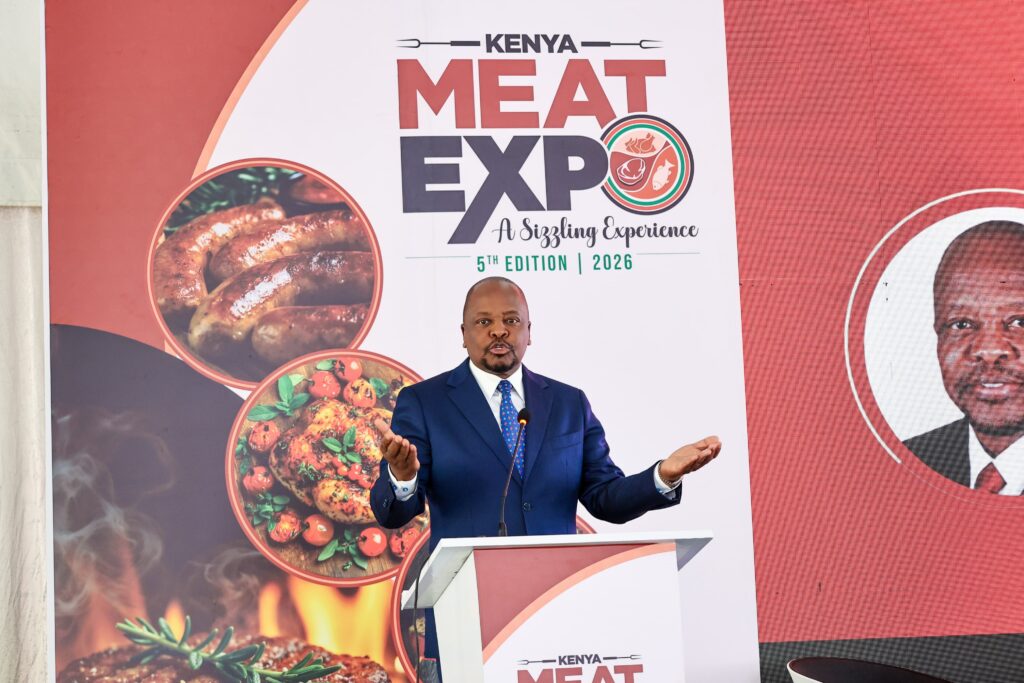
Agriculture Cabinet Secretary Sen. Mutahi Kagwe has challenged the Government, private sector and livestock producers to transform the industry into a larger source of jobs, investment, exports and higher incomes for farmers and pastoralists.
Speaking during the official opening of the Kenya Meat Expo 2026, Kagwe said Kenya has the livestock resources, domestic market and strategic location needed to compete more effectively in regional and international meat markets.
Kenya produced about 613,627 tonnes of meat in 2024, representing a 10.2 per cent increase in volume from the previous year. The value of production rose by 30.5 per cent to approximately KSh397 billion.
Beef remained the dominant category, accounting for about 260,000 tonnes valued at KSh160 billion. However, Kagwe said Kenya should look beyond beef and develop other livestock value chains, including goat meat, mutton, poultry, camel meat, pork and rabbit meat.
Kenya Must Stop Exporting Jobs With Live Animals
One of the biggest concerns raised by the CS was Kenya’s continued reliance on live-animal exports instead of processed meat and higher-value products.
Kagwe argued that exporting live animals means Kenya loses opportunities for employment, processing, packaging, logistics, branding and other businesses that could generate additional income along the value chain.
“When we export the animals, then we are sending out jobs.”
He challenged the industry to increase domestic slaughtering, processing and packaging capacity and position Kenyan meat products for premium regional and international markets.
The objective, he said, should be to ensure that more of the value created from livestock remains in Kenya and ultimately benefits farmers and pastoralists.
This presents an important opportunity for livestock farmers. Instead of viewing cattle, goats, sheep, camels and other animals simply as products to be sold at the farm gate, farmers can increasingly participate in organised value chains linked to processors, exporters, feedlots and premium markets.
Meat Processing Holds Major Growth Opportunity
Kenya has an extensive slaughter infrastructure, with approximately 2,000 slaughter facilities across the country.
The facilities include about 49 large slaughterhouses, 322 medium slaughterhouses and 1,530 slaughter slabs.
However, Kagwe said the country must focus on the quality and performance of these facilities rather than simply increasing their number.
Modern meat processing requires more than slaughter capacity. Facilities need effective hygiene systems, veterinary inspection, cold storage, refrigeration, waste management, reliable logistics and compliance with domestic and international food-safety requirements.
Improving these areas could allow Kenyan processors to access markets where consumers are willing to pay more for safe, traceable and consistently produced meat.
Animal Traceability to Become Central to Kenya’s Meat Industry
Animal health and traceability will also play a major role in the development of Kenya’s meat industry.
Kagwe said the Government is advancing the Animal Identification and Traceability System (ANITRAC) to enable animals to be tracked from their origin and ownership through vaccination history and movement to slaughter.
The system is expected to strengthen disease control and food safety while also helping address livestock theft and illegal movement of animals.
“Going forward, every Kenyan animal should have an identity and a traceable history,” Kagwe said.
A functional traceability system could also become increasingly important for export markets, where buyers require greater assurance about the origin, health status and production history of livestock and meat products.
Better Breeding and Feeding Needed to Increase Productivity
Kagwe also called for increased investment in livestock genetics, artificial insemination, breeding, animal nutrition and commercial feedlots.
Improved genetics can help farmers increase productivity, while better feeding can improve growth rates, carcass quality and the overall value of animals at market.
The CS stressed that commercial feedlots must have adequate feed, water and infrastructure if they are to contribute effectively to Kenya’s meat production system.
Climate-smart livestock production will also become increasingly important as farmers face drought, changing rainfall patterns and rising production costs.
Investment in water pans, boreholes, reliable feed systems and livestock insurance can help farmers reduce the risks associated with extreme weather events.
Meat Value Addition Could Create Thousands of Jobs
The meat industry extends far beyond the farmer and butcher.
A modern livestock value chain creates opportunities in breeding, animal nutrition, veterinary services, transport, slaughter, meat processing, cold-chain logistics, packaging, branding, retail, leather processing, waste management and export services.
Kagwe challenged young Kenyans to view livestock as a modern commercial enterprise rather than an activity limited to traditional pastoralism.
Opportunities exist for young entrepreneurs to establish businesses around livestock technology, breeding services, feed production, meat processing, digital marketplaces, logistics and export.
This could make the livestock sector an important source of employment for Kenya’s growing youth population.
Kenya Can Earn More From Goat Meat, Camel Meat and Other Emerging Markets
While beef remains the largest component of Kenya’s meat industry, other categories could provide significant opportunities.
Goat meat, for example, has strong domestic and international demand. Mutton, camel meat, poultry, pork and rabbit meat also offer opportunities for specialised production and value addition.
Kagwe pointed to Algeria and other international markets as potential destinations for Kenyan livestock products.
He recalled Algeria’s previous indication of demand for up to one million goats during Ramadan, illustrating the scale of opportunity available when Kenya develops reliable production and export systems.
However, accessing such markets will require consistency in supply, quality, animal health, traceability, processing standards and logistics.
Hides and Skins Offer Another Opportunity
The economic value of livestock does not end with meat.
Kagwe also highlighted the potential of hides and skins, particularly for Kenya’s leather industry.
Proper animal handling can help improve the quality of hides and skins and increase the value of livestock by-products.
This demonstrates why livestock development needs to be approached as a complete value chain rather than simply a meat-production business.
What the KSh397 Billion Meat Industry Means for Farmers
The growth of Kenya’s meat industry presents an opportunity to move livestock farming from subsistence production towards a more commercial and organised business model.
For farmers, higher returns will depend on several factors, including:
- Improved genetics to increase animal productivity.
- Better nutrition to achieve faster and healthier growth.
- Reliable water supplies to reduce drought-related losses.
- Animal health management to minimise disease and mortality.
- Organised marketing to improve bargaining power.
- Traceability to meet increasingly demanding markets.
- Value addition to capture more income beyond the farm gate.
- Access to insurance and finance to manage production risks.
- Export market development to create additional demand.
The larger opportunity lies in connecting these elements into an efficient livestock value chain.
Kenya’s Meat Industry Is Moving Beyond the Farm Gate
The KSh397 billion value recorded in 2024 shows that Kenya’s meat industry is already a major economic sector. The challenge is to increase the value captured from every animal produced.
That means producing better animals, reducing losses, improving slaughter and processing facilities, strengthening cold chains, developing recognised brands and opening premium export markets.
It also means ensuring that farmers and pastoralists receive a larger share of the value created along the chain.
As Kagwe put it, “Meat is food, and meat is money.”
For Kenya, the next phase of livestock development will therefore depend not only on producing more animals, but on building a modern meat industry capable of turning livestock into higher incomes, more jobs, stronger exports and greater national wealth.
https://farmerstrend.co.ke/farming-news/kenyas-ksh397-billion-meat-industry/https://farmerstrend.co.ke/wp-content/uploads/2026/08/Kenyas-KSh397-Billion-Meat-Industry-Has-Untapped-Potential-as-Kagwe-Pushes-Value-Addition-and-Export-Growth-1024x683.jpeghttps://farmerstrend.co.ke/wp-content/uploads/2026/08/Kenyas-KSh397-Billion-Meat-Industry-Has-Untapped-Potential-as-Kagwe-Pushes-Value-Addition-and-Export-Growth-150x150.jpegFarming NewsKenya’s meat industry generated approximately KSh397 billion in 2024, but the country is yet to fully exploit the economic opportunities available across livestock production, meat processing, value addition and exports.Agriculture Cabinet Secretary Sen. Mutahi Kagwe has challenged the Government, private sector and livestock producers to transform the industry into...FarmersTrendjohn doefarmerstrend@gmail.comAdministratorFarmers Trend Ltd.












Leave a Reply