Hass Avocado Management During El Niño: How to Prevent Root Rot, Manage Excess Moisture, and Improve Orchard Drainage
Learn expert Hass avocado management during El Niño in Kenya. Discover how to prevent avocado root rot caused by Phytophthora cinnamomi, improve orchard drainage, manage excess soil moisture, and protect your Hass avocado trees from prolonged rainfall.
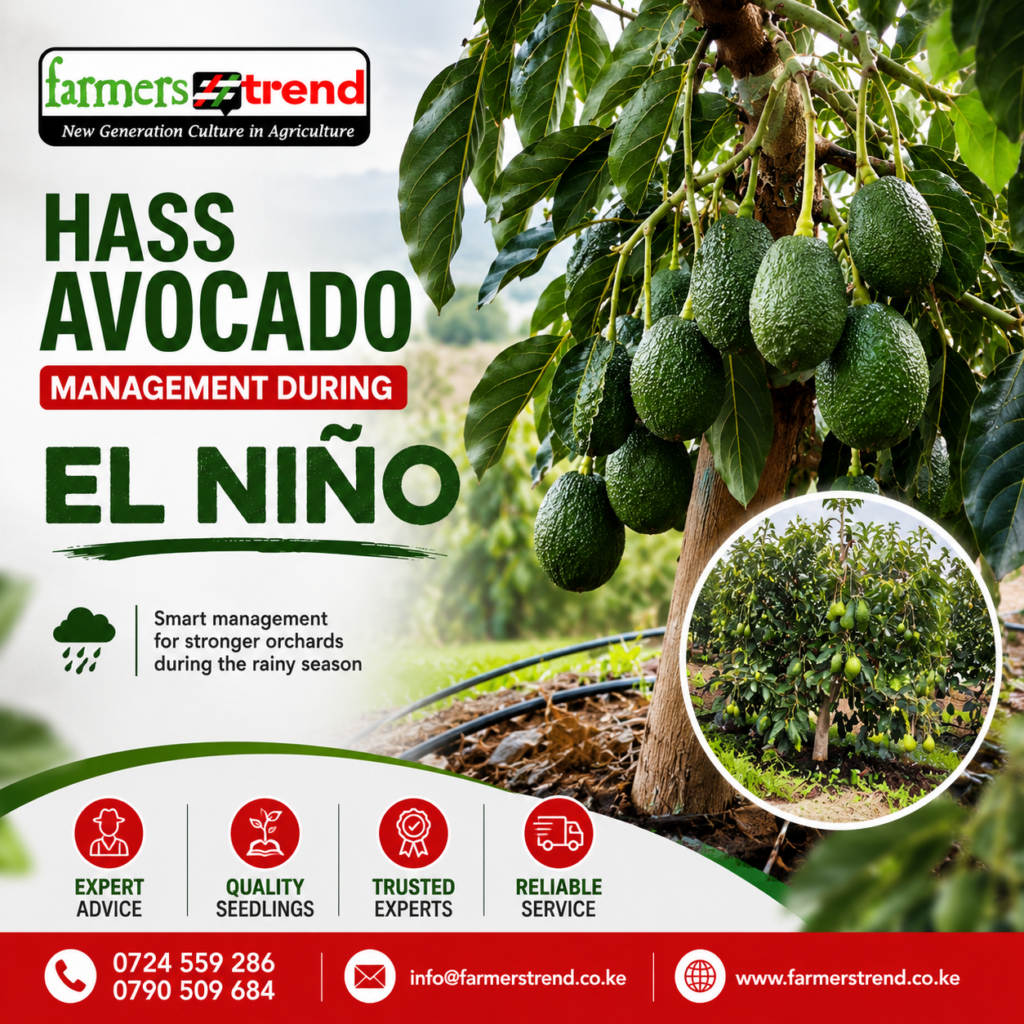
Hass Avocado Management During El Niño: How to Prevent Root Rot, Manage Excess Moisture, and Improve Orchard Drainage
The arrival of El Niño rains brings mixed emotions for Hass avocado farmers across Kenya. After months of dry weather, every farmer welcomes rainfall because it replenishes rivers, recharges the soil, and supports healthy tree growth. Adequate moisture encourages new vegetative flushes, improves nutrient uptake, and helps developing fruits gain size. Under normal conditions, rainfall is one of the most valuable resources in any avocado orchard.
Too much rain, however, tells a completely different story.
When rainfall continues for days or even weeks without sufficient sunshine, the soil begins to hold more water than the avocado tree can tolerate. Water slowly fills the tiny air spaces between soil particles, cutting off the oxygen needed by feeder roots. What starts as a healthy, well-watered orchard quickly turns into an environment where roots struggle to breathe and dangerous soil-borne pathogens multiply rapidly.
For Hass avocado trees, the greatest danger during El Niño is not what happens above the ground. It is what happens below the surface, where thousands of delicate feeder roots quietly support every part of the tree. These roots absorb water, transport nutrients, anchor the tree, and supply energy for flowering, fruit development, and new shoot growth. Once they begin to die, the entire orchard starts losing productivity, even if the canopy still appears green.
Many farmers do not notice the problem immediately.
The first heavy rains arrive, the trees look healthy, and everything appears to be progressing well. After another week of continuous rainfall, a few leaves begin turning pale. New shoots stop growing as vigorously as before. Fruits that looked healthy suddenly begin dropping. Several weeks later, one tree starts wilting while another develops dieback on one side of the canopy. At this stage, many growers suspect nutrient deficiency, insect damage, or poor-quality fertilizer. Some increase fertilizer application, while others spray pesticides without identifying the real problem.
Unfortunately, none of these actions solve the underlying cause.
The real damage often began several weeks earlier when excess water remained around the root zone long enough to weaken the feeder roots. Once the roots became stressed, they were easily invaded by one of the most destructive diseases affecting avocado production worldwide, Phytophthora root rot.
Across Murang’a, Kirinyaga, Nyeri, Meru, Embu, Kiambu, Nakuru, Uasin Gishu, and several other avocado-growing counties, root rot has become one of the leading causes of declining orchard productivity during wet years. The disease affects both young orchards and mature trees, reducing yields, lowering fruit quality, shortening orchard lifespan, and increasing production costs.
The financial impact extends far beyond losing a single tree.
Establishing a commercial Hass avocado orchard requires patience and significant investment. Farmers begin by purchasing certified grafted seedlings, preparing the land, digging planting holes, applying manure, irrigating during dry periods, controlling weeds, pruning young trees, and protecting them from pests and diseases. Depending on management practices, several years pass before the orchard begins generating meaningful income.
When a mature tree dies from root rot, replacing it is not as simple as planting another seedling. The new tree requires years to reach the same level of production. During that period, the farmer loses income that would have been generated by the mature tree while continuing to incur maintenance costs for the replacement. If dozens or even hundreds of trees become infected, the financial losses increase rapidly.
This is why experienced avocado farmers often say that protecting the root system is the most important investment in the entire orchard.
- Healthy roots support healthy trees.
- Healthy trees produce strong flowers.
- Strong flowers develop into quality fruit.
- Quality fruit generates better income.
- Everything starts below the soil surface.
Why Hass Avocado Trees Are More Sensitive to Waterlogging Than Many Other Crops
Every crop responds differently to excess rainfall.
Maize often recovers after temporary flooding if the water drains quickly. Napier grass tolerates wet conditions better than many fruit crops. Bananas survive periods of saturated soil because their root systems are naturally adapted to higher moisture levels.
Hass avocado behaves differently.
The crop originated in regions where soils are naturally well-drained and rich in organic matter. Over thousands of years, avocado trees evolved to grow in environments where rainwater infiltrated the soil quickly instead of remaining around the roots for extended periods. As a result, the avocado root system depends on a steady supply of oxygen within the soil profile.
Unlike crops that develop deep taproots, Hass avocado produces thousands of fine feeder roots concentrated near the soil surface. Most active roots are found within the top 30 to 45 centimetres of soil, exactly where heavy rainfall has the greatest impact.
These feeder roots perform nearly all the important work inside the tree.
They absorb water from the soil.
They take up nitrogen, phosphorus, potassium, calcium, magnesium, and micronutrients.
They transport nutrients to developing fruits.
They support flowering and vegetative growth.
They store carbohydrates required for future flushing cycles.
Because these roots are thin and highly active, they are also extremely vulnerable to poor soil drainage.
When heavy rain saturates the soil for several days, oxygen levels decline sharply. Root respiration slows, nutrient uptake becomes inefficient, and the feeder roots begin dying back. Even before disease organisms invade the root system, the tree has already entered a state of physiological stress.
This explains why farmers often observe yellowing leaves after prolonged rainfall despite having adequate soil moisture.
The tree is surrounded by water but cannot use it efficiently because its root system is no longer functioning normally.
Hass Avocado Management During El Niño: Understanding El Niño and Its Impact on Kenyan Avocado Orchards
El Niño is a naturally occurring climate phenomenon associated with warmer-than-average sea surface temperatures in the central and eastern Pacific Ocean. Although the phenomenon develops thousands of kilometres away from Kenya, it influences weather patterns across East Africa by increasing the likelihood of above-average rainfall during certain seasons.
For Kenyan farmers, El Niño often means prolonged storms, more frequent rainfall events, reduced sunshine hours, and saturated soils that remain wet for extended periods.
In counties such as Murang’a, Kirinyaga, Nyeri, and parts of Meru, many orchards are established on clay-loam soils. These soils are fertile and support excellent avocado production under normal weather conditions. During prolonged rainfall, however, they drain more slowly than sandy or well-structured volcanic soils. Water accumulates around tree basins, increasing the risk of root diseases.
Even in counties with well-drained volcanic soils, such as parts of Uasin Gishu and the Rift Valley, orchard design still determines how quickly excess water leaves the field. Poorly maintained drainage channels, compacted tractor paths, blocked waterways, and low-lying sections of the orchard often become temporary ponds after heavy rainfall.
The risk therefore depends on more than rainfall alone.
The slope of the land, soil texture, orchard design, drainage infrastructure, and management practices all influence whether an avocado tree survives a wet season or begins a slow decline.
Farmers who understand these factors before the rains arrive are far better prepared to protect their orchards than those who wait until symptoms become visible.
Why Prevention Costs Less Than Recovery
One of the biggest mistakes farmers make is treating root rot after it has already become established.
By the time yellow leaves, dieback, or poor fruit development become obvious, the disease has often destroyed a large proportion of the feeder roots responsible for absorbing water and nutrients.
Recovering such a tree requires considerable time, labour, and financial investment, and in severe cases, recovery is not possible.
Preventive management is much cheaper.
Digging diversion drains before the rainy season costs far less than replacing mature trees.
Removing blocked waterways takes only a few hours but can prevent weeks of waterlogging.
Inspecting orchards after every major rainfall allows farmers to identify drainage problems before disease develops.
Applying biological products early helps strengthen the root environment before pathogen populations increase.
Simple management decisions made before El Niño begins often determine whether an orchard remains productive or suffers heavy losses.
The most successful avocado growers do not wait for root rot to appear.
They make preparations while the soil is still dry enough to work, ensuring excess water has a clear path out of the orchard long before the first heavy storms arrive.
The Silent Enemy Beneath the Soil: Understanding Phytophthora cinnamomi
When avocado farmers discuss diseases, conversations often focus on visible problems such as anthracnose on fruits, powdery mildew on flowers, or insect damage on leaves. These problems are easy to notice because they appear above the ground.
Root rot is different.
It develops silently beneath the soil surface, often remaining undetected until a significant portion of the root system has already been destroyed.
At the centre of this disease is Phytophthora cinnamomi, a microscopic organism that has caused billions of shillings in losses to avocado farmers across the world. It is widely regarded as the most destructive disease affecting avocado production and remains the greatest biological threat to commercial Hass orchards in Kenya.
The Threat of Phytophthora cinnamomi During Wet Seasons
For most avocado farmers, the first instinct when a tree begins to decline is to look at the leaves. Yellow foliage, reduced flowering, premature fruit drop, and dying branches are easy to notice because they occur above the ground. The real problem, however, often begins several weeks or even months before these symptoms appear. Hidden beneath the soil, the tree is already losing the feeder roots responsible for absorbing water and nutrients.
This silent destruction is caused by Phytophthora cinnamomi, the pathogen responsible for avocado root rot. Across the world, no other disease has caused greater economic losses in avocado production. Whether in Kenya, South Africa, Australia, Mexico, Peru, or California, commercial avocado growers regard root rot as the disease that demands the greatest attention during wet seasons.
In Kenya, where El Niño often brings prolonged rainfall, the risk increases significantly. The combination of saturated soils, poor drainage, and warm temperatures creates the ideal environment for this destructive pathogen to multiply rapidly and spread throughout an orchard.
Unlike foliar diseases that affect leaves or fruits for a single season, root rot attacks the foundation of the tree itself. Once the root system becomes severely infected, restoring the tree to full productivity becomes difficult, expensive, and in many cases impossible.
Understanding how this pathogen survives, spreads, and attacks avocado roots is the first step towards protecting an orchard during prolonged rainfall.
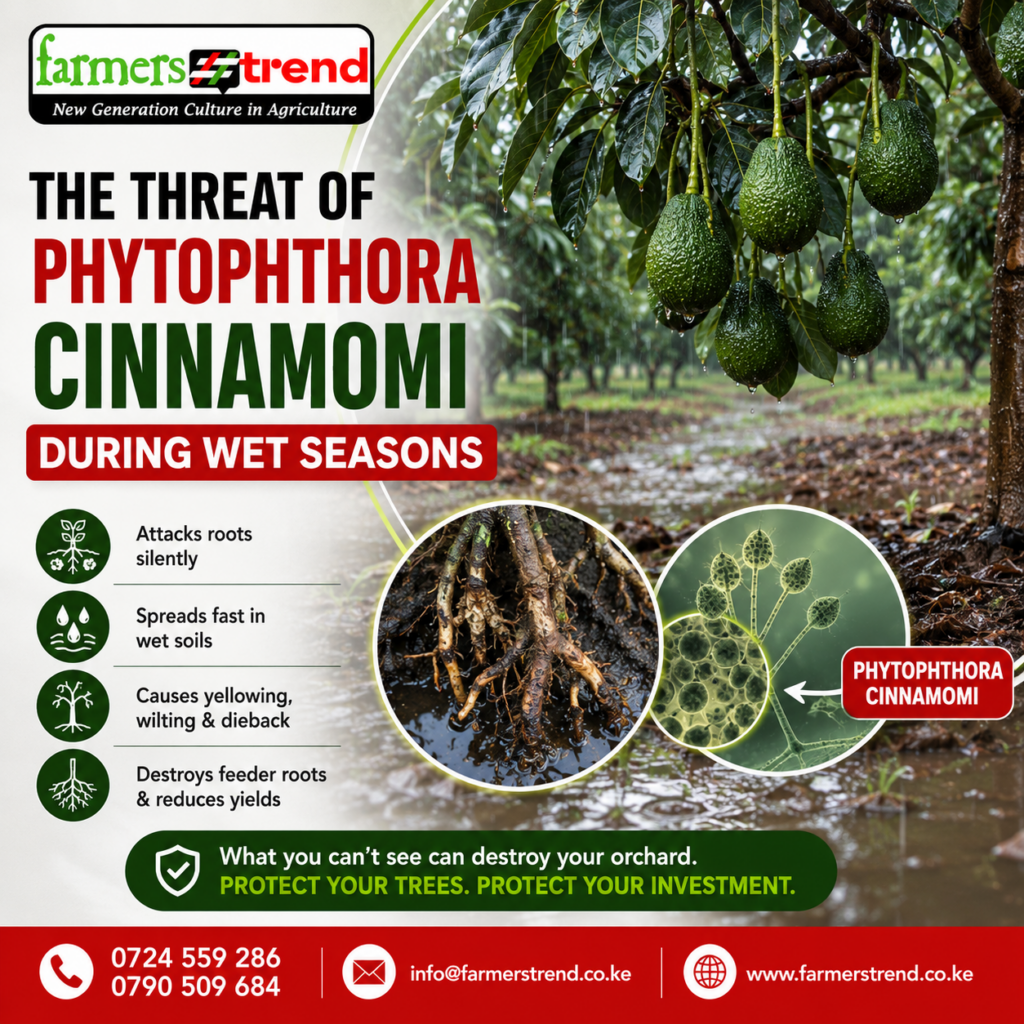
What Is Phytophthora cinnamomi?
Although commonly referred to as a fungal disease, Phytophthora cinnamomi is not a true fungus. It belongs to a different group of organisms known as oomycetes, or water moulds.
This distinction might sound technical, but it has practical implications for farmers.
Many fungicides used to control ordinary fungal diseases have little or no effect against oomycetes. This explains why some farmers continue spraying different fungicides yet see no improvement in trees affected by root rot.
Unlike fungi that reproduce primarily through airborne spores, Phytophthora cinnamomi depends heavily on water for movement. Every period of prolonged rainfall increases the opportunity for the pathogen to spread through an orchard.
Once established, the organism survives in infected roots, crop debris, contaminated soil, irrigation water, and even on machinery, gumboots, and vehicle tyres moving between farms.
One infected orchard can unknowingly become the source of infection for neighbouring farms if proper sanitation measures are ignored.
Why El Niño Creates the Perfect Environment for Root Rot
Heavy rainfall alone does not automatically cause root rot.
The real danger begins when water remains around avocado roots for extended periods.
Healthy soil contains millions of tiny pores. Some hold water while others contain air. This balance allows roots to absorb both moisture and oxygen.
During prolonged rainfall, these air spaces gradually fill with water.
As oxygen levels decline, feeder roots become stressed.
Stressed roots release compounds that attract Phytophthora spores.
At the same time, saturated soils stimulate the pathogen to produce thousands of microscopic swimming spores known as zoospores.
These spores possess tiny flagella that allow them to swim through water films surrounding soil particles.
This remarkable ability gives Phytophthora an enormous advantage during wet weather.
Instead of waiting for roots to grow towards them, the spores actively swim towards healthy avocado roots.
The process resembles sharks detecting blood in the ocean.
Healthy feeder roots release natural chemicals into the surrounding soil.
The swimming spores detect these chemicals and move directly towards their target.
Once they reach the root surface, they attach themselves, penetrate the outer tissue, and begin colonizing the root.
Within a short period, healthy white feeder roots begin turning brown before eventually becoming black and decaying.
The infection spreads silently beneath the soil while the canopy above still appears healthy.
How Infection Progresses Inside the Root System
The avocado root system functions much like the plumbing system in a house.
Fine feeder roots absorb water and dissolved nutrients before transporting them to larger structural roots, the trunk, branches, leaves, flowers, and developing fruit.
When Phytophthora cinnamomi infects feeder roots, this transport system begins breaking down.
The pathogen destroys the outer root tissues first.
Water uptake slows.
Nutrient absorption becomes less efficient.
New feeder roots stop developing.
As more roots die, the tree struggles to supply enough water to support the canopy.
Ironically, trees suffering from severe root rot often display symptoms associated with drought despite standing in saturated soil.
Farmers sometimes respond by increasing irrigation, unknowingly making conditions even more favourable for the pathogen.
Without intervention, the infection gradually spreads from feeder roots to larger roots.
Once a substantial proportion of the root system has been destroyed, the tree enters a steady decline that becomes increasingly difficult to reverse.
How Root Rot Spreads Across an Orchard
One infected tree rarely remains isolated.
During heavy rains, water flowing through an orchard transports spores from infected roots into surrounding soil.
If the orchard lacks properly designed drainage channels, contaminated water accumulates around neighbouring trees.
The disease gradually expands downhill following the natural movement of runoff.
This explains why root rot often appears first in lower sections of sloping orchards where water collects after storms.
Apart from surface runoff, the pathogen spreads through several other pathways.
Contaminated nursery seedlings remain one of the most common sources of introducing root rot into new orchards. Purchasing certified planting material from reputable nurseries is therefore essential.
Farm equipment also contributes to disease spread.
A tractor moving from an infected section of the orchard to a healthy area carries contaminated soil on its tyres.
Wheelbarrows, hoes, slashers, pruning tools, and even workers’ gumboots transfer infected soil if sanitation measures are ignored.
Livestock wandering through orchards after rainfall can also carry contaminated mud from one location to another.
Each movement creates another opportunity for the pathogen to establish itself.
Recognizing the Early Symptoms Before It Is Too Late
One of the reasons root rot causes severe losses is that farmers often detect it late.
The disease develops underground while visible symptoms remain subtle.
Early detection greatly improves the chances of successful management.
The first warning signs usually include reduced vigour.
Trees stop producing strong vegetative flushes.
New leaves appear smaller than normal.
The canopy gradually loses its rich dark green colour.
Instead, leaves become pale green before turning yellow.
Many farmers mistakenly diagnose this as nitrogen deficiency.
As the disease progresses, flowering becomes weaker.
Fruit set declines.
Small fruits begin dropping long before maturity.
Branches produce fewer new shoots.
The tree appears tired despite receiving adequate fertilizer.
Eventually, individual branches begin dying from the tips towards the centre of the canopy.
This progressive dieback continues until large portions of the tree become unproductive.
By this stage, root damage is often extensive.
Looking Below the Surface. The Most Reliable Diagnosis
Experienced avocado agronomists rarely rely on leaf symptoms alone.
Whenever root rot is suspected, they inspect the root system directly.
Using a hand hoe or spade, carefully remove soil approximately 30 to 50 centimetres from the trunk where feeder roots are concentrated.
Healthy avocado feeder roots should appear creamy white, firm, and highly branched.
They should snap cleanly when bent.
Infected roots tell a very different story.
The feeder roots appear brown or black.
Many become soft and brittle.
The outer bark peels away easily when gently rubbed between the fingers.
Some roots disappear completely, leaving only thread-like central tissues.
A noticeable reduction in the number of white feeder roots is often the earliest physical evidence that the disease is developing.
Regular root inspections during the rainy season allow farmers to detect problems long before serious canopy decline occurs.
Root Rot or Temporary Waterlogging? Understanding the Difference
Not every tree standing in wet soil suffers from root rot.
Temporary waterlogging and root rot often produce similar symptoms during the early stages.
Understanding the difference helps farmers choose the correct management strategy.
| Temporary Waterlogging | Phytophthora Root Rot |
|---|---|
| Symptoms appear after prolonged rainfall | Symptoms continue even after soils dry |
| Roots remain mostly white | Roots become brown or black |
| Trees recover once drainage improves | Trees continue declining without treatment |
| Leaf yellowing is temporary | Progressive yellowing and dieback continue |
| New growth resumes after soils dry | New growth remains weak or absent |
| Root system remains intact | Feeder roots progressively disappear |
Temporary waterlogging stresses the tree because oxygen becomes limited.
Root rot combines oxygen stress with active disease infection.
The second situation is far more damaging because the pathogen continues destroying roots even after excess water drains away.
Common Farmer Mistakes That Make Root Rot Worse
Many outbreaks become severe because farmers unknowingly create ideal conditions for disease development.
One common mistake is constructing deep basins around mature avocado trees. While basins help conserve irrigation water during dry seasons, they also trap rainwater during El Niño, allowing water to remain around the trunk for several days.
Another mistake is continuing irrigation after periods of heavy rainfall.
Some automated irrigation systems continue operating according to fixed schedules without considering current soil moisture.
The result is prolonged saturation of the root zone.
Applying excessive nitrogen fertilizer during waterlogged conditions also increases stress because damaged roots cannot absorb nutrients efficiently.
Some farmers pile mulch directly against the trunk, creating a permanently moist environment that encourages disease development around the crown.
Perhaps the most expensive mistake is ignoring early warning signs.
A few yellow leaves may appear insignificant.
Several months later, entire rows of trees begin declining because the underlying drainage problem was never corrected.
Expert Tip
Never judge the health of an avocado tree by the canopy alone.
At least once during every rainy season, inspect the feeder roots of several trees in different parts of the orchard. Trees growing in low-lying areas, heavy clay soils, or sections where water collects after storms should receive priority. A thirty-minute inspection below the soil surface often reveals problems weeks before they become visible above ground.
Pre-Rain Orchard Engineering and Drainage Systems
One of the biggest mistakes avocado farmers make is waiting until heavy rains have already flooded the orchard before thinking about drainage. By then, machinery struggles to move through the field, digging becomes difficult, and water has already begun damaging the root system. Drainage is not an emergency activity. It is part of orchard planning and should be completed several weeks before the onset of the rainy season.
Across Kenya, many cases of avocado root rot are not caused by unusually high rainfall alone. They result from poor orchard design. Water enters the farm easily but has no clear path to leave. Every heavy storm leaves pockets of standing water around trees, particularly in low-lying sections of the orchard. Over time, these areas become permanent hotspots for Phytophthora root rot.
Successful commercial avocado farmers rarely leave drainage to chance. Before planting a single tree, they study how water moves across the land during rainfall. They identify natural drainage paths, low-lying areas, compacted sections, and places where runoff enters the orchard from neighbouring farms. Every decision made during orchard establishment influences how well the trees withstand future El Niño seasons.
Good drainage does not mean removing all the water from the soil.
Avocado trees require adequate moisture for healthy growth. The objective is to remove excess water before it remains around feeder roots long enough to create oxygen deficiency and encourage root diseases.
A well-designed drainage system should move surplus water away from the orchard quickly while leaving enough moisture within the root zone to support healthy tree growth.

Start by Walking Your Orchard During Heavy Rain
Many farmers inspect their orchards only after the rain has stopped.
That approach hides valuable information.
One of the best times to assess drainage is during or immediately after a heavy storm. Water reveals every weakness in the orchard.
Walk slowly through every section of the farm and observe how water behaves.
Does runoff flow smoothly through natural channels?
Are there places where water remains standing after twenty-four hours?
Do wheel tracks become waterlogged?
Does runoff from neighbouring farms enter your orchard?
Are tree basins collecting water instead of draining it?
Does erosion expose roots on sloping land?
Carry a notebook or use your phone to mark every problem area. These observations become the foundation for designing an effective drainage system.
Many experienced avocado growers repeat this exercise several times during the rainy season because different storms reveal different weaknesses.
Understand Your Soil Before Digging Drains
Not all soils respond to rainfall in the same way.
Understanding your soil type helps determine the most appropriate drainage strategy.
| Soil Type | Common Counties | Drainage Characteristics | Root Rot Risk |
|---|---|---|---|
| Sandy soils | Parts of Kilifi and Kwale | Water drains quickly | Low |
| Sandy loam | Embu, parts of Meru | Good infiltration | Low to Moderate |
| Volcanic soils | Uasin Gishu, Trans Nzoia, parts of Nakuru | Good structure and moderate drainage | Moderate |
| Clay loam | Murang’a, Kirinyaga, Nyeri, Kiambu | Holds water for longer periods | High |
| Heavy clay | Some valley bottoms and poorly drained fields | Very slow drainage | Very High |
Clay-loam soils are excellent for avocado production because they retain nutrients and moisture. Unfortunately, they also remain saturated much longer after prolonged rainfall.
In these soils, drainage becomes one of the most important management investments a farmer makes.
Divert Water Before It Reaches the Orchard
One of the most effective and least expensive drainage techniques is the construction of diversion ditches.
A diversion ditch intercepts runoff before it enters the orchard and redirects it toward a safe discharge point.
Think of it as building a protective barrier around your investment.
Many avocado farms are located below roads, tea plantations, maize fields, or neighbouring farms. During heavy storms, large volumes of runoff flow downhill carrying water, soil, organic debris, and sometimes disease-causing organisms.
Without interception, this water enters the avocado orchard and floods tree rows.
A properly constructed diversion ditch prevents this problem.
The ditch should be dug along the upper boundary of the orchard, following the contour where runoff first enters the farm.
The channel should maintain a gentle gradient so water continues flowing without causing erosion.
If the slope becomes too steep, flowing water gains speed and begins washing away soil instead of protecting it.
Where possible, line the ditch with grass to reduce erosion and stabilize the banks.
Regular maintenance is equally important.
Leaves, weeds, fallen branches, and silt gradually block drainage channels.
Inspect diversion ditches before every rainy season and remove any material restricting water flow.
Installing Surface Drains Between Tree Rows
Once runoff enters the orchard, it must continue moving safely toward designated drainage outlets.
Surface drains achieve this objective.
These shallow channels collect excess water from between tree rows before it accumulates around the root zone.
Unlike deep trenches, surface drains require relatively little labour and blend naturally into the orchard landscape.
Their main purpose is to prevent water from remaining stagnant after prolonged rainfall.
Spacing depends on slope, rainfall intensity, and soil type.
Heavy clay soils often require more frequent drainage channels than sandy soils.
Farmers managing relatively flat land should pay particular attention to surface drainage because water moves much more slowly than on sloping ground.
Avoid directing water straight down steep slopes.
Rapid runoff causes soil erosion and exposes feeder roots.
Instead, guide water gradually through gently sloping channels until it reaches a safe outlet.
French Drains. A Long-Term Solution for Wet Orchards
Some orchards experience chronic drainage problems that ordinary surface channels cannot solve.
In such situations, French drains provide an effective long-term solution.
A French drain consists of a narrow trench filled with coarse gravel surrounding a perforated drainage pipe.
Instead of allowing water to remain near tree roots, the gravel collects excess moisture while the pipe transports it safely away from the orchard.
Although installation costs are higher than open drains, French drains remain effective for many years when properly constructed.
The system works particularly well in orchards established on heavy clay soils where natural infiltration rates remain low.
Commercial avocado growers often install French drains along persistently wet sections of the orchard where repeated root rot outbreaks have occurred.
The initial investment may appear expensive, but the cost is often lower than replacing mature avocado trees lost to disease.
Approximate Drainage Costs in Kenya
| Drainage Method | Estimated Cost (KES) | Best Suited For |
|---|---|---|
| Hand-dug diversion ditch | 4,000 to 8,000 | Small orchards |
| Surface drainage channels | 6,000 to 15,000 | Small to medium farms |
| French drain with perforated pipe | 20,000 to 45,000 | Poorly drained orchards |
| Excavator drainage works | 60,000 and above | Large commercial farms |
Actual costs vary depending on labour, materials, terrain, and the length of drainage structures required.
Raised Planting Mounds Reduce Waterlogging
For farmers establishing new orchards in poorly drained areas, raised planting mounds provide one of the simplest ways to reduce future root rot problems.
Instead of planting directly into level ground, soil is heaped into broad mounds before planting.
The grafted seedling is then planted on top of the mound rather than at ground level.
This simple adjustment increases the distance between the feeder roots and saturated soil.
Even when heavy rainfall occurs, excess water drains away from the elevated root zone much faster.
Raised mounds are particularly useful in valley bottoms and heavy clay soils where drainage remains naturally poor.
The mound should be wide rather than narrow.
A broad base provides better stability while encouraging roots to spread horizontally.
Avoid creating steep cone-shaped mounds because rainfall quickly washes soil away.
Adding well-decomposed organic matter during mound construction improves soil structure and encourages healthy root development.
Avoid Deep Basins Around Mature Trees
Many farmers create deep basins around avocado trees to conserve irrigation water during dry periods.
While this practice benefits irrigation efficiency, it becomes dangerous during El Niño.
Every basin acts like a small reservoir.
Instead of allowing rainfall to drain away, water collects around the trunk where feeder roots are concentrated.
If heavy storms continue, these basins remain flooded for several days.
The solution is simple.
Before the rainy season begins, reshape irrigation basins so they no longer trap excess rainfall.
Create gentle outlets allowing surplus water to escape naturally.
The objective is not to eliminate irrigation basins entirely but to prevent them from becoming permanent pools during prolonged storms.
Manage Orchard Slopes Carefully
Slope influences how quickly water moves across an orchard.
Very flat land often drains slowly.
Steep slopes drain quickly but introduce another problem, soil erosion.
Fast-moving runoff removes fertile topsoil, exposes feeder roots, and damages young trees.
Good orchard engineering balances both challenges.
Where slopes exceed recommended limits, construct grassed waterways that slow runoff without stopping water movement.
Plant permanent grass strips between tree rows where appropriate.
The grass reduces soil erosion, improves infiltration, and stabilizes drainage channels during heavy rainfall.
Avoid cultivating directly up and down steep slopes.
Instead, establish tree rows that follow the natural contours wherever practical.
This simple design reduces runoff velocity and conserves valuable topsoil.
Protect the Soil While Improving Drainage
Many farmers mistakenly believe drainage requires leaving bare soil.
The opposite is true.
Healthy ground cover protects the orchard while supporting drainage.
Cover crops such as desmodium or low-growing grasses improve soil structure over time by increasing organic matter and encouraging earthworm activity.
Healthy soils absorb rainfall more efficiently than compacted soils.
The roots of cover crops also create natural channels that improve water infiltration.
Avoid allowing weeds to become excessively tall because they compete with avocado trees for nutrients and make orchard inspections difficult.
Regular mowing provides an ideal balance between soil protection and orchard management.
Common Drainage Mistakes That Cost Farmers Money
Even well-intentioned improvements sometimes create new problems.
Some farmers dig drainage channels without considering where the water will eventually flow. The result is water leaving one section of the orchard only to flood another.
Others construct channels that are too narrow to handle heavy storms.
Some fail to maintain existing drains, allowing weeds and silt to block water movement.
Another common mistake is directing runoff onto neighbouring farms, creating disputes and increasing erosion.
Every drainage system should discharge water safely into an existing natural watercourse, grassed waterway, or approved drainage outlet without causing downstream damage.
Good drainage planning always considers the entire landscape rather than a single field.
Expert Tip
Walk through your orchard within twenty-four hours after every major rainfall event.
If water is still standing around the base of any avocado tree after one full day, consider that location a high-risk area for root rot. Mark it immediately and investigate why drainage failed. Correcting one poorly drained section early often prevents disease from spreading to neighbouring trees during the remainder of the rainy season.
Post-Flood Recovery and Tree Rehabilitation
Even with proper planning, some avocado orchards will still experience temporary flooding during periods of intense El Niño rainfall. Rivers overflow, drainage channels become overwhelmed, and soils remain saturated for several days. While these conditions increase the risk of root damage, they do not always mean an orchard is beyond recovery. The actions taken during the first few weeks after flooding often determine whether affected trees regain their productivity or continue declining over the following months.
Many farmers make the mistake of treating flooded trees immediately after the rain stops. They apply large amounts of fertilizer, increase irrigation, or carry out heavy pruning, believing these measures will help the trees recover faster. Unfortunately, such practices often place additional stress on already weakened root systems.
Recovery should begin with a careful assessment of the orchard rather than immediate intervention.
Assess the Extent of the Damage
Once the soil becomes firm enough to walk on, inspect every section of the orchard. Pay close attention to areas where water remained for the longest period, as these are usually the first locations to develop root problems.
Look for trees showing poor vigour, leaf yellowing, wilting during sunny afternoons, excessive fruit drop, or dieback beginning at the tips of branches. Compare these trees with healthy ones growing on higher ground to determine whether symptoms are localized or widespread.
Do not rely solely on the appearance of the canopy. Carefully remove a small amount of soil around several affected trees and examine the feeder roots.
Healthy feeder roots should remain white, firm, and actively growing.
Dark brown, black, or brittle roots indicate damage and require immediate attention.
Recording affected trees on a farm map also helps monitor recovery over the coming months and identify sections requiring improved drainage before the next rainy season.
Restore Soil Aeration as Quickly as Possible
The first priority after flooding is restoring oxygen to the root zone.
If standing water remains around trees, remove it immediately by opening temporary drainage channels or clearing blocked drains.
Avoid driving tractors or heavy machinery through wet orchards because this compacts the soil, reducing pore space and slowing root recovery.
Where surface crusting develops after flooding, lightly loosening the soil between tree rows without disturbing the roots improves air movement into the soil profile.
Allow the soil to dry naturally before resuming any cultivation activities.
Patience during this stage prevents additional damage to recovering roots.
Prune Conservatively to Balance the Root System
Trees that have lost a significant portion of their feeder roots often struggle to support a large canopy.
Reducing excessive vegetative growth helps restore balance between the damaged root system and the canopy.
Begin by removing dead, broken, diseased, or severely damaged branches.
If root loss is extensive, carry out light canopy thinning to reduce water demand while maintaining enough foliage for photosynthesis.
Avoid severe pruning immediately after flooding.
Heavy pruning stimulates vigorous shoot growth that weakened roots cannot support.
Instead, spread corrective pruning over several months as the tree regains strength.
Always disinfect pruning tools between trees to reduce the risk of spreading diseases throughout the orchard.
Adjust Your Fertilizer Program
Flooded soils often lose nutrients through leaching, especially nitrogen.
However, applying large amounts of granular fertilizer immediately after flooding is rarely effective because damaged roots have a limited ability to absorb nutrients.
Instead, allow the root system to begin recovering before returning to your normal fertilizer program.
Where trees show signs of nutrient deficiency, foliar feeding provides a practical alternative because nutrients are absorbed directly through the leaves while the root system continues recovering.
Balanced foliar fertilizers containing nitrogen, potassium, calcium, magnesium, boron, zinc, and other essential micronutrients support new vegetative growth without placing excessive pressure on weakened roots.
Once healthy white feeder roots begin reappearing, gradually resume soil fertilizer applications according to soil analysis recommendations.
Avoid excessive nitrogen during early recovery, as rapid shoot growth places additional demand on an already stressed root system.
Continue Monitoring for Root Rot
Flooding creates favourable conditions for Phytophthora cinnamomi long after the rain has stopped.
For this reason, continue inspecting susceptible trees every two to three weeks during the recovery period.
Monitor new shoot growth, leaf colour, flowering, and fruit retention.
Healthy recovery is usually indicated by fresh white feeder roots, improved leaf colour, and vigorous vegetative flushing.
Trees that continue declining despite improved drainage should be evaluated by a qualified agronomist or plant pathologist to determine whether further disease management is necessary.
Early intervention remains far more successful than waiting until severe canopy decline develops.
Learn from the Season
Every El Niño season provides valuable lessons.
After the rains end, walk through the orchard and identify every location where drainage problems occurred.
Ask practical questions.
Which areas remained flooded longest?
Where did runoff enter the farm?
Which drains became blocked?
Which tree rows showed the highest disease incidence?
Which sections recovered quickly?
Use these observations to improve orchard engineering before the next rainy season.
Installing additional diversion drains, reshaping irrigation basins, constructing French drains, planting cover crops, or raising low-lying sections often costs far less than replacing mature avocado trees.
The best avocado farmers continuously improve their orchards based on experience rather than repeating the same mistakes every season.
Hass Avocado El Niño Management Checklist
Use this checklist before and during every rainy season to reduce the risk of root rot and maintain healthy orchards.
| Task | Status |
|---|---|
| Inspect orchard drainage before the rainy season | ☐ |
| Clear blocked drains, culverts, and waterways | ☐ |
| Identify low-lying areas prone to flooding | ☐ |
| Construct diversion ditches where necessary | ☐ |
| Install surface or French drains in poorly drained sections | ☐ |
| Reshape irrigation basins to prevent standing water | ☐ |
| Suspend irrigation during prolonged rainfall | ☐ |
| Inspect feeder roots every two to three weeks | ☐ |
| Apply biological control products where appropriate | ☐ |
| Follow recommended phosphite fungicide programs if root rot risk is high | ☐ |
| Avoid moving contaminated soil between orchard blocks | ☐ |
| Remove dead or diseased branches after flooding | ☐ |
| Resume fertilizer applications only after root recovery | ☐ |
| Record problem areas for future drainage improvements | ☐ |
Frequently Asked Questions
Can Hass avocado trees survive flooding?
Yes, provided flooding is temporary and excess water drains quickly. Trees exposed to prolonged waterlogging are much more likely to develop root rot and suffer long-term decline.
How long can avocado roots remain under water?
Feeder roots begin experiencing oxygen stress within a short period of continuous saturation. The longer water remains around the root zone, the greater the risk of permanent root damage and infection by Phytophthora cinnamomi.
Should I irrigate during El Niño?
No. Irrigation schedules should always be adjusted according to soil moisture conditions. During periods of prolonged rainfall, irrigation should remain off until the soil has drained adequately.
Does mulch increase the risk of root rot?
Mulch benefits avocado orchards when applied correctly. Always leave a gap of 20 to 30 centimetres between the mulch and the trunk to prevent excessive moisture around the crown.
Is root rot curable?
Early infections are easier to manage than advanced cases. Improving drainage, protecting healthy roots, and applying recommended disease management practices greatly improve the chances of recovery.
Conclusion
El Niño seasons do not have to result in major losses for Hass avocado farmers. While prolonged rainfall creates ideal conditions for root diseases, successful orchards demonstrate that careful planning, timely intervention, and sound agronomic practices significantly reduce the impact of excess moisture on tree health and productivity.
Protecting an avocado orchard begins below the soil surface. Healthy feeder roots support every stage of tree growth, from nutrient uptake and flowering to fruit development and harvest. Once those roots become stressed by waterlogging or infected by Phytophthora cinnamomi, the entire orchard begins losing productivity.
Fortunately, most root rot problems are preventable.
Well-designed drainage systems, routine orchard inspections, proper soil moisture management, responsible irrigation practices, and early disease monitoring provide the strongest defence against prolonged rainfall. Farmers who prepare before the rainy season consistently experience fewer losses than those who respond only after symptoms appear.
As weather patterns continue changing, investing in resilient orchard management is no longer optional. It is an essential part of profitable avocado production. By understanding how water moves through your orchard, protecting the root zone, and responding quickly to early warning signs, you will not only reduce disease pressure but also improve tree longevity, fruit quality, and long-term returns from your investment.
Have you experienced root rot or flooding in your Hass avocado orchard during previous El Niño seasons? Share your experience, lessons learned, or questions in the comments below. Your story could help another farmer protect their orchard before the next rainy season arrives.
https://farmerstrend.co.ke/trending/hass-avocado-management-during-el-nino/https://farmerstrend.co.ke/wp-content/uploads/2026/07/Hass-Avocado-Management-During-El-Nino-How-to-Prevent-Root-Rot-Manage-Excess-Moisture-and-Improve-Orchard-Drainage-1024x1024.pnghttps://farmerstrend.co.ke/wp-content/uploads/2026/07/Hass-Avocado-Management-During-El-Nino-How-to-Prevent-Root-Rot-Manage-Excess-Moisture-and-Improve-Orchard-Drainage-150x150.png# TrendingAvocado FarmingFruitsavocado agronomy Kenya,avocado disease prevention,avocado drainage solutions,avocado drainage systems,avocado farm drainage,avocado farming best practices,avocado farming blog Kenya,avocado farming during rainy season,avocado farming guide Kenya,avocado farming in kenya,avocado farming tips,avocado irrigation management,avocado orchard design,avocado orchard maintenance,avocado orchard management,avocado production Kenya,avocado root disease prevention,avocado root rot Kenya,avocado root rot treatment,avocado soil moisture management,avocado tree care,avocado tree diseases,avocado tree health,avocado waterlogging solutions,avocado yield improvement,commercial avocado farming Kenya,diversion ditches,El Niño avocado farming,excess moisture management,Farmers Trend avocado guide,French drains for orchards,Hass avocado cultivation,Hass avocado disease control,hass avocado farming kenya,Hass avocado management El Niño,orchard drainage systems,orchard engineering,Phytophthora cinnamomi avocado,raised planting mounds,surface drainsLearn expert Hass avocado management during El Niño in Kenya. Discover how to prevent avocado root rot caused by Phytophthora cinnamomi, improve orchard drainage, manage excess soil moisture, and protect your Hass avocado trees from prolonged rainfall.Hass Avocado Management During El Niño: How to Prevent Root Rot, Manage Excess...FarmersTrendjohn doefarmerstrend@gmail.comAdministratorFarmers Trend Ltd.





Leave a Reply