How to Maximize Hass Avocado Yield Per Acre in Kenya: The 2026 Commercial Orchard Roadmap
Maximize Hass avocado yield per acre in Kenya. Year 1-5 roadmap, fertilizer calendar, fruit drop solutions, and export grade standards. Call 0790509684.
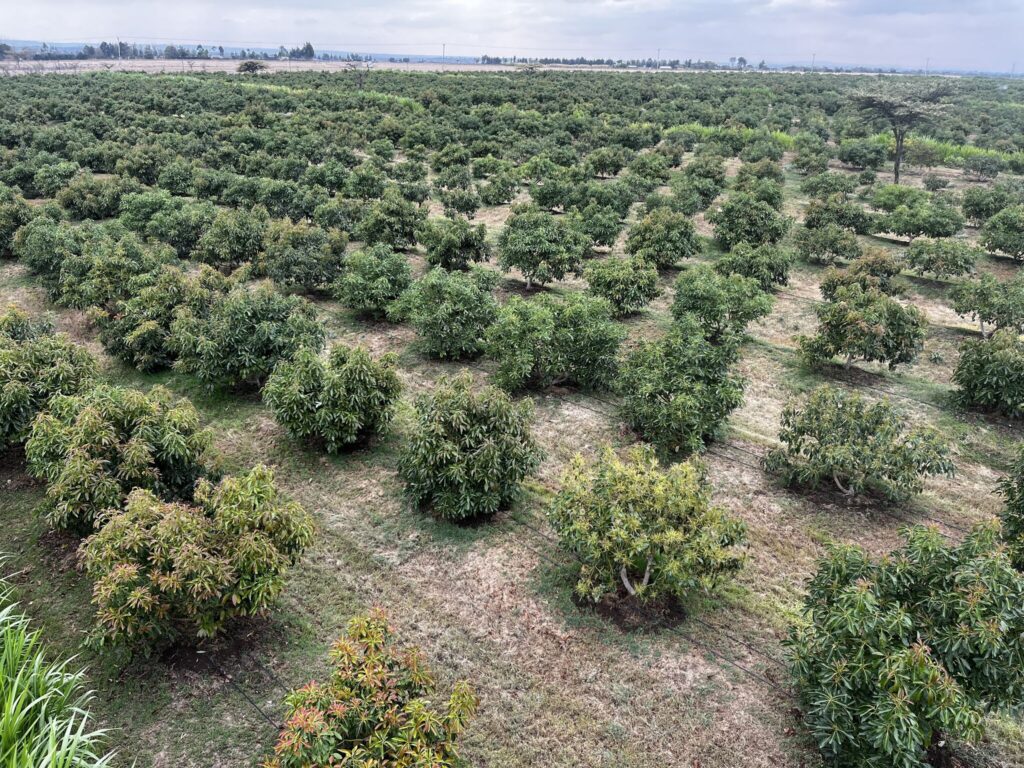
Introduction: The Hass Avocado Economy. Why Planting is not Profiting & Hass avocado yield per acre Kenya
Kenya’s avocado sector is growing fast. The Hass variety dominates this growth. Yet a dangerous gap separates the farmers who profit from this boom from those who only participate.
The yield gap in Kenyan Hass avocado orchards is stark. Poorly managed farms produce 5 to 8 tonnes per acre annually. Elite managed commercial orchards achieve 15 to 20 tonnes per acre. This difference represents about KES 1.5 million to KES 2 million in lost revenue per acre every year. Planting trees does not guarantee profit. Managing them for maximum commercial yield does.
This masterclass guide by Farmers Trend Ltd. provides the technical roadmap to close that gap. You will learn the precise year by year transition from establishment to break even and full production. You will understand the fertilization science, irrigation triggers, pruning protocols, and pest management strategies that separate elite orchards from average ones.
Farmers Trend Limited provides certified Hass seedlings and expert soil testing consultancy services. Access our certified seedling stock through our official channels.
Let us build your commercial orchard for 2026 and beyond.
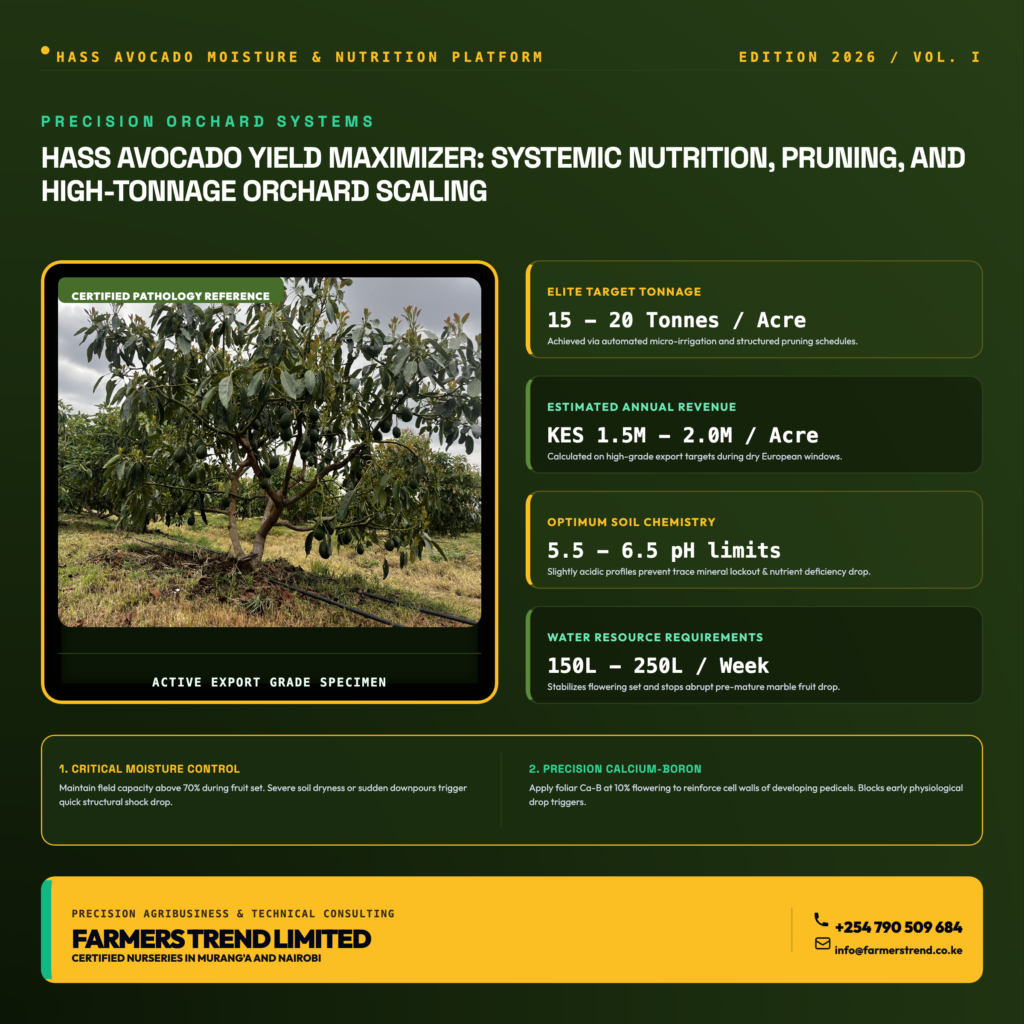
The Year 1 to 5 Harvest Roadmap
Hass avocado trees do not produce meaningful commercial yields until year three. The first 24 months focus entirely on root establishment and canopy development. Any fruit that sets during this period must be removed. Allowing early fruiting diverts energy from structural growth and permanently reduces the tree’s productive potential.
Year One: Establishment Phase
The tree grows to 1.5 or 2 meters. Zero harvest occurs. Your investment goes into irrigation infrastructure, mulching, and training the central leader. Water the young trees twice per week during dry spells. Apply 20 liters per tree each time. Mulch around the base using dry grass or coffee husks. The mulch layer should be 10 to 15 cm thick. Keep the mulch 15 cm away from the trunk to prevent rot. Remove all flowers that appear. Do not let the tree fruit. Every energy unit must go into root and branch development.
Year Two: Vegetative Expansion
The canopy expands to 2.5 or 3 meters. Minor flowering may occur, but you remove all fruit. Increase irrigation to 30 liters per tree per week during dry periods. Apply NPK 17:17:17 at 150 grams per tree three times this year. Prune the tree to maintain a central leader. Remove any branches that grow lower than 60 cm from the ground. By the end of year two, your tree should have 3 to 4 strong scaffold branches.
Year Three: Break Even Year
Each tree produces 30 to 50 fruits. This gives you approximately 300 to 400 kg per acre. At KES 80 per kilogram, revenue reaches KES 32,000 to KES 48,000 per acre. This is your first income. It will not cover all costs yet, but it signals that your orchard is entering production.
Allow fruit to set this year. However, do not let every flower become fruit. The tree is still young. Too much fruit will weaken the branches and reduce future yields. Thin the fruit when they reach marble size. Leave 20 to 30 fruits per tree. Remove the smallest and misshapen ones.
Year Four: First Commercial Harvest
Each tree produces 200 to 250 fruits. Total yield reaches 2,500 to 3,500 kg per acre. At KES 85 per kilogram, revenue reaches KES 212,500 to KES 297,500 per acre. Your cumulative investment starts to turn positive by the end of this year.
Fertilizer applications increase this year. Apply NPK 17:17:17 at 250 grams per tree pre flowering. Apply CAN at 150 grams per tree at fruit set. Apply Sulphate of Potash at 200 grams per tree during fruit development. Install additional drip emitters if the canopy has expanded beyond the original wetting zone.
Year Five: Full Commercial Production
Each tree produces 350 to 500 fruits. Total yield reaches 5,000 to 8,000 kg per acre under good management. Elite orchards with optimal nutrition, irrigation, and pruning hit 10,000 to 15,000 kg per acre by year five. At KES 90 per kilogram, revenue reaches KES 450,000 to KES 720,000 per acre for standard orchards. Elite orchards reach KES 900,000 to KES 1.35 million per acre.
Peak productivity occurs between years seven and fifteen. Mature trees produce 800 to 1,500 fruits annually. This translates to 15 to 22 tonnes per acre. Trees remain productive for decades when managed correctly.
Table 1: The 5 Year Financial and Yield Trajectory (Per Acre, 100 Trees)
| Year | Expected Yield (kg/tree) | Yield (kg/acre) | Market Price (KES/kg) | Total Revenue (KES/acre) | Cumulative ROI (KES) |
|---|---|---|---|---|---|
| 1 | 0 | 0 | 0 | 0 | (200,000) |
| 2 | 0 | 0 | 0 | 0 | (350,000) |
| 3 | 4-6 | 400-600 | 80 | 32,000-48,000 | (318,000) to (302,000) |
| 4 | 25-35 | 2,500-3,500 | 85 | 212,500-297,500 | (100,000) to 20,000 |
| 5 | 50-80 | 5,000-8,000 | 90 | 450,000-720,000 | 350,000 to 720,000 |
The revenue projection uses conservative market pricing. Export grade fruit attracts premium rates above KES 100 per kilogram during peak European demand windows. The cumulative ROI calculation assumes establishment costs of KES 200,000 per acre including certified seedlings, drip irrigation installation, and first year inputs.
Yield Gap Analysis
The difference between a poorly managed orchard and an elite managed orchard is 10 to 12 tonnes per acre. At KES 90 per kilogram, this gap represents KES 900,000 to KES 1,080,000 in lost revenue every year after year five. Over ten years of peak production, the cumulative loss exceeds KES 10 million per acre. Closing the yield gap is not optional. It is the difference between wealth and struggle.
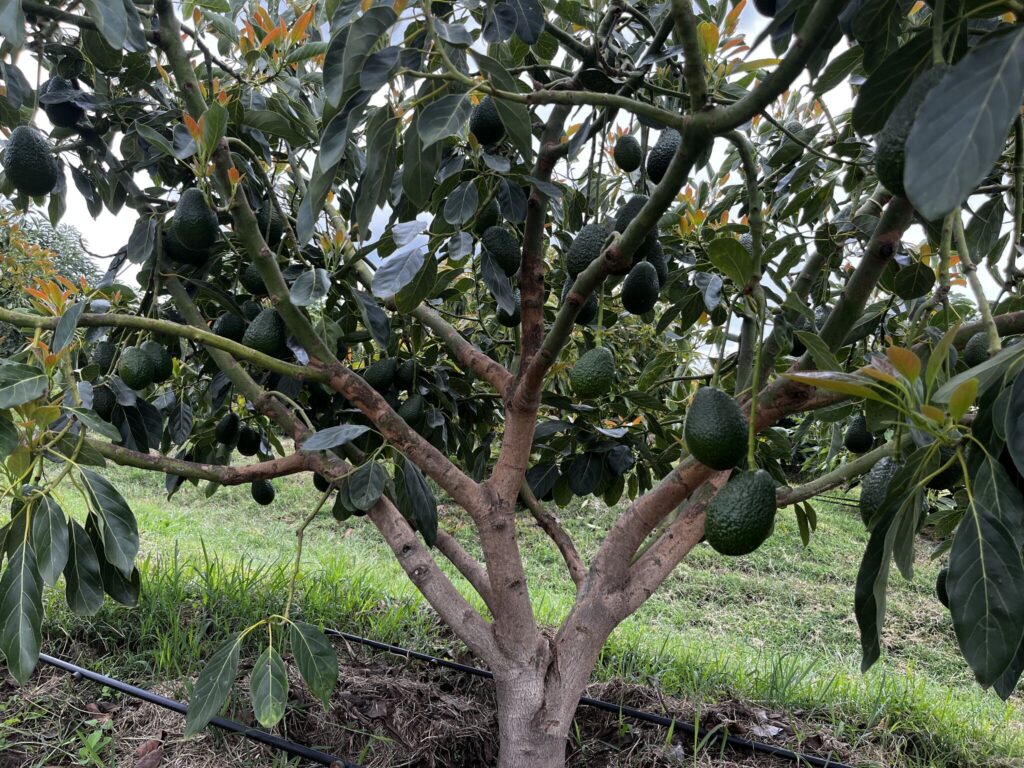
Precision Fertilization Regime
Broad brush fertilizing destroys yield potential. Hass avocado trees have specific nutrient demands at each growth stage. You must match application to growth phase.
Nitrogen Management
Nitrogen drives vegetative growth. Apply NPK 17:17:17 during the first two years to build canopy structure. Dosage starts at 100 grams per tree per application. Increase to 250 grams by year two. Apply three times annually. Do this during early vegetative flush, mid growth, and post harvest.
After year three, reduce nitrogen slightly. Too much nitrogen causes excessive vegetative growth at the expense of fruit. The tree becomes tall and leafy but produces few fruits. The fruit that does form has low oil content. Exporters reject low oil fruit.
Phosphorus for Root Development
Phosphorus supports root development. The first year’s applications should have higher phosphorus content. Use DAP or NPK 20:20:20 for the first four applications after planting. Phosphorus moves slowly in soil. You must place it where roots can reach it. Broadcast within the drip line of the tree.
Potassium for Fruit Quality
Potassium becomes critical from year three onward. Potassium drives fruit size, oil content, and yield. Apply Sulphate of Potash during fruit development. Potassium Nitrate applications through drip irrigation deliver rapid uptake during the fruit expansion phase.
The demand for potassium peaks when fruit reaches golf ball size. At this stage, the fruit is accumulating dry matter and oil. Without adequate potassium, the fruit remains small and the oil content stays below 21 percent. Exporters reject low oil fruit.
Calcium and Boron for Fruit Retention
Calcium and Boron prevent fruit drop and blossom end rot. Calcium strengthens cell walls. Boron ensures proper pollen tube growth and fruit set. Apply foliar Calcium Boron at 2 ml per liter of water during flowering and early fruit set. Repeat at fruit set and again four weeks later.
Boron deficiency is common in Kenyan highlands. The soil has been leached by heavy rainfall. The first sign of deficiency is small, misshapen fruit with brown spots. The fruit drops when it reaches marble size. By the time you see the symptoms, the crop is already lost. Preventive foliar applications are the only solution.
Organic Soil Conditioning
Organic soil conditioning is non negotiable. Apply 20 to 30 kg of well decomposed manure per tree annually. Manure improves soil structure, water holding capacity, and microbial activity. It also buffers pH changes and provides slow release micronutrients.
Apply manure in a ring around the tree. Start 30 cm from the trunk and extend to the drip line. Work it into the top 5 cm of soil. Do not pile manure against the trunk. This causes collar rot.
Soil pH Correction
Test your soil pH before planting. The ideal range for Hass avocado is 5.5 to 6.5. If your pH is below 5.0, apply agricultural lime at 2 to 3 tonnes per acre. Mix it into the top 20 cm of soil. Wait three months before planting. Lime reacts slowly. If your pH is above 7.0, apply elemental sulfur at 500 kg per acre. Sulfur also reacts slowly. Plan your soil corrections one full season before planting.
Table 2: The Critical Fertilization Calendar
| Growth Stage | Fertilizer Type | Dosage per Tree | Application Method |
|---|---|---|---|
| Pre flowering (July to August) | NPK 17:17:17 + Boron foliar | 200-300g + 2ml/L | Broadcast + Foliar |
| Flowering (September to October) | Calcium Boron + Zinc | 2ml/L + 1ml/L | Foliar spray only |
| Fruit set (November to December) | CAN + Potassium Nitrate | 150g + 50g | Broadcast + Drip |
| Fruit development (January to February) | Sulphate of Potash + Magnesium | 200g + 50g | Broadcast |
| Pre harvest (March to April) | NPK 15:15:15 | 250g | Broadcast |
| Post harvest (May to June) | Manure + Rock Phosphate | 25kg + 100g | Soil incorporation |
The timing aligns with Kenya’s two main flowering seasons. The primary season runs September to October with harvest from March to July. A secondary off season flowering occurs in March with harvest in October.
Foliar Spray Calibration
Mix foliar sprays correctly. Use clean water. Add a wetting agent at 2 ml per liter. This helps the spray stick to the leaves. Spray in the morning before 10 am or in the evening after 4 pm. Spraying during midday heat burns the leaves. Use a pressure sprayer with a cone nozzle. The droplet size should be fine but not mist. You want the spray to cover the leaf surface without running off.
The Irrigation Science
Water stress during flowering triggers mass fruit drop. The plant responds to dry soil by aborting flowers and small fruit to conserve resources for survival. You lose potential yield before it ever develops.
The Critical Water Window
The critical window spans from flowering onset through fruit set completion. This period typically lasts 8 to 10 weeks. Soil moisture must remain at 70 to 80 percent of field capacity throughout. Any drop below 60 percent triggers stress responses.
During this window, check soil moisture every morning. Use a tensiometer or the feel method. If the top 10 cm of soil feels dry, irrigate immediately. Do not wait until the leaves start wilting. Wilting means damage has already occurred.
Drip Irrigation Design
Drip irrigation delivers precise water amounts directly to the root zone. Overhead sprinklers waste water and promote fungal diseases on flowers and young fruit. Install double emitter drip lines with emitters spaced at 50 cm intervals. Each tree requires 4 to 6 emitters delivering 2 to 4 liters per hour each.
The drip lines should run along the row of trees. Place one line on each side of the trunk for young trees. As the tree grows, add more lines. By year five, you need 4 to 6 lines per tree. The root zone expands as the canopy expands. Your irrigation system must expand with it.
Water Filtration
Water filtration is critical. Avocado roots are sensitive to clogged emitters. If an emitter blocks, that section of root dries out. The tree responds by dropping fruit from that branch. Install a screen filter of 120 mesh or a disc filter. Clean the filter weekly during the irrigation season.
Daily Water Requirements
Daily water requirements change with growth stage. Young trees in year one need 20 to 30 liters per week. Apply this as 10 liters twice per week. Mature trees in full production need 150 to 250 liters per week during dry periods. Apply this as 50 liters three to five times per week.
Adjust based on rainfall, soil type, and mulch coverage. Sandy soils need more frequent irrigation with smaller amounts. Clay soils need less frequent irrigation with larger amounts. Mulch reduces evaporation and extends the time between irrigations.
Post Harvest Dry Stress
The post harvest dry period matters as much as the flowering wet period. Allow the soil to dry to 40 to 50 percent field capacity for 4 to 6 weeks after harvest. This dry stress triggers floral bud initiation for the next season’s crop.
Do not starve the tree completely. Monitor the leaves. If they start curling or turning yellow, irrigate lightly. The goal is moderate stress, not severe stress. Severe stress kills flower buds instead of initiating them.
Table 3: Flowering and Fruit Set Irrigation Protocol
| Physiological Stage | Soil Moisture Requirement (% Field Capacity) | Action to Take |
|---|---|---|
| Bud swell (4 weeks before flower) | 55-60% | Maintain moderate moisture. Begin increasing irrigation. |
| Flowering onset | 70-75% | Increase water by 30 percent. Do not allow drying. |
| Full flowering | 75-80% | Maintain consistently. Run 2L/hour drippers for 6-8 hours daily. |
| Fruit set (pea sized) | 75-80% | Critical period. Monitor daily. Any stress causes drop. |
| Fruit expansion | 65-70% | Reduce slightly. Deep water 3 times per week. |
| Pre harvest (4 weeks before) | 60-65% | Gradual reduction. |
| Post harvest | 40-50% | Dry stress triggers next season’s flowering buds. |
Soil Moisture Monitoring Tools
A tensiometer installed at 30 cm depth gives accurate readings. The device costs KES 3,000 to KES 5,000. Insert it within the drip line of a representative tree. Read it every morning. When the gauge reads 30 centibars, irrigate. When it reads 10 centibars after irrigation, stop.
You can also use the feel method. Dig a small hole 20 cm deep. Take a handful of soil from the bottom of the hole. Squeeze it. If water drips out, the soil is too wet. If it forms a firm ball that leaves slight moisture on your palm, moisture is adequate. If it crumbles, irrigate immediately.
The Fruit Drop Troubleshooting Matrix
Premature fruit drop destroys yield potential. Diagnosis requires systematic elimination of the five primary causes.
Boron Deficiency
Boron deficiency causes small, misshapen fruit with brown spots in the flesh. The fruit drops when it reaches marble size. The brown spots are necrotic tissue. The fruit cannot recover even if you add boron later.
The solution is to apply foliar Boron at 1 gram per liter at bud swell and again at full flowering. Use Solubor or Borax. Dissolve completely in warm water before adding to the spray tank. Soil application of Borax at 10 grams per tree annually prevents recurrence. Apply boron only every two years. Too much boron is toxic to the tree.
Thrips Infestation
Thrips infestations cause corky brown scarring on young fruit skin. The thrips feed on the surface cells. The damaged tissue dies and forms a scar. The fruit stops growing at the scar site. It becomes misshapen and drops within 2 to 4 weeks of infestation.
The solution is to apply spinosad or abamectin at 5 ml per liter during flowering. Repeat at fruit set. Monitor using yellow sticky traps at 10 traps per acre. Place traps at canopy height. Count thrips every week. When you see more than 10 thrips per trap, spray immediately. Rotate between spinosad and abamectin to prevent resistance.
Water Stress
Water stress from either drought or waterlogging triggers abscission. The fruit drops suddenly without visible damage. The drop happens within 24 to 48 hours of the stress event. You may lose 30 to 50 percent of your crop in one day.
The solution is to maintain soil moisture at 70 to 80 percent field capacity during flowering and fruit set. Install drainage channels in waterlogged areas. Mulch to reduce evaporation. Irrigate before the leaves show signs of stress. Do not wait.
Fungal Pathogens
Fungal pathogens like Anthracnose and Scab cause dark lesions on fruit. The lesions start as small black spots. They enlarge into sunken cankers. The fruit drops when the fungus reaches the stem attachment.
The solution is to apply copper based fungicides at 2 kg per acre during flowering. Repeat every 14 days until fruit set. Use copper hydroxide or copper oxychloride. Add a wetting agent. Remove infected fruit from the orchard floor. The fallen fruit produces spores that infect the next season’s crop.
Competition for Photosynthates
Competition for photosynthates occurs when the tree sets more fruit than it can support. The tree self thins by dropping the smallest fruit. This is natural. However excessive drop indicates poor nutrition or water stress.
The solution is to maintain optimal potassium levels during fruit development. Apply Sulphate of Potash at 200 grams per tree during the expansion phase. Thin the fruit manually when they reach marble size. Leave one fruit per cluster. Remove the smallest fruit. The remaining fruit will grow larger and have higher oil content.
Fruit Drop Diagnosis Timeline
Week one of drop: Check soil moisture first. Most drop is water related. Week two: Check for thrips on remaining fruit. Week three: Cut open dropped fruit. Look for brown spots (boron) or dark lesions (fungus). Week four: Send leaf samples for nutrient analysis. The results will confirm boron or potassium deficiency.
Pruning for Productivity
Pruning opens the canopy for better light penetration. Light drives photosynthesis. Photosynthesis drives fruit production. A closed canopy blocks light and reduces yield by 30 to 40 percent.
First Pruning at Planting
The first pruning happens at planting. Cut the central leader at 70 to 80 cm above ground. This forces lateral branch development. Select 3 to 4 strong lateral branches as the primary scaffold. These branches should be spaced evenly around the trunk. Remove all other branches. The goal is an open vase shape.
Year Two Pruning
Year two pruning removes inward growing branches. Cut any branch that crosses another. Remove low hanging branches below 60 cm. Remove suckers growing from the rootstock. The goal is a vase shaped tree with an open center. Air must flow freely through the canopy. Good air flow reduces fungal disease.
Year Three and Beyond Pruning
Year three and beyond pruning focuses on height control and renewal. Cut the central leader at 2.5 to 3 meters. This stops upward growth and promotes side branching. Remove one third of the oldest wood each year. This renews the fruiting wood. New wood produces better quality fruit than old wood.
Expert Tip on Pruning Timing
The best time to prune is immediately after harvest. However in Kenya, because of the two distinct seasons, you should be careful not to prune during the dry season if you do not have irrigation. Pruning during the dry season without irrigation leads to sunscald on the newly exposed bark. The bare branches get burned by the intense sun. This damage invites fungal infections and can kill the branch entirely.
If you lack irrigation, prune at the start of the rainy season. The rains will keep the soil moist. The humid air will protect the exposed bark from sunburn. The new growth will emerge quickly and provide shade. For farmers with drip irrigation, you can prune immediately after harvest regardless of the season. Just keep the soil moist for the following month.
Pruning Tool Care
Pruning tools must be sharp and clean. Disinfect between trees using 70 percent alcohol or bleach solution. Dip the tool for 30 seconds. Wipe it dry. This prevents disease spread. Cut branches flush to the branch collar. Do not leave stubs. Stubs rot and invite disease. Make clean cuts. Ragged cuts heal slowly and allow fungus to enter.
Light Penetration Measurement
Measure light penetration using a smartphone light meter app. Take a reading above the canopy. Take a reading below the canopy. Divide the lower reading by the upper reading. Multiply by 100. This gives you the percentage of light penetrating the canopy. Your target is 30 percent or higher. If you are below 20 percent, prune more aggressively next season.
The Kenyan Export Grade Standard
Exporters reject fruit that does not meet size and quality standards. You must understand these standards before you plant.

Size Requirements
The minimum fruit weight for export is 180 grams. Maximum weight is 380 grams. The ideal range is 200 to 330 grams. Fruit below 180 grams goes to local markets at lower prices. Fruit above 380 grams is often rejected for being too large. Exporters prefer consistent sizing. A carton of mixed sizes receives a lower grade.
Fruit Shape and Skin Quality
Fruit shape matters as much as size. Exporters want pear shaped fruit with a slightly elongated neck. Round or irregular fruit receives lower grades. The skin must be free from blemishes, scratches, and sunburn. The stem must be intact with 5 to 10 mm of stem attached. Fruit without a stem rots faster. Exporters reject stemless fruit.
Oil Content Standard
The oil content test happens at the packing house. The technician cuts a sample fruit and applies a reagent. The color change indicates oil percentage. Below 21 percent, the fruit is rejected. Above 24 percent, the fruit receives premium pricing. The highest prices go to fruit with 25 to 28 percent oil content.
How to Achieve Export Grade
Achieving export grade requires specific management. You must balance fruit load through pruning and thinning. A tree with too many fruit produces small fruit that falls below 180 grams. A tree with too few fruit produces oversized fruit above 380 grams. The correct load is 400 to 600 fruit per mature tree.
You must supply adequate potassium and calcium through the fertilization schedule. Potassium drives oil content. Calcium prevents skin blemishes. Without these nutrients, your fruit will not meet the export standard.
You must control thrips and fungal diseases that scar the skin. A single scratch or spot downgrades the entire carton. Exporters sort fruit by hand. Damaged fruit is removed. You are paid only for the fruit that passes inspection.
Harvest Timing for Export
Do not harvest based on fruit size alone. Harvest based on oil content. Sample fruit from different parts of the orchard. Send samples to a testing lab or use a field refractometer. When oil content reaches 21 percent, begin harvest. Harvesting too early gives low oil content. The fruit will be rejected. Harvesting too late gives overripe fruit. The fruit will have a short shelf life and will not survive the export journey.
Export Logistics
Export fruit must be packed within 24 hours of harvest. The fruit must be cooled to 6 to 8 degrees Celsius within 6 hours of packing. The shipping container must maintain this temperature throughout the journey to Europe. Any break in the cold chain causes premature ripening. The fruit arrives soft and bruised. The buyer rejects the shipment.
Smallholder farmers rarely export directly. The practical route is to join a cooperative or sell to an accredited packing house. Packing houses like Kakuzi, Kenya Fresh, and Vegpro handle the export logistics. They pay a premium for export grade fruit but deduct their costs. Your job is to produce fruit that meets the grade. The packing house handles the rest.
Frequently Asked Question
Question 1: How many Hass avocado trees can you plant per acre in Kenya?
Answer: You can plant 100 to 120 Hass avocado trees per acre in Kenya. Use a spacing of 7 meters by 7 meters or 8 meters by 8 meters. Wider spacing allows the canopy to expand fully and gives you higher yield per tree. Closer spacing causes overcrowding and reduces yield after year seven.
Question 2: What is the profit per acre for Hass avocado farming in Kenya?
Answer: A well managed Hass avocado orchard in Kenya generates KES 450,000 to KES 1,350,000 profit per acre by year five. Poorly managed orchards produce only KES 200,000 to KES 400,000 per acre. The difference comes from yield per tree, fruit size, oil content, and access to export markets.
Question 3: What is the best fertilizer for Hass avocado in Kenya?
Answer: The best fertilizer depends on growth stage. Use NPK 17:17:17 at pre flowering. Use CAN and Potassium Nitrate at fruit set. Use Sulphate of Potash during fruit development. Apply manure and rock phosphate post harvest. Always base your program on soil test results.
Question 4: How do you stop avocado fruit from dropping in Kenya?
Answer: Stop avocado fruit drop by maintaining soil moisture at 70 to 80 percent field capacity during flowering and fruit set. Apply foliar Boron at bud swell and full flowering. Control thrips using spinosad. Apply calcium boron spray at fruit set. Thin the fruit manually to reduce competition.
Question 5: When is the best time to prune Hass avocado trees in Kenya?
Answer: The best time to prune Hass avocado trees in Kenya is immediately after harvest. However if you lack irrigation, do not prune during the dry season. Dry season pruning without irrigation causes sunscald on exposed bark. Prune at the start of the rainy season instead.
Question 6: How long does it take for a Hass avocado tree to bear fruit in Kenya?
Answer: A Hass avocado tree takes 3 to 4 years to bear its first commercial fruit in Kenya. Year three gives 30 to 50 fruits per tree. Year four gives 200 to 250 fruits per tree. Full production starts at year five with 350 to 500 fruits per tree.
Question 7: What is the export size requirement for Hass avocado in Kenya?
Answer: The export size requirement for Hass avocado in Kenya is 180 to 380 grams per fruit. The ideal range is 200 to 330 grams. Fruit below 180 grams goes to local markets. Fruit above 380 grams is often rejected for being too large. Exporters also require pear shape, intact stem, and blemish free skin.
Question 8: What is the minimum oil content for export avocado from Kenya?
Answer: The minimum oil content for export avocado from Kenya is 21 percent. Fruit below 21 percent is rejected at the packing house. Premium prices go to fruit with 24 to 28 percent oil content. Oil content is tested using a reagent that changes color on the cut fruit flesh.
Question 9: How much water does a Hass avocado tree need per day in Kenya?
Answer: A mature Hass avocado tree needs 150 to 250 liters of water per week during dry periods. This equals 20 to 35 liters per day. Young trees in year one need 20 to 30 liters per week. Apply water through drip irrigation. Do not use overhead sprinklers.
Question 10: What causes avocado leaves to turn yellow in Kenya?
Answer: Yellow leaves on avocado trees in Kenya are caused by nitrogen deficiency, waterlogging, or root rot. Check soil moisture first. If the soil is wet and yellow, reduce irrigation. If the soil is dry, add water. If moisture is correct, apply CAN at 150 grams per tree. Persistent yellowing may indicate Phytophthora root rot.
Your Next Steps
Contact Farmers Trend Limited for your Precision Orchard Management Assessment. Our team will visit your farm, test your soil, assess your trees, and deliver a custom roadmap to maximize your yield per acre.
Call us at +254790509684. Visit our office in Nairobi for a personalized orchard audit. We provide certified Hass seedlings, soil testing services, drip irrigation design, and ongoing technical support.
The export market is waiting for your fruit. The demand grows every year. The difference between a struggling orchard and a profitable one is technical management. Start your elite orchard today.
What is your current tree spacing and what challenges are you facing with fruit drop? Leave your answer in the comments below. Sharing your experience helps other Kenyan farmers learn.
https://farmerstrend.co.ke/fruits/avocado-farming/commercial-hass-avocado-yield-per-acre-kenya/https://farmerstrend.co.ke/wp-content/uploads/2026/06/How-to-Maximize-Hass-Avocado-Yield-Per-Acre-in-Kenya-1024x768.jpeghttps://farmerstrend.co.ke/wp-content/uploads/2026/06/How-to-Maximize-Hass-Avocado-Yield-Per-Acre-in-Kenya-150x150.jpegAvocado Farming# Trendingavocado export grade standards Kenya,avocado oil content percentage export,avocado orchard establishment cost Kenya,best NPK fertilizer for Hass avocado,calcium boron spray for avocado,commercial Hass avocado farming Kenya,Hass avocado fertilizer schedule Kenya,Hass avocado fruit drop solutions,Hass avocado irrigation requirements,Hass avocado profit per acre,hass avocado pruning guide kenya,hass avocado yield per acre Kenya,how to maximize Hass avocado yield per acre in Kenya,sunscald prevention avocado pruning,thrips control in avocado Kenya,year by year avocado yieldMaximize Hass avocado yield per acre in Kenya. Year 1-5 roadmap, fertilizer calendar, fruit drop solutions, and export grade standards. Call 0790509684.Introduction: The Hass Avocado Economy. Why Planting is not Profiting & Hass avocado yield per acre Kenya Kenya's avocado sector is growing fast. The Hass variety dominates this growth....FarmersTrendjohn doefarmerstrend@gmail.comAdministratorFarmers Trend Ltd.

Leave a Reply