Kenyan Macadamia Trees Yield About 39 Kilos a Year Against a Potential 70 to 100: What Closes the Gap on the Land You Already Have
Macadamia yield per tree in Kenya averages about 39 kilograms of nuts a year on mature trees and about 17 kilograms on young trees. Researchers put the potential at 70 to 100 kilograms. The Agriculture and Food Authority (AFA) published the averages for 2021, and a Kenyatta University study repeated them in 2024.
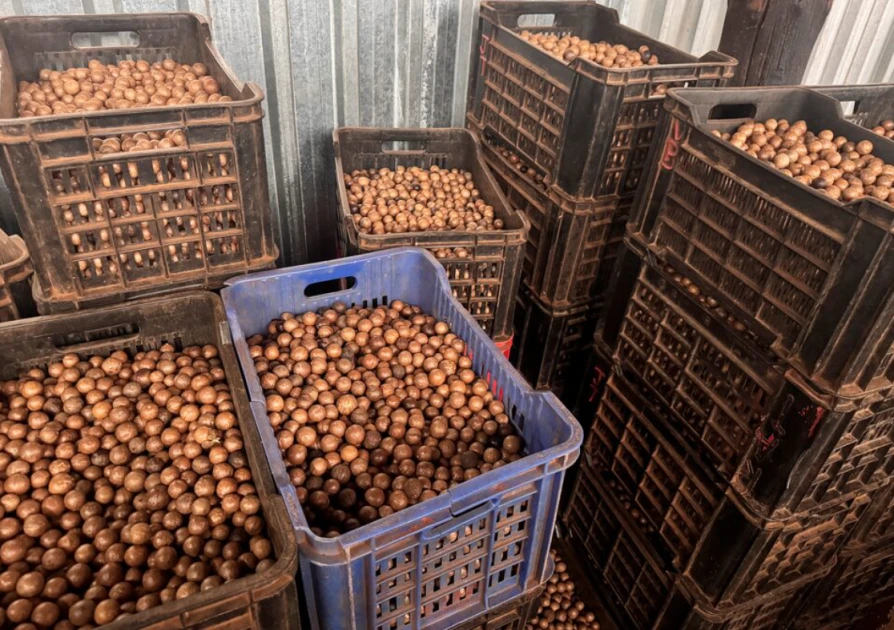
The gap is 31 to 61 kilograms on every mature tree. You already grow the trees. Closing part of the gap adds nuts without adding an acre.
This article is a diagnosis. You weigh your own trees first. Then you match your result to the causes of low macadamia yield per tree and fix the causes in order of cost. You also see the money at each step, so you spend where the return is largest.
The Gap in Numbers: What 31 to 61 Missing Kilos Cost You
Start with the arithmetic. Take an acre planted at 8 metres by 8 metres, which holds about 60 trees. Each mature tree gives the AFA average of 39 kilograms. The acre gives 2,340 kilograms of nuts in shell.
Raise each tree to 70 kilograms and the acre gives 4,200 kilograms. Raise each tree to 100 kilograms and the acre gives 6,000 kilograms. The table shows the value at KSh 70 and KSh 100 per kilogram. KSh 100 is the minimum farm gate price the government set in 2025 and enforced again in 2026. KSh 70 is the level some farmers reported getting when processors failed to pay the minimum.
| Yield per Tree | Nuts per Acre (60 Trees) | Income at KSh 70 per kg | Income at KSh 100 per kg |
|---|---|---|---|
| 17 kg (average young tree) | 1,020 kg | KSh 71,400 | KSh 102,000 |
| 39 kg (average mature tree) | 2,340 kg | KSh 163,800 | KSh 234,000 |
| 70 kg (low potential) | 4,200 kg | KSh 294,000 | KSh 420,000 |
| 100 kg (high potential) | 6,000 kg | KSh 420,000 | KSh 600,000 |
Moving from 39 to 70 kilograms adds 1,860 kilograms an acre. The gain is KSh 130,200 at KSh 70 and KSh 186,000 at KSh 100. Moving from 39 to 100 kilograms adds 3,660 kilograms, or KSh 256,200 to KSh 366,000. These are planning figures. Your trees, your price and your harvest decide the real result.
What the Gap Means for a Typical Farm
The Meru study surveyed 98 farmers. The average farm had 1.6 acres under macadamia and about 128 trees. The smallest orchard had 17 trees and the largest had 345. A farm with 128 mature trees at 39 kilograms gives about 5,000 kilograms. At 70 kilograms, the same trees give 8,960 kilograms.
The difference is almost 4,000 kilograms, worth about KSh 400,000 at KSh 100. A farmer with 128 trees gains this without planting a tree. You find the study at Kenyatta University study on macadamia farming in Meru County.
Why an Average Hides Your Orchard
An average mixes young trees with old trees, and cared-for trees with neglected trees. Your orchard sits somewhere inside the range. One of your trees gives 15 kilograms while the neighbouring tree gives 80. Do not plan from the national figure. Weigh your own trees.
Weigh Your Macadamia Yield Per Tree Before You Change Anything
You fix only the number you know. Pick 10 trees spread across your orchard. Include trees on slopes, in low spots and near the boundary. Tie a ribbon on each tree and give each tree a number.
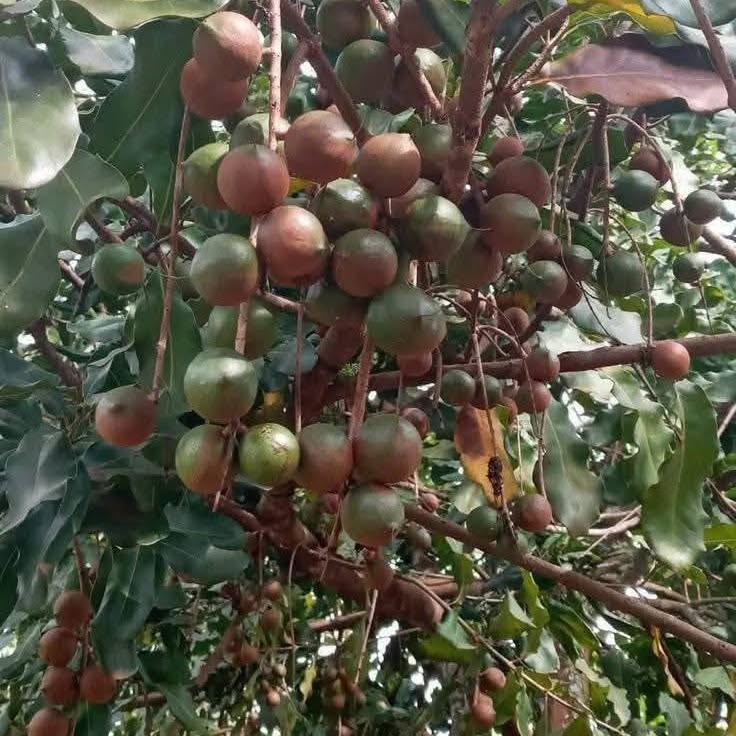
At every harvest, collect the nuts from each marked tree into a separate sack. Dehusk and dry the nuts. Weigh the dry nuts in shell and write the weight next to the tree number. After a full season, add the harvests for each tree. You now have your macadamia yield per tree for 10 trees.
Compare your macadamia yield per tree with the benchmarks. A tree below 20 kilograms has a serious problem. A tree between 20 and 39 kilograms sits below the national average. A tree between 40 and 69 kilograms is doing well. A tree above 70 kilograms is in the potential range.
Look at the pattern in your macadamia yield per tree. If the weak trees sit in one corner, the cause is the site, such as shade, wind or poor drainage. If the weak trees sit all over the orchard, the cause is management, such as feed, pruning or pests. The pattern tells you where to start.
What the Meru Survey Shows Farmers Skip
The Kenyatta University team asked 98 small-scale farmers in Central Imenti about their macadamia practices. The farmers had grown macadamia for 18 years on average. Experience was not the problem. The survey shows which practices most farmers still skip.
| Practice | Share of Farmers Using the Practice |
|---|---|
| Improved varieties | 36 percent |
| Pesticides | 32 percent |
| Inorganic fertiliser | 11 percent |
| Organic manure | 73 percent |
| Pruning | 66 percent |
| Irrigation | 38 percent |
| Access to extension advice | 57 percent |
| Access to credit | 26 percent |
| Direct sales to companies | 22 percent |
Read the table from the bottom of the list up. Most farmers sell through middlemen, lack credit and do not irrigate. About two in three still grow traditional varieties. Only one in nine applies inorganic fertiliser.
The authors name irrigation, pesticide use, the type of market and improved varieties as the major factors in yield. The survey covers one sub-county, so treat the figures as a strong indication, not a national count. The pattern matches what agronomists tell farmers across the country.
Water: The First Lever for Macadamia Yield Per Tree
In the Meru survey, irrigation showed the strongest link with yield among the technology practices. Only 38 percent of the farmers irrigated. The authors note irrigated trees yield through the year.
The Nation’s agronomist notebook explains the mechanism. An extended dry season makes trees drop nuts, especially on sandy soil which dries fast. Trees on such soil hold only the nuts they have water to support. Good watering decides how many nuts stay on the tree, and so decides your macadamia yield per tree.
What to Do for Water
Mulch under every tree with dry grass or leaves, about 10 centimetres thick. Keep the mulch a hand’s width from the trunk. Mulch preserves moisture and feeds the soil.
Water young trees and fruiting trees in dry spells. Give extra attention during nut set. Harvest rainwater from roofs into tanks and use the water in the dry months. If you have a stream or a borehole, plan drip lines for the rows with the weakest trees first.
Check the result. Mark two trees, water one and leave the other on rain alone. Compare the nuts at harvest. The difference shows you what water is worth on your own soil.
Variety and Rootstock: Why Improved Trees Out-Yield Old Seedling Trees
About 64 percent of the farmers in the Meru survey grew traditional varieties. The authors list improved varieties among the factors with the largest link to yield. Grafted varieties also start bearing earlier. The Nation reports grafted trees begin producing three to four years after planting, which is shorter than non-grafted trees.
An old tree grown from seed carries the variability of the seed. Macadamia yield per tree varies widely among seedling trees. Some trees give heavy crops, and some give little. You learn which only after the tree has grown for years. A grafted tree carries the proven traits of the parent variety from the day you plant.
Certified seedlings matter as well. The study recommends county governments make certified seedlings available, because farmers buy uncertified seedlings. Buy from a nursery which tells you the variety, the rootstock and the source of the scions.
Replace Your Weakest Trees With Grafted Stock
Your weighing result points to the trees to replace. A tree which stays below 20 kilograms after you fix water, feed and pruning is a weak variety or a poor site. Cut the tree and plant a certified grafted seedling in the gap. You keep the land in production and raise the average of the orchard.
Feed the Tree Before the Dry Season
Only 11 percent of the surveyed farmers used inorganic fertiliser, and 73 percent used manure. The Nation notes premature nut drop often follows inadequate nutrient uptake in the dry season. A tree short of nutrients sheds nuts the tree started to fill.
Test your soil before you buy fertiliser. A soil test tells you which nutrient is short, so you pay for the right product. Ask your extension officer where to send a sample. Apply well decomposed manure under the canopy at the start of the rains, and spread the manure away from the trunk.
Feeding lifts macadamia yield per tree only when water is present. Fertiliser in dry soil does little. Apply feed when the soil is moist, and water in the dry months so the nutrients reach the roots.
Light and Space: Prune So Every Branch Gets Sun
The Nation’s agronomist notebook warns congested trees cut off sunlight and lower production. Pruning opens the canopy and raises macadamia yield per tree. The notebook advises pruning in the early years, before flowering and after harvest. Make slanting cuts and disinfect your shears between trees to stop the spread of disease.
In the Meru survey, 66 percent of farmers pruned, but the authors found pruning showed no clear link with yield. They suggest farmers did not prune in the right way or at the right interval. Pruning without a plan does little.
Spacing Decides How Soon Trees Crowd Each Other
A spacing of 8 metres by 5 metres gives 100 trees an acre. A Kenyan organic farming magazine says this spacing suits intensive growing but needs more pruning. Ugandan extension material warns Murang’a and Kirinyaga varieties close in after year 8 to 10, which forces farmers to cut trees to make space.
Walk your orchard. If the canopies of neighbouring trees touch and the lower branches have died from shade, your trees are crowded. Remove every second tree in the worst rows, or prune the sides of the trees to restore light. Fewer trees with sunlight often give more nuts than many trees in shade.
Wind and Rain: Protect Stems and Flowers
Strong wind lowers macadamia yield per tree by breaking stems and knocking off flowers and young nuts. The Nation recommends planting border trees as a windbreak and keeping a good tree structure through pruning. Plant windbreaks on the side from which the wind blows.
Heavy rain at flowering also costs you nuts. The notebook says heavy rainfall causes poor pollination, which leads to flower abortion or nuts falling early. You do not control the rain, but you protect pollination. Avoid spraying chemicals at flowering, because the chemicals kill the insects which pollinate the flowers.
Kenya Met expects above-average rainfall over much of the country this short rains season. Check your drains, and stake or prune weak trees before the storms.
Pests: Stop Losing Nuts You Already Grew
Pests cut macadamia yield per tree before the nuts reach your sack. The Macadamia Association of Kenya says insects destroy about 17,460 tonnes of macadamia a year, including more than 2,200 tonnes of exportable kernel. A Business Daily column puts the loss to downgraded nuts at up to 406 kilograms a season per farmer, worth over KSh 40,000. KEPHIS lists stink bugs, nut borers, lace bugs, moths, rats and thrips as the key pests.
Only 32 percent of the surveyed farmers sprayed, and the key informant blamed cost. Cost is a fair concern, but a lost nut is a lost sale. A tree which gives 39 kilograms and loses 10 percent to pests loses about 4 kilograms. At KSh 100 per kilogram, the loss is KSh 400 a tree each year.
What to Do About Pests
Walk your orchard every two weeks. Look at nuts, leaves and the ground under the trees. Cut the grass under the trees, and collect fallen nuts promptly, because nuts left on the ground feed rats and pests. Keep farm hygiene high.
Use registered products only when scouting shows damage, and follow the label. Spray outside the flowering period. Ask your extension officer which products suit your pest and your area.
Harvest Fast and Sort Clean to Protect Your Macadamia Yield Per Tree
Good harvest habits protect the yield you worked for. The Nation advises harvesting when the skins begin to crack. Mature nuts are chocolate brown and drop off easily. Unripe nuts are sticky and you leave them on the tree.
Weed under the trees so you find every nut. Collect mature nuts often. Dehusk soon after collection and dry the nuts to the moisture your buyer wants. Store in clean sacks off the floor.
Sort your nuts. The Standard reported in March 2026 Kenyan processors need nearly eight kilograms of raw nuts to make one kilogram of export-ready kernel, and farm gate grading is absent. The Standard also reported brokers buying low-quality nuts at KSh 50 and mixing them with better nuts. When you sort and keep clean nuts apart, you prove your quality and protect your price.
Sell Where the Price Holds
A higher macadamia yield per tree pays only if you sell at a good price. In the Meru survey, 78 percent of farmers sold through middlemen at the farm gate or at the market. Only 22 percent sold directly to companies. The authors found direct market access among the strongest links with yield and income.
Agriculture Cabinet Secretary Mutahi Kagwe told processors in April 2026 to buy all local macadamia at KSh 100 per kilogram. He warned brokers paying as little as KSh 30 would not be tolerated. Use the minimum price as your reference. Ask any buyer who offers less to explain the grade and the reason.
Group with other farmers and sell graded nuts together. A cooperative offers volume, which buyers want, and a cooperative helps with credit, which three in four farmers in the survey lacked. The study recommends farmers form a cooperative for this reason.
How Each Fix Adds Kilos: A Worked Example for 60 Trees
Take your orchard of 60 mature trees at the AFA average of 39 kilograms. The example below is a planning model, not a research result. The gains are illustrative and your trees will differ.
Suppose mulch and water in dry spells add 8 kilograms a tree. Manure and fertiliser add 5. Better pruning adds 5. Pest control adds 4. Careful harvest and sorting save another 3 kilograms which would otherwise rot, drop unnoticed or sell at a low grade. The total is 25 kilograms more, which lifts macadamia yield per tree from 39 to 64 kilograms.
Across 60 trees, 25 kilograms a tree adds 1,500 kilograms. At KSh 100 per kilogram, the gain is KSh 150,000 a year. Even half of the gain, 750 kilograms, adds KSh 75,000.
Track each fix separately. Apply one change to a group of marked trees and keep another group unchanged. Weigh both groups at harvest. You learn which fix pays on your land, and you stop spending on the fixes which do not.
Macadamia Yield Per Tree in the First Seven Years
Young trees give less. The AFA average for young trees is about 17 kilograms a year. Grafted trees begin to bear three to four years after planting, according to the Nation. Commercial yields stabilise from year six or seven.
A Ugandan government extension guide expects about 5 kilograms a tree in year four, 15 in year five, 25 in year six and 35 in year seven, then rising each season. Conditions in Uganda differ from yours, but the shape of the curve helps. Use the curve as a rough guide for your young orchard.
If your six-year-old trees give 10 kilograms, they run behind the curve. Look at water, feed and light. If your seven-year-old trees give 35 kilograms or more, they are on track and your macadamia yield per tree is likely to keep rising.
Soil, Slope and Site: When the Land Limits Macadamia Yield Per Tree
Some losses trace to the site. The Nation says macadamia needs deep, well drained soils and adequate rainfall. Shallow or waterlogged soil weakens roots. Sandy soil dries fast and the trees drop nuts. Land with strong wind breaks stems and flowers.
Use your orchard map. Mark the trees with the lowest weights. If the marks cluster in a low spot, check drainage and dig drains. If the marks cluster along an exposed edge, plant a windbreak. If the marks sit under the shade of a neighbouring tree or building, prune or remove the shade.
Some corners never reach the potential. Move your effort to the trees which respond, and replace trees in poor spots with another crop or with a different use of the land. Fewer, healthier trees give more nuts than a full orchard of struggling trees.
Records Which Pay for Themselves
Keep one page for each harvest. Write the date, the tree numbers, the weight of dry nuts, the share rejected, the buyer, the price and your costs. After two seasons, you see your yield per tree, your income per kilogram and your cost per kilogram. These numbers guide every decision in this plan.
A Two-Season Plan for 100 Macadamia Trees
You do not fix everything at once. Order your actions by cost, starting with the free ones.
This week, mark and number 10 trees. Clear the ground under all trees. Collect every fallen nut. Prune dead and diseased branches with clean shears. Draw a map of your orchard and mark the weak trees.
In the next two months, spread mulch under every tree. Apply well decomposed manure at the start of the rains. Set up a routine to scout for pests every two weeks. Repair or plant windbreaks.
Before the dry season, plan water. Fill tanks, repair pipes and set a schedule. Send a soil sample to a laboratory and buy fertiliser based on the result. After harvest, prune to open the canopy and thin crowded rows.
In the second season, weigh your marked trees again. Compare your macadamia yield per tree with last season. Replace trees which stay weak with certified grafted seedlings. Add new blocks only after the old trees perform.
Fix Your Trees or Plant More? Run the Numbers
You face a choice. You raise the macadamia yield per tree of your existing trees, or you plant more trees. The numbers help you decide.
Suppose you raise 60 trees from 39 to 49 kilograms. The acre gains 600 kilograms. At KSh 100 per kilogram, the gain is KSh 60,000 a year. Most of the actions cost little, such as mulch, pruning and scouting.
Suppose you plant 60 new grafted trees instead. Seedlings at KSh 350 cost KSh 21,000. You also pay for holes, manure and labour. The trees give their first nuts in three to four years and reach commercial yields from year six or seven. The new trees repay the cost later.
The order is clear. Fix the trees you own first, because the macadamia yield per tree gain comes this season. Then add trees on land which has room, using certified grafted stock. Planting weak trees in a neglected orchard repeats the problem.
Certified Grafted MRG-20 Macadamia Seedlings From Farmers Trend Limited
With the rains here, this is a good time to establish your macadamia orchard. Farmers Trend Limited sells certified grafted MRG-20 (Murang’a 20) macadamia seedlings at KSh 350 each. Order at Grafted Macadamia Seedlings (MRG20).
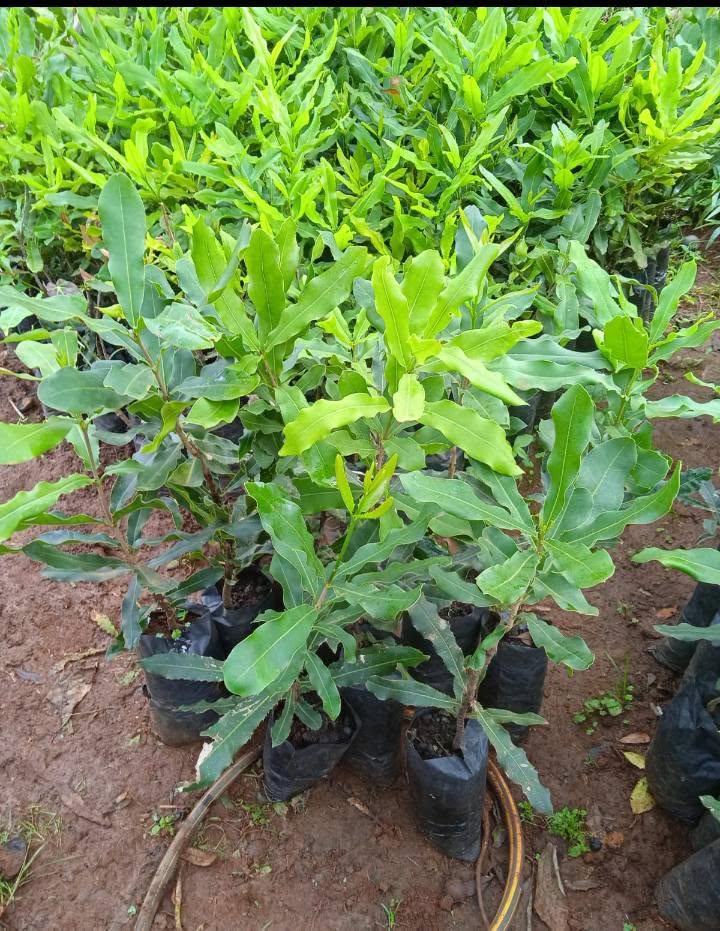
Use the seedlings to fill gaps where you removed weak trees, to lift the macadamia yield per tree average of your orchard or to start a new block. Twenty seedlings cost KSh 7,000. Sixty seedlings cost KSh 21,000, and one hundred cost KSh 35,000. Farmers Trend Limited also explains macadamia farming in Kenya in 2026 at macadamia farming in Kenya in 2026.
What to Check Before You Pay for Macadamia Seedlings
Look at the graft union. The union must be smooth and fully healed. Check the stem, which must stand straight and firm. Check the leaves, which must be green with no spots or chewed edges. Ask for the variety name, the rootstock and the source of the scions. Buy only from a nursery you trust.
Quick Answers on Macadamia Yield Per Tree
What is the average macadamia yield per tree in Kenya?
AFA figures for 2021 put the average at about 39 kilograms a year for mature trees and about 17 kilograms for young trees.
What is the potential macadamia yield per tree?
Researchers cited in the Kenyatta University study put the potential at 70 to 100 kilograms of nuts a year.
How do I raise the macadamia yield per tree on my farm?
Weigh your own trees first. Then fix water, feed, pruning, pests and harvest habits in order of cost. Replace trees which stay weak with certified grafted seedlings.
How far apart should macadamia trees be?
Spacing of 8 metres by 8 metres gives about 60 trees an acre. A spacing of 8 metres by 5 metres gives 100 trees but needs more pruning, and some varieties crowd after year 8 to 10. Ask your extension officer about the variety you grow.
Why is my macadamia yield per tree low?
Low macadamia yield per tree usually traces to a few causes. Trees run short of water in the dry season. Trees lack feed. Canopies are crowded and shaded. Wind, rain at flowering and pests take nuts. Trees grown from seed may also be a weak variety. Weigh your trees and read the pattern to find your cause.
How many kilos should a young macadamia tree give?
The AFA average for young trees is about 17 kilograms a year. A Ugandan extension guide expects about 5 kilograms in year four and 35 in year seven. Grafted trees start earlier than trees grown from seed. If your trees give much less, check water, feed and light.
When do grafted macadamia trees start to bear?
The Nation reports grafted trees start to bear three to four years after planting. Commercial yields usually stabilise from year six or seven.
Does irrigation raise macadamia yield?
The Meru survey found irrigation had the strongest link with yield among the technology practices, and the Nation says dry spells cause nut drop. Mulch, water in dry spells and watch your own results.
What is the minimum price for macadamia?
The government set a minimum farm gate price of KSh 100 per kilogram, and the Agriculture Cabinet Secretary told processors in April 2026 to pay the minimum price. Some farmers still report lower prices, so keep records of every sale.
How much do certified grafted MRG-20 macadamia seedlings cost?
Farmers Trend Limited sells certified grafted MRG-20 (Murang’a 20) macadamia seedlings at KSh 350 each.
Start This Week With the Trees You Already Own
Macadamia yield per tree averages 39 kilograms, and the potential is 70 to 100. The gap is 31 to 61 kilograms a tree. On an acre of 60 trees, closing the gap to 70 kilograms adds KSh 130,200 to KSh 186,000 a year.
The causes are known. Dry spells, poor feeding, crowded canopies, wind, pests, late harvest and weak markets each take nuts. You fix them in order of cost. You begin with the free actions this week.
Weigh 10 trees. Clear the ground. Prune with clean shears. Mulch before the dry season. Scout for pests. Sell graded nuts with other farmers. Then add certified grafted seedlings where your records show weak trees.
With the rains here, plant now. Farmers Trend Limited sells certified grafted MRG-20 (Murang’a 20) macadamia seedlings at KSh 350 each. Order at Grafted Macadamia Seedlings (MRG20).
Call or WhatsApp 0724 559 286 or 0790 509 684. Email info@farmerstrend.co.ke.
https://farmerstrend.co.ke/trending/macadamia-yield-per-tree-kenya/https://farmerstrend.co.ke/wp-content/uploads/2026/11/MACADAMIA-FB-CRATES.pnghttps://farmerstrend.co.ke/wp-content/uploads/2026/11/MACADAMIA-FB-CRATES-150x150.png# TrendingCropsIn cropsMacadamia FarmingAFA macadamia,Farmers Trend Limited,grafted macadamia seedlings,increase macadamia yield,macadamia average yield Kenya,macadamia brokers,macadamia cooperative,macadamia farm gate price,macadamia farming in kenya,macadamia fertiliser,macadamia grading,macadamia irrigation,macadamia low yield,macadamia minimum price KSh 100,macadamia nut drop,macadamia pests,macadamia pruning,macadamia seedlings Kenya,macadamia seedlings price Kenya,macadamia tree spacing,macadamia yield gap,Macadamia yield per acre,macadamia yield per tree,macadamia yield per tree Kenya,MRG-20 macadamia,murang'a 20 macadamia,nut borer macadamia,stink bugs macadamiaMacadamia yield per tree in Kenya averages about 39 kilograms of nuts a year on mature trees and about 17 kilograms on young trees. Researchers put the potential at 70 to 100 kilograms. The Agriculture and Food Authority (AFA) published the averages for 2021, and a Kenyatta University study...FarmersTrendjohn doefarmerstrend@gmail.comAdministratorFarmers Trend Ltd.

Leave a Reply