The Hass Avocado Farming Pivot: A 2026 Profit Blueprint for Maize Farmers Switching to Export Fruit
Hass avocado farming gives maize farmers in Kenya a higher return per acre and a route into export markets. You plant once. You harvest for decades. Buyers in Europe and the Middle East pay for fruit which meets size, maturity and residue rules. This guide shows you how to switch from maize to Hass avocado, step by step, with numbers you check against your own farm.

Maize farmers face a squeeze. Seed, fertiliser and labour cost more each year. One acre of maize gives about 25 bags of 90 kg. At KSh 3,000 per bag, your gross income is KSh 75,000. You pay for ploughing, planting, weeding and shelling every season. Your margin stays thin.
Avocado offers a different return. Kenya produced a record 694,000 tonnes of avocados in 2025. The USDA Foreign Agricultural Service forecasts 727,000 tonnes in 2026. Hass leads the export trade. Fresh avocado exports earned USD 159.1 million in 2025 even after shipping disruptions.
You read this guide to decide, plan and act. Each section gives you a task, a number and a deadline. Use the checklist at the end to start your orchard this planting season.
The 2026 Market Case for Hass Avocado Farming in Kenya
Demand drives your decision, so start with the market. Here is what the data shows.
| Category | Key statistics and developments |
|---|---|
| Production | 694,000 tonnes in 2025, with production forecast to reach 727,000 tonnes in 2026 (USDA FAS, April 2026). |
| Exports | Fresh avocado exports fell by 23% to 121,000 tonnes in 2025 following the Red Sea crisis and an AFA suspension linked to immature fruit. |
| 2026 Export Recovery | Exporters forecast 130,000 to 140,000 tonnes in 2026, representing an increase of about 7.4%. |
| Export Value | 2026 projections reach approximately KSh 25.4 billion (US$170 million). |
| Area Under Avocado | Avocado-growing land is projected to expand by 5.6% in 2026 to approximately 37,600 hectares. |
| Top Export Market | The Netherlands accounted for 24% of Kenya’s avocado exports in 2025 and redistributes fruit across the European Union. |
| Other Export Markets | The United Arab Emirates, France and Asian markets are also important buyers. Exports to Asia are growing following China’s market opening in 2022. |
Export unit values sit near USD 1.5 to USD 1.6 per kg. This price competes with other origins. Peru plans about 773,000 tonnes of Hass exports in 2026. South Africa plans 88,000 tonnes. You compete on quality and timing, not on volume.
Kenya has an advantage in timing. Your fruit reaches buyers while some southern hemisphere supply is low. Exporters pay a premium for consistent fruit in this window. Consistency starts on your farm with the right trees, the right care and the right harvest date.
Read the official season notices on the AFA website. AFA sets the dates for each export season and the maturity rules for fruit. In 2026, sea-bound exports opened on 2 April after field assessments. Farmers who harvested early lost money and damaged the national brand. You protect your income when you follow the calendar.
Be honest about the risks. Shipping costs rose in 2026 and slowed some export pacing. Prices soften when Peru and Mexico ship large volumes. Your plan must work at a conservative price. Later sections show you how.
Is Your Farm Ready for Hass Avocado Farming?
Hass avocado grows well in the cool highlands. Check your site against this list before you buy a single seedling.
Altitude: 1,200 to 2,100 metres above sea level suits Hass best. Temperature: 15 to 25 degrees Celsius in the growing season. Frost damages flowers and young trees. Rainfall: 1,000 to 1,600 mm per year, spread across the season. Plan irrigation when rain falls below this range. Soil: deep, well-drained loam with a pH between 5.5 and 6.5. Hass roots rot in waterlogged soil. Water: a reliable source within reach for the first three dry seasons. Access: a murram road to your farm so trucks collect fruit without delay.
Highland zones with strong avocado activity include Murang’a, Kiambu, Nyeri, Kirinyaga, Meru, Kisii, Nyamira and Uasin Gishu. Your county agricultural office tells you whether your ward fits.
Test your soil before you plant. A laboratory test costs a few thousand shillings and tells you your pH and nutrient levels. You correct acidity with lime and add phosphorus at planting. Skip this step and you guess for the next 20 years.
Look at drainage on your maize plot. Water which stands for more than a day after heavy rain signals a problem. Black cotton soils and flat valley bottoms carry high risk of root rot. Plant on a slope or build raised ridges.
Step 1: Buy Certified Grafted Hass Avocado Seedlings
Your seedling decides your harvest date, your yield and your export grade. Choose grafted Hass avocado seedlings from a certified source.
Seed-grown trees vary in fruit shape, size and quality. They take 6 to 8 years to bear. Grafted Hass trees keep the traits of the parent tree and start bearing in about three years. Exporters want uniform Hass fruit. A grafted tree gives you uniform fruit.
Check each seedling before you pay.
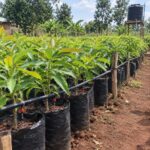
Look for a clean graft union, healed with no swelling or cracks. Pick seedlings 60 to 90 cm tall with a straight stem. Check for a healthy, white root system in a firm, intact planting bag. Reject seedlings with yellow leaves, leaf spots or curled roots. Ask for the nursery certification and the variety label.
Price matters, but cheap seedlings cost you more in lost years. Some smallholders pay KSh 100 to KSh 200 for uncertified stock. A wrong variety costs you five years of work before you find the error.

Farmers Trend sells certified grafted Hass avocado seedlings at KSh 250 each. One acre at 7 m by 7 m spacing needs 82 trees. Your seedling bill is KSh 20,500. Add 5 percent extra seedlings to replace trees which fail in the first year.
Order your certified grafted Hass avocado seedlings here.
Call or WhatsApp 0724 559 286 or 0790 509 684. Email info@farmerstrend.co.ke. Give your county, your acreage and your planting date so the team plans your order.
Step 2: Plan Hass Avocado Spacing and Prepare Your Land
Spacing sets your tree count per acre. Spacing also sets how long you intercrop and how easy spraying and harvest become. One acre holds 4,047 square metres.
6 m by 6 m: 112 trees per acre. High early income. Trees crowd by year 8 and need heavy pruning or thinning. 7 m by 7 m: 82 trees per acre. A balanced choice for most smallholders. 8 m by 8 m: 63 trees per acre. Lower cost and easier management. Lower income per acre.
This guide uses 7 m by 7 m. Adjust the numbers for your layout.
Follow this land preparation order.
Harvest your maize and remove the stalks. Burn nothing in the plot. Stalks left as mulch feed the soil. Mark the planting points with pegs and string. Run rows across the slope on hilly land. Dig holes 60 cm wide, 60 cm long and 60 cm deep, three to four weeks before planting. Place topsoil on one side and subsoil on the other. Mix the topsoil with 20 kg of well-decomposed manure and 200 g of phosphate fertiliser per hole. Refill the hole with the mixture and leave a small mound.
Add a windbreak of Grevillea or Casuarina on the windward side. Wind drops flowers and bruises fruit. Bruised fruit fails export grading.
On slopes, build terraces or fanya juu trenches. They stop erosion and hold water near the roots.
Step 3: Plant Your Hass Avocado Trees at the Start of the Rains
Plant when the long rains are established. Soil moisture helps roots settle in the first month. Follow these steps for each tree.
Remove the planting bag with care. Keep the root ball intact. Open the filled hole to match the size of the root ball. Set the tree so the graft union sits 15 to 20 cm above the soil line. Firm the soil around the roots. Leave no air pockets. Water with 10 litres immediately after planting. Stake the tree if wind is strong, and tie loosely. Spread 10 cm of mulch in a ring around the stem. Keep the mulch 10 cm from the bark. Shade seedlings with banana leaves or a shade net during the first dry spell.
Remove any shoots which grow below the graft union. These come from the rootstock and produce poor fruit.
Record your planting date and tree number in a notebook. Export buyers ask for farm records. Records also help you spot problems early.
Step 4: Feed, Water and Prune Your Hass Avocado Orchard
Good orchard care drives yield. Young trees need steady water, balanced nutrients and shape pruning.
Water your young trees on a schedule
Water each young tree with 20 to 40 litres per week in dry weather during years 1 to 3. Drip irrigation saves labour and water. A basic drip kit for one acre costs about KSh 40,000 to KSh 60,000. Avocado roots sit near the surface. Overwatering suffocates them. Water less often and apply enough to wet the root zone.
Feed your trees in stages
Follow a simple feeding plan and adjust with your soil test.
At planting: 20 kg manure and 200 g phosphate per hole. Year 1 to 2: a balanced NPK fertiliser, 100 to 200 g per tree, split into two applications at the start of each rain season. Year 3 onward: raise the rate each year as the canopy grows. Follow the advice from your soil test. Every year: add manure around the drip line and replace the mulch.
Zinc and boron shortages reduce fruit set and size in many highland soils. Apply foliar feeds as your agronomist advises.
Prune for light and shape
Prune each young tree to a single leader with strong side branches. Cut off the tip at 1 metre to encourage branching. Remove crossing branches and dead wood. Keep the lowest branch 60 cm above the ground so air moves through the tree.
After year 5, prune after harvest. Open the centre to light. Keep tree height under 5 metres. Short trees cost less to spray and harvest.
Control weeds and keep mulch thick
Keep a 1.5 metre ring around each trunk free of weeds. Use mulch, not hoes, near the roots. Avocado roots are shallow and break easily.
Step 5: Keep Your Income Flowing With Intercrops in Years 1 to 3
You lose maize income when you switch. Intercropping fills this gap while your trees grow.
Plant between your tree rows in the first three years. Keep a 1.5 metre clear ring around each tree.
Beans, peas and groundnuts fix nitrogen and suit young orchards. Cabbages, kale and onions give quick cash. Pumpkins and sweet potatoes cover soil and cut weeds.
Avoid tall maize beside young trees. Maize shades seedlings, competes for nitrogen and hides pests. If you must keep some maize, plant the maize at least 2 metres from the trees and stop after year 1.
Stop intercropping when canopies begin to meet, usually in year 3 or 4. By then, shade cuts crop yields and the trees need the space.
Use the intercrop income to pay for fertiliser, water and spraying. This keeps your orchard funded through the years without fruit.
Step 6: Protect Your Hass Avocado Trees From Pests and Disease
Export buyers reject fruit with blemishes or chemical residues above the legal limit. Plan your protection programme from the first day.
Watch for these problems.
Phytophthora root rot: yellow leaves, wilting and dieback in wet soil. Prevent root rot with drainage, raised planting and healthy seedlings. Anthracnose and cercospora spot: dark marks on fruit. Reduce them with pruning, clean harvesting and approved fungicides. Fruit flies: stings on ripening fruit. Use traps and clear fallen fruit weekly. Thrips and mites: scarred skin on fruit. Scout every week and spray only when numbers pass the threshold. Scale insects: sticky leaves and sooty mould. Release natural enemies and spray with oils.
Follow these rules for spraying.
Scout every week and write down your findings. Spray only registered products at the label rate. Respect the pre-harvest interval on every label. Record the date, product and dose for each spray. Store chemicals in a locked room away from fruit and feed.
Residue limits differ between the European Union and other markets. Exporters test fruit. One failed test closes a market for many farmers. The Kenya Plant Health Inspectorate Service (KEPHIS) publishes phytosanitary requirements. Check them each season.
Step 7: Meet Hass Avocado Export Requirements and Sell at the Right Price
You do not export alone. Licensed exporters and packhouses buy from farmers and handle shipping, cold chain and certificates. Your job is to deliver mature, clean, uniform fruit on the right day.
Know the export rules
Register your farm with the AFA Horticulture Crops Directorate or through your exporter. Follow the season dates AFA announces. Do not harvest early. Keep traceability records so each box links back to your farm. Ask your exporter about GlobalG.A.P. certification, which many European buyers require. Meet maturity standards. Exporters test dry matter before they accept fruit.
Immature fruit costs the sector dearly. Analysts estimate losses near KSh 7.5 billion per year from fruit which fails to ripen in destination markets. Pickers who cut early hurt every farmer. Insist on harvest by schedule.
Choose your buyer with care
Exporters and packhouses pay the highest prices for export grade. Farmer groups aggregate fruit and gain pricing power. Processors buy lower grades for avocado oil. Reports show processors paying KSh 30 to KSh 50 per kg against KSh 60 to KSh 80 per kg from exporters. Local markets absorb small fruit and rejects at lower prices.
Reported farm-gate prices for export-grade fruit vary. Some sources cite KSh 80 to KSh 130 per kg in good periods. Others show gluts with prices between USD 0.33 and USD 0.53 per kg. Plan with a conservative number and treat higher prices as extra income.
Negotiate on facts
Sign a written agreement with your buyer. Include the price basis, grading rules, payment days and who pays for transport. Ask how the buyer sets prices when export prices change. Keep your own harvest records to settle disputes.
Join or form a farmer group in your area. Groups share transport, packaging and training costs. Buyers prefer to collect from one point.
Hass Avocado Farming Profit Per Acre: Costs and Returns
Numbers decide your next move. This model uses 82 trees per acre. The figures are planning estimates, not guarantees. Replace them with quotes from your area.
Establishment costs for one acre
Seedlings, 82 at KSh 250: KSh 20,500. Land clearing and hole digging: KSh 12,000. Manure and phosphate at planting: KSh 15,000. Planting labour, stakes and mulch: KSh 14,000. Drip irrigation kit: KSh 45,000. Soil test and farm set-up: KSh 3,500.
Total: about KSh 110,000 per acre.
Running costs
Budget about KSh 50,000 per acre per year in years 1 to 7 for fertiliser, water, pruning, weeding and spraying. Add harvest labour, packing and transport at about 15 percent of fruit income once you harvest.
Yield ramp per tree
These yields are conservative. Mature Hass trees in good orchards produce 100 kg to 300 kg per year.
Year 3: 10 kg per tree, 820 kg per acre. Year 4: 30 kg per tree, 2,460 kg per acre. Year 5: 60 kg per tree, 4,920 kg per acre. Year 6: 80 kg per tree, 6,560 kg per acre. Year 7: 100 kg per tree, 8,200 kg per acre.
Income at KSh 80 per kg
Year 3: KSh 65,600. Year 4: KSh 196,800. Year 5: KSh 393,600. Year 6: KSh 524,800. Year 7: KSh 656,000.
Total fruit income over years 3 to 7: KSh 1,836,800.
Subtract establishment (KSh 110,000), seven years of running costs (KSh 350,000) and harvest costs at 15 percent of income (KSh 275,520). Your net return over seven years is about KSh 1,101,280 on one acre. The orchard keeps producing after year 7.
Price scenarios at maturity, year 7
Yield stays at 8,200 kg per acre in each case.
KSh 60 per kg: KSh 492,000 gross. KSh 80 per kg: KSh 656,000 gross. KSh 100 per kg: KSh 820,000 gross. Mixed grades, 70 percent export at KSh 80 and 30 percent processing at KSh 40: KSh 557,600 gross.
Even the mixed-grade case earns more than seven times the KSh 75,000 gross from one acre of maize. Maize costs recur every season. Avocado costs fall after year 3.
Run this model for your farm. Change the tree count, price and yield. Test a bad year with prices 30 percent lower. If your plan survives this test, you are ready to plant.
Hass Avocado Farming Risks and How You Reduce Them
Every crop carries risk. Name yours and plan for each one.
Long wait for income: intercrop and keep some maize or beans on other plots during years 1 to 3. Price swings: sell through contracts, join a farmer group and keep costs low. Shipping and market shocks: ask your exporter how they manage freight and which markets they serve. AFA season rules and suspensions: follow the calendar and harvest only mature fruit. Disease and pests: buy certified seedlings, drain your land and scout every week. Drought: install drip irrigation and mulch heavily. Competition from Peru, Mexico and South Africa: grow uniform fruit at the right size and deliver on time. Theft near harvest: harvest on schedule and use group security.
Seven mistakes maize farmers make when they switch
Planting uncertified seedlings to save a few thousand shillings. Digging shallow holes in compacted soil. Planting in waterlogged ground. Skipping the soil test. Intercropping tall maize next to young trees. Harvesting before the AFA date. Selling without a written agreement.
Fix each of these and you avoid most of the losses new orchard owners report.
Hass Avocado Farming FAQ
How long does Hass avocado farming take to pay?
Grafted Hass trees start bearing in about three years. Income climbs through years 4 to 7. Full production arrives around year 7 or 8.
How many Hass avocado trees fit on one acre?
At 7 m by 7 m spacing, you plant 82 trees. At 6 m by 6 m you plant 112 trees. At 8 m by 8 m you plant 63 trees.
How much does a grafted Hass avocado seedling cost in Kenya?
Farmers Trend sells certified grafted Hass avocado seedlings at KSh 250 each. Prices for uncertified seedlings run lower, but they carry risks of wrong variety and late bearing.
Is Hass avocado farming more profitable than maize?
On a conservative model, one acre of mature Hass avocado earns KSh 490,000 or more in gross income per year. One acre of maize earns about KSh 75,000 gross. Avocado needs more capital at the start and years of patience.
Which counties suit Hass avocado farming?
Highland counties such as Murang’a, Kiambu, Nyeri, Kirinyaga, Meru, Kisii, Nyamira and Uasin Gishu have active avocado production. Check altitude, rainfall and drainage on your own plot.
Where do I sell Hass avocados for export?
Sell to licensed exporters and packhouses, directly or through a farmer group. Confirm your buyer holds the right AFA licence and ask about payment terms before you sign.
Do I need certification to sell Hass avocados to exporters?
Exporters require farm registration, traceability and often GlobalG.A.P. compliance. Ask your buyer which standards apply to your market.
When should I plant Hass avocado seedlings?
Plant at the start of the long rains, when soil holds steady moisture. Dig your holes three to four weeks earlier.
Your 30-Day Hass Avocado Farming Action Plan
Action beats planning. Follow this schedule and you plant with confidence.
Week 1: Check your site and your buyers
Walk your plot after rain. Note where water stands. Measure your slope, your acreage and the distance to the nearest road. Send soil samples to a laboratory and ask for pH, phosphorus, potassium and zinc results. Visit your county agricultural office and ask about avocado extension services and training days. Call two licensed exporters. Ask about farm registration, grading, price basis and payment days.
Week 2: Fix your layout and place your orders
Choose your spacing and peg out your rows. Count your trees and add 5 percent extra for replacements. Book your certified grafted Hass avocado seedlings and agree your collection date. Price a drip irrigation kit from two suppliers. Order manure, phosphate fertiliser, mulch and stakes.
Week 3: Dig and fill your holes
Dig each hole to 60 cm by 60 cm by 60 cm. Keep topsoil and subsoil apart. Mix topsoil with manure and phosphate and refill each hole. Install your water tank or drip lines. Sow beans between the rows, 1.5 metres away from each hole.
Week 4: Plant and record
Collect your seedlings and keep them in light shade until planting day. Plant when the rains are established. Water each tree on the same day. Mulch each tree and stake where wind is strong. Open a farm record book. Write down the planting date, the variety, the seedling source and the number of trees. Photograph your orchard layout. Share the photo with your agronomist and your buyer.
Repeat this routine each time you expand. Many farmers add one acre every year. Each new acre starts earning while the older blocks reach full production. This staggered approach spreads your risk and builds steady cash flow across seasons.
Your Next Step in Hass Avocado Farming
Pick one acre. Test the soil. Run the profit model with your own prices. Book your grafted Hass avocado seedlings before the rains start.
Farmers Trend supplies certified grafted Hass avocado seedlings at KSh 250 each and the farm inputs your orchard needs. Order your grafted Hass avocado seedlings online or visit Farmers Trend.
Call or WhatsApp 0724 559 286 or 0790 509 684. Email info@farmerstrend.co.ke.
Plant this season. Your first Hass harvest arrives in three years.
https://farmerstrend.co.ke/trending/the-hass-avocado-farming-pivot/https://farmerstrend.co.ke/wp-content/uploads/2026/11/avocado-nice-farm.pnghttps://farmerstrend.co.ke/wp-content/uploads/2026/11/avocado-nice-farm-150x150.png# TrendingAvocado FarmingFruitsIn FruitsAFA avocado export season,avocado export requirements,avocado farming in kenya,avocado farming profit per acre,grafted hass avocado seedlings,Hass avocado export Kenya,Hass avocado price per kg Kenya,hass avocado spacing,switch from maize to avocadoHass avocado farming gives maize farmers in Kenya a higher return per acre and a route into export markets. You plant once. You harvest for decades. Buyers in Europe and the Middle East pay for fruit which meets size, maturity and residue rules. This guide shows you how to...FarmersTrendjohn doefarmerstrend@gmail.comAdministratorFarmers Trend Ltd.




Leave a Reply