KALRO Passion Fruit Varieties (KPF 4, KPF 11, KPF 12) vs Grafted Purple: What Should You Plant in 2026?
KALRO passion fruit varieties give you a second choice in 2026. KPF 4, KPF 11 and KPF 12 now compete with the grafted purple passion fruit sold in most Kenyan nurseries. You need to choose before this rainy season ends. The vines you plant now decide your income for the next three to five years.
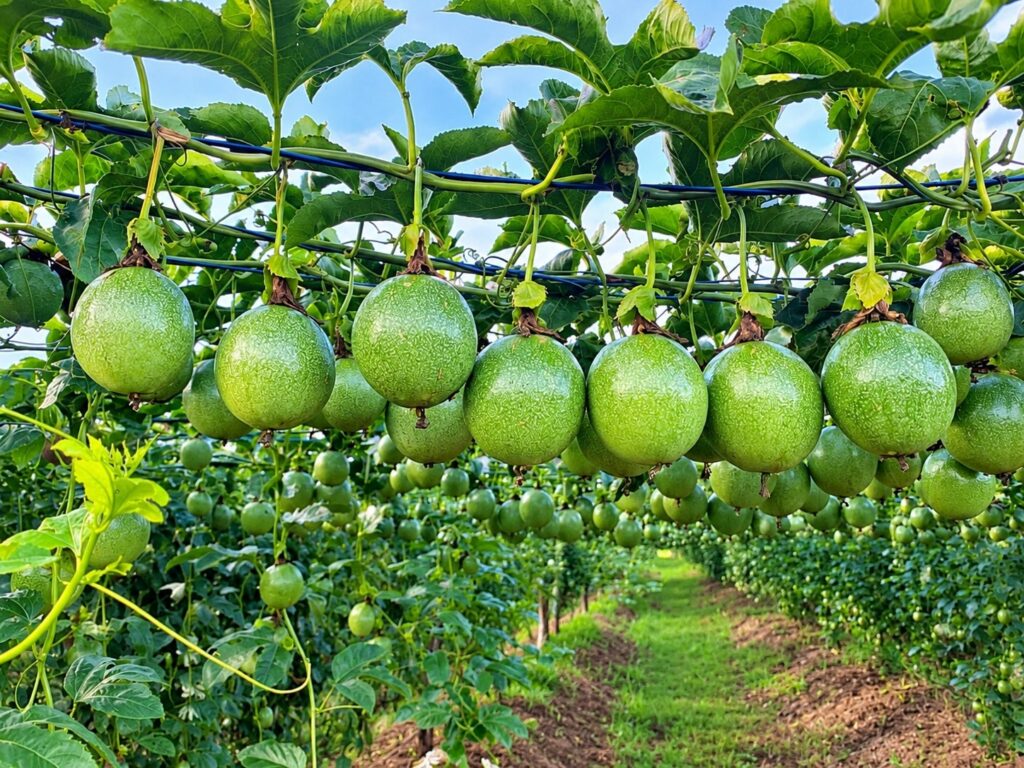
Both options work. Each fits a different altitude, market and budget. This article compares the two on yield, disease, price, altitude, cost and seedling quality. You get the numbers, the trade-offs and a clear rule for choosing.
Farmers Trend Limited sells grafted passion fruit seedlings at KSh 100 each. This article also tells you where KALRO data is thin, so you decide with full information.
Quick Answer: KALRO Passion Fruit Varieties or Grafted Purple?
Altitude and market decide the choice. Use this table first. Read the sections below for the evidence.
| Your situation | Plant this in 2026 |
|---|---|
| Above 1,500 m and you sell fresh fruit to supermarkets or exporters | Grafted purple |
| Between 1,200 m and 1,500 m and you sell to processors or local markets | KPF 4 on part of your plot, grafted purple on the rest |
| Semi-arid area, such as the lower parts of Embu, with limited rainfall | KPF 4, with drip irrigation |
| Below 1,200 m | KPF varieties or yellow passion fruit, not purple |
| You find no certified KPF planting material near you | Grafted purple from a nursery you trust |
Grafted purple is the safer choice for most highland farmers. Grafting onto yellow rootstock protects the roots from Fusarium wilt and nematodes. The fresh fruit market pays well. Seedlings are easy to find.
KALRO passion fruit varieties win on drier, lower farms and on plots where you sell to juice processors. Test both on a small area before you commit a full acre.
KALRO Passion Fruit Varieties: Where KPF 4, KPF 11 and KPF 12 Come From
Twenty Years of Research at KALRO Thika
The Kenya Agricultural and Livestock Research Organisation, known as KALRO, developed Kenya Passion Fruit 4, 11 and 12 over about 20 years of research. Farmbiz Africa reports KALRO is commercialising the three varieties with buyers such as Coca-Cola. The goal is better returns for farmers who sell fresh fruit and juice fruit.
Joseph Njuguna, a fruit expert at KALRO Thika, describes the varieties as sweet, bigger and juicier. He says they tolerate soil and foliar diseases better than the types grown at the Coast. KALRO also calls the varieties drought tolerant and suited to both the fresh market and processing.
KALRO built the varieties to supply soft drink makers. Those companies imported passion fruit concentrate when local supply fell short. Peter Mburu of the KALRO Horticulture Research Institute states this reason directly in a Farmbiz Africa report.
What KALRO Reports on Yield
Mburu says the three varieties produce 12 to 16 tonnes per 2.5 acres. The common purple type produces 6 to 8 tonnes on the same land. Convert those figures to one acre and you get 4.8 to 6.4 tonnes for the KPF varieties against 2.4 to 3.2 tonnes for common purple. The KPF varieties yield about twice as much.
Mburu also says the varieties are sweeter, bigger and less acidic than the common purple type. Sweeter and larger fruit both help you sell.
These numbers come from research officers. Use them as a cautious planning figure. Your soil, rainfall, spacing and disease control change the result on your farm.
KPF 4 in Embu: Field Evidence
Farmers in semi-arid parts of Embu grow KPF 4 and call the fruit sweet yellow passion. A study of passion fruit farmers in Mbeere Sub-County says yellow passion fruit thrives at mid altitudes up to 1,500 m. The study also reports growing KPF 4 production in semi-arid Embu. The same study measured fruit size over two seasons. KPF 4 produced longer, wider and heavier fruit than the conventional type in 2015. In 2017 the fruit traits did not differ significantly between the two.
This tells you two things. KPF 4 performs well in semi-arid conditions. The size advantage does not appear every season, so weather and management matter.
Farmers Trend Limited describes KPF 4 and KPF 11 as hybrids. They combine the sweetness of purple with the vigour of yellow. Farmers Trend Limited places KPF 4 at 1,200 to 1,800 m with a yield of 15 to 25 kg per plant, and sells to both fresh and processing buyers.
What Public Data Still Lacks
Public data on KPF 11 and KPF 12 is thin. Most field reports cover KPF 4. You find few independent trials comparing all three varieties side by side on the same farm.
Earlier KALRO reports quoted KSh 30 for a vegetatively propagated seedling and KSh 60 for a gram of seed. Those prices are old. Farmers Trend Limited puts KPF 4 seedlings near KSh 150 in 2026.
Ask every nursery for three facts before you pay. Ask for the variety name, the source of the cuttings and the date of propagation. A nursery with real KPF material answers all three without delay.
Grafted Purple Passion Fruit: What You Buy and Why Farmers Plant Grafted Vines
How Grafting Works
A nursery joins a purple passion fruit scion onto a yellow passion fruit rootstock. The scion gives you the fruit. The rootstock gives you the roots. Yellow passion fruit tolerates Fusarium wilt and nematodes better than purple.
A farmer in Meru, Morris Koome, found the yellow plant more tolerant of wilt than the purple one. He now grafts a purple scion onto a yellow rootstock. Farmbiz Africa reports this method controls Fusarium wilt, a disease with a 100 percent death rate in affected plants.
Lifespan and Speed to First Harvest
Farmers Trend Limited reports grafted vines live 4 to 5 years. Ungrafted vines live about 2 years. Another Kenyan seedling supplier, Seedfarm, gives 3 to 5 years for grafted vines and 2 to 3 years for ungrafted vines. Plan for 3 years of strong production and treat years 4 and 5 as a bonus.
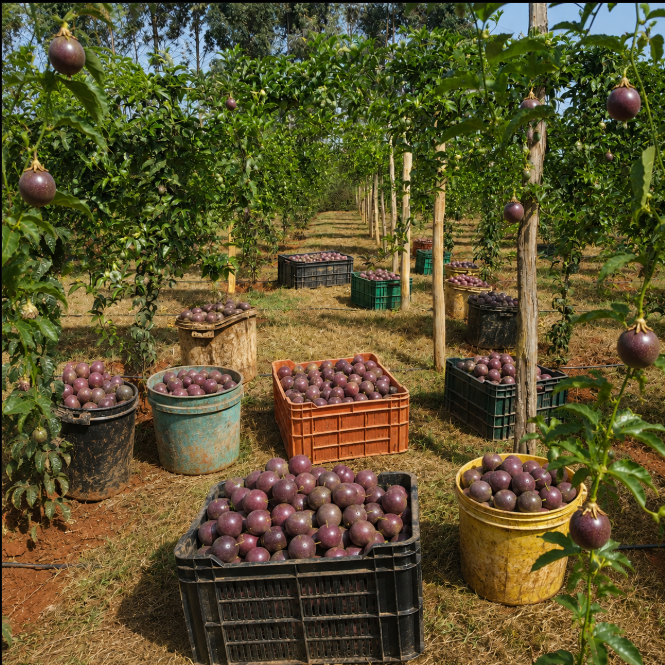
Farmers Trend Limited reports grafted seedlings flower 6 to 9 months after planting. The first harvest arrives at 9 to 11 months. Plant at the start of the rains to keep to this timeline.
Where Purple Grows Best
Purple passion fruit suits the upper midlands and highlands, from 1,100 m to 2,500 m above sea level. Fruits measure 4 to 5 cm across and carry a strong aroma. Exporters and supermarkets prefer this fruit.
Farmers Trend Limited lists grafted purple seedlings at KSh 100. The company advises a climate of 18 to 30 degrees Celsius and annual rainfall of 900 to 2,000 mm. Irrigation fills any gap.
What Grafting Does Not Fix
Grafting protects the roots. Woodiness virus attacks the vine above ground. Aphids spread the virus from plant to plant. Purple passion fruit is the type most exposed to woodiness. Yellow rootstock does not change this.
You still need aphid control, clean tools and quick removal of infected vines. The disease section below gives the steps.
KALRO Passion Fruit Varieties vs Grafted Purple: Side-by-Side Comparison
This table puts the two options next to each other. KPF figures come from KALRO officers, field studies and Farmers Trend Limited. Purple figures come from Farmers Trend Limited and Kenyan seedling suppliers.
| Factor | KPF 4, KPF 11, KPF 12 | Grafted purple |
|---|---|---|
| Developer | KALRO, Thika | Private nurseries, purple scion on yellow rootstock |
| Fruit | Sweeter, bigger, juicier and less acidic, per KALRO | 4 to 5 cm, strong aroma |
| Altitude | 1,200 m to 1,800 m for KPF 4, with reports from semi-arid Embu | 1,100 m to 2,500 m |
| Research yield per acre | 4.8 to 6.4 tonnes | 2.4 to 3.2 tonnes for common purple |
| Farm yield per plant at peak | 15 to 25 kg for KPF 4 | 15 to 20 kg |
| Drought | KALRO reports tolerance | Needs 900 to 2,000 mm of rain or irrigation |
| Fusarium wilt and nematodes | Reported tolerance, still being tested | Yellow rootstock gives tolerance |
| Woodiness virus | Reported tolerance, verify on your farm | Purple is the most exposed type |
| Main market | Processors and fresh market | Export and supermarkets |
| Seedling price in 2026 | About KSh 150 for KPF 4 | KSh 100 |
| Productive life | Not well documented | 3 to 5 years |
| Where to buy | KALRO Thika and community nurseries | Many nurseries, including Farmers Trend Limited |
| Quality of evidence | Research reports, few farm trials | Wide farm use across Kenya |
Read the last row twice. Grafted purple has years of farm records to support the choice. KPF varieties have strong research claims and fewer farm records. A new variety carries more risk, even when the research is good.
Yield and Income: Real Numbers Per Acre
Year-by-Year Yield Per Plant
Passion fruit does not give full yield in year one. Farmers Trend Limited reports 5 to 10 kg per plant in year 1, 15 to 20 kg in year 2 and 10 to 15 kg in year 3. Spacing of 2.5 m within rows and 3 m between rows puts about 540 plants on one acre. Calculate: 4,047 square metres divided by 7.5 square metres per plant gives 540 plants.
| Year | Kg per plant | Kg per acre at 540 plants |
|---|---|---|
| Year 1 | 5 to 10 | 2,700 to 5,400 |
| Year 2 | 15 to 20 | 8,100 to 10,800 |
| Year 3 | 10 to 15 | 5,400 to 8,100 |
Use these figures for your budget. Claims of 15 or 20 tonnes per acre need a check against plant numbers. At 540 plants, even 25 kg per plant gives 13.5 tonnes.
Gross Income at Three Yields and Three Prices
Farmers Trend Limited gives 2026 farm prices of KSh 80 to 120 per kg from local processors, KSh 150 to 220 per kg for GlobalGAP export fruit and KSh 200 to 300 per kg at supermarkets. This table uses KSh 80, 120 and 180 per kg to show a low, middle and high case. The yields are 10, 15 and 25 kg per plant at 540 plants.
| Yield per acre | At KSh 80 per kg | At KSh 120 per kg | At KSh 180 per kg |
|---|---|---|---|
| 5,400 kg (10 kg per plant) | KSh 432,000 | KSh 648,000 | KSh 972,000 |
| 8,100 kg (15 kg per plant) | KSh 648,000 | KSh 972,000 | KSh 1,458,000 |
| 13,500 kg (25 kg per plant) | KSh 1,080,000 | KSh 1,620,000 | KSh 2,430,000 |
Gross income is not profit. Farmers Trend Limited estimates first-year costs near KSh 389,000 per acre. At KSh 120 per kg you break even at about 3,240 kg. At KSh 80 per kg you break even at about 4,860 kg. At KSh 180 per kg you break even at about 2,160 kg.
What This Means for Your Choice
Price per kilogram matters as much as yield. A KPF vine with a higher yield sold to a processor at KSh 80 earns less than a purple vine sold at KSh 180 to an exporter. Compare the totals in the table above. Match the variety to the buyer you are able to reach.
Check your buyer before you buy seedlings. Ask for the price per kilogram, the grade rules and the payment day. Write the answers down.
Disease Pressure: Woodiness, Fusarium Wilt, Brown Spot and Nematodes
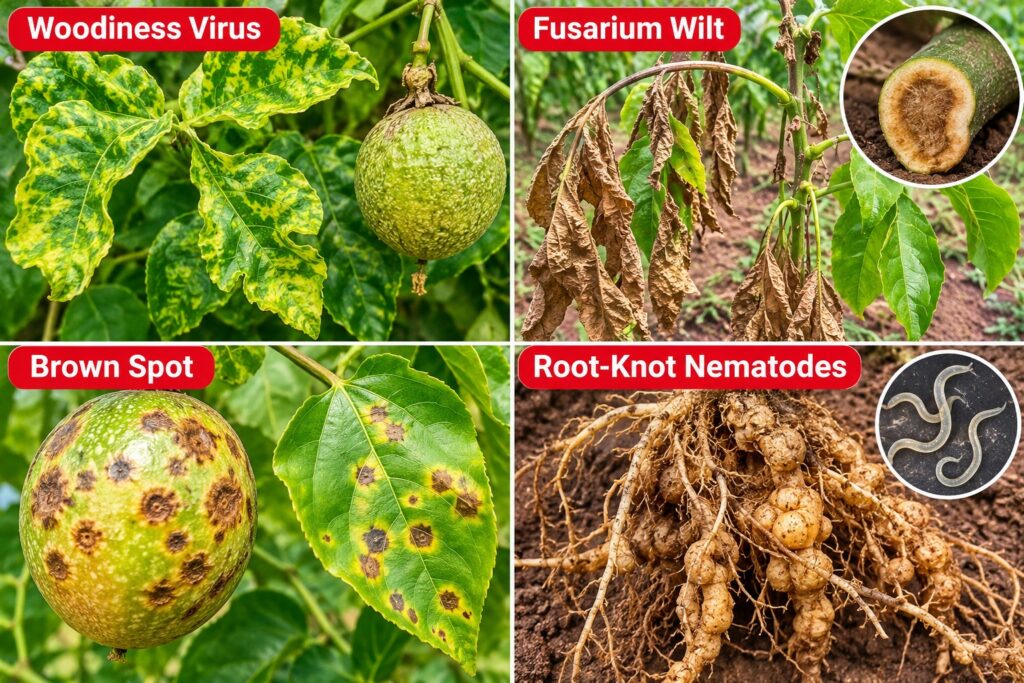
Why Disease Decides Your Variety
Disease causes the largest losses in Kenyan passion fruit. A study by Amata and colleagues in Acta Horticulturae reports disease losses of 80 to 100 percent in Kenyan passion fruit systems. The team found brown spot on 55 to 100 percent of surveyed farms and dieback on 64 to 100 percent across 8 districts.
The same study found lower Fusarium wilt incidence than brown spot and dieback. The authors link this to farmers planting seedlings grafted onto yellow passion fruit rootstock. This is the strongest published support for grafted purple. Read the study abstract at the International Society for Horticultural Science.
National output tells the same story. Farmbiz Africa cites the Horticultural Crops Directorate for a fall in passion fruit output from 46,628 tonnes in 2015 to 31,571 tonnes in 2018. The report ties the drop to Fusarium wilt.
How Grafted Purple Handles Each Disease
Fusarium wilt causes yellowing and death. Grafted purple on yellow rootstock resists the disease. Nematodes damage roots. Yellow rootstock tolerates them better than purple.
Brown spot and dieback attack leaves and stems. Grafting does not stop them. You control them with spacing, pruning, clean fields and timely spraying with products your agrovet recommends.
Woodiness makes fruit hard, small and juiceless. Aphids spread the virus. Farmers Trend Limited advises you to control aphids with neem oil or a recommended insecticide, remove infected plants and burn or bury the vines.
How KALRO Passion Fruit Varieties Handle Disease
KALRO officers describe the KPF varieties as more tolerant to soil and foliar diseases. One Farmbiz Africa report lists tolerance to Fusarium wilt, brown spot, woodiness virus and nematodes. Another report from KALRO Thika says the varieties tolerate drought.
Tolerant does not mean immune. A tolerant vine loses less to disease. A tolerant vine still loses some. Scout your plot every week. Look at leaf colour, stem lesions and fruit hardness.
What Is Coming Next
KALRO is also testing tissue culture planting material. The Kenya News Agency reports the material resists Fusarium wilt, brown spot, woodiness virus and nematodes. KALRO scientist Joseph Ndung’u says the clean material matures early and gives bigger bunch weights than traditionally grafted seedlings. These plants are still in trials. Do not wait for them. Passion fruit planted this season earns while the trials finish.
Altitude and Region: Which KALRO Passion Fruit Varieties Suit Your Area
Altitude sorts the options faster than any other factor. Check your farm height with a phone GPS app before you buy seedlings.
| Altitude | Best choice | Reason |
|---|---|---|
| Above 1,800 m | Grafted purple | Purple suits 1,100 m to 2,500 m. KPF 4 data stops at 1,800 m. |
| 1,500 m to 1,800 m | Grafted purple, with a small KPF 4 trial | Both grow here. Purple has more farm records. |
| 1,200 m to 1,500 m | Split plot, grafted purple and KPF 4 | This zone sits inside the range of both options. |
| Below 1,200 m | KPF varieties or yellow passion fruit | Purple prefers higher ground. Yellow suits lower altitudes. |
| Semi-arid, with irrigation | KPF 4 | Embu farmers report good results. KALRO calls the varieties drought tolerant. |
Seedfarm lists grafted passion fruit as suitable for Murang’a, Kiambu, Nyeri, Kirinyaga, Embu and Meru in Central Kenya. The same supplier also lists Kakamega, Bungoma, Kisii and Vihiga in Western Kenya, and Kericho, Bomet, Uasin Gishu and Nakuru in the Rift Valley. Check your exact altitude inside each county. Altitude varies a lot within one county.
Rainfall matters too. Farmers Trend Limited advises 900 to 2,000 mm a year, with irrigation to fill gaps. Heavy rain in flowering season lowers fruit set and raises disease. Drip irrigation gives you control in both dry and wet years.
Market and Price: Who Buys Which Passion Fruit
Match Your Variety to Your Buyer
Three buyer types take most passion fruit in Kenya. Exporters pay KSh 150 to 220 per kg for GlobalGAP certified purple. Supermarkets pay KSh 200 to 300 per kg for graded fresh fruit. Local processors such as Kevian and Del Monte pay KSh 80 to 120 per kg.
Purple fruit with a strong aroma fits export and supermarket buyers. Large, sweet, juicy fruit fits processors. KALRO designed the KPF varieties for this second group, and for fresh sales when fruit grades well.
Why Supply Gaps Help You
Output fell from 46,628 tonnes in 2015 to 31,571 tonnes in 2018. Soft drink makers import concentrate to fill the gap. Strong demand and weak local supply support farm-gate prices. A farmer with healthy vines and a signed buyer holds the advantage.
Export Standards You Must Plan For
Export fruit stores 3 to 4 weeks at 10 to 12 degrees Celsius. GlobalGAP certification costs KSh 50,000 to 100,000, according to Farmers Trend Limited. Join a farmer group to share this cost.
Cost of Starting One Acre: KPF Seedlings vs Grafted Purple
Farmers Trend Limited estimates the first-year cost of one acre at KSh 389,000. This table shows the cost lines.
| Cost line | Amount in KSh |
|---|---|
| Seedlings, 780 at KSh 100 | 78,000 |
| Trellis poles, 156 at KSh 500 | 78,000 |
| Galvanised wire | 48,000 |
| Drip irrigation | 80,000 |
| Land preparation | 15,000 |
| Manure and fertilisers | 50,000 |
| Labour | 40,000 |
| Total | 389,000 |
Your seedling cost depends on your spacing and your variety. At 540 plants, grafted purple costs KSh 54,000 (540 at KSh 100). KPF 4 costs KSh 81,000 (540 at KSh 150). The difference is KSh 27,000 per acre. This gap is small against a gross income of KSh 650,000 or more.
Do not choose a variety on seedling price. A cheap seedling of the wrong type costs you the whole season. Choose on altitude, buyer and disease risk first.
Seedling Quality: How to Buy KPF or Grafted Purple Safely
Checks for Any Passion Fruit Seedling
Inspect every seedling before you pay. Look for a healed graft union with no cracks. Look for white, healthy roots and green leaves with no spots. Reject seedlings with yellow leaves, twisted roots or soft stems.
Ask the nursery for proof of variety. For grafted purple, ask which rootstock the nursery used. Yellow passion fruit is the correct answer.
Where to Buy KPF Planting Material
Contact the KALRO Horticulture Research Institute in Thika for KPF planting material. KALRO also works with community nurseries in warm areas to multiply the varieties. Earlier reports counted more than 30,000 seedlings ready for distribution. Call ahead, because stock changes by season.
Where to Buy Grafted Purple Seedlings
Farmers Trend Limited sells grafted passion fruit seedlings at KSh 100. The company lists high yield and large, flavourful fruit as the aims of the scion, and disease resistance as the aim of the rootstock. Call or WhatsApp 0724 559 286 or 0790 509 684 to order and to check stock for your county.
How to Plant Passion Fruit This Rainy Season
The steps below fit both KPF seedlings and grafted purple seedlings. Plant at the start of the rains. Farmers Trend Limited names two planting windows, the long rains from March and the short rains from October to November. The short rains are here now, so you plant now.
Step 1: Prepare the Soil
Choose well-drained sandy loam with plenty of organic matter. Aim for a soil pH of 5.5 to 7.0. Test your soil, and add lime if the soil is too acid. Clear all weeds. Farmers Trend Limited recommends working about 5 tonnes of manure per acre into the soil.
Step 2: Dig Holes and Fill Them
Dig holes 60 cm wide, 60 cm long and 60 cm deep. Mix the topsoil with 10 to 20 kg of manure and 200 g of DAP. Fill the hole with this mix before planting.
Step 3: Set the Spacing
Space plants 2.5 m apart within rows and 3 m between rows. This gives about 540 plants per acre. Tighter spacing raises plant numbers but increases disease. Wider spacing eases spraying and picking.
Step 4: Plant the Seedling
Remove the polythene bag. Place the seedling in the centre of the hole. Keep the graft union above the soil line. A buried graft union lets the scion root into the soil and removes the protection of the yellow rootstock. Firm the soil and water the plant straight away.
Step 5: Build the Trellis
Set posts 3 m apart. Run wires at 1.5 m to 2 m above the ground. Train the main stem up a string to the wire. Passion fruit climbs well, but a weak trellis breaks under a heavy crop.
Step 6: Irrigate Well
Use drip irrigation. Keep the soil moist but not waterlogged. Farmers Trend Limited states mature plants need 15 to 20 litres of water per week. Water less in cold, wet weeks.
Step 7: Feed in Stages
Farmers Trend Limited recommends calcium ammonium nitrate at 100 g per plant during vine growth. Apply NPK 17:17:17 at 200 g per plant at flowering. Apply potassium nitrate at 150 g per plant during fruit growth. Add manure every season.
Step 8: Prune and Scout
Prune regularly after the vine reaches the wire. Remove dead, crowded and diseased growth. Cut suckers from below the graft union. Those shoots come from the rootstock and crowd out the purple scion. Scout for aphids weekly. Watch for yellowing leaves, which signal Fusarium wilt.
Six Mistakes to Avoid With KPF and Grafted Purple Passion Fruit
First mistake: planting without checking altitude. Purple prefers higher altitudes. KPF 4 data stops at 1,800 m.
Second mistake: buying seedlings with no proof of variety. Ungrafted seedlings look close to grafted ones. Check for the graft union and ask for the rootstock source.
Third mistake: burying the graft union. This removes the benefit of grafting. Keep the union above the soil.
Fourth mistake: ignoring aphids. One infected vine spreads woodiness to the whole plot. Spray early, remove sick vines and keep tools clean.
Fifth mistake: planting a full acre of an untested variety. Plant 100 vines of the new variety first. Measure yield and fruit quality in your own conditions.
Sixth mistake: planting before you find a buyer. A first-year harvest of 2,700 to 5,400 kg per acre needs a ready market. Talk to buyers six months before your first fruit.
Which Should You Plant? Four Farmer Cases
| Farmer case | Choice | Reason |
|---|---|---|
| Highland farmer at 1,900 m in Murang’a, selling to a supermarket buyer | Grafted purple, full acre | Altitude fits purple. Buyer wants aromatic fruit. Yellow rootstock protects the roots. |
| Mid-altitude farmer at 1,350 m, selling to a juice processor | Half an acre of KPF 4, half an acre of grafted purple | Both fit the altitude. The split plot tests both on your own soil. |
| Semi-arid Embu farmer at 1,100 m with a borehole and drip line | KPF 4, full acre | Field reports from Embu support KPF 4 here. KALRO reports drought tolerance. |
| Small farmer with a quarter acre and no export link | 135 grafted purple plants, sold at the local market | Low cost and easy to source. At 2.5 m by 3 m, a quarter acre holds about 135 plants. |
KALRO Passion Fruit Varieties: Frequently Asked Questions
Are KPF 4, KPF 11 and KPF 12 better than grafted purple?
They yield more in KALRO research, at 4.8 to 6.4 tonnes per acre against 2.4 to 3.2 tonnes for common purple. They suit lower and drier farms. Grafted purple has stronger farm records and fits highland fresh markets. Neither wins on every farm.
What does KPF mean?
KPF stands for Kenya Passion Fruit. KALRO numbered the improved varieties 4, 11 and 12.
Do KALRO passion fruit varieties need grafting?
Reports show KALRO supplying vegetatively propagated seedlings and seed. Grafting is the nursery method for purple. Ask your supplier how each KPF seedling was produced.
How much does a grafted passion fruit seedling cost in 2026?
Farmers Trend Limited sells grafted purple passion fruit seedlings at KSh 100. KPF 4 seedlings sell near KSh 150.
When should you plant passion fruit in Kenya?
Plant at the start of the rains. Farmers Trend Limited names the long rains from March and the short rains from October to November as the best windows. The short rains are active now.
How long until the first harvest?
Grafted seedlings flower 6 to 9 months after planting. You pick the first fruit at 9 to 11 months.
How many passion fruit plants fit on one acre?
About 540 plants at a spacing of 2.5 m by 3 m.
Which passion fruit variety resists woodiness?
No variety is fully immune. KALRO officers report tolerance in the KPF varieties. Purple is the most exposed type. Control aphids and remove sick vines whichever variety you plant.
Your 2026 Passion Fruit Decision
Start with altitude when you weigh KALRO passion fruit varieties against grafted purple. Above 1,500 m, plant grafted purple. Below 1,200 m, plant KPF varieties or yellow passion fruit. Between 1,200 m and 1,500 m, split your plot and measure both.
Next, pick your buyer. Exporters and supermarkets want aromatic purple fruit. Processors want large, sweet fruit, which KALRO built the KPF varieties to supply.
Then check disease risk. Grafted purple on yellow rootstock gives you published protection from Fusarium wilt and nematodes. KPF varieties give you reported tolerance and promising research yields. Plant a small block of KPF 4 first and watch how the vines perform on your land.
The short rains are the best planting window for this season. Order your seedlings now, prepare your holes and book your buyer. Your first fruit arrives 9 to 11 months after planting.
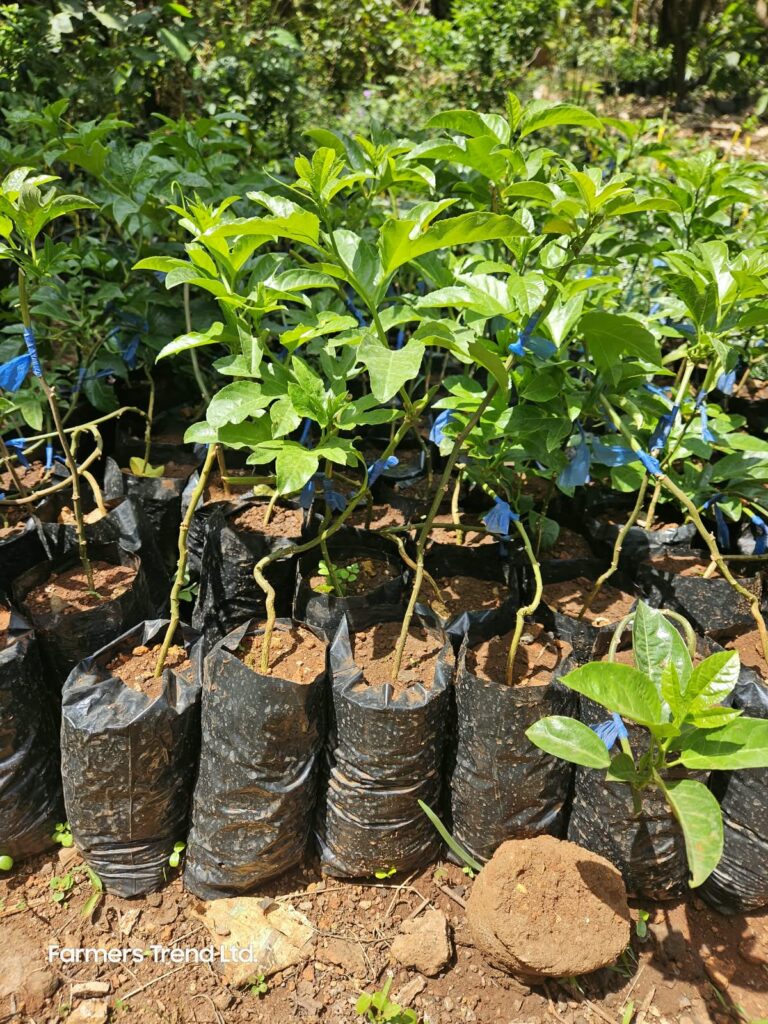
Farmers Trend Limited sells grafted passion fruit seedlings at KSh 100. Plant during this rainy season.
Call or WhatsApp: 0724 559 286 or 0790 509 684
Website: www.farmerstrend.co.ke
Email: info@farmerstrend.co.ke
Read the full passion fruit farming in Kenya 2026 commercial guide for trellising, irrigation, pruning and export steps.
https://farmerstrend.co.ke/trending/kalro-passion-fruit-vs-grafted-purple/https://farmerstrend.co.ke/wp-content/uploads/2026/11/passion-fruit-nice-farm-1024x768.jpghttps://farmerstrend.co.ke/wp-content/uploads/2026/11/passion-fruit-nice-farm-150x150.jpg# TrendingFruitsIn FruitsPassion fruit farmingKALRO passion fruit varieties give you a second choice in 2026. KPF 4, KPF 11 and KPF 12 now compete with the grafted purple passion fruit sold in most Kenyan nurseries. You need to choose before this rainy season ends. The vines you plant now decide your income for...FarmersTrendjohn doefarmerstrend@gmail.comAdministratorFarmers Trend Ltd.








Leave a Reply