Good on Arrival. Defective After Ripening. What Went Wrong? Why Kenyan Avocados Fail After Arrival?
A consignment of Kenyan Hass avocados arrived in good condition. The fruit was green, firm, and without significant visible quality defects. Four days into the ripening process, the condition changed dramatically. The fruit developed irregular black patches, uneven skin colour and areas of sunken skin.
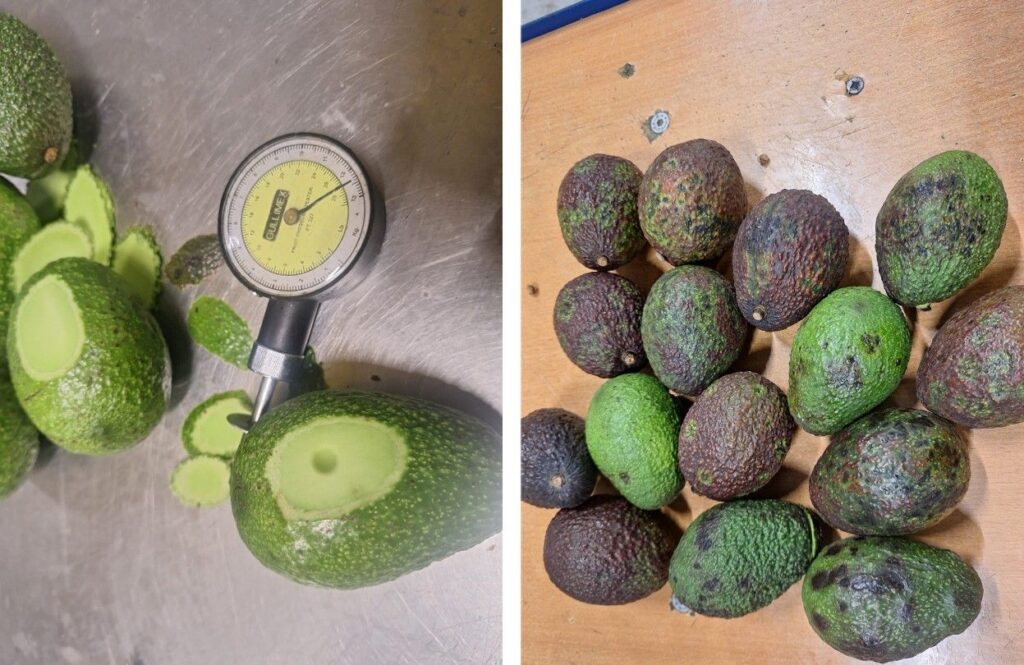
This is a common scenario in the fresh produce industry. A shipment appears perfect upon arrival. The problems only become apparent once ripening begins. #FreshtechSurveys was asked to investigate this specific claim. The investigation systematically eliminated the usual suspects: chilling injury, postharvest disease, mechanical damage, transport conditions and the ripening process itself. This led to a more fundamental question. Was the fruit physiologically mature enough at the time of harvest?
Key Takeaways
- Dry Matter (DM) is a key indicator of avocado maturity and is strongly correlated with oil content and flavor .
- The Horticultural Crops Directorate (HCD) has set the minimum dry matter standard for Hass avocado exports in Kenya at 24 percent .
- Consumer acceptance drops from approximately 95% to 70% when DM falls below 23% .
- Up to 70% of consumers would choose 26% DM avocados over 22% DM avocados .
- Kenyan avocados must meet 20-24% dry matter depending on variety before export clearance .
- Exporting immature fruit can lead to rejection rates of 30%, with annual losses exceeding KES 7.5 billion (US$57 million) .
- Licence revocation for non-compliant exporters has increased by 40% year-on-year .
- Harvesting fruit at ≥23% dry matter, passing it quickly through the supply chain, and keeping it at or below 5°C can reduce bruise expression .
- A well-managed Hass avocado orchard starts with quality planting material. You can order certified grafted Hass avocado seedlings to build a productive, export-quality orchard from the ground up.
The Case: What Happened?
The investigation began with a consignment of Kenyan Hass avocados that appeared to be in good condition upon arrival. The fruit was green, firm, and without significant visible defects. This is the ideal starting point for a successful ripening process. The fruit was placed in the ripening room under controlled conditions of temperature and ethylene. The process is designed to trigger the natural ripening response. It works well when the fruit is physiologically ready.
After four days, the condition changed dramatically. The fruit developed irregular black patches. The skin colour became uneven. Areas of sunken skin appeared. This is a clear indication that something went wrong. The problem was not with the ripening process itself. The problem was with the fruit’s ability to ripen properly. This brings us to the concept of dry matter.
This case mirrors a well-documented challenge in the avocado industry. A study on the impact of fruit development age found that extending the fruit development period enhances Hass avocado postharvest quality by increasing dry matter, optimizing fatty acid composition, and balancing mineral content. These improvements result in faster ripening, reduced internal disorders, and superior sensory attributes, such as creaminess and texture . In other words, the foundation for quality is laid long before the fruit reaches the packhouse.
What Is Dry Matter and Why Does It Matter?
Dry Matter (DM) is one of the key indicators of avocado maturity. It is strongly correlated with oil content and flavor. The dry matter content of an avocado increases as it matures on the tree. The development of oil and other solids within the fruit is what gives it the characteristic creamy texture and rich flavour. A simple way to understand dry matter is to think of it as the non-water components of the fruit. These include carbohydrates, proteins, fats, minerals and fibre .
Why Dry Matter Is Crucial for Export Quality
Hass avocados harvested at insufficient Dry Matter can still arrive green, firm and visually acceptable. This is why a visual inspection at the point of arrival is not enough. The real problem may only become apparent once ripening begins. This is what happened in the case investigated by #FreshtechSurveys.
Low-DM fruit can result in:
- Uneven ripening
- Irregular skin colour development
- Inconsistent softening
- Poor texture
- Disappointing eating quality
- Increased susceptibility to vascular browning and body rots
The Minimum Dry Matter Standard for Export
The Horticultural Crops Directorate (HCD) has revised the minimum dry matter percentage post-harvest to 24 per cent for Hass and Fuerte avocados meant for export. This is in lieu of the numerous complaints received on the quality of avocados imported to the European Union and the United Arab Emirates . The HCD stated: “We are looking to safeguard these critical markets, improve fruit quality aspects in line with global market requirements and safeguard Kenya’s competitiveness in the global arena” .
The AFA confirmed that harvesting for export started on April 2, 2026, following improved fruit maturity across major production zones . All fresh avocados for export undergo mandatory packhouse inspections from April 7, 2026, with exporters required to apply at least three days before shipment . Exporters must also submit lists of registered Horticultural Produce Marketing Agents or suppliers to ensure traceability .
At Jomo Kenyatta International Airport cargo terminal, inspectors from the Horticultural Crops Directorate are verifying oil content and rejecting consignments that do not meet maturity thresholds. The controls focus on dry matter content, with avocados required to meet 20 per cent to 24 per cent, depending on variety, before export clearance .
The importance of this standard is backed by consumer research. A study found that “the acceptance of the quality of avocados declined from approximately 95% to 70% if the DM was below 23% and up to 70% of consumers would choose 26% DM avocados over 22% DM avocados” . This data underscores that dry matter is not just a technical requirement. It is a direct driver of consumer satisfaction and repeat purchases.
The EU Standard Comparison
For context, the European Union standard sets the minimum dry matter content at 21% for Hass avocados, 20% for Fuerte, Pinkerton, Reed and Edranol, and 19% for other varieties . Kenya’s 24% standard is higher than the EU requirement, reflecting the country’s commitment to quality and competitiveness in global markets. This higher standard helps Kenyan avocados stand out in premium markets where consumers are willing to pay more for superior eating quality.
The Investigation: Eliminating the Usual Suspects
The investigation into the defective avocados followed a systematic process. It started by eliminating the usual causes of postharvest defects. Here is what was considered and why it was ruled out.
1. Chilling Injury
Chilling injury is a common problem in avocados. It occurs when fruit is exposed to temperatures below its optimal storage range. The optimal storage temperature for Hass avocados is between 5°C and 10°C. Temperatures below 5°C can cause chilling injury. Symptoms include pitting, discoloration and uneven ripening.
The risk of grey pulp, a form of chilling injury, increases the longer the fruit remains on the tree and is considered commercially to be indicative that the fruit has been stored for too long and has started to ripen in storage. Managing chilling injury is complicated, as raising the storage temperature slightly will reduce skin chilling damage, yet at the same time make grey pulp occur earlier .
In this case, the investigation found no evidence of chilling injury. The temperature records showed that the fruit had been maintained within the optimal range during transport and storage. This was not the cause of the problem.
2. Postharvest Disease
Postharvest diseases such as anthracnose and stem-end rot are major threats to avocado quality. The investigation found no evidence of postharvest disease. The black patches on the fruit were not characteristic of anthracnose or stem-end rot. The symptoms were more consistent with a physiological disorder.
3. Mechanical Damage and Mesocarp Bruising
Mechanical damage is another common cause of quality defects. It can occur during harvesting, packing, transport or handling. Symptoms include bruising, cuts and abrasions.
Mesocarp bruising is one of the most important negative issues experienced by avocado consumers . Visible symptoms of mesocarp bruising in avocado fruit result from cell and tissue damage. Cell walls and membranes deform under external impact or compression forces above their bio-yield threshold. Cellular decompartmentalisation allows polyphenoloxidase (PPO) activity to catalyse browning of the affected mesocarp tissue .
Mesocarp bruising is a significant postharvest problem of avocados as it results in cell and tissue damage which reduces the fruit’s keeping quality. Farmers should be careful when loading avocados as load pressure can exert internal injury which causes them to have a short shelf life.
Factors considered to affect visible bruise expression in avocado include fruit maturity, fruit firmness, fruit holding duration, and fruit holding temperature . Fruit harvested at an early degree of maturity typically have a relatively short postharvest life and are more susceptible to decay and other quality issues such as pink discolouration. They may also fail to ripen evenly, such that skin colour at ripe is non-uniform, showing patches of green. Moreover, in comparatively immature fruit, the seed may not separate ‘cleanly’ from the mesocarp .
Advancing fruit maturity is reported to reduce the bruise susceptibility of avocado fruit . The HCD’s 24% minimum dry matter standard “reduces the fruit’s susceptibility to mesocarp bruising.”
Research has shown that bruise severity increased progressively in fruit kept for up to 5 weeks before impact injury and also for those kept for up to 7 days after injury . Hard green mature stage fruit did not express bruising at ≤100 cm drop height. However, softening, firm ripe, and soft ripe stage fruit impacted from 50 cm developed progressively greater levels of bruising .
Keeping fruit at temperatures of 2.5 °C and 5 °C as compared with 20 °C at the time of impact resulted in less bruise expression. Similarly, fruit kept at post-impact temperatures of 2.5 °C and 5 °C as compared with 7.5 °C, 10 °C, and 20 °C also resulted in less bruise expression .
Overall, research proposes that harvesting fruit at ≥23% dry matter concentration, passing them quickly through the supply chain such that bruising has less time to express, and keeping the fruit ‘at’ or ‘below’ 5 °C in the supply chain could reduce bruise expression levels in ripening Hass avocado fruit .
The investigation found no evidence of mechanical damage or mesocarp bruising. The fruit was intact and without visible external damage. This was not the cause of the problem.
4. Transport Conditions
Transport conditions are critical for avocado quality. Factors such as temperature, humidity and ventilation must be carefully controlled. The AFA has stated that fruit must be transported in crates, with exporters using open trucks, pickups, or Probox vehicles at risk of licence revocation . The investigation found no evidence of problems with the transport conditions. The temperature and humidity records were consistent with best practice.
5. The Ripening Process Itself
The ripening process is designed to trigger the natural ripening response. It involves exposure to ethylene at controlled temperatures. The investigation found no evidence of problems with the ripening process. The temperature and ethylene levels were within the recommended ranges. The ripening process did not create the underlying problem. It revealed it.
The Root Cause: Insufficient Dry Matter
The investigation concluded that the root cause of the problem was insufficient dry matter. The fruit was harvested too early. It had not yet developed the necessary oil content and solids for proper ripening. This is a classic case of a problem that was built into the fruit at origin. The supply chain did not cause the defect. It simply revealed a problem that was already present.
This is a critical insight for anyone involved in the avocado supply chain. It shows that postharvest quality is not just about handling and transport. It is also about harvest maturity. If the fruit is not mature enough at harvest, no amount of careful handling will save it.
The Financial Impact of Non-Compliance
Kenya exported approximately 110,000 metric tons of avocados in the 2024-2025 period, valued at over KES 25 billion (US$190 million) . Rejection rates for immature fruit in premium markets can reach 30 per cent, resulting in losses exceeding KES 7.5 billion (US$57 million) annually . Licence revocation for non-compliant exporters has increased by 40 per cent year-on-year .
This affects shipment performance, as fruit harvested with low oil content fails to ripen to the required standards, leading to rejection in export markets .
The Science of Dry Matter and Postharvest Quality
The link between dry matter and postharvest quality is well established in the scientific literature. Several studies have demonstrated the importance of dry matter for successful ripening.
Dry Matter and Oil Content
Research has shown that dry matter content is highly correlated with oil content. This means that measuring dry matter is a reliable way to estimate the oil content of the fruit. Oil content is a key determinant of flavour and texture. Fruit with higher oil content will have a richer, creamier texture and a more pleasant flavour. The development of oil is a key indicator of physiological maturity. This is why dry matter is such a valuable tool for assessing harvest maturity.
Dry Matter and Postharvest Disorders
Research has also shown that low dry matter is associated with increased postharvest disorders. A study on the effect of dry matter content at harvest on the postharvest quality of Hass avocado found that heterogeneity in dry matter content was associated with internal browning disorders and reduced shelf-life. A New Zealand study showed that vascular browning, body rot and stem-end rot were all affected by dry matter content. Fruit with higher dry matter had lower incidence and severity of these disorders. This demonstrates that dry matter is not just about eating quality. It is also about resistance to postharvest diseases.
Consumer Preference for Higher DM
A study on ‘Hass’ avocados cultivated in the Canary Islands evaluated the fatty acid composition and sensory attributes of avocados with varying DM levels (19%, 21%, 24%, and 27%) . Consumer panelists showed a clear preference for avocados with higher DM contents (24–27%), associating the flavor (86.2%) and texture (59.6%) with the purchase intent . The high monounsaturated fatty acid content, particularly oleic acid, qualifies these avocados for the European nutritional claim ‘high in monounsaturated fat’ .
Impact on Fatty Acid Composition
The maturity stage at harvest also influences the fruit’s fatty acid composition, which affects flavour and texture. Six main fatty acids were identified, with oleic acid (38–43%) and palmitic acid (30–36%) being predominant. Higher DM levels were associated with increased concentrations of palmitoleic and linoleic acids . This research confirms that monitoring fatty acids and minerals can effectively guide optimal harvest timing to achieve consistent fruit quality.
The Challenge of Dry Matter Measurement
The accuracy of the avocado dry-matter maturity index may be influenced by fruit sampling procedures . Research has investigated the effects of avocado fruit location in the tree, fruit size, the presence of damage on the fruit, and of holding fruit after harvest at differing relative humidities, on the fruit percentage dry matter (DM) and quality . Fruit aspect in the canopy had no effect on the percentage DM or days to ripeness (DTR) in this trial, although fruit from the eastern side of the tree were larger .
Smaller fruit and damaged fruit had higher percentage DM and ripened more quickly, suggesting that they were more mature . Damaged fruit (with ring neck or sunburn) were also smaller . Holding fruit at 60% r.h. or lower for 4 days increased the percentage DM of the fruit after the holding period by almost 1.5%, and reduced the DTR, compared with storage at 98% r.h. .
There were significant differences in the average fruit percentage DM and DTR between trees, suggesting an important effect of rootstock on fruit quality . These results indicate that fruit sampling procedures can have an important effect on the percentage DM test, and may result in immature fruit being harvested .
Advancements in Dry Matter Measurement
Near-infrared diffuse reflectance spectroscopy (NIR-DRS) has emerged as a promising non-destructive technique for assessing fruit maturity. NIR-DRS is a rapid method for predicting dry matter content. It analyzes the light reflected from the fruit to provide information on internal characteristics such as moisture and oil content without causing damage.
Research has shown that NIR-DRS can be effectively combined with machine learning algorithms. A study on predicting Hass avocado maturity with NIR spectroscopy found that a Convolutional Neural Network (CNN) model demonstrated superior performance for dry matter prediction, with an R² of 0.91 in the testing set. The wavelength range of 1000-1500 nm was identified as optimal, offering accurate predictions while reducing computational complexity. This range shows potential for developing cost-effective NIR devices for real-time maturity assessment.
This research has significant practical implications. It suggests that it is possible to develop handheld NIR devices for use in the field. This would allow farmers to test their fruit quickly and easily. It would help them to make better decisions about when to harvest.
Practical Recommendations for Avocado Exporters
Based on the findings of this investigation and the supporting scientific evidence, here are several practical recommendations for avocado exporters. These recommendations are designed to help you avoid the problems encountered by the shipper in this case.
1. Prioritize Dry Matter Testing
Make dry matter testing a mandatory part of your pre-harvest program. Do not rely on visual inspection or the calendar alone. Dry matter is the single most reliable indicator of harvest maturity. It will tell you if your fruit is ready to be harvested and exported.
2. Understand Dry Matter Variability
Understand that dry matter can vary significantly between regions, orchards and even individual trees. This means you need to test a representative sample of your fruit. Do not assume that all fruit in a region is at the same stage of maturity.
3. Know the Minimum Standard
Know the minimum dry matter standard for your target markets. The standard for Hass avocados is 24 percent dry matter . Exporting fruit below this standard is a risk. It may lead to quality defects, consumer dissatisfaction and reputational damage.
4. Understand Mesocarp Bruising and Mechanical Damage
Mesocarp bruising is a significant postharvest problem that reduces fruit quality and consumer satisfaction . To prevent this, follow these guidelines:
- Harvest fruit at the recommended maturity to reduce its susceptibility to bruising.
- Avoid using open vehicles in packaging and transport as it affects overall quality .
- Be careful when loading avocados as load pressure can exert internal injury which causes them to have a short shelf life.
- Pass fruit quickly through the supply chain to reduce the time bruising has to express .
- Keep fruit ‘at’ or ‘below’ 5 °C in the supply chain to reduce bruise expression levels in ripening Hass avocado fruit .
5. Communicate with Your Buyers
Communicate with your buyers about harvest maturity. Let them know that you are using dry matter testing. This helps to build trust. It also gives them confidence in the quality of your fruit.
6. Invest in Training
Invest in training for your farm staff. Teach them how to conduct dry matter testing and how to interpret the results. This is an investment in quality control.
7. Consider Rapid, Non-Destructive Technologies
Consider investing in rapid, non-destructive technologies for dry matter assessment. NIR-DRS is a promising technology that could revolutionize the way we measure avocado maturity. It is faster, cheaper and more accurate than traditional methods.
8. Start with Quality Planting Material
The foundation of a successful export-quality orchard is the planting material. To ensure your trees have the genetic potential for high dry matter and excellent postharvest quality, source certified grafted Hass avocado seedlings from a reputable nursery. You can browse and order certified grafted Hass avocado seedlings to give your orchard the best possible start.
Conclusion: Look Beyond the Voyage
The important takeaway from this case is that not every defect discovered at destination is necessarily shipping related. When investigating fresh produce claims, it is important to look beyond the voyage itself. Harvest maturity, pre-shipment condition and the physiological characteristics of the fruit can be just as important as temperature and transport conditions.
Sometimes the supply chain does not cause the defect. It simply reveals a problem that was already built into the fruit at origin. The fruit in this case looked good on the outside. It met the visual standards for acceptance. But it was not physiologically mature. The ripening process revealed this hidden defect. This is a valuable lesson for anyone involved in the fresh produce industry. The quality of the final product depends on the quality of the starting material.
Frequently Asked Questions
What is Dry Matter in avocados?
Dry Matter is the non-water component of the fruit. It includes carbohydrates, proteins, fats, minerals and fibre. It is a key indicator of avocado maturity and is strongly correlated with oil content and flavor.
What is the minimum Dry Matter standard for Hass avocado exports?
The minimum dry matter standard for Hass avocado exports in Kenya is 24 percent. Fruit with dry matter below this level is considered immature and is not suitable for export.
What happens if you export avocados with low Dry Matter?
Low-DM fruit can result in uneven ripening, irregular skin colour development, inconsistent softening, poor texture and disappointing eating quality. It is also more susceptible to postharvest disorders such as vascular browning and rots. Consumer acceptance declines from approximately 95% to 70% when DM falls below 23%.
How is Dry Matter measured?
The traditional method involves drying a fruit sample in an oven. This is a destructive method that takes up to 72 hours. New non-destructive technologies, such as NIR spectroscopy combined with machine learning, are being developed to measure dry matter more quickly and accurately.
Can you tell if an avocado has high Dry Matter just by looking at it?
No. High-DM fruit does not look different from low-DM fruit. The differences are internal. This is why dry matter testing is essential for exporters.
What is mesocarp bruising and how can I prevent it?
Mesocarp bruising is tissue damage that results in browning of the avocado flesh. It is a significant postharvest problem that reduces fruit quality and consumer satisfaction. To prevent it, harvest at ≥23% dry matter , handle fruit carefully, avoid load pressure during transportation, pass fruit quickly through the supply chain, and keep fruit at or below 5°C.
What are the financial consequences of non-compliance?
Rejection rates for immature fruit in premium markets can reach 30%, resulting in losses exceeding KES 7.5 billion (US$57 million) annually. Licence revocation for non-compliant exporters has increased by 40% year-on-year.
Slug
hass-avocado-dry-matter-postharvest-quality-guide
Contact Farmers Trend for Quality Hass Avocado Seedlings
- Call/WhatsApp: 0724 559 286 | 0790 509 684
- Website: www.farmerstrend.co.ke
- Email: info@farmerstrend.co.ke
We Offer:
- Countrywide Delivery
- Export Arrangements
- Free Agronomy Support upon purchase



Leave a Reply