Maize Farming in Kenya 2026 The Complete Commercial Profit Guide for 40 Bags Per Acre
Maize Farming in Kenya: The 2026 Commercial Blueprint for High-Yield Agribusiness
Maize farming in Kenya represents the single largest agricultural subsector in the country. Over 3.5 million smallholder farmers depend on this crop for food security and income. The national annual production fluctuates between 35 and 45 million bags. The consumption gap, ranging from 5 to 10 million bags annually, is filled by imports. This structural deficit creates a stable market for farmers who adopt commercial production methods.
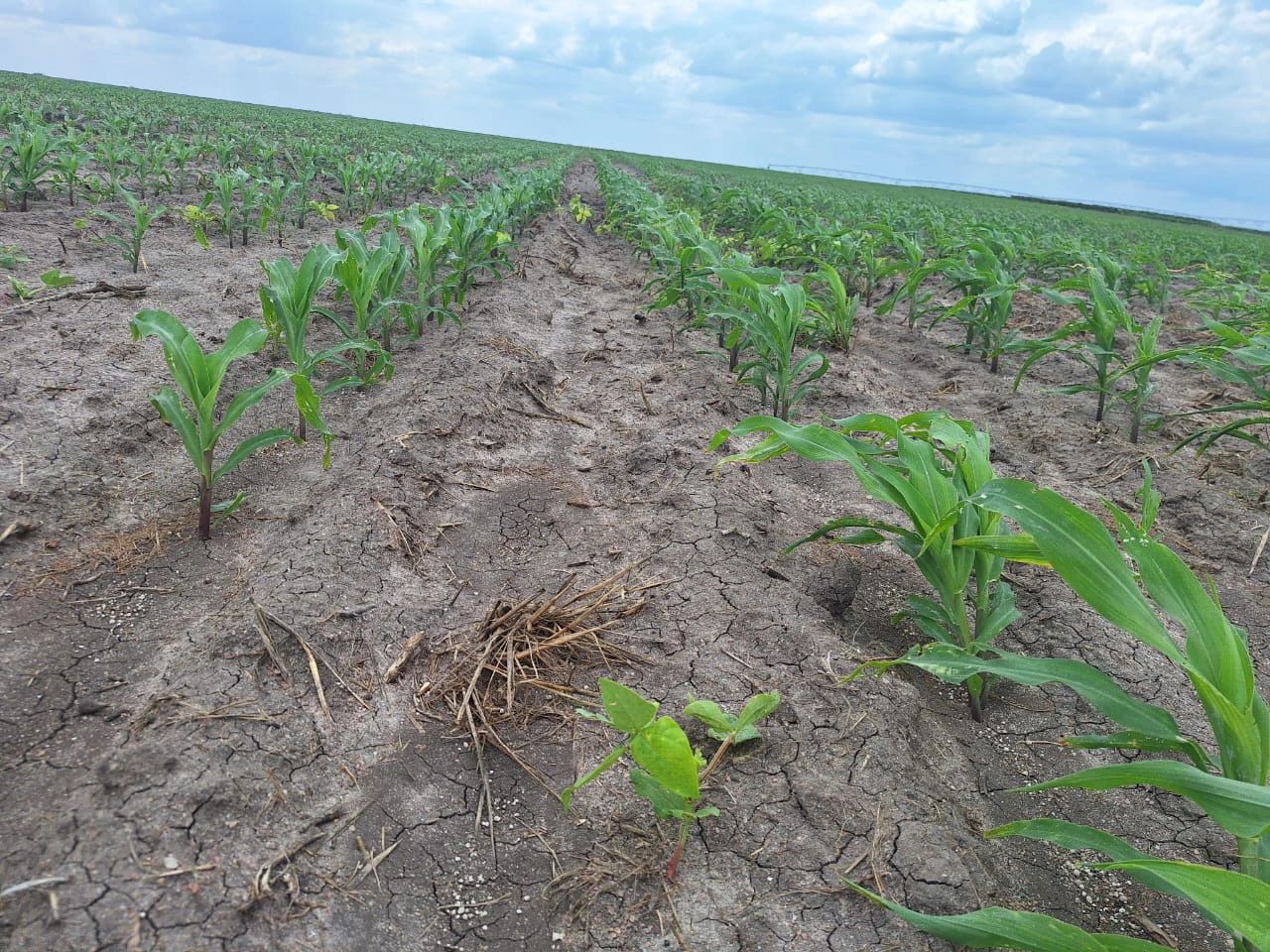
The economics of maize farming in Kenya have shifted. Input costs have risen. Climate patterns have changed. Yet the opportunity remains. A farmer who masters agronomy, inputs, and timing can achieve 35 to 40 bags per acre. At current market prices of 3,500 to 4,500 shillings per bag, gross revenue reaches 122,500 to 180,000 shillings per acre. With disciplined cost management, net profits reach 60,000 to 100,000 shillings per acre.
This guide by Farmers Trend Limited provides a comprehensive blueprint for commercial maize farming in Kenya. You will learn about variety selection, soil preparation, fertilizer protocols, planting precision, pest control, harvest management, and marketing strategies. The information is drawn from successful commercial farms and agricultural research stations across the country.
The 2026 Maize Farming in Kenya Economic Outlook
Maize farming in Kenya is transitioning from subsistence to commercial production. Farmers who treat maize as a business, not just food, are capturing the highest returns. The 2026 market outlook is positive. Millers need consistent supply. Traders seek quality grain. Export markets to regional neighbors are opening.
The most profitable crop comparison often pits maize against horticulture. Onions and garlic generate higher revenue per acre. But these crops require intensive management, irrigation, and specialized markets. Maize offers lower risk. It stores well. It has consistent demand. For farmers with moderate land, maize farming in Kenya remains the most reliable path to agricultural income.
Current farm-gate prices for dry grain range from 3,500 to 4,500 shillings per 90-kilogram bag. Green maize cobs sell for 10 to 20 shillings each during the season. A well-managed acre produces 15,000 to 20,000 cobs for the green maize market. The choice between green maize and dry grain depends on cash flow needs and storage capacity.
Agronomic Protocols and Variety Selection
Successful maize farming in Kenya begins with selecting the right variety for your location. Kenya has diverse agro-ecological zones. Each zone demands specific genetic material.
DH04 is a short-season hybrid developed by the Kenya Agricultural and Livestock Research Organization. This variety matures in 3 months. It is ideal for dryland areas and short rainy seasons. DH04 performs well in Machakos, Kitui, Makueni, and parts of Eastern Province. The variety has good drought tolerance and resistance to common leaf diseases.
PH4 is a medium-season hybrid maturing in 3.5 to 4 months. This variety produces large cobs with high grain fill. PH4 is suited for high-potential zones with reliable rainfall. Farmers in Trans Nzoia, Uasin Gishu, Nakuru, and Narok prefer this variety.
H614 is a high-altitude variety. It matures in 4 to 4.5 months. H614 thrives in areas above 1,800 meters. Farmers in Nyandarua, Laikipia, and parts of Meru use this variety.
Duma 43 is another 3-month variety. It is known for early maturity and good cob size. Duma 43 works well in medium-potential zones.
| Variety | Altitude Range | Maturity (Months) | Yield Potential | Best Regions |
|---|---|---|---|---|
| DH04 | 1,000-1,600m | 3 | 35-40 bags/acre | Eastern, drylands |
| PH4 | 1,200-1,800m | 3.5-4 | 40-45 bags/acre | Rift Valley highlands |
| H614 | 1,800-2,200m | 4-4.5 | 30-35 bags/acre | Central highlands |
| Duma 43 | 1,000-1,500m | 3 | 30-35 bags/acre | Medium-potential zones |
Certified seeds are available from Kenya Seed Company, East African Seed, and through Virtual Agrovet. Use only certified seeds. Saved seeds from previous harvests lose vigor and yield 20 to 30 percent less.
Input Science: Fertilization and Soil Nutrition
The best fertilizer for planting maize in Kenya is DAP. Diammonium phosphate contains 18 percent nitrogen and 46 percent phosphorus. Phosphorus drives root development. Strong roots access water and nutrients deeper in the soil. This is critical for early vigor and drought tolerance.
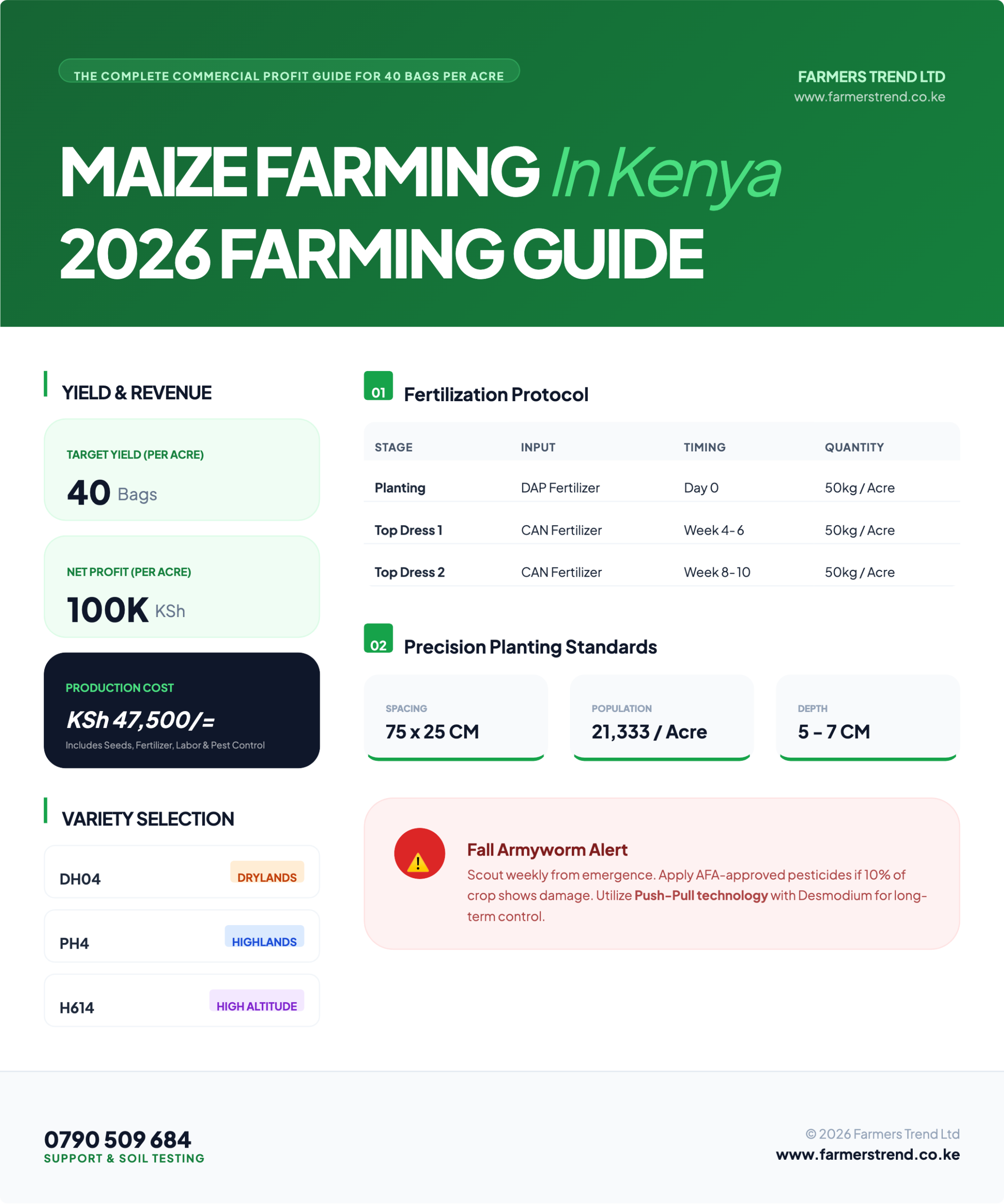
Apply one 50-kilogram bag of DAP per acre at planting. Place the fertilizer in the planting furrow. Cover with soil before placing seeds. This prevents seed burn while keeping nutrients available for emerging roots.
Nitrogen is the second critical nutrient. Maize requires nitrogen throughout the growing season. CAN (calcium ammonium nitrate) is the standard top-dressing fertilizer. CAN contains 26 percent nitrogen. It is water-soluble and quickly available to plants.
How many 50kg bags of fertilizer do you need per acre? The standard recommendation is one bag of DAP at planting and one to two bags of CAN for top-dressing. Total fertilizer requirement is 2 to 3 bags per acre. This translates to 100 to 150 kilograms of fertilizer.
| Growth Stage | Weeks After Planting | Fertilizer | Rate per Acre |
|---|---|---|---|
| Basal | 0 (planting) | DAP | 50 kg |
| Top-dress 1 | 4-6 | CAN | 50 kg |
| Top-dress 2 | 8-10 | CAN | 50 kg (optional) |
Soil testing before planting is essential. Testing determines nutrient levels and pH. Soils with pH below 5.5 require lime application. Soils deficient in phosphorus need higher DAP rates. Contact Farmers Trend Ltd at 0790509684 for soil testing services.
Precision Planting and Spacing Metrics
Maize planting spacing Kenya standards have evolved. The optimal spacing for commercial production is 75 centimeters between rows and 25 centimeters between plants. This spacing gives 21,333 plants per acre. The population allows each plant enough space for root development and light interception.
How many kg of maize to plant in 1 acre? You need exactly 10 kilograms of certified seed for the 75cm x 25cm spacing. This accounts for germination rates and potential replanting. Using less seed reduces plant population. Using more seed increases competition and reduces cob size.
Plant seeds 5 to 7 centimeters deep. Deeper planting delays emergence. Shallower planting exposes seeds to birds and sun. Place one seed per hole. Use a planter for uniform depth and spacing.
For high-input systems with irrigation, some farmers use 75cm x 20cm spacing. This gives 26,666 plants per acre. This population requires additional fertilizer and water. It also increases disease pressure. Only experienced farmers should attempt high-density planting.

Integrated Pest Management 2.0
Fall Armyworm remains the most destructive pest in maize farming in Kenya. The caterpillar feeds on leaves, tassels, and cobs. Early infestation stunts plants. Late infestation reduces grain quality.
The 2026 protocol combines monitoring, cultural practices, and targeted chemical control. Scout fields weekly from emergence to tasseling. Look for egg masses on leaves. Look for feeding damage. Apply control measures when 10 percent of plants show damage.
Push-pull technology is an effective cultural control. Plant desmodium between maize rows. This “pushes” the armyworm away. Plant napier grass around the field. This “pulls” the pest to a trap crop. Push-pull reduces pesticide use and improves soil fertility.
When chemical control is needed, use AFA-approved pesticides. Rotate between different modes of action to prevent resistance. Apply in the evening when armyworm larvae are active. Follow label instructions precisely.
Maize Lethal Necrosis Disease (MLND) is a viral disease spread by thrips and aphids. Symptoms include yellowing, stunting, and dead heart. Infected plants produce no grain. Control begins with resistant varieties. DH04 and PH4 have tolerance. Control vector insects with recommended insecticides. Remove infected plants immediately.
Weeds compete with maize during the first 6 weeks. Use pre-emergence herbicides like atrazine or pendimethalin. Apply immediately after planting. Follow with one hand weeding if needed. A clean field during the critical period maximizes yield.
High-Margin Strategies: Green Maize and Large Scale
Green maize farming in Kenya offers faster cash flow than dry grain. Harvest cobs 10 to 14 days after tasseling. The grains should be fully formed but still soft and milky. Green maize sells at 10 to 20 shillings per cob. A well-managed acre produces 15,000 to 20,000 cobs. Gross revenue reaches 150,000 to 400,000 shillings per acre.
The advantage of green maize is quick cash. The disadvantage is lower total weight compared to dry grain. Farmers near urban areas capture the best prices. Timing is critical. Green maize demand peaks during the off-season when dry grain supplies are low.
Large scale maize farming in Kenya requires mechanization. Farmers with 50 acres or more invest in their own equipment. Tractors, planters, and sprayers reduce labor costs. For farmers with 10 to 50 acres, hiring contractors is cost-effective.
Maize farming for beginners starts with 1 to 5 acres. Focus on getting the basics right. Use certified seeds. Follow spacing recommendations. Apply fertilizer correctly. Control weeds early. Keep records of costs and yields. Expand as you gain experience.

How Many Bags of Maize Can 1 Acre Produce in Kenya
A commercial farmer targeting high yields achieves 35 to 40 bags of 90 kilograms per acre. This requires certified seeds, proper spacing, adequate fertilizer, and timely pest control. A hectare yields 85 to 100 bags under good management.
The national average yield is much lower. Smallholder farmers average 15 to 20 bags per acre. The gap between potential and actual yield is opportunity. Farmers who adopt commercial practices close this gap.
How Much Does It Cost to Plant an Acre of Maize
The cost of planting an acre of maize ranges from 45,000 to 60,000 shillings. Here is a 2026 budget breakdown.
| Cost Item | Quantity | Unit Price | Total |
|---|---|---|---|
| Certified seeds | 10 kg | 400 KSh | 4,000 KSh |
| Land preparation | 1 acre | 5,000 KSh | 5,000 KSh |
| DAP fertilizer | 50 kg | 130 KSh | 6,500 KSh |
| CAN fertilizer | 100 kg | 90 KSh | 9,000 KSh |
| Labor (planting, weeding) | 20 days | 500 KSh | 10,000 KSh |
| Pest control | 1 acre | 8,000 KSh | 8,000 KSh |
| Harvest and transport | 1 acre | 5,000 KSh | 5,000 KSh |
| Total | 47,500 KSh |
How Many Weeks to Apply Fertilizer to Maize
Apply DAP at planting. This is week zero. Apply the first CAN top-dressing at 4 to 6 weeks after planting. Apply the second CAN top-dressing at 8 to 10 weeks if needed. This timing ensures nutrients are available during peak growth.

Post-Harvest Maturity and Aflatoxin Safety
Harvest when cobs are fully dry. The grain moisture content should be 13.5 percent. Higher moisture leads to mold growth and aflatoxin contamination. Lower moisture reduces grain weight.
Shell and dry grain further after harvest. Spread on tarpaulins in full sun. Turn regularly. Store only grain with 13.5 percent moisture or less.
Hermetic storage prevents aflatoxin and weevil infestation. PICS bags (triple-layer hermetic bags) seal out oxygen. Insects cannot survive. Mold cannot grow. Grain stored in hermetic bags stays fresh for 2 to 3 years.
Next Step
Maize farming in Kenya offers reliable returns for farmers who adopt commercial practices. Use certified seeds. Plant at 75cm x 25cm spacing. Apply DAP at planting and CAN at 4 to 6 weeks. Control Fall Armyworm through scouting and timely application. Harvest at 13.5 percent moisture. Store in hermetic bags.
The 2026 planting windows are March to April for the long rains and October to November for the short rains. Prepare your land now. Order certified seeds from Virtual Agrovet.
For soil testing and large-scale farm management, contact Farmers Trend Ltd at 0790509684. The Farmers Trend Technical Line provides 2026 maize farming guides and customized advice.
The farmers earning consistent profits from maize started where you are now. They learned, they planned, and they did the work. You can do the same. Your maize farming in Kenya journey starts today. The market is waiting. The returns are real. The time to act is now.
https://farmerstrend.co.ke/crops/maize-farming/maize-farming-in-kenya-2026-commercial-guide/https://farmerstrend.co.ke/wp-content/uploads/2026/03/1773858461540-768x1024.jpeghttps://farmerstrend.co.ke/wp-content/uploads/2026/03/1773858461540-150x150.jpegMaize Farming# TrendingBest fertilizer for planting maize in Kenya,Cost of planting maize per acre,DAP fertilizer for maize,DH04 maize variety,Fall Armyworm control Kenya,Farmers Trend maize farming,Green maize farming in Kenya,How many bags of maize per acre,Large scale maize farming in Kenya,Maize farming for beginners,Maize farming in Kenya pdf,maize planting spacing kenya,Maize top-dressing with CAN,PH4 maize variety,PICS hermetic bags,Push-pull technology,Virtual Agrovet maize seedsMaize Farming in Kenya: The 2026 Commercial Blueprint for High-Yield Agribusiness Maize farming in Kenya represents the single largest agricultural subsector in the country. Over 3.5 million smallholder farmers depend on this crop for food security and income. The national annual production fluctuates between 35 and 45 million bags. The...FarmersTrendjohn doefarmerstrend@gmail.comAdministratorFarmers Trend Ltd.

Leave a Reply