Marula Farming in Kenya: Complete 2026 Guide to Growing, Costs, Yields, and Profitability
Learn how to start marula farming in Kenya. This complete guide covers growing conditions, varieties, propagation, costs, profitability, value addition, and market opportunities.
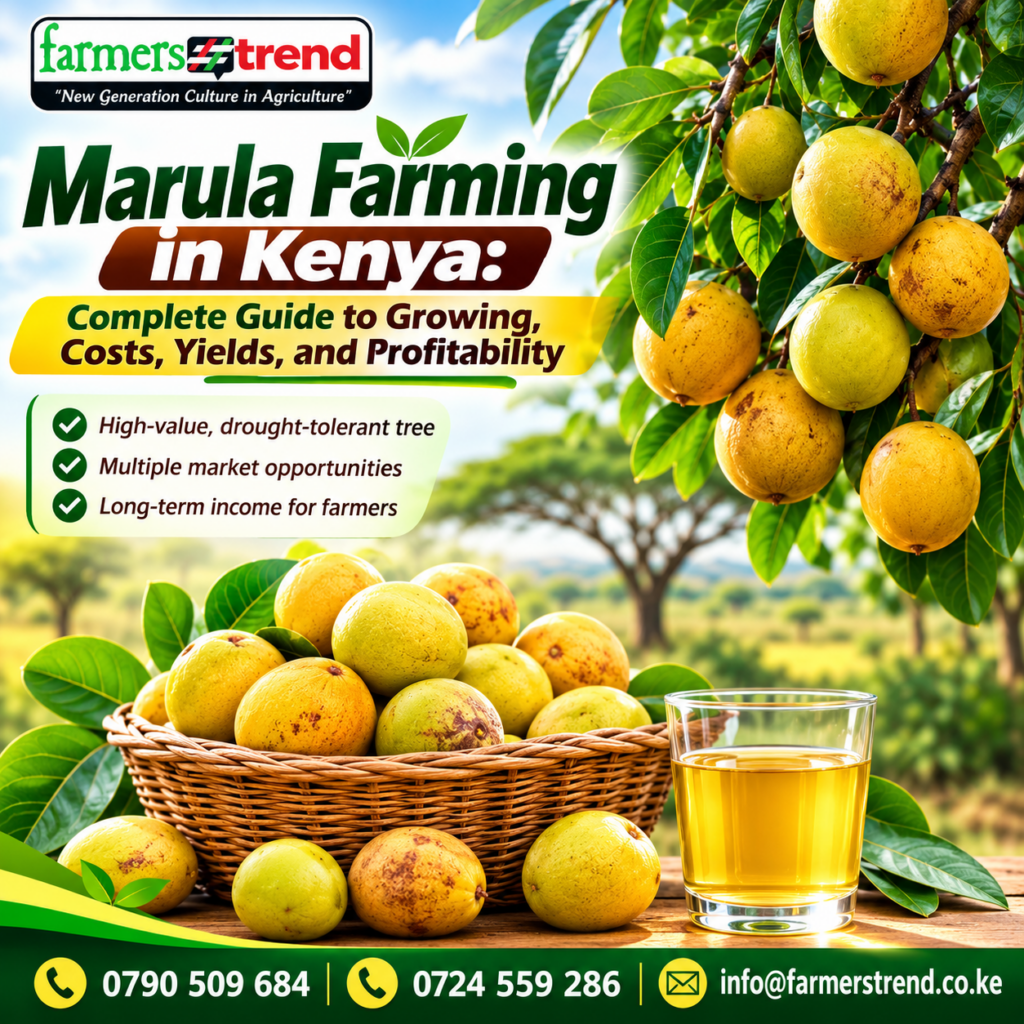
Marula Farming in Kenya: Complete Guide to Growing, Costs, Yields, and Profitability
Marula is one of Kenya’s indigenous fruit trees with real potential for commercial production in dryland and semi-arid areas. Known locally as Muuwa in Kamba, Mufula in Giriama, Ilmanguai in Maasai, or Oroluwo in Pokot, this tree has been part of Kenyan communities for generations. The Kenya Forestry Research Institute encourages farmers to plant indigenous fruit trees like marula in areas that often face food shortages.
Kenya has over 400 species of indigenous fruit trees. Many contain more vitamin C than common fruits like mangoes and oranges. Marula fruit contains vitamin C values ranging from 90 to over 300 mg per 100 grams of fresh fruit. It also has sugar content between 7 and 11 percent. This makes marula valuable both as food and as a source of income.
What Is Marula?
Marula is a deciduous shrub or medium-sized tree that can grow up to 15 meters tall. The bark is grey and later turns black with irregular cracks. The inner bark is pink-red in colour. Leaves are compound and crowded at the tips of branches with 3 to 18 pairs of leaflets. The tree can be dioecious or monoecious, meaning male and female flowers can be on the same or different trees.
Male flowers are pale green in hanging spikes, while female flowers are purple to reddish on shorter spikes. Mature fruits are yellow, oval, about 4 cm long, and each fruit contains two to three seeds. The tree is widespread in wooded grassland, riverine woodland, bushland, and on rocky hills from 800 to 1,800 metres above sea level.
Can Marula Grow in Kenya?
Yes. Marula is native to Kenya and grows in many counties. The tree does well in arid and semi-arid lands, which cover about 80 percent of Kenya’s land area. The species is found in Lambwe Valley, Moyale, West Pokot, Kerio Valley, Baringo, and also in parts of Coastal and Eastern regions. Kenya and Tanzania are considered centres of genetic diversity for marula, so populations in these countries should be a focus for conservation and selection programmes.
Best Counties for Marula Farming in Kenya
Eastern Region
The lower eastern counties of Kitui, Machakos, and Makueni have many marula trees. Farmers in Siakago, Embu County, are already growing marula alongside other indigenous fruit trees. The Chyulu Hills and Mbui Nzau areas in Makueni District have marula fruit of excellent quality.
Coastal Region
The coastal hinterlands have significant marula populations. The warm, humid conditions and well-drained sandy soils provide good growing conditions for the tree. The Giriama name for marula is Mufula.
Rift Valley
Parts of the Rift Valley, including areas in Narok County, have suitable conditions for marula. Farmers often integrate the tree into agroforestry systems in these areas. The Maasai name is Ilmanguai.
Western Kenya
The tree grows in Lambwe Valley and parts of West Pokot. The Pokot name is Oroluwo.
Central Kenya
Kerio Valley, Baringo, and parts of Meru have suitable conditions.
Marula Climate and Soil Requirements
Temperature: Marula grows in areas with temperatures between 20°C and 35°C.
Rainfall: The tree needs annual rainfall between 950 and 2,200 millimetres. It can survive in areas with as low as 600 millimetres mean annual rainfall.
Altitude: The tree grows from sea level up to 2,000 metres above sea level.
Soil: The tree prefers light, medium, or heavy well-drained soils. It can handle seasonal waterlogging and acidic soils. Fruit yields are highest on dry, sandy soil. Well-drained sandy-loam soil in full sunlight works best.
Spacing: Space trees 8 to 12 meters apart to allow for their expansive canopy development and extensive root system. At 8 by 8 metres, you can plant approximately 63 trees per acre.
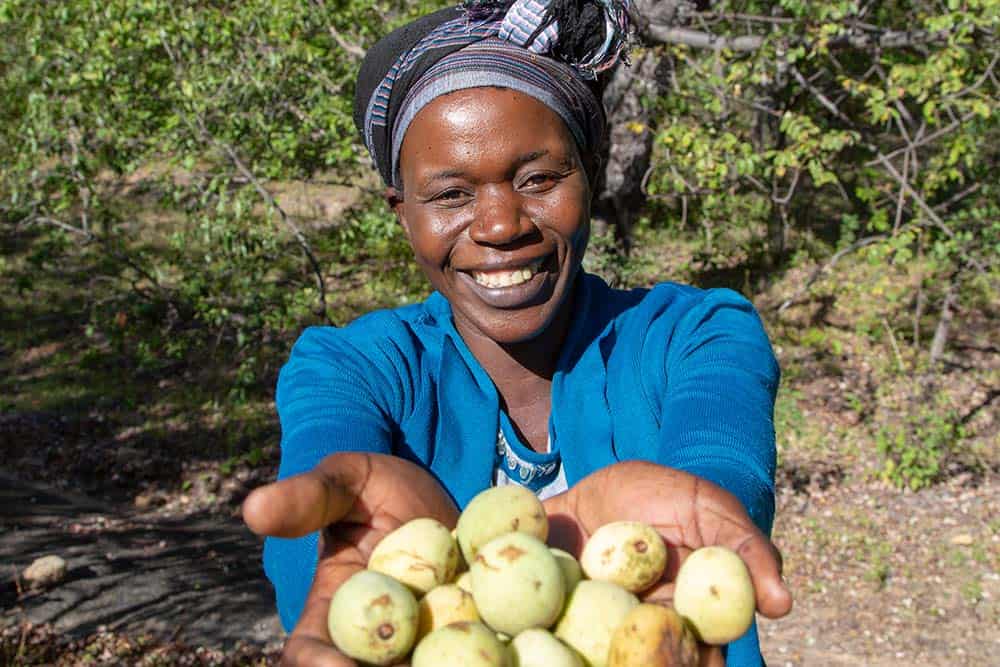
Marula Varieties and Grafted Seedlings
Seed Propagation
Marula grows easily from seeds if you treat them correctly. Seeds are extracted by rubbing the fruits gently on a wire mesh and washing in running water to remove the pulp. Seeds are then dried in direct sun to the required moisture content of about 10 percent and cleaned by hand sorting to remove debris. There are between 300 and 500 seeds per kilogram of clean seed. Seed can be stored in airtight containers in a cool dry place for up to one year with no significant loss of viability.
The only treatment needed to improve germination is removal of the operculum (seed cap). Under ideal conditions, treated seeds germinate within 2 to 10 days after sowing. The expected germination rate of mature, healthy, and properly treated seed is between 50 and 80 percent. The expected number of seedlings per kilogram of seed is 250.
Seed should be collected from fallen, ripened fruit and soaked overnight in warm water before sowing. After soaking, place the seeds on damp, fluffy peat moss at room temperature for about a week or two. This softens the plugs found at the broad end. Using a small pocket knife, carefully remove the plug. Once you do this, place the seed on damp peat moss and keep it moist at 25 to 30 degrees Celsius. Plant the seed directly into a black nursery bag filled with river sand. Keep it in the shade until the seedling appears.
The root grows quickly. As long as the weather is warm, you can plant the sprouted seed. Insert the root into the soil and just barely cover the seed. Do not let it get too wet or too cold. You can use a fungicide to prevent disease. Often more than one plant grows from the same nut, but remove all except one.
A seedling population tends to have mostly male trees. This is why grafting or buying grafted seedlings from nurseries works better for commercial orchards.
Grafting
Grafting is the preferred method for commercial marula production. Grafting ensures you get female trees that produce fruit. It also lets you select superior varieties with desirable traits.
You must grow rootstocks in advance from seed for later grafting. You can graft seedling trees when they reach about 20 centimetres and are about pencil size. Select graft wood of the same thickness as the rootstock. The buds must be swollen. The slanted cut on the graft wood and that of the rootstock must fit together neatly. The cambium layer should overlap on at least one side.
Tie the graft wounds firmly with PVC grafting strip. Cover the entire piece of graft wood with plastic strip or parafilm to prevent drying out. Grafted trees have a better root system than trees grown from other methods. Grafted trees are usually shorter and bear fruit from the third to the fifth year. Seedling trees usually bear fruit in five to seven years.
Cutting Propagation
You can also propagate marula by shoot cuttings. However, this method is not common because it results in a poor root system. The best time for taking cuttings is from September to March when the trees are actively growing. Plant cuttings of about 10 to 15 centimetres in diameter and 2 metres in length at a depth of 1 metre.
Getting Quality Planting Material
Always plant grafted seedlings from verified sources. Seed-grown trees are a gamble. Roughly half will be male, and the females will vary unpredictably in fruit quality. The higher initial cost of grafted seedlings pays for itself within the first few harvests. Farmers Trend Limited offers high-quality grafted marula seedlings at KSh 2,500 each that bear fruit in three to five years.
How to Start Marula Farming: Step by Step
Site Selection
Before ordering seedlings, assess rainfall, soil drainage, and access to water. This is particularly important in the dry counties where marula is likely to have the strongest commercial potential. Marula grows in areas with rainfall between 950 and 2,200 millimetres per year. The tree grows from sea level to 2,000 metres altitude. Make sure the soil drains well, as marula does not like waterlogging. On flat land, plant on slight mounds to keep the root crown above standing water.
Land Preparation
Dig a hole much larger and deeper than the container the young grafted tree is growing in. Use one part compost to two parts soil. Loosening and amending the soil with organic material encourages deeper rooting because oxygen and water can penetrate the soil more effectively.
Planting
Plant the tree in full sunlight and create some kind of windbreak, such as buildings or other trees. Remove the young plant from the container carefully. Prepare the planting hole well in advance to allow the soil to settle. Plant during the rainy season when soil moisture is adequate.
Spacing
Space trees 8 to 12 metres apart. At 8 by 8 metres, you can plant approximately 63 trees per acre. At 10 by 10 metres, you can plant approximately 40 trees per acre. The wider spacing allows for the tree’s expansive canopy and extensive root system.
Male-to-Female Ratio
Marula has separate male and female trees. Keep one male tree for every eight to ten female trees to ensure good pollination. One male tree can pollinate eight to ten female trees. The one-to-eight planting ratio provides adequate pollination.
Water Management
Marula handles drought well but benefits from water management in the early years and during dry periods. In Naivasha, a marula estate three kilometres from town, off the Nakuru-Nairobi road, stays green despite the heat and sun thanks to proper water management. This shows that with good practices, marula can thrive even in hotter areas. Introducing beehives (two to three hives per acre) during flowering improves pollination and yields while giving you honey as an extra income stream.
Intercropping During Establishment
For the first three years, maize, beans, cowpeas, or traditional vegetables can be grown between marula rows. This generates income while waiting for trees to mature and covers some of the establishment costs. Marula can also be intercropped with millet and corn in the presence of arbuscular mycorrhizal fungi, which enhances both biomass production and height growth of marula seedlings.
Marula Fertilizer and Manure Programme
Compost and Manure
Apply 5 to 10 kilograms of compost or manure per tree annually, split between the rainy seasons. Mature trees need 10 to 15 kilograms of organic compost or manure per tree annually. Organic matter improves soil structure, water retention, and nutrient availability.
NPK Fertilizer
Supplement with an organic fertilizer higher in potassium and phosphorus, such as 5:10:10 NPK, to boost flowering and fruit production. Limit nitrogen, as too much nitrogen encourages leaf growth at the expense of fruits. Fertilizer requirements should be based on soil-test results, tree age, rainfall, and crop performance. Where soil testing is unavailable, organic matter can provide a useful baseline, while any mineral fertilizer programme should be adjusted to the site’s nutrient status.
Mulching
Apply mulch around the tree to keep moisture in, suppress weeds, and add organic matter to the soil. Marula grows well with adequate moisture, and mulching helps maintain soil moisture during dry periods.
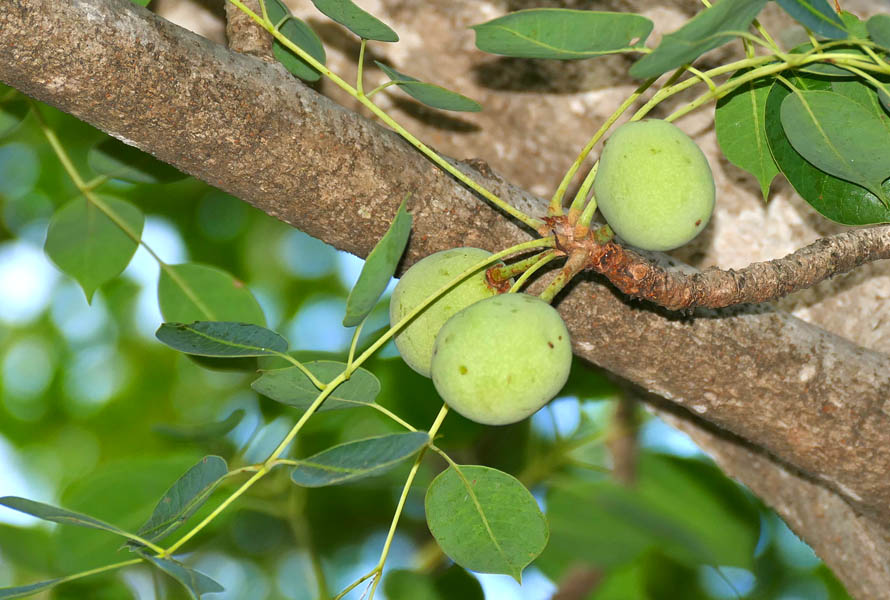
Marula Pruning and Orchard Management
Shaping Young Trees
Shape trees during the first few years by removing low or crossing branches to form a strong, open canopy. This encourages healthy growth and makes harvesting easier. A strong structure also stops branches from breaking under the weight of fruit.
Maintaining Mature Trees
Prune lightly after harvest to remove dead wood and improve airflow. Marula does not need heavy pruning. Keep trees at 6 to 8 metres tall for easier fruit and nut harvesting. Good airflow reduces the risk of fungal diseases and improves fruit quality.
Fire Protection
Young trees are easily damaged by fire. Keep firebreaks around orchards and clear dry grass during the dry season. This is especially important in dryland areas where bush fires are common.
Marula Pollination
Because marula has separate male and female trees, pollination is a key management issue. The one-to-eight (male to female) planting ratio provides adequate pollination. Adding beehives (two to three hives per acre) during flowering improves pollination and yields while giving you honey as an extra income stream. Marula is insect-pollinated, and low bee populations reduce fruit set.
If a female tree flowers but produces few fruit, pollination may not be enough. Make sure the orchard has at least one male tree per eight to ten female trees. Plant bee-attracting plants like sunflowers, basil, or marigolds within or around the orchard. Place beehives in the orchard during flowering.
Marula Pests and Diseases
Fruit Flies
Fruit flies pierce fruits, causing spoilage and early drop. Control using organic traps like vinegar-based traps or bag fruits with mesh netting.
Aphids
Aphids suck sap and cause leaf curling. Control with neem oil or a soap-water solution at one teaspoon per litre.
Scale Insects
Scale insects weaken trees by sucking sap. Apply horticultural oil or bring in natural predators like ladybugs.
Marula Beetles
Marula beetles chew leaves and fruits. Control through hand-picking or neem-based sprays.
Anthracnose
Anthracnose is a fungal disease that causes dark spots on fruits and leaves. Prune for better air circulation and apply copper-based organic fungicides. Apply copper-based organic fungicides at flowering and again two weeks later. Remove and destroy infected fruit and branches.
Root Rot
Root rot happens in waterlogged soils. Prevention is the only cure. Make sure you have good drainage and avoid planting in heavy clay soils. If root rot appears, apply Trichoderma biofungicides. Do not plant marula in heavy clay soils or areas with poor drainage.
Wildlife Damage
In areas near forests or game reserves, monkeys, baboons, and birds can take a large part of the crop. Guard dogs work well for small orchards. Scarecrows, reflective tape, and periodic banging (gas guns or metal sheets) keep birds away but need daily attention. For commercial orchards in high-wildlife areas, netting over individual trees or whole blocks may be necessary.
When and How to Harvest Marula
Harvest Timing
Marula fruit ripens between December and March, depending on the region. The fruit falls from the tree when ripe. Traditionally, farmers collect fallen fruit rather than picking from branches. The fruit continues to ripen on the ground.
Harvest at the right stage for your target market:
- For fresh fruit, collect when fruit turns yellow and falls. Use within a few days.
- For juice and processing, collect fruit slightly under-ripe.
- For kernel and oil production, allow fruit to fully ripen on the ground before collecting.
Harvesting Method
Collect fallen fruit from the ground daily. Marula fruit ferments quickly within 24 to 48 hours in warm conditions. Frequent collection is essential if you plan to sell fresh fruit. For oil production, some fermentation is acceptable as it helps separate the pulp from the stones.
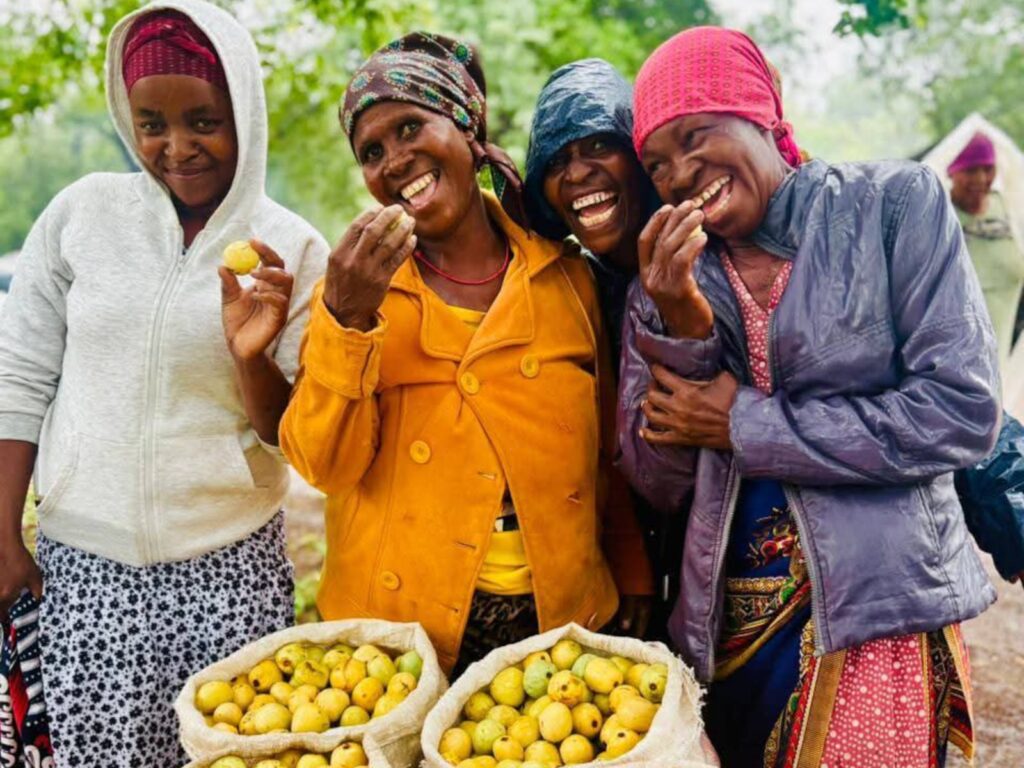
Marula Post-Harvest Handling
Fresh Fruit
Fresh marula fruit is highly perishable and should be used within two to three days of harvest. Store in a cool, shaded place to slow ripening.
Dried Fruit
Dried fruit stays good for months, stores easily, and ships well. A simple solar dryer costs KES 5,000 to 15,000 to build from local materials. This allows production of dried marula fruit, which stores for months and sells at higher prices than fresh.
Kernels
To extract kernels, remove pulp from stones by hand or using a mechanical pulper. Clean and dry the stones. Crack stones to extract kernels. This is labour-intensive and must be done by hand to avoid damaging kernels. Dry the kernels. Dried kernels store for several months before pressing.
Marula Oil
Cold-press kernels to extract oil. The cold-pressing process is critical for producing high-quality oil. Heat and chemical extraction destroy the oil’s natural antioxidant properties and reduce its value. Properly stored marula oil has a shelf life of 12 to 24 months when kept in cool, dark conditions.
Small-scale presses start around KES 50,000 but can be a shared cooperative asset. Oil pressing requires more investment but offers the highest returns.
Marula Processing and Value Addition
Fresh Fruit
Farm-gate prices range from KES 20 to 50 per kilogram. Local market retail prices range from KES 80 to 150 per kilogram depending on season and quality. The fresh fruit market is limited by the fruit’s short shelf life. Farmers near urban centres have better access to this channel.
Juice
Processed marula juice and traditional beers have established markets. Processors typically pay KSh 30 to 60 per kilogram for fruit delivered to their facilities. One kilogram of fruit yields about two litres of juice.
Dried Fruit
Dried fruit can fetch KES 300 to 500 per kilogram. It sells to health food stores, supermarkets, and export markets.
Kernels
Marula nuts come from the hard stone inside the fruit. You can eat them raw, roast them, or press them for oil. Kernels fetch KSh 500 to 800 per kilogram.
Marula Oil
Marula oil is a premium cosmetic ingredient used in skin and hair care products. One litre of oil needs about 50 kilograms of fresh fruit to get enough kernels. The oil sells to cosmetics manufacturers, soap makers, and directly to consumers. Conventional oil fetches KES 2,000 to 5,000 per litre. Certified organic oil reaches KES 7,000 per litre or more in export markets. Companies such as Arbor Oils of Africa in Kenya source and process marula oil for the global cosmetics industry. Global brands including The Body Shop, Drunk Elephant, and L’Occitane use marula oil in their products.
Value-Added Products
Value-added products like jams, juices, and syrups have longer shelf life and higher margins. They need small-scale processing equipment and must meet food safety standards. Margins can reach 100 to 300 percent over raw fruit prices.
Marula Farming Cost per Acre in Kenya
Establishment Costs (Year 1)
| Item | Estimated Cost (KES) |
|---|---|
| Grafted seedlings (63 at KES 2,500 each) | 157,500 |
| Land preparation | 15,000 |
| Planting holes | 10,000 |
| Compost/manure | 12,000 |
| Labour (planting) | 15,000 |
| Mulching | 8,000 |
| Pest management | 5,000 |
| Total establishment cost | 222,500 |
Annual Maintenance Costs (Years 2-5)
| Item | Estimated Cost (KES) |
|---|---|
| Weed control (labour) | 15,000 |
| Pruning (labour) | 10,000 |
| Manure and fertilizer | 12,000 |
| Mulching | 8,000 |
| Pest management | 8,000 |
| Total annual cost | 53,000 |
Annual Operating Costs (Years 6+)
| Item | Estimated Cost (KES) |
|---|---|
| Weed control (labour) | 15,000 |
| Pruning (labour) | 10,000 |
| Manure and fertilizer | 12,000 |
| Harvesting labour (at KES 3/kg) | 20,000 |
| Pest management | 8,000 |
| Transport to market | 10,000 |
| Total annual costs | 75,000 |
Marula Yield per Tree and per Acre
Yield per Tree
Under favourable conditions, mature trees can produce substantial fruit yields, but actual production varies considerably with tree age, genetics, rainfall, pollination, and management. In Namibia, a survey found an average yield of 596 kg per tree, with a range from a few kilograms to 2,860 kg. However, this survey was not statistically valid due to selection issues and timing. Studies from South Africa and Namibia indicate the possibility of selecting trees for either pulp or kernel production.
For Kenyan conditions, a conservative estimate would be 50 kg of fresh fruit per tree for established trees. With good management and favourable conditions, yields can be higher.
Yield per Acre
At 8 by 8 metre spacing, approximately 63 trees per acre. With one male tree for every eight female trees, approximately 56 female trees per acre. At 50 kg per tree, total fresh fruit per acre is 56 × 50 kg = 2,800 kg.
At 10 by 10 metre spacing, approximately 40 trees per acre. Approximately 36 female trees per acre. At 50 kg per tree, total fresh fruit per acre is 36 × 50 kg = 1,800 kg.
Is Marula Farming Profitable in Kenya?
Revenue Options for One Acre (8m x 8m spacing, 56 female trees)
| Product | Yield | Price | Gross Revenue (KES) |
|---|---|---|---|
| Fresh fruit | 2,800 kg | KES 40/kg | 112,000 |
| Fresh fruit (optimistic) | 2,800 kg | KES 100/kg | 280,000 |
| Dried fruit | 700 kg (25% weight retention) | KES 400/kg | 280,000 |
| Kernels only | 280 kg | KES 300/kg | 84,000 |
| Cold-pressed oil | 56 litres | KES 3,000/litre | 168,000 |
| Premium organic oil | 56 litres | KES 6,000/litre | 336,000 |
Net Income (Fresh Fruit Option)
Gross revenue (KES 100/kg): 2,800 kg × KES 100/kg = KES 280,000
Less annual operating costs: KES 75,000
Net income: KES 205,000 per acre
Net Income (Oil Option)
Gross revenue: 56 litres × KES 3,000/litre = KES 168,000
Less annual operating costs plus processing costs: KES 100,000
Net income: KES 68,000 per acre
Note that oil production has less competition and easier storage. The highest returns come from oil production, but this requires processing equipment and market access. These revenue figures may seem modest compared to intensive crops like vegetables. However, marula’s advantage is its minimal input requirement. Once established, the orchard produces with very little ongoing cost, and the trees are productive for decades.
Break-Even Timeline
With grafted trees, the first significant returns arrive in year 5 or 6. Break-even typically occurs between years 7 and 9. Years 1 through 5 generate lower yields and produce negative cash flow, requiring other income sources or patient capital.
Conservative Scenario
Yield: 50 kg fresh fruit per tree, 56 female trees, 2,800 kg per acre
Revenue: KES 280,000
Costs: KES 75,000
Net: KES 205,000
Moderate Scenario
Yield: 75 kg fresh fruit per tree, 56 female trees, 4,200 kg per acre
Revenue: KES 420,000
Costs: KES 85,000
Net: KES 335,000
High-Yield Scenario
Yield: 100 kg fresh fruit per tree, 56 female trees, 5,600 kg per acre
Revenue: KES 560,000
Costs: KES 95,000
Net: KES 465,000
Where to Sell Marula in Kenya
Sales Channels
- Local fresh markets let farmers near towns sell fresh fruit directly to consumers
- Cooperatives can bring production together and negotiate better prices
- Processors buy fruit for juice, jam, and wine production
- Horizon Business Ventures produces essential oils from marula seeds in the Mount Kenya region
- Arbor Oils of Africa sources and processes marula oil for the global cosmetics industry
- Farmers Trend Limited can connect farmers with buyers and processors
Marula Farming Challenges
Climate Change
Marula is drought-resistant but sensitive to extreme weather changes. Unpredictable rains and longer dry spells affect yields and quality.
Pollination
Because marula has separate male and female trees, pollination is a challenge. If you have too few male trees, fruit set will be low. If bee populations are low, pollination will be poor.
Harvesting and Processing
Harvesting requires daily collection during the season. Processing for oil requires equipment and labour. Kernels extraction is labour-intensive and must be done by hand to avoid damage.
Market Access
Finding consistent buyers for fresh fruit is a challenge due to perishability. Processing requires investment in equipment. Export markets require certification and compliance.
Wildlife
In areas near forests or game reserves, monkeys, baboons, and birds can take a large part of the crop.
Frequently Asked Questions
Can marula grow in Kenya? Yes. Marula is native to Kenya and grows in many counties. The tree does well in arid and semi-arid areas.
Which counties are suitable for marula farming? Marula grows in the lower eastern counties of Kitui, Machakos, and Makueni, the coastal hinterlands, parts of the Rift Valley, Lambwe Valley, Moyale, West Pokot, Kerio Valley, and Baringo.
How long does marula take to bear fruit? Grafted trees bear fruit in 3 to 5 years. Seedling trees take 5 to 7 years.
What is the planting ratio for male and female trees? Keep one male tree for every 8 to 10 female trees for good pollination.
Can marula grow from seeds? Yes, but seedling populations tend to have mostly male trees. Grafting works better for commercial orchards.
How long does a marula tree live? Marula trees can live and produce fruit for decades, making them a long-term investment.
How much fruit does a mature marula tree produce? Under favourable conditions, mature trees can produce substantial yields, but actual production varies considerably with tree age, genetics, rainfall, pollination, and management.
What products can come from marula? Products include fresh fruit, dried fruit, juice, jam, wine, nuts, and oil.
How much does marula oil sell for? Conventional oil fetches KES 2,000 to 5,000 per litre. Organic oil can reach KES 7,000 per litre.
Is marula farming profitable? Yes, especially with value addition. Processed products give much higher returns than raw fruit. However, farmers should be patient as returns only come after 5 to 7 years.
Does marula need water management? Marula handles drought well but benefits from proper water management in the early years and during dry periods.
Can marula grow with other crops? Yes, marula can be part of agroforestry systems with other crops. Marula can also be intercropped with maize and beans during the establishment phase.
What are the main pests affecting marula? Fruit flies, aphids, scale insects, and marula beetles are common pests.
What are the main diseases affecting marula? Anthracnose and root rot are the main diseases.
How is marula oil extracted? The oil is cold-pressed from kernels. Cold pressing keeps the oil’s natural antioxidant properties.
Where can I buy marula seedlings? Farmers Trend Limited offers high-quality grafted marula seedlings at KSh 2,500 each. Contact us for certified seedlings that bear fruit in three to five years.
Does marula need pruning? Light pruning is recommended to remove dead wood and improve airflow. Shape trees during the first few years.
What is the best time to harvest marula? Marula fruit ripens between December and March, depending on the region.
How long does fresh marula fruit last? Fresh fruit is highly perishable and should be used within 2 to 3 days of harvest.
Can marula grow in dry areas? Yes, marula does well in arid and semi-arid areas where other crops struggle.
What is the ideal spacing for marula trees? Space trees 8 to 12 metres apart to allow for proper growth and canopy development.
Does marula need fertilizer in the first year? Yes, apply compost during planting and supplement with NPK fertilizer during the growing season based on soil test results.
What is the best soil type for marula? Well-drained sandy loam or loamy soils with a pH between 5.5 and 7.5 are ideal.
How do I know if my marula tree is male or female? Male trees produce flowers but no fruit. Female trees produce flowers that develop into fruit when pollinated.
Can one male tree pollinate many female trees? Yes, one healthy male tree can pollinate 8 to 10 female trees.
How long does marula take from flowering to fruit maturity? Marula fruit takes about 6 to 8 months from flowering to ripening.
How do I store marula kernels before pressing? Store dried kernels in airtight containers in a cool, dry place away from sunlight.
What equipment do I need for oil extraction? You need a kernel cracker, a manual or electric press, and filtering equipment for small-scale production.
Can I sell marula leaves or bark? Yes, the bark has medicinal uses and can be sold to herbalists and traditional medicine practitioners.
Final Marula Farming Checklist
- Pick suitable location with proper climate and soil conditions.
- Get grafted seedlings from Farmers Trend Limited nurseries at KSh 2,500 each.
- Prepare the land with compost-amended planting holes.
- Plant during the rainy season.
- Keep one male tree for every 8 to 10 female trees.
- Add beehives for pollination.
- Apply compost and NPK fertilizer according to schedule.
- Prune young trees to form a strong canopy.
- Control pests and diseases.
- Harvest fruit when ripe.
- Process fruit for maximum value.
- Find market channels for fresh and processed products.


Leave a Reply