Herbs Farming in Kenya: The 2026 Successful Guide to Earning KSh 300,000 Monthly with Export Contracts
Herbs Farming in Kenya: The 2026 Definitive Guide to Commercial Success and Export
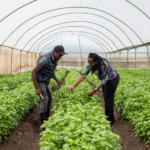
Herbs farming in Kenya has evolved from a kitchen garden activity into a sophisticated export-oriented business with million-shilling potential. Walk through the fertile fields of Kiambu, the highlands of Nyeri, or the organized farms in Naivasha, and you will find farmers who have abandoned traditional crops to focus on herbs. The reason is simple. Herbs offer quick returns, multiple harvests, and access to premium markets that pay in foreign currency.
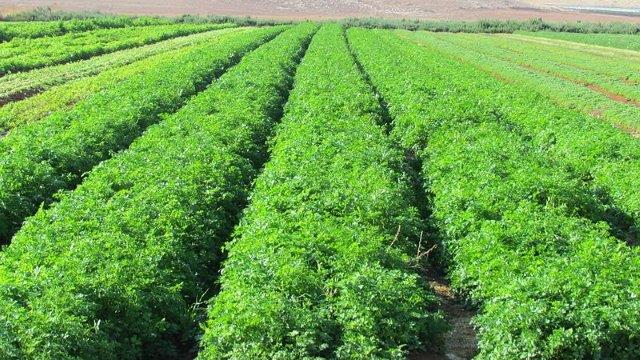
The numbers attract serious farmers. A quarter-acre plot of basil generates 50,000 to 80,000 shillings monthly. Coriander yields 1,500 to 2,000 kilograms per acre in 30 days, selling at 80 to 120 shillings per kilogram. With multiple cycles annually, monthly incomes of 100,000 to 300,000 shillings are achievable from small plots. Exporters pay premium prices for quality produce, with some herbs fetching 300 to 500 shillings per kilogram in European markets.
The global “clean label” and “wellness” trends drive demand in 2026. Consumers seek natural ingredients, herbal teas, and fresh culinary herbs. Supermarkets like Naivas and Carrefour stock fresh herbs year-round. Hotels and restaurants demand consistent supply. Export markets in Europe and the Middle East offer contracts for farmers who meet quality standards.
This guide by Farmers Trend provides everything you need to know about herbs farming in Kenya. You will learn about the most profitable varieties, technical production, sourcing from Farmers Trend Ltd, and accessing export markets. The information comes from successful commercial growers and horticultural experts across the country.
The Commercial Viability of Herbs Farming in Kenya
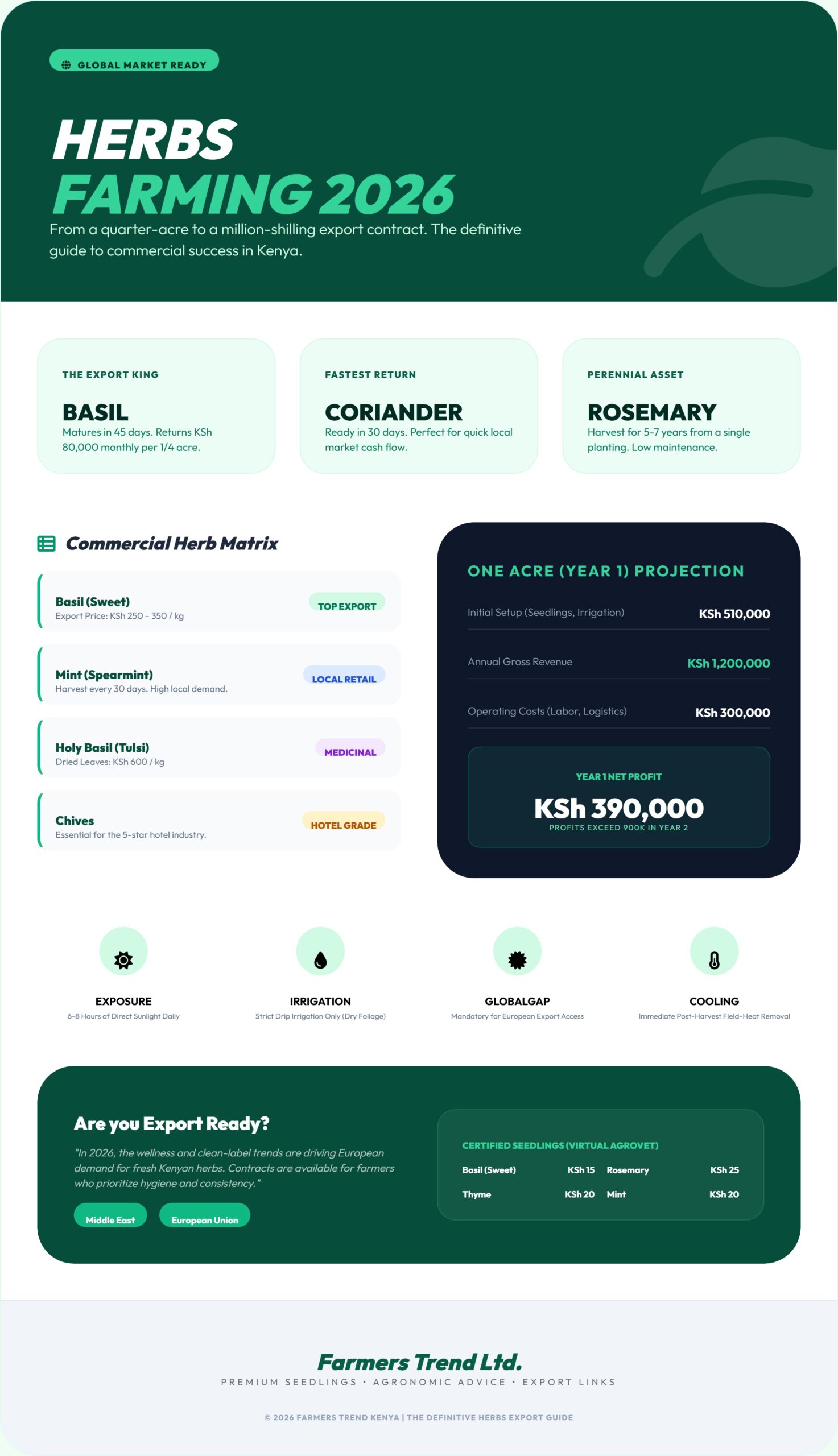
Can I make money selling herbs? Yes, and the evidence comes from farmers across Kenya who have built thriving enterprises on small plots. A quarter-acre basil farm produces 200 to 300 kilograms monthly, generating 50,000 to 80,000 shillings at farm-gate prices. Rosemary and thyme, being perennial, provide continuous income once established.
How profitable is herbs farming in Kenya? A well-managed herb farm generates 100,000 to 300,000 shillings monthly from one acre. With multiple herbs and staggered planting, income flows consistently throughout the year. Some farmers supplying exporters earn 500,000 shillings monthly during peak seasons.
The profitability varies by herb. Basil and rosemary lead for export markets. Mint and coriander dominate local supermarket sales. Chives and parsley supply the hotel industry. Diversification across multiple herbs spreads risk and captures different market segments.
The virtual agrovet platform has transformed how farmers access technical support and inputs. Through Farmers Trend Ltd, you can order certified seedlings, receive agronomic advice, and connect with buyers. This digital tool makes herbs farming accessible even to farmers in remote areas.
The Most Commonly Grown Herbs in Kenya
Understanding the ten most commonly used herbs helps you select the right varieties for your farm and target market.
Basil is the king of Kenyan herb farming. Sweet basil dominates export markets. Thai basil serves Asian cuisine restaurants. Purple basil adds color to supermarket shelves. Basil grows quickly, maturing in 45 days, and provides multiple harvests.
Coriander, also known as cilantro or dhania, is essential in Kenyan cuisine. It matures in 30 days, making it the fastest herb to generate income. Farmers harvest 1,500 to 2,000 kilograms per acre per cycle. Demand remains constant throughout the year.
Mint comes in several varieties. Spearmint and peppermint are most common. Mint spreads aggressively, so container planting is recommended. It thrives in wet conditions and provides continuous harvests for years. Beginners find mint almost impossible to kill.
Parsley has two main types. Curly parsley garnishes plates in hotels. Flat-leaf parsley, also called Italian parsley, has stronger flavor for cooking. Parsley takes 70 to 90 days to mature but provides multiple harvests.
Rosemary is a perennial woody herb highly valued in European cuisine. It takes 6 to 12 months to reach full production but then provides harvests for years. Rosemary tolerates drought and poor soils, making it ideal for marginal areas.
Thyme comes in lemon and common varieties. It is a low-growing perennial used in meat dishes and herb blends. Thyme takes 70 to 90 days to first harvest and continues producing for 3 to 4 years.
Sage is a perennial herb with velvety leaves used in poultry dishes and teas. It takes 80 to 100 days to mature and provides harvests for 4 to 5 years. Sage commands premium prices in health food markets.
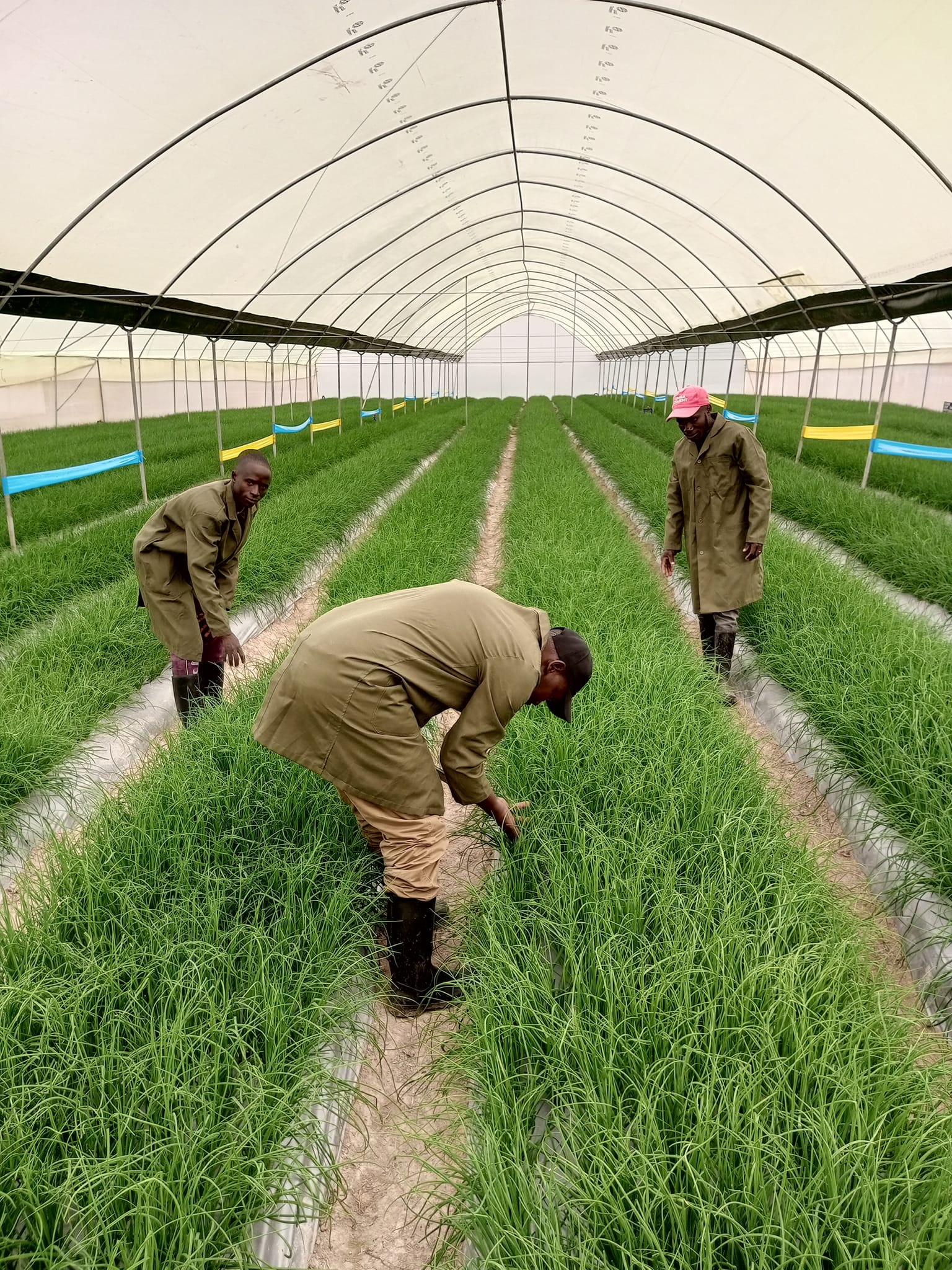
Chives are the smallest member of the onion family. They produce edible leaves and purple flowers. Chives mature in 60 to 80 days and provide continuous harvests. They are essential in salads and dips.
Oregano is a perennial herb essential in Italian and Mediterranean cuisine. It takes 70 to 90 days to mature and provides harvests for 4 to 5 years. Oregano has strong medicinal properties, increasing its market value.
Dill produces both leaves and seeds. It is used in pickling, fish dishes, and salads. Dill matures in 60 to 80 days and provides multiple harvests. The seeds fetch premium prices in health food markets.
Which Herbs Are Best for Beginners
Mint, basil, and rosemary are the best herbs for beginners due to their resilience and forgiving nature.
Mint grows almost anywhere and recovers quickly from mistakes. It thrives in wet conditions and provides continuous harvests. Plant mint in containers to prevent spreading. A few mint plants supply a family and generate surplus for sale.
Basil grows rapidly from seed or seedling. It responds well to regular harvesting, becoming bushier with each cut. Basil tolerates a range of conditions but prefers warm temperatures. Beginners achieve success with basil in their first season.
Rosemary survives neglect and drought. Once established, it requires minimal care. Rosemary provides harvests for years from a single planting. Its perennial nature makes it ideal for farmers building long-term production.
The Most Profitable Herb to Grow in Kenya
Basil and rosemary are the most profitable herbs for Kenyan farmers targeting export markets.
Basil generates multiple harvests from a single planting. A well-managed basil crop produces 5 to 7 cuts over 6 months. Each cut yields 1,000 to 1,500 kilograms per acre. Export prices range from 150 to 300 shillings per kilogram, significantly higher than local market rates.
Rosemary, being perennial, provides continuous income once established. A rosemary planting produces for 5 to 7 years with minimal maintenance. Harvests occur 4 to 6 times annually. Export markets pay premium prices for fresh rosemary sprigs.
For local markets, coriander and mint generate the fastest returns. Their short growth cycles allow multiple plantings annually, maximizing land use and income.
What Is the Mother of All Herbs
Holy Basil, also called Tulsi, is revered as the mother of all herbs in traditional medicine systems. In Kenya, Tulsi has found a growing market among health-conscious consumers and in the medicinal herb trade.
Tulsi has three varieties. Rama Tulsi has green leaves and is most common. Krishna Tulsi has purple leaves and stronger medicinal properties. Vana Tulsi grows wild in forested areas.
The Kenyan medicinal market for Tulsi includes herbal tea processors, health food stores, and direct consumers. Dried Tulsi leaves sell for 400 to 600 shillings per kilogram. Fresh leaves supply urban consumers who make herbal teas at home.
How to Start Herbs Farming in Kenya
How to start a successful herb garden begins with site selection and preparation. Herbs require 6 to 8 hours of direct sunlight daily. Morning sun is especially important for drying dew and reducing disease pressure.
Soil must be well-drained. Herbs cannot tolerate waterlogged roots. Sandy loam soils with pH between 6.0 and 7.5 produce the best results. If your soil is heavy clay, plant on raised beds to improve drainage.
Incorporate well-decomposed manure during land preparation. Apply 10 to 15 tons per acre. Herbs prefer moderately fertile soils. Excess nitrogen produces lush leaves with reduced flavor intensity.
Install drip irrigation before planting. Herbs need consistent moisture but cannot tolerate wet leaves. Drip irrigation delivers water to roots while keeping foliage dry. This reduces disease pressure significantly.
Select herbs based on your target market. Beginners should start with 2 to 3 varieties and expand as they gain experience. Plant each herb in separate blocks for easier management.
Which Herbs Grow Faster
Coriander is the fastest herb, maturing in 30 days from planting to first harvest. Farmers can complete 8 to 10 cycles annually with staggered planting. This rapid turnover generates quick cash flow for new farmers.
Basil matures in 45 days to first harvest. Unlike coriander, basil provides multiple harvests from the same plants. After the first cut, plants regrow for 4 to 6 additional harvests over 6 months.
Mint provides first harvest in 50 to 60 days. Once established, mint produces continuous growth. Farmers harvest mint every 30 to 40 days throughout the year.
Dill and chives mature in 60 to 80 days. Both provide multiple harvests from established plants.
Perennial herbs like rosemary, thyme, sage, and oregano take 6 to 12 months to reach full production. Their long-term productivity compensates for the slower start.
Types of Herbs Farming in Kenya
Herbs farming in Kenya divides into three main categories based on end use and market channels.
Culinary herbs dominate commercial production. Basil, coriander, mint, parsley, chives, dill, rosemary, thyme, sage, and oregano supply fresh markets, supermarkets, hotels, and export markets. These herbs are grown for their leaves and tender stems used in cooking.
Medicinal herbs serve a growing health market. Holy Basil, chamomile, lemon balm, and echinacea are produced for herbal teas and traditional medicine. These herbs often command higher prices but require specific processing.
Aromatic herbs are grown for essential oils and fragrance. Lavender, lemon grass, and scented geraniums supply the cosmetics and aromatherapy industries. These herbs require specialized processing equipment.
Technical Production Requirements on Herbs Farming in Kenya
Soil preparation starts with deep ploughing to 20 to 25 centimeters. Break all clods and remove weeds and stones. Form beds 1 meter wide for easy access and drainage.
Planting density varies by herb. Basil requires 30 centimeters between plants and 40 centimeters between rows, giving approximately 33,000 plants per acre. Coriander planted in rows 20 centimeters apart with plants 10 centimeters apart accommodates 200,000 plants per acre.
Water requirements average 20 to 25 millimeters weekly. During hot weather, increase frequency but maintain consistency. Drip irrigation running 30 to 60 minutes daily maintains ideal moisture.
Mulching with dry grass or straw conserves moisture and suppresses weeds. Organic mulch also adds nutrients as it decomposes. Maintain 5 to 10 centimeters of mulch around plants.
Sourcing Certified Herbs Seedlings in Kenya
Farmers Trend Ltd nurseries are the premier source for certified herb seedlings in Kenya. Their Virtual Agrovet platform allows you to order seedlings online with delivery arranged to your farm.
| Herb Seedling | Price per Seedling |
|---|---|
| Basil (Sweet) | 15 KSh |
| Basil (Thai) | 18 KSh |
| Coriander | 12 KSh |
| Mint (Spearmint) | 20 KSh |
| Mint (Peppermint) | 20 KSh |
| Parsley (Curly) | 15 KSh |
| Parsley (Flat-leaf) | 15 KSh |
| Rosemary | 25 KSh |
| Thyme | 20 KSh |
| Sage | 25 KSh |
| Chives | 20 KSh |
| Oregano | 20 KSh |
| Dill | 15 KSh |
| Holy Basil (Tulsi) | 25 KSh |
Seedlings from Farmers Trend Ltd are certified disease-free and true to type. The Virtual Agrovet platform provides technical support, planting guides, and market connections. Ordering online saves travel time and ensures you receive quality planting material.
Herb Maturity and Profitability Table
| Herb | Days to First Harvest | Harvest Cycles/Year | Yield/Acre/Year (kg) | Price/kg (KSh) | Gross Revenue/Acre |
|---|---|---|---|---|---|
| Basil | 45 | 6-7 | 8,000-10,000 | 150-200 | 1.5M |
| Coriander | 30 | 8-10 | 12,000-15,000 | 80-120 | 1.2M |
| Mint | 50-60 | 8-10 | 10,000-12,000 | 100-150 | 1.3M |
| Parsley | 70-90 | 4-5 | 6,000-8,000 | 120-180 | 1.1M |
| Rosemary | 180-210 | 4-6 | 5,000-7,000 | 200-300 | 1.4M |
| Thyme | 70-90 | 4-6 | 5,000-6,000 | 180-250 | 1.2M |
| Sage | 80-100 | 4-5 | 4,000-5,000 | 200-280 | 1.1M |
| Chives | 60-80 | 6-8 | 4,000-5,000 | 150-200 | 850K |
| Oregano | 70-90 | 4-5 | 4,500-5,500 | 180-250 | 1.1M |
| Dill | 60-80 | 5-6 | 5,000-6,000 | 150-200 | 950K |
Best Practices for Herbs Farming in Kenya
Organic practices enhance herb quality and market access. Exporters and high-end local buyers prefer herbs grown without synthetic chemicals.
Integrated pest management controls problems without heavy chemical use. Neem oil sprays control aphids and whiteflies. Beneficial insects like ladybugs provide natural control. Regular scouting catches problems early.
Harvesting at the right time ensures quality. Harvest basil and mint in the morning after dew dries but before heat stresses plants. Cut stems above leaf nodes to encourage regrowth. Handle herbs gently to prevent bruising.
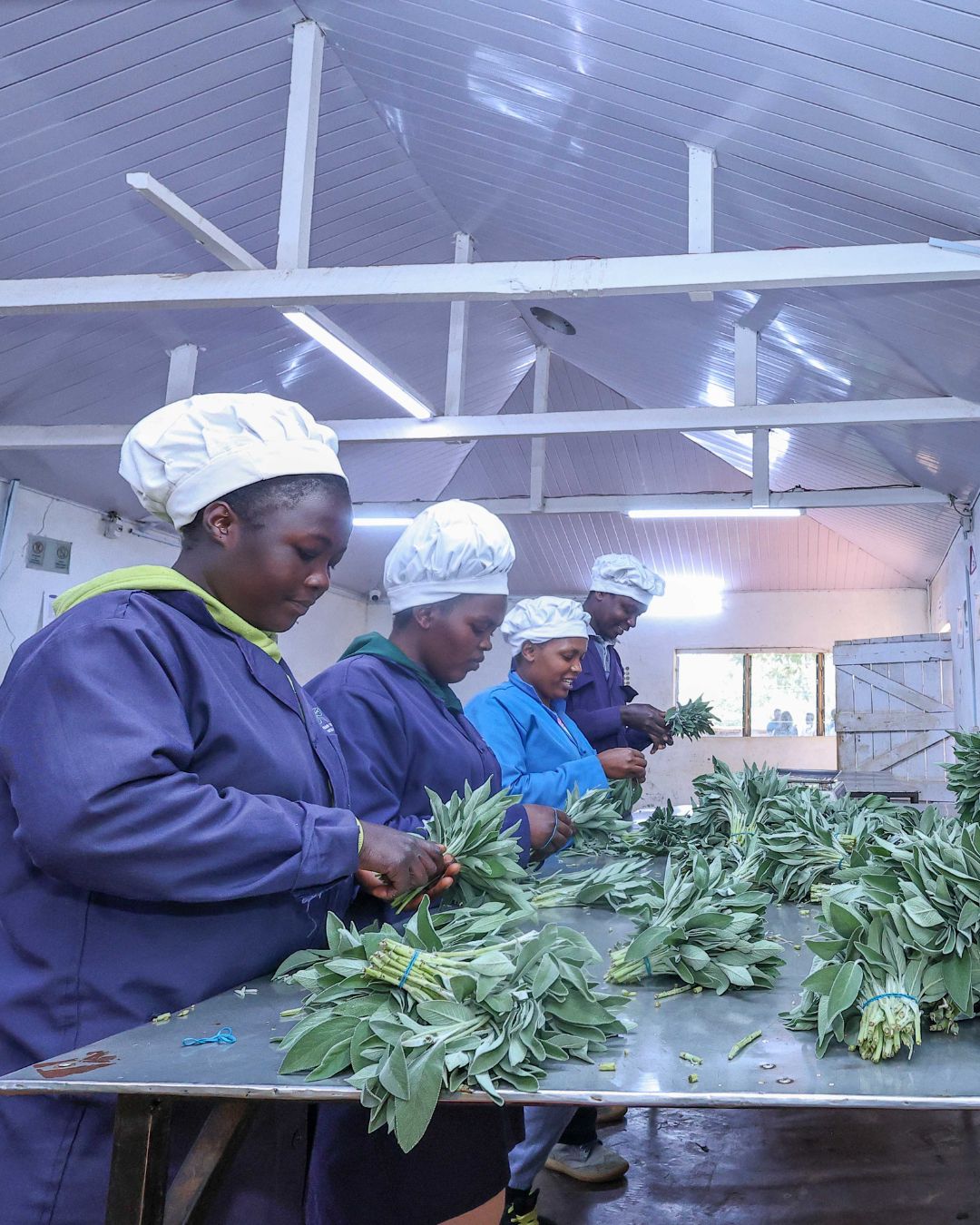
Post-harvest handling determines market acceptance. Cool herbs immediately after harvest. Hydro-cooling or forced-air cooling removes field heat. Pack in clean, ventilated containers. Transport in refrigerated vehicles to maintain quality.
Where to Sell Herbs in Kenya
Where to sell herbs in Kenya depends on your scale and quality standards.
Supermarkets like Naivas, Quickmart, and Carrefour stock fresh herbs year-round. They require consistent supply, proper packaging, and reliable delivery. Approach their procurement departments with samples and a supply proposal. Supermarkets pay within 30 to 60 days and provide steady demand.
Hotels and restaurants need daily supply of fresh herbs. Five-star hotels in Nairobi, Mombasa, and tourist destinations use herbs extensively. Approach their chefs directly with samples. Build relationships for consistent orders.
Exporters offer the highest prices but require GlobalGAP certification. Companies like Taste Kenya and Vegpro export herbs to European markets. Contract farming arrangements provide technical support and guaranteed prices. Export prices for basil range from 250 to 350 shillings per kilogram.
Fresh produce markets serve smaller farmers. Wakulima Market in Nairobi, Kongowea in Mombasa, and other regional markets have herb sections. Prices are lower but payment is immediate.
Herbs Contract Farming in Kenya
Herbs contract farming in Kenya offers security for farmers willing to meet exporter standards. Companies provide seedlings, technical support, and guaranteed markets in exchange for quality produce.
Exporters require GlobalGAP certification. This international standard covers food safety, environmental sustainability, and worker welfare. Certification costs 50,000 to 100,000 shillings initially, with annual renewal fees. Many exporters assist farmers with certification.
Contract terms specify quality standards, delivery schedules, and prices. Read contracts carefully before signing. Understand your obligations and the exporter’s commitments.
Benefits of contract farming include technical support, guaranteed prices, and market access. Farmers avoid the stress of finding buyers and price negotiations. The exporter invests in your success.
Financial Projections for One Acre on Herbs Farming in Kenya
Production costs for one acre of mixed herbs include seedlings, land preparation, irrigation, labor, and pest control.
| Cost Item | Amount |
|---|---|
| Seedlings (15,000 at KSh 15 average) | 225,000 KSh |
| Land preparation | 15,000 KSh |
| Drip irrigation system | 75,000 KSh |
| Manure and fertilizer | 25,000 KSh |
| Labor (planting, weeding, harvest) | 120,000 KSh |
| Pest control | 20,000 KSh |
| Packaging materials | 30,000 KSh |
| Total First-Year Investment | 510,000 KSh |
Annual revenue from one acre of mixed herbs averages 1.2 million shillings based on the profitability table. Net profit after first-year costs is 690,000 shillings. In subsequent years, profit exceeds 900,000 shillings annually.
Next Step
Herbs farming in Kenya offers one of the most accessible and profitable opportunities in horticulture. Basil matures in 45 days. Coriander in 30 days. Perennial herbs provide years of production. Monthly incomes reach 100,000 to 300,000 shillings from well-managed plots.
The 2026 planting windows approach. March to May and September to October offer ideal conditions. Your seedlings are waiting at Farmers Trend Ltd nurseries. The Virtual Agrovet platform makes ordering simple.
Start with soil testing to know your pH and nutrient levels. Choose 2 to 3 herbs for your first season. Basil, coriander, and mint offer quick returns and established markets.
Prepare your land thoroughly. Install drip irrigation for consistent moisture. Order certified seedlings from Farmers Trend Ltd through their Virtual Agrovet platform.
The farmers earning substantial incomes from herbs started exactly where you are now. They learned, they planned, and they took action. You can do the same.
Your herbs farming in Kenya journey begins today. The market is waiting. The profits are real. The time to act is now.
https://farmerstrend.co.ke/trending/herbs-farming-in-kenya-contract-farming/https://farmerstrend.co.ke/wp-content/uploads/2026/03/open-field-herbs-farm-in-kenya.jpghttps://farmerstrend.co.ke/wp-content/uploads/2026/03/open-field-herbs-farm-in-kenya-150x150.jpg# TrendingHerbs Farming In Kenyabasil farming in kenya,Coriander yield per acre Kenya,Farmers Trend herbs seedlings,Fresh herbs market Nairobi,GlobalGAP certification herbs Kenya,Herb export companies Kenya,Herb farming business plan Kenya,Herb seedlings price Kenya,Herbs contract farming in Kenya,Herbs profitability per acre,Mint farming Kenya,Most profitable herbs to grow in Kenya,Rosemary farming Kenya,Virtual agrovet herbs,Where to sell herbs in KenyaHerbs Farming in Kenya: The 2026 Definitive Guide to Commercial Success and Export Herbs farming in Kenya has evolved from a kitchen garden activity into a sophisticated export-oriented business with million-shilling potential. Walk through the fertile fields of Kiambu, the highlands of Nyeri, or the organized farms in Naivasha, and...FarmersTrendjohn doefarmerstrend@gmail.comAdministratorFarmers Trend Ltd.

Leave a Reply