How Climate Change is Reshaping Farming in Kenya’s Nyandarua and Laikipia Counties
- Discover how climate change is reshaping farming in Nyandarua and Laikipia Counties. Learn how farmers are adapting with intercropping, staggered planting, and drought-resistant crops to combat unpredictable weather.
- Kenyan farmers are abandoning traditional planting calendars due to erratic rainfall. Find out how this shift impacts food security, pest control, and local agricultural trade in Nyandarua and Laikipia.

The landscape of farming in Kenya’s Nyandarua and Laikipia Counties has undergone a dramatic transformation as changing weather patterns disrupt generations-old agricultural practices.
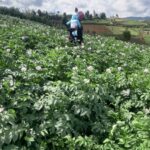
Where farms once displayed uniform crops stretching across the horizon, today’s fields present a patchwork of crops at various growth stages – a visible testament to farmers’ attempts to adapt to increasingly unpredictable weather.
Traditionally, farmers in these regions followed well-established planting calendars, preparing their lands between January and early March for the long rains season.
This synchronised approach allowed for efficient resource allocation, pest management, and community-wide farming practices. However, climate change has forced farmers to abandon this time-tested system in favour of opportunistic planting, sowing their crops whenever rain appears.
“The secret I have adopted is inter-cropping maize and beans, unlike before, where I planted both crops separately,” explains John Njuguna, a farmer in Ndaragua Constituency. His story illustrates the new reality facing farmers in the region. Mr Njuguna has divided his acre of land into three sections, a strategy that represents both adaptation and compromise. In October, he inter-cropped maize and beans on half an acre, but by December, the maize had withered due to insufficient rainfall. While he managed to salvage the failed maize crop as silage for his dairy cows and goats, he harvested only one bag of beans – barely enough to cover his production costs for both crops.
This shift to smaller, staggered planting areas marks a significant departure from past practices where farmers would prepare their entire acreage for a single planting season. While this new approach helps manage risk, it comes with considerable challenges for food security. Farmers now produce smaller quantities, often just enough for family consumption, rather than the surplus needed for commercial sales and broader food security.
The ripple effects of these changes extend beyond the farm gate. Agricultural input traders, who previously stocked their inventories based on predictable planting seasons, now struggle to maintain appropriate stock levels.
“We were used to stocking the seeds and other inputs guided by planting season,” says Felister Ndirangu, an agronomist and agro-vet dealer in Ndaragua. “From late January, we stocked enough seeds for the long rains, stored to be used up by the end of March. But now, drought-tolerant seeds are in increasing demand throughout the year,” she said.
The unsynchronised planting has created unexpected challenges in pest management. When farmers planted simultaneously, the risk of bird damage was distributed across many farms. Now, isolated maturing crops become targets for concentrated bird attacks.
Anthony Mwangi from Witeithie village in Laikipia experiences this firsthand, spending significant time protecting his one-acre maize plot from birds.
“I have five acres but I decided to plant maize in one acre, fearing huge losses if rains failed. I have to spend more time battling the birds because there is no other farm with maturing maize,” he explained.
The changing patterns have also complicated the work of agricultural extension officers, who struggle to provide timely guidance to farmers planting at different times.
In response, the Nyandarua County government has launched an innovative programme, training 200 young people in agricultural entrepreneurship to supplement the work of extension officers. These youth entrepreneurs provide valuable support to local farmers, helping them access inputs, improve farming techniques, and find markets for their produce. The programme also incorporates training in climate-smart farming practices, recognising the need to build resilience against future climate challenges.
Some farmers have found unexpected advantages in the new reality. Lydia Wambui’s experience in Pesi, Laikipia County, demonstrates how crop diversification can help manage risk. When she planted both cabbages and onions in September, the onions thrived while the cabbages suffered from pest attacks during a dry spell. Her experience highlights the importance of choosing crops with different resilience levels to weather variations.
The shift in farming practices has particular significance in drier areas, where farmers have historically struggled with weather variability. These regions have become testing grounds for new adaptation strategies, with farmers experimenting with different crop combinations and planting times to find what works best in their specific conditions.
However, these adaptations come with trade-offs. The inability to practise proper crop rotation due to staggered planting increases the risk of pests and diseases. Traditional pest management strategies, which relied on community-wide planting and harvesting times, are becoming less effective. Farmers must now invest more in individual pest control measures, adding to their production costs.
The changes also affect traditional farming knowledge transmission. As weather patterns become less predictable, the agricultural wisdom passed down through generations becomes less reliable. Farmers must now develop new skills and knowledge bases, learning to read weather patterns and make planting decisions based on immediate conditions rather than traditional calendars.
While farmers have shown remarkable adaptability, the current solutions may not be sustainable in the long term. The reduced scale of farming operations threatens both local food security and agricultural commerce, while the increased complexity of farming operations demands more resources from already stretched farmers.











Leave a Reply