From Farm to Market: The Broken Economics of Potatoes in Kenya
Discover the true cost of potato farming in Kenya, from farm to market, and why farmers earn the least while consumers pay the most.

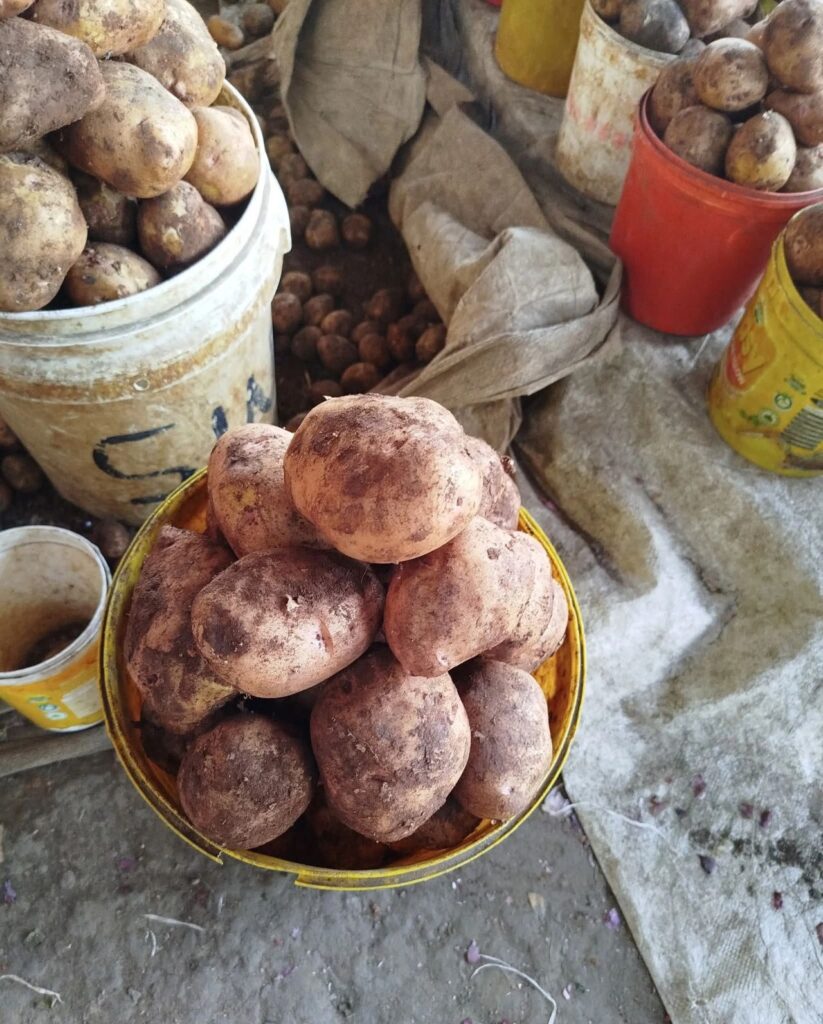
Potatoes are a staple in Kenya — but to most farmers, they’ve become a symbol of struggle rather than sustenance.
In Meru, Nyandarua, and Nakuru’s highlands, there are many smallholder farmers who relies on potato farming for their daily bread. Kenya is one of the leading producers of potatoes in Sub-Saharan Africa, second only to South Africa. The crop adds more than Ksh 50 billion to the economy every year and covers more than 160,000 hectares of land across 20 counties and is eaten by millions of households and rural economies.
Behind such encouraging figures, lies a sobering truth. For all the magnitude and significance of potato farming, those driving the harvest are often doing so in the red. A 2022 report by the Ministry of Agriculture established that more than 60% of Kenya’s potato farmers make less than Ksh 20,000 per acre per season, yet spend close to the same amount — or more — on inputs, transport, and general operations. Even worse, post-harvest losses owing to improper handling, storage, and access to markets stand at 30 to 40% on average, which means spoiling months of labor in a matter of days.
The market is extremely fragmented. In the absence of robust farmer cooperatives or guaranteed contracts, farmers must negotiate with middlemen or brokers — usually at harvesting time when they’re most vulnerable.
Government regulation, like the 2019 Irish Potato Regulations that compulsorily require standard 50kg packaging, has proved hard to implement at the ground level. The net result is a supply chain in which the risks are great, margins are small, and the profits accrue to all except the farmer.
Farm Gate Reality
Let us follow the journey of a standard 80kg sack of potatoes, beginning with one in a Nyandarua farm.
The farmer will sell the bag for Ksh 1,500 to Ksh 1,800 at harvesting time. That is what the market will bear — forget the labor invested, the increasing price of inputs, or the quality of the crop. These farmers have struggled with erratic rainfall, expensive seeds, costly fertilizer, and deteriorating soils. Most lack cold storage, and so they are hard-pressed to sell as soon as possible before the produce starts to rot.
The causes of such minimal prices are not difficult to establish:
- Luck of storage equates to perishability panic — the produce has to be shifted fast, regardless of the cost.
- Lacking direct market access, farmers are left at the mercy of intermediaries.
- Oversupplies during harvest overwhelm the market and drive prices even further down.
The power structures are straightforward. The farmer, though performing the hardest labor, possesses the least power. They stand the most to lose — and gain the smallest reward.
Wholesale Market: The Middleman’s Margin
The moment the bag departs the farm, it goes into the non-transparent middle layer — the wholesale market. In Nairobi centers such as Marikiti, Wakulima, or Gikomba, the same bag now sells for Ksh 2,200 to Ksh 2,700, if not more, subject to demand and time of year.
Why does the price go up?
- Transportation from Nyandarua to Nairobi costs between Ksh 300 to 500 per bag.
- Handling, loading, and packaging fees add another chunk.
- County cess and unofficial “fees” also diminish the value.
- Transit losses — through spoilage, rough handling, or theft — silently pad prices.
By then, there’s a 30–50% markup over the farm gate price — none of which makes it to the farmer. It goes to logistics, unseen charges, and profit margins for middlemen who did not dig, plant, or harvest one tuber.
Retail Price: Where The Real Profits Lie
And then there is the last lap: retail.
It is split into 2kg tins that are sold between Ksh 80 to 120, depending on the location and time of year, in open-air markets such as Kawangware, Githurai, Kangemi, or Umoja.
Let’s do the math:
- 80kg / 2kg tins = 40 tins
- 40 cans × Ksh 100 (average price) = Ksh 4,000 per bag
This means the farmer who sold the same bag for Ksh 1,500 now receives almost three times more money. Maximum profit margins occur not where value is being created but where value is being transferred. Retailers and middlemen at the end of the chain are scooping the profits — while the farmer is left at the beginning, struggling to make ends meet.
Who’s Actually Making What?
Let’s break it down:
- Farmer: Ksh 1,500 – 1,800
- Logistics chain (transport, handlers, cess): ~Ksh 400 – 600
- Retailer/broker: Ksh 1,500 – 2,000+
Consumer: Pays the most, without knowing who gets the profit in the end
It’s a chain where the value is created by the farmer but he or she earns the least. The consumer pays more in the hope of supporting farming, but the lion’s share of their money goes to middlemen. The real beneficiaries? Middlemen who risked nothing but earn on each sale.
The System is Broken — But It Can Be Fixed
This is not a potato tale. This is a snapshot of how not to build an agricultural economy. The inefficiencies in our food chains — lack of infrastructure, opacity, over-reliance on middlemen, insufficient cold storage — are costing both sides of the chain. Farmers lose revenue. Consumers lose confidence. The country loses the potential for food sovereignty and rural growth.
There is, however, a different direction.
What We’re Building
At Farmers Trend and through the work of grassroots innovators across Kenya, we’re not romanticizing farming. We’re re-engineering the chain.
- Producer-driven, market-based systems that appreciate producer voice and actual data
- Digital market access solutions to allow farmers to be aware of real-time prices and directly connect with buyers
- Integrated logistics that minimize unit cost and cut out unnecessary transport intermediaries
- Direct B2B and B2C sites to enable farmers to sell directly to retailers or consumers
Cold storage and aggregation centers to provide farmers with breathing space and negotiating power There is no magic solution. But this is a genuine beginning.
A Potato Need Not Be a Symbol of Loss If the farmer prosper, the consumer dines well, and the economy grows.
A more equitable, more transparent, and more efficient potato value chain isn’t merely good business — it’s a moral imperative. For food systems aren’t only concerned with food. They’re concerned about people.
Let’s repair the food chain. Let’s get agriculture to make sense again. Let us restore dignity to the potato — and to its farmers.
Article Credit: Read original article HERE
https://farmerstrend.co.ke/trending/from-farm-to-market-the-broken-economics-of-potatoes-in-kenya/https://farmerstrend.co.ke/wp-content/uploads/2025/06/1749756169204-823x1024.jpeghttps://farmerstrend.co.ke/wp-content/uploads/2025/06/1749756169204-150x150.jpeg# TrendingPotato Farmingagricultural logistics Kenya,agriculture in kenya,B2B agriculture Kenya,digital agriculture solutions,farm gate prices,farmer income Kenya,farmer market access,food system Kenya,Gikomba potatoes,kenyan farmers,Marikiti market,Nyandarua potatoes,post-harvest losses,potato aggregation centers,potato brokers,potato farming in kenya,potato retail prices,potato storage Kenya,potato value chain,Wakulima marketDiscover the true cost of potato farming in Kenya, from farm to market, and why farmers earn the least while consumers pay the most.Potatoes are a staple in Kenya — but to most farmers, they've become a symbol of struggle rather than sustenance.In Meru, Nyandarua, and Nakuru's highlands, there...FarmersTrendjohn doefarmerstrend@gmail.comAdministratorFarmers Trend Ltd.












Leave a Reply