Agricultural Financing in Africa AfDB Warned by Civil Society Against Industrial Livestock Push
Civil society organisations have urged financial institutions to provide clearer guidance and stronger safeguards for agricultural financing.
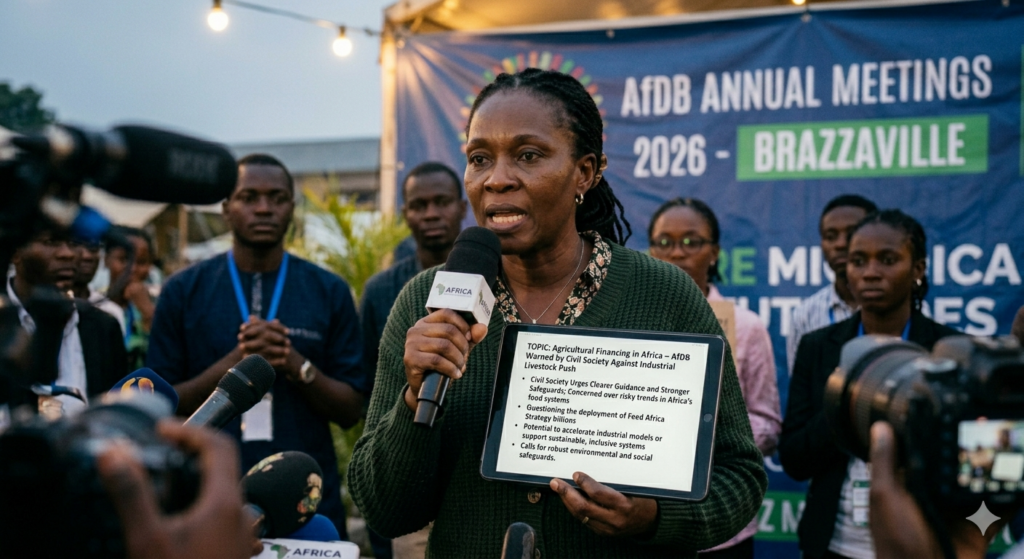
This appeal was made as the African Development Bank (AfDB) was holding its 2026 Annual Meetings in Brazzaville, Republic of Congo. The groups warned that the current investment trends could steer Africa’s food systems in risky and unsustainable directions.
The Stop Financing Factory Farming coalition, comprising more than 30 organisations, says there is growing concern over how the billions of dollars expected to flow through the AfDB’s Feed Africa Strategy would be deployed, and whether they will support sustainable, inclusive food systems or accelerate industrial agricultural models.
The Feed Africa Strategy estimates that transforming agriculture on the continent will require between $315 billion (Sh40.82 trillion) and $400 billion (Ksh51.8 trillion) over the next decade. The AfDB has committed approximately $24 billion (Sh3.11 trillion) to help mobilise additional public and private investment.
While acknowledging the urgency of addressing hunger, climate shocks and food insecurity, the groups warn that financing models that focus heavily on large-scale industrial agriculture and livestock production without robust safeguards could exacerbate environmental degradation, biodiversity loss and public health risks.
“Development finance decisions made today will shape agricultural systems, land use and rural economies across Africa for decades,” Roselilly Ushewokunze, the executive director of the Food Justice Network, said in a statement.
She called for investment to strengthen food sovereignty, climate resilience, and community-led production systems.
Recent initiatives backed by the AfDB, such as Special Agro-Industrial Processing Zones (SAPZs) and blended finance partnerships with international institutions, are expected to lead to an increase in private-sector driven agricultural investment across Africa.
However, campaigners argue that expanding industrial livestock and monoculture production could put pressure on natural resources and smallholder farmers.
“Harmful impacts can emerge when investment prioritises rapid production growth and export competitiveness without fully accounting for environmental sustainability and smallholder livelihoods,” said Salome Kahiu, External Affairs Lead at World Animal Protection.
Studies cited by a coalition of civil organisations indicate that the use of antimicrobials in livestock production across several African countries was estimated to be between 3,558 and 4,279 tonnes between 2015 and 2019. Projections suggest that this figure will increase if industrial systems expand.
The organisations are also concerned about broader risks linked to industrial agriculture, including deforestation, water stress, greenhouse gas emissions, and growing competition for land.
As African countries grapple with climate shocks, debt pressures and persistent food insecurity, civil society groups say that the stakes have risen beyond investment volumes to encompass the nature of the food systems being financed.
“The debate is not simply about agricultural growth, but what kind of food systems are being locked in through public development finance,” said Opeyemi Elujulo, Policy and Campaign Coordinator at the Stop Financing Factory Farming Coalition.
The coalition is urging the AfDB to stop financing industrial livestock systems that are linked to environmental degradation, to scale up its support for smallholder farmers and pastoralists, and to increase its investment in agroecological and climate-resilient farming approaches.
They are also calling for greater transparency and accountability in the bank’s agricultural lending and value chain investments.
By Sammy Waweru
https://farmerstrend.co.ke/trending/agricultural-financing-in-africa-afdb/https://farmerstrend.co.ke/wp-content/uploads/2026/06/Gemini_Generated_Image_g2qqo2g2qqo2g2qq-1024x559.pnghttps://farmerstrend.co.ke/wp-content/uploads/2026/06/Gemini_Generated_Image_g2qqo2g2qqo2g2qq-150x150.png# TrendingCivil society organisations have urged financial institutions to provide clearer guidance and stronger safeguards for agricultural financing.This appeal was made as the African Development Bank (AfDB) was holding its 2026 Annual Meetings in Brazzaville, Republic of Congo. The groups warned that the current investment trends could steer Africa’s food...FarmersTrendjohn doe[email protected]AdministratorFarmers Trend Ltd.





Leave a Reply