Complete Banana Farming in Kenya Guide: Profit Per Acre, Costs & 2026 Expert Tips
Banana farming in Kenya is one of the most established and reliable agricultural businesses in the country. Bananas are grown on small family plots and large commercial farms across many regions. The crop provides food security and regular income for thousands of Kenyan families. Understanding the proper methods for banana farming in Kenya can transform a simple garden crop into a major source of serious cash. This guide by Farmers Trend Ltd. explains everything from selecting the right variety to getting the best price at the market.

Profit Potential in Banana Farming
The question of how profitable banana farming in Kenya can be depends completely on management. A poorly managed farm may struggle, while a well-managed one can generate substantial wealth.
Let us look at the numbers. On one acre of land, a farmer using good spacing can plant about 450 banana plants. Each mature banana plant can produce one bunch per year. The average bunch weight varies by variety, but a common Cavendish variety can yield 30 to 50 kilograms per bunch.
If we take a conservative average of 35 kilograms per bunch, one acre produces 450 bunches x 35 kg = 15,750 kilograms of bananas per year. The price of bananas in Kenya changes with season and location, but a common farm-gate price is between KSh 15 and KSh 25 per kilogram.
Using a price of KSh 20 per kilogram, the gross annual income from one acre is 15,750 kg x KSh 20 = KSh 315,000. This is the income from selling the fruit alone. A smart farmer can also sell banana leaves, stems, and suckers for additional income.
After accounting for costs of labor, fertilizer, pest control, and harvesting, the net annual profit from one acre of well-managed banana farming in Kenya often ranges between KSh 180,000 and KSh 250,000. This steady annual income is why bananas are considered a reliable cash crop.
When comparing which crop has the highest profit per acre in Kenya, bananas are consistently in the top tier for smallholder farmers because of their year-round production and stable market.
Best Banana Varieties for Kenyan Farms
Choosing the right variety is the first critical decision in banana farming in Kenya. Different varieties serve different markets and climates.
The most common commercial variety is the Giant Cavendish. It is preferred for its high yield, large bunch size, and good transport quality. It is the banana you most commonly see in urban markets.
For cooking, the Muraru and Uganda Green varieties are popular. These are starchier and hold their shape when cooked. They are often preferred in rural households and local markets.
For a sweet dessert banana, the Apple Banana or Chinese banana is excellent. These are smaller, sweeter, and often command a higher price in niche markets. Sweet banana farming in Kenya using these varieties can be particularly profitable near urban centres.
The choice of which banana breed is best depends on your target market and local growing conditions. Visiting successful farms in your area through networks like Farmers Trend can give you a clear idea of what works best locally.
Correct Spacing for Maximum Yield
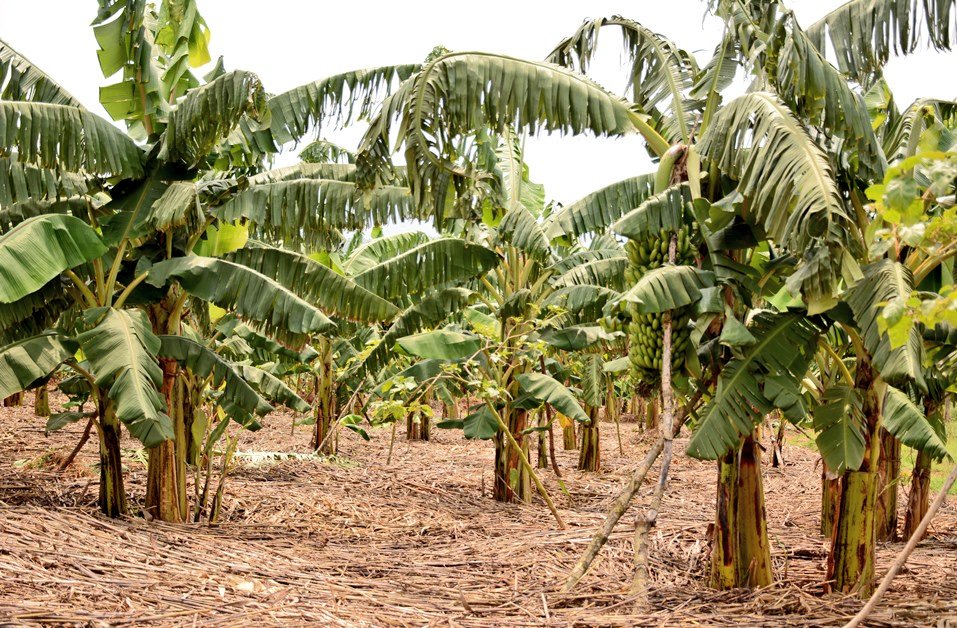
One of the most common mistakes in banana farming in Kenya is poor spacing. Plants placed too close together compete for sunlight, water, and nutrients, resulting in small bunches and disease spread.
The recommended spacing for bananas in Kenya is 3 meters by 3 meters. This means each plant is 3 meters from its neighbor in every direction. In one acre, which measures approximately 70 meters by 70 meters, this spacing allows for about 450 plants.
For those practicing modern banana farming with irrigation and intensive management, a spacing of 2.5 meters by 2.5 meters can be used to increase plant population to around 650 plants per acre. However, this closer spacing requires excellent management and fertile soil to avoid problems.
Proper spacing allows for easy movement for weeding, spraying, and harvesting. It also lets sunlight reach all parts of the plant, which is crucial for fruit development. Good air circulation between plants helps prevent fungal diseases that thrive in damp, crowded conditions.
Growth Timeline and Planting Schedule
Understanding how many months it takes for a banana to grow helps with planning and expectation management. From planting a tissue culture seedling or a healthy sucker, it takes about 9 to 12 months for the plant to produce its first flower. The flower then takes another 3 to 4 months to develop into a mature bunch ready for harvest.
This means from planting to first harvest is typically 12 to 16 months. After the mother plant produces its bunch, it will then produce suckers that will become the next generation of bearing plants. A well-managed banana field can therefore produce continuously for many years from the initial planting.
Regarding which month is best for banana plantation in Kenya, the beginning of the long rains in March or April is ideal. Planting at this time gives the young plants ample water to establish their root systems without the stress of irrigation. However, with reliable irrigation, bananas can be planted at any time of the year.
Fertilizer and Nutrient Management
Bananas are heavy feeders that require regular nutrition for optimal production. The question of which top dressing fertilizer for bananas in Kenya is best has a clear answer: a balanced approach is key.
At planting, incorporate plenty of well-rotted farmyard manure into the planting hole, about 20 kilograms per hole. This provides slow-release nutrients and improves soil structure.
For chemical fertilizers, a compound fertilizer with a ratio like 17:17:17 (Nitrogen, Phosphorus, Potassium) is good for young plants. As the plant matures and begins to flower, it needs more potassium. The best fertilizer for bananas in Kenya during the fruiting stage is one high in potassium, such as 10:10:20 or similar ratio.
A common fertilization schedule for banana farming in Kenya is:
- Month 1-3 after planting: Apply 100g of 17:17:17 per plant every month
- Month 4-6: Apply 150g of 17:17:17 per plant every month
- From flowering: Apply 200g of a high-potassium fertilizer (like 10:10:20) every two months
Always split fertilizer applications rather than applying all at once. Water the fertilizer in well after application. Regular leaf analysis can help tailor your fertilizer program to your specific soil conditions.
Major Challenges and Solutions in Banana Farming
Successful banana farming in Kenya requires overcoming several common challenges. Understanding these problems before they occur is the best defense.
Pests are a constant concern. The banana weevil borer is perhaps the most destructive. The adult beetle lays eggs at the base of the plant, and the larvae tunnel into the corm, weakening and sometimes killing the plant. Regular clean cultivation, use of pheromone traps, and application of recommended insecticides can control this pest.
Diseases pose another major challenge. Black Sigatoka, a fungal leaf spot disease, can reduce yields by up to 50% if not controlled. It causes dark spots on leaves that eventually kill large sections of the leaf surface. Fungicide sprays on a regular schedule are necessary in humid areas. Choosing resistant varieties is the best long-term strategy.
Bacterial wilt, spread by insects and farm tools, can devastate entire plantations. There is no cure once a plant is infected. The only control is prevention through using clean planting material, disinfecting tools, and removing and destroying infected plants immediately.
Market access and price fluctuations represent economic challenges. Having a reliable buyer before harvest and considering value-added products like banana flour or chips can help stabilize income.
Harvesting and Marketing Your Bananas
Knowing when and how to harvest significantly affects both yield and market price. Bananas should be harvested when the fruit is mature but still green. The right time is when the fingers are plump and the small flowers at the tip of the fingers are dry and rub off easily.
Harvest early in the morning when temperatures are cool. Cut the stem with a sharp knife, leaving a long stalk for carrying. Handle bunches carefully to avoid bruising, as damaged fruit fetches much lower prices.
The question of where to sell bananas in Kenya has several answers. Local markets are accessible but prices may be lower. Urban markets in cities like Nairobi, Mombasa, and Kisumu offer better prices but involve transport costs. Some large-scale farmers sell directly to supermarkets or processors. Export markets to the Middle East are growing but require certification and consistent high quality.
To increase banana yield and get the most money from your farm, consider these tips: practice regular de-suckering to leave only 2-3 healthy followers per mat, remove the male bud after the last hand of fruit has set to direct energy to the developing fruit, and prop up heavy bunches with poles to prevent stem breakage.
County Production and Market Dynamics
Meru County is widely recognized as the area which produces the most bananas in Kenya. The fertile soils and favorable climate in areas around Meru have made it the banana basket of the country. Other major producing counties include Kisii, Embu, Kirinyaga, and Murang’a.
The concentration of production in these areas has led to the development of collection markets and some processing facilities. However, this also means farmers in these regions face more competition and sometimes lower prices during peak seasons. Farmers in non-traditional banana areas may find less competition and better prices if they can produce quality fruit.
The question of whether the banana trade is fair in Kenya is complex. While prices fluctuate with supply and demand, farmers with better market information and collective bargaining power through cooperatives tend to fare better. Organizations like the Kenya Agricultural and Livestock Research Organization (KALRO) provide market intelligence that can help farmers make better selling decisions.
Starting Your Banana Farming Business
For those wondering how to start a profitable banana farming business in Kenya, the process begins with thorough planning. Start with a clear banana farming business plan that includes all costs: land preparation, planting materials, irrigation, labor, inputs, and marketing.
Begin with a manageable size, perhaps half an acre, to learn the practical aspects before expanding. Source clean planting material, preferably tissue culture plants from certified nurseries. These are disease-free and will give uniform growth and fruiting.
Prepare your land properly by deep plowing and incorporating organic matter. Plant at the correct spacing and install irrigation if rainfall is unreliable. Implement a regular schedule for fertilization, weeding, and pest control from the beginning.
Keep good records of all expenses and income. This will help you understand your true profit and guide decisions about scaling up. Connect with other banana farmers to learn from their experience and possibly collaborate on marketing.
Long-Term Sustainability and Innovation
The future of banana farming in Kenya lies in adopting sustainable practices and modern techniques. Soil conservation through mulching with banana leaves and stems helps retain moisture and suppress weeds while recycling nutrients.
Integrated pest management reduces reliance on chemicals. This includes using biological controls, pheromone traps for weevils, and planting trap crops. Drip irrigation saves water and delivers fertilizer directly to the roots through fertigation.
Exploring value addition can significantly increase income from the same harvest. Simple processing like making banana chips, flour, or wine can multiply the value of the raw fruit. Some farmers are also finding markets for banana fiber for crafts and paper making.
Continuous learning is essential. Attend farmer field days, read the latest banana farming in Kenya PDF guides from research institutions, and experiment with new techniques on a small scale before adopting them widely. The most successful banana farmers are those who view their farm as a constantly evolving business that adapts to new challenges and opportunities.
Conclusion
Banana farming in Kenya offers a proven pathway to agricultural success for those willing to apply good management practices. While challenges exist, they can be overcome with knowledge and diligence. The key to high profits lies in attention to detail: selecting the right variety, maintaining optimal plant population through correct spacing, providing balanced nutrition, controlling pests and diseases proactively, and marketing strategically.
The steady demand for bananas in Kenya, both for fresh consumption and processing, ensures that well-produced fruit will always find a market. By starting with a clear plan, learning continuously, and managing the crop with care, a banana farm can provide a stable and growing income for many years. The journey begins with that first well-prepared planting hole and continues through each carefully harvested bunch that makes its way to appreciative consumers.
https://farmerstrend.co.ke/trending/banana-farming-in-kenya-profit-guide/https://farmerstrend.co.ke/wp-content/uploads/2025/12/GcFQr0cXMAI-cri.jpeghttps://farmerstrend.co.ke/wp-content/uploads/2025/12/GcFQr0cXMAI-cri-150x150.jpeg# TrendingBanana FarmingFruitsBanana farming in Kenya is one of the most established and reliable agricultural businesses in the country. Bananas are grown on small family plots and large commercial farms across many regions. The crop provides food security and regular income for thousands of Kenyan families. Understanding the proper methods for banana farming...FarmersTrendjohn doefarmerstrend@gmail.comAdministratorFarmers Trend Ltd.










Leave a Reply