Kenya Livestock Sector: The Push Toward a Ksh1 Trillion Industry
For generations, Kenya’s pastoralist communities have kept the country fed while staying largely outside the economy they were feeding. That imbalance is starting to shift, and the numbers behind the shift are hard to ignore.
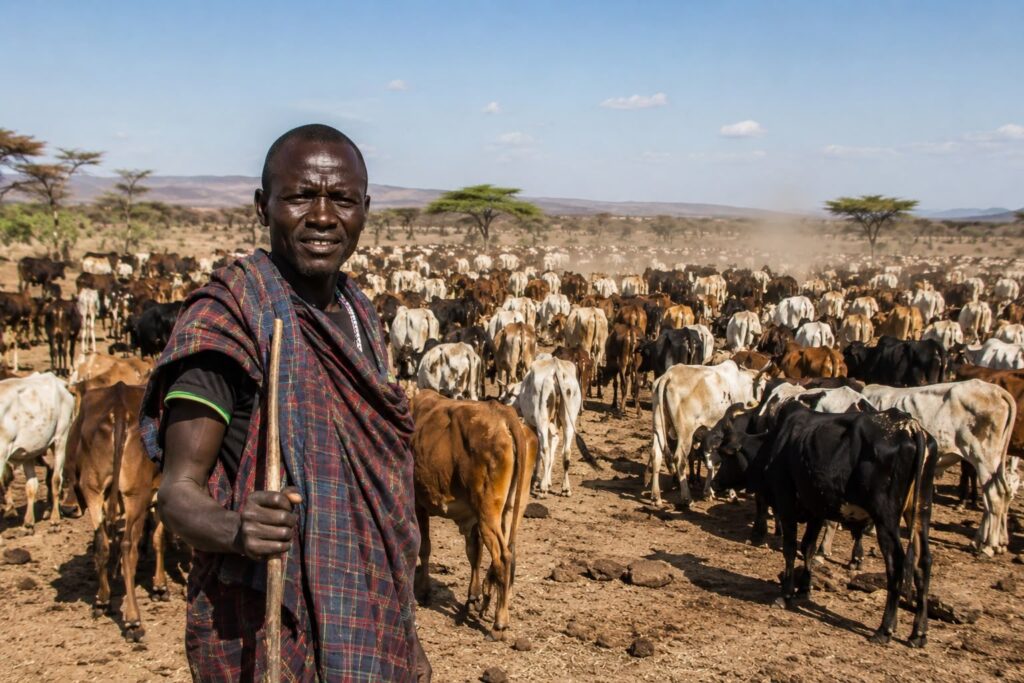
Kenya has overtaken Egypt as Africa’s top milk producer, with annual output climbing from 4.6 billion to 5.4 billion litres. Meat exports have jumped 87 percent, from Ksh8.9 billion to Ksh16.4 billion, while dairy exports have nearly tripled, from Ksh4.9 billion to Ksh14.2 billion. Behind those figures sit real households — farmers earning more, families with steadier incomes, and a sector finally starting to realise its potential.
The ambition doesn’t stop there. Government officials have set a target of turning livestock and meat into a Ksh1 trillion industry, built on four pillars: genetics, disease control, traceability, and aggregation.
Pillar 1: Better Genetics, Better Yields
Every productive livestock sector starts with genetics. Through the National Livestock Breeding Programme and the Kenya Animal Genetic Resources Centre (KAGRC), more than 1.7 million doses of bull semen have been distributed, backed by a reserve of over 724,000 straws.
A presidential directive has also slashed the price of subsidised sexed semen from Ksh8,000 to just Ksh1,000, putting better breeding within reach of smallholder farmers. Kenya has even begun exporting semen to Sierra Leone, Mauritius, Rwanda, Burundi, and Nigeria — positioning itself as a regional genetics hub.
Pillar 2: Disease Control at Scale
No commercial livestock sector survives without disease control. Since the National Mass Livestock Vaccination campaign launched in January 2025, more than 18 million animals have been vaccinated against Foot and Mouth Disease and Peste des Petits Ruminants — two diseases that have historically wiped out herds and livelihoods.
Meanwhile, the Kenya Veterinary Vaccines Production Institute (KEVEVAPI) has produced over 114 million vaccine doses since August 2022, with annual output growing more than 500 percent, from 6.6 million to 41 million doses. This isn’t only about animal welfare — it underpins national food security and Kenya’s ability to keep exporting to international markets that demand disease-free supply chains.
Pillar 3: Traceability from Farm to Fork
The third pillar is traceability, delivered through ANITRAC — Kenya’s digital livestock identification system. Every animal is tagged with an RFID chip and tracked across its entire life cycle, from birth to processing.
Already piloted on government farms and private ranches, with a nationwide rollout underway, ANITRAC does more than track livestock. It unlocks access to premium markets in the EU and Middle East that require traceability as a condition of entry, strengthens disease surveillance, discourages illegal livestock movement, and turns animals into bankable assets that farmers can use for financial inclusion.
Pillar 4: Aggregation Through CLICs
The final pillar reshapes how pastoralists participate in the value chain. Just as tea farmers own KTDA and dairy farmers own cooperatives, pastoralists are now getting their own County Livestock Investment Companies (CLICs) — professionally run, commercially oriented businesses owned primarily by pastoralists, with public and private capital behind them.
Through CLICs, pastoralists gain access to organised markets and finance, become shareholders in the value chain rather than price-takers at its edges, and sell collectively to high-value export markets — shielded from exploitation by brokers.
Backing this up is a Ksh5 billion Pastoralist Livestock Business Fund, designed to help over 350,000 pastoralists across 21 ASAL counties set up and run their own CLICs. Phase One alone is expected to improve livelihoods for two million household members.
The Results So Far
The four pillars are designed to reinforce each other: better breeds produce healthier animals, which get vaccinated, traced through ANITRAC, and marketed collectively through CLICs. Early results suggest the model is working —
- Meat exports up 87 percent
- Milk production at record highs
- Over 330,000 pastoralist households now insured under the DRIVE project, covering 2.7 million animals worth Ksh29.3 billion
Why It Matters
The real challenge was never getting Kenyans to own livestock — it’s turning that ownership into commercial value. By investing in genetics, disease control, traceability, and aggregation together, Kenya is trying to build a sector that’s resilient, competitive, and plugged into global markets, rather than one that simply survives season to season.
For the pastoralist communities who have carried this sector for decades with little to show for it economically, the message from this year’s Kenya Meat Expo is direct: the shift from herd to wealth is underway.
Based on remarks by Jonathan Mueke, Principal Secretary, State Department for Livestock Development, Ministry of Agriculture and Livestock Development, at the 5th Edition of the Kenya Meat Expo and Conference, KICC Nairobi.
https://farmerstrend.co.ke/trending/kenya-livestock-sector-transformation/https://farmerstrend.co.ke/wp-content/uploads/2026/08/Kenya-livestock-sector-1024x683.jpghttps://farmerstrend.co.ke/wp-content/uploads/2026/08/Kenya-livestock-sector-150x150.jpg# TrendingFor generations, Kenya's pastoralist communities have kept the country fed while staying largely outside the economy they were feeding. That imbalance is starting to shift, and the numbers behind the shift are hard to ignore.Kenya has overtaken Egypt as Africa's top milk producer, with annual output climbing from 4.6...FarmersTrendjohn doefarmerstrend@gmail.comAdministratorFarmers Trend Ltd.






Leave a Reply