Tomato Grafting Technology in Kenya Helps Farmer Beat Wilt Disease and Boost Yields
For nearly a year, Hellen Rono has successfully kept tomato wilt disease at bay. She is a farmer from Bomet County in western Kenya. She achieved this using grafting technology introduced through a China-Kenya agricultural collaboration. This came after years of watching her crops perish just before harvest.

Rono discovered the technology through a joint training program. The program was conducted by Egerton University and Nanjing Agricultural University. The technology combines Chinese-sourced rootstock with locally adapted Kenyan tomato seedling varieties.
“The highest yield from the grafted plants was an incredible 73.2 kg per day, while the non-grafted yield peaked at just 8.7 kg before the plants died,” Rono told Xinhua in a recent interview.
Rono is a mother of six. She grows tomatoes commercially for local markets. Her farm uses a 120-square-meter greenhouse. Before learning the grafting technique, she cultivated conventional non-grafted tomato varieties. Even within the controlled greenhouse environment, her crops would gradually wither one after another. This happened just before they reached the critical flowering stage.
“The withering continued until nearly 10 plants were dying each day. That was a huge loss for me because I was growing tomatoes commercially. I was told there was no cure, but I was advised to irrigate the plants heavily to prevent withering. Instead, the situation only worsened,” Rono said.
Agricultural specialists who later inspected her greenhouse found a problem. Excessively high temperatures were aggravating the issue. After receiving training on greenhouse temperature regulation, she made changes. She reduced the number of tomato plants from 500 to 250. This ensured proper spacing and ventilation.
She then introduced grafted seedlings. These seedlings were specifically bred to resist bacterial wilt. “I planted both grafted and non-grafted tomatoes in the same greenhouse. After a month, the non-grafted tomatoes started withering, while the grafted ones began flowering one after another.”
“The disease did not infect them, while the non-grafted ones continued to wither. That is when we realized the grafted tomatoes were resistant to the disease,” she added.
Since adopting the tomato grafting technology in Kenya, Rono has regained confidence. She believes she has found a lasting solution to the destructive tomato wilt disease. The disease has been a major problem for tomato farmers across the country. It attacks the plant’s vascular system, causing it to collapse and die. There are few effective chemical controls. Most are expensive and harmful to the environment.
“It took 75 days for me to start harvesting grafted tomatoes, which was the same period as for the non-grafted ones. However, the non-grafted plants stopped producing much earlier, while I continued harvesting the grafted ones for a longer period,” Rono said.
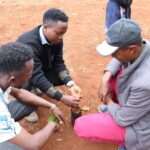
According to project scientists from Egerton University, 18 demonstration sites have been established across Kenya. These sites showcase advanced tomato grafting technology. At these demonstration centers, participating farmers cultivate grafted crops. They achieve a sustained six-month harvest period during each planting season. This is a major improvement over conventional farming. Most tomato farmers get only a few weeks of harvest before wilt kills their plants.
Like Rono, hundreds of farmers participating in the project are expecting bumper harvests in the coming weeks. The technology is spreading. More farmers are learning about grafting. More demonstration sites are being set up. The partnership between Egerton University and Nanjing Agricultural University continues.
The tomato grafting technology in Kenya works by attaching a desirable tomato variety to a resistant rootstock. The rootstock comes from China. It has strong resistance to bacterial wilt and other soil-borne diseases. The top part of the plant, which produces the fruit, comes from a local Kenyan variety. This ensures the tomatoes taste familiar to local consumers.
Farmers who have adopted the technology report fewer losses. They spend less money on pesticides. They get higher yields. They harvest for longer periods. Their incomes have increased. Families who once struggled to pay school fees now have money. Mothers who watched their crops die now watch them thrive.
Rono’s story is not unique. Across Bomet, Kericho, and other tomato-growing counties, farmers are discovering grafting. They are attending training sessions. They are visiting demonstration sites. They are buying grafted seedlings. The change is happening slowly but steadily.
Agricultural experts say grafting is not new. It has been used in Asia for decades. But it is new to many Kenyan farmers. Bringing this technology to Kenya required collaboration between scientists, universities, and farmers. It required training, demonstration, and patience. The results are now visible.
Rono’s greenhouse is now full of healthy plants. They are tall, green, and loaded with tomatoes. The wilt that once killed her crops is gone. She no longer worries about losing everything just before harvest. She plans to expand her farm. She wants to train other farmers. She wants to share what she has learned.
The tomato grafting technology in Kenya is changing lives. It is one example of how agricultural innovation can solve real problems. It shows that with the right technology and training, farmers can overcome challenges that once seemed impossible. For Hellen Rono, the nightmare of tomato wilt is finally over. The harvests are now something to celebrate, not fear.
https://farmerstrend.co.ke/trending/tomato-grafting-technology-in-kenya/https://farmerstrend.co.ke/wp-content/uploads/2026/05/tomato-grafting-technology-in-kenya.jpeghttps://farmerstrend.co.ke/wp-content/uploads/2026/05/tomato-grafting-technology-in-kenya-150x150.jpeg# TrendingFor nearly a year, Hellen Rono has successfully kept tomato wilt disease at bay. She is a farmer from Bomet County in western Kenya. She achieved this using grafting technology introduced through a China-Kenya agricultural collaboration. This came after years of watching her crops perish just before harvest.Rono discovered...FarmersTrendjohn doefarmerstrend@gmail.comAdministratorFarmers Trend Ltd.











Leave a Reply