Scientists in Kenya Develop Eight New Papaya Hybrids That Resist Disease and Produce More Fruit
Scientists in Kenya have developed eight new papaya hybrid lines. The improved varieties mature early, resist diseases, and produce more fruit. The research was led by a team from Jomo Kenyatta University of Agriculture and Technology (JKUAT) and Kenyatta University. The study was published in the journal Biological Diversity.
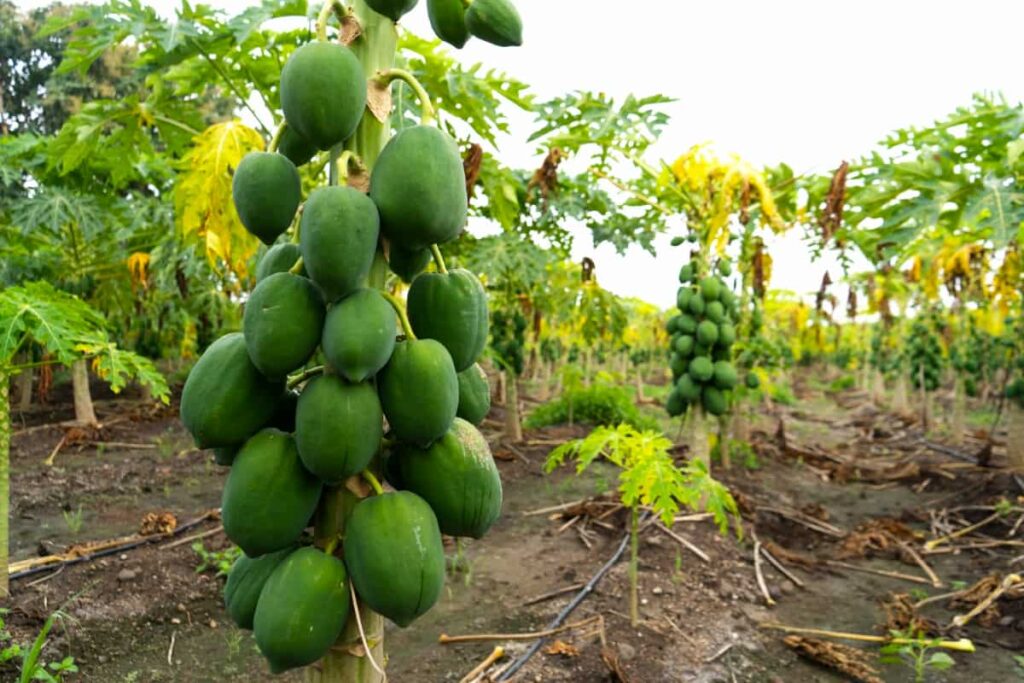
The new hybrids deliver earlier maturity and higher yields. They also have shorter trees, which makes harvesting easier. They are stronger at fighting viral and fungal diseases. The research provides critical data to support local seed production. This will help farmers reduce reliance on expensive imported varieties.
The field trial was conducted over 12 months at JKUAT’s Juja campus. Researchers compared hybrid lines 1 to 8 against the commercial control variety called Sunrise Solo. The results were impressive. All hybrids matured 6 to 15 days earlier than the control. They also fruited at heights 23 to 37 centimetres lower. This shorter stature makes management and harvesting much easier for farmers.
Most lines were high yielding. They produced 40 to 64 fruits per tree. Hybrid 4 stood out from the rest. It produced large, heavy fruits that are ideal for local markets and industrial processing. Lines 1, 2, 5, 7, and 8 produced medium sized fruits suitable for export. These matched the premium quality of Sunrise Solo, which is the current market standard.
Disease screening showed strong resilience in some hybrids. Hybrids 6 and 7 had lower symptoms of papaya mosaic virus. They also showed greater tolerance to powdery mildew compared to the control variety. Line 6 was completely free of powdery mildew. It also had the lowest occurrence of water soaked stem lesions, which is a key sign of the mosaic virus. These findings are a major advance against the main biological threat to Kenya’s papaya industry.
The study addresses two long standing problems for papaya farmers. First, farmers have limited access to improved varieties. Many have relied on imported seeds or poor quality local seeds. Second, viral diseases cause huge yield losses. These diseases have devastated papaya farms across the country.
By validating locally bred hybrids with good traits and disease tolerance, the research supports affordable seed multiplication for farmers with limited resources. The authors say standard farming practices can further improve performance. This supports Kenya’s goals to increase horticultural output, food security, and export earnings.
Papaya is one of Kenya’s most important fruits. It is grown in many counties, including Machakos, Makueni, Kiambu, Murang’a, and parts of the Coast. The fruit is sold locally and exported to regional and international markets. But production has been held back by poor seed quality and disease pressure.
The new papaya hybrids could change this. Farmers who plant them can expect earlier harvests. This means faster returns on their investment. Shorter trees make it easier for women and older farmers to harvest without using ladders. Higher yields mean more income per acre. Disease resistance means less money spent on fungicides and lower risk of total crop failure.
The timing of this research is critical. Climate change is making farming more unpredictable. Diseases are spreading to new areas. Farmers need varieties that can withstand these pressures. The new papaya hybrids offer a solution that is both practical and affordable.
Local seed production is a key part of the strategy. Instead of relying on expensive imported seeds that may not be adapted to local conditions, Kenyan farmers can access seeds produced locally. This reduces costs and ensures the seeds are suited to the local environment. It also creates opportunities for local seed companies to multiply and distribute the new varieties.
The researchers recommend that farmers follow standard agronomic practices to get the best results. This includes proper spacing, adequate irrigation, timely weeding, and integrated pest management. Farmers who follow these practices can expect even better yields and fruit quality.
The new papaya hybrids represent a major step forward for Kenya’s horticulture sector. With earlier maturity, higher yields, shorter trees, and strong disease resistance, these hybrids offer a resilient and cost effective foundation for a more sustainable and productive papaya industry. Farmers who adopt these new varieties stand to benefit from higher incomes, reduced losses, and greater food security for their families and communities. The research team at JKUAT and Kenyatta University has provided a valuable tool that can transform papaya farming in Kenya for years to come.
https://farmerstrend.co.ke/trending/new-papaya-hybrids-in-kenya-jkuat/https://farmerstrend.co.ke/wp-content/uploads/2026/05/Organic-Papaya-Farming-1-1024x683-1.jpghttps://farmerstrend.co.ke/wp-content/uploads/2026/05/Organic-Papaya-Farming-1-1024x683-1-150x150.jpg# TrendingScientists in Kenya have developed eight new papaya hybrid lines. The improved varieties mature early, resist diseases, and produce more fruit. The research was led by a team from Jomo Kenyatta University of Agriculture and Technology (JKUAT) and Kenyatta University. The study was published in the journal Biological Diversity.The...FarmersTrendjohn doefarmerstrend@gmail.comAdministratorFarmers Trend Ltd.










Leave a Reply