Quinoa Farming in Kenya 2026: The Ultimate Guide to the Sh500,000-per-Acre Superfood Profits
Table of Contents
ToggleQuinoa Farming in Kenya 2026 – The Complete Guide to Growing Superfood for Profit
Quinoa is not a common crop in Kenya yet, but that is changing fast. Farmers in Narok, Kajiado, Nakuru, and Baringo are discovering that this ancient grain can grow where maize cannot. While maize wilts when the rains fail, quinoa keeps growing. It needs only 300 to 500 millimeters of rain per season, compared to maize which needs 600 millimeters or more. This makes quinoa a smart choice for farmers in dry areas.
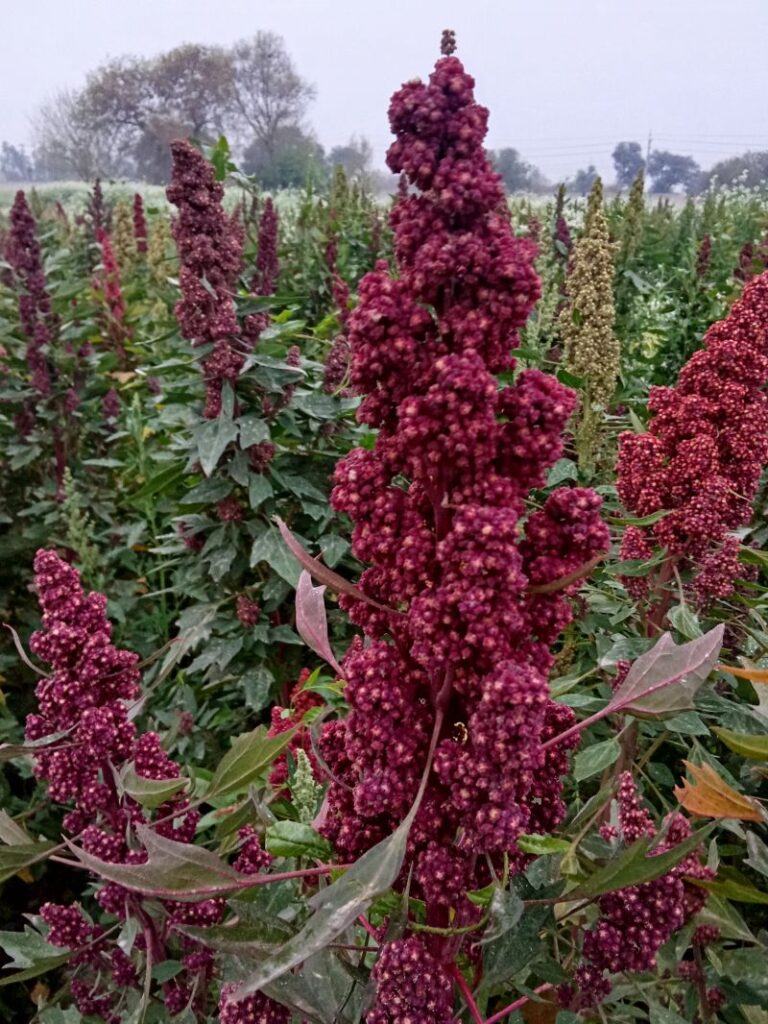
The money is good too. In Nairobi supermarkets, a kilogram of Kenyan-grown quinoa sells for 243 to 338 shillings. A well-managed acre gives you 1,200 to 1,800 kilograms of grain. That is 300,000 to 600,000 shillings per acre before costs. After you subtract your expenses, you can easily clear 500,000 shillings per acre. Few other crops give you that kind of profit in Kenya’s dry lands.
Quinoa farming in Kenya is still new, but the potential is huge. The crop was first introduced by KALRO several years ago, and they have been testing different varieties in different parts of the country. The good news is that several varieties have performed very well. Farmers who are willing to learn can make good money from quinoa farming in Kenya.
This guide by Farmers Trend Limited will show you how to grow quinoa for profit. You will learn which varieties to plant for successful quinoa farming in Kenya, where to plant them, how to prepare your shamba, how to remove the bitter saponin coating, and where to sell your harvest. The information comes from KALRO field trials and from farmers who are already making money from quinoa farming in Kenya. Let us get started.
Why Quinoa Farming in Kenya Is Beating Maize in 2026
Maize has been the king of Kenyan agriculture for a long time, but the weather is changing. Rains are becoming less reliable. Dry spells are getting longer. In many parts of the country, maize now fails more often than it succeeds. Farmers end up losing money on seeds and fertilizer, and they have nothing to show for their work.
Quinoa farming in Kenya handles dry conditions much better than maize. The plant comes from the high Andes mountains in South America, where the weather is harsh and unpredictable. It has learned to survive with very little water. In Kenya, quinoa can produce a good harvest with just 300 to 500 millimeters of rain. That is about half of what maize needs. This makes quinoa farming in Kenya a smart choice for farmers in dry areas.
The plant also tolerates poor soils. You do not need rich, fertile land to grow quinoa. It will produce on sandy soils and even on slightly salty soils where other crops would die. This opens up new possibilities for farmers in the ASALs who have struggled to find reliable cash crops. Quinoa farming in Kenya is giving hope to farmers who thought their land was useless.
The nutritional value of quinoa is another reason it is beating maize. Quinoa has more protein than any other grain. Some varieties have up to 25 percent protein. It also contains all nine essential amino acids that your body needs. This makes it popular with health-conscious consumers in Nairobi and with buyers in Europe and North America. The demand keeps growing, and prices remain strong. This is why more farmers are turning to quinoa farming in Kenya.
| Crop | Rainfall Needed (mm) | Protein Content | Market Price per kg (KSh) | Best for Dry Areas |
|---|---|---|---|---|
| Maize | 600-800 | 8-10% | 30-50 | No |
| Beans | 500-700 | 20-22% | 80-120 | No |
| Quinoa | 300-500 | 14-25% | 243-338 | Yes |
| Sorghum | 400-600 | 10-12% | 40-60 | Yes |
| Millet | 350-550 | 10-12% | 50-80 | Yes |
Choosing the Right Seeds for Quinoa Farming in Kenya
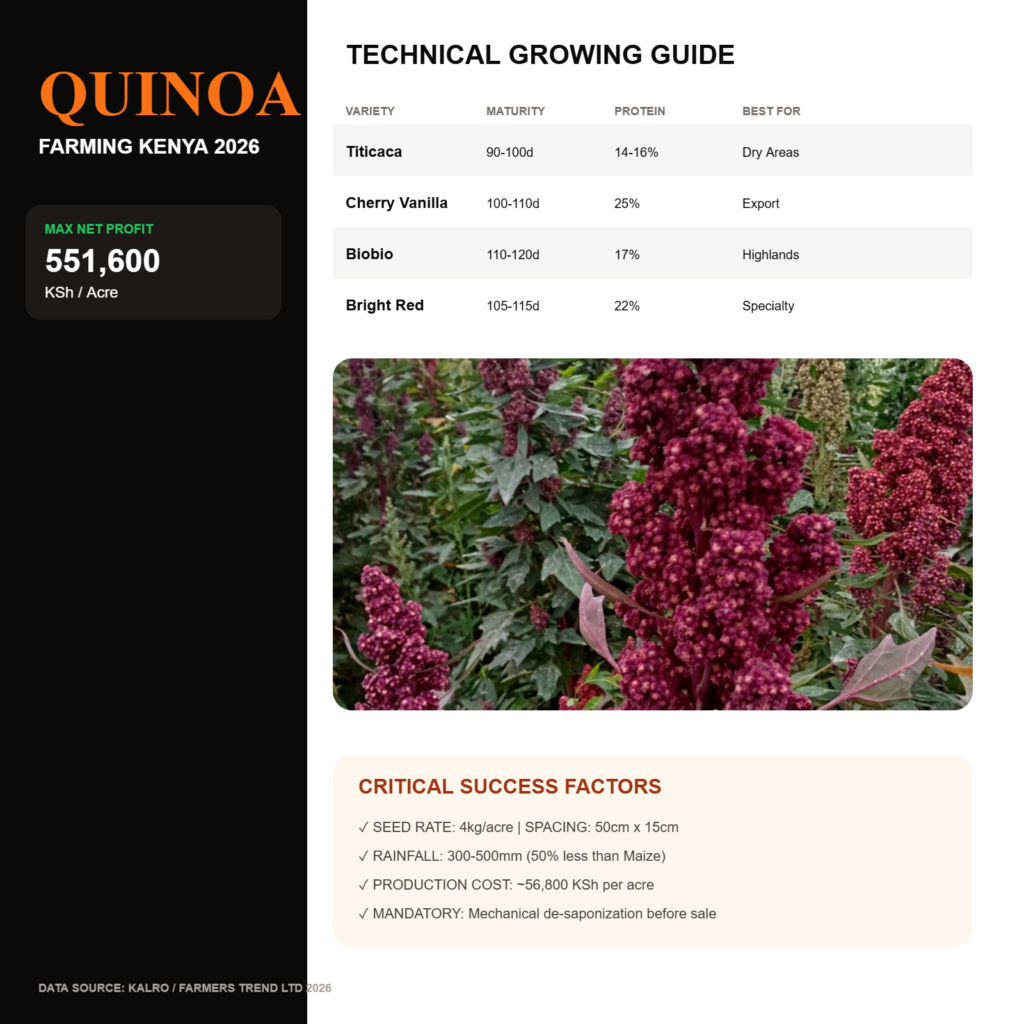
KALRO has tested several quinoa varieties in Kenyan conditions, and they have released the best ones for farmers. The best varieties for quinoa farming in Kenya are Titicaca, Cherry Vanilla, Brilliant Bright Red, and Biobio. Each one has its own strengths, and you should choose based on your area and your target market.
- Titicaca is the most popular variety for quinoa farming in Kenya. It matures in 90 to 100 days, which is relatively fast. The grain is white to yellow and has a mild flavor that most people like. Titicaca handles heat well, and it produces consistently even when the rains are poor. This is the variety to plant if you are in a dry area like Kajiado or Baringo. Many farmers start their quinoa farming in Kenya journey with Titicaca because it is forgiving.
- Cherry Vanilla takes a little longer, 100 to 110 days. The grain is red, and it has very high protein content, sometimes up to 25 percent. The red color makes it attractive to health food buyers overseas. Cherry Vanilla also has good resistance to downy mildew, which can be a problem in areas with more humidity. For farmers who want to target export markets, Cherry Vanilla is a top choice for quinoa farming in Kenya.
- Biobio is a variety from Chile that has adapted well to Kenyan highlands. It matures in 110 to 120 days and produces larger seeds than Titicaca. The grain is white and has a nutty flavor. Biobio is best suited for areas with reliable rainfall, such as the higher parts of Nakuru and Narok. This variety is gaining popularity in quinoa farming in Kenya because of its large seed size.
- Brilliant Bright Red is similar to Cherry Vanilla but with even deeper red color. It is a specialty variety for export markets. The yield is slightly lower than Titicaca, but the price per kilogram is higher. Farmers who have established markets for specialty grains may prefer this variety for their quinoa farming in Kenya operation.
| Variety | Days to Mature | Protein Content | Yield per Acre | Best For | Seed Availability |
|---|---|---|---|---|---|
| Titicaca | 90-100 | 14-16% | 1,200-1,500 kg | Dry areas, beginners | KALRO, Farmers Trend |
| Cherry Vanilla | 100-110 | 22-25% | 1,000-1,300 kg | Export, health food | KALRO, Farmers Trend |
| Biobio | 110-120 | 15-17% | 1,300-1,600 kg | Highlands, fresh market | KALRO, Farmers Trend |
| Brilliant Bright Red | 105-115 | 20-22% | 900-1,200 kg | Specialty export | KALRO, Farmers Trend |
Where to Plant: The Best Counties for Quinoa Farming in Kenya
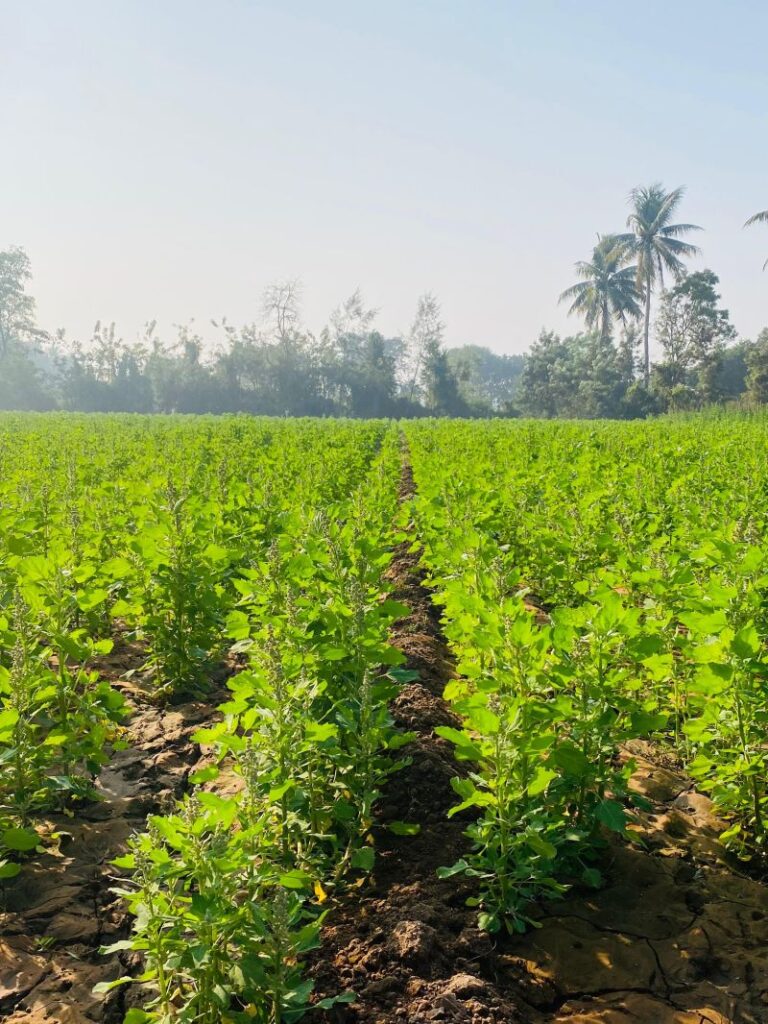
Quinoa grows best in cool, dry areas. The ideal altitude for quinoa farming in Kenya is 1,500 to 3,000 meters above sea level. The temperatures should be between 15 and 25 degrees Celsius during the growing season. The plant does not like extreme heat, and it cannot tolerate frost. Choosing the right location is the first step to successful quinoa farming in Kenya.
Narok County is one of the best places for quinoa farming in Kenya. The high altitude areas around Narok town have the right climate, and the soils are good. Farmers there have been testing quinoa for several years, and the results have been promising. Some farmers are already selling their grain to buyers in Nairobi. The success in Narok has encouraged more farmers to try quinoa farming in Kenya.
Kajiado County is another good location for quinoa farming in Kenya. The land is drier than Narok, but quinoa handles dry conditions well. The key is to plant at the start of the rains so the crop gets enough moisture during the early growth stages. Farmers near the Loitokitok area have had success with Titicaca variety. Quinoa farming in Kenya is giving Kajiado farmers a new option for their dry land.
Nakuru County, especially the higher areas around Njoro and Mau Narok, is also suitable for quinoa farming in Kenya. The soils are fertile, and the rainfall is more reliable. You can get higher yields here, but you also need to watch out for downy mildew during wet seasons. Farmers in these areas are reporting good results from quinoa farming in Kenya.
Baringo County is a new frontier for quinoa farming in Kenya. The area is dry, and farmers there have struggled with maize. Early trials of Titicaca have been successful, and more farmers are planting quinoa each season. The potential for quinoa farming in Kenya in Baringo is very high.
Other counties with potential for quinoa farming in Kenya include Laikipia, Meru (upper zones), Trans Nzoia, and parts of Uasin Gishu. The key is to look for areas with good drainage and soils that are not too acidic. Quinoa farming in Kenya can succeed in many places if you choose the right variety and manage the crop properly.
Soil Preparation for Quinoa Farming in Kenya
Quinoa is not very picky about soil, but it grows best in well-drained sandy loam. The soil pH for successful quinoa farming in Kenya should be between 6.0 and 8.5. If your soil is too acidic, you can add lime a few months before planting. If it is too alkaline, you can add sulfur or organic matter to lower the pH.
Start by ploughing your land to a depth of 20 to 25 centimeters. This breaks up compacted layers and allows the roots to go deep. After ploughing, harrow the field to break up the clods and create a fine seedbed. Quinoa seeds are small, and they need good contact with the soil to germinate properly. Good land preparation is essential for successful quinoa farming in Kenya.
Add organic matter to your soil. Well-decomposed manure at 2 to 3 tons per acre is enough. The manure improves soil structure and helps the soil hold water. You can also add compost if you have it. Organic matter is especially important in sandy soils where water drains quickly.
If your soil is poor, you can add DAP fertilizer at 50 kilograms per acre at planting. Quinoa does not need a lot of nitrogen, so do not overdo it. Too much nitrogen will make the plants grow too many leaves and not enough grain. Balanced nutrition is key to profitable quinoa farming in Kenya.
| Cost Item | Quantity | Unit Price (KSh) | Total (KSh) |
|---|---|---|---|
| Certified KALRO seeds (Titicaca) | 4 kg | 500 | 2,000 |
| Land preparation (plough + harrow) | 1 acre | 8,000 | 8,000 |
| Manure | 2 tons | 3,000 | 6,000 |
| DAP fertilizer | 50 kg | 130 | 6,500 |
| Lime (if pH is low) | 500 kg | 10 | 5,000 |
| Labor for planting and weeding | 15 days | 500 | 7,500 |
| Pest control (organic) | 1 acre | 5,000 | 5,000 |
| Harvesting labor | 1 acre | 6,000 | 6,000 |
| De-saponization (mechanical) | 1,200 kg | 5 per kg | 6,000 |
| Packaging (jute bags) | 24 bags | 100 | 2,400 |
| Transport to market | 1,200 kg | 2 per kg | 2,400 |
| Total Production Cost per Acre | 56,800 |
The Step-by-Step Planting Guide for Quinoa Farming in Kenya
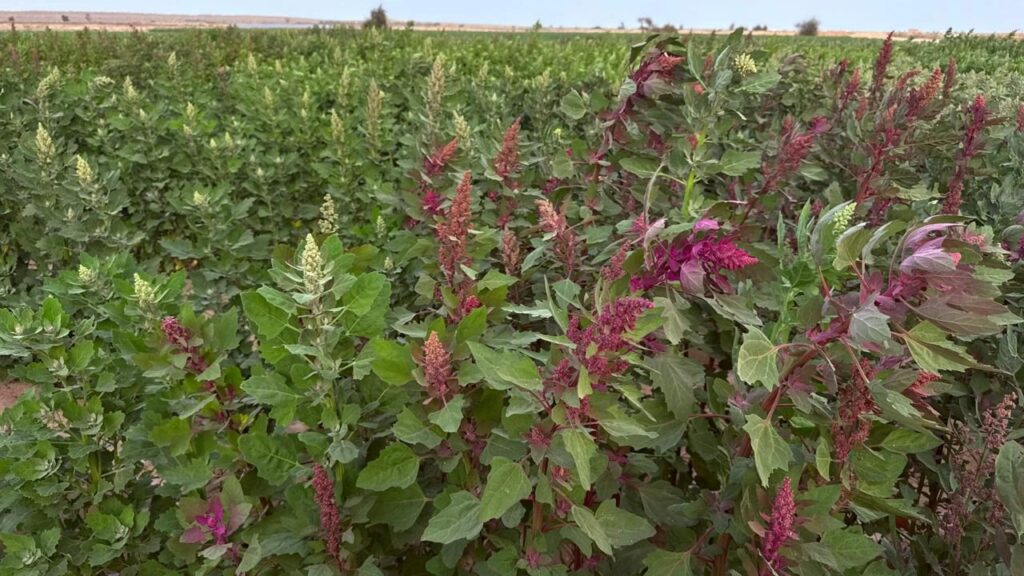
Planting quinoa is not difficult, but you need to get the details right. The seeds are small, and they will not germinate if you bury them too deep. Here is the step-by-step process for successful quinoa farming in Kenya.
First, wait for the rains. The best time to plant for quinoa farming in Kenya is at the start of the long rains in March or April. You can also plant at the start of the short rains in October or November. If you have irrigation, you can plant at any time. Timing your planting well is crucial for quinoa farming in Kenya.
Prepare your seedbed. The soil should be loose and free of large clods. If the soil is too compact, the small seeds will struggle to push through. A fine seedbed gives you uniform germination, which is important for quinoa farming in Kenya.
Make furrows or rows. The spacing for quinoa farming in Kenya should be 50 centimeters between rows and 15 centimeters between plants. This gives the plants enough room to grow without competing with each other. Proper spacing is essential for high yields in quinoa farming in Kenya.
The seed rate is 4 kilograms per acre for quinoa farming in Kenya. Do not plant more than that because crowded plants will produce smaller grain heads. Using certified seeds gives you better germination and more uniform plants.
Plant the seeds at a depth of 1 to 2 centimeters. This is shallow. If you plant deeper, the seeds may not germinate. If you plant shallower, birds may eat them. Correct planting depth is a key factor in quinoa farming in Kenya.
After planting, roll or press the soil lightly to ensure good contact between the seeds and the soil. Water gently if the soil is dry. Good seed-to-soil contact improves germination rates for quinoa farming in Kenya.
The seeds will germinate in 5 to 10 days depending on soil temperature and moisture. Keep the field free of weeds during the first few weeks because the young quinoa plants are small and cannot compete with fast-growing weeds. Early weed control is critical for success in quinoa farming in Kenya.
Water Management for Quinoa Farming in Kenya
Quinoa needs regular water during the early growth stages. The first 30 days are critical. If the soil dries out during this time, the plants will be stunted and yield will be low. Irrigation can help if the rains are delayed. Proper water management is essential for profitable quinoa farming in Kenya.
After the plants are established, they can handle dry conditions. The deep taproot reaches water that other crops cannot access. In most areas, the natural rainfall is enough once the plants are past the seedling stage. This drought tolerance is one of the main advantages of quinoa farming in Kenya.
If you have irrigation, you can water the crop during flowering and grain filling to increase yields. The plants will produce more grain and larger seeds with adequate moisture. Supplemental irrigation can boost your profits from quinoa farming in Kenya.
Mulching helps with water conservation. Put a layer of dry grass or straw around the plants. This will keep the soil moist and reduce evaporation. Mulch is especially useful in sandy soils that dry out quickly.
Weed Management for Quinoa Farming in Kenya
Weeding is very important for quinoa farming in Kenya. Quinoa grows slowly at first, and weeds will take over if you do not keep on top of them. Weed the field by hand or with a hoe when the plants are 10 to 15 centimeters tall. A second weeding may be needed three to four weeks later.
Do not let weeds go to seed. If you do, you will have weed problems for years to come. Regular weeding is essential for successful quinoa farming in Kenya.
Mulching helps with weed control. A thick layer of dry grass or straw around the plants makes it harder for weeds to grow. Mulch also keeps the soil moist and adds organic matter as it breaks down.
Some farmers use pre-emergence herbicides, but these must be approved for use on quinoa. Check with your local agricultural officer before using any chemicals. Organic methods are preferred for export markets.
Pests and Diseases in Quinoa Farming in Kenya
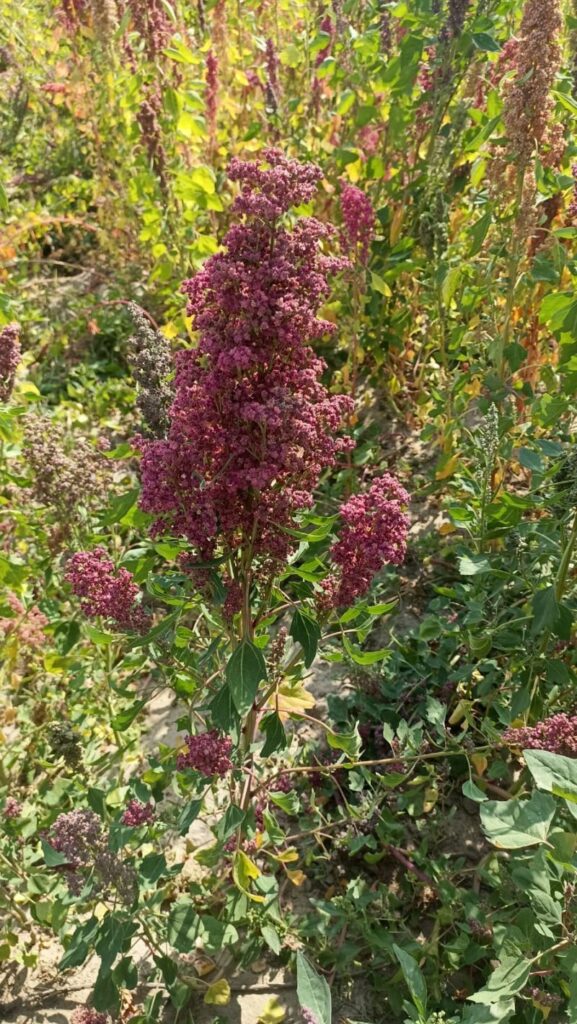
Quinoa has fewer pest problems than maize or beans, but there are some things to watch for in quinoa farming in Kenya. Aphids can appear during dry weather. They cluster on the young leaves and growing tips. Spray neem oil or insecticidal soap to control them. Early detection is key to managing pests in quinoa farming in Kenya.
Birds love quinoa seeds. As the grain heads mature, birds will come to eat them. You can use scarecrows, reflective tape, or netting to protect your crop. Some farmers plant a small patch of sunflowers or sorghum nearby to distract the birds. Bird damage can be a major problem in quinoa farming in Kenya if not managed properly.
Downy mildew is the most common disease. It appears as yellow spots on the leaves, with a fuzzy growth underneath. The disease spreads in wet, humid weather. Choose resistant varieties like Cherry Vanilla if you are in a high-rainfall area. You can also use copper-based fungicides if the disease appears. Proper spacing and air circulation help prevent downy mildew in quinoa farming in Kenya.
| Pest/Disease | Damage | Control Method | Timing |
|---|---|---|---|
| Aphids | Stunted growth, curled leaves | Neem oil, insecticidal soap | As needed |
| Birds | Eaten seeds, reduced yield | Scarecrows, netting, reflective tape | Grain filling stage |
| Downy mildew | Yellow spots, leaf death | Resistant varieties, copper fungicides | Wet seasons |
| Cutworms | Seedlings cut at base | Hand picking, beneficial nematodes | Early growth |
Harvesting Your Quinoa
Quinoa is ready to harvest when the leaves have turned yellow and the grain heads are dry. The seeds should be hard and should not dent when you press them with your fingernail. Harvesting at the right time is crucial for quinoa farming in Kenya.
Do not wait too long to harvest. If you delay, the seeds will start to fall off the plant, and birds will eat them. In dry weather, the seeds can be ready 90 to 120 days after planting, depending on the variety. Timely harvesting is essential for good yields in quinoa farming in Kenya.
You can harvest by hand or with a combine harvester. Hand harvesting is slower but causes less seed loss. Cut the plants at the base and stack them in small piles to dry further. After a few days, thresh the grain by beating the plants or by using a simple thresher.
After threshing, winnow the grain to remove the chaff. You can do this by tossing the grain in the air on a windy day. The lighter chaff blows away, and the heavier grain falls back down.
Solving the “Bitter” Problem: Saponin Removal for Quinoa Farming in Kenya
Here is the biggest challenge with quinoa. The seeds have a natural coating called saponin that tastes bitter. You cannot sell quinoa with this coating on. No one will buy it. You must remove the saponin before the grain is fit to eat. Saponin removal is essential for commercial quinoa farming in Kenya.
The traditional method is to wash the seeds with water. You soak the seeds, rub them together, and rinse. You repeat this process several times until the water no longer forms foam. This works, but it uses a lot of water and labor. It is not practical for large harvests. Small-scale farmers in quinoa farming in Kenya sometimes use this method.
The better method is mechanical de-saponization. You use a machine called an abrasive polisher to rub off the saponin coating. The machine costs 150,000 to 300,000 shillings, but it can process 100 to 500 kilograms of grain per hour. If you cannot afford your own machine, you can join a cooperative or pay someone to process your grain for you. This is the preferred method for commercial quinoa farming in Kenya.
After de-saponization, the grain is dried to 12 to 14 percent moisture. Then it is cleaned, graded, and packed for sale. Proper drying prevents mold and preserves quality for quinoa farming in Kenya.
The saponin that you remove has value. It can be used as a natural insecticide, a foaming agent, or a wetting agent. Some companies buy crude saponin for industrial uses. This is an extra income stream for quinoa farming in Kenya.
| Method | Equipment Needed | Cost | Water Usage | Suitable For |
|---|---|---|---|---|
| Hand washing | Buckets, water | Low | High | Small harvests |
| Mechanical polishing | Abrasive polisher | 150,000-300,000 KSh | Low | Commercial farms |
| Cooperative processing | Shared polisher | Membership fee | Low | Small to medium farms |
Quinoa Market Prices in Nairobi and Export Secrets for Quinoa Farming in Kenya
You have several options for selling your quinoa. The price varies depending on where you sell and how you process the grain. Understanding the market is crucial for profitable quinoa farming in Kenya.
In Nairobi, health food stores and upscale supermarkets sell quinoa for 243 to 338 shillings per kilogram. These retailers want high-quality grain that is clean, well-packaged, and free from saponin. They also prefer organic quinoa, which commands a premium price. Supplying these markets is a good goal for quinoa farming in Kenya.
You can sell directly to consumers at farmers markets or online. The prices are similar to retail, but you have to do the marketing and distribution yourself. Direct sales can increase your profits from quinoa farming in Kenya.
The export market pays about 1.70 US dollars per kilogram (roughly 220 shillings) for conventional quinoa. Organic quinoa gets 2.20 to 2.50 US dollars per kilogram (about 290 to 330 shillings). Export buyers want consistent quality and large volumes. You may need to join a farmers group to meet their requirements. Export markets offer the best prices for quinoa farming in Kenya.
Some local food processors are starting to buy quinoa for use in porridge flour, pasta, and breakfast cereals. These buyers pay lower prices than the export market, but they offer consistent demand and payment terms. Diversifying your buyers is a good strategy for quinoa farming in Kenya.
| Market Channel | Price per kg (KSh) | Requirements | Volume Needed |
|---|---|---|---|
| Nairobi supermarkets | 243-338 | Clean, packaged, de-saponized | Small to medium |
| Health food stores | 280-350 | Organic, high quality | Small |
| Direct to consumers | 250-300 | Well-packaged | Small |
| Local processors | 150-200 | Bulk, de-saponized | Large |
| Export (conventional) | ~220 | Certified, consistent quality | Large |
| Export (organic) | ~290-330 | Organic certified | Large |
The Livestock Bonus: Using Quinoa Stalks as Fodder
Do not throw away the stalks after you harvest the grain. They are valuable livestock feed. The straw has 5 to 7 percent protein, which is higher than maize stover. It is also more digestible. This is an extra benefit of quinoa farming in Kenya.
Dairy farmers will pay for good quality quinoa straw. You can sell it to them, or you can use it on your own farm. The straw can be fed to cattle, goats, and sheep. Chop it into small pieces and mix it with other feeds.
The straw also makes good mulch for your garden or for the next season crops. Using the straw adds value to your quinoa farming in Kenya operation.
Organic Certification for Export
If you want to sell to the export market, you may need organic certification. European and North American buyers pay premium prices for certified organic quinoa. Organic certification can significantly increase your profits from quinoa farming in Kenya.
The certification process takes 2 to 3 years. During this time, you must follow organic farming practices. You cannot use synthetic fertilizers or pesticides. You must use organic seeds and natural pest control methods.
Keep good records of everything you do on your farm. The certifier will inspect your fields, your storage facilities, and your records. If you pass, you will receive a certificate that allows you to sell your quinoa as organic.
The cost of certification is 50,000 to 100,000 shillings per year. This is expensive for a small farmer, but you can share the cost by joining a farmers group or cooperative. Many successful quinoa farming in Kenya operations are pursuing organic certification.
| Yield Level (kg/acre) | Price per kg (KSh) | Gross Revenue (KSh) | Production Costs (KSh) | Net Profit (KSh) |
|---|---|---|---|---|
| 800 | 250 | 200,000 | 56,800 | 143,200 |
| 1,000 | 280 | 280,000 | 56,800 | 223,200 |
| 1,200 | 300 | 360,000 | 56,800 | 303,200 |
| 1,500 | 320 | 480,000 | 56,800 | 423,200 |
| 1,800 | 338 | 608,400 | 56,800 | 551,600 |
How Much Money You Can Make from Quinoa Farming in Kenya
The first season of growing quinoa on one acre costs about 56,800 shillings for certified seeds, land preparation, manure, fertilizer, lime, labor, pest control, harvesting, de-saponization, packaging, and transport. You will harvest 3 to 4 months after planting, and the total yield can be 800 to 1,800 kilograms depending on the variety and how well you manage the crop.
At an average price of 300 shillings per kilogram, the revenue from 1,200 kilograms is 360,000 shillings. After subtracting the costs of 56,800 shillings, your profit is about 303,200 shillings for one season. With two seasons per year, the annual profit can reach 600,000 shillings per acre.
Farmers who grow Cherry Vanilla or Brilliant Bright Red for export can get 320 to 338 shillings per kilogram. A farmer who harvests 1,500 kilograms at 320 shillings per kilogram gets 480,000 shillings, and after costs, the profit is 423,200 shillings per season. With two seasons, the annual profit is 846,400 shillings per acre.
The table above shows the profit potential at different yield levels and prices. Even at the lowest yield, you still make a profit. At the highest yield and price, you make over 550,000 shillings per acre per season. This is why quinoa farming in Kenya is attracting more farmers every year.
Next Step for Quinoa Farming in Kenya
Quinoa farming in Kenya is a real opportunity for farmers in dry areas. The crop needs less water than maize. It tolerates poor soils. It produces grain that sells for good money. A well-managed acre can give you 300,000 to 600,000 shillings in revenue. After costs, you can easily clear 500,000 shillings per acre.
Start with the Titicaca variety if you are a beginner. It is easy to grow and handles dry conditions well. Plant at the start of the rains. Space your rows 50 centimeters apart. Keep the field free of weeds. Harvest when the leaves turn yellow.
The biggest challenge is saponin removal. Plan for this before you plant. Either save up for a polishing machine or find a cooperative that has one. Do not grow quinoa if you have no way to remove the bitter coating.
For KALRO-certified quinoa seeds, soil suitability maps, and the 2026 Quinoa Farming in Kenya PDF guide, contact Farmers Trend Ltd at 0790509684. The farmers who started growing quinoa a few years ago are now earning good money every season. They learned, they planned, and they did the work. You can do the same. The time to start your quinoa farming in Kenya journey is now.


Leave a Reply