Kale Farming in Kenya: The 2026 Complete Guide to Earning KSh 900,000 Per Acre with Malkia F1 Sukuma Wiki Variety
Kale (Sukuma Wiki) Farming in Kenya: The 2026 Blueprint for Maximum Yield and Commercial Profit
Sukuma wiki is Kenya’s most consumed vegetable. Walk into any market in Nairobi, Kisumu, or Mombasa, and you will find piles of fresh kale. Families buy it daily. Hotels serve it at every buffet. Schools include it in their meal programs. The demand never stops.
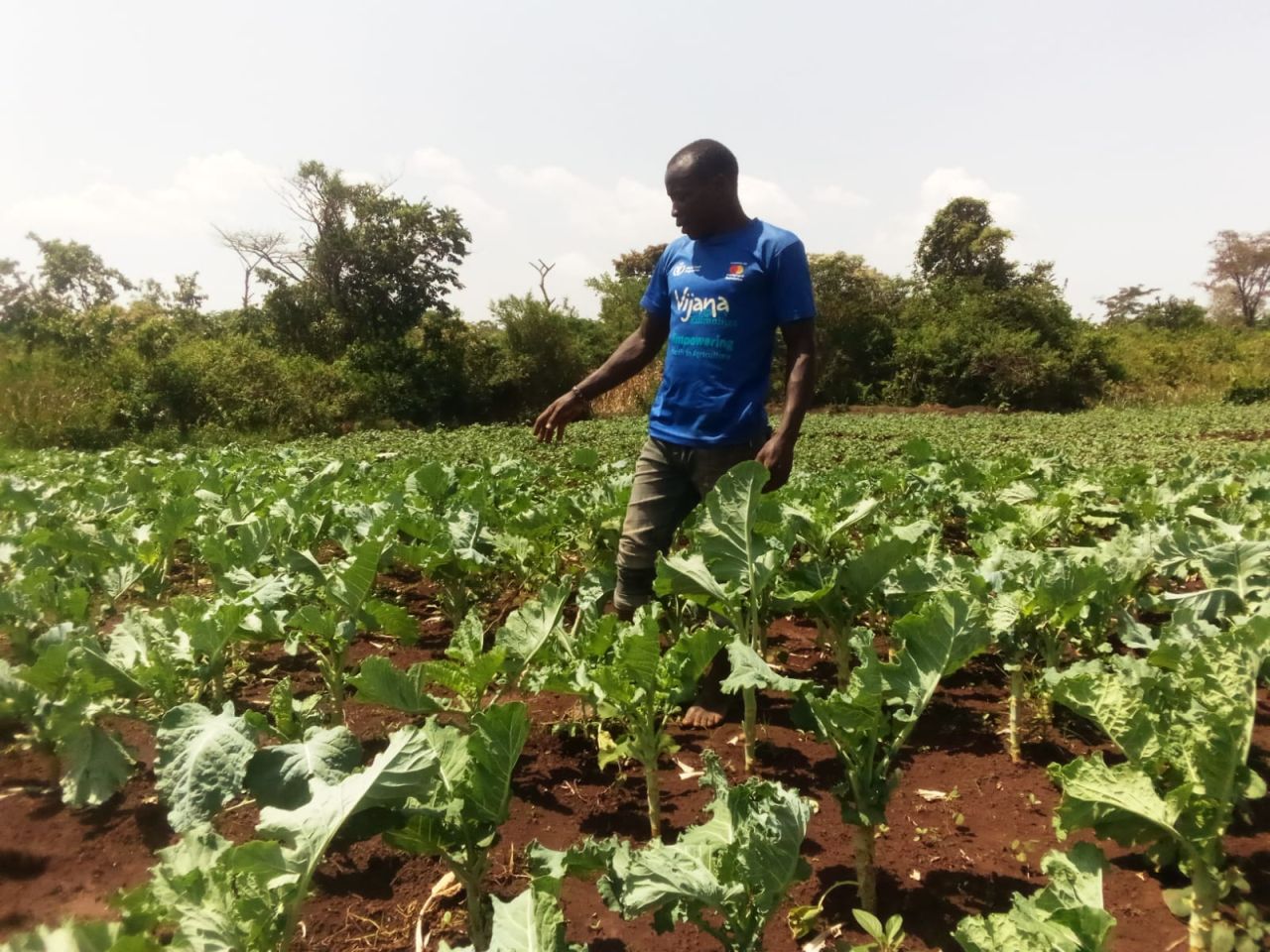
For farmers, this consistent demand creates a very big opportunity. A well-managed acre of kale produces 10,000 to 15,000 kilograms annually. At peak prices of 80 shillings per kilogram, gross revenue reaches 800,000 to 1.2 million shillings per acre. Even during glut seasons when prices drop to 10 shillings per kilogram, the volume and multiple harvest cycles keep farmers profitable.
This guide by Farmers Trend Ltd. covers everything you need for commercial success in kale farming in Kenya. You will learn about variety selection, nursery establishment, field preparation, fertilizer programs, pest management, harvesting, and marketing. The information comes from successful sukuma wiki farmers and agricultural research stations across the country.

The 2026 Market Reality for Kale Farming in Kenya
Kale prices follow a predictable seasonal pattern. From January to March, dry season conditions reduce supply. Prices rise to 60 to 80 shillings per kilogram. From April to June, the long rains increase supply. Prices drop to 20 to 30 shillings per kilogram. From July to September, the dry spell returns. Prices climb back to 40 to 60 shillings per kilogram. From October to December, short rains increase supply again. Prices settle at 30 to 50 shillings per kilogram.
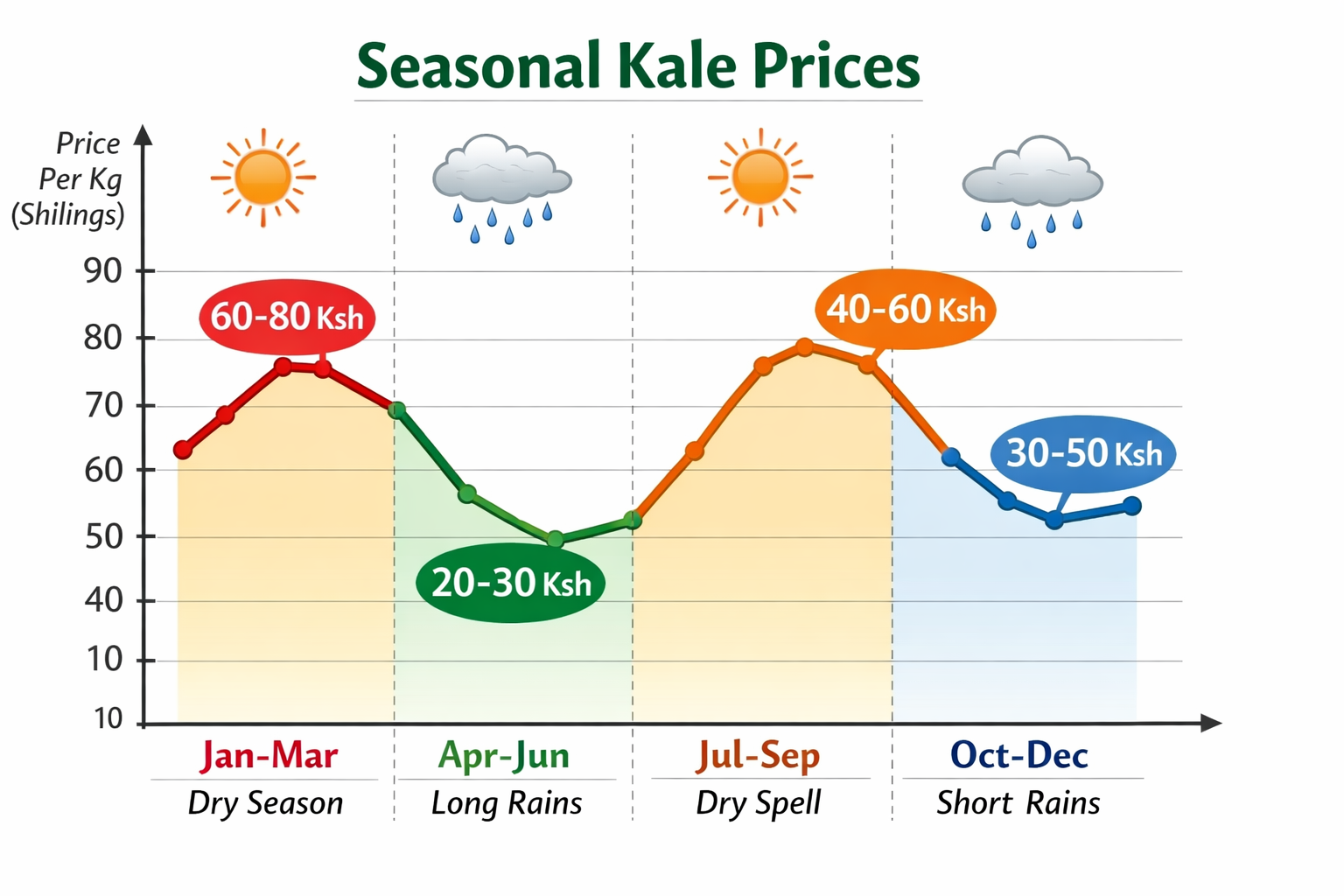
Farmers who understand this cycle can time their plantings to capture peak prices. Planting in August positions your harvest for the January to March high-price window. Planting in February targets the July to September window. With irrigation, you can plant year-round and adjust your schedule to market conditions.
The export market for kale is small but growing. Kenyan kale appears in supermarkets in Uganda, Tanzania, and Rwanda. The requirements are strict. Exporters need consistent quality, proper packaging, and traceability. Farmers who meet these standards earn 100 to 120 shillings per kilogram.
| Market Channel | Price Range | Requirements |
|---|---|---|
| Farm gate (traders) | 20-80 KSh/kg | Bulk, any quality |
| Wakulima Market | 30-100 KSh/kg | Fresh, clean leaves |
| Supermarkets | 50-120 KSh/kg | Packaged, uniform |
| Export | 80-150 KSh/kg | Certified, consistent |
The 2026 Seed Selection Matrix for Kale Farming in Kenya
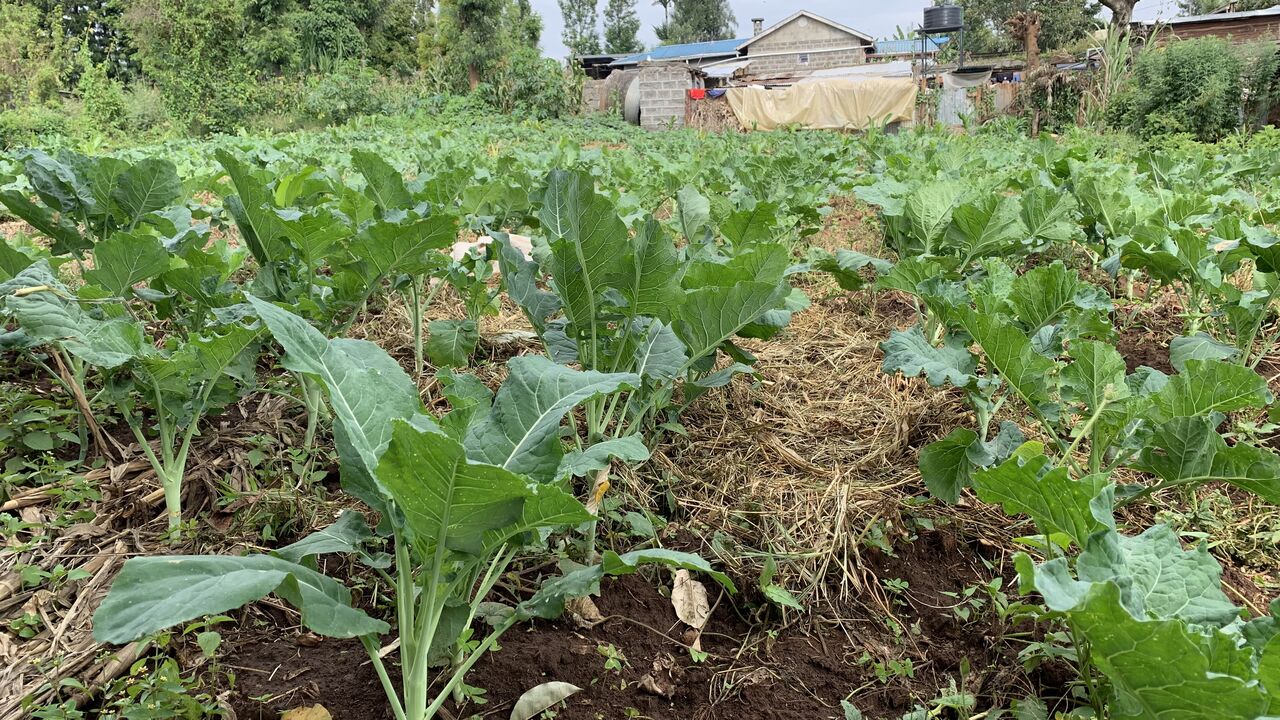
Seed selection determines your yield potential and disease resistance. Commercial farmers in 2026 choose F1 hybrid varieties for their uniformity, fast growth, and market acceptance.
Malkia F1 is the top choice for commercial kale farming in Kenya. It matures in 45 to 50 days. The leaves are dark green, tender, and uniform. The plant is compact, allowing high-density planting. Malkia F1 resists black rot and other common diseases. A 50-gram packet of Malkia F1 seeds costs 3,500 to 4,500 shillings and covers one acre.
Mfalme F1 is another excellent hybrid. It matures slightly later at 50 to 55 days. The leaves are larger and broader than Malkia F1. It yields slightly more but requires more spacing. Mfalme F1 is popular among farmers targeting supermarket markets where large leaves are preferred.
Thousand Headed is the traditional open-pollinated variety. It matures in 60 to 70 days. The leaves are smaller and less uniform. Yields are lower than hybrids. However, it has good disease resistance and can be harvested over a longer period. Seed costs are lower, making it suitable for farmers with limited capital.
| Variety | Maturity | Leaf Size | Yield Potential | Seed Cost per Acre | Best Market |
|---|---|---|---|---|---|
| Malkia F1 | 45-50 days | Medium | 12,000-15,000 kg | 3,500-4,500 KSh | Commercial |
| Mfalme F1 | 50-55 days | Large | 13,000-16,000 kg | 3,500-4,500 KSh | Supermarket |
| Thousand Headed | 60-70 days | Small | 8,000-10,000 kg | 1,500-2,000 KSh | Local market |
Source certified seeds from Simlaw Seeds, Seed Co Kenya, KALRO, or Virtual Agrovet. Uncertified seeds may have low germination rates or produce plants that are not true to type. The extra cost for certified seeds pays back through higher yields and uniform crops.
Nursery Establishment and Damping-off Prevention
Kale seeds need a nursery before transplanting. A nursery bed of 2 meters by 4 meters produces enough seedlings for one acre. Prepare the nursery bed by digging to 15 centimeters. Remove all stones and weeds. Mix in 5 kilograms of well-decomposed manure per square meter.
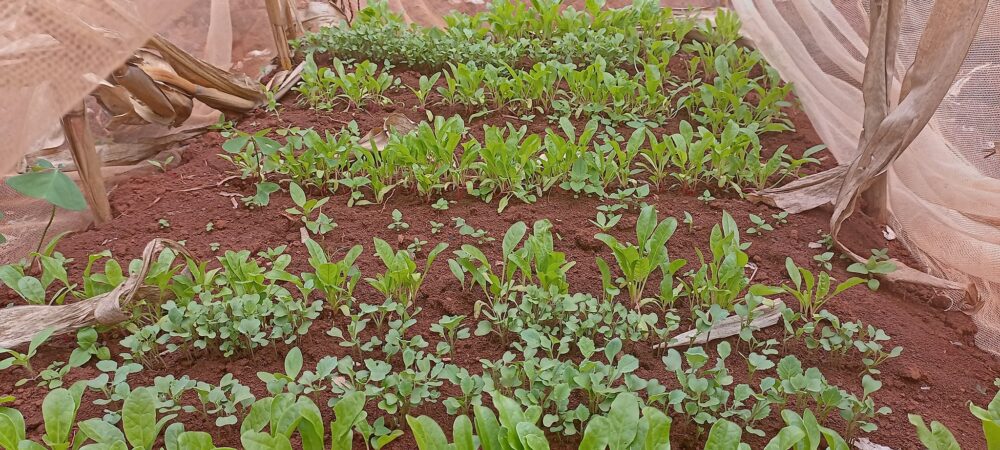
Sow seeds in rows spaced 10 centimeters apart. Cover lightly with soil. Water gently with a fine rose can. Do not flood the bed. Seeds germinate in 4 to 7 days depending on temperature.
Damping-off is the biggest threat in the nursery. This fungal disease attacks seedlings at soil level. The stems rot and the seedlings collapse. Prevention is the only cure. Use fresh, sterile soil. Do not overwater. Provide good air circulation. Apply a copper-based fungicide at first sign of infection.
Seedlings are ready for transplanting at 3 to 4 weeks. They should have 4 to 6 true leaves and be 10 to 15 centimeters tall. Water the nursery bed thoroughly before transplanting to reduce root damage.
Field Preparation and Transplanting
Kale requires well-drained soils with pH between 6.0 and 7.0. Test your soil before planting. Add lime if pH is below 6.0. Add manure to improve soil structure and fertility.
Plough to 20 to 25 centimeters. Remove all weeds and break clods. Incorporate 10 to 15 tons of well-decomposed manure per acre. For commercial production, raised beds are recommended. Beds of 1 meter width improve drainage and make harvesting easier.
Spacing determines your plant population. For Malkia F1, use 60 centimeters between rows and 45 centimeters between plants. This gives approximately 18,000 plants per acre. For Mfalme F1, use 60 centimeters by 50 centimeters for 14,500 plants per acre. For Thousand Headed, use 60 centimeters by 60 centimeters for 11,000 plants per acre.
Transplant in the evening to reduce transplant shock. Water each seedling immediately after planting. Apply 200 grams of DAP per planting hole, mixing well with soil. Do not let fertilizer touch the roots directly.

How Long Do Kales Take to Grow
How long do kales take to grow? The answer depends on your variety and the harvest window you target. Malkia F1 reaches first harvest at 45 to 50 days. Mfalme F1 reaches first harvest at 50 to 55 days. Thousand Headed reaches first harvest at 60 to 70 days.
After the first harvest, the plants continue producing. How many times can you harvest kale? You can harvest every 7 to 10 days for 6 to 9 months. Each harvest removes the outer leaves. The inner leaves continue growing. A single planting can yield 15 to 20 harvests.
How many Sukuma wiki per acre? With Malkia F1 at 18,000 plants per acre, each plant produces 600 to 800 grams over its lifetime. Total yield reaches 10,000 to 15,000 kilograms per acre.
Soil Fertility and Heavy Nitrogen Management
Kale is a heavy nitrogen feeder. It needs consistent nutrition for rapid leaf growth. The best fertilizer for kales in Kenya combines organic and inorganic sources.
Apply DAP at transplanting. Use 50 kilograms per acre. Phosphorus supports root development. Place in planting holes and mix with soil.
Top-dress with CAN at 3 weeks after transplanting. Apply 50 kilograms per acre. Nitrogen drives leaf growth. Water immediately after application to move nutrients to the root zone.
Apply a second CAN top-dressing at 6 weeks. Use another 50 kilograms per acre. For extended harvest, apply CAN every 6 to 8 weeks after the first harvest.
Supplement with organic foliar feeds. Apply every 2 weeks during active growth. Foliar feeds provide micronutrients that soil applications may miss.
| Application | Timing | Product | Rate per Acre |
|---|---|---|---|
| Pre-planting | At land prep | Manure | 10-15 tons |
| Planting | At transplant | DAP | 50 kg |
| First top-dress | Week 3 | CAN | 50 kg |
| Second top-dress | Week 6 | CAN | 50 kg |
| Maintenance | Every 6-8 weeks | CAN | 50 kg |
Irrigation for Consistent Production
Kale needs consistent moisture for high yields. Water stress causes tough leaves and reduced growth. Drip irrigation is the most efficient method. It delivers water to roots while keeping leaves dry. Wet leaves invite disease.
During dry periods, water every 2 to 3 days. Apply 20 to 25 millimeters of water per week. This equals 20,000 to 25,000 liters per acre. Sandy soils need more frequent watering. Clay soils hold water longer.
Mulch around plants to conserve moisture. Apply 5 to 10 centimeters of dry grass or other organic material. Keep mulch away from the stem to prevent rot.
Signs of water stress include wilting during hot afternoons and leaves that feel tough. Do not wait for these signs. Maintain consistent moisture throughout the growth cycle.
Pest and Disease Safe Management
Kale farming in Kenya faces several pests and diseases. The shift toward “clean food” markets demands reduced chemical use. Integrated Pest Management combines cultural, biological, and targeted chemical controls.
Diamondback moth is the most destructive pest. The caterpillars eat leaves, leaving only veins. Severe infestations defoliate plants. Control with pheromone traps to monitor populations. Use Bacillus thuringiensis (Bt), a biological insecticide, for caterpillar control. For severe infestations, use targeted chemical sprays, rotating between classes to prevent resistance.
Aphids cluster on new growth and leaf undersides. They suck sap and transmit viruses. Control with neem oil or insecticidal soap. Encourage natural predators like ladybugs.
What should not be planted next to kale? Avoid planting kale near cabbages, broccoli, or cauliflower. These crops share the same pests, especially diamondback moth. Separating them breaks pest cycles.
Black rot causes V-shaped yellow lesions on leaf edges. The disease spreads in wet conditions. Use certified disease-free seed. Rotate crops. Remove infected plants immediately. Copper-based fungicides provide some control.
Downy mildew appears as yellow spots on leaf tops with fuzzy growth on undersides. Improve air circulation through proper spacing. Avoid overhead irrigation. Apply copper-based fungicides at first sign.
Harvesting for Maximum Returns
Harvest in the morning after dew dries. Leaves are crisp and cool. Use a sharp knife to cut outer leaves. Leave the central growing point intact. New leaves will emerge for future harvests.
How many times can you harvest kale? With proper care, you harvest every 7 to 10 days for 6 to 9 months. Each harvest yields 500 to 800 kilograms per acre. Over the crop’s life, total yield reaches 10,000 to 15,000 kilograms per acre.
Grade leaves by quality. Remove yellow or damaged leaves. Pack in clean, ventilated containers. Do not pack too tightly. Leaves bruise easily and rot if crushed.

Market Timing and Value Addition
The profit difference between glut and peak seasons is substantial. A farmer who sells at 80 shillings per kilogram earns 4 to 8 times more than one who sells at 10 to 20 shillings per kilogram. Timing your planting to hit peak seasons is the single most important factor in profitability.
Selling “loose leaves” to traders is the simplest marketing method. Prices are lower, but payment is immediate. Supermarkets pay 50 to 120 shillings per kilogram for pre-cut and bagged kale. They require consistent quality and proper packaging. The extra work pays.
Value addition through pre-cutting and bagging increases returns. Wash leaves thoroughly. Cut into uniform pieces. Drain well. Pack in sealed bags with labels. Supermarkets and urban consumers pay premium prices for this convenience.
| Product Form | Price Range | Processing Cost | Net Benefit |
|---|---|---|---|
| Loose leaves | 20-80 KSh/kg | None | Base |
| Pre-cut bagged | 50-120 KSh/kg | 5-10 KSh/kg | +20-40 KSh/kg |
2026 Production Budget and ROI
How profitable is kale? Let us break down the numbers for one acre using Malkia F1.
| Cost Item | Quantity | Unit Price | Total |
|---|---|---|---|
| Certified Malkia F1 seeds | 50g | 4,000 KSh | 4,000 KSh |
| Nursery establishment | 1 bed | 2,000 KSh | 2,000 KSh |
| Land preparation | 1 acre | 8,000 KSh | 8,000 KSh |
| Manure | 10 tons | 3,000 KSh/ton | 30,000 KSh |
| DAP | 50 kg | 130 KSh/kg | 6,500 KSh |
| CAN | 200 kg | 90 KSh/kg | 18,000 KSh |
| Foliar fertilizer | 20 liters | 800 KSh/liter | 16,000 KSh |
| Drip irrigation system | 1 acre | 60,000 KSh | 60,000 KSh |
| Labor (planting, weeding, harvest) | 50 days | 500 KSh/day | 25,000 KSh |
| Pest control | 1 acre | 10,000 KSh | 10,000 KSh |
| Total First-Year Investment | 179,500 KSh |
| Yield Level | Total Yield (kg) | Price/kg | Gross Revenue | Net Profit |
|---|---|---|---|---|
| Glut season | 12,000 | 20 | 240,000 KSh | 60,500 KSh |
| Average | 12,000 | 40 | 480,000 KSh | 300,500 KSh |
| Peak season | 12,000 | 70 | 840,000 KSh | 660,500 KSh |
| Supermarket/Export | 12,000 | 90 | 1,080,000 KSh | 900,500 KSh |
Annual maintenance after the first year is lower. You already have irrigation and tools. Replanting costs are 80,000 to 100,000 shillings per cycle.
Common Mistakes in Kale Farming
Overcrowding is a common mistake. Farmers plant too many seeds to maximize yield. The result is thin, leggy plants that produce small leaves. Follow recommended spacing for your variety.
Poor nursery management leads to weak seedlings. Damping-off kills entire nursery beds. Use fresh soil. Do not overwater. Provide good air circulation.
Ignoring soil pH causes nutrient lockout. Kale needs pH between 6.0 and 7.0. Test your soil. Add lime if needed.
Inconsistent watering causes tough leaves and reduces yields. Drip irrigation solves this problem. It delivers consistent moisture without wetting leaves.
Not rotating crops allows pests and diseases to build up. Rotate kale with maize, beans, or other non-brassica crops. A 3-year rotation is ideal.
Sourcing Inputs for Kale Farming
Virtual Agrovet offers F1 hybrid kale seeds, drip irrigation kits, and organic fertilizers. Order online for delivery to your farm. The Virtual Agrovet platform also provides technical support.
Farmers Trend offers a commercial farm setup service. Contact the Technical Support Line at 0790509684 for soil testing and farm planning.
Next Step
Kale farming in Kenya offers reliable returns for farmers who understand the market cycle. Malkia F1 gives first harvest in 45 days. Total yield reaches 12,000 kilograms per acre. Peak season prices hit 80 shillings per kilogram. Net profit reaches 900,000 shillings per acre.
The 2026 planting windows are coming. Plant in February for July to September peak prices. Plant in August for January to March peak prices. Order your certified seeds from Virtual Agrovet.
Start with soil testing. Kale needs pH 6.0 to 7.0. Prepare your nursery. Use fresh soil and avoid overwatering. Transplant at 3 to 4 weeks. Space at 60 centimeters by 45 centimeters. Apply DAP at planting. Top-dress with CAN at weeks 3 and 6.
The farmers earning consistent profits from kale started where you are now. They learned, they planned, and they did the work. You can do the same.
Your kale farming in Kenya journey starts today. The market is waiting. The returns are real. The time to act is now.
https://farmerstrend.co.ke/crops/kale-sukuma-wiki-farming/kale-farming-in-kenya-2026-profit-guide/https://farmerstrend.co.ke/wp-content/uploads/2026/03/kales-farm-in-kenya-1024x576.jpeghttps://farmerstrend.co.ke/wp-content/uploads/2026/03/kales-farm-in-kenya-150x150.jpegKale (sukuma wiki) farming# TrendingBest fertilizer for kales in Kenya,Diamondback moth control kale,Farmers Trend kale farming,How long does kale take to mature,Kale farming profit per acre,Kale harvest cycles Kenya,Kale planting seasons Kenya,Kale spacing per acre,Malkia F1 kale seeds price,Mfalme F1 kale variety,Sukuma wiki yield per acre Kenya,Thousand Headed kale yield,Virtual Agrovet kale seedsKale (Sukuma Wiki) Farming in Kenya: The 2026 Blueprint for Maximum Yield and Commercial Profit Sukuma wiki is Kenya's most consumed vegetable. Walk into any market in Nairobi, Kisumu, or Mombasa, and you will find piles of fresh kale. Families buy it daily. Hotels serve it at every buffet. Schools...FarmersTrendjohn doefarmerstrend@gmail.comAdministratorFarmers Trend Ltd.

I would like to be a member of this team because I love agriculture so much and I want to start a project of vegetables and fruits so I need help