Cassava Value Chain Development in Kenya Gains Momentum as Hidden Gold for Food Security
Cassava value chain development in Kenya is gaining momentum. The TAGDev 2.0 Program is helping farmers adopt improved varieties and create enterprises across the value chain.
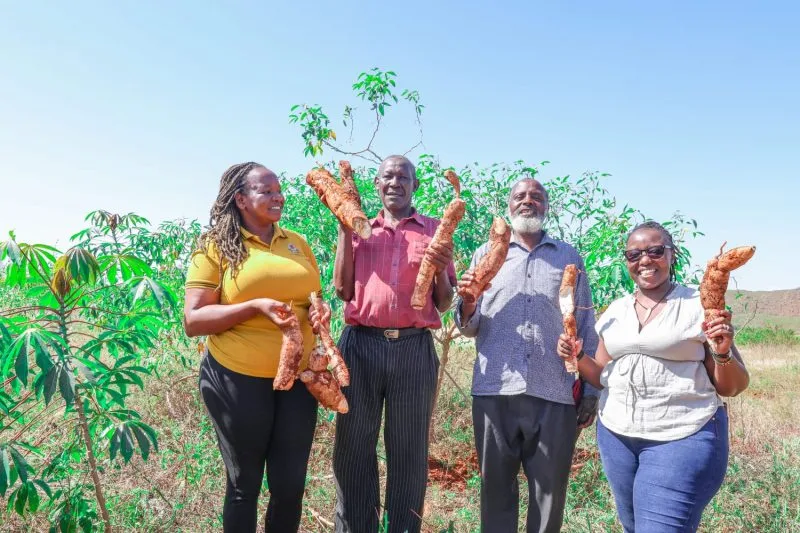
As Kenya grapples with the effects of climate change, rising food insecurity and growing youth unemployment, cassava is increasingly being recognised as one of the country’s most promising but under-utilised economic crops.
Traditionally viewed as a subsistence crop, cassava is now emerging as a strategic solution for strengthening food security, improving nutrition, creating jobs and supplying raw materials for various industries.
Despite its growing importance, Kenya currently produces about 1.2 million metric tonnes of cassava annually against an estimated national demand of nearly three million metric tonnes, forcing the country to rely on imports from neighbouring Uganda and Tanzania.
According to Prof. Richard Mulwa, the Cassava Value Chain Lead under the TAGDev 2.0 Program at Egerton University, bridging the production gap presents significant opportunities for farmers, agribusinesses and investors while reducing Kenya’s dependence on imports.
Mulwa says the TAGDev 2.0 Program is working to transform cassava into a commercially viable and climate-smart value chain through research, farmer training and enterprise development.
The initiative equips farmers with improved drought-tolerant cassava varieties, climate-smart agriculture techniques, Good Agricultural Practices (GAP), post-harvest handling skills and value-addition technologies.
“By linking research, farmer training and enterprise development, the program is helping communities adapt to climate change while at the same time creating sustainable livelihood opportunities,” says Mulwa.
For Thomas Maina, a smallholder farmer in Njoro, Nakuru County, the initiative has transformed both his farming practices and household income.
After years of struggling with declining maize yields and food shortages, Maina joined the program and adopted improved cassava farming methods that significantly boosted production.
“There was a major change after the training because we learned better farming methods and received improved cassava varieties that increased production,” he says.
Today, cassava provides year-round food for his family while surplus harvests generate income for school fees, healthcare and other household needs.
His daughter now supplies fresh cassava to markets in Samburu County, while his son has ventured into cassava flour processing, producing cakes and other value-added products.
According to Mulwa, the crop presents opportunities far beyond farming.
“Young people can build enterprises in seed multiplication, production, aggregation, transport, processing, packaging, branding and marketing,” he explains.
Cassava also supports industries such as livestock feed manufacturing, pharmaceuticals, textiles, paper, adhesives, biodegradable packaging and bioethanol production through starch processing.
Mulwa notes that high-quality cassava flour could help Kenya reduce its reliance on imported wheat by partially substituting wheat in bakery products and enriching maize and cereal-based flour blends.
He says the TAGDev 2.0 Program has already reached more than 4,439 farmers, demonstrating how university-led research and innovation can drive community transformation and strengthen resilient agricultural systems.
Mulwa believes that with sustained investment in research, innovation and value chain development, cassava has the potential to become a major driver of food security, job creation and rural economic growth in Kenya.
“What has long been hidden beneath Kenya’s soil is proving to be far more than a resilient root crop,” he says.
https://farmerstrend.co.ke/trending/cassava-value-chain-development-in-kenya/https://farmerstrend.co.ke/wp-content/uploads/2026/07/Cassava-value-chain-development-in-Kenya.webphttps://farmerstrend.co.ke/wp-content/uploads/2026/07/Cassava-value-chain-development-in-Kenya-150x150.webp# TrendingCassava farmingCassava value chain development in Kenya is gaining momentum. The TAGDev 2.0 Program is helping farmers adopt improved varieties and create enterprises across the value chain.As Kenya grapples with the effects of climate change, rising food insecurity and growing youth unemployment, cassava is increasingly being recognised as one of...FarmersTrendjohn doefarmerstrend@gmail.comAdministratorFarmers Trend Ltd.








Leave a Reply