Transforming Urban Food Systems in Kenya with Black Soldier Fly Innovations
Black Soldier Fly innovations in Kenya’s urban food systems are turning waste into animal feed and jobs. A school-centered model could tackle food insecurity and youth unemployment.
Every day, Nairobi generates approximately 2,400 metric tonnes of waste. The city is running out of space to put this waste. At the same time, Kenya is grappling with rising food insecurity, shrinking agricultural land, water scarcity, and high youth unemployment. These challenges are often addressed separately. But a growing coalition of researchers, entrepreneurs, policymakers, and community organizations is advancing a different view.
They believe that the Black Soldier Fly (BSF) offers a single, integrated innovation capable of addressing these challenges in tandem. BSF systems convert organic waste into valuable animal feed and organic fertilizer. They also generate green jobs for young people. This is a practical solution that turns waste into opportunity.
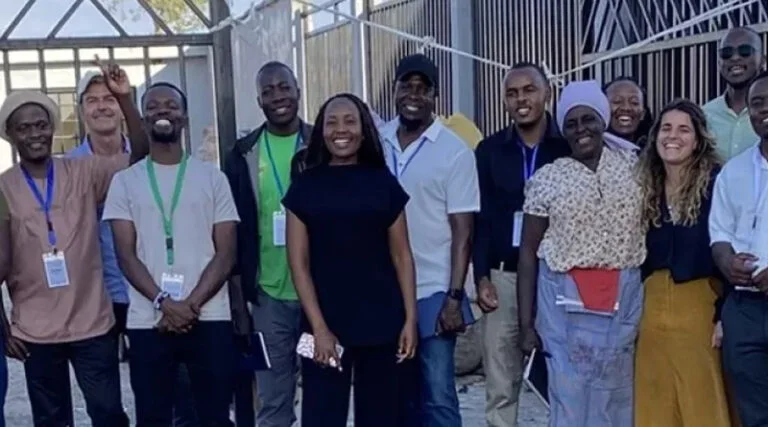
This momentum was reinforced during a two-day stakeholder workshop convened by the International Institute of Tropical Agriculture (IITA) and the World Vegetable Center (WorldVeg) from February 19 to 20. More than 15 organizations explored how to join forces in using BSF systems to reshape urban waste management and strengthen food systems.
The discussions marked a significant breakthrough. Stakeholders converged on shared opportunities across the BSF value chain and urban agriculture systems. A strong consensus emerged around the idea of a school-centered ecosystem as the most strategic entry point for implementation. Youth were positioned as a catalytic force for scaling impact. Participants also committed to follow-up engagements to refine and advance the emerging concept into actionable programming.
At the heart of the proposed approach is a school-centered BSF ecosystem that integrates education and awareness, waste management, food production, and youth employment. In this model, schools are not only learning spaces but also active nodes within a circular economy. School gardens provide platforms for sustainable food production and climate-smart agriculture learning. School canteens generate organic waste streams that feed into BSF production systems.
BSF training centres would equip young people with practical skills in insect-based agriculture, waste valorization, and circular economy entrepreneurship. At the community level, production units would process organic waste into insect protein and frass fertilizer. This would create employment opportunities while closing nutrient loops within urban systems.
Academic perspectives further highlighted the need to design systems suited to urban realities. Prof. Wesonga from JKUAT pointed out that BSF systems must be adapted for environments characterized by limited land, space, and time. This is particularly important in dense urban settings where space is at a premium.
Agricultural research shared during the workshop reinforced the multifunctional value of BSF outputs. Dr. James Kisaakye demonstrated that BSF frass, especially when combined with exuvia, not only enhances soil fertility but also significantly suppresses nematode pests. This leads to improved yields and stronger economic and ecological outcomes.
From an implementation standpoint, Joseph Kinyanjui from Nairobi City County emphasized that while technical solutions are available, the greatest challenge lies in bridging community awareness gaps and strengthening incentives for adoption. People need to understand the value of waste separation and the benefits of BSF systems.
Several cross-cutting insights emerged from the discussions. First, Kenya’s BSF sector is characterized by a significant mismatch between high market potential and extremely low current production. Demand is estimated at around 80,000 metric tonnes annually, but actual output is around 1 per cent of this potential. This gap represents a massive opportunity for entrepreneurs.
Second, youth participation remains constrained by high entry costs. However, emerging technologies are beginning to lower these barriers and open new pathways for entrepreneurship. Low-cost innovations such as biopods allow youth to enter the sector with minimal resources.
Third, effective waste management systems, particularly source segregation and reliable organic waste streams, are essential for BSF systems to function at scale. These systems remain weakly implemented in most urban areas.
Fourth, urban agriculture innovations highlighted during the workshop demonstrate strong potential for water-efficient and space-efficient food production systems. These are particularly relevant for urban centres suffering environmental stress.
Finally, BSF-derived products such as frass offer dual benefits. They serve both as fertilizers and biological pest control agents, delivering integrated agricultural value.
Despite this promise, several barriers continue to limit scale-up. These include inadequate waste segregation systems, high initial investment costs, inconsistent enforcement of waste management policies, limited public awareness, and fragmented infrastructure for waste collection and processing.
From the private sector, Nicholas Ndekei of Zehunger Solutions emphasized the high entry barriers that have historically limited youth participation in waste valorization industries. Traditional systems require significant capital investment. He contrasted this with emerging low-cost innovations such as biopods, which allow youth to enter the sector with minimal resources, effectively democratizing access to circular economy opportunities.
From a waste management perspective, Winnie Githinji of Harcourt Agri-Eco Farm underscored the importance of functional systems and enforcement of existing regulations. She emphasized that effective waste solutions must be built on incentives where value is created rather than subsidized.
The workshop concluded with a clear message: the technical foundations for scaling BSF systems in Kenya are present and already exist. The country has active entrepreneurs, supportive research institutions, emerging policy frameworks, and growing demand for sustainable agricultural inputs and alternative proteins.
What is needed now is stronger coordination, increased investment, and demonstration models capable of inspiring wider adoption. As cities across Africa grapple with mounting pressures from urbanization, climate change, and food insecurity, Black Soldier Fly systems offer a practical pathway toward more resilient and inclusive food systems.
By transforming waste into opportunity, empowering youth entrepreneurs, and strengthening sustainable agriculture, BSF innovation is demonstrating how biocircular solutions can generate environmental, social, and economic benefits simultaneously. The momentum generated in Nairobi suggests that Kenya is well positioned to become a leader in Africa’s emerging circular bioeconomy.
The vision is clear. Waste is no longer a problem to be managed. It is a resource that fuels prosperity, resilience, and sustainable development. The workshop concluded with a shared vision for a youth-led, school-centered BSF ecosystem. This positions circular agriculture as a practical pathway for transforming Nairobi’s urban challenges into opportunities for resilience, livelihoods, and sustainable food production.
Transforming urban food systems in Kenya with Black Soldier Fly innovations is a model for other cities. The work is happening. The partnerships are forming. The youth are ready. The waste is waiting. The opportunity is now. The transformation has begun.
https://farmerstrend.co.ke/trending/black-soldier-fly-innovations-in-kenya/https://farmerstrend.co.ke/wp-content/uploads/2026/06/Black-Soldier-Fly-innovations-in-Kenya.webphttps://farmerstrend.co.ke/wp-content/uploads/2026/06/Black-Soldier-Fly-innovations-in-Kenya-150x150.webp# TrendingBlack Soldier Fly innovations in Kenya's urban food systems are turning waste into animal feed and jobs. A school-centered model could tackle food insecurity and youth unemployment.Every day, Nairobi generates approximately 2,400 metric tonnes of waste. The city is running out of space to put this waste. At the...FarmersTrendjohn doefarmerstrend@gmail.comAdministratorFarmers Trend Ltd.





Leave a Reply