Kenya’s 5 Billion Egg Shortfall Ties Fuel Shocks to Food Inflation and Interest Rates
Kenya’s 5 billion egg shortfall ties fuel price shocks to food inflation. May inflation hit 6.7% as tomato prices rose 45.7%. Central Bank holds rates at 8.75%.
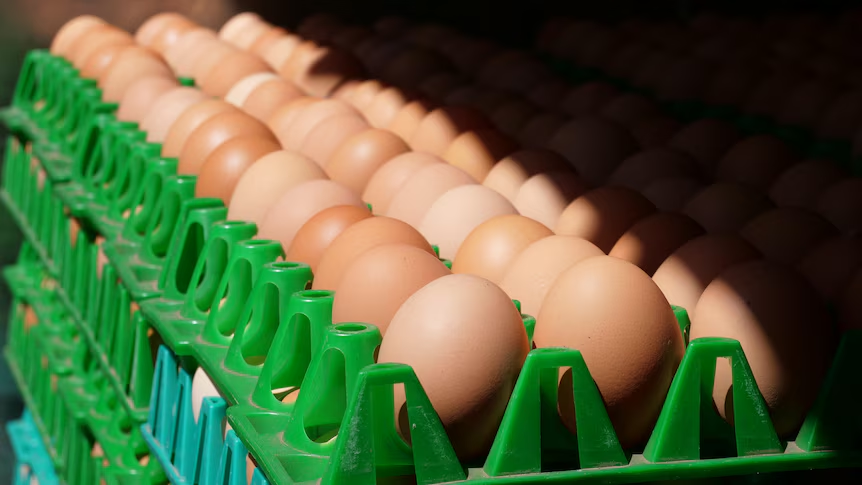
Kenya’s June inflation figures, due from the Kenya National Bureau of Statistics (KNBS) on 30 June, may indicate whether the recent rise in food and fuel prices is easing or settling in for longer. Kenya produces about four billion eggs a year but needs around nine billion, a shortfall of roughly five billion eggs filled mainly by imports, with similar yearly gaps in milk, fish and honey. Kenya imports a lot of their food, so when fuel and transport get pricier, food prices tend to follow. All of this makes food inflation harder to tame, with possible knock-on effects for interest rates, the shilling against the dollar, and business lending
David Precious, Senior Market Analyst at EBC Financial Group, said, “Finance does not remove the risks of farming, but badly timed lending can make them worse, while better designed lending can absorb some of them. In Kenya, the inflation story begins before food reaches the shelf, because fuel, transport and credit all shape how hard a price shock hits.”
The food and fuel pressure is already visible in the latest monthly inflation report. Kenya’s annual inflation rose to 6.7% in May 2026 from 5.6% in April. Food and non-alcoholic drinks led the way, up 9.4%, followed by transport, up 16.5%, finally housing and utilities, up 3.4%. The headline figure hides a sharp split. Core inflation, which leaves out food and energy because their prices jump around a lot, was only 3.2%, while the food and energy part rose 16.0%. In plain terms, the pressure sits in food and fuel, not across the whole economy. For example, tomato prices rose 45.7% over the year to May, after heavy rain damaged farms and blocked roads. A near doubling in the price of a common food shows the pressure on family budgets that the headline number can hide.
In May 2026, after a dispute with public transport operators, the energy regulator EPRA cut the price of diesel by about 10 shillings per litre. This may have eased some immediate pressure, but it might not change the deeper reasons fuel shocks feed into transport, food and business costs. Farmers expect more pressure ahead. In the Central Bank of Kenya’s May 2026 Agriculture Sector Survey, most respondents expected inflation to rise in the next one to three months, mainly on fears that Middle East tensions could lift production and distribution costs.
The central bank has stayed cautious, holding its main rate at 8.75% on 9 June, the second straight hold after ten cuts that trimmed 4.25 points since August 2024. It pointed to higher energy and transport costs and the need to keep inflation expectations steady, and it lowered its 2026 growth forecast to 4.9% from 5.3%.
Activity at private businesses has slowed under these same costs. The Stanbic Bank Kenya Purchasing Managers’ Index, a monthly survey of private firms, fell to 46.6 in May from 49.4 in April, a third month in a row below the 50 mark that separates growth from decline. That leaves the central bank with a narrow choice. Higher rates could add pressure to a slowing economy, while cutting them too soon could raise doubts about inflation and about the Kenyan shilling.
Bank lending to businesses has been recovering as interest rates fall, but it has long reached some parts of the economy far more than others. Lending to private firms grew to 9.3% in May from 7.1% in April, and the average bank lending rate fell to 14.5% from 17.2% in November 2024. Even so, lending to agriculture has stayed at only about 3% to 5% of total commercial bank credit, so cheaper loans may not be reaching food producers.
Part of the reason the shortages last is how farm lending is built. An FSD Kenya study of 1,210 farm and food businesses found that workable models already exist across dairy, poultry, fishing, fruit and vegetables and beekeeping, but few are taken up because loans rarely match seasonal incomes. In that study, 53% named a lack of assets to use as loan security as their main barrier to credit, 43% named irregular income, and 16% named weak financial records.
“Kenya’s inflation is not really a story about one month’s number.” Precious added. “As the country imports much of its food, a rise in fuel and transport costs has more room to push food prices up. The pressure sits in food and energy rather than across the economy, and cheaper credit is reaching most sectors but not the farmers who grow the food. For investors and lenders following Kenya, those links explain more than the headline alone.”
For more information, visit www.ebc.com.
https://farmerstrend.co.ke/trending/kenyas-5-billion-egg-shortfall/https://farmerstrend.co.ke/wp-content/uploads/2026/06/Kenyas-5-billion-egg-shortfall.avifhttps://farmerstrend.co.ke/wp-content/uploads/2026/06/Kenyas-5-billion-egg-shortfall-150x150.jpg# TrendingKenya's 5 billion egg shortfall ties fuel price shocks to food inflation. May inflation hit 6.7% as tomato prices rose 45.7%. Central Bank holds rates at 8.75%.Kenya’s June inflation figures, due from the Kenya National Bureau of Statistics (KNBS) on 30 June, may indicate whether the recent rise in...FarmersTrendjohn doefarmerstrend@gmail.comAdministratorFarmers Trend Ltd.












Leave a Reply