How to Export Vegetables and Herbs from Kenya to the USA (2026 Complete First Timer’s Guide)
Learn how to export vegetables and herbs from Kenya to the US. Understand FDA rules, KEPHIS certification, GlobalGAP, AGOA, buyers, costs, and the export process.

How to Export Vegetables and Herbs from Kenya to the USA (2026 Complete Guide)
Exporting vegetables and herbs from Kenya to the United States can be profitable, but only if you meet FDA food safety requirements, obtain KEPHIS certification, find an approved US importer, and maintain proper cold-chain logistics. This guide covers every step from choosing export crops to getting paid by US buyers.
Kenya exported edible vegetables and certain roots and tubers to the United States worth $662.51 million in 2024. The US market imports approximately 52 percent of fresh fruits and 22 percent of fresh vegetables consumed in the country. These numbers show the scale of the opportunity. The growing African diaspora in the US and the rising popularity of African vegetables are opening doors for Kenyan farmers. But success requires understanding the complex requirements, meeting strict quality standards, and building relationships with the right buyers.
Can I Export Vegetables from Kenya to USA?
Yes. Kenyan farmers and exporters can sell vegetables and herbs to the US market if they register with the Horticultural Crops Directorate, obtain phytosanitary certificates from KEPHIS, comply with FDA food safety requirements, work with a US-based importer, and meet pesticide residue limits.
The process is complex but achievable. Many Kenyan farmers and exporters are already doing it successfully. The key is understanding what is required and following the steps carefully. This guide by Farmers Trend Limited highlights all the information you need to get started.
Which Vegetables and Herbs Can I Export to the USA?
Kenya produces a wide range of vegetables and herbs that find buyers in the US market. The most in-demand products include fresh green beans, snow peas, sugar snaps, baby corn, fresh herbs like mint, basil, coriander, parsley, rosemary, and dill, traditional African vegetables like amaranth, spider plant, and nightshade, dried vegetables including dried traditional vegetables, chilies and peppers, and specialty leafy greens.
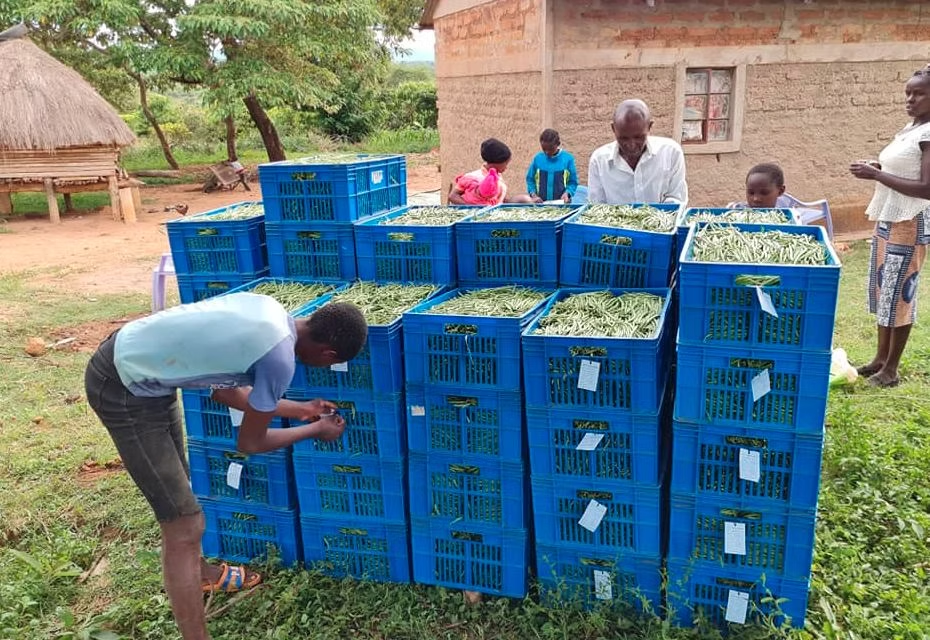
Green beans remain one of Kenya’s top vegetable exports to the US market. US buyers demand specific quality parameters including length between 8 and 10 centimeters, diameter between 4 and 6 millimeters, mid to dark green colour, and minimal pest damage. Snow peas and sugar snaps are also popular, with strict specifications for size, colour, and freshness. These vegetables are typically exported by air freight due to their perishable nature.
Fresh herbs have gained significant traction in the US market. Kenyan farmers have successfully exported mint, basil, coriander, parsley, rosemary, and dill to US buyers. These herbs must be fresh, free from pests, and properly packaged for air freight. The short shelf life of fresh herbs requires efficient cold chain management from harvest to delivery. Buyers specify stem length, leaf size, colour, and absence of wilting.
Traditional African vegetables are creating new opportunities in the US market. The growing African diaspora and increasing interest in diverse vegetables have opened doors for amaranth, spider plant, and nightshade. These vegetables are often sold as specialty produce, commanding premium prices. Dried versions of these vegetables have also found export markets, offering the advantage of longer shelf life and lower shipping costs. The drying process preserves the vegetables while reducing volume and weight for shipping.
Chilies and peppers, including both fresh and dried varieties, are also in demand. US buyers specify heat levels, colour, and size requirements. Specialty leafy greens and baby vegetables have niche markets that can be profitable for farmers who meet the specific quality standards. The key to success is choosing the right products for your farm and finding the right buyers.
What Do US Buyers Look For in Imported Vegetables and Herbs?
Food Safety and Certification
Food safety is the number one priority for US buyers. The FSVP rule established under the FDA Food Safety Modernization Act requires importers to verify that foreign suppliers produce food in a manner that meets US safety standards. Buyers will demand evidence that your vegetables and herbs are produced under safe conditions and free from adulteration.
The importer is the US owner or consignee of a food offered for import. If there is no US owner or consignee, the importer is the US agency or representative of the foreign owner at the time of entry. This means you need a US-based importer to bring your vegetables and herbs into the country.
Under FSVP, importers must establish and follow written procedures to ensure they import foods only from foreign suppliers approved based on an evaluation of the risk posed by the imported food and the supplier’s performance. Importers must determine known or reasonably foreseeable hazards with each food, based on experience, illness data, scientific reports, and other information. These hazards include biological hazards like disease-causing bacteria, chemical hazards like pesticide and drug residues and natural toxins, and physical hazards like glass.
Phytosanitary Compliance
Phytosanitary certificates are required for all plant and plant products entering the US. These certificates prove that KEPHIS inspected the product and found it free from quarantine pests. The destination country will ask for this certificate before allowing the product to enter, and without it, the consignment is stopped at the port. Exporters must register with KEPHIS on the Integrated Export Import Certification System and request inspections for each shipment. Destructive sampling during exit point verification is required to ensure that produce meets the required standards.
Pesticide Residue Limits
Maximum Residue Limits are strictly enforced in the US. Produce found to have pesticide residues above the acceptable limits will be rejected. This is one of the major causes of shipment interceptions. Regular residue testing is essential to ensure compliance. The Kenya Bureau of Standards has been working to establish standards for packaging materials and design to avoid having the same Kenyan product packaged in different sizes and designs.
Quality and Freshness
Buyers demand consistent quality. Vegetables and herbs must be fresh, properly graded, and well-packaged. For French beans, the length should be minimum 8 cm and maximum 10 cm with a diameter between 4 mm and 6 mm. Colour should be mid to dark green with minimal pest damage. Most supermarkets demand totally blemish-free beans. Fresh herbs must be vibrant, free from wilting, and properly cooled. Dried vegetables must have consistent colour, proper moisture content, and no signs of mould or contamination.
Traceability
Buyers demand traceability. They want to know exactly where the produce came from, when it was harvested, and how it was handled. The KEPHIS electronic certification system requires exporters to maintain detailed records for every farm. This traceability is not optional; it is mandatory. Buyers who discover that produce cannot be traced back to its source will not return for a second order.
Required Certifications for Exporting Vegetables to USA
HCD Export License
You must register as an exporter with the Horticultural Crops Directorate to obtain an export license. The license costs KES 5,000 per year and is required for any horticultural exports. To obtain the license, you must present documents including certificate of business registration, KRA PIN, bank details, photocopy of identity card, documentary evidence from overseas clients, produce packing facilities inspection report, farm inspection report, buyer-produce contracts as witnessed by HCDA, company stamp, and a typed application form.
Phytosanitary Certificate
Phytosanitary certificates are issued by KEPHIS for each shipment. The certificate proves that the produce has been inspected and found free from quarantine pests. Each phytosanitary certificate request incurs a fee. The certificate has a specific validity period, and the shipment must arrive at the destination before the certificate expires.
GlobalGAP Certification
GlobalGAP certification is increasingly essential for accessing international markets. This certification demonstrates that you have engaged in Good Agricultural Practices, ensuring that crops have been grown in safe, healthy, and responsible ways. The certification process involves audit and inspection of your farm operations, including pesticide use, worker safety, and environmental practices. The certification is valid for one year and requires annual renewal.
HACCP Certification
HACCP certification is a key requirement for many international buyers. The Hazard Analysis Critical Control Point system provides the framework for monitoring the total food system, from harvesting to consumption, to reduce the risk of food-borne illnesses and assure food safety. The certification is now held by the AFA Horticultural Crops Directorate for horticultural products.
Organic Certification
If you are marketing your vegetables and herbs as organic, strict compliance requirements apply. Under US law, an agricultural product may be sold or labeled as organically produced only if it is produced and handled in accordance with the Organic Foods Production Act. Imported organic products must be produced and handled under an organic certification program that provides safeguards at least equivalent to US requirements. The USDA National Organic Program has specific filing requirements for organic shipments.
Required Certifications Table
| Certification | Required | Issued By | Validity |
|---|---|---|---|
| HCD Export License | Yes | Horticultural Crops Directorate | 1 Year |
| Phytosanitary Certificate | Yes | KEPHIS | Per Shipment |
| GlobalGAP | Recommended | Certification Body | 1 Year |
| HACCP | Usually Required | Accredited Body | 1 Year |
| Organic Certification | For Organic Claims | USDA Accredited Body | 1 Year |
| GMP Certification | Often Required | Accredited Body | 1 Year |
Step-by-Step Process on How to Export Vegetables and Herbs from Kenya to the USA
Step 1: Register Your Business and Obtain Export License
You must register with the Horticultural Crops Directorate to obtain an export license. The license costs KES 5,000 per year. You need to present certificate of business registration, KRA PIN, bank details, photocopy of identity card, documentary evidence from overseas clients, produce packing facilities inspection report, farm inspection report, buyer-produce contracts, and a typed application form. The process typically takes 2 to 4 weeks.
Step 2: Register with KEPHIS
You must register your farm and facilities on the KEPHIS Integrated Export Import Certification System. The process requires a formal letter, business registration certificate, KRA PIN, identification documents, and details about nursery locations and varieties. An audit of facilities follows. The one-time registration fee for KEPHIS export approval is KES 15,000. Start the process at least 60 days before your planned shipment.
Step 3: Obtain GlobalGAP and HACCP Certification
GlobalGAP certification demonstrates that you engage in Good Agricultural Practices. HACCP certification is also required by many international buyers. The certification process involves audit and inspection of your operations, including pesticide use, worker safety, and environmental practices. The process can take 2 to 6 months, so start early.
Step 4: Establish Residue Testing Program
Regular residue testing is required to ensure compliance with US MRL limits. This involves sampling and laboratory analysis of your produce to confirm that pesticide residues are within acceptable limits. The testing should be conducted before harvest to allow corrective action if residues exceed limits.
Step 5: Find a US-Based Importer
You must work with a US-based importer who handles the FSVP requirements. The importer must perform risk-based foreign supplier verification activities based on an evaluation of the risk posed by the imported food and the supplier’s performance. Finding a reliable importer can take 1 to 3 months. Start early and verify the importer’s credentials.
Step 6: Prepare Export Documentation
Each shipment requires a phytosanitary certificate issued by KEPHIS, an export certificate issued by the Horticultural Crops Directorate, a certificate of origin, and final customs verification. The phytosanitary certificate has a lifespan of 60 days, so timing is critical. Maintain detailed farm records for every farm to meet mandatory traceability requirements.
Step 7: Harvest and Handle Produce Properly
Harvest at the right maturity. Use specialized tools to minimize damage. Collect in padded crates. Transport in clean vehicles. Sanitize using food-safe disinfectants. Pre-cool to the appropriate temperature. The fruit must be sanitized and pre-cooled to between 5 and 12 degrees Celsius before loading into refrigerated containers.
Step 8: Pack and Ship
Pack in approved cartons ensuring correct labelling. Load into refrigerated containers. For sea freight, use Controlled Atmosphere containers to maintain freshness during the journey, which takes 12 to 15 days to reach Marseilles and 21 days to reach Rotterdam or Amsterdam. For air freight, ensure cold chain is maintained throughout the journey.
Step 9: Present for Inspection
Present documents to KEPHIS for final exit point verification. This includes destructive sampling to confirm the produce meets export standards. Obtain phytosanitary certificate once verification is complete. Submit documents to Horticultural Crops Directorate for the final export certificate. Present all documents including the phytosanitary certificate, export certificate, certificate of origin, and commercial invoice for verification.
Export Costs Breakdown Table
| Item | Approximate Cost (KES) |
|---|---|
| HCD Export License | 5,000 per year |
| KEPHIS Registration | 15,000 one-time |
| Phytosanitary Certificate | Per shipment fee |
| GlobalGAP Certification | 50,000 – 200,000 |
| HACCP Certification | 30,000 – 100,000 |
| Residue Testing | Per test |
| Air Freight (per kg) | Varies by volume |
| Packaging Materials | Per shipment |
| Cold Chain Logistics | Per shipment |
| Insurance | Per shipment |
Export Timeline Table
| Stage | Time Required |
|---|---|
| Business Registration | 1-2 weeks |
| HCD Export License | 2-4 weeks |
| KEPHIS Registration | 2-4 weeks |
| GlobalGAP Certification | 2-6 months |
| Finding US Importer | 1-3 months |
| First Shipment Preparation | 1-2 months |
| Total Process | 3-6 months |
How to Find Buyers in the US Market
Contact Supermarkets and Retailers Directly
When approaching US retailers, your email must demonstrate professionalism and readiness to supply. Use a clear subject line such as “Supplier Introduction: Fresh Vegetables and Herbs from Kenya – [Your Product Name].” In the body, introduce your farm, the specific vegetables or herbs you produce, and your production capacity.
List all your certifications including GlobalGAP, HACCP, organic certification if applicable, and any other third-party audits you have passed. Attach your phytosanitary certificate template, export license, and traceability system overview. Include high-resolution photographs of your produce and packing facility. Mention the volumes you can supply weekly or monthly and your shipping capabilities including cold chain management.
State that you have a US-based importer handling FSVP compliance. Request an opportunity to submit product samples and offer to schedule a call to discuss their specific requirements.
Kroger operates roughly 2,800 stores and is the largest pure-play grocery retailer in the United States. To become a supplier, you must complete registration through the Kroger Supplier Portal with your business legal name, federal tax ID, business address, diversity certification status, product categories, food safety certifications, insurance certificates, and banking information. For food product suppliers, Kroger requires a product sample submission and a food safety audit. A good starting point is approaching with a specific product for a specific region, proposing a test or pilot in a subset of stores.
Aldi prefers to work directly with manufacturers or growers and requires GFSI or GMP facility certifications. They also require private label capabilities, Advanced Shipping Notices, product liability insurance, and EDI capability for business document exchange. Product needs to be shipped in display ready cases. Apply through Aldi’s New Supplier Application on their corporate website.
Walmart requires you to first obtain a Supplier Evaluation Report from Dun & Bradstreet, then contact the Store Manager or Food Merchandiser. If your product is accepted, you will complete a Local Supplier Questionnaire and provide your Dun & Bradstreet number, UCC Membership number, and Certificate of Liability Insurance.
Supervalu can be reached by contacting Carrie Conrad at 952-294-7457. They supply about 2,300 retail grocery stores in 48 states.
SYSCO, the largest foodservice distributor in North America, can be reached by contacting Carl Shaug at 831-771-5000.
Whole Foods buys direct from farmers on a single store basis. For specific locations, you would contact the Produce Buyer directly. They require an Everclean audit for food safety and product liability insurance.
Supplier Diversity Programs
Many US retailers have supplier diversity programs specifically designed to find and onboard diverse suppliers. Kroger has publicly committed to spending billions with diverse-owned businesses and participates in the National Minority Supplier Development Council and the Women’s Business Enterprise National Council. NMSDC certification and WBENC certification carry significant weight.
H-E-B, which operates roughly 340 stores across Texas and Mexico, has a dedicated Local Texas Business Program aimed at small and mid-sized Texas businesses. They are an affiliate member of NMSDC through the Texas MSDBC.
Wakefern Food Corp., which operates ShopRite, Price Rite Marketplace, The Fresh Grocer, Gourmet Garage, Fairway Market, and other banners, has opened applications for its Local Supplier Summit. The opportunity targets suppliers in nine states. Businesses can apply through RangeMe, with 10 finalists selected to pitch their products in person and secure at least a one-year placement.
Partner with Local Contracting Companies
Several companies in Kenya contract farmers to produce vegetables for export. For the average farmer, partnering with these companies is ideal as it reduces the number of engagements involved before selling the produce.
Mace Foods specializes in dehydrated spices, indigenous vegetables, and herbs. They offer contracted farmers the support needed in the production process and a guaranteed market for their produce. Mace has contracts with 1,810 farmers from 14 counties.
The Cheer Up Programme in Lari has found success, with 30 percent of the vegetables they dry now going to the export market. They currently supply dried vegetables to the Middle East, the US, Canada, and several European countries.
Work with Established Exporters
Many US buyers prefer to work with established exporters rather than individual farmers. Exporters have the infrastructure, certification, and relationships to handle large volumes and meet strict quality requirements. Partnering with a reputable exporter can provide access to markets that would otherwise be impossible to reach. The exporter handles the complex logistics, documentation, and compliance requirements, allowing you to focus on production.
Some of Kenya’s most reliable vegetable exporters include Kakuzi Limited, Kenya Fresh Produce Exporters Limited, Keitt Exporters Limited, Sunripe Limited, and Sasini. These companies have established relationships with US buyers and can provide access to markets.
Attend International Trade Shows
International trade shows are where buyers and sellers meet face to face. Events like the PMA Fresh Summit and IFPA Global Produce Show in the US are excellent opportunities to meet buyers, understand their requirements, and build relationships. Participation requires investment, but the returns can be substantial.
Leverage Government and Industry Bodies
The Horticultural Crops Directorate and KEPHIS maintain lists of registered exporters. The Kenya Export Promotion and Branding Agency promotes Kenyan products internationally. For more information on how to reach the export market, contact the Kenya Export Promotion and Branding Agency through phone or email exports@brand.ke.
Build a Professional Online Presence
Having a professional website with details about your farm, certifications, and product offerings can help US buyers find you. A strong online presence has helped groups like Cheer Up Programme reach foreign markets through referrals and exhibitions. High-quality photographs of your produce and certifications build trust. This is an increasingly important method to find buyers as buyers increasingly search online for suppliers.
Understanding AGOA and Its Impact
What AGOA Offers
AGOA is a US Trade Act that significantly enhances market access to the US for qualifying Sub-Saharan African countries. The Act accords duty-free market access for 1,835 products in addition to the 4,600 items already enjoying duty-free status under the US Generalized System of Preferences program. Kenya was the first Sub-Saharan African country to qualify for AGOA benefits.
The sectors with great potential under AGOA include processed and specialty foods, fresh fruits, and vegetables. Kenya’s exports to the US under AGOA have supported tens of thousands of jobs in export processing zones, with apparel, macadamia nuts, coffee, and horticultural products leading the way. Since 2000, Kenya has exported goods worth $13.3 billion (about Sh1.7 trillion) to the US under AGOA.
Current Status of AGOA
The trade landscape has been volatile. AGOA, reinstated in February 2026, runs only until December 2026, heightening uncertainty for businesses reliant on the US market. During the four months between October 2025 and January 2026, shipments to the US were hit with duties ranging from 15 to 42 percent, squeezing margins and disrupting orders.
The Office of the United States Trade Representative has indicated that it targets to modernise AGOA, making it clear that the current model, which provides for unilateral trade preferences in favour of Africa, will be reviewed. The USTR is seeking reforms to “ensure the programme meets the needs of American workers and businesses” and to “provide a path for reciprocal trade agreements with the more advanced countries as they develop and graduate from the programme.”
What This Means for You
The expiration of AGOA on September 30, 2025 marked a crucial moment for Africa’s horticultural exports. With AGOA’s termination, key horticultural exports are exposed to tariffs reaching as high as 28 percent or more, rendering African products expensive and less competitive compared to alternatives from other regions.
However, the Kenyan Parliament has unanimously approved a motion urging the government and the United States to pursue an extension of AGOA for an additional 16 years, until 2041, to safeguard economic gains and protect livelihoods. There is also a push for a two-year transition window in the event that AGOA is not extended.
Practical Steps for Navigating AGOA
Work through established exporters who have experience navigating the current trade environment and can advise on tariff exposure. Consider focusing on value-added products such as dried vegetables, which have been finding export markets successfully. The Cheer Up Programme in Lari has been exporting dried traditional vegetables to the US, Canada, and Europe. Companies like Mace Foods specialize in dehydrated spices, indigenous vegetables, and herbs, offering contracted farmers support in the production process and a guaranteed market.
Common Mistakes That Lead to Rejected Shipments
Harvesting Immature or Poor Quality Produce
Harvesting vegetables and herbs before they reach maturity leads to rejection. Buyers have specific size, colour, and quality specifications. Delivering produce that does not meet these specifications will lead to rejection. For French beans, the length should be minimum 8 cm and maximum 10 cm with a diameter between 4 mm and 6 mm. The colour should be mid to dark green with minimal pest damage.
Pesticide Residue Violations
Pesticide residues above the acceptable limits are a major cause of shipment interceptions. Regular residue testing is essential to ensure compliance with US MRL limits. Failure to comply will result in rejected shipments and damage to your reputation. The testing should be conducted before harvest to allow corrective action if residues exceed limits.
Poor Handling During Harvest and Transport
Bruised or damaged produce will not pass inspection. Using improper containers, overfilling crates, or transporting produce in open vehicles causes damage that cannot be repaired. Specialized harvesting tools, padded crates, and clean covered vehicles are essential. The fruit must be sanitized using food-safe disinfectants and pre-cooled to between 5 and 12 degrees Celsius before loading into refrigerated containers.
Inadequate Pest Management
Presence of harmful organisms in consignments is a major cause of rejection. Different markets have different pest requirements. Failure to meet these pest management standards will lead to the shipment being rejected. For South Korea, specific traps must be installed and maintained. For the US, APHIS requirements must be met.
Incomplete Documentation
Missing or incorrect documentation is a common and costly mistake. The phytosanitary certificate must be current. The export certificate must match the shipment details exactly. The certificate of origin must be authentic. Any discrepancy causes the shipment to be held at the port, where demurrage costs mount quickly.
Poor Temperature Management
Vegetables and herbs must be properly pre-cooled and maintained at the correct temperature throughout the journey. Any break in the cold chain leads to premature spoilage and rejection. The temperature must be maintained from the packhouse through transport to the airport or port and during the journey.
Not Having Traceability Records
International buyers demand traceability. If you cannot prove exactly where the produce came from and how it was handled, your shipment will be rejected. KEPHIS requires detailed records for every farm. This is mandatory, not optional.
Substandard Packaging
Packaging quality is a challenge that has affected Kenyan products. International buyers have expressed concerns about packaging being of lower quality, appeal, and design. Using substandard packaging materials or failing to follow buyer specifications leads to rejection. The entire packing process must be based on HACCP Quality Assurance standards, and box materials must be FDA-approved to guarantee no damage to the product.
Mixing Different Produce in One Shipment
Mixing different types of produce in the same shipment can lead to cross-contamination and rejection. Each product must be handled and shipped separately according to its specific requirements. It is strictly prohibited to mix certain produce types in the same shipment.
Common Mistakes and Consequences Table
| Mistake | Consequence |
|---|---|
| Harvesting immature produce | Rejection at destination |
| Pesticide residue violations | Rejection and reputation damage |
| Poor handling during harvest | Bruising and rejection |
| Inadequate pest management | Rejection at border |
| Incomplete documentation | Held at port, demurrage costs |
| Poor temperature management | Premature spoilage |
| No traceability records | Rejection |
| Substandard packaging | Rejection |
Exporting to USA vs Europe Comparison Table
| Factor | USA | Europe |
|---|---|---|
| Certification Requirements | FSVP, HACCP, GlobalGAP | GlobalGAP, BRC, IFS |
| Pest Regulations | APHIS strict | EU strict |
| MRL Limits | Very strict | Very strict |
| Inspection Intensity | High | High |
| Freight Cost | Higher (longer distance) | Lower |
| Transit Time | Longer (21+ days) | Shorter |
| Profit Potential | Higher | Moderate |
| AGOA Benefits | Duty-free access | No AGOA |
| Organic Standards | USDA NOP | EU Organic |
Profitability Calculation Example
Exporting 1 Tonne of Fresh Green Beans to USA
| Item | Cost (KES) |
|---|---|
| Production Cost | 50,000 |
| Harvesting and Packing | 20,000 |
| Packaging Materials | 15,000 |
| Cold Chain Logistics | 10,000 |
| Air Freight | 100,000 |
| Certification Costs (annualized) | 5,000 |
| Documentation Fees | 10,000 |
| Total Cost | 210,000 |
| Revenue | Amount |
|---|---|
| Selling Price (USD 3-5 per kg) | 300,000 – 500,000 |
| Estimated Profit Margin | 30-60% |
Frequently Asked Questions
Can an individual farmer export vegetables to USA? Yes, but you must register your business, obtain HCD license, register with KEPHIS, and work with a US-based importer. Individual farmers can export, but many choose to work through established exporters or contracting companies to simplify the process.
Which vegetables are most profitable to export to USA? Green beans, snow peas, sugar snaps, fresh herbs, and specialty African vegetables have strong demand and good profit margins. The most profitable crops vary by season and market conditions.
What certifications are required to export to USA? HCD license, phytosanitary certificate, and FDA compliance are mandatory. GlobalGAP and HACCP are strongly recommended. Organic certification is required if marketing as organic.
How much does it cost to get an export license? The HCD export license costs KES 5,000 per year. Additional costs include KEPHIS registration at KES 15,000 one-time, and certification costs for GlobalGAP and HACCP.
Does AGOA cover vegetable exports? Yes, horticultural products including vegetables and herbs qualify for duty-free access under AGOA. However, AGOA is currently set to expire in December 2026, so verify current status.
Is GlobalGAP certification mandatory? It is not legally mandatory but most US buyers require it. Without GlobalGAP, you will struggle to find buyers in the US market.
How long does it take to get KEPHIS registration? KEPHIS registration typically takes 2-4 weeks after submitting complete documents. The process involves providing formal letter, business registration certificate, KRA PIN, identification documents, and details about nursery locations and varieties.
What happens if pesticide residue limits fail? The shipment will be rejected at the US border and may be destroyed or re-exported. This results in substantial financial losses and damages your reputation with buyers.
Can I export dried vegetables to USA? Yes, dried vegetables have found successful export markets. Companies like Mace Foods and Cheer Up Programme export dried products. Dried vegetables offer the advantage of longer shelf life and lower shipping costs.
Which airport handles vegetable exports from Kenya? Jomo Kenyatta International Airport handles the majority of air freight exports. Kenya Airways offers direct cargo capacity to the US, but space is limited and must be booked in advance.
How do I find a US importer? Contact established exporters, attend trade shows, use online marketplaces like Tridge and Selina Wamucii, or work with government agencies. Finding a reliable importer can take 1 to 3 months.
Can I export without GlobalGAP certification? Some buyers accept without, but most major US retailers require it. Without GlobalGAP, your market access will be limited.
How long does the entire export process take? From registration to first shipment typically takes 3-6 months. The timeline depends on how quickly you can complete the certification and registration processes.
Is exporting vegetables profitable? Yes, with proper planning and quality control, vegetables exported to USA can be highly profitable. The profit margin typically ranges from 30 to 60 percent depending on the product and market conditions.
Do I need a US agent to export? You need a US-based importer to handle FSVP compliance. The importer must be registered in the US and responsible for verifying that the imported food meets US safety standards.
What are the packaging requirements? Pack in approved cartons with proper labelling. For some markets, insect-proof packaging is required. The entire packing process must be based on HACCP Quality Assurance standards.
How much does air freight cost? Cost varies but expect $3-5 per kilogram depending on volume and season. Air freight is the most significant cost for fresh vegetable exports.
Can I export organic vegetables? Yes, but you need USDA organic certification for your produce. Imported organic products must be produced and handled under an organic certification program that provides safeguards at least equivalent to US requirements.
What is the shelf life for exported vegetables? Depends on the vegetable and cold chain management, typically 7-21 days. Proper pre-cooling and temperature maintenance throughout the journey are essential.
How do I ensure traceability? Maintain detailed farm records including planting, spraying, harvesting, and handling information. The KEPHIS electronic certification system requires exporters to maintain detailed records for every farm.
Can I export to USA without HACCP certification? Some buyers accept without, but most major US retailers and food service companies require it. HACCP certification is strongly recommended.
What documents do I need for each shipment? Phytosanitary certificate, export certificate, certificate of origin, commercial invoice, packing list, and customs documentation. The phytosanitary certificate has a lifespan of 60 days.
How do I find US buyers for African vegetables? Contact specialty importers who focus on African and ethnic produce. The growing African diaspora in the US is creating demand for these products.
What happens if my shipment is damaged during transit? Marine cargo insurance can cover losses from damage, delay, or rejection. Ensure you have appropriate insurance coverage.
How do I get paid by US buyers? Payment terms are typically agreed upon in the contract. Common methods include letters of credit, wire transfers, and documentary collections.
Can small-scale farmers export? Yes, but many choose to work through contracting companies like Mace Foods or established exporters. Small-scale farmers can also form cooperatives to pool production and share costs.
What is the certification cost for GlobalGAP? GlobalGAP certification typically costs between KES 50,000 and 200,000 depending on the scope and size of your operation.
How often must I renew certifications? GlobalGAP and HACCP certifications are typically valid for one year and require annual renewal. KEPHIS registration is one-time but requires annual updates.
Which US market has the highest demand? The East Coast and West Coast have the highest demand for imported produce. Major cities like New York, Los Angeles, and Miami are key entry points.
Final Checklist
- Register business with relevant authorities.
- Obtain HCD export license.
- Register with KEPHIS.
- Complete GlobalGAP certification.
- Complete HACCP certification.
- Establish residue testing program.
- Build traceability system.
- Find US-based importer.
- Prepare export documentation.
- Establish cold chain logistics.
- Arrange air freight or sea freight.
- Present to KEPHIS for final inspection.
- Obtain phytosanitary certificate.
- Submit for final customs verification.
- Maintain communication with buyer.
About This Guide
https://farmerstrend.co.ke/trending/how-to-export-vegetables-and-herbs-from-kenya-to-the-us/https://farmerstrend.co.ke/wp-content/uploads/2026/08/How-to-Export-Vegetables-and-Herbs-from-Kenya-to-the-USA-2026.avifhttps://farmerstrend.co.ke/wp-content/uploads/2026/08/How-to-Export-Vegetables-and-Herbs-from-Kenya-to-the-USA-2026-150x150.jpg# TrendingAfrican vegetables export USA,AGOA Kenya vegetable exports,agricultural exports Kenya,air freight vegetables to USA Kenya,Aldi supplier Kenya,APHIS regulations for imported vegetables,best herbs to export to USA,certificate of origin Kenya,common mistakes vegetable export Kenya,cost of exporting vegetables from Kenya,dried vegetable export Kenya,export certification timeline Kenya,export coriander to USA,export green beans to USA,export herbs from Kenya to USA,export inspection KEPHIS,export license Kenya HCD,export mint to USA,export quality standards Kenya.,export snow peas to USA,export vegetables to USA profit,FDA requirements for imported vegetables,fresh herbs export Kenya USA,fresh produce export Kenya,FSVP compliance Kenya,GlobalGAP certification Kenya,HACCP certification Kenya,horticultural crops directorate Kenya,horticultural exports Kenya,how to become supplier to Walmart Kenya,how to contact US grocery buyers,how to export vegetables from Kenya to USA,how to find US buyers for Kenyan produce,how to get FDA approved for vegetable export,how to start vegetable export business Kenya,Kenya Export Promotion and Branding Agency,Kenya to US air freight cost,Kenya to USA trade regulations,Kenya vegetable export profit margins,Kenya vegetable export requirements,Kenya vegetable exports 2026,Kenyan farmers exporting to USA,Kenyan vegetable exporters list,Kenyan vegetables in American supermarkets,KEPHIS phytosanitary certificate,Kroger supplier Kenya,organic vegetable export Kenya,pesticide residue testing Kenya,rejected vegetable shipments USA,small scale vegetable export Kenya,supplier diversity programs USA,supplier introduction email for US retailers,SYSCO supplier Kenya,traceability requirements for vegetable export,traditional African vegetables US market,US import requirements for fresh herbs,US MRL limits vegetables,US supermarket produce buyer contacts,US supermarket supplier Kenya,US vegetable import regulations Kenya,US vegetable importers directory,US vegetable market requirements,USDA organic import Kenya,vegetable cold chain logistics,vegetable export business plan Kenya,vegetable export checklist Kenya,vegetable export documentation,vegetable export market USA,vegetable export packaging requirements,vegetable export sample submission,vegetable export success stories Kenya,vegetable export timeline Kenya,vegetable production for export Kenya,vegetables with highest demand in USA,which vegetables to export to USA,Whole Foods supplier KenyaLearn how to export vegetables and herbs from Kenya to the US. Understand FDA rules, KEPHIS certification, GlobalGAP, AGOA, buyers, costs, and the export process.How to Export Vegetables and Herbs from Kenya to the USA (2026 Complete Guide) Exporting vegetables and herbs from Kenya to the United States can be...FarmersTrendjohn doefarmerstrend@gmail.comAdministratorFarmers Trend Ltd.This guide by Farmers Trend Limited was prepared using current export regulations, official KEPHIS and HCD guidance, FDA import requirements, and interviews with Kenyan vegetable exporters. Regulations change frequently, so verify current requirements with KEPHIS and HCD before exporting.





Leave a Reply