Digital Farming in Kenya: 8.9 Million Farmers Registered and Proven Drone Technology Rolled Out
Digital farming in Kenya now reaches 8.9 million registered farmers. Agriculture and Livestock Development Cabinet Secretary Mutahi Kagwe gave the figure during the 2026 Nairobi International Trade Fair, according to the Kenya News Agency. He also said the Ministry is introducing drone technology with Fahari Aviation, a Kenya Airways subsidiary, for precision spraying, crop and livestock monitoring, soil analysis and pest detection.
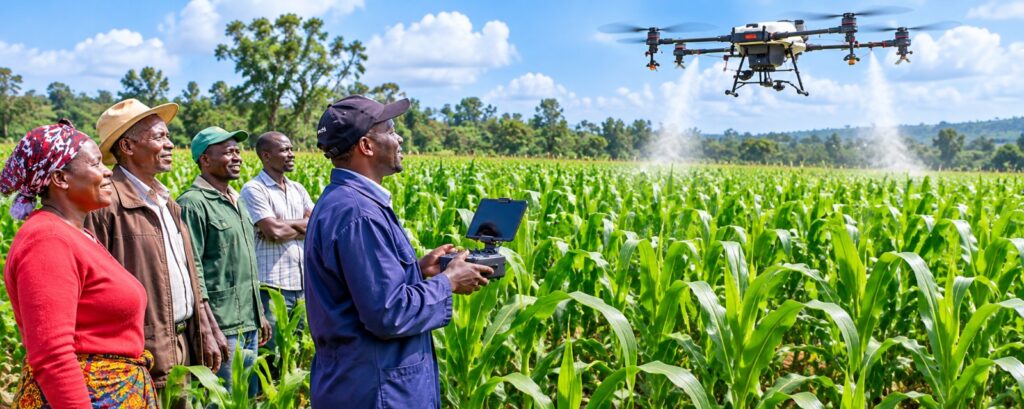
You need to know what these two announcements mean for your farm. A registered farmer receives e-vouchers for subsidised fertiliser, certified seed, extension messages and livestock vaccination. A farmer who hires a drone sprays an acre in minutes and uses less chemical. A farmer outside the system misses all of these services.
This guide explains digital farming in Kenya step by step. You will see how the farmer registry grew, how to join, what you receive, what drones cost per acre, which rules apply and how to start in the next 90 days. The figures come from Government statements, research institutes and named service providers.
What Digital Farming in Kenya Means for Your Farm
Digital farming means you use phones, data systems and machines to make farm decisions with facts. You stop guessing. In Kenya today, digital farming has four working parts. Each part links to money you spend or earn on your farm.
The first part is the farmer registry. The Kenya Integrated Agriculture Management Information System, called KIAMIS, records you, your land, your crops and your animals. The second part is the e-voucher. Registered farmers receive a voucher by SMS and buy subsidised fertiliser with this voucher. The third part is soil data. Laboratories under the Kenya Agricultural and Livestock Research Organization, called KALRO, test samples and publish fertility maps. The fourth part is drones. Drones spray, map and scout fields faster than a person with a knapsack sprayer.
| Part of digital farming | What you receive | What you do |
|---|---|---|
| Farmer registry (KIAMIS) | A digital record of your land, crops and livestock | Register with your ID card and phone number |
| E-voucher | Subsidised fertiliser by SMS voucher | Redeem at a depot or partner outlet |
| Soil data | Test results and county fertility maps | Request sampling through your agricultural officer |
| Drones | Spraying, mapping and pest scouting | Hire a licensed operator, alone or with a group |
Most farmers still sit outside these tools. Researchers from the University of Nairobi, writing for the World Economic Forum, estimate only 20 to 30 percent of Kenyan farmers use any digital agricultural solution. This gap works in your favour. Farmers who join early learn the system while others wait.
How 8.9 Million Registered Farmers Built Kenya’s Digital Farming Base
From 300,000 Farmers in 2022 to 8.9 Million in 2026
President William Ruto said in his 2025 State of the Nation address fewer than 300,000 farmers sat on the national register in 2022. The Ministry launched KIAMIS in early 2023. By July 2025, the system held over 6.6 million farmers. In August 2025, the Ministry ran a two-week drive to add 500,000 more farmers and to check existing records.
The Food and Agriculture Organization of the United Nations, called FAO, handed KIAMIS to the Ministry on 28 November 2025 with 7.1 million farmers on the platform. Reports in February 2026 gave about 7.2 million. In September 2026, Kagwe cited more than 8 million. In October 2026, he gave 8.9 million. The figure covers registration under KIAMIS and the Animal Identification and Traceability System. The register is now about 30 times larger than in 2022.
| Period | Farmers registered | Reported by |
|---|---|---|
| 2022 | Fewer than 300,000 | President Ruto, 2025 State of the Nation |
| July 2025 | Over 6.6 million | Kenya News Agency |
| November 2025 | Over 7.1 million | The Star, People Daily |
| February 2026 | About 7.2 million | The Standard |
| September 2026 | More than 8 million | Kenya News Agency |
| October 2026 | 8.9 million | Kenya News Agency |
Totals differ with the date and the system counted. Deputy President Kithure Kindiki has also cited 7.2 million crop farmers and 3 million livestock keepers on the national register. When you share the total, quote the latest Ministry figure and name the date.
What KIAMIS Records About You
Agricultural officers capture your land size, the crops you grow, your livestock numbers and the size of your fish ponds. Agriculture Principal Secretary Paul Ronoh said the second phase of registration also validates existing records, so only genuine farmers receive subsidies. Your record drives the services you receive. A wrong phone number or an old crop list sends you the wrong message or no message at all.
KADIC: One Place for Farm Data
The Kenya Agricultural Digital Information Centre, known as KADIC, now hosts KIAMIS. The Ministry describes KADIC as a national hub for farmer profiling, market intelligence and advisory services. Kagwe told the trade fair the Government launched KADIC as a single source of agricultural data and technology. FAO confirmed work is underway to link KIAMIS with digital systems at the Ministry of Lands. The link supports farmer verification, credit access and planning. The Swedish Ambassador said Sweden has invested over USD 5.5 million in the digital programme.
Universal Digital Addressing
Kagwe also said the Government is introducing universal digital addressing. The Ministry says digital addresses help extension services, finance, insurance, inputs and market information reach the right farmer at the right time. A digital address works only when your details are correct. Check your name, ID number, phone number and ward every season.
The Draft Law Behind the System
The Ministry has drafted the Kenya Agricultural Data, Information and Digital Policy, 2026 and the Digital Agricultural Information Bill, 2026. The bill would give KADIC a legal base and set rules for managing agricultural data. Stakeholders gave input in March 2026, and a national validation meeting took place on 7 August 2026 at the KALRO headquarters in Loresho, Nairobi. Watch this process. The final law decides who owns and shares your farm data.
Why Digital Farming in Kenya Matters for Your Income
The World Bank reports agriculture employs over 40 percent of Kenya’s workforce and contributes about 22 percent of national output. Productivity growth has lagged behind population growth. Your farm sits inside this gap, and the gap costs you money every season.
Inputs take the largest share of your costs. Data from the Tegemeo Institute of Agricultural Policy and Development, cited in a Capital FM opinion piece, shows farm inputs make up more than 60 percent of total production costs for smallholder farmers. Digital farming targets this cost in three places. The e-voucher lowers the fertiliser price. Soil tests stop you from buying nutrients your land already holds. Drone spraying lowers chemical use by up to 30 percent, according to KIPPRA.
Records help you reach finance and markets. FAO says the link between KIAMIS and Ministry of Lands systems supports credit access. Buyers who ask for traceability look for records. A farmer with clean digital records and a spray diary answers these requests faster than a farmer without records.
Time is the fourth gain. KIPPRA says a drone compresses spraying time from several days into a few hours. You use the saved days to prune, weed, scout and sell.
How to Register for Digital Farming in Kenya
Registration is simple. Visit your nearest agricultural officer. Carry your national ID card and the phone number you use every day. The Ministry says farmers need both to register on KIAMIS. Dial *616*3# for details on the process. Earlier e-voucher rounds also took farmer details at assistant chiefs’ offices, so ask your chief where registration runs in your area.
Details to Have Ready
Bring your ID and phone. Know your land size in acres. List your crops and the number of trees in each block. Count your cattle, goats, sheep and poultry. Measure any fish ponds. The officer enters all of this into the system. Write the same figures in your farm book, so you hold your own copy.
Check Your Record After Registration
Ask the officer to confirm your entry. Confirm the phone number first. The e-voucher arrives by SMS on this number. Update your record when you plant new trees, buy animals or change your land size. Ask your county agriculture office about any fee before you pay anyone. Use only officers and official channels. Never share your ID number with strangers who call you.
Digital Farming in Kenya Without a Smartphone
You do not need a smartphone. The USSD code works on a basic phone. Farmers also do not need an app to use the e-voucher system. Once registered, you receive an SMS with the voucher based on your value chain, and the agro-dealer redeems the voucher using an app. Ask a family member or your agricultural officer to read longer messages if the screen is small. Keep the phone charged on voucher days.
What Registered Farmers Receive
E-Voucher Fertiliser at Lower Prices
The e-voucher system sends you an SMS with the voucher and the redemption steps. You take the voucher and your ID to a National Cereals and Produce Board depot, a cooperative or a partner outlet. Government spokesperson Isaac Mwaura said registered farmers buy subsidised fertiliser at KSh 2,500 per 50 kilogram bag. The Government reports fertiliser prices fell from KSh 7,500 to KSh 2,500 per bag.
The scale is large. President Ruto said 7 million bags of fertiliser and 35 million kilograms of certified seed reached farmers in 2025. The Government planned 12.5 million bags for 2026 across all 1,450 wards. In September 2026, Kagwe said over 180,000 bags of subsidised fertiliser moved daily through the National Cereals and Produce Board. The Ministry reports 16,000 agro-dealers and 7,000 stockists registered digitally to serve the last mile. Kirinyaga County leads the register with more than 135,000 farmers.
Seed, Extension and Animal Health
Kagwe said registration supports more than fertiliser. Through KIAMIS, the Government also supports farmers with certified seed, extension services and livestock vaccination programmes. The Cabinet Secretary says soil health information and tailored agronomic advice will reach farmers’ phones in real time. Keep your phone on and your number current.
Subsidy Linked to Your Soil
The Ministry and KALRO plan to link soil test results to KIAMIS. Over time, your subsidy support will reflect what your soil needs. Test your soil now, so your record holds the data when the link goes live.
Drone Technology Rolled Out in Kenyan Farming
The Ministry and Fahari Aviation Partnership
Kagwe told the trade fair the Ministry is introducing drone technology through a partnership with Fahari Aviation. The drones support precision application of inputs, crop and livestock monitoring, soil analysis and detection of pests and diseases. The Ministry announced plans for a national drone roadmap with Fahari in 2025. In April 2025, Kagwe described a plan to collect soil data with drones and send the findings to farmers by phone.
Fahari Aviation also signed an agreement on 15 April 2026 with aak-GROW and CropLife Kenya. The agreement has four goals. The partners will research yield gains, train farmers and agronomists, work with regulators on safe-use policy and combine drones with artificial intelligence and satellite imagery. They expect lower input costs, less chemical runoff, less worker exposure to hazardous pesticides and better traceability.
Training supports the rollout. Fahari offers programmes in drone operation, data analysis and digital agriculture for young people. Egerton University launched an Agricultural Drone Pilots Training Programme at the Njoro campus. Both programmes add licensed pilots to the market.
What Drones Do on Your Farm
Spraying comes first. A drone applies herbicide, pesticide and foliar fertiliser from the air. Alex Mugane, a drone service provider, told Kenyans.co.ke his drones spray one acre in about seven minutes. A 30-litre tank covers up to three acres per trip. A 50-litre tank covers five acres. Providers in Kirinyaga report about 15 minutes per acre, so expect a range.
Mapping and scouting come next. Drones carry cameras to read plant health. Mugane said NDVI and RGB imaging measure chlorophyll and show stressed crops, and artificial intelligence flags problem areas. You see where pests or water stress start before you walk the whole field. KIPPRA, the Kenya Institute for Public Policy Research and Analysis, lists early pest and disease detection, water stress assessment and farm mapping among drone uses.
Animal and bird control follow. The State Department for Agriculture used drones to spray quelea bird colonies, more than 5 million birds, which threaten wheat, sunflower and barley in Narok County. The Ministry now lists livestock monitoring among the drone uses.
Drone Costs and Performance in Kenya
| Measure | Reported figure | Reported by |
|---|---|---|
| Spraying service | KSh 1,000 per acre | Alex Mugane, drone service provider |
| Spraying on Agricultural Development Corporation farms | KSh 800 per acre | The Standard |
| Mapping and crop analysis | KSh 2,000 to KSh 10,000 per acre, by farm size | Alex Mugane |
| Area covered | 10 acres per hour, ten times faster than manual labour | KIPPRA |
| Pesticide use | Down by up to 30 percent | KIPPRA |
| Water need | Down by up to 40 percent | KIPPRA |
| Fertiliser saving | KSh 1,500 to KSh 2,500 per acre | KIPPRA |
| Drone purchase price | KSh 600,000 to KSh 1.5 million | KIPPRA |
| Smallholders using drone services | 5 to 7 percent | KIPPRA |
| Tea estate case | Over 3,000 acres in under two weeks, 50 percent saving in cost and time | Fahari Aviation, Kipkebe estate |
Do the sum for your group. Twenty neighbours with one acre each pay about KSh 20,000 at KSh 1,000 per acre. A drone covering 10 acres per hour finishes all 20 acres in two hours. Buying a drone makes no sense for one acre. A drone at KSh 600,000 needs 600 acres of paid spraying to recover the price at KSh 1,000 per acre, before you count batteries, pilot pay and repairs. Hire the service.
Rules You Must Follow
The Civil Aviation (Unmanned Aircraft Systems) Regulations 2020 require every drone operator to complete a certification process and hold a licence from the Kenya Civil Aviation Authority. The rule applies to private and commercial flying. If you hire, ask the operator to show the licence. Licensed operators handle the mixing and application, so you do not touch the chemical.
Use only products registered by the Pest Control Products Board. Tell your neighbours the flight date. Spray in calm weather, early in the morning, to limit drift onto nearby plots. Keep people and animals out of the sprayed area until the product label says entry is safe.
Seven Questions to Ask Before You Hire a Drone Operator
First, ask for the Kenya Civil Aviation Authority licence number and check the expiry date. Second, ask which products the operator sprays and whether the Pest Control Products Board registers each one. Third, ask the tank size and the acres covered per hour. Fourth, ask how the operator controls drift near homes, streams and neighbouring crops. Fifth, ask for the price per acre, including travel and setup. Sixth, ask for a service record after each flight. Seventh, ask for names of farmers the operator served in your area.
Call two of those farmers. Ask about timing, coverage and any crop damage. Reliable operators give references without delay.
Drone Spraying Versus Knapsack Spraying
A knapsack sprayer puts a person in the crop with the chemical. The person walks every row, carries the load and breathes the mist. A drone flies above the crop. Licensed operators handle mixing and application, and the farmer stays out of the spray zone. Speakers at the Kirinyaga drone launch named the same gains: faster work, lower labour cost and less direct contact with harmful pesticides.
Knapsack spraying still has a place. Small, steep or fenced plots near houses suit a person with a sprayer better. Pick the method by plot size, slope and crop height. Use a drone where speed and coverage matter. Use a knapsack where access is tight.
Closing the Adoption Gap
KIPPRA says only 5 to 7 percent of smallholder farmers access drone services. The Institute calls the price of a drone prohibitive without external support. Mugane urges farmer groups and cooperatives to pool money and hire services together. Do this. Form a group of 10 to 20 neighbours in your ward. Agree on spraying dates and crops. Request a written quote per acre. Ask for a service record after each flight showing area, product and rate.
Digital Soil Testing: The Data Behind Your Voucher and Your Drone
Soil data decides how well every other digital tool works. Kagwe said about 63 percent of Kenya’s arable land is acidic and close to 7 million acres are strongly acidic. A farmer who applies the wrong fertiliser on acidic soil wastes money, even at the subsidised price. Kagwe said a soil test on his own farm showed he had added nutrients the land already held while missing those the land lacked.
The Government is building the response. Kagwe launched the National Digital Soil Works Project, a connected network of modern laboratories under KALRO. In September 2026, he handed over refurbished KALRO soil chemistry laboratories worth KSh 220 million. He also launched the National Soil Laboratory Network and the national rollout of the Global Soil Doctors Programme. KALRO targets over 77,000 soil samples from 45 counties by 2027. The Ministry directed KALRO to publish county-level soil fertility maps for public use. KALRO officials say mid-infrared machines cut testing time from weeks to days.
Trained agri-preneurs visit farms, collect soil data on mobile devices and send results to KALRO laboratories. Ask your agricultural officer how to reach one. Request the soil pH and the lime requirement with every result. Apply lime where acidity is strong, then choose fertiliser by the test result and not by habit.
Digital Farming in Kenya for Fruit and Tree Crop Farmers
Orchards pay back over years, so errors cost more than in a maize plot. Digital records protect your investment. Start with your registration. Record your tree crops, the varieties and the number of trees in each block. Add the planting date and the source of your seedlings. Update the record each season.
Keep a spray diary. Write the date, product, dose, block and weather for every application. Exporters and packhouses ask for these records. The Ministry ties agricultural digitisation to export traceability, and Fahari and aak-GROW list better traceability as a benefit of drone use. A clean diary prepares you for these buyers.
Test your soil before you plant. Tree crops stay in the ground for many years, so a wrong soil decision costs you every season. Use the test to set your lime and fertiliser plan before the planting holes open.
Use drones for mapping first. NDVI imaging shows weak trees and uneven growth, and Mugane says mapping also helps select sites for dams and irrigation projects. For spraying, hire operators with orchard experience. Canopy height changes coverage and drift, so ask the operator how the drone handles tall trees. Start with young blocks, then compare results with your knapsack blocks before you extend the service.
Join other orchard owners in your ward. Hire one drone provider for the whole group, and share the mapping reports. Group hiring cuts the cost per acre and gives you more bargaining power with the operator.
Use a simple example to plan your budget. You own two acres of young orchard and spray four times in a season. At KSh 1,000 per acre, each round costs KSh 2,000 and the season costs KSh 8,000. Compare this with your labour and chemical cost for the same four rounds by knapsack. Include your own time. The comparison shows whether the drone saves you money on your plot.
Start your orchard on the right footing. Farmers Trend Limited sells fruit seedlings for farmers who plan to register their trees and keep clean records from the first day. Record the variety and the planting date of every seedling you buy.
Limits and Risks of Digital Farming in Kenya
Digital farming brings gains and risks. Know both before you commit money.
Network access is the first limit. Many rural wards have weak internet. The USSD code works without internet, but apps and image reports need a signal. Ask your officer for the offline route when your network fails.
Data privacy is the second limit. The draft bill sets rules for agricultural data, but the public reports on the draft do not detail data protection. Ask your county office who sees your farm record and why. The Data Protection Act, 2019 gives you rights over your personal data. Use them.
Cost is the third limit. A drone costs KSh 600,000 to KSh 1.5 million. Pool money with neighbours and hire the service instead.
Operator quality is the fourth limit. Wind, steep slopes and poor calibration cause drift and uneven coverage. Choose a licensed operator, ask for references and walk the field after the flight.
Scams are the fifth limit. Criminals use farmer programmes to collect fees and ID numbers. Register through officers and official channels only. Confirm any payment request with your county agriculture office.
A 90-Day Plan to Start Digital Farming on Your Land
Days 1 to 7: Register or Check Your Record
Visit your agricultural officer with your ID card and phone. Register if you are new. If you registered before, ask the officer to read your record back to you. Correct the phone number, land size, crops and livestock. Write the date of the visit in your farm book.
Days 8 to 30: Test Your Soil and Form a Group
Request a soil sample through your county agriculture office. Collect samples from each block of your farm. Meet neighbours with plots near yours. Agree on one calendar for spraying. Ask two licensed drone operators for written quotes per acre. Compare price, tank size, chemicals and licence number.
Days 31 to 90: Buy Inputs by Test Result and Book Your First Flight
Use your soil result to choose fertiliser and lime. Redeem your e-voucher at the depot or partner outlet named in your SMS. Book your first drone flight for the next spraying window. Record the date, product, rate and area sprayed. After the flight, walk the field and check coverage. Review your records at day 90 and decide which service saved you money.
Digital Farming in Kenya: Questions Farmers Ask
How many farmers are registered for digital farming in Kenya?
The Ministry of Agriculture and Livestock Development reports 8.9 million farmers registered under Government systems as of October 2026. The figure covers KIAMIS and the Animal Identification and Traceability System.
How do I register on KIAMIS?
Visit your nearest agricultural officer with your national ID card and phone number. Dial *616*3# for details on the process.
How much does drone spraying cost per acre in Kenya?
Providers report KSh 800 to KSh 1,000 per acre for spraying. Mapping and crop analysis cost KSh 2,000 to KSh 10,000 per acre, depending on farm size.
Do I need a licence to fly a drone on my farm?
Yes. Kenyan regulations require a licence from the Kenya Civil Aviation Authority for private and commercial flights. Hire a licensed operator if you do not hold a licence.
Which crops suit drone spraying?
Drones already spray maize, tea and rice. Orchard owners hire operators for young trees and canopy mapping. Ask your operator for results on your crop before you book.
Will my soil test affect my subsidy?
The Ministry and KALRO plan to link soil test results to KIAMIS. Over time, subsidy support will reflect what your soil needs.
Digital Farming in Kenya Rewards Farmers Who Start Now
The numbers tell a plain story. The register grew from fewer than 300,000 farmers in 2022 to 8.9 million in October 2026. Fertiliser moves through e-vouchers at KSh 2,500 per bag. KALRO laboratories test soil in days. Drones spray an acre in minutes at about KSh 1,000.
Your next step costs little. Register or check your record this week. Test your soil before the next planting. Join neighbours and hire a licensed drone operator. Keep records of every input and every flight.
Digital farming in Kenya will grow as KADIC, the soil laboratory network and the drone programme reach more wards. Farmers with accurate records, tested soil and organised groups will use these services first. Start with one visit to your agricultural officer. Then call Farmers Trend Limited on 0724 559 286 or 0790 509 684 when you are ready to plant.
Order Fruit Seedlings and Get Advice From Farmers Trend Limited
Farmers Trend Limited helps farmers across Kenya plan orchards and choose fruit seedlings. Call or message the team to ask about varieties, prices and delivery to your county.
Call or WhatsApp: 0724 559 286 or 0790 509 684
Website: www.farmerstrend.co.ke
Email: info@farmerstrend.co.ke
Browse the Farmers Trend Limited catalogue with images of the fruit seedlings on WhatsApp.
https://farmerstrend.co.ke/trending/digital-farming-in-kenya/https://farmerstrend.co.ke/wp-content/uploads/2026/11/WhatsApp-Image-2026-11-21-at-11.22.08-1024x409.jpeghttps://farmerstrend.co.ke/wp-content/uploads/2026/11/WhatsApp-Image-2026-11-21-at-11.22.08-150x150.jpeg# TrendingDigital farming in Kenya now reaches 8.9 million registered farmers. Agriculture and Livestock Development Cabinet Secretary Mutahi Kagwe gave the figure during the 2026 Nairobi International Trade Fair, according to the Kenya News Agency. He also said the Ministry is introducing drone technology with Fahari Aviation, a Kenya Airways...FarmersTrendjohn doefarmerstrend@gmail.comAdministratorFarmers Trend Ltd.







Leave a Reply