Kenya Avocado Export Requirements: 6 Rules Every Farmer Must Meet Before Exporting
Learn the Kenya avocado export requirements every farmer must meet, including AFA registration, KEPHIS certification, dry matter testing, GLOBALG.A.P. and export documents.
Kenya Avocado Export Requirements: 6 Rules Every Farmer Must Meet Before Exporting
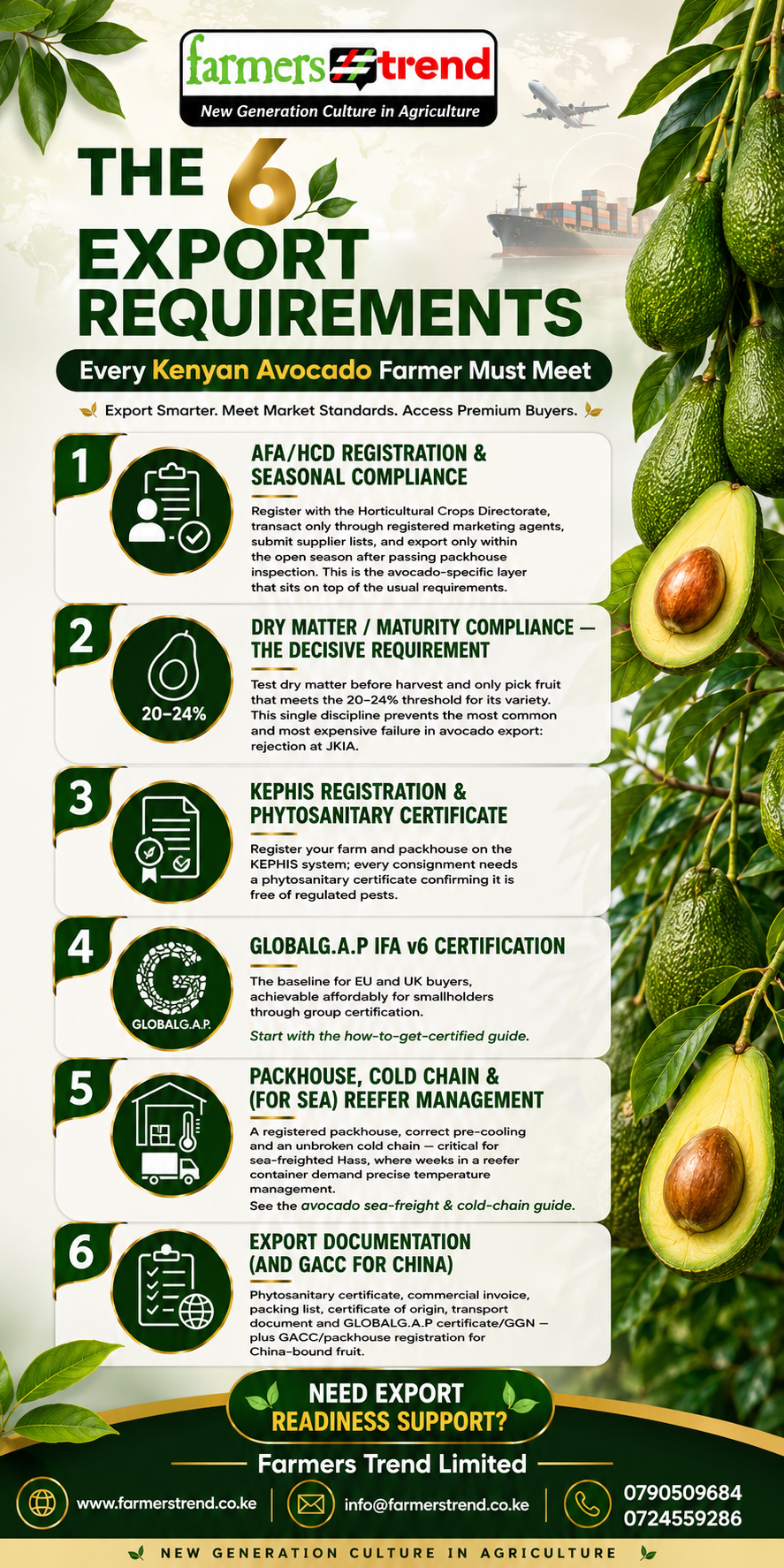
Kenya is one of Africa’s biggest exporters of avocados, and demand for Kenyan Hass avocados continues to grow in Europe, the Middle East, China and other international markets. This growing demand has encouraged more farmers to plant avocado trees, hoping to earn better prices than those available in local markets. While export prices are often attractive, many farmers discover that producing good fruit alone is not enough.
Export markets are highly regulated. Every avocado that leaves Kenya must meet strict quality, food safety and plant health standards before it reaches consumers overseas. Buyers want fruit that ripens properly, remains fresh throughout the journey and can be traced back to the farm where it was grown. They also expect farmers and exporters to comply with both Kenyan regulations and the import requirements of the destination country.
Over the years, Kenya has tightened avocado export regulations after several cases of immature fruit reached international markets. In some instances, consumers bought avocados that never softened even after several days. Others developed poor flavour, rubbery flesh or internal defects. These complaints affected the reputation of Kenyan avocados and threatened access to premium markets. To protect the industry, the government introduced stricter controls on harvesting, marketing and exports.
For farmers, these rules should not be seen as obstacles. They are designed to ensure that only high-quality fruit reaches export markets, giving Kenya a good reputation and helping farmers earn better returns over the long term. Farmers who understand the export requirements also become more attractive to exporters because they supply fruit that consistently meets international standards.
Whether you own 50 avocado trees or manage several acres of Hass avocados, understanding these requirements can make the difference between selling to premium export markets or being forced to sell locally at lower prices.
This guide by Farmers Trend Limited explains the six export requirements every Kenyan avocado farmer should understand before supplying fruit for export.
1. Register with AFA/HCD and Follow the Official Export Season
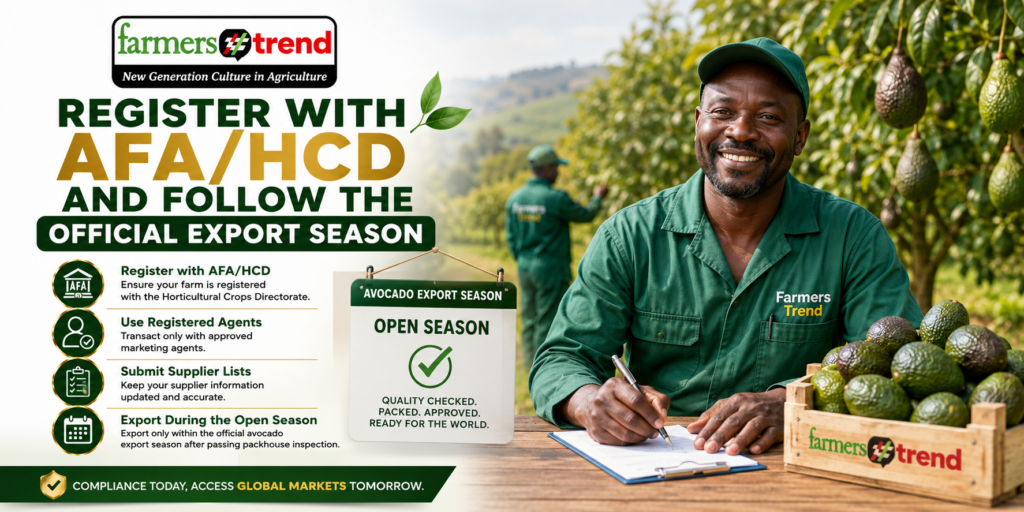
The first requirement is registration with the Agriculture and Food Authority (AFA) through the Horticultural Crops Directorate (HCD). Registration creates an official record of avocado growers participating in Kenya’s horticulture sector. It also helps regulators monitor production, improve traceability and ensure exporters buy fruit from legitimate sources.
Registration has become increasingly important because international buyers now want to know exactly where their food comes from. Supermarkets in Europe and other developed markets expect exporters to provide information about the farm where the fruit was grown, the production methods used and the handling procedures followed before export. Without proper records, exporters struggle to satisfy these buyer requirements.
AFA registration also supports Kenya’s efforts to maintain order in the avocado industry. Farmers are encouraged to work with licensed exporters and registered marketing agents instead of selling fruit to unlicensed brokers who often encourage premature harvesting. These brokers usually focus on quick profits rather than protecting the long-term interests of farmers or the country’s export reputation.
Another important requirement under AFA regulations is compliance with the official avocado export season. Unlike many crops, avocado exports are controlled to prevent immature fruit from entering international markets. Before the season opens, regulators inspect registered packhouses, assess crop maturity and confirm that exporters are ready to begin harvesting.
Farmers should therefore avoid harvesting simply because a buyer offers a good price before the official season opens. Early harvesting may provide quick cash, but it exposes farmers and exporters to significant losses if the fruit fails maturity tests or is rejected by buyers.
The government introduced these seasonal controls because premature harvesting had become one of the biggest threats to Kenya’s avocado industry. When immature fruit reaches foreign supermarkets, consumers lose confidence in Kenyan produce. Retailers may then reduce future purchases or impose stricter inspection requirements, making it harder for exporters and farmers to access those markets.
Farmers should also keep proper production records throughout the season. These records include pesticide application dates, fertilizer use, irrigation schedules and harvesting records. Good documentation improves traceability and makes compliance inspections much easier.
Many exporters now prefer working with farmers who maintain accurate farm records because it reduces risk throughout the supply chain. Well-organised farmers also find it easier to qualify for certification programmes and long-term supply contracts.
2. Dry Matter Testing and Fruit Maturity: The Requirement That Determines Everything
If there is one export requirement every avocado farmer must understand, it is fruit maturity.
Every year, many avocado consignments are rejected because the fruit was harvested before reaching the required maturity level. In most cases, the fruit may look large and healthy from the outside, but internally it has not developed enough oil content to ripen properly.
This is why exporters rely on dry matter testing before harvesting begins.
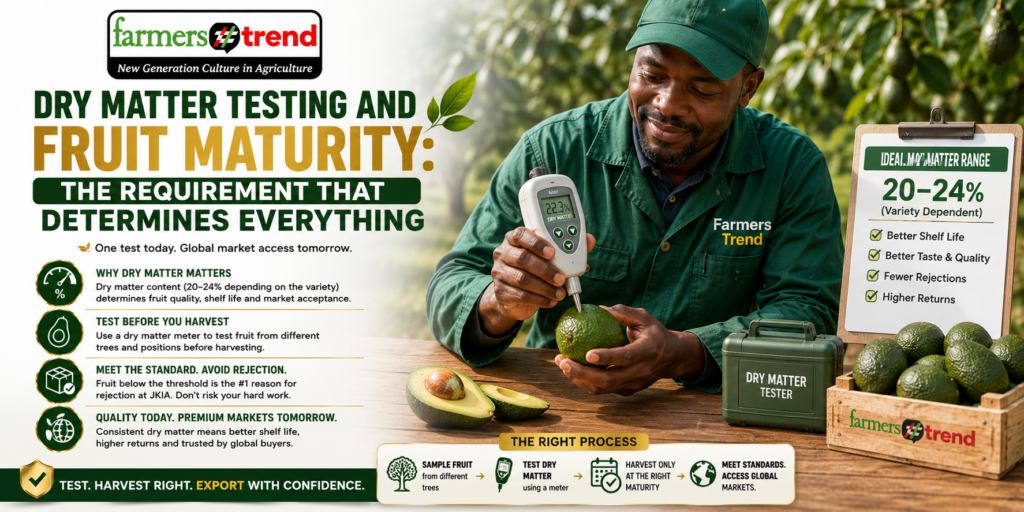
Dry matter measures the amount of solid material inside the avocado after removing water. As avocados mature, they accumulate more oil and the dry matter percentage increases. Higher dry matter generally means better eating quality, improved flavour and proper ripening after harvest.
Most export markets require dry matter levels between 20 and 24 percent depending on the avocado variety. Hass avocados generally require higher dry matter than green-skin varieties because they continue developing oil content as they mature.
Dry matter testing is carried out by collecting representative fruit samples from different parts of the orchard. The avocado flesh is weighed, dried in an oven and weighed again after the moisture has been removed. The remaining weight is then used to calculate the dry matter percentage.
Although the procedure sounds technical, it is one of the most reliable methods of determining harvest readiness. Exporters and inspection agencies rely on these results before allowing commercial harvesting to begin.
Many farmers make the mistake of judging maturity based on fruit size alone. Large fruit is not necessarily mature fruit. Weather conditions, tree health and irrigation practices can all influence fruit size without affecting maturity.
Harvesting immature avocados creates problems throughout the supply chain. The fruit may remain hard for weeks, soften unevenly or develop poor flavour. Consumers who buy such fruit often blame the country of origin rather than the individual farmer. As a result, one poorly handled shipment can damage Kenya’s reputation in an entire market.
Farmers should never harvest because neighbouring farms have started picking. Every orchard matures differently depending on altitude, rainfall, tree age, management practices and variety. Waiting for proper maturity protects both income and future market opportunities.
The financial consequences of immature harvesting can be severe. Exporters may reject the fruit before packing, downgrade it to local markets or refuse to buy from the same farmer during future seasons. In some cases, exporters suffer heavy losses when overseas buyers reject entire consignments because the fruit failed to ripen properly.
Good orchard management also contributes to better maturity. Proper nutrition, adequate irrigation, timely pruning and effective pest control all support healthy fruit development. Farmers who neglect these practices often produce fruit with inconsistent quality, making it difficult to satisfy export standards.
For growers targeting export markets, patience is often more profitable than rushing to harvest. Waiting until the fruit reaches the required dry matter level protects quality, improves buyer confidence and increases the chances of securing repeat business.
Farmers who are unsure about maturity should seek advice before harvesting. Exporters, extension officers and qualified agricultural professionals can help determine whether the orchard is ready for picking.
Farmers looking for practical production advice can also access free farming guides through Farmers Trend. The platform also supplies certified grafted Hass avocado seedlings and provides extension services to farmers across Kenya. For enquiries, farmers can call 0790 509 684 or 0724 559 286.
3. KEPHIS Registration and the Phytosanitary Certificate
After meeting the maturity requirements, the next step is compliance with the Kenya Plant Health Inspectorate Service (KEPHIS).
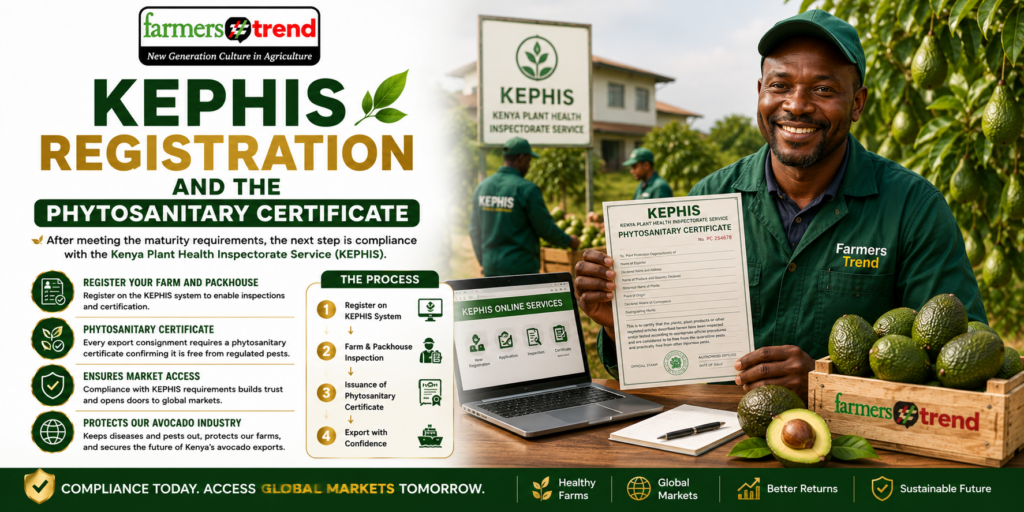
KEPHIS is responsible for protecting Kenya’s plant health and ensuring exported agricultural produce complies with the phytosanitary requirements of importing countries. Every avocado consignment intended for export must be inspected before a phytosanitary certificate is issued.
A phytosanitary certificate is an internationally recognised document confirming that the fruit has been inspected and found free from regulated pests and diseases. Without this certificate, most importing countries will not allow the shipment to enter their borders.
For this reason, both farms and packhouses involved in avocado exports should be properly registered and available for inspection whenever required.
KEPHIS inspections focus on several issues, including pest infestation, orchard hygiene, traceability and compliance with the phytosanitary requirements of the destination market. Different countries may have additional conditions depending on their plant health regulations, making compliance even more important.
Farmers should understand that pest management is not something to think about a few weeks before harvest. It begins immediately after the previous harvest and continues throughout the production season.
An orchard with poor weed management, neglected pruning and inadequate pest monitoring is much more likely to experience problems during inspection.
Integrated Pest Management offers one of the best approaches for controlling pests while reducing unnecessary pesticide use. This includes regular scouting, orchard sanitation, biological control where appropriate and responsible pesticide application when necessary.
Keeping fallen fruit on the ground for long periods, for example, creates breeding sites for fruit flies and other pests. Simple orchard hygiene practices can significantly reduce infestation levels and improve export compliance.
Likewise, farmers should always observe the recommended pre-harvest intervals after spraying pesticides. Export markets monitor pesticide residues closely, and failure to comply with residue limits can result in rejection even if the fruit appears healthy from the outside.
4. GLOBALG.A.P. Certification Is No Longer Optional for Serious Export Farmers
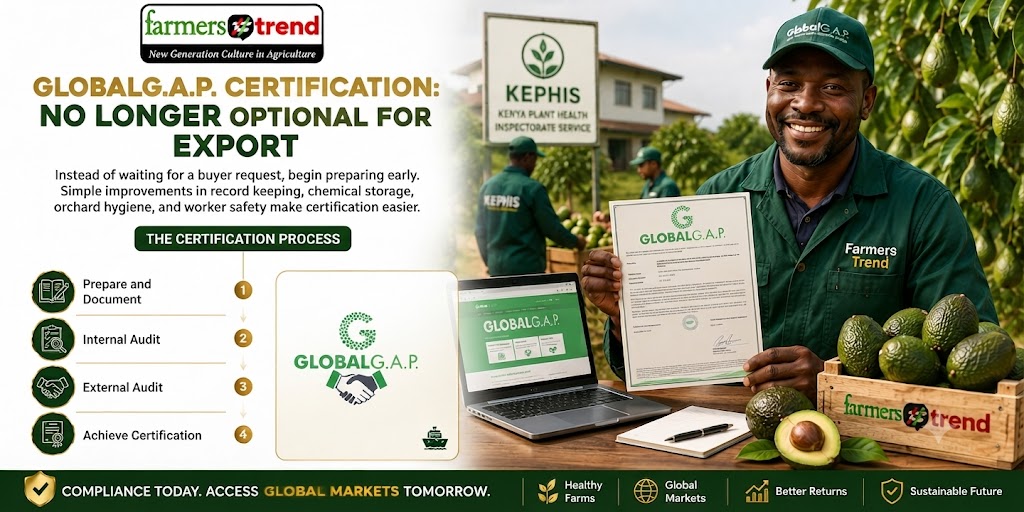
Many small-scale farmers believe GLOBALG.A.P. certification is only meant for large commercial farms. That is no longer the case. Today, many exporters, farmer groups and cooperatives help smallholders obtain certification through group schemes, making it much cheaper than applying as an individual farmer.
If you plan to supply avocados to exporters targeting Europe or the United Kingdom, you should expect to hear about GLOBALG.A.P. sooner or later. Most buyers in these markets want proof that the fruit was produced safely, responsibly and in a way that protects both consumers and the environment.
GLOBALG.A.P., which stands for Global Good Agricultural Practices, is an internationally recognised standard that sets out how food should be produced on farms. It covers everything from how pesticides are used to how workers are treated, how irrigation water is managed and how records are kept.
Certification does not mean a farm is perfect. It means the farm follows accepted practices that reduce food safety risks and make production more consistent.
One of the biggest areas inspected during certification is record keeping. Farmers should know when fertilizers were applied, which pesticides were used, who applied them, how much was used and whether the correct waiting period was observed before harvesting. These records help buyers verify that the fruit is safe for consumption.
Water management is another important area. If irrigation water comes from a river, dam or borehole, there should be measures to ensure it does not contaminate the fruit. Clean water reduces the risk of spreading diseases and improves food safety.
Worker welfare is also part of the certification process. Farms should provide basic protective clothing when pesticides are being applied. Workers should know how to handle farm chemicals safely and have access to clean drinking water and sanitation facilities.
Environmental conservation is becoming increasingly important in export agriculture. Buyers want farmers to reduce unnecessary pesticide use, protect soil health and use natural resources responsibly. Practices such as mulching, soil conservation, composting and efficient irrigation all support sustainable production.
Certification also improves farm management. Farmers who keep proper records often discover they spend less on unnecessary inputs because they know exactly what has been applied and when. They can also identify production trends from one season to another and make better management decisions.
For exporters, working with certified farmers reduces business risk. They know the orchards follow recognised standards and are more likely to produce fruit that satisfies international buyers.
Farmers who have not yet obtained certification should not be discouraged. Many exporters organise training programmes before every season and recruit farmers into certification groups. Joining such programmes is often the easiest and least expensive path to becoming certified.
Instead of waiting until a buyer requests certification, farmers should begin preparing early. Simple improvements in record keeping, chemical storage, orchard hygiene and worker safety can make the certification process much easier.
5. Packhouses and Cold Chain Management Determine Whether Good Fruit Remains Good
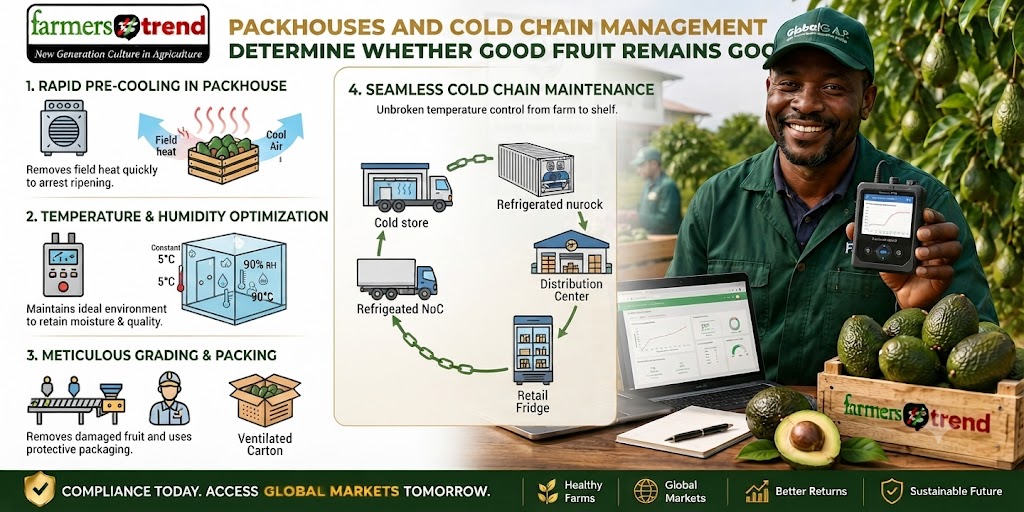
Growing quality avocados is only part of the work. The way the fruit is handled after harvest determines whether it arrives overseas in good condition.
Many farmers assume that once fruit leaves the farm, the responsibility shifts entirely to the exporter. In reality, fruit quality can begin deteriorating within hours if harvesting and handling are done carelessly.
This is why registered packhouses are an important part of Kenya’s avocado export system.
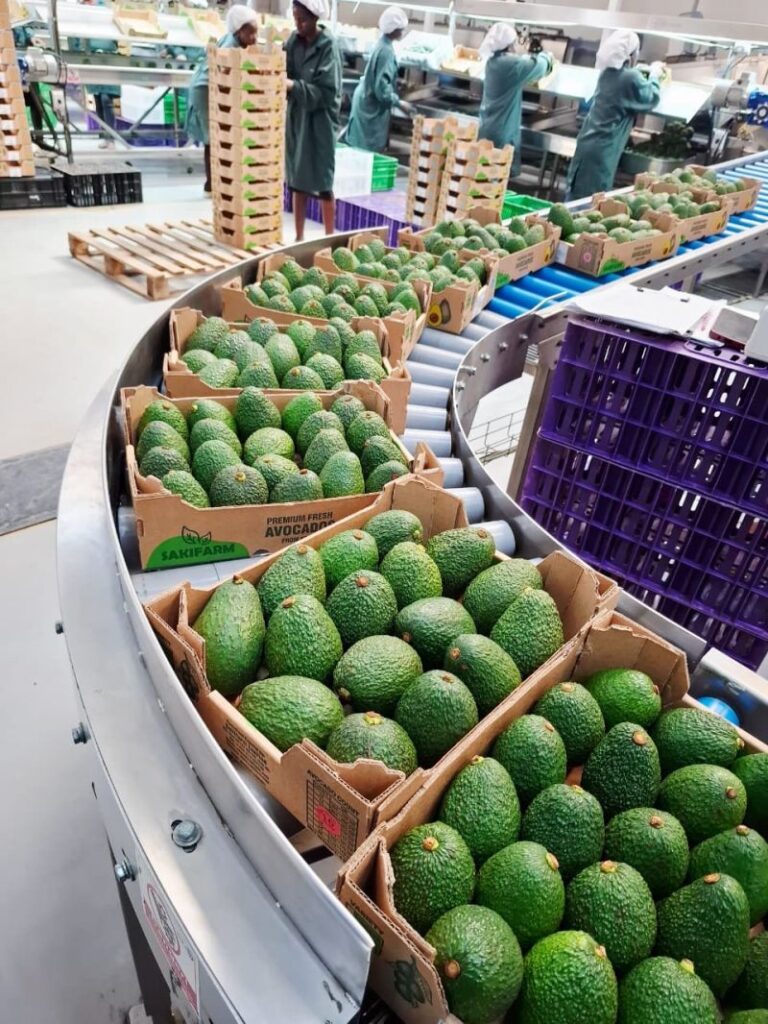
A packhouse is much more than a storage building. It is where export fruit is received, inspected, sorted, graded, packed and prepared for shipment. Every stage is designed to protect fruit quality before it begins the long journey to overseas markets.
When fruit reaches the packhouse, inspectors first check whether it meets export standards. Damaged, diseased or undersized fruit is removed before grading begins.
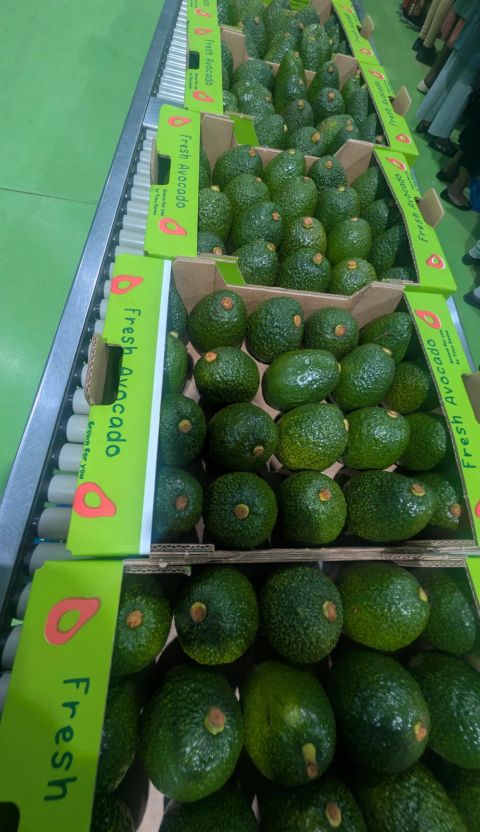
The remaining fruit is sorted according to size, weight and quality. Buyers in different markets often request specific size categories depending on consumer preferences. Uniformity is important because supermarkets want every carton to contain fruit of similar quality and size.
After grading, the avocados are carefully packed into export cartons that protect them during transport. Each carton carries information that allows the fruit to be traced back to the farm, packhouse and exporter if any problem arises later.
Harvesting practices on the farm also affect packhouse acceptance.
Fruit should never be dropped onto the ground. Every impact creates bruises that may not be visible immediately but become noticeable after several days in storage. These bruises reduce shelf life and increase rejection rates.
Harvesters should use proper picking poles or harvesting bags instead of pulling fruit from branches by hand. The stem should be trimmed to the recommended length because long stems can puncture neighbouring fruit during transport.
Filled harvesting bags should be emptied carefully into clean field crates. Overfilling sacks or throwing crates onto vehicles causes unnecessary mechanical damage.
Clean harvesting equipment also reduces contamination risks.
One mistake repeated every season is leaving harvested fruit under direct sunlight while waiting for collection. Avocados continue respiring after harvest. Exposure to high temperatures increases water loss and speeds up the ripening process before the fruit even reaches the packhouse.
Keeping harvested fruit in a shaded, well-ventilated area helps preserve quality until transport arrives.
Why the Cold Chain Matters
Many of Kenya’s export markets are thousands of kilometres away.
The fruit harvested today may not reach supermarket shelves in Europe or Asia for several weeks. During this period, temperature control becomes one of the most important quality management tools.
The cold chain simply means keeping avocados at the correct temperature from the time they leave the packhouse until they reach the buyer.
This process begins with pre-cooling.
Freshly harvested avocados contain field heat. Removing this heat quickly slows respiration, delays ripening and helps preserve freshness.
If fruit is loaded into refrigerated containers while still warm, cooling takes much longer and quality begins declining before the desired temperature is reached.
Maintaining consistent temperatures throughout transport is equally important. Sudden temperature changes can trigger uneven ripening, increase moisture loss and shorten shelf life.
For exporters using air freight, transit time is relatively short.
Sea freight, however, presents greater challenges.
Many sea shipments take between three and five weeks before reaching destination ports. During this period, avocados remain inside refrigerated containers known as reefers.
These containers continuously control temperature, humidity and airflow to keep the fruit in good condition throughout the voyage.
Even small temperature fluctuations can create serious quality problems. Fruit may ripen too quickly, develop internal browning or arrive with reduced shelf life.
For this reason, exporters invest heavily in monitoring refrigeration systems throughout the journey.
Farmers contribute to cold chain success by harvesting mature fruit, handling it gently and delivering it to packhouses as quickly as possible.
Good cold chain management cannot improve poor quality fruit. It can only preserve quality that already exists.
6. Export Documents Every Avocado Shipment Must Have
No avocado shipment can leave Kenya without the required export documents.
These documents allow customs authorities, shipping companies and buyers to verify that the consignment meets legal and commercial requirements.
Each document serves a specific purpose.
The phytosanitary certificate confirms the fruit has been inspected and meets plant health requirements.
The commercial invoice provides details about the buyer, seller, quantity and value of the shipment.
The packing list describes the contents of every consignment, including the number of cartons, weights and packaging details.
The certificate of origin confirms that the avocados were produced in Kenya. Some importing countries require this document before granting preferential tariff treatment under trade agreements.
Transport documents vary depending on how the fruit is shipped. Air shipments use an Air Waybill while sea freight uses a Bill of Lading.
Exporters supplying European supermarkets may also provide the farm’s GLOBALG.A.P. certificate or the GlobalG.A.P. Number (GGN), allowing buyers to verify certification status.
Although exporters usually prepare these documents, farmers also play an important role. Incorrect farm information, missing records or poor traceability can delay documentation and interfere with shipment schedules.
Additional Requirements for Exports to China
China has become an important market for Kenyan avocados, but it also has some of the strictest import requirements.
Only orchards and packhouses approved under the agreed export protocol can supply fruit destined for China.
China also requires registration with the General Administration of Customs of China, commonly known as GACC.
This registration helps Chinese authorities verify approved production sites and processing facilities before imports are allowed.
Because China’s requirements are highly specific, farmers should work closely with exporters supplying that market instead of assuming the same procedures apply everywhere.
Why Some Export Shipments Are Rejected
Every export season, some consignments fail to reach overseas buyers because they do not meet required standards.
In many cases, the problem began long before harvest.
Immature fruit remains the leading cause of rejection. Even when avocados look large from the outside, low dry matter means they will not ripen properly after export.
Poor pest management is another common reason. Orchards with inadequate monitoring often fail inspections because regulated pests are detected before shipment.
Careless harvesting also creates losses. Bruised fruit may appear normal during packing but develops visible damage during transport.
Poor record keeping creates traceability problems that discourage exporters from buying from certain farms.
Residues from incorrect pesticide use continue to attract attention in international markets. Farmers should always follow label instructions and observe recommended waiting periods before harvesting.
Some consignments are delayed because documentation is incomplete or contains errors.
Most of these problems can be avoided through proper planning, good farm management and close cooperation with exporters.
In export farming, quality is built gradually throughout the production season. It cannot be created at the packhouse after mistakes have already occurred in the orchard.
Practical Steps Farmers Can Take to Meet Export Standards
Meeting avocado export requirements does not happen a few days before harvesting. It starts when you establish the orchard and continues throughout the life of the trees. Farmers who consistently supply exporters understand that every activity in the orchard affects the quality of the fruit they harvest months later.
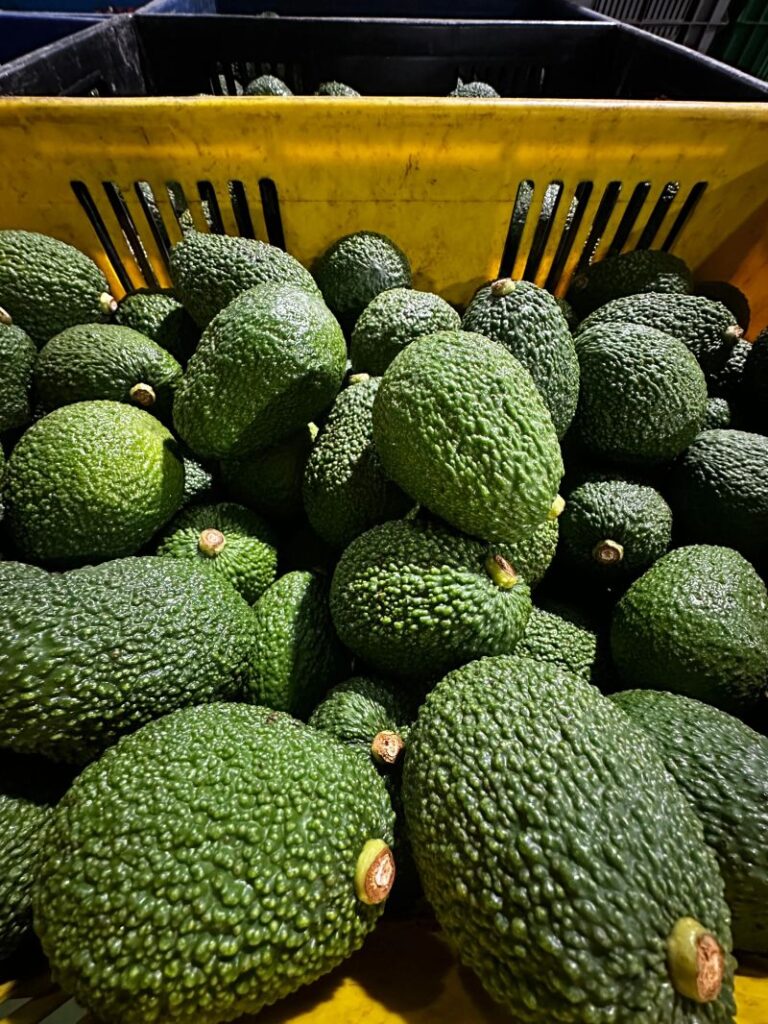
One of the first decisions is choosing the right planting material. Exporters prefer Hass avocados because they are widely accepted in international markets. Planting certified grafted seedlings from a trusted nursery reduces the risk of poor varieties, weak rootstocks and low yields. Healthy seedlings establish faster, begin bearing earlier and produce more uniform fruit.
Proper orchard management also makes a big difference. Trees that are pruned regularly receive more sunlight and better air circulation. This reduces disease pressure and makes it easier to spray, scout for pests and harvest fruit. Pruning also encourages stronger branches that can support heavy fruit loads without breaking.
Nutrition should be based on the needs of the trees instead of guesswork. Many farmers apply fertilizers because neighbouring farms are doing the same, yet every orchard is different. A soil test and leaf analysis provide a better understanding of nutrient deficiencies and help farmers apply the right fertilizer at the right time. Balanced nutrition improves flowering, fruit set, fruit size and overall quality.
Water management is equally important. Avocado trees need adequate moisture during flowering, fruit development and periods of prolonged drought. Water stress can reduce fruit size and increase fruit drop. However, overwatering creates its own problems by encouraging root diseases such as Phytophthora root rot. Farmers should aim for consistent soil moisture rather than alternating between very dry and waterlogged conditions.
Pest and disease control should become part of the farm routine rather than an emergency response. Walking through the orchard every week allows farmers to identify problems early before they become difficult or expensive to control. It is much easier to manage a small pest population than to deal with a widespread infestation shortly before harvest.
Farm hygiene is another area that is often ignored. Fallen fruits should be collected and destroyed because they provide breeding sites for fruit flies and other pests. Dry branches should be removed, weeds controlled and the orchard kept clean. These simple practices reduce pest pressure and improve the general health of the farm.
Harvesting also requires careful planning. Fruit should be picked during the cooler hours of the day whenever possible. Harvesters should avoid throwing fruit into bags or piling it carelessly in the field. Every bruise reduces the chances of that fruit reaching an overseas supermarket in good condition.
Good record keeping ties all these activities together. Farmers should record when they spray, the products used, fertilizer applications, irrigation schedules and harvesting dates. These records not only support certification but also help farmers evaluate what worked well during the season and what needs improvement.
Why Exporters Prefer Long-Term Farmer Partnerships
Many farmers think exporters simply buy fruit from whoever offers the lowest price. In reality, reputable exporters prefer building long-term relationships with reliable farmers.
Exporting fresh produce is expensive. Exporters invest in maturity testing, grading, packaging, cold storage, shipping and marketing. If one farmer supplies immature or poor-quality fruit, the exporter risks losing an entire shipment worth millions of shillings.
For this reason, many exporters work with the same farmers season after season. These farmers understand the required standards, maintain proper records and follow technical advice provided by extension officers.
Some exporters go a step further by training farmers throughout the year. They organise field days, demonstrate pruning techniques, advise on pest management and help growers prepare for GLOBALG.A.P. certification. The exporter benefits by receiving better fruit, while the farmer gains access to stable markets and technical support.
Trust is therefore one of the most valuable assets in the avocado export business. A farmer who consistently delivers mature, clean and well-handled fruit is likely to receive repeat orders and stronger business relationships.
The Growing Importance of Traceability
A few years ago, many buyers focused mainly on fruit appearance. Today, they want much more information.
If an importer receives a complaint from a supermarket, they should be able to trace that carton back to the exporter, the packhouse and finally the farm where the avocados were grown.
This level of traceability has become standard in many export markets.
Farmers should therefore label orchards properly, keep production records and cooperate with exporters during inspections. Traceability helps identify problems quickly and prevents unnecessary losses across the supply chain.
It also protects honest farmers. If an issue is traced to a specific farm, authorities do not need to suspend purchases from an entire region.
Opportunities in the Global Avocado Market
Global demand for avocados continues to increase as more consumers include the fruit in their daily diets. Avocados are valued for their healthy fats, fibre, vitamins and versatility in cooking. They are used in salads, sandwiches, smoothies, sushi and many other dishes.
Europe remains Kenya’s largest export destination, with countries such as the Netherlands, France, Spain and Germany importing significant volumes every year. The Middle East also continues to offer a strong market because of its growing population and high demand for fresh produce.
China presents another promising opportunity. Although the market has strict import requirements, its large population and increasing interest in healthy foods create room for future growth. Farmers who meet the required standards stand to benefit as exports continue expanding.
These opportunities explain why more farmers are planting Hass avocados. However, expanding acreage alone will not guarantee success. International buyers have many options, including suppliers from Peru, Colombia, Mexico, South Africa and Tanzania. Kenya remains competitive only by maintaining high standards and delivering consistent quality.
Common Questions Farmers Ask About Avocado Exports
Can a small-scale farmer supply export markets?
Yes. Many exporters buy from smallholders, provided they meet the required standards. Farmers often join cooperatives or organised producer groups to simplify certification and marketing.
Can I export avocados without registering with AFA?
No. Registration is part of Kenya’s regulatory framework for horticultural exports. Farmers should work within the approved system.
Why is dry matter testing so important?
Fruit harvested too early does not ripen properly. Dry matter testing confirms that avocados have reached the required maturity before harvesting begins.
Is GLOBALG.A.P. compulsory?
Not for every market, but it is increasingly expected by buyers in Europe and the United Kingdom. Farmers targeting these markets should work towards certification.
Who issues the phytosanitary certificate?
The certificate is issued by the Kenya Plant Health Inspectorate Service (KEPHIS) after the consignment has been inspected and found to meet the importing country’s plant health requirements.
Can I harvest whenever prices increase?
No. Export harvesting should only take place during the approved export season and after the fruit has reached the required maturity.
Final Thoughts
Kenya has built a strong reputation as a producer of high-quality Hass avocados, but maintaining that reputation requires commitment from everyone involved in the value chain. Farmers, exporters, regulators and packhouses all have a role to play in ensuring that only mature, healthy and properly handled fruit reaches international markets.
The six export requirements discussed in this guide are not independent rules. They work together to protect fruit quality from the orchard to the consumer. Registration with AFA creates an organised production system. Dry matter testing ensures only mature fruit is harvested. KEPHIS inspections protect importing countries from regulated pests. GLOBALG.A.P. certification gives buyers confidence in how the fruit was produced. Registered packhouses and proper cold chain management preserve quality during transport, while complete export documentation allows shipments to move smoothly through international borders.
Farmers who consistently meet these standards place themselves in a better position to supply exporters year after year. They are also more likely to receive technical support, participate in certification programmes and build lasting relationships with buyers.
Export farming should not be viewed as a quick way to make money during one season. It is a long-term business that rewards farmers who invest in quality, discipline and continuous improvement. Every pruning decision, every fertilizer application, every pest control measure and every harvesting decision contributes to the final quality of the fruit.
As Kenya continues to grow its avocado exports, the farmers who will benefit most are those who understand that international markets reward consistency more than quantity. A smaller harvest that fully meets export standards is often more profitable than a large harvest that fails inspection.
If you are planning to establish a Hass avocado orchard or improve an existing one, start by building a strong foundation. Plant certified seedlings, keep proper farm records, seek technical advice when needed and work closely with licensed exporters. Taking these steps early makes it much easier to meet export requirements when the harvesting season arrives.
For more practical farming guides on avocado production, orchard management, pest control and export farming, visit Farmers Trend. Farmers Trend also supplies certified grafted Hass avocado seedlings and offers extension services to farmers across Kenya. For seedling orders or technical support, call 0790 509 684 or 0724 559 286.
Kenya_Avocado_Export_Guide .PDF Guide
https://farmerstrend.co.ke/trending/kenya-avocado-export-requirements-2/https://farmerstrend.co.ke/wp-content/uploads/2026/07/Kenya-Avocado-Export-Requirements-2026-768x1024.jpeghttps://farmerstrend.co.ke/wp-content/uploads/2026/07/Kenya-Avocado-Export-Requirements-2026-150x150.jpeg# TrendingLearn the Kenya avocado export requirements every farmer must meet, including AFA registration, KEPHIS certification, dry matter testing, GLOBALG.A.P. and export documents.Kenya Avocado Export Requirements: 6 Rules Every Farmer Must Meet Before Exporting Kenya is one of Africa's biggest exporters of avocados, and demand for Kenyan Hass avocados continues to...FarmersTrendjohn doefarmerstrend@gmail.comAdministratorFarmers Trend Ltd.





Leave a Reply