Lemongrass Farming in Kenya 2026 – The Complete Commercial Profit Guide for Essential Oil and Tea Production
Lemongrass Farming in Kenya: The 2026 Commercial Blueprint for Essential Oil and Tea Production
Kenya imports millions of shillings worth of essential oils every year. The global market for natural citral, the compound that gives lemongrass its distinct aroma, continues to expand. Cosmetic companies need it. Herbal tea processors want it. Organic insect repellent manufacturers demand it. The country has the perfect climate for growing lemongrass, yet most of the oil used locally still comes from abroad.
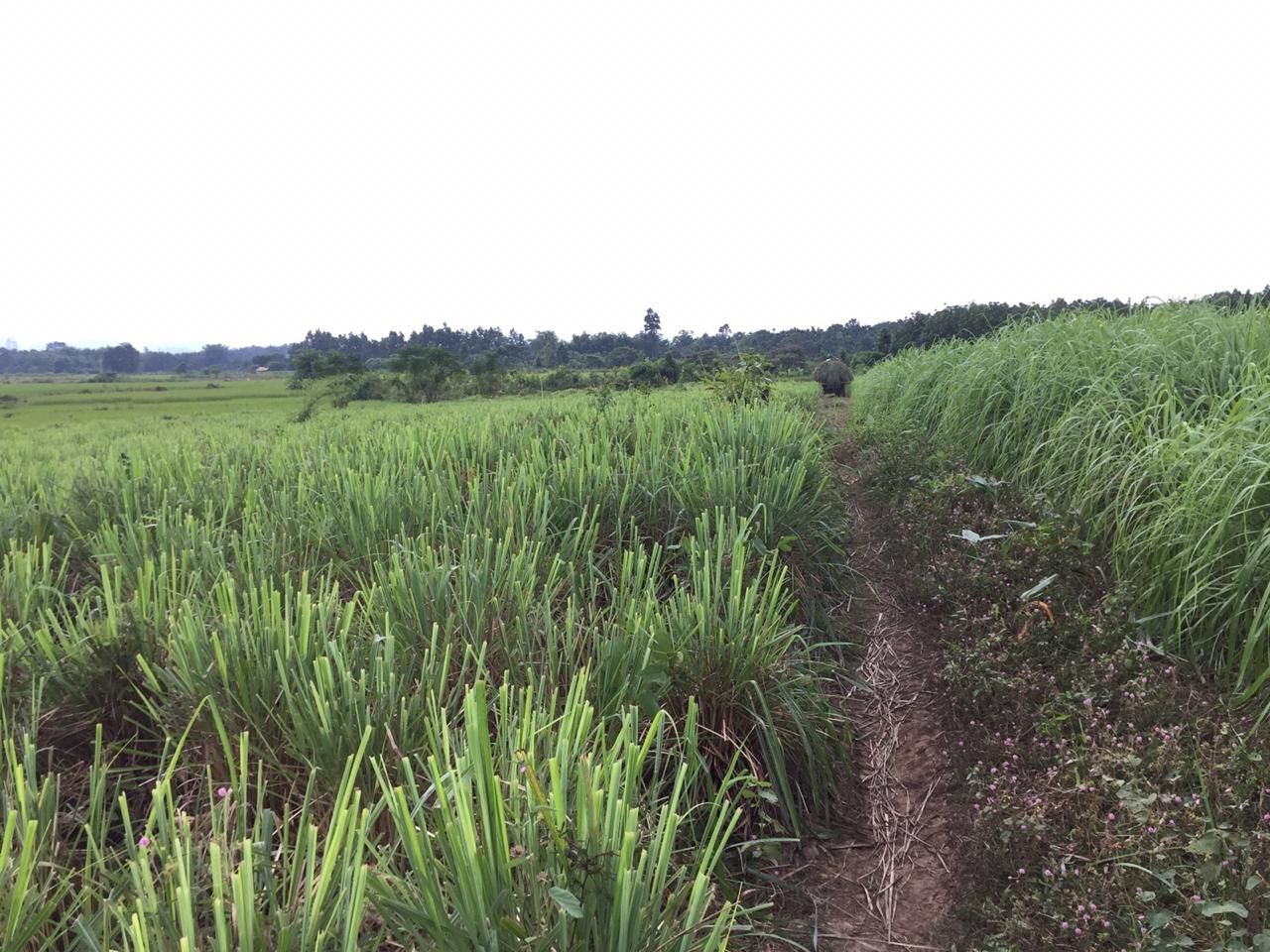
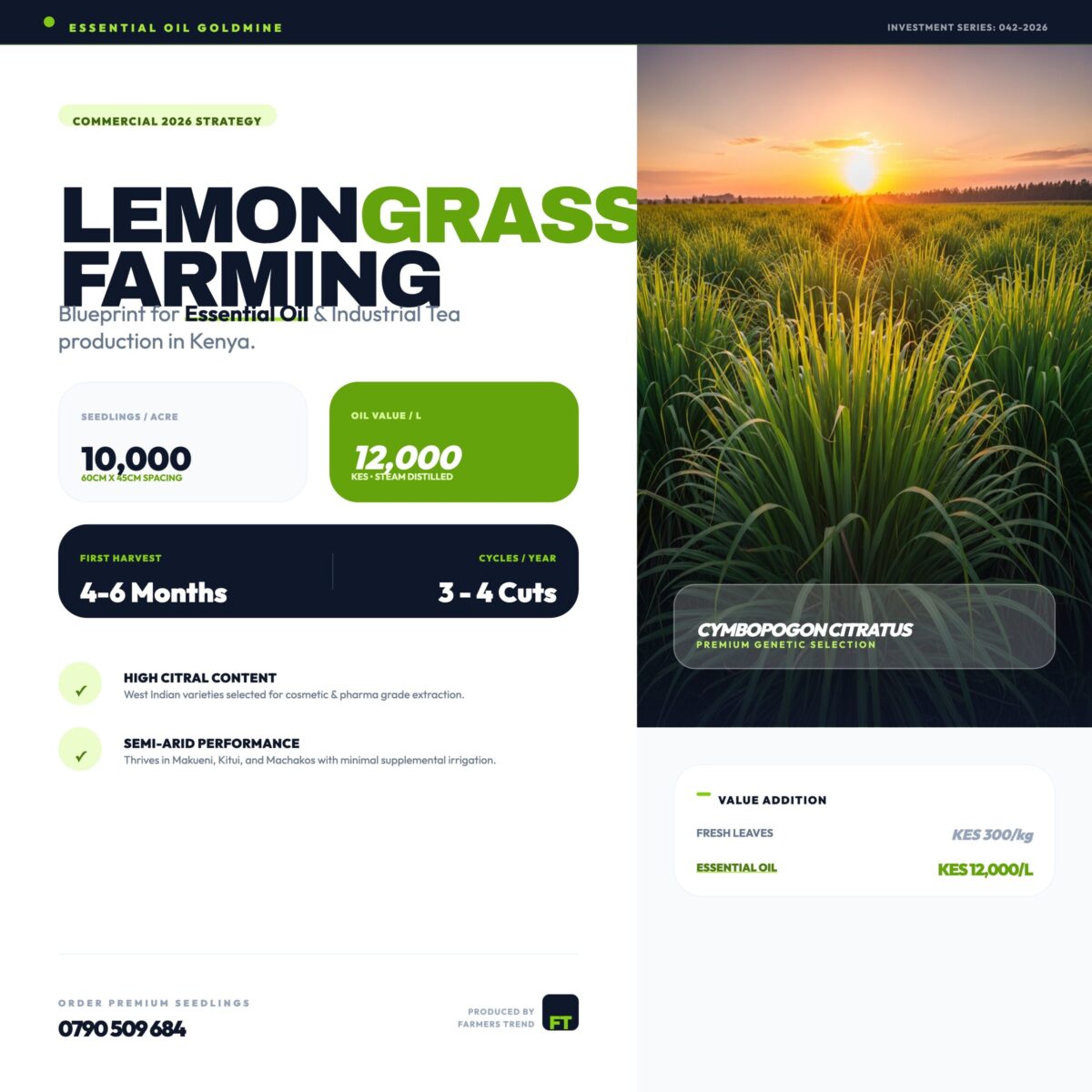
A farmer who plants lemongrass today can start harvesting leaves within 4 to 6 months. The grass regrows after each cut, giving 3 to 4 harvests every year. Fresh leaves sell to local processors for 150 to 300 shillings per kilogram. The essential oil commands 8,000 to 12,000 shillings per liter. The value addition potential is enormous.
This guide by Farmers Trend Ltd. covers everything needed for commercial success in lemongrass farming in Kenya. You will learn about variety selection, field establishment, crop management, distillation protocols, and financial projections. The information comes from successful essential oil producers and agricultural research stations across the country.
The 2026 Aromatic Market Explosion
Lemongrass farming in Kenya is positioned to benefit from the global shift toward natural products. Cosmetic manufacturers are replacing synthetic fragrances with plant-based alternatives. Herbal tea companies are expanding their product lines. The pharmaceutical industry is exploring citral for its anti-inflammatory and antimicrobial properties.
The Kenyan climate provides ideal conditions for lemongrass cultivation. The plant thrives in warm temperatures between 20 and 30 degrees Celsius. It produces higher oil concentrations when grown at altitudes between 500 and 1,500 meters. The semi-arid regions of Makueni, Kitui, Machakos, and parts of Coast province are particularly suitable.
The profitability of lemongrass farming in Kenya depends on what you do with the harvested leaves. Selling fresh leaves gives quick cash but lower margins. Distilling the leaves into essential oil requires an initial investment in equipment but multiplies the returns. A farmer who processes the oil captures the full value chain.
Propagation and Genetic Quality
Lemongrass farming in Kenya starts with quality planting material. Farmers Trend Virtual Agrovet sells premium lemongrass seedlings at 150 shillings each. These seedlings come from selected mother plants with high oil content and disease resistance. Wild divisions from unknown sources produce lower yields and inconsistent oil quality.
The Cymbopogon genus includes several varieties. West Indian lemongrass produces the highest citral content for essential oil production. East Indian lemongrass has a coarser leaf and lower oil yield but performs better in drier conditions. Farmers Trend supplies the West Indian variety for commercial oil production.
One acre requires 10,000 seedlings based on 60 centimeters by 45 centimeters spacing. This plant population ensures full ground cover within 3 to 4 months. The dense canopy suppresses weeds and maximizes leaf production per square meter.
Industrial Field Management and Spacing
Proper spacing is critical for high yields in lemongrass farming in Kenya. The recommended layout is 60 centimeters between rows and 45 centimeters between plants. This arrangement gives 10,000 plants per acre. The plants have enough room to develop tillers while forming a closed canopy quickly.
Prepare the land by ploughing to 20 to 25 centimeters depth. Remove all weeds and break clods. Incorporate 10 tons of well-decomposed manure per hectare during land preparation. The soil pH should be between 5.5 and 7.0. Add lime if the soil is too acidic.
Plant at the start of rains. March to April for the long rains and October to November for the short rains work well. With irrigation, you can plant year-round. Dig holes 15 centimeters deep and 15 centimeters wide. Place one seedling per hole and cover with soil. Water immediately after planting.
Irrigation is essential during the establishment phase. Drip irrigation delivers water efficiently while keeping leaves dry. Mature plants tolerate drought but produce more leaves with consistent moisture. In semi-arid zones, supplemental irrigation during dry spells increases yields by 30 to 50 percent.
Growth Timeline and Harvest Cycles
How many months does lemongrass take to mature? The first harvest comes 4 to 6 months after planting. The leaves should be 1 to 1.5 meters tall. Cut the leaves 10 to 15 centimeters above ground level using a sharp knife or machete.
After the first harvest, the grass regrows quickly. Subsequent harvests come every 3 months. A well-managed planting produces 3 to 4 harvests annually. The planting remains productive for 3 to 5 years before yields decline.
How much lemongrass can you get from one acre? Annual fresh leaf yield ranges from 2,000 to 3,000 kilograms per acre under good management. With irrigation and intensive feeding, yields reach 4,000 kilograms per acre.
How to Start Lemongrass Farming in Kenya
Start with soil testing to determine pH and nutrient levels. Lemongrass grows best in well-drained sandy loam soils. Heavy clay soils cause root rot and reduce yields.
Order seedlings from Farmers Trend Virtual Agrovet. One acre needs 10,000 seedlings at 150 shillings each, costing 1.5 million shillings. This is the largest single expense. The investment pays back within 12 to 18 months.
Prepare the land by ploughing and harrowing. Mark the field using a string to ensure straight rows. Dig holes at 60 centimeters by 45 centimeters spacing. Mix the topsoil with manure before planting.
Plant the seedlings during the rainy season to reduce irrigation costs. Water the plants for the first 4 weeks to ensure establishment. Apply nitrogen-rich fertilizer at 50 kilograms per acre after each harvest.
Value Addition: The Distillation Protocol
The essential oil is where the real money lies in lemongrass farming in Kenya. Fresh leaves contain 0.5 to 0.8 percent oil by weight. This means 100 kilograms of fresh leaves yield 500 to 800 grams of oil.
Steam distillation is the standard extraction method. Place the harvested leaves in a distillation tank. Pass steam through the tank. The steam carries the oil vapor to a condenser, where it cools and separates from water. Collect the oil using a separator.
A small distillation unit processing 200 kilograms of leaves per batch costs 150,000 to 300,000 shillings. The unit pays for itself within 3 to 6 months of regular operation.
The quality of the oil depends on harvest timing and distillation technique. Harvest leaves in the morning after the dew dries but before the sun gets hot. Oil concentration peaks during this window. Distill the leaves within 24 hours of harvest to prevent oil degradation.

How Much is Lemongrass Oil Per Litre in Kenya
Lemongrass oil price per litre in Kenya ranges from 8,000 to 12,000 shillings for high-quality, organic oil. Export markets pay 15,000 to 20,000 shillings per liter for certified organic oil meeting international standards.
| Product Form | Market Price | Processing Required | Profit Margin |
|---|---|---|---|
| Fresh leaves | 150-300 KSh/kg | None | Low |
| Dried leaves | 400-600 KSh/kg | Sun drying | Medium |
| Essential oil | 8,000-12,000 KSh/liter | Steam distillation | High |
| Organic export oil | 15,000-20,000 KSh/liter | Distillation + certification | Very high |
Integrated Health and Pest Control
Leaf blight is the most common disease in lemongrass farming in Kenya. It causes yellowing and drying of leaf tips. The disease spreads during wet conditions. Control with copper-based fungicides applied at first sign of infection. Remove and destroy infected leaves.
Mealybugs cluster at the base of the leaves and suck plant sap. Heavy infestations stunt growth and reduce yields. Control with neem oil or insecticidal soap. Encourage natural predators like ladybugs.
Weeds are the biggest challenge in the first 3 months before the canopy closes. Hand weed the field twice during this period. Mulching between rows suppresses weed growth and conserves moisture.
Does lemongrass repel mosquitoes? Yes. The citronella content in lemongrass oil repels mosquitoes effectively. This property has created a market for lemongrass-based insect repellents. Manufacturers of natural repellents are consistent buyers of quality oil.
What are the Disadvantages of Lemongrass Farming
The high initial cost of seedlings is a barrier for farmers with limited capital. Ten thousand seedlings at 150 shillings each cost 1.5 million shillings per acre. However, the planting lasts 3 to 5 years, spreading the cost over multiple harvests.
Manual weeding is labor intensive. The field must be weeded twice in the first 3 months. Weeding requires 30 to 50 person-days per acre. Farmers with family labor have an advantage.
Distillation equipment requires significant upfront investment. A small unit costs 150,000 to 300,000 shillings. Farmers who cannot afford their own unit can form cooperatives to share equipment.
The market for fresh leaves is limited to local processors. Farmers without access to distillation equipment depend on these buyers. Essential oil production opens access to premium markets.

10-Year ROI and Financial Forecast on Lemongrass Farming in Kenya
Here is a 2026 budget for establishing one acre of lemongrass.
| Cost Item | Quantity | Unit Price | Total |
|---|---|---|---|
| Seedlings | 10,000 | 150 KSh | 1,500,000 KSh |
| Land preparation | 1 acre | 15,000 KSh | 15,000 KSh |
| Manure | 5 tons | 3,000 KSh/ton | 15,000 KSh |
| Drip irrigation system | 1 acre | 60,000 KSh | 60,000 KSh |
| Labor (planting, weeding) | 30 days | 500 KSh/day | 15,000 KSh |
| Fertilizers (annual) | 50 kg | 90 KSh/kg | 4,500 KSh |
| Pest control materials | 1 acre | 5,000 KSh | 5,000 KSh |
| Total First-Year Investment | 1,614,500 KSh |
| Year | Fresh Leaves (kg) | Revenue from Leaves | Oil (liters) | Revenue from Oil | Total Revenue |
|---|---|---|---|---|---|
| 1 | 2,000 | 400,000 | 12 | 120,000 | 520,000 |
| 2 | 3,000 | 600,000 | 20 | 200,000 | 800,000 |
| 3 | 4,000 | 800,000 | 28 | 280,000 | 1,080,000 |
| 4 | 4,000 | 800,000 | 28 | 280,000 | 1,080,000 |
| 5 | 4,000 | 800,000 | 28 | 280,000 | 1,080,000 |
A farmer selling fresh leaves alone recovers the investment by year 4. A farmer distilling oil recovers the investment by year 3 and earns significantly higher returns thereafter.
Where to Sell Lemongrass in Kenya
Local herbal tea processors buy fresh and dried lemongrass leaves. These companies package lemongrass tea for supermarket shelves. Cosmetic manufacturers buy essential oil for soap, lotion, and shampoo production.
The European export market offers the highest prices for organic lemongrass oil. Buyers require certification and consistent quality. The export price ranges from 15,000 to 20,000 shillings per liter.
Farmers Trend Ltd assists farmers with market linkages for both fresh leaves and essential oil. Contact 0790509684 for buyer introductions.

Next Step
Lemongrass farming in Kenya offers a clear path to profit with value addition. Seedlings from Farmers Trend Virtual Agrovet cost 150 shillings each. One acre requires 10,000 seedlings at a cost of 1.5 million shillings. The first harvest comes at 4 to 6 months. Fresh leaves sell for 150 to 300 shillings per kilogram. Essential oil commands 8,000 to 12,000 shillings per liter.
The 2026 planting windows are March to April for the long rains and October to November for the short rains. Prepare the land now. Order seedlings from Farmers Trend Virtual Agrovet.
For site suitability audits, distillation equipment sourcing, and the 2026 Lemongrass farming in Kenya PDF guide, contact Farmers Trend Ltd at 0790509684.
The farmers making good money from lemongrass started where you are now. They learned, they planned, and they did the work. You can do the same. Your lemongrass farming in Kenya journey starts today. The market is waiting. The returns are real. The time to act is now.
https://farmerstrend.co.ke/crops/lemongrass-farming/lemongrass-farming-in-kenya-2026-guide/https://farmerstrend.co.ke/wp-content/uploads/2026/04/lemongrass-market.jpeghttps://farmerstrend.co.ke/wp-content/uploads/2026/04/lemongrass-market-150x150.jpegLemongrass Farming# TrendingFarmers Trend lemongrass seedlings,Lemongrass oil price per litre Kenya,Lemongrass seedlings for sale Kenya,Lemongrass yield per acre,Profitability of lemongrass farming,Value addition of lemongrass,Virtual Agrovet lemongrassLemongrass Farming in Kenya: The 2026 Commercial Blueprint for Essential Oil and Tea Production Kenya imports millions of shillings worth of essential oils every year. The global market for natural citral, the compound that gives lemongrass its distinct aroma, continues to expand. Cosmetic companies need it. Herbal tea processors want...FarmersTrendjohn doefarmerstrend@gmail.comAdministratorFarmers Trend Ltd.

Give me details on the marketing aspect
I am in Bungoma