Cassava Farming in Kenya: The 2026 Complete Guide to Profit & High Yield
The Definitive 2026 Guide to Profitable Cassava Farming in Kenya
Cassava farming in Kenya is undergoing a quiet revolution. No longer seen merely as a subsistence crop for rural households, it is now recognized as a strategic, climate-resilient commercial venture with extensive value-chain opportunities. For the forward-thinking farmer, cassava presents a unique proposition: a hardy crop that guarantees food security while serving as a primary raw material for numerous industries. This comprehensive guide by Farmers Trend Ltd. addresses every critical question with precise, actionable data for 2026. We will dissect the exact profitability metrics, analyze the best high-yielding varieties, provide a scientifically-backed planting protocol, and explore the lucrative processing opportunities that transform cassava from a simple tuber into a wealth-generating asset. This is your manual for building a successful and future-proof cassava enterprise.

Understanding the Profitability and Economic Potential of Cassava
The central question for any agribusiness is financial viability. How profitable is cassava farming in Kenya? The answer is resoundingly positive, but the profit margin is a direct function of management intensity and market access. When comparing staple crops, cassava consistently demonstrates superior returns per acre over maize, especially in marginal rainfall areas. Its profitability stems from three pillars: remarkably high yield potential, low relative input costs, and burgeoning demand from processing industries.
Let us analyze the numbers. Under good agricultural practices, the cassava yield per acre in Kenya for improved varieties like Tajirika or Kibanda Meno can range from 15 to 40 tons. Conservative commercial farming often achieves 20-25 tons per acre. The cassava price per kg in Kenya fluctuates based on season, location, and form (fresh roots vs. dried chips). As of 2024, the farm-gate price for fresh tubers ranges between Ksh 12 to Ksh 25 per kilogram. Using a conservative yield of 20 tons (20,000 kg) at a low price of Ksh 15/kg, gross revenue per acre is Ksh 300,000.
The cost of cassava farming in Kenya is notably lower than for cereal crops. Establishment costs, including land preparation, cuttings, and planting labor, average Ksh 40,000 to Ksh 60,000 per acre. Maintenance costs are minimal, focusing primarily on weeding. This creates a compelling profit margin that answers the question, “Is cassava a good investment?” affirmatively. When asking which crop has the highest profit per acre in Kenya, a well-managed cassava field is a top contender, particularly due to its low risk profile in drought-prone regions.

Ecological Conditions for Optimal Cassava Production
Cassava is renowned for its resilience, but maximizing yield requires understanding its ideal environment. What climate is best for cassava? It thrives in warm, tropical and subtropical climates with temperatures between 25°C and 35°C. It is extremely sensitive to frost. In Kenya, it is predominantly grown in the Western, Nyanza, Coastal, and Eastern regions, as well as in parts of the Rift Valley.
Rainfall requirements are moderate but specific. Cassava performs best with 1000mm to 1500mm of well-distributed rainfall annually. However, its deep root system grants it exceptional drought tolerance, allowing it to produce where other crops like maize would fail. This makes it a critical crop for climate adaptation. Crucially, cassava does not tolerate waterlogging. Excess water in poorly drained soils causes root rot and drastically reduces yield. Therefore, the answer to “Does cassava like sun or shade?” is definitive: it requires full sun for optimal photosynthesis and growth.
Soil preferences are flexible but important. Cassava grows in a wide range of soils, from sandy loams to clay loams, but the ideal is a deep, well-drained, medium-textured soil with a pH between 5.5 and 6.5. Good soil depth is critical for the development of large, unobstructed tubers.
A Detailed Step-by-Step Guide to Modern Cassava Farming
Modern cassava farming moves away from traditional, low-yield practices. This is a systematic guide for commercial production.
Phase 1: Land Selection and Preparation. The process of how to prepare land for cassava is foundational. Select a sunny, well-drained field. Clear all existing vegetation and plough deeply to a depth of at least 30 cm to break any hardpan. This deep tillage is non-negotiable as it allows for easy tuber expansion. Harrow to achieve a fine tilth. Cassava is often grown on mounds or ridges, especially in areas with heavy rainfall, to improve drainage. Ridging is a recommended modern practice that increases yield potential.

Phase 2: Selecting and Sourcing Planting Material. The choice of variety determines your yield ceiling. The best cassava varieties in Kenya are those released by the Kenya Agricultural and Livestock Research Organization (KALRO). These include:
Tajirika: High yielding, disease resistant, suitable for multiple uses.
Kibanda Meno: Excellent for both fresh consumption and processing, with good drought tolerance.
Serere: Known for early maturity and high dry matter content, ideal for flour processing.
Always source healthy, disease-free cassava cuttings for sale in Kenya from certified nurseries or reputable seed producers. Use the middle third of mature, woody stems from plants aged 8-14 months. Cuttings should be 20-30 cm long with at least 5 nodes.
Phase 3: Planting and Spacing. What month can I plant cassava? The best time is at the onset of the long rains, from March to April. Can cassava be planted in October? Yes, with the short rains, but establishment may be less robust if the rains are unreliable. Plant cuttings at an angle or vertically, burying about two-thirds into the soil. Correct spacing is vital for high yield. A commercial recommendation is an inter-row spacing of 1 meter and an intra-row spacing of 0.8 to 1 meter. This gives a plant population of approximately 10,000 to 12,500 stems per hectare (4,000-5,000 per acre), optimizing light interception and root development.

Phase 4: Crop Management. How often should cassava be watered? While drought-tolerant, consistent moisture during the first 3-4 months of growth is critical for good canopy establishment. Irrigation can be used to supplement rainfall in dry spells. Weeding is the most crucial management activity. Keep the field weed-free, especially during the first 3-5 months, to prevent competition. Modern farmers use pre-emergent herbicides followed by careful manual weeding.
Fertilization directly addresses the question of how to make cassava grow big. While cassava can grow in poor soils, it is highly responsive to fertilizer. How many bags of fertilizer per hectare of cassava? Soil testing is essential. A general recommendation is to apply 200-400 kg per hectare of a balanced NPK fertilizer (e.g., 17:17:17) at planting, followed by a top-dressing of nitrogen-rich fertilizer like Calcium Ammonium Nitrate (CAN) at 2-3 months. The best fertilizer for cassava is one that includes potassium, which is crucial for tuber bulking and starch accumulation.
Navigating the Value Chain: From Harvest to Market
The question of how long cassava takes to grow in Kenya is variety-specific. Early-maturing varieties can be harvested from 8-10 months, but for maximum starch and dry matter content, the ideal maturity period is 12-18 months. The lifespan of a cassava plant is a single growing cycle; it is an annual crop harvested by uprooting the entire plant.
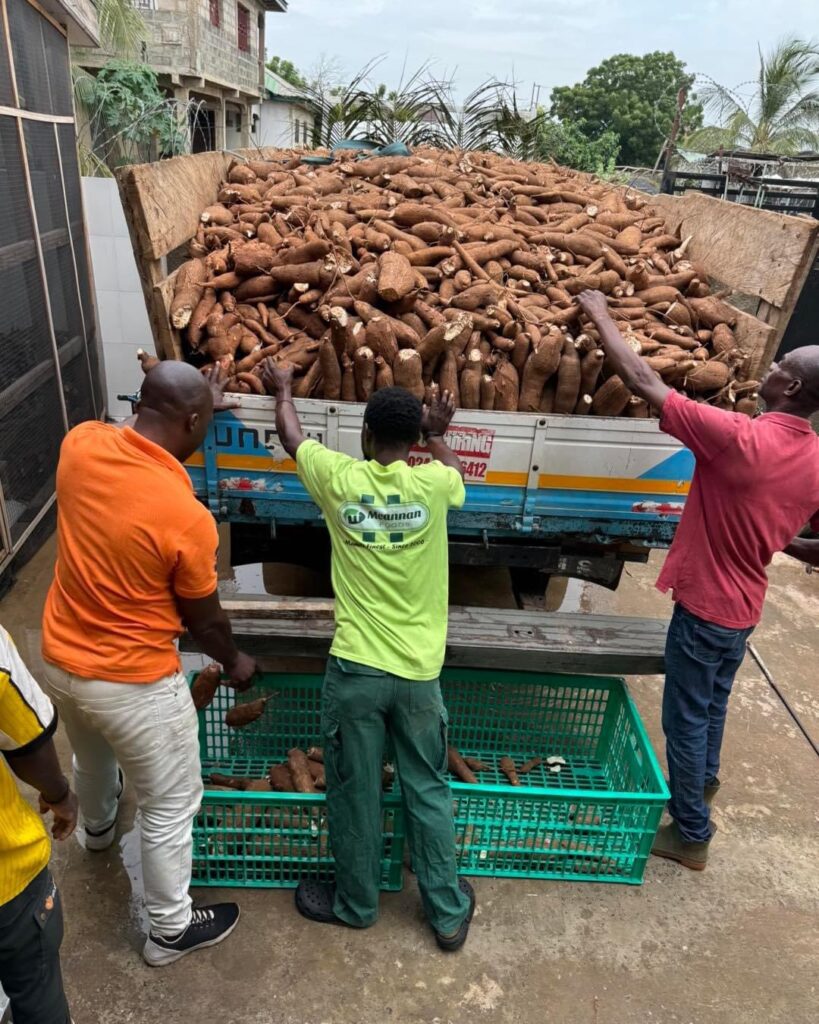
Harvesting is labor-intensive. Yields are measured in tons per acre. How many bags of cassava make a ton? Approximately 20-25 standard 50kg bags of fresh tubers equal one metric ton. A common query is, “How many tonnes of cassava can I get in one acre?” With improved varieties and good management, 20-25 tons is a commercially achievable target.
The biggest threat to farmers’ profits is not production but post-harvest loss and poor market access. Fresh cassava roots perish within 2-3 days after harvest. Therefore, the key to unlocking wealth lies in processing and value addition. How can cassava farmers in Kenya find a market for their products? The most secure path is to engage with or establish small-scale processing. Cassava processing machines for chipping, drying, grating, and milling are readily available. Processing roots into dried chips (for animal feed), high-quality flour (for human consumption), starch, or ethanol opens doors to stable, large-volume buyers like feed manufacturers, supermarkets, and industrial plants. This move up the value chain is what transforms cassava into a truly lucrative business.
Confronting Challenges and Seizing Opportunities
The challenges of cassava farming are manageable with knowledge. Key threats include Cassava Mosaic Disease (CMD) and Cassava Brown Streak Disease (CBSD), which are best controlled by planting certified resistant varieties. Pest issues like the cassava mealybug and green mite require integrated pest management. The manual labor bottleneck for planting and harvesting is being addressed by the gradual mechanization of modern cassava farming.
For the ambitious individual asking how to earn 10k per day in Kenya, a structured cassava enterprise provides a clear path. Controlling 5 acres of land, achieving a modest yield, and moving into processing and direct marketing can easily generate this level of income. The crop’s resilience, coupled with its diverse end-uses in starch, flour, ethanol, and animal feed, positions cassava farming in Kenya not just as a farming activity, but as a cornerstone of agri-industrial growth for 2026 and beyond.
https://farmerstrend.co.ke/trending/cassava-farming-in-kenya-profit-yield-guide-2026/https://farmerstrend.co.ke/wp-content/uploads/2026/01/GzS6nljWgAAZTFY.jpghttps://farmerstrend.co.ke/wp-content/uploads/2026/01/GzS6nljWgAAZTFY-150x150.jpg# TrendingCassava farmingThe Definitive 2026 Guide to Profitable Cassava Farming in KenyaCassava farming in Kenya is undergoing a quiet revolution. No longer seen merely as a subsistence crop for rural households, it is now recognized as a strategic, climate-resilient commercial venture with extensive value-chain opportunities. For the forward-thinking farmer, cassava presents...FarmersTrendjohn doefarmerstrend@gmail.comAdministratorFarmers Trend Ltd.






Leave a Reply