Coffee Under Avocado Shade: What Kenyan Science Reveals About Yields, Quality and the Right Tree Numbers
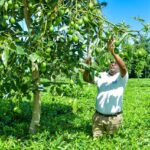
For decades, coffee farming in Kenya followed a simple rule: keep coffee alone. The belief was deeply ingrained among farmers, extension officers, and policymakers alike – mixing coffee with other trees would reduce yields, weaken quality, and complicate farm management. But today, across the highlands of Central Kenya, the Rift Valley, and parts of Eastern Kenya, that rule is quietly being rewritten. Walking along ranges of Murang’a county in particular, Avocado trees—once considered outsiders in coffee fields—are now rising above coffee bushes. Farmers introduced avocadoes into coffee farms when incomes from coffee dwindled without uprooting coffee. The intercropping is reported to be promising extra income, climate protection, and improved soil health.

The big question remains: can coffee and avocados coexist without undermining productivity? Evidence from Kenyan scientists suggests the answer is yes — but only if farmers get the numbers right.
The most detailed local assessment of coffee intercropping comes from research conducted at the Coffee Research Institute (CRI) in Ruiru under the Kenya Agricultural and Livestock Research Organization (KALRO). The study, led by Margaret W. Mithamo, Richard K. Kerich and Joseph K. Kimemia, was published in 2017 in the International Journal of Enology and Viticulture, an international peer-reviewed journal published by International Scholars Journals.
In the experiment, the researchers did not focus on avocados alone. They examined mature Arabica coffee intercropped with a range of fruit trees commonly found on Kenyan farms — including avocado, mango, macadamia, banana, guava and loquat — alongside a pure coffee stand. Each fruit tree interacts differently with coffee in terms of shade, nutrient uptake and root competition.
This article focuses specifically on avocados, reflecting their growing economic importance, rapid expansion in export markets and increasing adoption by coffee farmers.Under sole coffee production, the study recorded an average yield of about 1,128 kilograms of clean coffee per hectare, equivalent to roughly 456 kilograms per acre-3000kgs of cherry per acre or roughly 5.5 kilograms of cherry per bush.
When coffee was intercropped with avocados under the study conditions, yields declined sharply. Clean coffee output fell to about 708 kilograms per hectare, or around 287 kilograms per acre. In cherry terms 1.9 tonnes per acre or 3.5 kilograms of cherry per coffee tree.That is a reduction of roughly 37 per cent in cherry yield per bush — a figure that has often been cited as proof that intercropping does not work.
But the study’s authors were careful to explain what drove this decline. The problem was not the presence of avocado trees itself, but their density. In the experiment, avocados were planted at a spacing of nine metres by nine metres, equivalent to about 123 avocado trees per hectare, or roughly 50 trees per acre. At that density, avocado canopies created shade levels of up to 50 per cent, far above what Arabica coffee can tolerate without sacrificing productivity.
Several studies I checked on Coffee physiology showed that Arabica coffee performs best under a moderate shade of about 20 to 30 per cent. Beyond that threshold, photosynthesis declines and yields fall rapidly. In effect, the study demonstrated the consequences of excessive shade rather than the inherent incompatibility of coffee and avocados.
Interestingly, while yields declined under heavy shading, coffee quality improved. Coffee grown under avocado shade recorded 89.7 per cent Grade A beans, compared with 86.8 per cent under sole coffee. That four-percentage-point improvement in premium-grade coffee is significant in a market where bean size and screen retention strongly influence buyer interest and auction performance at the Nairobi Coffee Exchange.
The quality improvement was closely linked to changes in soil nutrition. The study found significantly higher soil phosphorus levels in coffee plots intercropped with avocados, particularly in the topsoil near the trees. Avocado leaf litter and fallen fruit decompose steadily, recycling nutrients back into the soil and supporting better bean development even where shade reduces overall yield. The real lesson from the research, therefore, is not that intercropping should be avoided, but that it must be managed with discipline. Based on the study’s findings and my applied interpretation informed by the well-established requirement that Arabica coffee performs optimally under 20–30 per cent shade, the avocado densities used in the experiment were simply too high for commercial coffee production.
A more balanced system would involve far fewer avocado trees. In practical terms, an avocado population of about 40 to 70 trees per hectare — equivalent to roughly 16 to 28 trees per acre — is more appropriate for coffee farms. At this level, shade remains within productive limits, soil fertility benefits are retained and coffee yield losses moderate significantly, typically to around 10–15 per cent, rather than the 37 per cent observed under heavy shading. Beyond yield and quality, the broader implications are strategic. Properly managed coffee–avocado systems improve soil health, buffer farms against rising temperatures and diversify production in an increasingly volatile global market.
The evidence from CRI’s work suggests that Kenya’s coffee future may not lie in rigid monocropping, but in managed diversification — where per-bush productivity, quality, and resilience matter as much as total volume. Coffee and avocados can grow together, but only when farmers respect the limits of shade and understand that, in intercropping, as in business, balance determines success. Keep it here for more details on coffee matters in Kenya.
BY: Henry Kinyua
Advisor-Crops and Value Chains-President Economic Transformation Secretariat
Read original post here












Leave a Reply