Miraa Farming in Kenya 2026 – The Complete Guide to the Multi-Billion Shilling Industry
Miraa Farming in Kenya 2026 – The Complete Guide to the Multi-Billion Shilling Industry
The miraa sector in Kenya has grown into a highly organized 13-billion-shilling industry governed by the Crops (Miraa) Regulations of 2022 and overseen by the Agriculture and Food Authority (AFA).
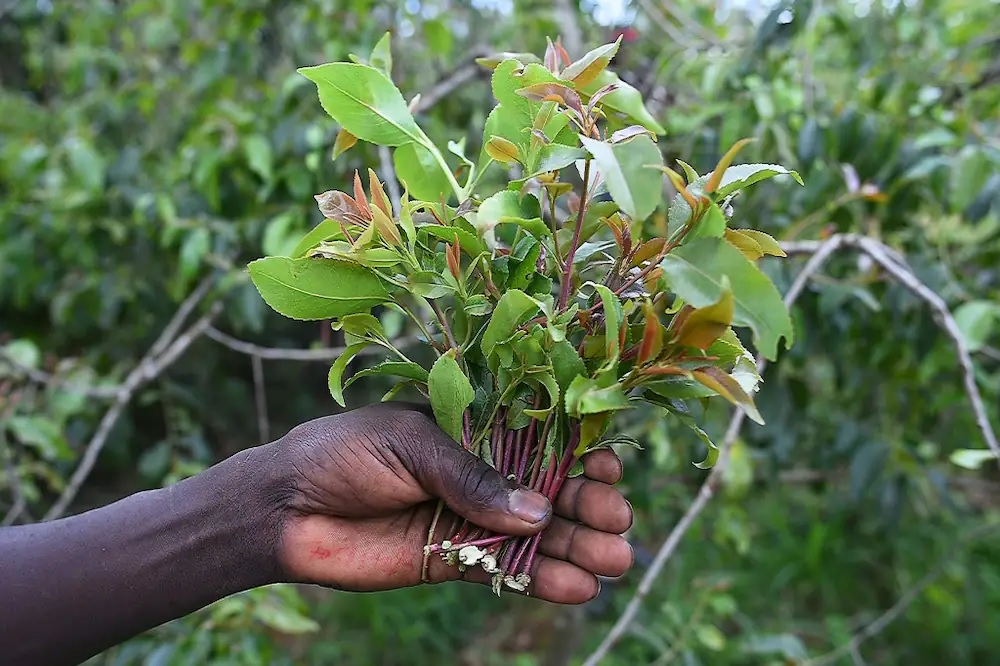
Farmers in the Nyambene Hills of Meru, Embu, Tharaka Nithi, and now expanding into Marsabit, Kirinyaga, and parts of the Rift Valley have benefited from fixed government floor prices that have stabilized incomes and made miraa one of the most reliable cash crops in the country.
The 2026 regulatory framework has further strengthened the value chain by enforcing traceability standards, requiring nursery certification, and mandating the use of field holding facilities with potable water for post-harvest handling.
Miraa farming in Kenya has become a serious generational investment because a well-managed tree has an economic lifespan of 50 to 100 years, which means that a farmer who plants seedlings today will be harvesting twigs for the rest of their life and their children will also benefit from the same trees.
Commercial harvesting typically begins 3 to 4 years after planting seedlings in miraa farming in Kenya, with the tree reaching its full canopy and peak production by the seventh year.
A mature, well-managed acre can produce between 1,500 and 2,500 kilograms of high-grade twigs annually, and with the government floor prices set at 1,300 shillings per kilogram for Grade 1 (Kisa/Kachu), 700 shillings for Grade 2, and 1,000 shillings for Alele, the gross revenue potential for a dedicated commercial grower ranges from 1.95 to 3.25 million shillings per acre at full production.
This guide by Farmers Trend provides a comprehensive technical analysis of the miraa value chain in 2026, covering variety selection, nursery establishment, field engineering, nutritional management, regulatory compliance, harvesting protocols, and financial projections for miraa farming in Kenya. The information comes from successful growers, AFA officials, and market analysts.

The 2026 Formalization of the Miraa Industry in Kenya
The formalization of the miraa industry through the Crops (Miraa) Regulations of 2022 has brought order to a sector that was previously characterized by price volatility and inconsistent quality standards, benefiting miraa farming in Kenya tremendously.
The AFA now registers all growers, requires nursery certification, and enforces strict harvesting and post-harvest handling protocols that have improved the reputation of Kenyan miraa in export markets. The government’s intervention in setting floor prices has eliminated the exploitation of farmers by brokers and has created a predictable income stream that allows farmers to plan their operations and invest in their farms for miraa farming in Kenya.
The primary growing zones for miraa farming in Kenya remain the Nyambene Hills in Meru County, where the red volcanic soils and cool misty conditions produce the most tender twigs with the characteristic aroma and flavor that buyers prefer. Embu and Tharaka Nithi have also emerged as major production zones for miraa farming in Kenya, and the crop has expanded into Marsabit, Kirinyaga, and parts of the Rift Valley where soil drainage is optimal and irrigation is available.
The crop is sensitive to waterlogging, which means that gently sloping land with well-drained soils is essential for successful miraa farming in Kenya.
The export market for miraa is primarily Somalia, where Kenyan miraa is preferred for its freshness and quality, but the industry has also opened channels to other markets in the region. The AFA has established inspection protocols at the point of export to ensure that only high-quality twigs that meet the required standards leave the country, and this has improved the perception of Kenyan miraa among international buyers, further supporting miraa farming in Kenya.
| Grade Name | Physical Characteristics | 2026 Floor Price | Target Market |
|---|---|---|---|
| Kisa/Kachu (Grade 1) | Young, tender twigs with 3-4 nodes | 1,300 KSh/kg | Premium export |
| Alele | Medium maturity, 5-6 nodes | 1,000 KSh/kg | Export, local |
| Grade 2 | Older twigs, 6+ nodes | 700 KSh/kg | Local, processing |
Genetics and Material Selection for Miraa Farming in Kenya
The choice of planting material is the most critical decision in commercial miraa farming in Kenya because the variety determines the twig quality, the yield potential, and the market grade that the farmer can achieve. Farmers Trend Ltd sells certified miraa seedlings for 100 shillings each, and these plants are grown from cuttings taken from high-yielding, disease-free mother trees of the Giza, Kangeta, and Alele varieties.
The seedlings are inspected to ensure they are true to type and free from pests and diseases, and they are ready for transplanting after 6 to 8 months in the nursery for miraa farming in Kenya.
The Giza variety is the most popular for commercial miraa farming in Kenya because it produces the tender, thin twigs with close nodes that are classified as Grade 1 and command the highest price of 1,300 shillings per kilogram. The leaves are small, the internodes are short, and the twigs have a characteristic sweet taste and aroma that buyers prefer. Giza is grown primarily in the high-altitude areas of the Nyambene Hills where the cool misty conditions favor the development of the desired qualities, making it the top choice for miraa farming in Kenya.
The Kangeta variety is also widely planted in miraa farming in Kenya and produces good quality twigs that are classified as Grade 1 or Alele depending on the harvesting stage. The twigs are slightly thicker than Giza but still have good flavor and market acceptance. Kangeta is more vigorous and produces higher yields than Giza, which makes it a good choice for farmers who have access to irrigation and can manage the faster growth rate in miraa farming in Kenya.
The Alele variety produces thicker twigs that are classified as Alele grade and sell for 1,000 shillings per kilogram. This variety is more drought-tolerant than Giza and Kangeta, and it performs well in lower altitude areas where the other varieties may struggle. Alele is a good choice for farmers in marginal areas who still want to participate in miraa farming in Kenya.
| Cost Item | Quantity | Unit Price | Total |
|---|---|---|---|
| Miraa seedlings (Giza) | 1,000 | 100 KSh | 100,000 KSh |
| Land preparation | 1 acre | 15,000 KSh | 15,000 KSh |
| Manure (5kg per hole) | 5,000 kg | 3,000 KSh/ton | 15,000 KSh |
| DAP fertilizer | 50 kg | 130 KSh/kg | 6,500 KSh |
| Drip irrigation system | 1 acre | 60,000 KSh | 60,000 KSh |
| Licensing and registration fees | 1 year | 10,000 KSh | 10,000 KSh |
| Labor (planting) | 20 days | 500 KSh/day | 10,000 KSh |
| Pest control materials | 1 acre | 10,000 KSh | 10,000 KSh |
| Total First-Year Investment | 226,500 KSh |

Field Engineering and Planting for Miraa Farming in Kenya
Miraa farming in Kenya requires careful attention to site selection because the crop is sensitive to waterlogged conditions and prefers well-drained, gently sloping land. The recommended spacing for commercial miraa farming in Kenya is 2 meters by 2 meters, which gives approximately 1,000 trees per acre. This spacing allows each tree to develop a full canopy without competing with neighbors, and it also provides enough room for workers to walk between the rows during harvest.
Dig holes that are 60 centimeters wide, 60 centimeters deep, and 60 centimeters long for your miraa farming in Kenya operation, and mix the topsoil with 5 kilograms of well-rotted manure and 100 grams of DAP fertilizer per hole. Fill the holes back up and let them settle for two weeks before you plant because fresh soil can sink after watering, and if the tree sinks too deep, the root collar may be buried and the tree may rot, harming your miraa farming in Kenya investment.
The best time to plant miraa is at the onset of the long rains in March, but 2026 regulations require commercial nurseries to demonstrate a reliable irrigation source for year-round planting, which means that farmers with drip irrigation can plant at any time. The seedlings should be planted at the same depth they were growing in the nursery pot, and the soil should be firmed gently around the roots for successful miraa farming in Kenya.
Nutrition and Water Management in Miraa Farming in Kenya
Miraa trees need consistent nutrition to produce the tender, succulent twigs that command premium prices in the export market. Apply CAN fertilizer at 50 grams per tree twice yearly at the start of the rains, and apply NPK 17:17:17 at 100 grams per tree once yearly for the first 3 years of miraa farming in Kenya. For mature trees that are 4 years and older, apply CAN at 100 grams per tree twice yearly and NPK 17:17:17 at 200 grams per tree once yearly.
Potassium is important for twig quality in miraa farming in Kenya because it improves the succulence and flavor of the twigs. Apply potassium sulphate at 50 grams per tree during the growing season, and without enough potassium, the twigs will be woody and less marketable, reducing your returns from miraa farming in Kenya.
Irrigation is critical for miraa farming in Kenya because the trees need consistent moisture to produce the tender twigs that buyers want. Drip irrigation is the most efficient method, and the water source must be potable because contaminated water can introduce diseases to the plantation. The AFA regulations require that field holding facilities use potable water for post-harvest handling, which means that farmers need access to clean water for their miraa farming in Kenya operations.
Harvesting and Post-Harvest Handling in Miraa Farming in Kenya
Miraa is a perpetual harvest crop in miraa farming in Kenya, which means that farmers can harvest every 2 to 3 weeks throughout the year depending on irrigation and nutrient management. The succulent twigs are hand-snapped in the early morning to maintain moisture content before they are bulked in field holding facilities, and the timing of harvest is critical because twigs harvested during the heat of the day lose moisture quickly and have a shorter shelf life.
The harvest is sorted by grade based on the number of nodes and the tenderness of the twigs. Grade 1 (Kisa/Kachu) twigs have 3 to 4 nodes and are the most tender, Alele has 5 to 6 nodes, and Grade 2 has 6 or more nodes. Proper sorting is essential for miraa farming in Kenya because each grade commands a different price, and mixing grades can result in lower overall returns.
The sorted twigs are packed in clean containers and transported to field holding facilities where they are inspected by AFA officials before being cleared for export. The field holding facilities must be serviced with potable water and must maintain proper hygiene standards to prevent contamination of the product, which is a key requirement for commercial miraa farming in Kenya.
Regulatory Compliance and Traceability in Miraa Farming in Kenya
The Crops (Miraa) Regulations of 2022 require that all miraa growers register with the AFA and obtain a license to produce and sell miraa. The registration process involves providing details of the farm location, the area under cultivation, and the expected production volume, and this registration is essential for legal miraa farming in Kenya.
The AFA conducts regular inspections of farms to ensure compliance with good agricultural practices, and farmers who fail to meet the standards may have their licenses suspended. The inspections cover field hygiene, pest management, irrigation water quality, and post-harvest handling procedures, all of which are important for maintaining the quality of miraa farming in Kenya.
Traceability is a key requirement for export, and each consignment of miraa must be accompanied by documentation that traces the product back to the farm of origin. This traceability requirement has improved the reputation of Kenyan miraa in international markets and has created accountability throughout the value chain for miraa farming in Kenya.
| Year | Yield per Tree (kg) | Total Yield (kg) | Price/kg | Gross Revenue | Net Profit |
|---|---|---|---|---|---|
| 1-3 | 0 | 0 | 1,300 | 0 | -226,500 |
| 4 | 0.5 | 500 | 1,300 | 650,000 | 423,500 |
| 5 | 1.0 | 1,000 | 1,300 | 1,300,000 | 1,073,500 |
| 6 | 1.5 | 1,500 | 1,300 | 1,950,000 | 1,723,500 |
| 7+ | 2.0 | 2,000 | 1,300 | 2,600,000 | 2,373,500 |
Financial Forecasting for Miraa Farming in Kenya
The first year of miraa farming in Kenya costs about 226,500 shillings per acre for seedlings, land preparation, manure, fertilizer, irrigation, licensing, and labor. You will not get any harvest for the first 3 years of miraa farming in Kenya, so you need other income during this time. Some farmers intercrop with beans or vegetables in the early years to get some money while they wait for the miraa trees to grow.
From year 4 onward in miraa farming in Kenya, the trees start producing. A 4 year old tree gives about 0.5 kilograms, which is 500 kilograms per acre. At 1,300 shillings per kilogram for Grade 1, you get 650,000 shillings, and your profit is about 423,500 shillings.
By year 5 of miraa farming in Kenya, each tree gives 1.0 kilograms, which is 1,000 kilograms per acre. At 1,300 shillings per kilogram, you get 1.3 million shillings, and your profit is about 1.07 million shillings.
By year 6 of miraa farming in Kenya, each tree gives 1.5 kilograms, which is 1,500 kilograms per acre. At 1,300 shillings per kilogram, you get 1.95 million shillings, and your profit is about 1.72 million shillings.
By year 7 and beyond in miraa farming in Kenya, each tree gives 2.0 kilograms, which is 2,000 kilograms per acre. At 1,300 shillings per kilogram, you get 2.6 million shillings, and your profit is about 2.37 million shillings per acre every year.

Next Step for Miraa Farming in Kenya
Miraa farming in Kenya offers a stable, long-term income for farmers who have the right land and water resources, and the government-backed floor prices provide price certainty that is rare in the agricultural sector. Giza, Kangeta, and Alele are the best varieties for Kenyan conditions, and certified seedlings from Farmers Trend cost 100 shillings each. A well-managed acre with 1,000 trees yields 1,500 to 2,500 kilograms of twigs per year, and the government floor prices range from 700 to 1,300 shillings per kilogram depending on the grade. By year 7 of miraa farming in Kenya, you can earn over 2.3 million shillings per acre.
The best time to plant is March at the onset of the long rains, and you should prepare your land, put in drip irrigation, and test your soil before you order seedlings. The trees need well-drained, gently sloping land and will produce for 50 to 100 years, making miraa farming in Kenya a true generational asset.
For certified miraa seedlings at 100 shillings, site checks, and the 2026 Miraa farming in Kenya PDF guide, contact Farmers Trend Ltd at 0790509684. The farmers who planted miraa decades ago are still harvesting every week, and their trees have paid for themselves many times over. The time to start your miraa farming in Kenya journey is now.
https://farmerstrend.co.ke/crops/miraa-farming/miraa-farming-in-kenya-2026-guide/https://farmerstrend.co.ke/wp-content/uploads/2023/08/Miraa-farmers-in-meru-cut-down-trees.jpghttps://farmerstrend.co.ke/wp-content/uploads/2023/08/Miraa-farmers-in-meru-cut-down-trees-150x150.jpgMiraa farming# TrendingAFA miraa regulations,Alele miraa variety,Best miraa variety in Meru,Cost of miraa farming per acre,Farmers Trend miraa seedlings,Giza miraa variety,Government miraa prices per kg 2026,Kangeta miraa variety,Miraa export to Somalia,Miraa farming in Kenya PDF,Miraa seedlings price in Kenya 2026,Miraa spacing 2m x 2m,Miraa yield per acreMiraa Farming in Kenya 2026 - The Complete Guide to the Multi-Billion Shilling Industry The miraa sector in Kenya has grown into a highly organized 13-billion-shilling industry governed by the Crops (Miraa) Regulations of 2022 and overseen by the Agriculture and Food Authority (AFA).Farmers in the Nyambene Hills of Meru,...FarmersTrendjohn doefarmerstrend@gmail.comAdministratorFarmers Trend Ltd.

Hello