Kiwi Fruit Farming in Kenya: 2026 Complete Guide to Profits, Seedlings, and Market Prices
Kiwi Fruit Farming in Kenya: The 2026 Comprehensive Guide to Profits and Management
Kenyan farmers are always searching for the next high-value crop. Which is the most profitable fruit to grow in Kenya today? The answer is shifting. Avocado once dominated the conversation, but prices have softened as more farmers planted. Dragon fruit attracts attention, but yields remain modest for many growers. Kiwi fruit now offers something different. How profitable is kiwi farming? A mature orchard can earn you between KSh 1.2 million and KSh 1.8 million per acre annually. These returns explain why farmers in the highlands are turning to kiwi.
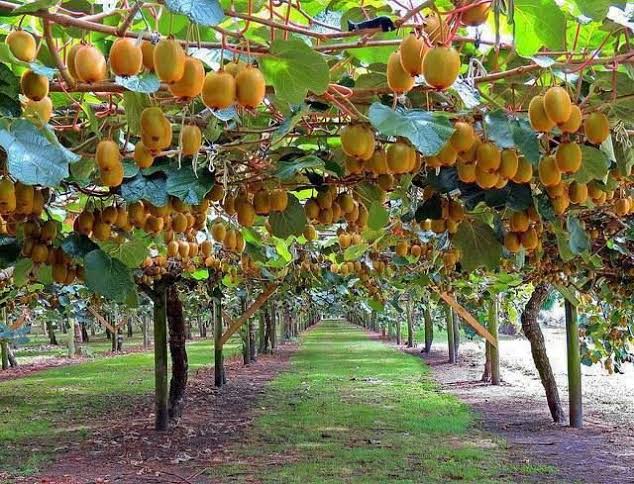
Kiwi fruit farming in Kenya is still in its early stages. That scarcity is exactly what creates opportunity. Supermarkets and hotels still import most of the kiwi they sell. The fruit you see on shelves comes from Italy, New Zealand and China. Local production cannot meet current demand. Farmers who plant now will supply this gap and build businesses that last for decades.
This guide by Farmers Trend Ltd. gives you everything you need to start and manage a successful kiwi orchard. You will learn where to plant, how to prepare your soil, which seedlings to buy, and what returns to expect. The information comes from successful growers and certified nurseries like Farmers Trend Limited. Use it as your roadmap to profitable kiwi farming.
Where Are Kiwi Fruits Grown in Kenya?
Kiwi is a temperate crop. It grows best in cool highland areas with consistent rainfall and moderate temperatures. The plant needs cold winters to break dormancy and warm summers to develop fruit.
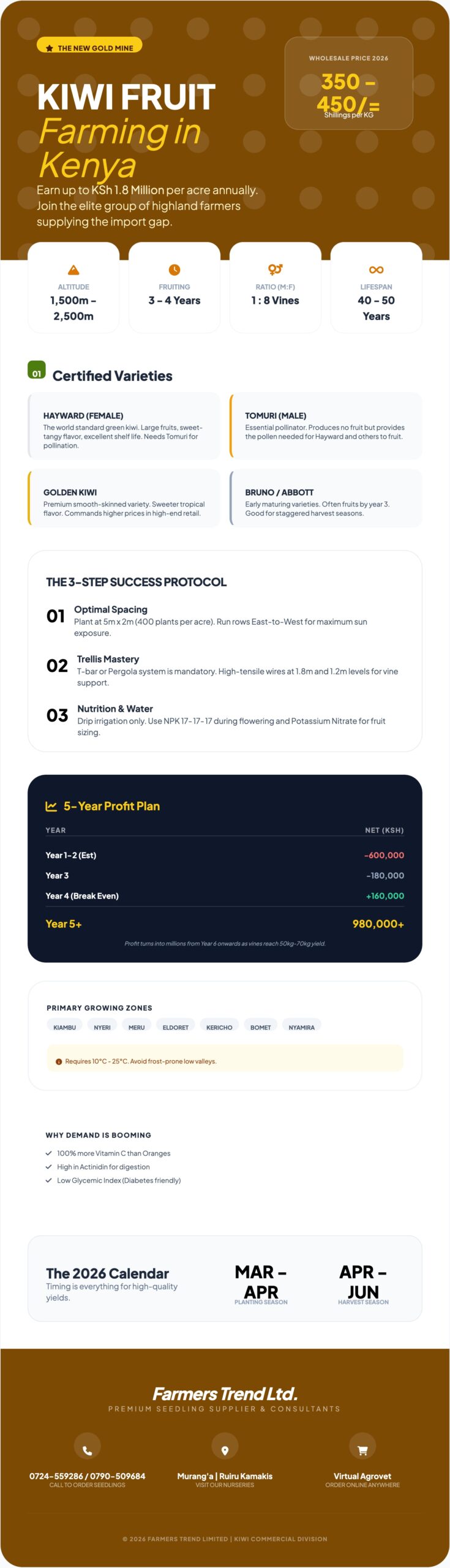
The ideal altitude for kiwi in Kenya ranges from 1,500 meters to 2,500 meters above sea level. Temperatures should stay between 10 degrees Celsius and 25 degrees Celsius. The plant can tolerate short periods of heat, but extended high temperatures stress the vines and reduce fruit quality.
Where are kiwi fruits grown in Kenya? The main growing zones are:
Central Highlands: Kiambu, Murang’a, Nyeri, Nyandarua, Meru and Embu offer excellent conditions. These counties receive reliable rainfall and have deep volcanic soils. Temperatures stay cool throughout the year, especially in higher altitude zones.
Rift Valley Highlands: Uasin Gishu, Nandi, Kericho, Bomet and parts of Nakuru provide ideal growing environments. The long rains and cool nights suit kiwi perfectly. Farmers in Eldoret and its surroundings have reported strong growth and good yields.
Western Highlands: Kisii, Nyamira, Trans Nzoia and areas near Kakamega forest also support kiwi cultivation. These regions have high rainfall and fertile soils, though you must watch for waterlogging during the wettest months.
Where is kiwi fruit grown in Kenya beyond these zones? Some farmers are experimenting in Machakos and Makueni at higher altitudes. Success in these drier areas requires irrigation and careful site selection. If you farm outside the traditional highlands, consult agricultural experts before investing heavily.
Soil Requirements and Land Preparation
Kiwi vines need deep, well-drained soil to thrive. The roots spread wide and go deep, so compacted or shallow soils limit growth. What type of soil is best for growing kiwi? Loamy soils with high organic matter work best. Sandy loams and volcanic loams are excellent. Clay soils can work if you improve drainage with raised beds and organic matter.
The ideal soil pH ranges from 5.5 to 6.5. Kiwi tolerates slightly acidic conditions but struggles in alkaline soils. Test your soil before planting. If the pH is too low, add agricultural lime. If it is too high, incorporate sulfur or organic matter to lower it.
Start land preparation at least three months before planting. Clear the land of perennial weeds and deep-rooted grasses. Plow deeply to break up compacted layers. Kiwi roots need room to spread, so deep tillage is essential.
Dig planting holes three feet wide and two feet deep. This seems excessive, but it gives the young vines the best start. Mix the topsoil with 20 kilograms of well-decomposed manure. Add 500 grams of double superphosphate to each hole to support early root development. Fill the holes back up and mark them for planting.
If your soil drains poorly, plant on raised beds. Mound the soil to a height of 30 centimeters and plant on top of the mounds. This keeps the roots above standing water during heavy rains.
Seedlings and Varieties: Where to Get Kiwi Seedlings in Kenya
The most important decision you will make is where to buy your kiwi seedlings. Uncertified seedlings waste years of your time. They may be diseased, weak, or the wrong variety. They may even be seedlings grown from seed, which take much longer to fruit and produce inferior quality.
Where to get kiwi seedlings in Kenya? Farmers Trend Limited nurseries and Virtual Agrovet are the only recommended sources. These nurseries supply certified grafted kiwi seedlings that fruit within three to four years. They maintain the correct ratio of male to female plants, which is essential for pollination.
Contact Farmers Trend Limited on 0724-559286 or 0790-509684 to place your order. Visit their nurseries in Murang’a and their offices in Ruiru Kamakis to inspect the seedlings before buying. The Virtual Agrovet platform allows you to order online and arrange delivery.
Kiwi fruit price in Kenya 2026 for seedlings: A certified grafted seedling costs between KSh 450 and KSh 800. The price depends on the variety and the size of the seedling. This investment pays for itself many times over through higher yields and earlier fruiting.
Kiwi plants are dioecious. Male and female flowers grow on separate plants. Male vines produce pollen but no fruit. Female vines produce fruit only if pollinated by a male. You need to plant one male vine for every six to nine female vines. Certified nurseries like Farmers Trend Limited supply the right mix when you buy in bulk.
The main kiwi varieties available in Kenya include:
Hayward: This is the world standard for green kiwi. It produces large, oval fruits with fuzzy brown skin and bright green flesh. The flavor is sweet with a hint of tang. Hayward stores well and ships without damage. It is a female variety that needs a male pollinator.
Tomuri: This is the male variety that pollinates Hayward and other female varieties. It produces abundant pollen over a long flowering period. You will not harvest fruit from Tomuri, but you cannot grow kiwi without it.
Bruno: This variety produces elongated fruits with smooth skin. The flavor is more acidic than Hayward, making it suitable for processing. Bruno fruits earlier than Hayward, often in the third year after planting.
Monty and Abbott: These are older varieties that still perform well in Kenya. They produce medium-sized fruits with good flavor. They serve as alternatives to Hayward and extend the harvest season.
Golden Kiwi: This smooth-skinned variety commands premium prices. The fruit is sweeter than green kiwi and has a tropical flavor. Golden kiwi is more delicate and requires careful handling. Seedlings are still scarce but becoming available through Farmers Trend Limited.
Planting and Orchard Establishment
What Month to Plant Kiwi?
The best time to plant kiwi in Kenya is March or April. This coincides with the onset of the long rains. Planting at this time gives your vines several months of reliable moisture to establish strong root systems. You will need less irrigation, and the young plants will grow faster.
You can also plant in October during the short rains, but you must be prepared to irrigate if the rains fail. October planting works best in areas with reliable short rains like parts of the Rift Valley.
Spacing and Density
Kiwi vines grow vigorously and need space. The recommended spacing is 2 meters between plants within the row and 5 meters between rows. This arrangement gives you 400 plants per acre. The wide rows allow sunlight to reach all parts of the vines and provide room for trellis construction and maintenance.
Some farmers plant at higher densities, up to 650 plants per acre. Higher density increases early yields but requires more intensive management. The vines compete more for water and nutrients, and you must prune carefully to prevent overcrowding.
Plant your rows running east to west. This orientation ensures every vine gets maximum sunlight throughout the day.
Trellis Systems
Kiwi is a climbing vine. It needs support to grow and produce fruit. A trellis system is not optional; it is essential. The most common design uses wooden or concrete posts set 5 meters apart in the row. Run high-tensile wire between the posts at two levels. The top wire should be at 1.8 meters, and the lower wire at 1.2 meters.
Train the main stem of each vine up to the wires. Once it reaches the top, let it grow along the wires in both directions. This T-bar or pergola system creates a horizontal canopy that produces fruit along its length.
Install your trellis before planting or immediately after. Young vines grow fast and will need support within months.
Irrigation
Kiwi needs consistent moisture throughout the year. Drip irrigation is the best method. It delivers water directly to the root zone without wetting the leaves. Wet leaves encourage fungal diseases.
Install a drip line along each row with emitters spaced 50 centimeters apart. In the first year, water every three to four days during dry spells. Mature vines need deep watering once or twice per week, depending on the weather.
Mulch around the base of each vine with organic material. Grass, straw or wood chips work well. Mulch conserves moisture, suppresses weeds, and adds organic matter as it breaks down.
Growth, Maturity and Harvest
How Long Does a Kiwi Plant Take to Mature?
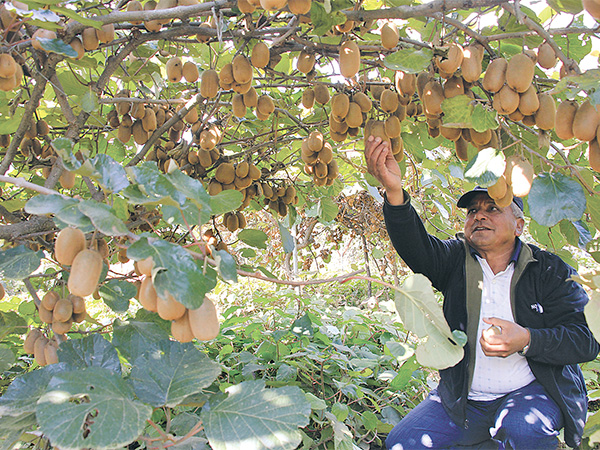
Grafted kiwi vines from certified nurseries start fruiting in three to four years. The first harvest will be small, perhaps 5 to 10 kilograms per vine. Production increases each year as the vines grow larger and develop more fruiting wood.
How long does kiwi fruit take to mature once the flowers appear? After pollination, the fruit takes five to seven months to develop. In Kenya, flowers appear in October and November. Harvest happens from April to June, depending on your altitude and variety.
The Lifespan of a Kiwi
A kiwi plant can produce fruit for 40 to 50 years with proper management. Some orchards in New Zealand and Italy are still productive after 50 years. This long lifespan makes kiwi one of the best long-term agricultural investments available.
Your first three years require investment with no returns. Years four through six see increasing harvests. From year seven onward, you enjoy full production and strong profits for decades.
How Many Kiwis per Plant?
A young vine in its fourth year produces 20 to 25 kilograms of fruit. By year six, production rises to 35 to 45 kilograms. Mature vines in full production yield 50 to 70 kilograms per year under good management.
How many kiwi fruits are in 1 kg? One kilogram contains 8 to 12 fruits, depending on size. Larger fruits mean fewer pieces per kilo but higher prices in the retail market.
For commercial planning, you need to know how many trays of kiwifruit per hectare. A standard tray holds 25 to 30 fruits. One hectare of mature kiwi produces 5,000 to 7,000 trays. This metric helps you calculate packaging needs and expected revenue.
Kiwi Vines Yield Per Acre
Let us calculate yield per acre. With 400 vines and mature production of 50 kilograms per vine, your total harvest is 20,000 kilograms. At wholesale prices, this generates substantial revenue. The yield per acre table later in this guide gives you year-by-year projections.

Nutrition and Crop Management
What Is the Best Fertilizer for Kiwi Fruit?
Kiwi vines need balanced nutrition throughout the year. Nitrogen drives vegetative growth. Phosphorus supports root development. Potassium is critical for fruit size and quality. Calcium and magnesium prevent physiological disorders.
At planting, the manure and phosphate you added to the holes provide the foundation. In the second and third years, apply nitrogen regularly during the growing season. Use CAN or urea at 100 grams per vine, split into three applications.
From year four onward, switch to a maintenance program. Apply well-decomposed manure around each vine at 20 kilograms per year. Apply NPK 17-17-17 at 300 grams per vine during flowering. Follow with potassium nitrate at 200 grams per vine during fruit development.
Foliar sprays deliver micronutrients quickly. Spray calcium and magnesium three times during fruit growth. This improves fruit quality and prevents storage disorders.
What Not to Mix with Kiwi?
The question of what not to mix with kiwi has two answers. First, do not mix certain fertilizers. Calcium and phosphorus react in the soil and become unavailable to plants. Apply them separately, at least two weeks apart.
Second, do not plant competitive crops near your kiwi vines. The roots spread wide and shallow. Heavy feeders like maize, potatoes and pumpkins compete for water and nutrients. This competition slows vine growth and reduces yields. Keep the area under your trellis clear. Use mulch to control weeds.
If you must intercrop, choose shallow-rooted legumes like beans or dolichos. They add nitrogen to the soil without competing heavily. Plant them only in the first two years while the vines are small.
Pruning
Pruning is essential for kiwi production. Vines that are not pruned become tangled masses of unproductive wood. Fruit quality suffers, and harvest becomes difficult.
Prune twice each year. In winter, after harvest, remove all wood that fruited the previous season. Leave the main leaders and select new canes to fruit next year. In summer, trim back excessive growth to let light into the canopy.
2026 Financial Projections
Kiwi Fruit Price in Kenya 2026
What is the rate of 1 kg of kiwi? Wholesale prices for Kenyan-grown kiwi range from KSh 350 to KSh 450 per kilogram. Retail prices in supermarkets and high-end outlets reach KSh 600 or more per kilogram.
Kiwi fruit price in Kenya 2026 will depend on supply and demand. As more farmers plant, prices may soften slightly. But the import gap remains wide, and local production will not meet demand for many years. Prices should stay strong for the foreseeable future.
Five-Year Cost and Return Analysis
The table below shows projected costs and returns per acre over five years. These figures assume 400 vines per acre, grafted seedlings, and good management. Actual results vary with location, management, and market conditions.
| Year | Investment (KSh) | Revenue (KSh) | Net Profit (KSh) |
|---|---|---|---|
| Year 1 | 450,000 | 0 | -450,000 |
| Year 2 | 150,000 | 0 | -150,000 |
| Year 3 | 180,000 | 0 | -180,000 |
| Year 4 | 200,000 | 360,000 | +160,000 |
| Year 5 | 220,000 | 1,200,000 | +980,000 |
| Total | 1,200,000 | 1,560,000 | +360,000 |
By year five, cumulative profit turns positive. From year six onward, annual profits exceed KSh 1 million.
Kiwi Yield Per Acre Over Time
Year 4: 2,000 to 3,000 kilograms
Year 5: 6,000 to 8,000 kilograms
Year 6: 10,000 to 12,000 kilograms
Year 7+: 16,000 to 20,000 kilograms
These yields assume optimal management. Farmers who neglect pruning, irrigation or fertilization will see lower numbers.
Market Demand and Consumer Benefits
Understanding why people buy kiwi helps you market your fruit effectively. The 10 benefits of kiwi fruit explain its growing popularity:
Immune support: Kiwi contains more vitamin C per gram than oranges. Regular consumption strengthens the immune system.
Digestive health: The enzyme actinidin breaks down proteins and aids digestion. The fruit also provides dietary fiber.
Heart health: Potassium in kiwi helps regulate blood pressure. Fiber lowers cholesterol.
Skin health: Vitamin C and antioxidants promote collagen production. This keeps skin firm and reduces signs of aging.
Eye health: Lutein and zeaxanthin protect the eyes from damage caused by blue light and UV radiation.
Sleep quality: Some studies show that eating kiwi before bed improves sleep duration and quality.
Weight management: Kiwi is low in calories but high in nutrients. It satisfies hunger without adding excess energy.
Blood sugar regulation: The fruit has a low glycemic index and does not spike blood sugar levels.
Bone health: Vitamin K and calcium support bone density and reduce fracture risk.
Antioxidant protection: Kiwi contains numerous antioxidants that neutralize free radicals and reduce oxidative stress.
These benefits drive demand among health-conscious consumers. Supermarkets and health food stores actively seek locally grown kiwi to meet this demand.

Common Challenges and Solutions
Poor Pollination
If your vines flower but produce few fruits, pollination is the problem. Ensure you have enough male vines planted in the correct ratio. During flowering, introduce honey bee hives to your orchard. One hive per acre improves fruit set significantly.
Fruit Drop
Young fruits sometimes drop from the vine. This happens due to water stress, nutrient deficiency or pest damage. Maintain consistent soil moisture throughout fruit development. Apply potassium and calcium during fruit growth.
Pest and Disease Management
Thrips, mites and mealybugs attack kiwi. Monitor your vines regularly. Use insecticidal soaps or neem oil for light infestations. For heavy infestations, consult an agricultural expert for appropriate chemicals.
Powdery mildew occurs in humid conditions. Prune to improve air circulation. Avoid overhead irrigation. Apply sulfur-based fungicides preventively during humid weather.
Sunburn
Kiwi fruits sunburn easily in intense tropical sunlight. The trellis canopy should provide enough shade. Do not prune excessively during hot weather. Some farmers use shade netting in very hot areas.
Your Path Forward
Kiwi fruit farming in Kenya offers a rare combination of high profits and long-term stability. The market is growing, the crop is durable, and the window of opportunity is open now. Farmers who enter today will supply the market for decades.
Your first step is to secure quality kiwi seedlings. Contact Farmers Trend Limited on 0724-559286 or 0790-509684. Visit their nurseries or use the Virtual Agrovet platform to place your order.
Prepare your land well. Test your soil. Install irrigation. Build your trellis before the vines need it.
Learn continuously. Join farmer groups. Visit successful orchards. Ask questions. Kiwi farming rewards those who pay attention to detail.
The farmers who plant this year will be the ones harvesting premium prices when their orchards mature. Join them and build a profitable, lasting agricultural business.
https://farmerstrend.co.ke/trending/kiwi-fruit-farming-in-kenya-complete-guide/https://farmerstrend.co.ke/wp-content/uploads/2026/03/kiwi-fruit-farmers-inkenya.jpghttps://farmerstrend.co.ke/wp-content/uploads/2026/03/kiwi-fruit-farmers-inkenya-150x150.jpg# TrendingKiwi Fruit farmingKiwi Fruit Farming in Kenya: The 2026 Comprehensive Guide to Profits and Management Kenyan farmers are always searching for the next high-value crop. Which is the most profitable fruit to grow in Kenya today? The answer is shifting. Avocado once dominated the conversation, but prices have softened as more farmers...FarmersTrendjohn doefarmerstrend@gmail.comAdministratorFarmers Trend Ltd.






Leave a Reply