Best Maize Varieties in Kenya by County: What to Plant for Short Rains, Long Rains, Dry Areas and High-Rainfall Regions
- A county-by-county guide to the best maize varieties in Kenya, matched to altitude, rainfall, season length and short-rain or long-rain planting.
Best Maize Varieties in Kenya by County: What to Plant for Short Rains, Long Rains, Dry Areas and High-Rainfall Regions
A farmer in Chuka does not need the same maize seed as a farmer in Homa Bay. A farmer in Baringo North is not dealing with the same problem as a farmer in Uasin Gishu. But most conversations about maize seed in Kenya start the same way. Someone asks “which variety is best” as if one packet of seed will work the same way on a highland farm in Nyeri, a lakeshore plot in Siaya, and a hot, dry field in Kitui.
It will not. That single mistake causes a lot of the disappointing harvests farmers report every season.
This article by Farmers Trend does not hand you one “best maize variety in Kenya” and stop there. It walks through how to pick a variety based on where you farm, your rainfall pattern, how long your season usually lasts, and what you are growing maize for. It also covers maize varieties by county, the difference between short rains and long rains, dryland and highland options, and practical questions farmers actually ask, like how much seed you need per acre.
Why Choosing Seed by Brand Name Alone Is Not Enough
It is easy to ask a neighbour or an agrovet worker for “the best maize seed” and take that answer at face value. The problem is that how maize performs is not a fixed trait of a variety. It depends on how that variety interacts with the local environment and how the farm is managed.
The same seed that gives a good harvest in Uasin Gishu can do badly in Kitui. Not because the seed is faulty, but because it was bred and recommended for a different altitude, different rainfall, and a different season length. A variety that needs six or seven months of steady rain will struggle where the rains usually stop after three months. A variety picked for a cool highland climate will not reach its full potential in a hot lowland.
This is why “best maize seed in Kenya” is really a location question dressed up as a general one. The honest answer to “which variety is best” is almost always “best for what conditions.” Before looking at variety names, work out the factors that actually decide performance:
- County and specific location. Even inside one county, conditions can change sharply between a highland ward and a lowland one.
- Altitude. This decides which whole family of maize you should even be looking at.
- Rainfall amount and reliability. Total rainfall and how evenly it falls across the season.
- Growing season and length of the available rains. How many weeks of usable moisture the crop can expect from planting to maturity.
- Soil conditions. Fertility, drainage, and how well the soil holds moisture.
- Disease pressure. Some areas have ongoing problems with grey leaf spot, maize streak virus, maize lethal necrosis, or ear rot.
- Expected maturity period of the variety. Early, medium, or late.
- Market or household use. Subsistence, milling, selling green maize, or livestock feed.
- Expected yield under real conditions, not lab conditions.
Every section below is built on these factors.
Section 1: Why There Is No Single “Best” Maize Variety for Every Farmer
Maize breeders in Kenya do not make one universal hybrid. They make families of varieties for specific agro-ecological zones, because altitude and rainfall change so much across the country, from cool Rift Valley highlands above 2,000 metres down to hot, dry plains in Kitui and Baringo below 1,000 metres.
Kenya Seed Company groups its maize hybrids by altitude. Industry guidance places the 6-series hybrids, H614D, H627, H6213, H626, H6210, H629, H6401, H628 and H6212, in the high-altitude group, around 1,800 to 2,200 metres above sea level. Below that, varieties such as H623, H632, H624 and H622 sit in the intermediate band, around 1,500 to 2,000 metres. The 5-series, including H513, H515 and H516, is for medium altitude, around 1,200 to 1,800 metres. Separate lowland and dryland hybrids such as PH1, PH2, DH02 and DH04 exist for hot, low-altitude zones.
This is the real reason there is no single “best” variety. A hybrid bred to use six or seven months of cool highland growing conditions works against itself if it is planted in a hot lowland field where the crop moves faster through its stages and the rains end early. A fast, short-season variety bred for a three-month window will also not beat a long-season highland hybrid where the rains genuinely last that long.
Maize performance comes from genetics and environment and management together, not genetics alone. Any article, agrovet, or Facebook post that presents one variety as best for everyone is skipping the part that actually decides whether a farmer gets a good harvest.
Section 2: How to Choose a Maize Variety in Kenya
Work through these questions before you buy seed. They matter more than any variety name.
Where is your farm? County matters less than the specific agro-ecological zone inside it. Two farms twenty kilometres apart, one on a hillside and one in a valley, can sit in different zones.
When are you planting? Long rains (usually March to May in most of the country) and short rains (usually October to December) behave differently. A variety suited to one is not automatically suited to the other.
How long do the rains normally last in your area? This is one of the most useful questions you can ask an agricultural officer or a neighbour who has farmed there for years. If your rains usually run 90 to 100 days, do not plant a variety that needs 150 days to fill its grain.
Is your farm in a highland, mid-altitude, or lowland area? This decides which family of varieties you should look at: highland hybrids, transitional or medium-altitude hybrids, or lowland and dryland hybrids.
Do you depend entirely on rainfall, or do you have irrigation? Rain-fed farms carry much more risk from a mismatch between maturity period and season length.
Do you need an early-maturing crop? This could be because your rains are short, because you want to plant a second crop after, or because you want to sell green maize early for cash.
Are you growing maize for food, for sale, or both? A household growing mainly for food may care more about reliability and drought tolerance than top yield. A farmer selling to millers may care more about grain type, cob size, and how well it shells.
What disease problems happen in your area? Grey leaf spot, maize streak virus, northern leaf blight, and maize lethal necrosis affect different areas differently, and some varieties tolerate specific diseases better than others.
How much land are you planting, and what is your budget for certified seed and inputs? This affects how many packets you need and whether a more expensive, higher-yielding hybrid makes sense this season.
Answer these first. Then walk into the agrovet with “here is my farm, which variety fits it” instead of “give me the best maize seed.”
Section 3: Short-Season Maize Varieties in Kenya
Short-season (early-maturing) maize varieties finish their full cycle, germination, growth, flowering, and grain fill, in a shorter window than standard hybrids, usually around 90 to 120 days instead of 150 to 210 days.
When should farmers use short-season varieties?
- When local rains are historically short or unreliable, as in much of Eastern Kenya and parts of the Rift Valley floor.
- When planting is delayed and there is not enough season left for a long-maturity hybrid to finish safely.
- When a farmer wants to fit two crops into one year.
- When drought risk is high and cutting down the crop’s exposure to a dry spell during grain fill is the priority.
Advantages of short-season varieties include a lower chance of the crop being caught by an early end to the rains, earlier harvest, earlier cash flow, and lower water demand overall.
Limitations are real and often ignored. Short-season varieties usually have a lower yield ceiling than long-season hybrids grown under good conditions, because they simply have less time to build biomass and fill grain. Planting a short-season variety where the rains are genuinely long and reliable, without changing anything else, can leave yield on the table.
Planting at the right time still matters, even with a short-season variety. Early maturity does not make up for late planting. A fast variety planted three weeks late can still miss the tail end of the rains during flowering, which is when the crop is most sensitive.
Short maturity does not automatically mean higher yield. This is one of the most common mistakes farmers make when switching varieties. Short-season hybrids are built for reliability under a tight season, not for maximum tonnage. If the season allows for a longer-maturity variety, that variety usually outperforms a short-season one under the same management.
Rainfall distribution, not just total rainfall, decides outcomes. A season with 500mm spread evenly across 100 days can beat a season with 700mm that falls in two heavy bursts with a long dry gap during flowering, the stage when maize is most sensitive to moisture stress. This is exactly why matching maturity period to the pattern of rains, not just the calendar dates, matters.
Kenya Seed Company’s shorter hybrids, such as H517, H520, H624 and H629, sit closer to the medium and transitional altitude bands, while H6213, H614D, H6210 and H6218 are the longer-maturing highland hybrids for long-rain, high-altitude conditions. Before treating any pairing of variety to season as fixed advice, confirm the current maturity-period specs with Kenya Seed Company, KALRO, or KEPHIS, since seed companies update recommendations and release new hybrids over time.
Section 4: Maize Varieties for Different Regions of Kenya
Instead of naming one “best variety” per region, this section covers what a farmer in each region should be checking, because altitude and rainfall vary enough inside every region below to change the right answer from one ward to the next.
Central Kenya (Tharaka Nithi, Chuka, Embu, Murang’a, Kiambu, Nyeri)
Central Kenya covers a wide altitude range, from the cooler upper slopes of Mount Kenya and the Aberdares down to the drier, warmer lower zones of Tharaka Nithi and parts of Embu. A farmer in Chuka or lower Tharaka Nithi usually deals with a shorter, less reliable rainfall pattern than a farmer higher up in Nyeri or Kiambu.
Highland areas of Nyeri, Kiambu, and Murang’a sit closer to conditions that favour highland hybrids such as the 6-series (H6213, H6210, H6218, H629, H614D), which industry sources link to tea-zone areas of central Kenya, Nyeri, Kiambu, and Meru’s tea zones. The lower, warmer, drier stretches of Tharaka Nithi and Embu behave more like transitional or dryland zones, where medium-altitude or short-season varieties are usually the safer choice. A Chuka farmer should check their ward’s typical rainfall duration before assuming the same variety recommended for highland Nyeri will work the same way at home.
Eastern Kenya (Kitui, Makueni, Machakos, Meru)
Eastern Kenya has some of the most rainfall-constrained maize-growing areas in the country, alongside genuinely good zones around Meru’s slopes. Kitui and Makueni fall mostly into semi-arid, low- to mid-altitude zones where drought tolerance and short maturity matter more than raw yield. Machakos covers a similar range, with higher zones near Nairobi behaving differently from its drier eastern wards. Meru includes higher-rainfall, higher-altitude areas that can support longer-maturity, higher-yielding hybrids.
This is why “best maize variety for Eastern Kenya” is not one answer. It depends on which part of Eastern Kenya, and Section 5 goes further into the dry-area case.
Western Kenya (Kakamega, Bungoma, Busia, Vihiga)
Western Kenya generally gets higher and more reliable rainfall than Eastern Kenya, with a longer effective growing season most years. This supports medium- to high-altitude hybrids and has also made the region a strong adoption area for drought-tolerant hybrids built for climate stress. DroughtTEGO, a drought-tolerant white maize variety developed under the Water Efficient Maize for Africa project, has become popular among smallholder farmers in western Kenya, with average yields of around 4.5 tonnes per hectare compared to about 1.8 tonnes per hectare for local varieties under moderate drought. Farmers in Kakamega, Bungoma, Busia, and Vihiga should still confirm their altitude band, since parts of the region sit closer to medium altitude than others, but overall this area supports a wider range of maturity classes than the drier east.
Nyanza (Kisumu, Homa Bay, Siaya, Kisii, Migori)
Nyanza is another region where altitude range matters more than the regional label. Kisii sits considerably higher and cooler than the lakeshore areas of Homa Bay, Siaya, and parts of Kisumu and Migori, which are lower, hotter, and exposed to shorter, less predictable rains. This is the kind of detail that gets lost when a recommendation is given for “Nyanza” as a whole instead of for a specific zone inside it. A highland hybrid that does well in Kisii’s cooler areas will not necessarily do the same on the lakeshore.
Rift Valley (Baringo, Transmara, Narok, Uasin Gishu, Nakuru)
The Rift Valley shows this altitude problem more clearly than any other region on this list, because it contains both some of Kenya’s most productive highland maize zones and some of its hottest, driest floor areas inside the same county boundaries. Uasin Gishu and most of Nakuru sit in classic highland hybrid territory. Nakuru County itself is split into several ecological zones, highland, transitional, mid-altitude and lowland, each doing best with a different variety group. Narok also spans high-potential grain-belt zones and lower, drier stretches. Baringo and the Kerio Valley, on the other hand, drop into hot, low-altitude conditions that need different varieties entirely, covered in Section 7. Transmara sits closer to medium altitude with fairly good rainfall, but it still helps to check local season length before assuming a highland hybrid recommended for Uasin Gishu will work the same way there.
Coastal and Warmer Areas
Coastal Kenya has its own challenge, low and often erratic rainfall combined with high year-round temperatures. Research in the coastal region found that in these semi-arid coastal lowlands, average annual rainfall is only 450 to 700mm while total annual evapotranspiration is 1,200 to 1,800mm, meaning moisture deficit, not just rainfall total, drives outcomes. In trials comparing drought-tolerant varieties under different water-harvesting methods, Duma 43 gave the highest grain yield among the varieties tested, while PH4 did best for grain recovery when pounded and for stover. Yields under water-harvesting methods such as zai pits and tied ridges were clearly higher than under normal planting. The lesson for coastal and similar hot, low-rainfall areas is that seed choice alone is not enough. Moisture conservation methods often matter just as much.
Section 5: Best Maize Varieties for Low Rainfall and Dry Areas (Makueni, Kitui and Similar Zones)
Farmers in Makueni and Kitui often ask which variety performs best in their conditions. The useful answer moves past the variety name to the factors that actually decide whether any variety succeeds there:
- Maturity period. Shorter is usually safer, since dry-area rains rarely support a crop past 100 to 120 days reliably.
- Rainfall reliability. Average rainfall figures can be misleading. What matters is how often the rains fail partway through the season.
- Planting date. Planting at the true start of the rains, not the first light shower, cuts the risk of germination followed by a dry spell.
- Moisture at critical growth stages. Especially around flowering and grain fill, when maize is most sensitive to drought.
- Soil fertility. Sandy, low-fertility soils common in these areas make drought stress worse. Even a drought-tolerant variety does poorly on depleted soil.
- Plant population. Lower plant numbers per acre in genuinely dry conditions can reduce competition for scarce moisture.
- Weed management. Weeds compete directly for limited moisture, so late weeding costs more in dry areas than in high-rainfall ones.
- Water conservation methods. Zai pits, tied ridges, mulching, and terracing all measurably improve outcomes in these zones, as the coastal trial data above shows.
On variety choice, Kenya’s meteorological and agricultural extension guidance for Makueni has grouped the county by agro-ecological zone rather than giving one blanket answer. For the county’s upper zones, wards such as Tulimani, Mbooni, Mukaa, Kaiti, Kilungu and Ilima, past advisories have recommended Duma 41/43, DK 8031/8033, Pioneer P28, Pioneer 3253, and DH04. For the middle zone, wards such as Kalamba, Mavindini, Kitise, Wote, Kisau/Kiteta, Kako/Waia, Kathonzweni, Kasikeu, Kiima Kiu/Kalanzoni and Emali/Mulala, recommended maize types have included Duma 41/43, KDV1/KDV4, local varieties such as Sawa, Mituki, Haraka and Sungura, DH01/DH02, Kishindo, and DH04/DK 8031.
On the ground, adoption of these drought-tolerant options has changed outcomes for some farmers. One farmer in Makueni reported that switching to KDV4, an open-pollinated variety that matures in about 110 days and suits dry mid-altitude regions, producing around 44 bags per hectare, was a major step up from the traditional local variety she used before, which could barely fill one 90-kilogramme bag and could not handle drought.
Because zoning inside a single county can change from one ward to the next, and because advisories get updated season by season, Makueni and Kitui farmers should confirm the current recommendation for their specific ward with their county agricultural office instead of relying on one fixed list.
Section 6: Best Maize Varieties for the Lake Region and Western Kenya
Farmers around the lake region often ask two related questions. Which variety generally suits Nyanza, and does a specific popular hybrid, H533 for example, do well around Homa Bay. Instead of answering with one blanket variety, it helps more to compare the factors that matter here:
- Altitude split inside the region. As noted above, Kisii’s cooler highland zones support a different variety class than the hotter lakeshore stretches of Homa Bay, Siaya, and parts of Kisumu and Migori.
- Heat and evapotranspiration near the lake. Lakeshore areas run hotter than inland Nyanza, which shortens the window during which the crop can access enough moisture even when total rainfall looks adequate.
- Disease pressure. Humid conditions near the lake can favour certain foliar diseases and ear rots, making disease tolerance a real factor alongside maturity.
- Access to certified seed. Which hybrids are available through agrovets changes by sub-county, and this limits real-world choice as much as agronomic suitability does.
For a specific variety like H533, the right move is not to accept or reject it based on reputation, but to check its published altitude range and maturity period against Homa Bay’s actual conditions, and to look at what nearby farmers at a similar elevation have seen over several seasons, since one good or bad season does not prove a variety’s fit. Western Kenya and higher-rainfall lake-adjacent zones have also seen more use of drought-tolerant hybrids such as DroughtTEGO, which reflects a broader move toward varieties built for resilience to unpredictable rain rather than assuming heavy rains every season.
Section 7: Maize Varieties for Baringo, Kerio Valley and Other Hot, Low-Altitude Areas
Farmers asking specifically about Baringo North and the Kerio Valley are asking, in effect, the clearest version of the question this whole guide is built around. “Best maize seed in Kenya” cannot be answered without knowing the location, because Baringo and the Kerio Valley sit at the opposite end of Kenya’s altitude and rainfall range from places like Uasin Gishu or Nyeri’s highlands, even though both fall loosely under “Rift Valley.”
These areas are hot, low altitude, and prone to short, unreliable rains, conditions closer to the semi-arid zones of Eastern Kenya covered in Section 5 than to the Rift Valley’s grain-belt highlands. Kenya Seed Company’s own product information groups lowland and dryland zones together, including lower parts of Kirinyaga, West Pokot, Bungoma’s lowlands, Homa Bay, the Kerio Valley, Kagio, Mwea, Makueni, Kitui, Marakwet, and Baringo/Koibatek, and recommends its early-to-medium and lowland-dryland hybrids for this shared set of hot, low-altitude conditions instead of treating them as belonging to different variety groups just because they sit in different regions on a map.
In practice, this means a farmer in Baringo North or the Kerio Valley should look at the same group of short-to-medium maturity, drought-tolerant, lowland-suited hybrids covered in Section 5, such as DH-series and PH-series varieties, or drought-tolerant options like Duma 43 and DK8031, rather than the highland hybrids more commonly pushed for the wider Rift Valley region. It shows clearly why grouping variety advice by county name alone, instead of actual altitude and rainfall zone, leads to bad recommendations.
Section 8: Long-Rain Versus Short-Rain Maize Varieties
Most of Kenya has two rainy seasons. Long rains generally run from March to May, with some regional variation, and short rains generally run from October to December. This difference matters directly for variety choice.
Long rains are usually more reliable, in both total amount and duration, in most parts of the country. This is why long-season, higher-yielding hybrids, the longer-maturity highland varieties such as H6213, H6210, and H614D discussed earlier, are usually planted in this season where they fit the local altitude.
Short rains tend to be shorter and, in many areas, less predictable in both when they start and how long they last. This is why shorter-maturity varieties are more commonly recommended for the short-rains season, especially in Eastern Kenya, parts of the Rift Valley floor, and lower-altitude zones generally.
Why maturity period matters here: a variety’s maturity period should be shorter than, or close to, the usual duration of usable rains for that season, not just the average, but with room to spare for years when rains end early. Planting a 150-day variety into a season that typically gives 100 to 110 days of usable rain is a mismatch. It shows up as poorly filled cobs, aborted kernels near the cob tip, and lower yield, even if germination and early growth looked fine.
What happens when a long-maturity variety is planted expecting rains that end early: the crop reaches flowering and grain filling, its highest water demand stage, right as soil moisture runs out. Because flowering and grain fill are the most drought-sensitive stages in a maize plant’s life, an early end to the rains at this exact point causes much bigger yield loss than the same stress at another stage. This is the single most common and most avoidable cause of maize crop failure tied directly to variety choice.
Section 9: A Closer Look at Common Kenyan Maize Varieties
The table below sums up publicly available specs for several widely discussed varieties. Use this as a starting reference, not a final buying decision. Always confirm current specs with the seed company, KEPHIS, or KALRO before buying, since companies update recommendations and release replacement hybrids over time.
| Variety | Altitude Range | Maturity Period | Yield Potential (90kg bags/acre) | Best-Suited Regions | Key Traits |
|---|---|---|---|---|---|
| H6218 | 1,500 to 2,800m | 175 to 210 days | around 56 | Trans-Nzoia, Uasin Gishu, Nakuru, Laikipia, Kisii, Narok, Bungoma, Kakamega, Nandi, Kericho, Central Kenya tea zones | Blight tolerant, good husk cover |
| H6213 | 1,500 to 2,800m | 160 to 190 days | around 52 | Highland zones countrywide | Tolerant to lodging, ear rot, rust, grey leaf spot, leaf blight |
| H6210 | 1,500 to 2,800m | 160 to 190 days | around 50 | Highland zones countrywide | Tolerant to lodging, ear rot, rust, grey leaf spot, stem and leaf blight |
| H629 | 1,500 to 2,800m (approx.) | around 160 to 190 days | around 35 | Highland zones | Good husk cover, tolerant to lodging and blight |
| H624 | 1,500 to 2,000m | Medium, transitional | around 35 | Transitional-zone areas | Tolerant to leaf diseases and lodging |
| H614D | 1,800 to 2,200m | Long season | Highland level | High-altitude, long-rain areas | Standard long-season highland hybrid |
| H517 | around 1,200 to 1,800m | Medium to short | around 20 | Mid-altitude, transitional zones | Suited to shorter seasons than the 6-series |
| H520 | around 1,200 to 1,800m | Medium | Moderate | Transitional zones | Alternative to H624 in the same band |
| DH04 | 800 to 1,200m, dryland | around 3 to 4 months | around 11 (as DLC-class) | Kitui, Machakos, Makueni drier zones | Drought-tolerant, short season |
| PH1 | 0 to 1,200m, lowland or hot | around 3 to 4 months | around 14 | Lowland, hot, humid zones | Drought-tolerant, lower yield ceiling |
| PH4 | 0 to 1,200m, lowland or dryland | around 3 to 4 months | around 18 | Coastal, dryland zones | Best grain recovery when pounded, high stover |
| Duma 43 | Low altitude, dryland | Short season | Highest among drought-tolerant options tested in trials | Coastal and dry Eastern Kenya | Best performer under water-harvesting trials |
| DK8031 | Low altitude, dryland | Short season | Moderate | Coastal, Eastern Kenya drylands | Drought-tolerant hybrid |
| KDV4 | Dry mid-altitude | around 110 days | around 44 bags per hectare | Makueni and similar dry mid-altitude zones | Open-pollinated, drought-tolerant |
Specifications are pulled from Kenya Seed Company documentation, KALRO agro-ecological tables, and published agricultural research. Reconfirm current figures before publishing, since maturity and yield data get updated as new hybrids come out.
Because seed companies discontinue, rename, or replace hybrids over time, and because recommendations get refined as new drought-tolerant lines come out, none of the numbers above should go out as final agronomic advice without checking them against current Kenya Seed Company, KALRO, or KEPHIS documentation.

Section 10: How Much Maize Does a 2kg Packet Plant?
There is no single fixed number of bags a farmer can expect from a 2kg seed packet. The outcome depends on several things working together, not the seed alone:
- Seed rate. How many kilograms of seed go into an acre, which itself depends on spacing and germination rate.
- Plant population achieved. The actual number of healthy plants standing at harvest, after germination failure and early losses.
- Spacing. Row and inter-plant spacing decide how many seed holes an acre can hold.
- Germination percentage. Certified seed usually germinates well, but poor storage, damaged seed, or planting into overly dry or waterlogged soil lowers this.
- Soil fertility. Poor soil limits how many cobs each plant can properly fill, no matter the plant population.
- Rainfall during the season. Moisture stress at any stage cuts the number of viable kernels per cob.
- Fertiliser use. Both basal and top-dressing fertiliser affect final yield per plant.
- Weed control. Weeds cut into the moisture and nutrients available to the crop, especially in the first six to eight weeks.
- Pest and disease management. Fall armyworm, stem borer, and foliar diseases can each cause big yield losses if unmanaged.
- Harvest losses. From lodging, birds, rodents, or late harvesting after maturity.
- Drying and storage losses. Poor drying or storage pests can cut into the final usable quantity.
A worked example, using stated assumptions: a 2kg packet of hybrid maize seed at a typical seed rate of around 8 to 10kg per acre plants roughly a fifth to a quarter of an acre. Assuming a plant population target of around 25,000 to 30,000 plants per acre at standard spacing, a fifth of an acre would carry roughly 5,000 to 6,000 plants. If each plant produces one well-filled cob averaging around 150 to 200 grams of shelled grain under reasonable management, that quarter acre could give somewhere around 3 to 5 bags (90kg each) under good conditions. That figure can be cut in half by poor rainfall, low soil fertility, or pests, and can go higher under strong management with enough fertiliser and rainfall. These numbers are examples, not a guarantee, because of the long list of variables above.
Section 11: How Many 2kg Packets Do You Need Per Acre?
This is a more straightforward calculation once you know the seed rate.
- Land size: 1 acre.
- Recommended seed rate: roughly 8 to 10kg per acre for most hybrid maize varieties at standard spacing, though this varies slightly by variety, so check the specific packet label.
- Number of 2kg packets needed: about 4 to 5 per acre.
- Expected plant population: roughly 25,000 to 30,000 plants per acre at typical spacing of around 75cm between rows and 25 to 30cm between plants, though wider or narrower spacing changes this and should follow the seed company’s specific recommendation.
Farmers planting several acres can scale this directly. A 5-acre farm would need roughly 20 to 25 2kg packets at the same seed rate, adjusted for whatever spacing is recommended for the chosen variety.
Section 12: How to Calculate Expected Maize Yield
Instead of promising a fixed number of bags per acre, farmers can estimate expected yield using a simple formula based on plant population and cob characteristics.
Plants per acre times ears (cobs) per plant times grain weight per cob equals estimated total grain yield.
For example, 25,000 plants per acre times 1 productive cob per plant, a reasonable assumption for most hybrids under normal conditions, times 180 grams of shelled grain per cob comes to about 4,500,000 grams, or roughly 4,500kg, which is about 50 bags of 90kg each under strong management and good conditions.
Why field yield almost always differs from this calculation:
- Not every plant survives to produce a harvestable cob. Germination gaps, pest damage, and drought stress cut the effective plant population below target.
- Not every plant produces a fully filled cob. Poor pollination, moisture stress during flowering, and nutrient deficiency all reduce grain weight per cob.
- Uneven spacing in practice, compared to the ideal used in the calculation, changes actual plant population.
- Harvest and post-harvest losses reduce the usable final quantity below what was standing in the field at maturity.
This calculation works best as a planning tool, to compare the effect of improving one factor, like raising plant population through better spacing or improving grain fill through enough fertiliser, rather than as a guaranteed output.
Section 13: What Makes a Good Maize Seed?
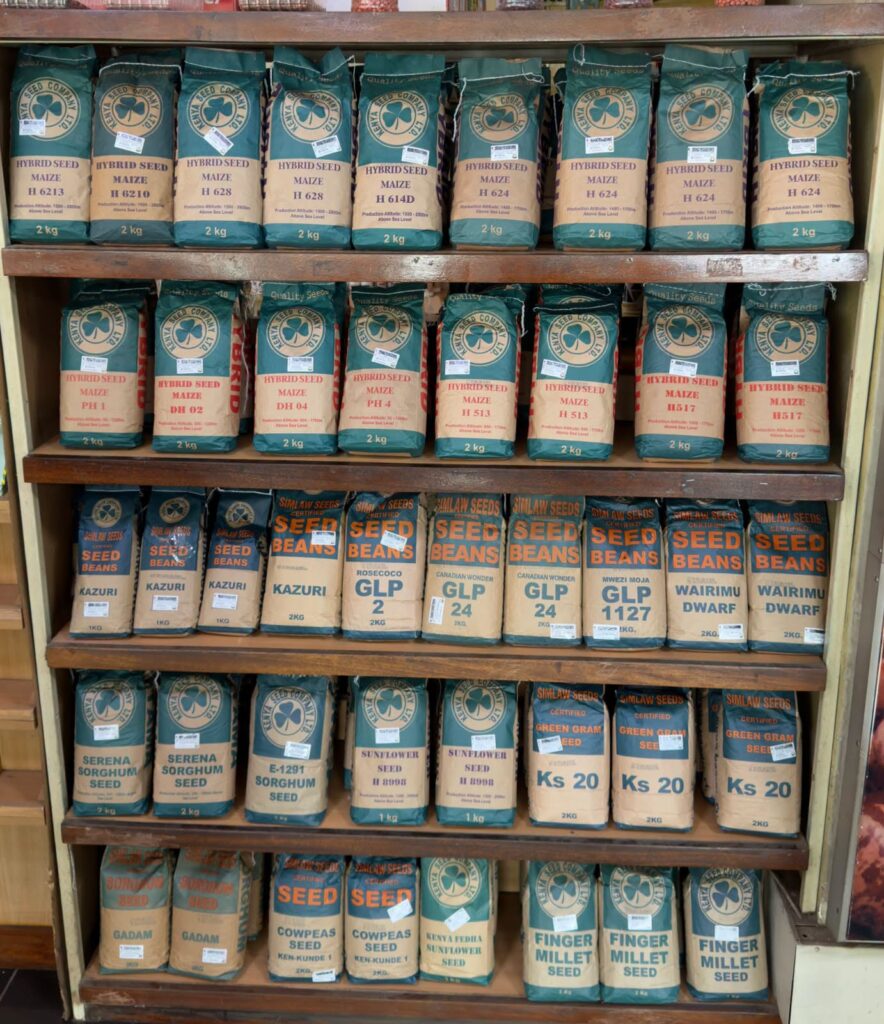
Shelves stocked with different maize varieties alongside beans, sorghum, sunflower, green grams, cowpeas and finger millet are a common sight at agrovets. It is a good reminder that choosing seed is about more than picking the packet with the biggest yield claim printed on it. A good maize seed purchase depends on a few checkable things:
- Certified seed status. Seed certified by KEPHIS has passed quality and purity checks. Uncertified or recycled seed has no such guarantee.
- Correct variety for your conditions. Matched to altitude, rainfall pattern, and season length as covered above.
- Authenticity. Buying from recognised agrovets and licensed stockists lowers the risk of counterfeit seed, a problem that has affected some regions after fake-seed cases were caught in the past.
- Germination rate. Reputable seed should carry a stated germination percentage. Low or unstated germination is a warning sign.
- Seed treatment. Most certified hybrid seed comes pre-treated against early pests and soil-borne disease. Check for a visible treatment coating.
- Packaging integrity. Torn, resealed, or unbranded packaging is a common sign of counterfeit or repackaged seed.
- Production and expiry information. Legitimate seed packets carry lot numbers and dates. Missing information is a red flag.
- Proper storage before purchase. Seed stored in damp or overheated conditions at the point of sale can have lower viability even if it was certified at production.
- Buying from recognised outlets. Established agrovets, licensed distributors, and seed company branches carry more accountability than informal or unregistered sellers.
Section 14: Common Mistakes Farmers Make When Choosing Maize Seed
Mistake 1: Choosing a variety because a neighbour got a good harvest. One good season on a neighbouring farm does not account for differences in soil, micro-climate, planting date, or fertiliser use between the two farms.
Mistake 2: Choosing solely because someone says it is “high yielding.” Every variety’s yield potential depends on matching altitude, rainfall, and management. A high-yielding hybrid planted outside its recommended zone will not reach that potential.
Mistake 3: Ignoring maturity period. As covered in Section 8, this is the most common preventable cause of poor yield when rains end early.
Mistake 4: Using the same variety every season regardless of changing conditions. Rainfall patterns shift year to year. A variety that did well in a good-rainfall year may be the wrong pick going into a season forecast to be drier.
Mistake 5: Ignoring local disease pressure. Planting a variety with weak tolerance to a disease that is common locally invites avoidable losses.
Mistake 6: Planting late. Even the right variety loses much of its advantage if planted well after the true start of the rains, since it then reaches flowering under worse moisture conditions.
Mistake 7: Buying unverified or uncertified seed from informal sources to save money, risking poor germination, off-type plants, or outright fake product.
Mistake 8: Expecting seed genetics to make up for poor farm management. No hybrid, however well matched to the environment, overcomes serious nutrient deficiency, uncontrolled weeds, or unmanaged pest outbreaks.
Mistake 9: Comparing yield from different farms without comparing management. A farmer who hears a neighbour got 20 bags an acre from a variety, while they got 8, may be comparing two very different fertiliser, spacing, and weeding routines rather than two different seeds.
Section 15: A Simple Maize Variety Selection Checklist
Before buying seed this season, go through this list:
- Where exactly is my farm, not just the county, but the ward-level agro-ecological zone?
- What is my farm’s approximate altitude?
- When does the planting season normally start in my area?
- How long do the rains typically last, from start to end?
- Is my area prone to drought, and how often have the rains failed short in recent years?
- What diseases affect maize locally, and does my chosen variety have real tolerance to them?
- How many acres am I planting, and what is my budget for seed and inputs this season?
- What maturity period actually suits my farm’s rainfall pattern, not just the average season, but a realistic worst case?
- What does the seed producer, Kenya Seed Company, KALRO, or another registered breeder, officially recommend for my agro-ecological zone?
- Is the seed I am about to buy certified, properly packaged, and bought from a recognised outlet?
Section 16: Where to Buy Certified Maize Seed in Kenya
Certified maize seed is sold through established agrovet outlets, licensed seed distributors, and seed company branch offices across the country. Kenya Seed Company, for example, has kept distribution outlets in major towns including Kitale, Bungoma, Kakamega, Kisii, Kericho, Narok, Eldoret and Nakuru, with its subsidiary Simlaw Seed operating in Nairobi and branches in Karatina, Meru and Loitoktok, plus a wide network of licensed agents and stockists numbering in the thousands nationally. Similar branch and stockist networks exist for other registered seed companies operating in Kenya.
The safest general rule is to buy from an outlet that can show it is an authorised stockist for the seed company in question, and to check the packaging, certification marks, and production information described in Section 13 before buying. Avoid loose, unbranded, or informally repackaged maize seed regardless of price, since the quality and even the true identity of such seed cannot be checked.
The Bigger Picture
The real question a maize farmer in Kenya is asking is never really “which variety is best” on its own. It is: given my location, my altitude, my rainfall pattern, my season length, and what I’m growing this maize for, which variety should I buy?
Answering it well starts with the farm, not the seed packet. Check county and altitude, rainfall reliability and season length, soil and disease conditions, and intended use, before comparing variety names at all. Facebook comment sections full of farmers from Chuka, Nyanza, Makueni, Kitui, Homa Bay, Baringo, Transmara, and Eldoret all asking versions of the same question show this location-first approach is what farmers actually need, far more than another single “best maize seed” recommendation.
https://farmerstrend.co.ke/crops/maize-farming/best-maize-varieties-in-kenya/https://farmerstrend.co.ke/wp-content/uploads/2026/09/795332588_2324352991712288_4399225335713378307_n-884x1024.jpghttps://farmerstrend.co.ke/wp-content/uploads/2026/09/795332588_2324352991712288_4399225335713378307_n-150x150.jpgMaize Farming# TrendingA county-by-county guide to the best maize varieties in Kenya, matched to altitude, rainfall, season length and short-rain or long-rain planting.Best Maize Varieties in Kenya by County: What to Plant for Short Rains, Long Rains, Dry Areas and High-Rainfall Regions A farmer in Chuka does not need the same...FarmersTrendjohn doefarmerstrend@gmail.comAdministratorFarmers Trend Ltd.









Leave a Reply