Peach Farming in Kenya 2026 The Complete Guide to Earning KSh 1.7 Million Per Acre with Grafted Trees
Peach Farming in Kenya: The 2026 Commercial Guide to High-Value Temperate Orchards
Kenya does not grow enough peaches to feed its own market. The country imports peaches from South Africa to make up the shortfall. A single imported peach sells for 150 to 250 shillings in local supermarkets. A kilogram of imported peaches costs 2,000 to 2,500 shillings. This situation creates an opening for local farmers who want to grow peaches commercially.

Growing peaches in Kenya takes patience and good management. The tree needs cold weather during the winter months and warm weather when the fruit is developing. You must prune the trees correctly and remove some young fruits so the remaining ones grow bigger. A well-run peach orchard produces fruit for 12 to 15 years. Farmers who do it right can earn 3 to 5 million shillings per acre every year.
This guide by Farmers Trend Limited covers everything you need to know about growing peaches commercially in Kenya. You will learn which varieties to plant, whether to buy grafted or seedling trees, what kind of land and climate the trees need, how to prune and thin the fruits, how to control pests and diseases, and how much money you can expect to make. The information comes from farmers who grow temperate fruits successfully and from agricultural research stations around the country.
The Commercial Viability of Peach Farming in Kenya
Peach farming in Kenya is becoming more profitable because fewer local farmers are growing peaches. The highland areas like Limuru, Molo, and Timau have the right conditions for peach trees. These places get cold enough in winter and warm enough in summer for the trees to grow well.
Many farmers have turned to avocados instead of peaches. Avocado farming has become very common. Prices for avocados have stopped rising quickly. The profits from avocados are not as high as they used to be. Peaches offer a different opportunity. Kenya does not produce enough peaches to meet local demand. The peaches you see in supermarkets mostly come from other countries. Farmers who plant peach orchards now will have fruit to sell when the shortage is even worse.
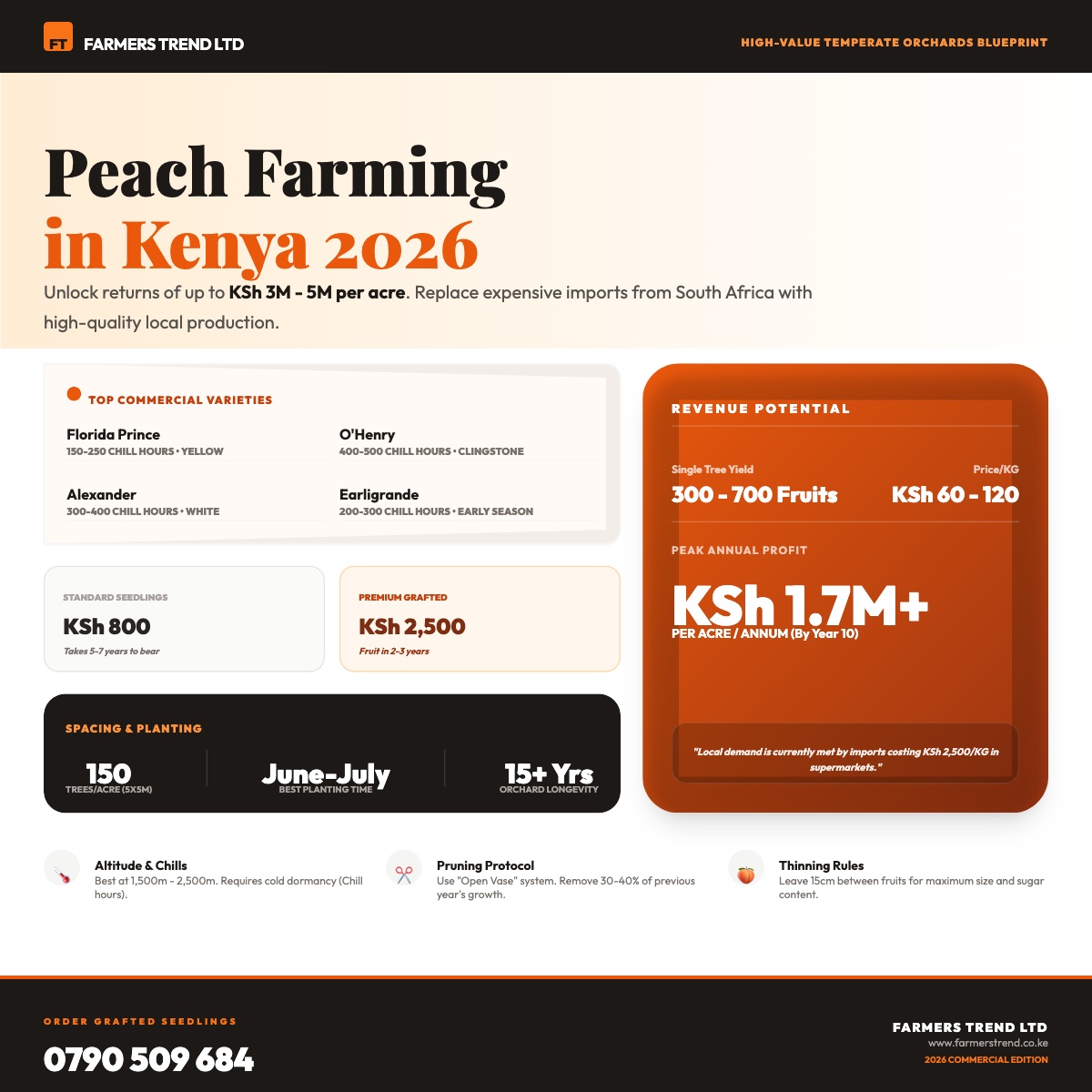
Is peach farming profitable in Kenya? Yes. A fully grown peach tree produces 300 to 700 fruits every year. If you sell the fruit at 60 shillings per kilogram at the farm gate, one tree gives you 3,000 to 7,000 shillings. With 150 trees on one acre, you can make 450,000 to 1.05 million shillings. As the trees get older, they produce more fruit. The best farmers earn 2 to 3 million shillings per acre.
Local peaches are hard to find in the market. Supermarkets cannot get enough local supply. Food companies that make juices and jams import frozen peaches from South Africa. Hotels serve imported peaches at breakfast. The gap between what the country needs and what local farmers produce will stay wide for many years. Orchards planted now will reach their best production just when the shortage is biggest.
Grafted Seedlings Versus Seedling Trees for Commercial Orchards
The choice between seedling trees and grafted trees is one of the most important decisions you will make in peach farming in Kenya. Peach Seedling trees cost 800 shillings each. They take 5 to 7 years to start producing fruit. The quality of the fruit is not consistent. Some trees give small, sour peaches. Other trees give fruit with low sugar content. Planting seedlings is a gamble.
Grafted trees cost 2,500 shillings each. They start producing fruit in 2 to 3 years. The fruit quality is the same from tree to tree. The sugar levels meet the standards that exporters look for. The tree grows in a predictable way. Grafted trees are a real investment.
Why would you pay 2,500 shillings for a grafted tree instead of 800 shillings for a seedling? The answer is time. A seedling tree costs less money at the start but you wait 5 to 7 years to get any fruit. A grafted tree costs more but you get fruit in 2 to 3 years. The grafted tree starts earning you money 3 to 4 years sooner. Over the whole life of the orchard, the grafted tree gives you more fruit and better quality fruit.
- Florida Prince is the best variety for commercial peach farming in Kenya. This variety does not need very cold winters to produce fruit well. It gives large, sweet peaches with high sugar levels. Florida Prince ripens early, so you can sell your fruit before other varieties come to the market.
- O’Henry is another good variety for commercial growers. This peach has yellow flesh with red skin. The fruit stays firm and can be stored longer. O’Henry is good for selling to export markets.
- Alexander is a newer variety that more farmers are planting. It gives medium to large fruits with very good flavor. The tree grows strongly and produces well.
- Earligrande is an early season variety. It gives medium sized fruits with good flavor. This variety is good for farmers who want to sell their fruit early in the season.
- Suncrest is a late season variety. It gives large, yellow fleshed peaches with excellent flavor. This variety extends your harvest season so you are not selling all your fruit at the same time.
| Variety | Chill Hours Needed | Fruit Type | Best Places to Grow |
|---|---|---|---|
| Florida Prince | 150-250 | Yellow freestone | Kiambu, Nyeri, Meru |
| O’Henry | 400-500 | Yellow clingstone | Limuru, Molo, Timau |
| Alexander | 300-400 | White freestone | Nyandarua, Laikipia |
| Earligrande | 200-300 | Yellow freestone | Murang’a, Kirinyaga |
| Suncrest | 500-600 | Yellow freestone | Timau, Kinangop |
Farmers Trend Ltd sells both seedling trees and premium grafted peach seedlings. Seedlings cost 800 shillings. Premium grafted varieties like Florida Prince and O’Henry cost 2,500 shillings. Call 0790509684 to place your order.
Where Peaches Grow Well and Favourite Ecological Conditions
Peach farming in Kenya works best in specific areas. The best altitude is 1,500 to 2,500 meters above sea level. The temperature should drop below 7 degrees Celsius during the winter when the tree is resting. This cold period is measured in chill hours.
Chill hours are the number of hours when the temperature stays below 7 degrees Celsius. Different peach varieties need different amounts of chill hours. Florida Prince needs 150 to 250 chill hours. O’Henry needs 400 to 500 chill hours. If you plant a variety that needs more chill hours than your area gets, the tree will not flower well and you will get low yields.
Low chill hybrids have made it possible to grow peaches in areas that were not suitable before. Varieties like Florida Prince and Tropic Snow produce fruit in places with milder winters. These hybrids have opened up new growing areas for peach farming in Kenya.
How do you measure chill hours? Put a thermometer at the height of the tree. Record the temperature every hour during the winter months. Many weather stations can tell you how many chill hours your area gets. Your local agricultural office can also give you advice about chill hour accumulation in your region.
What happens if your area does not get enough chill hours? The tree will produce fewer flowers. The flowers that do appear will be weak. Not many fruits will set. The tree may grow leaves late. Without enough chill hours, the tree will not give you a worthwhile harvest.
What happens if your area gets too many chill hours? Some varieties can handle high chill hours. Others may wake up from dormancy too late. You should choose varieties that match your specific location.
Recommended Spacing and Planting Calendar on Peach Farming in Kenya
Standard spacing for a commercial peach orchard is 5 meters between trees and 5 meters between rows. This gives you 150 trees per acre. Some farmers use 4 meters by 4 meters spacing to get 250 trees per acre. Dwarf varieties can be planted even closer together.
Standard spacing works well for most commercial orchards. The trees have enough room to grow their full canopy. Sunlight reaches all parts of the tree. Air moves freely between the trees. This spacing also allows you to drive a tractor through the orchard for spraying and harvesting.
High density spacing gives you more fruit in the early years. You must prune the trees more often and more carefully. The canopy must be managed so the trees do not get too crowded. This system is good for farmers who can give their orchard intensive management.
Dwarf varieties can be planted at 3 meters by 3 meters spacing, giving you 450 trees per acre. These trees need staking and intensive pruning. Each tree gives less fruit, but the total fruit from the whole acre is higher.
The best time to plant peaches is June to July. This is when the tree is dormant. Planting during dormancy reduces the shock of moving the tree. The tree grows roots before the next growing season starts. If you have irrigation, you can plant at any time of year.
Prepare your planting holes 60 centimeters wide, 60 centimeters deep, and 60 centimeters long. Mix the topsoil with 20 kilograms of well rotted manure. Add 200 grams of DAP fertilizer. Fill the holes back up and let them settle for 2 weeks before you plant.
Growth Timeline and Orchard Longevity on Peach Farming in Kenya
Grafted trees start producing fruit in 2 to 3 years. The first harvest is small, maybe 5 to 10 fruits per tree. By year 4, you get 50 to 100 fruits per tree. By year 6, the tree reaches full production of 300 to 700 fruits. Seedling trees take 5 to 7 years to bear fruit. Commercial growers always choose grafted trees.
After flowering, the fruit develops over 3 to 4 months. Florida Prince matures in 90 to 100 days. O’Henry takes 110 to 120 days. Earligrande matures in 85 to 95 days. Suncrest takes 120 to 130 days.
A peach tree produces good commercial harvests for 12 to 15 years. After that, the amount of fruit goes down. You should plan to replant your orchard every 15 to 20 years. Some farmers plant new trees between the old ones before removing the old trees. This keeps production going without a gap.
Pruning and Thinning Protocols
Pruning shapes the tree and directs energy where you want it to grow. The open vase training system is the standard method used in peach farming in Kenya. You remove the central leader so the tree grows with an open center. You select 3 to 4 scaffold branches that form a 45 degree angle with the trunk. You remove any branches that cross each other and any water sprouts that grow straight up.
You should prune during dormancy, ideally in June to July. Remove 30 to 40 percent of the growth from the previous year. This encourages new branches that will bear fruit. Make clean cuts at 45 degree angles. Remove any dead, diseased, or damaged wood.
For first year pruning, cut the newly planted tree to 60 to 70 centimeters above the ground. Select 3 to 4 well spaced branches to become your main scaffolds. Remove all other branches.
For second year pruning, select secondary branches growing from the scaffolds. Remove any branches that grow inward or cross over others. Keep the center of the tree open.
For third year and beyond, remove old wood that is not producing fruit. Thin out areas where branches are crowded. Keep the center open. Keep the tree height at 2.5 to 3 meters so you can harvest easily.
Fruit thinning is the difference between fruit you can sell and fruit you throw away. A peach tree sets more fruit than it can support. If you do not thin the fruits, they stay small and have low sugar content. If you thin the fruits, the ones that remain grow larger and sweeter.
You should thin the fruits when they are the size of a marble. Leave 15 to 20 centimeters between fruits. Remove any fruits that are misshapen or damaged. A mature tree should carry 300 to 700 fruits after thinning.
The thinning process takes time but it pays off. A thinned tree produces 300 large, sweet fruits that buyers want. An unthinned tree produces 1,000 small, poor quality fruits that are hard to sell. The thinned tree gives you more money because large fruits sell for higher prices.
Pest and Disease Management Strategies on Peach Farming in Kenya
Brown rot is the most destructive disease in peach farming in Kenya. It attacks flowers, fruit, and small branches. Fruits that get infected turn brown and dry up on the tree. You control brown rot with copper based fungicides. Apply the fungicide when the tree is in bloom and again before harvest.
Leaf curl causes the leaves to become deformed and turn red. The disease spreads during wet spring weather. You control leaf curl with copper fungicide applied when the tree is dormant. Remove any infected leaves promptly.
Fruit flies attack ripening fruit. Female flies lay eggs inside the fruit. The maggots feed on the flesh and ruin the fruit. You control fruit flies with pheromone traps that attract the male flies. You can also apply protein bait sprays mixed with insecticide. Harvest your fruit as soon as it is ripe.
Peach twig borer tunnels into young shoots and fruit. The larvae cause the tips of branches to die back and damage the fruit. You control twig borer with dormant oil sprays applied in winter. You can also apply insecticides during the growing season.
Aphids cluster on new growth and suck sap from the plant. They can also spread viruses from tree to tree. You control aphids with neem oil or insecticidal soap. Encourage natural predators like ladybugs to live in your orchard.
Scale insects attach themselves to branches and trunks. They suck sap and weaken the tree over time. You control scale insects with dormant oil sprays. Prune out branches that are heavily infested.
Financial Returns and Long Term Profitability on Peach Farming in Kenya
Here is a 2026 budget for establishing one acre of grafted peach orchard at 5 meters by 5 meters spacing.
| Cost Item | Quantity | Unit Price | Total |
|---|---|---|---|
| Grafted seedlings (Florida Prince) | 150 | 2,500 KSh | 375,000 KSh |
| Land preparation | 1 acre | 15,000 KSh | 15,000 KSh |
| Manure (20kg per hole) | 3,000 kg | 3,000 KSh/ton | 9,000 KSh |
| DAP fertilizer | 30 kg | 130 KSh/kg | 3,900 KSh |
| Drip irrigation system | 1 acre | 60,000 KSh | 60,000 KSh |
| Mulch materials | 1 acre | 10,000 KSh | 10,000 KSh |
| Labor (planting, mulching) | 20 days | 500 KSh/day | 10,000 KSh |
| Pest control materials | 1 acre | 15,000 KSh | 15,000 KSh |
| Pruning and thinning tools | 1 set | 5,000 KSh | 5,000 KSh |
| Total First-Year Investment | 502,900 KSh |
Your annual maintenance costs after the first year will include fertilizers, pest control, pruning labor, irrigation operation, and harvest and transport. These costs add up to about 100,000 shillings per year.
| Year | Yield (kg) | Price/kg | Gross Revenue | Costs | Net Profit |
|---|---|---|---|---|---|
| 1 | 0 | 60 | 0 | 502,900 | -502,900 |
| 2 | 0 | 60 | 0 | 100,000 | -100,000 |
| 3 | 500 | 60 | 30,000 | 100,000 | -70,000 |
| 4 | 2,000 | 70 | 140,000 | 100,000 | 40,000 |
| 5 | 5,000 | 80 | 400,000 | 100,000 | 300,000 |
| 6 | 8,000 | 90 | 720,000 | 100,000 | 620,000 |
| 7 | 12,000 | 100 | 1,200,000 | 100,000 | 1,100,000 |
| 8 | 14,000 | 110 | 1,540,000 | 100,000 | 1,440,000 |
| 9 | 15,000 | 110 | 1,650,000 | 100,000 | 1,550,000 |
| 10 | 15,000 | 120 | 1,800,000 | 100,000 | 1,700,000 |
Planning Your Exit and Succession
A peach orchard produces well for 12 to 15 years. You should start planning for the end of your orchard from year 10. Plant new trees between the rows of old trees. The new trees will start producing as the old trees slow down.
Some farmers sell their orchards to other investors when the trees are still productive. A mature orchard with 150 trees generating 1.5 million shillings per year has real value as an asset. The buyer is paying for the future income from the orchard.
You can also process your fruit into value added products. Make peach jam, dried peaches, or peach juice. These products last longer and give you higher profit margins. A processing line can keep earning money even after your fresh fruit market slows down.
Next Step
Peach farming in Kenya offers good money for farmers who are willing to wait for their trees to mature. Grafted varieties like Florida Prince and O’Henry start producing fruit in 2 to 3 years. A fully grown orchard gives you 300 to 700 fruits per tree. You can sell your fruit for 60 to 120 shillings per kilogram at the farm gate. By year 7, you can be making 1.1 to 1.7 million shillings in profit per acre.
The best time to plant is June to July when the trees are dormant. Get your land ready now. Order your grafted trees from Farmers Trend Ltd. Seedling trees cost 800 shillings. Premium grafted trees cost 2,500 shillings.
For professional advice about your site and to get the 2026 Peach farming in Kenya pdf guide, contact Farmers Trend Ltd at 0790509684.
The farmers who are making good money from peaches started exactly where you are now. They learned what to do, they made a plan, and they did the work. You can do the same thing.
Your peach farming in Kenya journey starts today. The market needs your fruit. The money is there to be made. The time to plant is now.
https://farmerstrend.co.ke/fruits/peach-farming/peach-farming-in-kenya-guide/https://farmerstrend.co.ke/wp-content/uploads/2026/04/Peach-Farming-in-kenya-768x1024.jpeghttps://farmerstrend.co.ke/wp-content/uploads/2026/04/Peach-Farming-in-kenya-150x150.jpegPeach farming# TrendingAlexander peach variety,Best peach variety in Kenya,Brown rot control peaches,Earligrande peach variety,Farmers Trend peach seedlings,Florida Prince peach Kenya,Fruit thinning peach trees,Grafted peach seedlings price Kenya,O'Henry peach variety,Open vase pruning peaches,Peach chill hours requirements,Peach farming in Kenya pdf,Peach tree spacing per acre,Peach yield per acre,Suncrest peach variety,Temperate fruit farming in KenyaPeach Farming in Kenya: The 2026 Commercial Guide to High-Value Temperate Orchards Kenya does not grow enough peaches to feed its own market. The country imports peaches from South Africa to make up the shortfall. A single imported peach sells for 150 to 250 shillings in local supermarkets. A kilogram...FarmersTrendjohn doefarmerstrend@gmail.comAdministratorFarmers Trend Ltd.

Leave a Reply