Lentil Farming in Kenya The 2026 Complete Guide to Earning KSh 150,000 Profits Per Acre
Lentil Farming in Kenya: The 2026 Commercial Blueprint for High-Value Pulse Production
Kenya imports over 80 percent of its lentils from Canada and Ethiopia. Walk into any supermarket in Nairobi, and you will find lentils priced at 180 to 240 shillings per kilogram. The demand is massive. The local production is tiny. This gap represents a multi-billion shilling opportunity for farmers willing to treat lentil farming as a serious commercial venture.

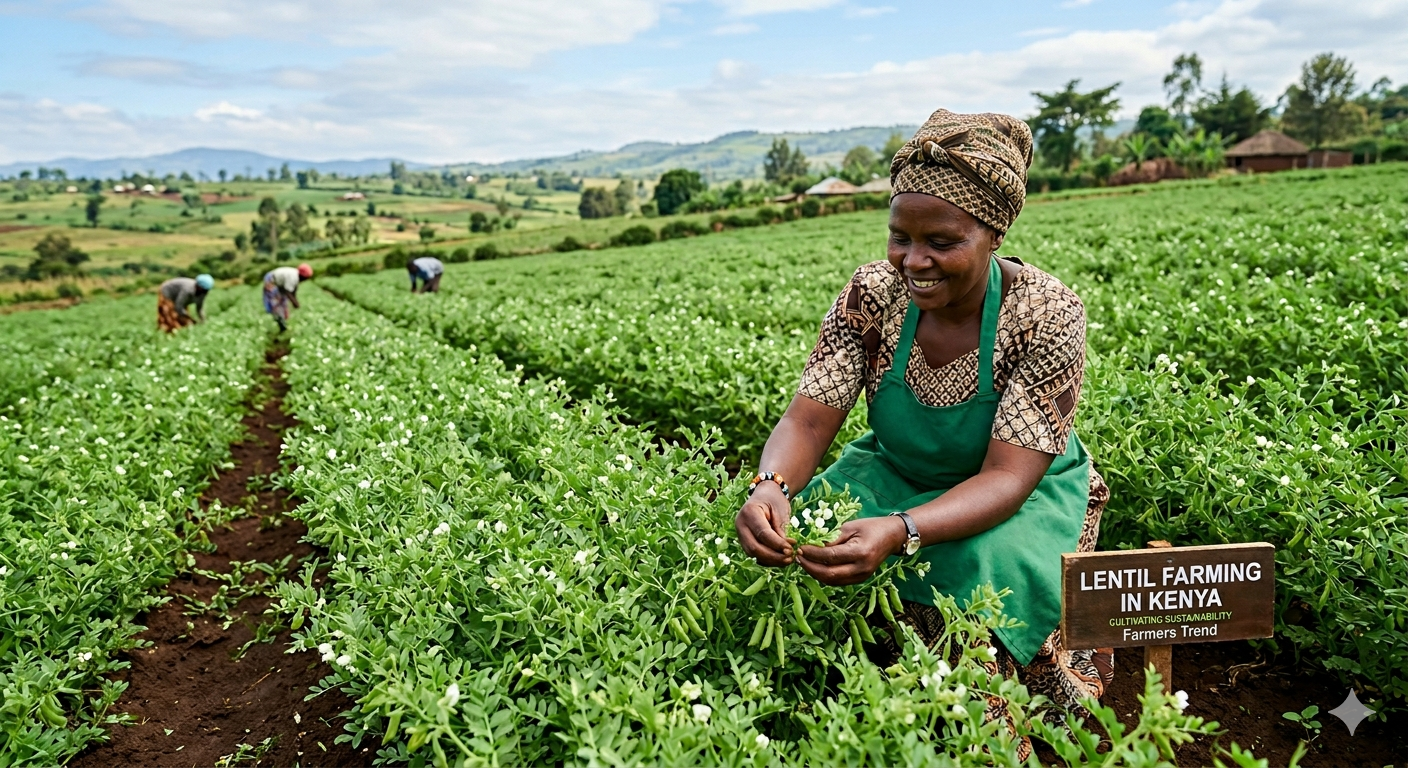
Lentil farming in Kenya is not new. Farmers in Eastern and Rift Valley regions have grown kamande for generations. But most treat it as a subsistence crop, planting small plots with saved seeds and harvesting whatever comes. The potential is far greater. A well-managed acre of lentils yields 5 to 12 bags of 90 kilograms each. At 200 shillings per kilogram, gross revenue reaches 90,000 to 216,000 shillings per acre. With low input costs, net profit exceeds 150,000 shillings per acre.
This guide by Farmers Trend Limited covers everything you need for commercial success in lentil farming in Kenya. You will learn about variety selection, land preparation, planting techniques, pest management, harvesting, and marketing. The information comes from successful growers and agricultural research stations across the country.

The 2026 Market Reality for Lentil Farming in Kenya
Kenya’s pulse market is growing. Urban populations are expanding. Health-conscious consumers are adding lentils to their diets. Processors are looking for local sources to reduce import dependence. The government is promoting pulses as part of the national food security strategy.
Lentil prices have remained strong. In March 2026, retail prices range from 180 to 240 shillings per kilogram. Wholesale prices to traders are 140 to 180 shillings per kilogram. Export prices to regional markets are even higher. Farmers who produce quality lentils capture these prices.
Is lentil farming profitable in Kenya? Yes. The numbers prove it. A one-acre plot with 5 bags of 90 kilograms yields 450 kilograms. At 200 shillings per kilogram, revenue is 90,000 shillings. Production costs are 40,000 to 60,000 shillings per acre. Net profit is 30,000 to 50,000 shillings per acre. With higher yields under irrigation, profits exceed 150,000 shillings per acre.
The Best Lentil Varieties for Kenya
Which is the best variety of lentils in Kenya? The answer depends on your target market and growing region. Two main varieties dominate commercial production.
Precoz is a large yellow lentil variety. It produces bold seeds that are highly preferred in local markets. Consumers and processors prefer Precoz for its color and cooking quality. The variety matures in 90 to 100 days. It performs well in altitudes of 1,200 to 1,800 meters. Precoz is drought-tolerant and yields 5 to 8 bags per acre under rain-fed conditions.
Rose is a small red lentil variety. It produces smaller seeds with a red color. This variety is preferred for export markets. European and Middle Eastern buyers specifically request red lentils. Rose matures in 100 to 110 days. It performs well in higher altitudes up to 2,000 meters. Yields are similar to Precoz.
Local landraces exist across different regions. Farmers in Eastern Kenya have maintained their own varieties. These are adapted to local conditions but yield less than improved varieties. For commercial production, certified Precoz and Rose seeds are the best choice.
How to Grow Lentils from Seeds
Lentil farming in Kenya requires specific conditions. The crop thrives in well-drained sandy loam soils with pH between 6.0 and 7.0. Heavy clay soils cause waterlogging and root rot. The crop prefers cool, dry conditions during flowering and pod filling.
Land preparation starts with deep ploughing to 20 to 25 centimeters. Remove all weeds and break clods. Lentil seeds are small and need a fine seedbed for good germination. Incorporate 5 to 10 tons of well-decomposed manure per acre.
Spacing is 30 centimeters between rows and 10 centimeters between plants. This gives approximately 100,000 plants per acre. Plant seeds at 2.5 to 3 centimeters depth. Deeper planting delays emergence. Shallower planting exposes seeds to birds and sun.
The best month to plant lentils in Kenya is October to November for the short rains. This timing allows the crop to mature during the dry season when pod filling is optimal. February to March planting for the long rains also works but may face higher disease pressure.

Soil Preparation and Nitrogen Fixation
Lentils are legumes. They form a partnership with soil bacteria called rhizobia. These bacteria live in root nodules and convert atmospheric nitrogen into a form the plant can use. A well-nodulated lentil crop needs no nitrogen fertilizer.
Rhizobium inoculation is essential for lentil farming in Kenya. Kenyan soils often lack the specific strains of bacteria that nodulate lentils. Apply rhizobium inoculant to seeds before planting. Mix the inoculant with water and coat the seeds evenly. Plant immediately after treatment.
DAP fertilizer at planting provides phosphorus for root development. Apply 50 kilograms per acre. Place in planting furrows, avoiding direct seed contact. Lentils do not need nitrogen fertilizer. Excess nitrogen reduces nodulation and wastes money.
The crop grows slowly for the first 30 days. During this period, weeds are the biggest threat. Keep the field weed-free. Use pre-emergence herbicides like pendimethalin immediately after planting. Follow with one hand weeding at 3 to 4 weeks.
How Long Do Lentils Take to Mature
How long do lentils take to mature? The answer depends on the variety and growing conditions. Precoz matures in 90 to 100 days. Rose takes 100 to 110 days. Local landraces take longer, up to 120 days.
The crop follows a predictable growth pattern. Seeds germinate in 7 to 10 days. Flowering begins at 40 to 50 days. Pod filling takes another 30 to 40 days. Maturity is signaled by yellowing of leaves and rattling of seeds inside pods.
What Are the Challenges of Lentil Farming
Waterlogging is the biggest threat. Lentils cannot survive in waterlogged soils. Plant on raised beds or slopes in heavy rainfall areas. Ensure good drainage throughout the field.
Aphids are the most common pest. They cluster on new growth and suck plant sap. Heavy infestations stunt plants and reduce yields. Control with neem oil or insecticidal soap. Apply at first sign of infestation.
Pod borers attack developing pods. The larvae tunnel into pods and eat seeds. Control with pheromone traps to monitor populations. Apply recommended insecticides when needed.
Fungal diseases like ascochyta blight cause leaf spots and stem lesions. Use certified disease-free seed. Practice crop rotation. Apply copper-based fungicides at first sign of infection.
Weed Management in Lentil Farming
Weeds are most competitive during the first 40 days. After the canopy closes, lentils suppress weeds naturally. Pre-emergence herbicides are the most effective control. Apply pendimethalin immediately after planting. Water in lightly.
For post-emergence control, use selective grass herbicides if grass weeds are a problem. Hand weeding is effective for broadleaf weeds. One thorough weeding at 3 to 4 weeks is usually sufficient.
Harvesting and Storage
How many bags of lentils per acre in Kenya? Under rain-fed conditions, expect 5 to 8 bags of 90 kilograms each. With supplemental irrigation, yields reach 10 to 12 bags per acre. Good management and quality seeds make the difference.
Harvest when 90 percent of pods are dry and seeds rattle inside. The rattle test is the most reliable maturity indicator. Delay harvest too long, and pods shatter. Harvest too early, and seeds shrink.
Harvest by cutting plants at ground level. Stack in small piles to dry further. Thresh by beating or using a thresher. Winnow to remove chaff and debris.
Store lentils in clean, dry containers. PICS bags (triple-layer hermetic bags) are the best storage solution. They prevent bruchid beetle infestation without chemicals. Store in a cool, dry place.
Lentil Market Price per kg in 2026
Lentil market price per kg in Kenya ranges from 140 to 240 shillings depending on quality, variety, and season. Precoz fetches higher prices in local markets. Rose is preferred for export.
| Market Channel | Price Range | Requirements |
|---|---|---|
| Farm gate | 140-160 KSh/kg | Bulk, clean |
| Wholesale market | 160-180 KSh/kg | Graded, sorted |
| Supermarkets | 180-240 KSh/kg | Packaged, premium |
| Export | 200-250 KSh/kg | Certified, red variety |
2026 Investment vs. ROI Breakdown
Here is a 2026 budget for a 1-acre lentil farm.
| Cost Item | Quantity | Unit Price | Total |
|---|---|---|---|
| Certified Precoz seeds | 20 kg | 200 KSh | 4,000 KSh |
| Rhizobium inoculant | 1 packet | 500 KSh | 500 KSh |
| Land preparation | 1 acre | 5,000 KSh | 5,000 KSh |
| DAP fertilizer | 50 kg | 130 KSh/kg | 6,500 KSh |
| Pre-emergence herbicide | 1 liter | 1,000 KSh | 1,000 KSh |
| Labor (planting, weeding, harvest) | 15 days | 500 KSh/day | 7,500 KSh |
| Pest control | 1 acre | 2,000 KSh | 2,000 KSh |
| Total Costs | 26,500 KSh |
| Yield Level | Bags (90kg) | Total kg | Price/kg | Revenue | Net Profit |
|---|---|---|---|---|---|
| Low | 5 | 450 | 180 | 81,000 | 54,500 |
| Average | 8 | 720 | 200 | 144,000 | 117,500 |
| High | 10 | 900 | 220 | 198,000 | 171,500 |
| Irrigated | 12 | 1,080 | 200 | 216,000 | 189,500 |
Post-Harvest Desiccation and Seed Quality
The float test determines seed quality. Place seeds in water. Mature, high-quality seeds sink. Immature, damaged seeds float. Remove floating seeds before storage or sale.
Post-harvest desiccation improves storage life. Dry seeds to 10 percent moisture content. Spread in thin layers on tarpaulins. Turn regularly. Store only fully dried seeds.
Sourcing Certified Lentil Seeds
Virtual Agrovet offers certified Precoz and Rose lentil seeds. Order online for delivery to your farm. The Virtual Agrovet platform also provides rhizobium inoculants and pest control products.
Farmers Trend Ltd (0790509684) supplies certified seeds for large-scale commercial farms. Contact them for bulk orders and market off-take agreements.
Next Step
Lentil farming in Kenya offers a clear path to profit. The crop matures in 90 to 110 days. Yields reach 5 to 12 bags per acre. Prices range from 140 to 240 shillings per kilogram. Net profit exceeds 150,000 shillings per acre.
The 2026 planting window is coming. October to November for the short rains. Prepare your land now. Order your certified seeds from Virtual Agrovet.
Start with soil testing. Lentils need well-drained soil with pH 6.0 to 7.0. Apply rhizobium inoculant to seeds before planting. Plant at 30 centimeters by 10 centimeters spacing. Control weeds in the first 40 days. Harvest when pods rattle.
The farmers earning profits from lentils started where you are now. They learned, they planned, and they did the work. You can do the same.
Your lentil farming in Kenya journey starts today. The market is waiting. The returns are real. The time to act is now.
https://farmerstrend.co.ke/trending/lentil-farming-in-kenya-guide/https://farmerstrend.co.ke/wp-content/uploads/2026/03/Gemini_Generated_Image_i6dkigi6dkigi6dk-1024x559.pnghttps://farmerstrend.co.ke/wp-content/uploads/2026/03/Gemini_Generated_Image_i6dkigi6dkigi6dk-150x150.png# TrendingKamande (Lentil) FarmingBest lentil varieties for drylands,Farmers Trend lentil seeds,How to grow lentils from seeds,kamande farming in kenya,Lentil farming profit per acre,Lentil harvesting and storage,Lentil market price per kg 2026,Lentil spacing per acre,Lentil yield per acre Kenya,PICS bags for lentil storage,Precoz lentil variety,Rhizobium inoculation for lentils,Rose lentil variety,Virtual Agrovet lentil seedsLentil Farming in Kenya: The 2026 Commercial Blueprint for High-Value Pulse Production Kenya imports over 80 percent of its lentils from Canada and Ethiopia. Walk into any supermarket in Nairobi, and you will find lentils priced at 180 to 240 shillings per kilogram. The demand is massive. The local production...FarmersTrendjohn doefarmerstrend@gmail.comAdministratorFarmers Trend Ltd.


Mine is a question, I have just discovered your Facebook page and it drove my curiosity to great heights. Do you have educational programs that teach and advance knowledge on modern agriculture, farming and all there in? If so where do I sign up! If not? What’s the best platform to get the above knowledge?