Cashew Nuts in Kenya: The 32,000 Tonne Gap and 8 Costly Mistakes to Avoid
Cashew nuts grow well along the Kenyan coast and in warm, well-drained parts of the lower country, yet Kenya produces far less than its factories need. The country harvests about 13,000 tonnes a year against an installed processing capacity of 45,000 tonnes. Processors want nuts. Farmers want better yields. This guide connects the two, and starts with the decision you make before any money leaves your pocket: which tree you plant, where, and at what spacing.
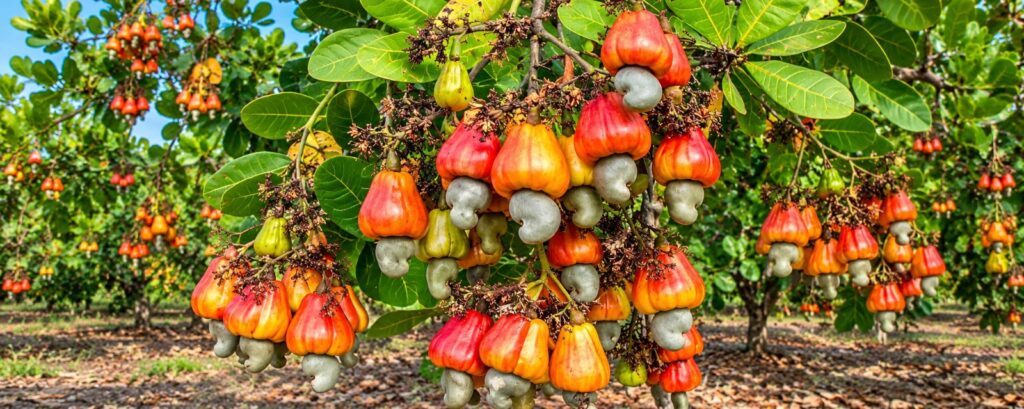
You will find practical answers here on seedling price, varieties, propagation, climate, soil, planting, care, yield, harvesting, marketing, costs and profit per acre. You will also find a section on the nutritional value of the kernel, because your buyers and your own family eat the product. Where a figure is a planning assumption and not a quoted price, the text says so. Replace those figures with the numbers you get from your own suppliers and buyers. For a shorter overview of the crop, read this earlier guide to cashew nut farming in Kenya.
Cashew Nuts in Kenya
Portuguese traders brought the cashew tree from Brazil to the East African coast centuries ago. The tree settled in well. Many coastal families own old trees planted by their parents, and these trees fed a strong export trade in the 1980s. Production then fell for several reasons. Trees aged. Powdery mildew attacked flowers and young shoots. Farm gate prices stayed low, and the 2009 ban on raw nut exports changed how farmers sold. Many farmers stopped weeding, pruning and spraying, and some abandoned their orchards.
Today the picture is changing. The Ministry of Agriculture and KALRO Mtwapa, the centre which works only on cashew research, have released improved planting material and are pushing better spacing and orchard rehabilitation. Kenyan processors have spare capacity and need raw nuts. Coastal farmers produce about 10 kg of nuts per tree on average, while the improved varieties have recorded far higher potential. This gap is the opportunity.
The main growing counties are Kilifi, Kwale, Lamu and Tana River, with scattered trees in Taita Taveta and other warm lowland areas. Cashew is a tree crop. You plant once, wait several years and then harvest for decades if you manage the orchard well. Plan for this timeline before you buy a single seedling.
Cashew Seedlings Price in Kenya
Price depends on who raises the seedling and what type you buy. Private nurseries charge more, especially for grafted seedlings of improved varieties. Grafting needs skilled labour, selected scion wood, time in the nursery and careful handling, and the price reflects this. A seed-raised seedling costs less than a grafted one, but the cheaper seedling is a gamble on yield, as the next sections explain.
Do not compare prices alone. A grafted seedling of a named variety at a higher price often costs less per kilogram of nuts over twenty years than a cheap seedling from an unknown tree. Ask each seller for the variety name, the age of the seedling, the type of propagation and the delivery cost. Quotations differ by variety, quantity and location, so request a current price instead of relying on figures you saw last season.
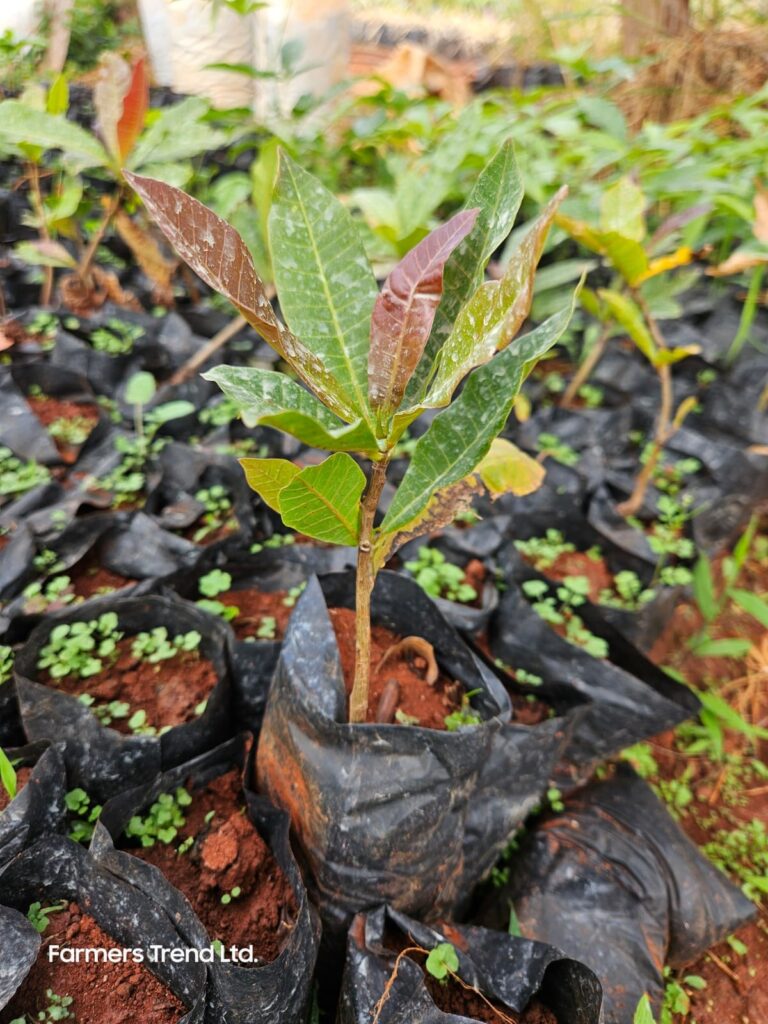
Farmers Trend sells cashew seedlings at KES 500 each. At 10 m by 10 m spacing, one acre needs about 44 seedlings including replacements, so the seedlings for one acre cost KES 22,000. Order cashew seedlings from Farmers Trend, or call or WhatsApp 0724 559 286 or 0790 509 684 to confirm stock before you travel. For more on returns and growth timelines, read the cashew nut farming profit and growing guide.
Where to Buy Cashew Seedlings in Kenya
Start with the sources you are able to verify.Farmers Trend sells cashew seedlings at KES 500 each and answers buyer questions by phone and email.
Before you order, ask three things. Is the nursery registered and inspected by KEPHIS? Does the seller name the variety and show you the mother trees or the scion source? Will the seller let you inspect the seedlings before you pay? A seller who avoids these questions is telling you something.
Buy early. The best time to plant is the start of the rains, and good grafted seedlings sell out before then. Place your order two to three months ahead, prepare your holes while you wait and collect seedlings in the week you plan to plant. Seedlings left in polybags for weeks lose vigour as roots coil.
Roadside sellers carry a risk. You will not know the variety, the age or the origin of the planting material, and you will find out only after four or five years when the trees fail to bear. Buy from sellers who stand behind their seedlings and give you a receipt.
What Are Cashew Nuts?
The scientific name of the cashew tree is Anacardium occidentale. The tree belongs to the same family as the mango, and the species originates from north-eastern Brazil. The tree is an evergreen with a wide, spreading canopy. In an orchard with good care, a tree reaches 6 to 10 metres in height, and an old seedling tree left unpruned spreads wider still.
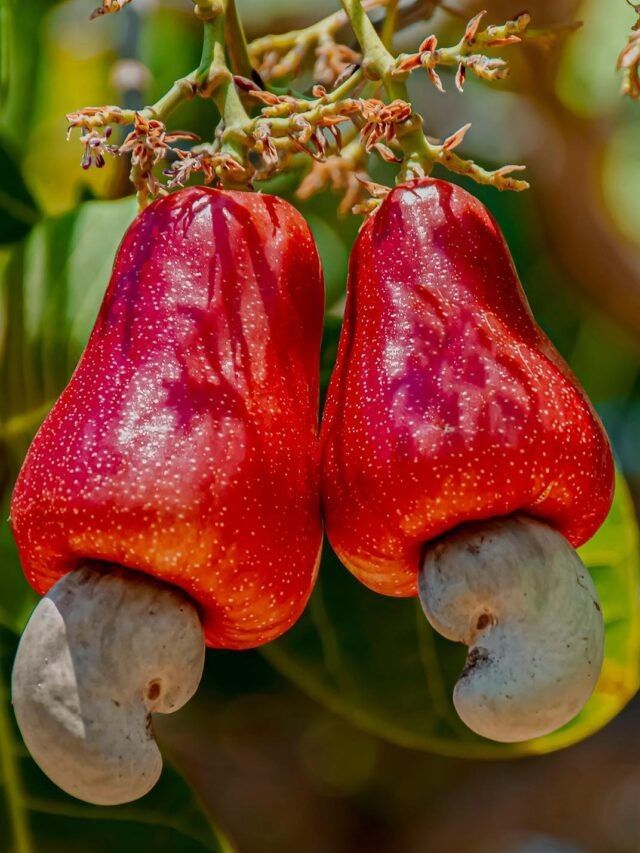
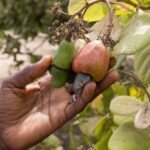
The fruit looks unusual. The nut hangs below a swollen, juicy stalk called the cashew apple. Botanists call the apple a false fruit, and the grey, kidney-shaped nut is the true fruit. The apple ripens yellow, orange or red, spoils within a day or two after falling and has a strong, astringent taste. Many coastal families eat the apple fresh or press juice from the fruit.
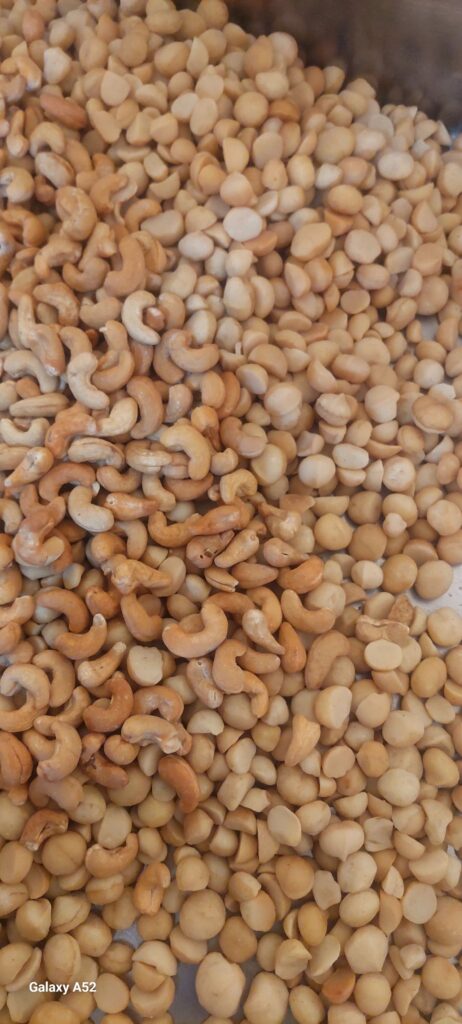
The edible part is the kernel inside the shell. Roughly a quarter of the raw nut weight is kernel. The shell wall holds a thick, caustic oil, so you never crack raw nuts with bare hands. The oil burns skin and blisters. Processors roast or steam the nuts under controlled conditions, crack the shell, peel the thin skin from the kernel, grade the kernels and pack them.
Farmers sell the raw nut, and processors do the rest. Some farmers in groups buy small shelling machines to sell kernels and capture more of the value. The section on selling covers this decision.
Health Benefits of Cashew Nuts
Your buyers eat the product, so you should know what the kernel contains. Cashew nuts are a calorie-dense food rich in unsaturated fat, plant protein, minerals and some dietary fibre. The table below shows approximate values for 100 grams of raw kernels. Values change with variety, roasting and salting, so read the label on any packet you buy.
Table: Cashew nuts nutrition and health notes, per 100 grams of raw kernels (approximate)
| Nutrient | Approximate amount | What this means in your diet |
|---|---|---|
| Energy | 550 kcal | Dense food. A 30 gram handful gives about 165 kcal. |
| Total fat | 44 g | Mostly unsaturated fat, with some saturated fat. |
| Protein | 18 g | A plant source of protein for meals and snacks. |
| Carbohydrate | 30 g | Includes small amounts of natural sugar and starch. |
| Dietary fibre | 3 g | Adds some fibre, though less than beans or whole grains. |
| Magnesium | 290 mg | Cashew kernels are among the richer nut sources of this mineral. |
| Zinc | 6 mg | A useful contribution to daily zinc intake. |
| Copper | 2 mg | Cashew kernels contain more copper than many other foods. |
| Iron | 7 mg | A plant source of iron, absorbed less easily than iron from meat. |
| Phosphorus | 590 mg | Supplied in the kernel together with potassium. |
| Potassium | 660 mg | Present in useful amounts. |
| Water | about 5 g | Low, which is why dry kernels store well when kept dry. |
Cashew kernels also contain vitamin K, vitamin B6 and plant compounds such as antioxidants. Antioxidants are substances found in plant foods, and scientists study how they behave in the body. This guide does not claim cashew nuts treat or prevent any disease. The kernels belong in a varied diet next to vegetables, fruit, legumes and whole grains, and portion size matters because of the calories.
The cashew apple has a different profile. The fresh apple is juicy and contains vitamin C. The tannins give the astringent, dry feeling in the mouth. Fresh juice spoils fast, so people drink or process the apple on the day they pick.
Two safety points matter. Tree nut allergy is serious, and people with this allergy must avoid cashew nuts completely. Salted and flavoured nuts add sodium, so plain roasted or raw kernels are the better choice for daily eating. Anyone with a health condition should ask a doctor or dietitian about their own diet.
Cashew Varieties in Kenya
Kenya grows two broad groups of cashew trees. The first group is the old coastal seedling trees, which grew from seed of mixed parentage. Their nut size, yield and disease tolerance vary from tree to tree, even within one farm. The second group is the improved varieties from research, which farmers multiply by grafting so every tree copies the mother tree.
KALRO has developed 14 cashew varieties, and four were certified early on. These certified varieties have a yield potential of up to 1,680 kg per acre, compared with current farm averages near 500 kg per acre. Farmers Trend has new disease-tolerant variety, with over 20,000 seedlings released for the long rains. Before buying, ask the nursery for the official name and release status of any variety you buy. If a seller cannot name the variety, treat the seedling as unselected.
Look at four traits when you compare varieties. Yield per tree matters, but so does nut size, because processors pay attention to the number of nuts per kilogram. Disease tolerance matters because powdery mildew destroys flowers and young shoots, and losses reach 70 to 100 percent in a bad season on susceptible trees. The fourth trait is canopy shape. A compact canopy lets you plant at a sensible spacing and makes spraying and harvesting easier.
Do not mix many unknown selections in one block. Plant one or two named varieties per block, record which is which, and watch how each one performs through two seasons. This record guides your next planting and tells you which variety suits your own soil and rainfall.
How Cashew Seedlings Are Propagated
Cashew trees are raised in two ways. Farmers sow seed to get seedlings, or nurseries graft a selected scion onto a young rootstock. The method you choose decides how long you wait, how much you harvest and how uniform your orchard turns out. This section explains how each step works in a good nursery, so you know what to look for when you buy. The text describes standard cashew practice and does not describe any single nursery.
Selecting Mother Trees and Planting Material
Good propagation starts with the mother tree. Select trees which bear heavily each year, carry large nuts of uniform size and show little damage from powdery mildew and tea mosquito bug. Mark these trees and record their yield for at least three seasons before you take material from them.
For seed-raised seedlings, pick seed nuts from the best trees. Choose heavy, mature nuts which sink in water, and discard floaters, which are light and often empty. Sun-dry the nuts for a short period and sow within a few weeks, as old seed loses its ability to germinate.
For grafting, collect scion wood from healthy mother trees. The best scion wood is a firm, pencil-thick shoot with plump, dormant buds. Cut early in the morning, keep the wood moist and graft within a day or two. Never take scions from trees with dieback or mildew, because disease travels in the planting material.
Propagation Methods
Seed propagation is simple. A nursery sows one nut per polybag, usually with the eye of the nut facing sideways, and covers lightly with soil. Seeds germinate in about two to three weeks. The problem is genetic. The seedling does not copy its mother, so a tree from your best mother tree gives a mixed result. Some seedlings yield well and some yield poorly.
Grafting solves this problem. Nurseries raise rootstock seedlings from seed, and when the stems reach pencil thickness, they graft scion wood from a selected mother tree. Common methods are side grafting, wedge or cleft grafting and softwood grafting. The graft union is wrapped with grafting tape and shaded until the bud breaks. Grafted trees copy the mother tree, start bearing earlier and give a uniform orchard.
Top-grafting is a related method for old orchards. The grower cuts back an old, poor-yielding tree and grafts improved scions onto the new shoots. KALRO recommends this to restore old orchards because the tree already has a strong root system. If you own old trees on a good site, ask your extension officer about top-grafting before you cut them down.
Nursery Management
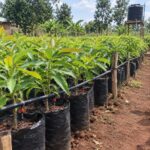
Seedlings grow in polybags filled with a mix of topsoil, well-rotted manure and sand. Cashew grows a deep taproot, so the nursery uses deep, tall polybags and keeps them off hard ground to prevent roots from escaping through the base. Roots which grow into the ground and then get cut at lifting damage the seedling.
Water the bags regularly but avoid waterlogging. Cashew seedlings rot in soggy mix. Keep the nursery free of weeds, check leaves each week for pests, and separate any sick seedling from the healthy ones. Label each batch with the variety, the sowing date and the graft date, so you track what you sell.
Root Development
A healthy cashew seedling builds one strong taproot with side roots which fill the polybag without coiling. Seedlings left too long in small bags grow roots in circles. These trees establish slowly and lean or fall in wind when they mature. Good nurseries move or sell seedlings on schedule. When you buy, tip a seedling from its bag if the seller allows and look at the root ball. Roots should hold the soil together and show white, active tips.
Hardening
Hardening prepares the seedling for the farm. The nursery moves seedlings from shade to full sun over about two to three weeks, and reduces watering gradually. The goal is a seedling with firm, dark green leaves and a woody base. A seedling taken straight from heavy shade to your field often scorches and loses leaves in the first week. Ask how long the seedlings have spent in hardening before you collect them.
Quality Inspection
A good nursery inspects every seedling before sale. The checks are straight stem, healthy leaves, a firm graft union with no cracks or swelling for grafted seedlings, active root tips and no sign of pests. Seedlings which fail go to a cull pile. Ask whether the nursery culls, and ask to see the cull pile. A nursery without one sells everything.
Packing and Delivery
Seedlings travel upright in crates or on the back of a lorry with sides to prevent tipping. Cover them from sun and wind during transport. Do not stack bags on top of each other, and do not carry seedlings by the stem or the graft. Water the seedlings before loading and again after arrival, and plant within a few days. If you collect seedlings yourself, bring a vehicle with a covered body and plan the route so they do not sit in the sun.
How to Choose Healthy Cashew Seedlings
Do not choose seedlings by height alone. A tall seedling in a small bag is stretched and weak. Look for a sturdy stem about the thickness of a pencil, dark green leaves with no spots, and a bag full of roots but not crowded with them.
Check the graft union on grafted seedlings. The union should be smooth, firm and fully healed, with the scion and rootstock of similar thickness. A swollen or cracked union breaks in wind. Look below the union for shoots from the rootstock and remove them, because these shoots take food from the grafted part.
Check the leaves and growing tips for damage. Black spots and dead shoot tips point to tea mosquito bug. White, powdery patches on young leaves point to mildew. Do not take seedlings with either problem, even at a discount, because you carry the problem into your orchard.
Ask for the age. A grafted cashew seedling ready for the field is usually several months old after grafting. A seedling much older than this has outgrown its bag. A seedling much younger has not hardened.
Finally, ask about the variety and the mother trees, and write the answer on your receipt. This one step protects your investment better than any other check, because you pay for planting material which will occupy your land for decades.
Where Cashew Nuts Grow Best in Kenya
Cashew belongs to the warm lowlands. Altitude from sea level up to about 1,000 metres suits the tree, and the ideal sits near 600 metres. The coastal counties of Kilifi, Kwale, Lamu and Tana River carry most of the trees, and parts of Taita Taveta and the warm lower eastern country also suit the crop.
Do not assume every warm area works. Check your own farm. Look at the lowest night temperature in the cool months, the number of dry months, the depth of your soil and whether water collects in the field after heavy rain. A farm at 1,400 metres with cold nights will not flower well, and a farm with a high water table will lose trees to root rot, even when the rainfall figure looks right.
Walk your neighbourhood before you plant. Find old cashew trees nearby and look at their health. Ask the owners how much they harvest, when the trees flower and how often mildew strikes. Trees which have grown well for thirty years on a similar soil tell you more than any map.
Cashew Climate Requirements
Temperature comes first. Cashew grows best between about 24 and 30 degrees Celsius. The tree tolerates heat, and frost damages young shoots and flowers. Cool, misty weather during flowering invites powdery mildew and reduces nut set, so a cool pocket of land makes a poor site.
Rainfall needs a careful look. Cashew grows on 600 to 1,200 mm a year and survives on as little as 400 mm in some areas because the deep taproot reaches stored soil moisture. What matters more than the annual total is the pattern. The tree needs a clear dry season of several months to flower and set nuts. Heavy rain during flowering washes pollen from the flowers, spreads fungal disease and cuts the crop.
Humidity works the same way. High humidity at flowering favours mildew and tea mosquito bug. Sites with good air movement and sun on the canopy suffer less than sheltered, damp hollows.
Sunlight must reach the whole canopy. Cashew is a full-sun tree. Shade from taller trees lowers flowering, so keep rows open and clear of competing trees, except where you intercrop with coconut at a planned spacing.
Cashew is a climate-smart crop in the sense of drought tolerance, but young trees still need water during the first two dry seasons. A tree which dies in year one tells you nothing about its tolerance. Water the young trees and let the deep roots develop.
Cashew Soil Requirements
Cashew prefers deep, well-drained sandy loam or loamy sand. Choose a soil with at least 1.5 metres of workable depth, because the taproot grows downward in search of water. Shallow soil over rock or a hardpan stunts the tree.
Drainage decides survival. Cashew roots rot in waterlogged soil, and heavy black clay which stays wet after rain is a poor choice. Dig a test pit before you plant. If you see water standing in the pit a day after rain, or a grey, sticky layer below 50 cm, look for another field or build raised planting mounds.
Soil pH between 5.0 and 6.5 suits the tree. Strongly acid soil locks up nutrients, and soil above pH 7 also causes problems. A soil test costs little compared with the cost of an orchard, and the result tells you how much lime or phosphate to apply. Ask your extension officer how to collect and submit a sample.
Cashew does not need rich soil. The tree gives acceptable growth on poor sandy soil if you supply manure and fertilizer, and rich fertile soil is often better used for crops with a shorter payback. Matching the crop to the land saves money.
How Many Cashew Trees Fit on One Acre?
An acre is about 4,047 square metres. To find the number of trees, divide 4,047 by the area each tree occupies. Spacing of 10 m by 10 m gives each tree 100 square metres, so 4,047 divided by 100 gives 40 trees per acre. The table shows common spacing options and the resulting populations. All figures round down to whole trees.
Table: Cashew spacing and trees per acre
| Spacing | Area per tree | Trees per acre | Trees per hectare (about) |
|---|---|---|---|
| 12 m by 12 m | 144 square metres | 28 | 69 |
| 10 m by 10 m | 100 square metres | 40 | 100 |
| 9 m by 9 m | 81 square metres | 49 | 123 |
| 8 m by 8 m | 64 square metres | 63 | 156 |
| 7 m by 7 m | 49 square metres | 82 | 204 |
These are area calculations for blocks of several acres. In a single small plot, edge rows change the count slightly, so peg the field and count your actual planting points. Order about 10 percent more seedlings than your count to replace deaths. At 10 m by 10 m, a one-acre block needs 40 planting holes and about 44 seedlings.
Cashew Spacing
The Ministry of Agriculture and KALRO recommend 10 m by 10 m for orchards in Kenya, and this spacing suits most farms. Cashew trees grow wide, and a mature canopy reaches 8 to 10 metres across. At 10 m by 10 m, canopies touch at maturity without a heavy overlap.
Spacing affects every job in the orchard. Wide spacing lets sunlight reach the lower canopy, which supports flowering and nut set. Air movement dries the leaves after rain and lowers mildew pressure. Space between rows lets a tractor, a sprayer or a handcart pass, and lets workers weed, apply fertilizer in a ring and collect nuts without damaging branches. Irrigation lines run straight and cost less per tree. Harvest is faster when the ground beneath each tree is clear.
Closer spacing of 8 m by 8 m or 7 m by 7 m gives more trees in the early years and higher early yield per acre. The cost comes later. By year eight or ten, the canopies crowd, shade reduces flowering and spraying becomes difficult. Growers who use close spacing must thin trees early, and many do not. Most smallholders choose 10 m by 10 m and use the space between young trees for short-term crops.
Do not copy another farmer’s spacing without looking at your own conditions. A farmer on deep, fertile soil gets bigger trees and needs wider spacing than a farmer on poor sandy soil. Fixing a crowded orchard by cutting trees after seven years hurts. Choose your spacing once and mark the field well.
How to Prepare Land for Cashew Nuts
Start by choosing the field, and test the soil as described above. Clear bush and remove stumps and roots, especially of woody weeds which harbour pests. Burn as little as possible, since burning destroys organic matter and leaves bare soil.
Mark the lines with pegs and string. Use a measuring tape or a 10 metre rope so every planting point sits exactly at its planned point. Straight lines make weeding and harvest easier for twenty years.
Plan access and water at this stage. Decide where you will keep tools, where seedlings will stand before planting and where the nearest water source is. Think about fencing early. A one-acre square block has a perimeter of about 254 metres, and goats, cattle and wild animals damage young cashew trees.
On sloping land, plant along the contour and build terraces or trenches to hold rainwater and stop erosion. Do not plant in a valley bottom where cold air and water collect.
How to Prepare Cashew Planting Holes
Dig holes about 60 cm wide, 60 cm long and 60 cm deep, at least a month before planting. Each hole holds about 0.22 cubic metres of soil, so 40 holes mean moving about 8.6 cubic metres. Plan the labour for this task.
Place the topsoil on one side and the subsoil on the other. When you fill the hole, return topsoil first and mix the soil with two buckets of well-rotted manure, about 100 to 200 grams of phosphate fertilizer, and a handful of lime if your soil test calls for lime. Keep subsoil on top of the mound. Fill the hole and leave the soil to settle.
Filling the hole early lets the manure break down and the soil settle. In dry areas, dig holes at the end of the previous season and fill them before the rains start. Do not use fresh manure in the hole, because fresh manure burns roots and brings termites.
Termites are a common problem on coastal sandy soils. Ask your agrovet for a registered treatment and apply the product as the label directs.
How to Plant Cashew Seedlings
Plant at the start of the rains, once the soil is wet to a depth of at least 30 cm. On the coast, this is usually the long rains in March or April, and some farmers plant with the short rains in October or November. Planting in dry soil kills seedlings.
Water the seedlings before you carry them to the field. Make a hole in the filled pit, a little larger than the root ball. Remove the polybag with care, and avoid breaking the root ball. For a seedling with a long taproot at the bag base, cut the coiled tip with a sharp blade and do not bend the root.
Set the seedling so the soil level in the bag matches the soil level in the field. For grafted seedlings, keep the graft union at least 15 to 20 cm above the ground. A buried union rots and allows roots to form from the scion, which defeats the purpose of grafting.
Firm the soil around the stem. Use your hands, not your boots. Water each tree with about 10 to 20 litres. Place a stake beside the seedling and tie the stem loosely to keep the stem upright in wind. Cover the soil with mulch, keeping the mulch a hand’s width away from the stem.
Check the field after one week and again after one month. Replace dead seedlings quickly, so the replacement grows with the others.
Cashew Watering Requirements
Young trees need water. In the first two years, water each tree once a week during dry spells with about 20 litres. The roots have not reached deep moisture yet, and drought in the early life of a tree is the single biggest cause of death.
From year three, the taproot supports the tree through normal dry seasons. Established cashew trees do not need regular irrigation in most coastal areas. Water does help in two situations. A dry spell during the early nut-filling stage reduces nut size, and light irrigation at this stage improves nut weight. Water at flowering is different. Wetting the canopy at flowering raises the risk of mildew and washes pollen away, so avoid overhead irrigation then.
Drip irrigation suits cashew best because the water goes to the root zone and leaves the canopy dry. If you do not have a pump or a tank, a drum and bucket system works for a small orchard. Dig a shallow basin around each young tree to hold water, and mulch the basin.
Do not rely on rainfall alone where rain is unreliable. If you plant in a drier area, plan a water source before you plant. A tank filled during the rains and a simple drip line cost less than replacing dead trees and losing a year.
Cashew Manure and Fertilizer Requirements
Feed the tree from the day you plant. Apply well-rotted manure in the planting hole, as described earlier, and top up with manure each year. Spread about 10 to 20 kg of compost or manure around each young tree at the start of the rains, in a ring under the edge of the canopy, and scratch the material into the topsoil.
Chemical fertilizer supports growth and nut set. A common approach is to apply a balanced NPK fertilizer to young trees in two doses a year, at the start of each rainy season. Start with about 100 grams per tree in year one, and raise the amount each year as the canopy grows. Mature trees need more, and a soil test or leaf test shows what your trees lack. Do not guess rates. Over-feeding with nitrogen produces leafy growth, which attracts tea mosquito bug and gives fewer nuts.
Apply the fertilizer in a ring under the outer edge of the canopy, where the feeder roots work, not against the stem. Water or rain must follow the application. Applying fertilizer to dry soil wastes money.
Phosphate helps root growth in young trees, and potassium helps nut filling. Zinc and boron deficiency appear in some soils as poor flowering and deformed shoots, so ask your extension officer if you notice this pattern.
Keep a record of what you apply and the yield which follows. After two or three seasons you see which dose paid, and which did not.
Cashew Mulching and Weed Management
Mulch protects the soil and keeps the young tree alive through the dry months. Spread dry grass, crop residue or leaves about 5 to 10 cm deep in a circle around each tree, and keep the mulch clear of the stem. Mulch holds moisture, reduces weeds and feeds the soil as the mulch rots.
Weeds compete with young trees for water and nutrients. Keep a clean ring about one metre wide around each tree for the first three years. Between the rows, slash the grass or grow a short-term crop. Do not let weeds climb into the canopy of young trees.
In the first two or three years, the space between rows gives you a crop. Legumes such as cowpeas and green grams fit well, because they fix nitrogen and give a harvest. Keep short crops at least one metre from the tree stems, and avoid tall crops which shade the seedlings. Do not plant cassava or sorghum close to the young trees, because they compete hard for water.
When the canopy closes, shade suppresses most weeds. The Ministry promotes intercropping cashew with coconut and mango at proper spacing. If you plan this, mark the position of every tree species when you peg the field.
Cashew Training and Pruning
Pruning shapes the tree for easy management and good yield. Start in the first year. Remove any shoots below the graft union on grafted trees at once, because they are rootstock growth. Keep one strong central stem to a height of about one metre for a seedling tree, then allow three or four well-spaced branches to form the main frame.
In following years, remove dead wood, crossing branches and shoots growing into the middle. Cut low branches which touch the ground, because they block weeding and harvest and give pests an easy path up. Keep the canopy open so light and air reach the centre.
Prune after harvest, not during flowering. Cutting at flowering removes flower shoots and invites disease. Use a clean, sharp saw or secateurs, and cut cleanly above a bud or a branch collar. Paint large cuts with a registered wound dressing, or leave them if the cuts are small.
Old orchards need a different approach. Heavy rejuvenation pruning or top-grafting restores a tired tree, and you get a harvest sooner than from a new seedling. Ask KALRO or your extension officer to show you the method before you start cutting.
Cashew Pests and Diseases
Pest and disease control separates a profitable cashew orchard from an abandoned one. Check your trees every week during flowering and fruit set. Early action costs less than late action.
Powdery mildew is the most serious disease. The fungus attacks young shoots, flowers and small nuts, and shows as a white, powdery coating. In a bad season on a susceptible variety, losses run from 70 to 100 percent of the crop. Spray sulphur-based or other registered fungicides at the first sign, and repeat as the label directs. Choose tolerant varieties, prune for air movement and avoid dense, damp planting.
Tea mosquito bug feeds on young shoots, flowers and developing nuts. The bug leaves small dark spots, then dead shoot tips and shrivelled flowers. Monitor the trees at dawn or dusk, when the bugs are active, and spray registered insecticides at the flush and flowering stages. Do not spray at midday or when bees are working the flowers.
Stem and root borers attack older trees. Look for frass, which is a fine sawdust, at the base of the trunk and for gum oozing from the bark. Cut out affected wood where this is practical, and keep trunks clean. Remove and destroy dead trees quickly, because borers spread from them.
Other problems include leaf miners, thrips, anthracnose and dieback. Termites damage young seedlings, so protect seedlings at planting.
Use only pesticides registered in Kenya for cashew, follow the label on dose, spray interval and pre-harvest period, and wear protective clothing. Ask your extension officer or agrovet for the current list. Never mix a stronger dose than the label says.
How Long Does Cashew Take to Produce Nuts?
Cashew is not a quick crop. Plan for years, not seasons.
Grafted trees of improved varieties usually start flowering in the second or third year and give a small first harvest. Seed-raised trees take longer, often three to five years, and give lighter early yields. Commercial yields start around year five or six for grafted trees under good care, and trees keep improving until about year eight to ten. A well-managed tree bears for twenty to thirty years or more.
This timeline shapes your finances. You pay for land preparation, seedlings, holes, labour, water and weeding for several years before the first meaningful income. Plan how you will cover the family and farm costs during these years. Intercropping with short-term crops in the early years gives some income while the trees grow.
Do not establish a large orchard without the cash flow to carry the orchard. Five well-managed acres give a better result than twenty neglected ones. Start with an area you are able to maintain, then expand as your first block begins to pay.
Cashew Yield Per Tree
Yields in Kenya vary widely. Farmers at the coast average about 10 kg of raw nuts per tree, and research puts the potential of improved varieties much higher, with figures of up to 70 kg per tree under ideal management. Average farm yields near 500 kg per acre compare with a potential of up to 1,680 kg per acre for certified improved varieties.
Treat these as upper and lower bounds. Your own yield depends on variety, tree age, rainfall pattern, mildew control, soil, spacing and care. A grafted tree of a good variety on suitable soil, with sprayed flowers, fertilizer and pruning, gets closer to the upper figure. An old seedling tree left unmanaged stays near the lower one.
At 40 trees per acre, a yield of 10 kg per tree gives 400 kg per acre. A yield of 20 kg per tree gives 800 kg. A yield of 42 kg per tree gives 1,680 kg, which matches the research potential for certified varieties. The profit section uses these three figures as scenarios, and treats the highest one as a target, not a normal result.
Record your yield tree by tree for at least three seasons. Mark each tree, weigh nuts at harvest and write the figure down. You will quickly see which trees pay, and which deserve to be top-grafted or removed.
Cashew Harvesting and Drying
Cashew nuts are harvested from the ground. Do not pick nuts from the tree, because green nuts have not finished filling and give poor kernels. A mature nut falls with its apple. Collect the fallen fruit every day or every second day in the harvest season, because wet ground, ants and rats spoil the nuts.
The main harvest falls in the dry months towards the end of the year and into the new year in many coastal areas, and the exact timing changes with location and variety. Ask your extension officer or a neighbour with mature trees what to expect on your land.
Twist the nut from the apple soon after collecting. Do not leave nuts attached for days, because the apple juice stains the shell and promotes mould. Keep the apples for juice, animal feed or compost.
Dry the nuts in the sun on a clean surface, such as a raised rack, a tarpaulin or a concrete floor. Spread them thinly and turn them regularly. Drying takes several days in good weather. Well-dried nuts rattle slightly in the shell, and the moisture content falls near 10 percent. Wet nuts mould in the sack and lose value.
Sort before you sell. Remove broken, shrivelled, mouldy and immature nuts, and keep nuts of similar size together. Store in clean, breathable sacks on pallets, away from walls and moisture, and keep fuel and chemicals away from the store. Buyers pay by quality, and clean, dry, sorted nuts earn a better price.
How to Sell Cashew Nuts in Kenya
Think about marketing before you plant. Kenya harvests about 13,000 tonnes of cashew nuts against a processing capacity of 45,000 tonnes, so processors have room to buy more. Even so, the price you receive depends on quality, volume, timing and your bargaining position.
Processors are the main buyers of raw nuts. Several processors operate at the coast and in central Kenya, and some buy through farmer groups and aggregators. Ask your county agriculture office and the Agriculture and Food Authority for a current list. Visit a processor if you are able, and ask what quality they require, how they weigh and pay, and whether they offer contracts.
Middlemen and traders collect nuts at the farm gate. They save you transport and often pay in cash, which many farmers value. Compare their price with the processor price and the cost of delivery before you decide.
Farmer groups and cooperatives improve your position. A group delivers larger volumes, shares transport cost and negotiates better. Many of the recent revival efforts work through groups.
Value addition raises income per kilogram. A group or small enterprise which buys a shelling machine sells kernels to supermarkets, hotels, roasters and consumers. This step needs capital, training, hygiene standards, a safe way to handle the caustic shell oil and a reliable supply of nuts. Start with raw nut sales, and add processing when your volume justifies the cost.
The cashew apple has a local market for fresh fruit and juice in coastal towns, though the fruit spoils within a day or two and needs quick handling.
Prices change from season to season. Recent farm gate prices in Kenya have been reported near KES 60 to 70 per kilogram of raw nuts, though prices vary by buyer, grade and year. Check the current price before you calculate your plan. Do not plan an orchard around a single good price.
Cashew Farming Cost Per Acre
The table lists the cost items for one acre at 10 m by 10 m spacing. The Quantity column gives what you need, and the Cost column tells you which figures you must confirm locally. These numbers are not quoted prices. Costs differ widely by county, by season and by whether you use family labour. Ask three suppliers for a quotation on each item before you finalise your budget.
Table: Cashew establishment cost items for one acre
| Cost item | Quantity for one acre | Cost to confirm |
|---|---|---|
| Seedlings | 40 trees plus about 10 percent for replacement, so 44 seedlings | KES 500 each at Farmers Trend, so 44 seedlings cost KES 22,000 |
| Land clearing and pegging | One acre, 40 pegs | Local labour rate |
| Planting holes | 40 holes at 60 cm by 60 cm by 60 cm, about 8.6 cubic metres of soil | Labour rate per hole |
| Manure | About 80 buckets, at two per hole | Price per bucket or load |
| Phosphate fertilizer | About 100 to 200 grams per hole, so 4 to 8 kg | Price per bag |
| Termite protection | As the product label directs | Agrovet quotation |
| Irrigation | Drip line, tank and pump, or drums and buckets for young trees | Quotation for your system |
| Mulching | Dry grass or crop residue, about 5 to 10 cm deep | Labour or purchase cost |
| Labour for planting and staking | Family or hired labour | Local daily rate |
| Fencing | About 254 metres of perimeter for a square acre | Quotation for your type of fence |
| Tools | Spade, jembe, panga, secateurs, pruning saw, sprayer | Shop prices |
| Annual care after planting | Weeding, pruning, fertilizer, spraying, harvest labour, transport | Your own records |
Fencing and irrigation are often the two largest items, so get these quotations first. Family labour lowers cash cost, though the time still has a value. Count the hours you spend, so you know what the farm pays you.
Spread the cost across the years. The big spending falls in the planting year, and care costs repeat every year. Income comes later, so plan a way to fund years two to five.
Cashew Farming Profit Per Acre
Profit equals sales minus costs. Many farmers confuse gross sales with profit, which leads to wrong decisions. Gross sales are the money the buyer pays you. Profit is what remains after you pay for fertilizer, spraying, labour, transport, tools and other costs.
Three things decide the result. The first is yield per tree, which depends on variety and management. The second is the price per kilogram, which depends on quality and the buyer. The third is your annual operating cost. A farmer who sprays on time, prunes and weeds gets more nuts for a given cost than a farmer who neglects the orchard.
Do not expect profit in the first years. Several seasons of costs come before the first real income. Do the calculation below with your own numbers, and treat the example as a method, not a promise.
Example Cashew Profitability Calculation
This example uses 40 trees per acre at 10 m by 10 m spacing, at a mature stage of the orchard. The yield per tree figures come from the ranges described earlier. The prices and annual operating costs are planning assumptions which you must replace with your own quotations. Annual operating cost includes weeding, pruning, fertilizer, spraying, harvest labour and transport, and rises with yield because harvest and handling take more labour.
Table: Cashew yield and profitability scenarios for one acre at maturity
| Item | Conservative | Moderate | Higher production |
|---|---|---|---|
| Trees per acre | 40 | 40 | 40 |
| Yield per tree | 10 kg | 20 kg | 42 kg |
| Total yield | 400 kg | 800 kg | 1,680 kg |
| Assumed price per kg | KES 60 | KES 80 | KES 100 |
| Gross sales | KES 24,000 | KES 64,000 | KES 168,000 |
| Assumed annual operating cost | KES 30,000 | KES 35,000 | KES 45,000 |
| Estimated surplus per year | Loss of KES 6,000 | KES 29,000 | KES 123,000 |
Check the arithmetic. In the conservative case, 40 trees at 10 kg give 400 kg, and 400 kg at KES 60 gives KES 24,000. Subtract KES 30,000 in costs and you lose KES 6,000. In the moderate case, 40 trees at 20 kg give 800 kg, and 800 kg at KES 80 gives KES 64,000. Subtract KES 35,000 and the surplus is KES 29,000. In the higher case, 40 trees at 42 kg give 1,680 kg, and 1,680 kg at KES 100 gives KES 168,000. Subtract KES 45,000 and the surplus is KES 123,000.
Read the table carefully. The conservative case matches the average coastal farm today, and the example shows why many farmers lose interest in cashew. The higher case needs a certified variety, good soil, timely mildew control, a better price and strong management. Do not treat this as normal. The moderate case is a realistic target for a farmer who plants improved material and manages the orchard well.
The table leaves out the establishment costs and the years without income. A full plan spreads the establishment cost over the life of the orchard and counts the waiting years. Add your own figures from the cost table, and test your plan with the conservative scenario first. If the plan survives, you have a sound plan.
Common Mistakes When Growing Cashew Nuts in Kenya
Planting unselected seedlings is the first mistake. A farmer collects nuts from a neighbour, raises seedlings and plants them, then waits five years and finds poor trees. The cost of the wrong tree is years of land use. Buy grafted seedlings of a named variety from a nursery you trust.
The second mistake is planting too close. A farmer plants at 5 m by 5 m to get more trees, and by year seven the canopies shade each other and the yield falls. Follow the recommended spacing, and use the gaps for short crops in early years.
Poor drainage is the third. Cashew in a field which floods dies slowly from root rot, and the farmer blames the variety. Test the soil before you plant.
The fourth is skipping mildew and bug control. A farmer ignores flowering care in a damp season and loses most of the crop. Scout weekly at flowering and spray on time with registered products.
The fifth is neglect in the early years. Young trees without water, weeding and fencing die or stunt. Protect your investment in the first two years.
Sixth, farmers pick nuts from the tree or harvest too early. Collect mature fallen nuts and dry them well. Wet, immature or mouldy nuts earn less, or find no buyer.
Seventh, farmers sell without comparing buyers. Ask for prices from at least two buyers and consider selling through a group.
The last mistake is expanding before the first block works. Prove your method on a small area, record the results and then grow.
Do Cashew Nuts Grow in Containers?
Cashew grows a deep taproot and a wide canopy, so containers do not suit the crop beyond the nursery stage. A cashew tree in a large drum or tub survives for a few years, though growth stays limited, yield is poor and the tree needs constant watering and feeding.
If you want a cashew tree at home as a shade tree or a curiosity, plant the tree in the ground in a sunny, well-drained spot at least 8 metres from buildings and other trees. In a tight compound, choose a different tree.
Containers do have a role in nursery work. You raise seedlings in deep polybags until they reach planting size, and you keep seedlings of the right variety healthy until the rains start. Move them to the ground as soon as conditions allow.
Do Cashew Nuts Suit a Small Farm?
Yes, if you have the right site. A smallholder with one or two acres plants 40 to 80 grafted trees, and uses the spaces between young trees for beans, cowpeas or green grams during the first years. The trees then become a long-term asset for the next generation.
Choose your land with care. Put cashew on the well-drained, lower-value land, and keep your best soil for food and short-cycle crops. Plan water for the first two dry seasons.
Join our group or form a farmer group before you plant. A group of small farms gives a processor a reliable volume, lowers transport cost per kilogram and gives you someone to share information and tools with. Training from KALRO and county extension officers often reaches groups first.
Do not put your entire farm under cashew. The waiting years and the price swings carry a risk a small farmer cannot afford. Keep food crops and other income running, and let the cashew block grow.
Do Cashew Nuts Suit Commercial Farming in Kenya?
Commercial cashew farming is possible and the market gap supports this, since Kenya produces less than a third of its processing capacity. The real question is whether your farm and finances suit a long-term orchard.
A commercial grower needs suitable land of tens or hundreds of acres in the warm lowlands, capital for the establishment years, a reliable water plan, skilled labour for grafting, pruning, spraying and harvest, and a buyer contract or a processing plan. Orchard records, consistent quality and good drying and storage separate a commercial operation from a large farm.
Plant in blocks of one or two named varieties, with a record of each block. Keep roads and firebreaks open. Plan intercropping with coconut and mango, as the Ministry encourages, to spread risk. Budget for years of cost before income, and test your numbers with the conservative scenario.
Many commercial growers invest in processing or partner with a processor. Talk to processors before you plant, and ask what volumes and quality they will buy at what terms. A written supply arrangement lowers the risk of an orchard which has no buyer.
Cashew Nuts for International Buyers
Buyers outside Kenya ask about raw nuts, kernels and planting material. The rules change, and Kenya has restricted the export of raw cashew nuts in the past to support local processing. Before you promise anything, confirm the current export rules, certificates and phytosanitary requirements with the Agriculture and Food Authority and KEPHIS.
If you are an international buyer, send your enquiry by email or WhatsApp. Include the product you want, the quantity, the quality or grade you need, the destination country and city, and any packing or certification requirements. Farmers Trend reads each request and replies with the steps for your case. Freight cost, documentation, logistics and timeframe depend on the product, the quantity and the destination.
Contact Farmers Trend on 0724 559 286 or 0790 509 684, or email info@farmerstrend.co.ke.
Frequently Asked Questions About Cashew Nuts
1. How much do cashew seedlings cost in Kenya?
Farmers Trend sells cashew seedlings at KES 500 each, so 44 seedlings for one acre cost KES 22,000. Before buying, ask for the variety, age, propagation method and delivery cost.
2. Where do I buy cashew seedlings in Kenya?
Buy from Farmers Trend, we sells cashew seedlings at KES 500 each through the Farmers Trend agrovet, and you are able to confirm stock on 0724 559 286.
3. Are grafted cashew seedlings better than seed-raised ones?
Grafted seedlings copy a selected mother tree, so you know the variety and the trees in your orchard behave alike. They start bearing earlier. Seed-raised trees vary from tree to tree and take longer to bear.
4. Which cashew varieties grow in Kenya?
Old coastal seedling trees of mixed type cover most of the area. KALRO has developed 14 improved varieties, four of them certified, and has released a new disease-tolerant variety with more on the way. Ask the nursery for the official variety name.
5. How are cashew seedlings propagated?
Nurseries sow seed nuts for rootstock or for seed-raised seedlings, and graft selected scion wood onto rootstock for improved varieties. Old orchards are rehabilitated by top-grafting. The graft union needs shade and careful handling until the bud breaks.
6. Which areas of Kenya suit cashew nuts?
Warm lowland areas from sea level to about 1,000 metres suit the crop, with the best results near 600 metres. Kilifi, Kwale, Lamu and Tana River hold most of the trees. Check your own night temperatures, dry season length and drainage before you plant.
7. What soil do cashew nuts need?
Deep, well-drained sandy loam with a pH of about 5.0 to 6.5 suits cashew. Avoid heavy clay and waterlogged land, and dig a test pit to look for standing water or a hardpan.
8. What spacing do you use for cashew nuts?
The recommended spacing is 10 m by 10 m. Closer spacing gives more early yield but crowds the canopy by year eight to ten and raises mildew pressure. Wider spacing of 12 m by 12 m suits fertile soil with vigorous trees.
9. How many cashew trees fit on one acre?
At 10 m by 10 m, one acre holds 40 trees. At 9 m by 9 m the count is 49, at 8 m by 8 m the count is 63, and at 12 m by 12 m the count is 28. Order about 10 percent extra seedlings for replacements.
10. When do you plant cashew seedlings?
Plant at the start of the rains, once the soil is wet to at least 30 cm. On the coast this is usually March or April, and some farmers plant in October or November. Prepare and fill the holes a month ahead.
11. How often do you water cashew trees?
Water young trees weekly in dry spells during the first two years, with about 20 litres per tree. Established trees rarely need regular irrigation, though light watering during nut filling helps nut size. Avoid wetting the canopy at flowering.
12. Which fertilizer suits cashew trees?
Apply well-rotted manure each year and a balanced NPK fertilizer in two doses at the start of the rains. Begin with about 100 grams per tree in year one and raise the rate as the canopy grows. A soil test gives the right rates for your farm.
13. How long do cashew trees take to bear nuts?
Grafted trees start flowering in the second or third year and reach commercial yield around year five or six. Seed-raised trees take about three to five years to first bearing. Full yield comes around year eight to ten.
14. How many kilograms of cashew nuts does one tree give?
Coastal farmers average about 10 kg per tree. Improved varieties under good management reach much more, with research potential of up to 70 kg per tree. Your result depends on variety, age, mildew control and care.
15. When do you harvest cashew nuts?
Collect mature nuts which fall to the ground with their apples, and do not pick from the tree. In many coastal areas the main harvest falls in the dry months towards the end of the year. Twist off the nut, dry the nut in the sun to about 10 percent moisture and sort before sale.
16. Who buys cashew nuts in Kenya?
Processors, traders at the farm gate and farmer groups buy raw nuts. Processors have spare capacity because Kenya harvests about 13,000 tonnes against 45,000 tonnes of capacity. Compare at least two buyers before you sell.
17. Is cashew farming profitable in Kenya?
Profit depends on yield, price and cost. At 40 trees per acre, the example in this guide shows a loss at 10 kg per tree and KES 60 per kilogram, a surplus of KES 29,000 at 20 kg and KES 80, and a surplus of KES 123,000 at 42 kg and KES 100. The orchard needs years before the first real income.
18. Do cashew trees grow in pots?
A cashew tree survives in a large container for a few years, though growth and yield stay poor. The deep taproot and wide canopy need ground space. Use pots only for nursery seedlings.
19. What are the health benefits of cashew nuts?
Cashew kernels supply protein, unsaturated fat, fibre and minerals such as magnesium, zinc, copper and iron, together with some vitamin K and vitamin B6. They fit into a varied diet when eaten in sensible portions. They are not a medicine, and a handful of about 30 grams gives about 165 kcal.
20. What nutrients do cashew nuts contain, and who must avoid them?
A 100 gram portion of raw kernels holds about 18 g of protein, 44 g of fat, 30 g of carbohydrate and 3 g of fibre. People with tree nut allergy must avoid cashew nuts entirely. Choose plain kernels over salted ones if you watch your sodium intake.
Final Guide to Buying Cashew Seedlings and Growing Cashew Nuts in Kenya
Start with the site. Cashew needs warm lowland conditions, deep and well-drained soil, a clear dry season and full sun. Test the soil and dig a pit before you order anything. If your land fails these checks, choose a different crop or a different field.
Buy grafted seedlings of a named variety from a registered nursery. Ask for the variety, the age, the propagation method and the mother tree source, and inspect the graft union, the roots and the leaves. Compare quotations, and remember a cheap seedling of unknown parentage costs you more in lost yield over twenty years. At KES 500 each, the seedlings for one acre cost KES 22,000, which is a small share of the cost of waiting years for poor trees.
Plant at 10 m by 10 m for 40 trees per acre, and order about 44 seedlings per acre to cover losses. Dig 60 cm holes a month ahead, fill them with topsoil and manure, and plant at the start of the rains. Water the young trees weekly in dry spells, mulch, weed, fence against animals and prune from the first year.
Protect the flowers. Scout for powdery mildew and tea mosquito bug each week at flowering, and spray registered products on time. Harvest fallen nuts, dry them to about 10 percent moisture, sort them and sell through a group or a contract buyer at the best price you find.
Plan for the long wait. Commercial yields begin around year five or six, and profit depends on yield, price and cost. Use the conservative scenario to test your plan, keep records on every tree and expand only after your first block works.
Read more farming guides and seedling listings at www.farmerstrend.co.ke.
Farmers Trend
Call/WhatsApp: 0724 559 286 | 0790 509 684
Website: www.farmerstrend.co.ke
Email: info@farmerstrend.co.ke







Leave a Reply